On Christmas Eve, I sat alone in a freezing house, waiting for my ten daughters to return for dinner.
Instead of a doorbell, I received a text from my eldest.
“We have no obligation to compensate for your loneliness.”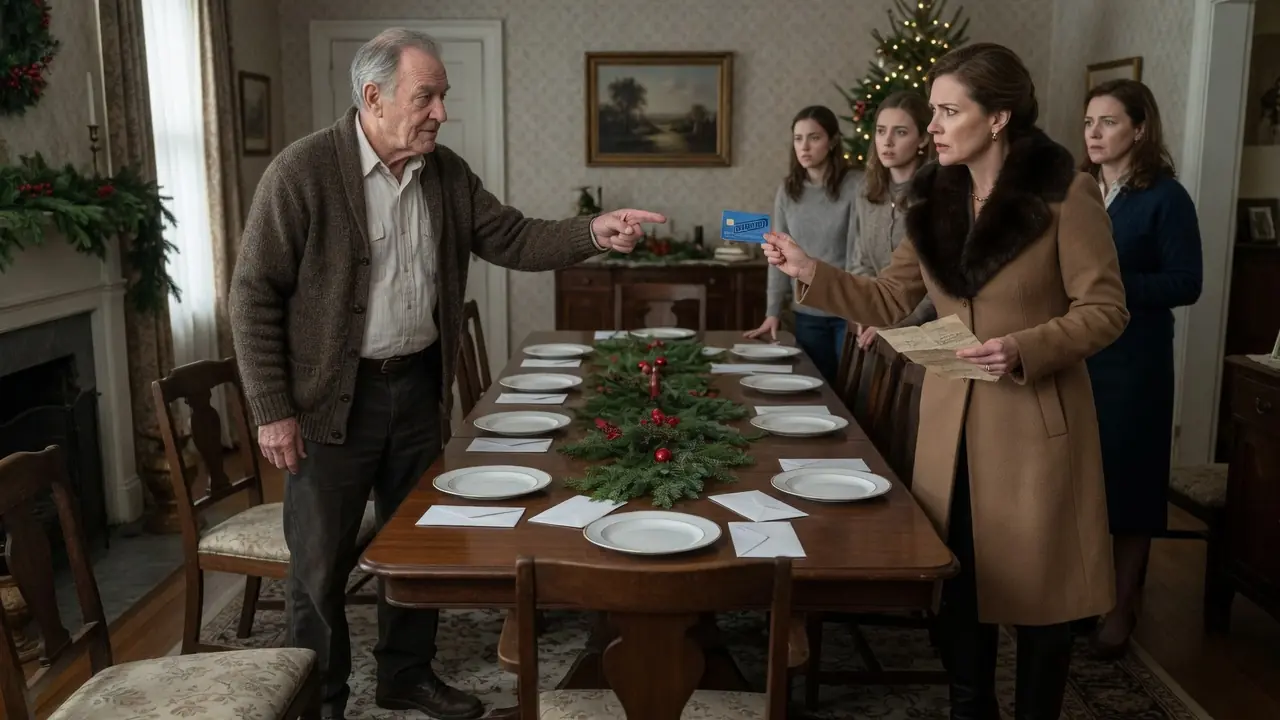
I had devoted my life to raising them. Yet only two years after my wife’s death, they chose parties, trips, excuses, and other families over their aging father.
The pain was sharp, but it awakened me.
I realized I had confused sacrifice with enabling.
The next morning, I executed a plan my late wife had prepared long before she died.
Seventy-six missed calls followed. Hundreds of messages. Pleas, threats, apologies, demands.
I answered none.
It was time for my daughters to understand who truly held the power of choice.
I stood in the kitchen doorway, hands resting on the frame.
The dining room table stretched before me, ten white plates arranged in a perfect circle. Each one waited empty and patient under the soft glow of the Christmas lights I had strung three days earlier.
The turkey sat in the center, golden and gleaming, the skin crisp just the way Martha used to like it. Mashed potatoes steamed in a serving bowl. Cranberry sauce caught the light, deep red and glossy.
The apple pie cooled on the counter behind me, filling the house with cinnamon and memory.
Everything was ready.
Everything except the people who were supposed to be there.
The clock on the wall ticked.
That was the only sound.
No laughter. No footsteps on the porch. No car doors slamming in the driveway.
Just the steady mechanical rhythm of time passing, second by second, in a house that felt too big and too quiet.
I had set the table at three that afternoon.
Ten plates. Ten forks. Ten knives. Ten napkins folded the way Martha taught me, crisp triangles that looked almost elegant.
I had even put out the good glasses, the crystal ones we only used for special occasions.
This was supposed to be special.
This was supposed to be the first Christmas in three years where all ten of my daughters came home.
But the driveway stayed empty.
The porch stayed dark.
And my phone, sitting face up on the counter, stayed silent.
I walked to the table and adjusted one of the forks.
It did not need adjusting.
I just needed something to do with my hands. Something to keep me from checking my phone again.
I had already checked it seventeen times in the past hour.
No messages. No missed calls. Nothing.
The wind picked up outside, rattling the windows. Snow had started falling an hour earlier, light flurries that danced in the streetlight glow.
Now it was coming down heavier, thick flakes sticking to the driveway and the bare branches of the oak tree in the front yard.
The weather forecast had called for it. Winter storm moving in. Travel not recommended after six.
It was almost six now.
I turned back to the table.
Ten plates. Ten empty chairs.
I could picture them all sitting there the way they used to when they were younger.
Margaret at the head, bossy even as a child. Elizabeth beside her, always the peacemaker. Rebecca, quiet and thoughtful. Rachel, the baby, laughing at something one of her sisters said.
They had filled this house once.
Filled it with noise and chaos and life.
Now the house was just mine.
Mine and the silence.
It had been three years since Martha died.
Three years since that last Christmas when she sat on the couch in a blanket that swallowed her whole, too weak to help with dinner, but too stubborn to stay in bed.
The girls had been there that year, all ten of them. They had flown in from across the country, crowded into the house, cooked, laughed, cried, and held their mother’s hand.
I remembered the moment Martha pulled me aside late that night after the girls had gone to bed.
She asked me to sit with her by the tree. The lights were the only thing illuminating her face, casting soft shadows beneath her tired eyes.
She took my hand. Her fingers were cold, thin, fragile as bird bones.
But her grip was strong.
“George,” she said, “promise me something.”
I nodded. I would have promised her anything.
“If they forget you after I’m gone,” she continued, her eyes locked on mine, “don’t let them take you for granted.”
I started to protest.
“They won’t forget. They’re our daughters.”
She smiled at that. A sad, small smile that did not reach her eyes.
“I hope you’re right. But if I’m not, you’ll know what to do.”
I did not understand what she meant.
Not then.
But I was starting to now.
The furnace kicked on, or tried to.
I heard the familiar hum, the click of the ignition, and then nothing.
The hum died. The house stayed cold.
I walked to the thermostat in the hallway. The little screen blinked red.
Error.
I pressed the reset button and waited.
Nothing.
The temperature dropped another degree.
I went down to the basement. The furnace sat in the corner, old and reliable for thirty years, until tonight. I checked the pilot light.
Out.
I tried to relight it. The spark clicked, caught, then died. It clicked again. Nothing.
Outside, the wind howled louder.
I climbed back upstairs. The kitchen felt colder than it had ten minutes ago. I pulled my cardigan tighter around my chest.
The turkey was starting to lose its shine. The mashed potatoes were not steaming anymore. The cranberry sauce sat there perfect and untouched, like a prop in a play no one was watching.
I walked to the window and looked out at the snow.
It was coming down in sheets now, thick and fast, erasing the driveway, the yard, and the road beyond. The streetlights glowed orange through the white curtain.
My phone buzzed.
I spun around, hope flaring in my chest.
But it was not a call.
Just a weather alert.
Winter storm warning in effect until midnight. Avoid travel. Stay indoors.
I set the phone back down. The screen went dark.
I thought about calling them.
Margaret, Elizabeth, any of them.
Just to check in. Just to see if they were coming.
But I did not.
Because I already knew the answer.
If they were coming, they would be here by now.
I had heard plenty of excuses over the past three years. Work. Traffic. Kids. Plans. Always something. Always a reason why they could not make it for Sunday dinner, my birthday, or even a phone call that lasted longer than five minutes.
I told myself it was fine.
They were adults. They had lives.
But this was Christmas.
This was the one day I had asked.
I pulled out the chair at the head of the table and sat down. The wood creaked under my weight.
The house settled around me, groaning in the cold.
The clock ticked.
The wind howled.
The snow fell.
And somewhere deep in the back of my mind, I heard Martha’s voice.
Soft. Certain.
“You’ll know what to do.”
I sat on the couch with my phone in my lap, watching the screen like it might suddenly come alive.
The living room felt smaller than usual, the walls pressing in with every minute that passed.
Outside, the snow kept falling.
Inside, the silence stretched.
My fingers were numb. Not from the cold, though the house was losing heat fast without the furnace. It was the kind of numbness that comes from waiting for something you already know is not coming.
Then the phone buzzed.
Finally.
I picked it up so fast I almost dropped it.
Rachel.
My youngest.
Twenty-five, still calling me every Sunday to ask how to cook a roast or fix a leaky faucet.
I opened the message.
Dad, I’m so sorry. Got stuck at work. Boss needs me to cover tonight. Rain check.
Rain check.
Like Christmas was a coffee date we could reschedule.
I typed back.
It’s okay, sweetheart. Be safe.
I set the phone down.
Then it lit up again.
Elizabeth.
Thirty-eight. The responsible one.
David’s parents are hosting. Can’t skip it. Maybe next week.
Next week.
As if Christmas happened twice.
The phone buzzed again.
Jennifer.
Steven’s sick. Got to stay home with him. Sorry, Dad.
Then Patricia.
Kevin’s family emergency. Talk soon.
The messages kept coming, one after another, each one a variation of the same excuse.
Catherine said she was snowed in at a friend’s place.
Amanda said Brian had booked a surprise trip and they were already at the airport.
Nicole said she had a double shift at the hospital.
Stephanie said the kids were sick and she could not risk spreading anything.
Then the phone rang.
Actual ringing this time.
I answered before the second ring.
Rebecca.
“Hi, Dad.”
Her voice was soft, hesitant.
“Are you coming?”
She was quiet for a moment.
Too long.
“I can’t. I’m sorry. I really am.”
“Why?”
“It’s complicated.”
“Complicated how?”
Another pause.
I could hear her breathing on the other end. I could picture her biting her lip the way she used to when she was little and did not want to tell me she had broken something.
“I just can’t, Dad. I’m sorry.”
She hung up before I could say anything else.
I set the phone on the coffee table and stared at it.
Ten daughters.
Ten excuses.
Some of them might have even been legitimate, but that did not change the fact that I was sitting there alone with a table full of food no one was going to eat.
The clock on the mantel said 9:30.
I had been sitting there for over two hours, waiting, hoping, fooling myself into thinking maybe one of them would surprise me.
But no one came.
The phone buzzed one more time.
I almost did not pick it up. I had already had enough.
But something made me look.
Margaret.
My oldest.
Forty years old. The one who used to climb into my lap when she was little and make me promise I would never let anything bad happen to her.
The one who called me crying when her first boyfriend broke her heart, when she did not get into her top-choice college, when she found out she was pregnant with her first child.
I opened the message.
No apology.
No explanation.
Just a wall of text in all caps, like she was shouting at me through the screen.
We don’t owe you company just because you’re lonely, Dad. You need to understand that we have our own lives now. Stop guilt-tripping us.
I read it once.
Twice.
Three times.
Each word hit like a fist.
Not the kind that leaves bruises you can see. The kind that knocks the air out of you and leaves you gasping.
I set the phone down.
My hands were not shaking.
They should have been, but they were not.
I just sat there staring at the screen until it went dark.
Guilt-tripping.
That was what she thought this was.
Me sitting there with a table full of food I had spent all day making, waiting for my daughters to show up because I had asked them to.
Because I thought that just once, they might want to be there.
I stood.
My knees cracked. My back ached. Sixty years of wear and tear, of carrying people out of houses that were falling apart, of running toward danger when everyone else was running away.
And now I was standing in my own house alone because the people I had spent my whole life protecting could not be bothered to show up for dinner.
Something shifted in my chest.
Not anger.
Not even sadness.
Just clarity.
The kind that cuts through everything else and leaves you seeing things exactly as they are.
I walked to the dining room.
The ten plates were still there.
The food was cold now. The turkey had lost its shine. The mashed potatoes had a film on top. The cranberry sauce sat there untouched like a monument to wasted effort.
I did not clean it up. I did not cover it.
I just turned around and walked toward the bedroom.
Behind me, the house was silent. The Christmas lights blinked on and off, casting shadows across the walls.
The clock ticked.
The wind rattled the windows.
And somewhere in the back of my mind, I heard Martha’s voice again.
“You’ll know what to do.”
I did.
I finally did.
The house settled around me as midnight approached.
I had turned off the Christmas lights an hour earlier. The blinking had started to feel less festive and more like a reminder of everything that was not happening.
Now the only light came from the lamp on the side table, casting long shadows across the living room floor.
I walked to the kitchen and opened the cabinet above the refrigerator.
The bottle was where I had left it three years ago, tucked in the back behind the whiskey I never drank.
Pinot Noir.
Martha’s favorite.
We had bought it together on our last anniversary, back when she could still walk without help, back when we thought we had more time.
I carried the bottle to the living room and set it on the coffee table.
The cork came out with a soft pop.
I poured a glass and watched the dark red liquid catch the lamplight.
I lifted the glass.
The wine smelled like earth and cherries and something else I could not name. Something that reminded me of autumn evenings on the porch, of Martha’s hand in mine, of the life we had built before everything fell apart.
“Merry Christmas, Martha,” I said to the empty room. “You were right.”
I drank.
The wine was smooth, almost sweet, with a bite at the end that made me wince. I was not much of a wine drinker. Never had been.
But Martha had loved it, so I had learned to tolerate it.
Her picture sat on the mantel.
I had taken it five years earlier at Rebecca’s wedding. Martha was wearing a blue dress that matched her eyes, her smile bright even though I knew she had been tired that day.
I raised the glass to the picture.
“You knew they wouldn’t come, didn’t you?”
The photo did not answer, but I could hear her voice in my head anyway, clear as if she were sitting right next to me.
The memory hit me without warning.
October 2021. St. Mary’s Hospital. Room 314 on the oncology floor.
Martha was in the bed by the window, propped up on pillows that made her look smaller than she was. The IV drip hung beside her, clear liquid flowing through a tube into her arm.
She had been there for three weeks by then.
The treatments were not working.
The doctors had stopped using words like remission and started using words like comfortable and quality of life.
I had pulled a chair up next to her bed.
She turned her head to look at me, and even though her face was drawn and pale, her eyes were sharp.
“George,” she said, “I’ve been thinking about the girls.”
“What about them?”
“They love us, but they’ve grown too comfortable. They expect everything. Money, time, support. But they never ask how you are. They only call when they need something.”
I wanted to argue, but deep down, I knew she was right.
“That’s not fair,” I said anyway. “They’re busy. They have their own lives.”
“They do. And I’m proud of them for that. But after I’m gone, it will get worse. You’ll see.”
“Don’t talk like that.”
She reached out and took my hand.
Her fingers were cold, thin, fragile.
“Listen to me. I want you to test them. One Christmas after I’m gone, don’t send gifts. Don’t send money. Just invite them. See who shows up.”
“And if they don’t?”
Her grip tightened.
“Then you’ll know. And you’ll be free.”
“Free from what?”
“From waiting for people who aren’t coming.”
I sat there holding her hand, not knowing what to say.
The machines beeped softly in the background.
“Promise me,” she said.
“I promise.”
She smiled then. A sad, small smile.
“Good. Because I’m going to make sure you follow through.”
“What does that mean?”
“You’ll see.”
I came back to the present with the taste of wine still on my tongue.
The living room was quiet. The clock on the mantel said 11:53.
In seven minutes, it would be Christmas.
I stood and walked down the hallway to the bedroom.
The room smelled like dust, old wood, and faint lavender from the sachets Martha used to keep in the dresser drawers.
I had not changed much since she died. Her side of the closet still held her clothes.
I knelt in front of the dresser and opened the bottom drawer.
Beneath sweaters I never wore and extra blankets, there was a brown cardboard box about the size of a shoebox. A label was stuck to the top in Martha’s handwriting.
Important. Open only when ready.
I had found it a week after the funeral, tucked away in her closet.
She had told me about it in the hospital during one of those quiet conversations we had in the last few weeks. She said she was leaving me instructions. A plan. Something to help me when the time came.
I had not been ready to open it then.
I was not sure I was ready now.
But ready or not, the time had come.
I lifted the box out of the drawer and carried it to the small desk by the window. I set it down and stared at it for a moment, running my thumb over the label.
Then I opened it.
Inside were papers. Legal documents folded and organized with the kind of precision only Martha could manage.
There was a letter on top in an envelope with my name written on the front.
I recognized the handwriting immediately.
Strong. Neat. Unmistakable.
I opened the envelope and unfolded the letter.
Dear George,
If you’re reading this, it means the test has begun. Here is what you need to do next.
I stopped reading.
Not because I did not want to know, but because I needed a moment.
Because once I read the rest of that letter, once I followed the instructions Martha had left for me, there would be no going back.
Outside, the wind howled.
The snow kept falling.
The house stayed cold.
And somewhere between the last sip of wine and the first line of Martha’s letter, something inside me settled.
Not peace, exactly.
But something close to it.
A kind of acceptance.
A kind of understanding.
Clarity came like dawn, slow, inevitable, impossible to ignore.
I sat down at the desk and kept reading.
Martha’s handwriting was precise, even in those last weeks. The instructions were numbered, methodical, each step laid out with the kind of care she had always brought to things that mattered.
The first document in the box was a copy of the property deed.
47 Maple Street, Pinewood Heights.
I had bought the house thirty-two years earlier, back when Martha was pregnant with Margaret and we needed more space.
The deed had both our names on it then.
Now it just had mine.
I unfolded the paper and ran my finger down the typed lines.
Current estimated value: $485,000.
The number felt abstract, like it belonged to someone else’s life.
Next was the bank statement for our joint account.
First National Bank.
Balance: $25,000.
Our emergency fund, the money we had scraped together over the years for whatever life threw at us.
I set the statement aside and picked up the next paper.
Life insurance policy.
MetLife.
Benefit amount: $600,000.
Beneficiary: George Hutchison.
The payout had come through in January of 2023, three weeks after Martha died. I had deposited it straight into savings and tried not to think about what it represented.
Beneath that was a portfolio statement from Vanguard.
$180,000 spread across mutual funds and bonds.
Conservative investments, the kind that grew slowly but steadily.
Below that, another statement.
My old 401k from the fire department.
$95,000.
I added the numbers in my head.
The house, the emergency fund, the insurance payout, the investments, the retirement account.
All told, somewhere north of $700,000.
More money than I had ever thought I would have.
More than enough to live on for the rest of my life, if I was careful.
But there was more.
Another set of papers clipped together with a binder clip that had started to rust at the edges.
Monthly allowances.
I recognized the heading immediately.
Martha had started keeping track about two years before she died, when she noticed how often the girls were calling to ask for money.
She had made a spreadsheet.
Daughter. Amount. Date. Reason.
Margaret, $1,200 a month, sometimes more.
Elizabeth, $900.
Jennifer, $800.
Patricia, $1,000.
On and on, all ten of them.
Some months, the total hit $10,000.
Ten thousand dollars a month going out to my daughters for rent, car payments, credit card bills, and emergencies that never quite seemed to end.
I stared at the numbers.
Forty years of working, saving, and planning for a future that was supposed to include Martha and me growing old together.
And here it was, leaking out month by month to daughters who had stopped saying thank you years ago.
I set the papers down and reached deeper into the box.
My fingers brushed against something smooth and heavy.
An envelope sealed with wax.
Martha had pressed her initial into it.
M for Martha.
I broke the seal carefully.
Inside was a document, official and dense with legal language.
At the top, in bold letters, it read:
The Martha Eleanor Hutchison Irrevocable Trust.
I read the date first.
November 15th, 2022.
One month before she died.
One month before that last Christmas, when all ten girls had come home.
The document was six pages long. I read it slowly, my eyes catching on words I half understood.
Trust. Irrevocable. Beneficiary. Condition precedent.
The language was formal, precise, unforgiving.
Martha had worked with Mr. Daniels on this.
I skipped ahead, looking for the section that mattered.
Section 3.1. Conditions precedent.
The words were clear.
All ten daughters were required to be present at a specific time and place.
If the condition was met, the trust would be distributed according to schedule.
If not, the entire amount would be transferred to the Pinewood Heights Community Foundation.
I sat back in the chair. The wood creaked under my weight.
Outside, the sky was starting to lighten, deep black fading to bruised purple.
Martha had planned this.
Every word. Every condition.
She had known they would not come.
Or at least she had suspected.
And she had built this test to prove it.
At the bottom of the page, in smaller print, it said:
This trust has been irrevocable since its creation. No changes, amendments, or revocations may be made by any party after the date of execution.
I read that line three times.
Irrevocable.
Once the trust was created, it could not be undone.
Not by me.
Not by the girls.
Not by anyone.
Martha had made sure of that.
I opened my laptop. The screen glowed blue in the dim room. The battery was low, but it had enough for what I needed to do.
I opened my email and started typing.
Subject: Trust Activation, Christmas Eve 2024
I kept it simple. Professional.
The kind of email you send when you are doing something that cannot be undone.
Dear Mr. Daniels,
I am writing to inform you that the conditions outlined in the Martha Eleanor Hutchison Irrevocable Trust have now been tested.
As you are aware, the test date was set for December 24th, 2024.
None of my ten daughters attended Christmas dinner tonight. I have documentation via text messages, calls, and timestamps.
Per the terms of the trust, I am requesting that you proceed with the next steps as outlined in Section 4.2 of the trust agreement.
I will be available for a meeting at your earliest convenience.
Sincerely,
George Hutchison.
I read it once.
Then again.
Then I hit send.
The email disappeared from my screen.
Sent.
Delivered.
Irreversible.
I closed the laptop and looked out the window.
The snow had stopped. The sky was lighter now, the first hint of dawn creeping over the roofline of the house across the street.
I pulled out a blank sheet of paper and a pen.
My handwriting was not as neat as Martha’s, but it was clear enough.
Authorization to freeze joint accounts.
Date: December 25th, 2024.
Account holder: George Hutchison.
Reason: pending legal review.
I signed my name at the bottom. The ink was still wet when I folded the paper and slipped it into an envelope.
By sunrise, everything would change.
The test was over.
The reckoning had begun.
The drive into town took longer than usual.
The streets were slick with snow that had frozen overnight, and the plows had not made it through all the neighborhoods yet.
I took my time, kept both hands on the wheel, and tried not to think about what I was about to do.
Downtown Pinewood Heights was quiet. Most of the shops were closed for the holiday, their windows dark except for Christmas displays that nobody was around to see.
I found a parking spot on Main Street, pulled in, and sat there for a moment with the engine running.
The building was easy to spot. Three stories of red brick with a brass plaque beside the door.
Daniels and Associates. Established 1987.
I had been there before, years ago, when Martha and I drew up our wills.
The place had not changed much.
I turned off the engine and stepped out into the cold. The wind cut through my jacket, sharp and bitter.
Inside, the air was warmer, but not by much.
The reception area was small, just a desk and a few chairs with framed law degrees on the walls.
A woman sat behind the desk, older than me by a few years, with reading glasses on a chain around her neck.
She looked up when I came in and smiled.
“Mr. Hutchison?”
“That’s me.”
“He’s expecting you. Second door on the left.”
I nodded and walked past her.
The hallway was narrow, lined with filing cabinets and framed photographs of Pinewood Heights from decades ago. The floorboards creaked under my feet.
The second door was open.
I stopped in the doorway and saw Mr. Daniels sitting behind a heavy wooden desk, surrounded by stacks of paper and legal books.
He glanced up, saw me, and stood.
“George.”
He was older than I remembered. Sixty-eight, maybe sixty-nine now. His hair had gone completely white, and he had grown a beard that was more salt than pepper.
But his eyes were the same.
Sharp. Focused.
“Mr. Daniels.”
“Come in. Sit down.”
I stepped inside and closed the door behind me. The office smelled like old paper and coffee.
I took the chair across from his desk. The leather was cracked, but comfortable.
He sat back down and folded his hands on top of a manila folder.
“I got your email. I figured we should talk.”
He opened the folder.
I recognized the papers inside immediately. The trust document. Copies of everything I had gone through the night before.
“I’ve been Martha’s lawyer for twenty-two years,” he said. His voice was steady, calm, the kind of voice you trusted whether you wanted to or not. “She came to me in November of 2022, a month before she passed. She was very clear about what she wanted.”
“Did she really think they wouldn’t come?”
He looked at me for a long moment.
“She hoped they would. But she prepared for the worst. And she was right, wasn’t she?”
I did not answer.
I did not need to.
He pulled out a sheet of paper and slid it across the desk.
“Let’s review the facts. December 24th, 2024 was the test date. All ten daughters were required to be physically present at your home by six in the evening. You have documentation proving none of them attended.”
“I do. Text messages, calls, timestamps, all of it.”
He nodded.
“Then per Section 3.1 of the trust, the primary condition has failed.”
I leaned back in the chair.
“What happens next?”
He pulled out another paper.
“I’ll send a formal notice to all ten daughters informing them that the joint accounts are frozen effective immediately. This includes checking accounts, credit cards linked to your name, and monthly allowances.”
“How long will the freeze last?”
“Until you decide otherwise, or until the trust is fully executed.”
“And they can’t contest it?”
“Not without proof of fraud, which they don’t have. Everything Martha did was legal, documented, witnessed by three people, notarized twice, and accompanied by a psychological evaluation confirming she was of sound mind.”
He looked at me over the top of his reading glasses.
“They can try, but they’ll lose.”
I let that sink in.
“What about the house?”
“The house is yours. Your name is on the deed. You can sell it, keep it, do whatever you want with it.”
“And my pension? My savings?”
“Yours. Separate from the joint accounts. They have no claim to any of it.”
I nodded.
The weight I had been carrying since last night felt a little lighter.
He pulled out three documents and set them in a row across the desk.
“I need you to sign these.”
The first was titled Authorization to Freeze Accounts.
Effective date: December 26th, 2024, noon.
The second was a notice to be sent to all ten daughters.
Your accounts have been temporarily frozen pending legal review. Contact the account holder for details.
The third was a timeline.
Phase one: freeze accounts.
Phase two: family meeting.
Phase three: trust execution.
I picked up the pen he had set out and signed all three.
My handwriting looked shaky compared to the printed text, but it was legible.
He collected the papers and slipped them back into the folder.
“George, I have to warn you. When those accounts freeze, your phone is going to explode. They’ll call. They’ll threaten. They’ll beg. Are you ready for that?”
I thought about the ten empty plates. The cold food. The text from Margaret. The years of waiting for people who never showed up.
“I’ve been ready for three years.”
He nodded.
“Then let’s begin.”
I stood. He stood. We shook hands across the desk. His grip was firm, solid, the kind of handshake that sealed something permanent.
“One more thing,” he said. “The freeze takes effect at noon. That gives you about two hours.”
“Two hours for what?”
“To prepare. Once that first card declines, they’ll know. And they’ll come looking for answers.”
I nodded.
“I’ll be ready.”
When I got home, the house was exactly as I had left it.
The dining room table still held ten empty plates. The food was gone, scraped into the trash that morning, but the plates remained.
I had not been able to put them away yet.
I walked past them and into the small office off the hallway. The desk was cluttered with bills and old magazines. I cleared a space and pulled open the bottom drawer.
Inside was a box of stationery Martha had bought years ago.
Cream-colored linen paper, the expensive kind she used for thank-you notes and condolence letters.
Heavy. Formal. The kind of paper that demanded to be taken seriously.
I took out ten sheets and set them on the desk.
For thirty-two years, I had run toward danger, toward houses falling apart, toward people who needed saving.
This was different.
This was not running toward anything.
This was walking away.
And somehow that felt harder.
I picked up the pen and stared at the blank page.
The first letter took almost an hour.
Not because I did not know what to say.
Because I knew too much.
Margaret,
I remember the day you graduated from law school. You called me first. You said, “Dad, I did it. Thank you for believing in me.”
I still believe in you, but I can’t keep being your ATM.
You’re forty years old, married to a man with a good job, and yet every month you ask for just a little extra. Last month, it was $2,400.
I’m not angry.
I’m tired.
The joint account is frozen. Your credit card linked to my name is frozen.
From now on, if you want my time, you’ll have to give me yours first.
I’m not asking you to choose between your life and mine. I’m asking you to remember I’m still here.
Love,
Dad.
I folded the letter, slipped it into an envelope, wrote Margaret’s name on the front, and set it aside.
The second letter was easier, or maybe just different.
Rebecca,
You were the only one who hesitated last night. I heard it in your voice when you called.
You didn’t want to say no.
You just did.
I don’t know if that makes it better or worse.
I’m not asking for an apology. I’m asking for honesty.
If you knew why, why didn’t you say something?
The account is frozen, not as punishment, but as a boundary.
If you want to talk, really talk, you know where I am.
Love,
Dad.
I folded it, wrote her name, and moved on.
The rest came faster.
Not because they mattered less, but because the pattern was the same.
A memory. A truth. A boundary.
Rachel, you were five when your mother taught you to ride a bike. You fell seventeen times. Every time, you got back up. I don’t know when you stopped trying.
Last night, you said you were stuck at work. But your online photos say you were at a resort.
The account is frozen. Not because I don’t love you. Because I do.
Elizabeth, on your wedding day, you asked me to walk you down the aisle twice because you wanted to get it perfect. But you can’t skip my Christmas dinner and still expect me to fund yours.
Catherine, you spent one summer on my porch reading books and watching the sunset. You said you loved the quiet. I thought that meant something.
Jennifer, the night you called me crying because Steven lost his job, I sent you $3,000 the next day. No questions asked. I haven’t heard from you since.
Patricia, you used to bring the grandkids over every Sunday. Then you got busy. I understand busy. But busy is not an excuse for three years.
Amanda, you told me Brian booked a surprise trip. But the tickets were bought two weeks ago. I saw the confirmation email. I still check your mother’s old address sometimes.
Nicole, I know nursing is hard. I know the hours are long. But you found time to go to Catherine’s birthday party last month. You could not find time for Christmas.
Stephanie, your kids are sick. I believe you. But they were healthy enough for photos at the park yesterday. I’m not asking you to choose. I’m asking you to stop pretending you don’t have a choice.
I folded each letter. Wrote each name. Lined them up on the desk like soldiers waiting for orders.
Ten letters.
Ten daughters.
Ten ways of saying the same thing.
I love you.
But I am done waiting.
At noon, the first card declined.
I did not know it at that exact moment, but I could imagine it.
Margaret standing at the checkout counter of a Whole Foods, her cart full of organic vegetables, grass-fed beef, and a bottle of wine that cost more than I used to spend on groceries for a week.
The total came to $287.43.
She swiped her card.
Declined.
She tried again.
Declined.
Then Elizabeth’s card failed at a restaurant. Jennifer’s at a gas station. Patricia’s at a nail salon. One after another, every card linked to my accounts stopped working.
By three in the afternoon, I finally picked up my phone.
The screen lit up red with notifications.
Seventy-six missed calls.
One hundred forty-three unread messages.
Margaret had called nineteen times. Elizabeth twelve. Craig, Margaret’s husband, eight. Jennifer seven. Catherine six. Patricia five. Rebecca four. Amanda four. Nicole three. Stephanie three. Rachel five.
I opened the messages.
Margaret: Dad, my card was declined. Fix this now.
Elizabeth: What’s going on? Call me back.
Craig: George, I don’t know what game you’re playing, but this is illegal. Call me.
Rebecca: Dad, please. I just want to talk.
Rachel: I’m sorry about Christmas. Can we fix this?
Craig again: Last warning, George. Call me or I’m coming over.
I read through most of them.
After the first twenty, they started to blur together.
Demands. Threats. Apologies that did not sound like apologies. Questions that were not really questions.
Not one asked how I was.
Not one said, I love you.
They only wanted to know why the money had stopped.
The first knock came at 5:45.
I was upstairs when I heard it.
Not a polite knock.
A pounding.
Fist on wood, hard and insistent.
I walked to the bedroom window and looked down at the driveway.
Three cars at first. Then more.
Margaret and Craig. Elizabeth and David. Rebecca alone. Then Jennifer, Patricia, Catherine, Amanda, Nicole, Stephanie, and Rachel.
All ten daughters.
Plus husbands.
Twelve people standing in my driveway, looking up at the house like it owed them something.
Craig was the one pounding on the door.
“George, open the door. We need to talk now.”
I stood at the window for a moment, watching them.
Margaret had her arms crossed, her face tight with anger. Elizabeth looked worried, glancing between the door and her sisters. Rebecca stood off to the side, not quite part of the group but not separate either.
Rachel was crying.
The pounding continued.
Louder. Faster.
I walked downstairs slowly. My knees ached. My back ached.
Sixty years of running toward danger, and now I was walking toward something that felt just as threatening.
I reached the front door, put my hand on the knob, and waited.
Craig pounded again.
“George!”
I counted to ten.
Then I opened the door.
They pushed in like a flood.
Margaret came first. She moved past me without looking, snow melting off her boots onto the hardwood.
Craig followed, taller than I remembered, jaw set tight.
Then Elizabeth and David. Rebecca. Jennifer and Steven. Patricia and Kevin. Catherine. Amanda. Nicole. Stephanie. Rachel last, wiping her face with the back of her hand.
The hallway filled quickly.
Margaret spun around to face me.
“What the hell, Dad? My card was declined at the grocery store. Do you know how embarrassing that was?”
I did not answer.
Elizabeth stepped forward, trying to soften the blow.
“Dad, we need to talk. What’s going on with the accounts?”
I looked at her. Then at Margaret. Then at the others.
All of them staring at me, waiting for an explanation.
I closed the door behind them and walked past them into the dining room.
I said nothing.
Just raised my arm and pointed.
The table.
Ten white plates arranged in a circle.
Still there.
Still empty.
In front of each plate was a white envelope, each one with a name written across the front in black ink.
Rebecca saw hers first. Her breath caught.
“What are these?”
I found my voice.
Quiet. Steady.
“Read them.”
Margaret grabbed hers off the table.
“This is ridiculous. We don’t have time for—”
“Then leave.”
The room went still.
Margaret stared at me. Her mouth opened, then closed.
For once, she did not have a response.
She tore the envelope open and pulled out the letter.
The others followed.
One by one, they opened the letters.
One by one, they began to read.
The room filled with the sound of paper rustling.
No voices.
No one spoke.
Rebecca read slowly, her eyes moving across the lines. Her hands trembled. When she finished, she looked up at me, and I saw guilt.
Real guilt.
Margaret read fast, her jaw tightening with every sentence. By the time she reached the end, her face had gone red.
Not from embarrassment.
From anger.
Rachel got halfway through and stopped. Tears spilled down her cheeks. She did not wipe them away.
Elizabeth folded her letter carefully when she finished, set it down on the table, and looked at me with something that might have been understanding.
No one spoke.
The silence stretched, fragile and tense, like glass about to shatter.
Then Margaret crumpled her letter in her fist.
“So what? You’re blaming us for having lives?”
“I’m not blaming you,” I said. “I’m setting boundaries.”
Craig stepped forward. He moved into my space and pointed a finger at my chest.
“Boundaries? You froze our accounts without warning. That’s financial abuse.”
I looked at him.
Calm. Tired.
“Those accounts have my name on them. Not yours.”
“Margaret is your daughter. She has a right.”
“She has no right to my money. None of you do.”
Rebecca’s voice broke through, small and trembling.
“Dad, I’m sorry. I should have come.”
Margaret whipped around.
“Don’t apologize to him. He’s manipulating us.”
Elizabeth held up a hand.
“Dad, can we talk about this calmly? There has to be a way to—”
“There is,” I said. “But it starts with honesty.”
Margaret shook her head.
“Honesty? Fine. You want honesty? We didn’t come because we didn’t want to. Because Christmas with you feels like an obligation, not a choice. Because every time we’re here, you look at us like we’ve disappointed you. So yes, we chose not to come. And I’m not sorry.”
The words landed like stones.
Heavy. Final.
I nodded slowly.
“All right.”
She blinked.
“All right?”
“You made a choice. Now I’m making mine.”
Craig stepped closer.
“And what choice is that?”
I kept my eyes on Margaret.
“The accounts stay frozen. The house is being sold. And the trust your mother left will be distributed according to her wishes, not mine. Hers.”
Elizabeth spoke up.
“What trust, Dad?”
Before I could answer, Margaret’s voice rose sharp and brittle.
“Fine. Keep your money. But don’t expect us to come crawling back.”
She grabbed her coat and turned toward the door. Craig followed her.
I said her name once.
“Margaret.”
She stopped. Did not turn around.
“There’s more.”
She turned slowly, eyes red with rage.
“What?”
I looked at all of them.
At the ten daughters I had raised.
At the anger, confusion, and fear written across every face.
“Sit down,” I said. “All of you.”
No one moved.
“Sit down,” I said again, quieter this time.
But they heard me.
One by one, they pulled out chairs. Some sat at the table. Some on the couch. Some on the floor.
They did not know what was coming.
But they knew it was not over.
When everyone was seated, I spoke.
“None of you came.”
Elizabeth leaned forward.
“We explained why.”
“Lies.”
The word hung in the air, sharp and final.
Catherine’s head snapped up.
“What?”
I pulled out my phone, unlocked it, and turned the screen toward Catherine.
The photo was clear.
Four women standing by a pool, cocktails in hand, smiling wide. Palm trees in the background.
The caption read:
Lakeside Resort. Christmas Eve vibes.
Posted December 24th, 7:32 p.m.
Catherine’s face went pale.
“How did you—”
“Your photos are public.”
I swiped to the next image and turned the phone toward Elizabeth.
This one showed her and David at a dinner table surrounded by family, plates piled high, glasses raised.
The caption read:
Merry Christmas from the Millers.
Elizabeth opened her mouth, then closed it.
“You said you couldn’t skip David’s parents’ dinner,” I said. “But you could skip mine.”
Jennifer stood, her voice rising.
“So what? We chose to spend Christmas elsewhere. That’s our right.”
“You’re right. It is. But don’t lie to me and say you were snowed in or stuck at work.”
Rachel’s voice broke through, small and trembling.
“Dad, I’m sorry. I just didn’t think it mattered that much.”
I turned to her.
“Didn’t matter?”
I walked to the dining table and stood beside the ten empty plates.
“I cooked for ten people. I set ten plates. I waited until midnight. And not one of you thought it mattered.”
Margaret pushed back her chair and stood.
“We’re adults, Dad. We have our own families, our own plans.”
“And I have mine,” I said. “And my plan now is to stop being your bank.”
The room went quiet again.
Tense. Brittle.
Then Rebecca spoke.
Just one word.
But it changed everything.
“I knew.”
Every head turned toward her.
She was still sitting, hands folded in her lap, face pale.
Margaret stared at her.
“Knew what?”
Rebecca looked up at me, her eyes red and her voice thick with tears.
“About the trust. About the test. Mom told me before she died.”
Elizabeth stood now, confusion written all over her face.
“What trust? What test?”
Rebecca took a shaky breath.
“Mom set up a trust fund. A big one. She told me that if we all showed up on Christmas Eve 2024, we’d each get our share. But if we didn’t…”
She stopped and swallowed hard.
Margaret’s voice went cold.
“If we didn’t what?”
Rebecca looked at her, then at me.
“It goes to charity.”
The silence that followed was crushing.
Craig stepped forward.
“How much?”
I looked at him.
“That’s not the question you should be asking.”
His jaw tightened.
“How much?”
“Enough that you wouldn’t have to ask me for money ever again.”
Margaret turned on Rebecca.
“You knew. You knew this whole time and you didn’t tell us.”
Rebecca stood, her hands shaking.
“I didn’t think she was serious. I thought it was something she said because she was sick. I didn’t know she actually—”
“She actually what?” Jennifer cut in. “Set up a test to see if we loved Dad enough? That’s insane.”
“Is it?” I asked.
They all looked at me.
I walked to the center of the room.
“Here’s what I want to know. And I want an honest answer.”
I paused.
“Do you want a father, or do you want a trust fund?”
No one spoke.
“Because if it’s the money, just say so. I’ll sign the papers. You’ll never have to see me again. And we can all move on.”
Rachel was crying again. Rebecca looked like she might collapse. Elizabeth sat back down, her face in her hands.
“But if it’s me,” I continued, softer now, “if you actually want me in your lives, then prove it.”
Margaret’s voice was sharp.
“This is insane.”
“Then leave.”
She did not move.
None of them did.
Craig tried again.
“George, you can’t just—”
“I can. And I did. Your mother made sure of it.”
Amanda spoke for the first time.
“What do you mean?”
I looked at her.
“Your mother knew this day was coming. She knew you’d stop showing up. Stop calling. Stop caring. So she built a test. And you failed.”
Patricia stood, her face flushed.
“That’s not fair. We have lives. We have responsibilities.”
“I know. So do I. And one of them was to stop letting you take me for granted.”
Margaret grabbed her coat off the back of the chair.
“I’m not doing this. I’m not sitting here and being told I’m a bad daughter because I have a life.”
“I never said you were a bad daughter,” I said. “I said you made a choice. And now you have to live with it.”
She stared at me.
For a moment, I thought she might say something.
But she did not.
She just turned and walked toward the door.
Craig followed.
No one else moved.
I looked at the eight daughters still in the room.
“You have a choice to make. You can walk out that door and pretend this never happened. Or you can stay, and we can figure out what comes next. But know this. If you walk out now, the trust is gone. The accounts stay frozen. And you won’t hear from me again.”
Margaret stopped at the door, her hand on the knob.
She did not turn around.
Then she opened the door and walked out into the cold.
Craig glanced back at me once.
Then followed her.
The door slammed shut.
The rest of them stayed.
The silence after Margaret left felt different.
Heavier.
Like the air itself had changed.
The eight daughters still sitting in my living room looked at each other, then at me, waiting to see what would happen next.
I did not make them wait long.
I walked into the kitchen, opened the drawer beside the sink, and pulled out the folder I had placed there that morning.
I carried it back to the living room and set it on the coffee table in front of them.
A single sheet of paper was inside.
Official. Legal. Impossible to misunderstand.
Elizabeth leaned forward first. Her eyes scanned the heading.
I watched the color drain from her face.
“Property listing agreement,” she whispered.
Rebecca reached for it next, her hands shaking. She read it aloud slowly.
“47 Maple Street, Pinewood Heights. Listed price, $485,000. Agent, Johnson Realty. Date listed, December 26th, 2024. Status, active.”
She set the paper down carefully and looked up at me.
“You listed the house.”
“Yes.”
Catherine shot to her feet.
“When?”
“Yesterday. While you were calling me seventy-six times.”
The room erupted.
Overlapping voices, questions without answers, disbelief that sounded like anger.
Catherine’s voice rose above the rest.
“You can’t do that. This is our childhood home.”
“It’s my house. My name is on the deed. And I can do whatever I want with it.”
Jennifer stepped closer, her voice sharp with panic.
“Where will you live?”
“I’ll figure it out.”
Patricia shook her head.
“You’re being ridiculous. You’re sixty years old. Where are you going to go?”
“Anywhere but here.”
Amanda’s voice cracked.
“Dad, please. This is extreme. We can work this out.”
“I’ve been working it out for three years. Alone.”
Nicole stood, arms crossed tight.
“So what? You’re just going to sell our home out from under us without even asking?”
“I’m not selling it out from under you. You don’t live here. None of you do. You left years ago.”
Stephanie’s voice was quieter, but desperate.
“But it’s still ours. It’s still where we grew up.”
“No,” I said. “It’s where you grew up. There’s a difference.”
The front door burst open.
Margaret stood there, Craig right behind her.
They must have been standing outside, listening.
Craig’s face was red. His hands were balled into fists.
He pointed at me, his voice loud enough to fill the room.
“If you sell this house, I’ll sue you. I’ll get a lawyer and prove you’re mentally unfit.”
I looked at him.
This man who thought he could intimidate me.
“Go ahead. I’ve already talked to my lawyer. Everything I’m doing is legal. The house is in my name. The deed is in my name. And I’m of sound mind. You won’t win.”
He took a step closer.
“You’re trying to punish Margaret because she asked for help.”
“I’m not punishing anyone. I’m protecting myself.”
Rebecca’s voice, small and broken, came from behind me.
“From what?”
I turned to look at her.
“From being forgotten while I’m still alive.”
The words hung there.
No one spoke.
No one moved.
Nicole finally broke the silence.
“So what happens now? You sell the house, take the money, and disappear?”
“Something like that.”
Stephanie looked up at me with red-rimmed eyes.
“What about the trust fund? If we can’t get that, at least we should get something from the house.”
I shook my head.
“You won’t.”
Elizabeth frowned.
“What do you mean?”
“The house sale money is mine. Separate from everything else. The trust fund is a different story.”
Margaret’s voice was sharp again.
“How much is the trust fund, Dad?”
“Enough.”
Craig stepped forward again.
“We have a right to know.”
“You had a right to show up on Christmas Eve. You didn’t.”
Rachel, still sitting on the floor, let out a sob.
“So we lose everything because of one night?”
I turned to her.
The youngest.
The one who had lied about being stuck at work.
“Because of three years.”
The room went silent again.
But this time, it was not the silence of shock.
It was the silence of realization.
Jennifer tried one more time.
“Dad, please. We can fix this.”
“It’s already done.”
I stood and walked toward the stairs. My knees ached. My back ached. But I kept walking.
At the bottom step, I turned back to look at them.
“I’ve said what I needed to say. The house will sell. The trust will be executed according to your mother’s wishes. Not mine. Hers. And you’ll all have to decide what matters more.”
Margaret’s voice was quieter now.
“You’re really doing this.”
It was not a question.
But I answered anyway.
“I already have.”
I went upstairs and closed the bedroom door.
I stayed there for ten minutes, maybe fifteen, long enough for my hands to stop shaking, long enough to remind myself why I was doing this.
When I opened the door, the house was still.
No voices. No movement.
Just the sound of the furnace trying and failing to keep up with the cold.
I walked downstairs slowly.
At the bottom, I could see into the living room. They were still there, all ten of them.
Margaret sat on the couch staring at nothing. Elizabeth stood by the window. Rebecca had her face in her hands. Rachel was still on the floor. The others were scattered around the room like pieces of something broken.
They looked up when I came in.
I cleared my throat.
“Have you eaten?”
Margaret’s head snapped toward me.
“What?”
“I asked if you’ve eaten. It’s late. You must be hungry.”
Elizabeth stepped away from the window, confused.
“Dad, we’re not here to—”
“I know why you’re here,” I said. “But you’re still here. And I made dinner three nights ago for ten people. It’s been in the fridge. I can warm it up.”
Rebecca finally broke the silence.
Her voice was quiet, uncertain.
“Okay.”
I nodded and walked into the kitchen.
I did not do this to be kind.
I did it because I needed them to feel what I had felt, sitting at an empty table, surrounded by silence, waiting for people who never came.
I pulled the containers out of the fridge. Turkey, mashed potatoes, cranberry sauce, rolls, everything I had made with hope.
Everything that had sat untouched while I waited alone.
I reheated it all, arranged it on serving platters, and carried it to the dining room table.
The ten plates were still there, still arranged in a circle, still empty.
I set the food down in the center and looked at my daughters standing in the doorway.
“Sit.”
They moved slowly.
One by one, they found their seats.
Margaret took her usual spot at one end. Rachel sat at the other. The rest filled in between.
No one spoke.
I served them, going around the table with the platters, putting food on each plate.
Turkey. Potatoes. Sauce.
Just like I would have done three nights ago if they had been there.
When everyone had food, I sat down at the head of the table.
“Three rules,” I said. “No phones on the table. No talking about money. And no one leaves until everyone is finished.”
No one argued.
The room filled with the small sounds of eating. Forks scraping against plates. Someone swallowing. Someone’s breath catching.
But no real conversation.
Five minutes passed. Then ten. Then fifteen.
I watched them.
Margaret cut her food into smaller pieces but barely ate. Elizabeth ate mechanically. Rebecca cried silently over her plate.
The others moved through the meal like it was something they had to endure.
I set my fork down. The sound seemed loud in the quiet room.
“I want to tell you something. And I need you to listen.”
They looked up, all ten of them.
“When your mother died, I thought I had lost everything. But I was wrong. I still had you. And I thought that would be enough.”
I paused.
“But it wasn’t, because you weren’t here. Not really. You called when you needed money. You texted when you wanted advice. You visited when it was convenient. But you never just stayed. You never asked how I was. You never checked in unless you needed something.”
My voice did not rise. It did not crack.
I just stated it.
“I don’t blame you for having lives. I’m proud of your lives. But I can’t keep being the man you only remember when you need something.”
I looked at each of them.
“So here’s what’s going to happen. The accounts stay frozen. The house will sell. And the trust will be handled according to your mother’s wishes. Not mine. Hers.”
Rachel’s voice was small.
“What do we have to do?”
“If you want me in your life, you’ll have to show me. Not with words. With time. With presence. With showing up when it’s inconvenient. With calling just to talk. With remembering that I exist even when you don’t need anything.”
I stood and started gathering plates.
Most were still full.
“If you don’t do that,” I said, “then I’ll know. And I’ll let you go.”
One by one, they stood.
One by one, they walked toward the door.
Margaret went first. She did not say goodbye.
Elizabeth stopped at the door, turned, opened her mouth like she wanted to say something, but nothing came out. She just looked at me, then left.
The others followed.
Catherine, Jennifer, Patricia, Amanda, Nicole, Stephanie, each one leaving without a word.
Rachel came to me, put her arms around me, and held on tight.
I stood there, my hands full of plates, and did not hug her back.
Could not.
Not yet.
She let go, wiped her face, and left.
Rebecca was the last.
She stood in the doorway, looking at me with red, swollen eyes.
“I’m sorry,” she said.
“I know.”
She nodded and turned to go.
Then stopped.
“Will you answer if I call?”
I looked at her.
“Yes.”
She nodded again.
And then she was gone.
The house fell silent.
But this time, the silence felt different.
Not empty.
Just clear.
Like something that had been clouding my vision for years had finally lifted.
The morning of January 3rd arrived cold and bright.
I woke early and walked to the window with my first cup of coffee.
The street outside was quiet. Most people were still recovering from the holidays.
That was when I saw it.
A red sign planted in the front yard.
Bold white letters against that bright red background.
Sold.
Below it, in smaller print: Johnson Realty. $485,000. All cash offer.
I stood there for a long time, holding my coffee, looking at that sign.
Thirty-two years in this house.
Thirty-two years of memories pressed into every wall, every floorboard, every corner.
Margaret’s first steps in the hallway. Elizabeth’s graduation party in the backyard. Rebecca learning to ride a bike in the driveway.
All of it reduced to a red sign and a number.
I did not feel sad.
I did not feel happy either.
Just relieved.
Like I had been carrying something heavy for a long time and had finally set it down.
A week later, I sat in a notary’s office downtown.
The room was small and plain, with a long table in the center.
Mr. Johnson sat across from me, his briefcase open, papers spread out in neat stacks.
Next to him sat a woman I did not recognize. Mid-forties, dark hair pulled back, wearing a navy blazer.
She stood when I came in and extended her hand.
Mr. Johnson gestured toward her.
“George, I’d like you to meet Donna Mitchell. She represents the buyer.”
I shook her hand.
“Ms. Mitchell.”
“Mr. Hutchison,” she said, smiling gently. “It’s an honor to meet you. I’ve read your file. Thirty-two years with the Pinewood Heights Fire Department. Captain, retired.”
I nodded.
“That’s right.”
She sat back down and folded her hands on the table.
“I’m the director of the Safe Haven Foundation. We provide transitional housing for retired first responders. Firefighters, paramedics, police officers. People who spent their lives helping others and now need a safe place to rebuild.”
I did not say anything.
Just listened.
“When Mr. Johnson told us about your house,” she continued, “we knew it was perfect. The location, the size, the history. We want to turn it into a residence for retired firefighters who are struggling financially, emotionally, or both. Men and women who need somewhere safe to land while they figure out what comes next.”
I looked at Mr. Johnson.
He nodded, confirming everything she had said.
Donna leaned forward slightly.
“We’d like to name it after your wife, if you’re comfortable with that. The Martha Hutchison Home.”
Something in my chest tightened.
Not pain, exactly.
Recognition.
Martha would have wanted this. She would have loved knowing that the house we had built together would become a place where people could find their footing again.
I felt tears pressing at the corners of my eyes.
But I did not let them fall.
I just nodded.
“She would have liked that.”
Donna reached into her bag and pulled out a small package wrapped in brown paper.
“We had this made. For you. And for the house.”
I unwrapped it carefully.
Inside was a bronze plaque about the size of a book. The metal was polished, the engraving deep and clear.
Martha Hutchison Home.
In memory of a woman who believed in second chances.
I ran my finger over the letters.
“Thank you,” I said.
My voice came out rougher than I expected.
The contract was straightforward.
Sale price, $485,000.
Buyer, Safe Haven Foundation Incorporated.
All cash offer, no financing contingencies.
Closing date, January 31st.
I signed my name at the bottom of each page.
George Hutchison.
Over and over.
When it was done, Donna shook my hand again.
“We’ll take good care of it. I promise.”
“I know you will.”
That evening, I sent a group text to all ten of my daughters.
The house has been sold. Closing date, January 31st. The buyer is a nonprofit organization that will turn it into a residence for retired firefighters. It will be named the Martha Hutchison Home. You have until January 30th to collect any personal belongings you left behind.
I hit send, set the phone down, and waited.
The responses came quickly.
Margaret: You sold it to a charity? Are you kidding me?
Elizabeth: Dad, we should have been consulted about this.
Jennifer: This is unbelievable.
Then, a few minutes later, two different messages.
Rebecca: I think it’s beautiful, Dad. Mom would have loved it.
Rachel: Can I come see it one last time?
I read through all of them.
Then I typed a response.
But I only sent it to Rebecca and Rachel.
Yes. Come whenever you’re ready.
I did not respond to the others.
On January 15th, I packed a single suitcase.
Clothes. A few books. The photo of Martha from the mantel. The plaque Donna had given me.
Everything else I left behind.
The furniture could stay with the house. The dishes. The pots and pans.
All of it could be useful to whoever came next.
I walked out the front door one last time, locked it, and put the key in an envelope for Mr. Johnson.
Then I walked across the lawn, past the flower beds Martha had planted, past the tree where we had hung a tire swing for the girls, past the driveway where I taught them all to drive, and past the red Sold sign.
I stopped there and turned back.
Thirty-two years.
Ten daughters.
One empty table.
And now a second chance.
Not for me.
For the people who would need it most.
I did not feel sad.
I felt free.
I picked up my suitcase and walked toward my car.
I did not look back again.
The conference room at Daniels and Associates was on the second floor, at the end of a narrow hallway that smelled like old paper and furniture polish.
I arrived fifteen minutes early.
Mr. Daniels was already there, arranging folders at the head of a long table.
He looked up when I came in, nodded once, and gestured to the seat on his left.
“They’ll be here soon,” he said.
I sat and waited.
At exactly two o’clock, the door opened.
Margaret came in first, Craig right behind her. Then Elizabeth and David. Then the rest, one by one, filing in and taking seats on the right side of the table.
Ten daughters.
Four husbands.
All of them looking at me like I had called them there to deliver bad news.
Which, I suppose, I had.
Mr. Daniels waited until everyone was seated. Then he opened the thick brown folder in front of him and cleared his throat.
“Thank you all for coming. We’re here today to discuss the Martha Eleanor Hutchison Irrevocable Trust.”
Margaret leaned forward immediately.
“Finally. How much are we talking about?”
Mr. Daniels looked at her. His expression did not change.
“I’ll get to that. But first, I need to read the terms.”
He pulled out a document several pages thick, set it in front of him, adjusted his reading glasses, and began.
“The Martha Eleanor Hutchison Irrevocable Trust was established on November 15th, 2022, one month before Mrs. Hutchison’s death. The trust was funded with the following assets.”
He paused and looked up.
“All life insurance proceeds, $600,000. Personal savings, $250,000. Sale of family business shares, $150,000.”
Another pause.
Longer this time.
“Total, $1,000,000.”
The room went still.
Not silent.
Still.
Like everyone had stopped breathing at the same time.
Margaret sat up straighter. Elizabeth’s eyes widened. Catherine’s mouth opened slightly.
Craig, sitting next to Margaret, started to smile.
A big, satisfied smile that made my stomach turn.
“One million dollars,” he said loudly. “Split ten ways, that’s a hundred grand each.”
Mr. Daniels did not look at him.
“Not quite.”
Craig’s smile faltered.
“What do you mean?”
“The trust includes specific conditions for distribution.”
Mr. Daniels turned the page.
“Let me read Section 3.1, Conditions Precedent.”
He read slowly, clearly, making sure every word landed.
“In order for each beneficiary, the ten daughters of George and Martha Hutchison, to receive her share of the trust, the following condition must be met. All ten daughters must be physically present at George Hutchison’s residence, 47 Maple Street, Pinewood Heights, on December 24th, 2024, no later than six in the evening, for the purpose of sharing a family Christmas dinner.”
He looked up at each pair of eyes around the table.
“Physical presence is defined as being inside the residence at the dinner table for a minimum of one hour. If any daughter fails to meet this condition, the entire trust shall be transferred to the Pinewood Heights Community Foundation, a registered nonprofit organization.”
The silence that followed was shock.
Margaret spoke first.
“Wait. What?”
Elizabeth leaned forward, her lawyer instincts kicking in.
“All of us? At the same time?”
“Yes,” Mr. Daniels said.
Jennifer’s voice was quieter.
“And if one person didn’t show up, no one gets anything?”
“Correct.”
Craig shot to his feet. The chair scraped loudly against the floor.
“This is insane. You’re saying they lost a million dollars because of one dinner?”
Mr. Daniels looked at him, calm and unflinching.
“They lost a million dollars because not one of them showed up.”
Margaret turned to me, her face red.
“You knew about this. You knew and you didn’t tell us.”
“Your mother made the rules,” I said. “I just followed them.”
Elizabeth’s voice cracked.
“Dad, you could have warned us. We would have come.”
I looked at her.
At the daughter who had always been reasonable. The daughter who always tried to see both sides.
“Would you?”
She opened her mouth, then closed it.
Rebecca’s voice, rough and broken, came from the far end of the table.
“I told you. I told you Mom had conditions. But none of you believed me.”
Amanda was crying now, her hands covering her face.
“So that’s it? A million dollars gone?”
Mr. Daniels shook his head.
“Not gone. Transferred. The Pinewood Heights Community Foundation will receive the full amount on February 1st, 2025. It will be used to fund programs for at-risk youth and elderly care.”
Craig slammed his hand on the table.
“We’re going to contest this. No court will uphold a trust this unfair.”
Mr. Daniels looked at him.
Really looked at him.
“The trust has been irrevocable since its creation. Mrs. Hutchison was of sound mind when she signed it. Three witnesses, two notaries, and a psychological evaluation all confirm this. You can try to contest it, but you’ll lose.”
Margaret stood, pushing her chair back hard enough that it almost fell over.
“I can’t believe you did this.”
“I didn’t,” I said. “Your mother did.”
She stared at me, then turned toward the door.
Craig followed.
So did Elizabeth.
So did Jennifer.
One by one, they started to leave.
Then Mr. Daniels spoke again.
Six words, quiet but clear.
“There’s one more thing.”
Everyone stopped.
Margaret’s hand was on the door handle. Elizabeth was halfway out of her seat. Craig had his coat over his arm.
They all turned back.
Mr. Daniels looked at me.
I nodded.
He turned back to the document.
“Section 3.2. Alternate Distribution Authority.”
He did not pause. He did not give them time to process.
He just kept reading, his voice steady and professional.
“In the event that the primary condition is not met and the trust is transferred to the Pinewood Heights Community Foundation, George Hutchison retains the right, for a period of ten years from the date of Martha Hutchison’s death until December 15th, 2032, to petition the court for redistribution of the trust funds.”
Margaret let go of the door handle.
“What?”
Elizabeth sat down slowly.
“What does that mean?”
Mr. Daniels looked up from the document.
“It means your father can, at any point within that time period, request that the court redirect the funds to one or more of his daughters, but only if he believes they have demonstrated genuine change and renewed commitment to their relationship with him. And only if the court agrees that the change is genuine.”
The room was silent again.
Not the shocked silence from before.
This was different.
Hope mixed with uncertainty.
Rebecca spoke first, barely above a whisper.
“So we might still get it?”
“Only if your father chooses to petition the court,” Mr. Daniels said. “And only if the court agrees. This isn’t automatic. It’s discretionary.”
Craig stepped forward, his face red again.
“So George holds all the cards.”
I looked at him.
“No. Your mother did. I’m just the executor.”
Amanda stood, tears streaming down her face.
“Dad, please. We’ll change. We’ll do better. Just don’t let the money go.”
I shook my head.
“This isn’t about the money.”
Jennifer’s voice was sharp.
“Then what is it about?”
I looked at her, then at each of them.
“It’s about whether you actually want me in your life, or whether you just want access to what I have.”
Margaret’s voice went cold.
“So you’re going to dangle this over our heads for the next eight years? Make us prove ourselves?”
“I’m not dangling anything. I’m giving you a choice. You can walk away right now, never think about me again, take whatever you learned from this, and move on. Or you can stay, try to rebuild what we lost, and we’ll see what happens.”
Rachel pushed away from the table, her voice breaking.
“I want to stay.”
Rebecca nodded, wiping her eyes.
“Me too.”
Catherine did not say anything. She just looked at me and nodded once, slow and certain.
Margaret stared at them like they had betrayed her.
“This is emotional blackmail.”
“No, Margaret. This is a boundary. Something I should have set a long time ago.”
Mr. Daniels reached into his briefcase and pulled out a small white envelope, sealed with wax the way Martha used to seal important things.
On the front, in her handwriting, were the words:
To my daughters. To be opened only after the truth is revealed.
He held it up.
“Your mother left this. She asked that I give it to you after today’s meeting.”
He handed it to me.
I looked at it for a long moment, feeling the weight of it.
Then I walked over to Margaret and held it out.
She took it, but did not open it.
“What does it say?” she asked.
“I don’t know. She didn’t tell me.”
Elizabeth leaned forward.
“Aren’t you going to read it with us?”
I picked up my coat from the back of the chair.
“No. This is between you and your mother.”
Margaret looked up at me, the envelope still in her hands.
“You’re just leaving?”
“I’ve said what I needed to say. Your mother said the rest.”
I walked toward the door, stopped with my hand on the knob, and looked back at them one more time.
Ten daughters.
Some crying.
Some angry.
Some confused.
All of them holding something that might have been hope or desperation.
“Read it,” I said. “Really read it. Not just the words. What she meant.”
Then I walked out.
The hallway was quiet, just the sound of my footsteps on the old wooden floor.
I stopped at the window at the end of the hall and looked down at the street below.
It was snowing again, light flurries catching the streetlights and dancing in the air.
I could hear voices behind me, muffled through the closed door.
Someone crying.
Someone arguing.
I did not try to make out the words.
Whatever they decided next was out of my hands now.
I did not need to read the letter.
I already knew what Martha would say.
She would tell them the truth they did not want to hear. She would remind them of who they used to be before life made them forget. She would give them one last chance to choose family over convenience.
The question was not what Martha would say.
The question was whether they would listen.
I turned away from the window, walked down the stairs, out the front door, and into the cold.
My car was parked at the end of the block. I got in, started the engine, and let it warm up while I sat there, hands on the wheel, staring at nothing.
I had done everything I could.
Everything Martha had asked me to do.
The rest was up to them.
The ocean sounded different than I expected.
Quieter.
Not the crashing waves I had seen in movies, but a steady rhythm, gentle and constant.
I sat on the porch of the small cottage I had rented, a cup of coffee cooling in my hands, and listened to it.
Coastview was nothing like Pinewood Heights.
Smaller. Quieter. The kind of place where people did not ask too many questions.
The cottage was one bedroom, barely eight hundred square feet, with windows facing the water and a porch that creaked when you walked on it.
Eight hundred fifty dollars a month.
Five-minute walk to the beach.
I had been there three weeks.
Three weeks of silence that felt nothing like loneliness.
Just peace.
The knock came just after nine in the morning.
I was not expecting anyone. I did not know anyone there to expect.
I set down my coffee and walked to the door.
The man standing there was tall and broad-shouldered with white hair and a trimmed beard. He wore jeans and a black hoodie with faded yellow letters across the chest.
Pinewood Heights Fire Department. Retired.
“George Hutchison?”
I nodded.
“That’s me.”
He smiled and held out his hand.
“Jack Patterson. Ladder Company 3. Retired 2018. Martha told me you might show up.”
I shook his hand. His grip was firm and familiar, the grip of someone who had spent years holding on to things that mattered.
“She did?”
“She did. You got a few minutes? There’s something I need to show you.”
We walked.
Jack led me down a narrow street that ran parallel to the water, past small houses and a seafood restaurant that was not open yet.
We stopped at a low building with blue siding and a sign out front.
Coastview First Responders Community Center.
Inside, it smelled like coffee and old wood. Six or seven people sat around a table talking and laughing. Men and women, all middle-aged or older. Most wore shirts with department logos.
Fire. Police. EMS.
They looked up when we came in, waved at Jack, then went back to their conversation.
Jack poured two cups of coffee and gestured to a corner table.
We sat.
“Martha called me in October of 2022,” he said. “Told me she was dying. Told me you’d need a place to go when the time came.”
I did not say anything.
Just listened.
“She told me about the test. About the Christmas dinner. Said if the girls didn’t show up, you’d sell the house and leave town. And she wanted to make sure you had somewhere to land.”
He took a sip of coffee and set the cup down carefully.
“She asked me to look out for you. Said you were the best captain she’d ever known. Said you deserved better than what you’d gotten.”
I felt something tighten in my chest.
“She said that?”
Jack nodded.
“She also left something for you.”
He reached into his jacket pocket and pulled out a yellow envelope.
Sealed.
Martha’s handwriting on the front.
For George. To be opened when you’re ready to start again.
I took it, felt the weight of it, turned it over in my hands.
“Take your time,” Jack said. “I’ll be over there if you need anything.”
He stood and walked back to the others, leaving me alone at the corner table.
I opened the envelope carefully.
Inside were four pages folded together, covered in Martha’s handwriting.
Small. Precise. The way she always wrote when something mattered.
My dearest George,
If you’re reading this, it means the test is over.
And I’m so sorry, my love.
Sorry that I had to do this. Sorry that you had to carry this burden alone. But I couldn’t let them take you for granted. Not after everything you’ve given.
You spent thirty-two years running into danger for strangers. You spent forty years being a father to ten daughters who forgot what that meant. And I could not, would not, let you spend your final years being forgotten.
So I set the test.
And if they failed, I wanted you to know it is not your fault.
You did not fail them.
They failed you.
That is on them.
But here is what matters now, George.
You are free.
Free to choose who you let in.
Free to set boundaries.
Free to say no.
Free to live the life you earned.
I’ve set aside $25,000 in a separate account at First National Bank. I want you to use it for something that matters to you.
Not for the girls. Not for obligations.
For you.
And if someday one of them, or two, or three, come back and prove they’ve changed, you’ll know.
You’ll feel it.
Not in their words.
In their actions.
In their time.
In their presence.
When that day comes, you can decide what to do with the trust.
But until then, live for yourself.
You’ve given enough. You’ve sacrificed enough. Now it is time to choose what you want.
Not what they need. Not what they expect.
What you want.
One more thing, my love.
Do you remember Maria Thompson, the nurse who cared for me during those last three months?
She has a son, Sam. Eight years old. Bright kid. Kind. Never complained, even when his mother had to bring him along on late shifts because she couldn’t afford a sitter.
I left a small fund for his education. Not much, but enough to give him a start.
If you feel moved to add to it, I won’t stop you.
That boy deserves a chance.
I love you. I have always loved you.
And I am so proud of the man you are.
Live well, my love. You’ve earned it.
Always,
Martha.
I read it twice, then folded it carefully and put it back in the envelope.
Jack came back after a while, sat across from me, and did not ask questions.
Just waited.
“She left me $25,000,” I said finally. “And she mentioned Maria Thompson’s son.”
“Sam,” Jack said. “Good kid. Maria’s raising him on her own. Works two jobs. Hospice nurse and weekend shifts at the clinic.”
“I want to add $25,000 of my own,” I said. “From the house sale. Make it $50,000 total. Set it up in a trust he can access when he turns eighteen.”
Jack smiled.
“Martha would have been proud of you.”
“I hope so.”
We sat in silence for a while.
Then Jack stood and clapped me on the shoulder.
“Come on. Let me show you the rest of town. There’s a lighthouse down by the point. Best view in Coastview.”
We walked down to the water.
The lighthouse stood at the end of a rocky point, white and red, weathered by decades of salt and wind. We climbed the path to the base and stood looking out at the ocean.
The water stretched forever, gray and blue and endless.
The lighthouse beam would sweep across it tonight, guiding people home, keeping them safe.
I thought about Martha.
About the test.
About the daughters who had failed it, and the ones who might still come back.
About the house that was not mine anymore.
And the life I was building here.
Free.
That was what Martha had said.
You are free.
Standing there, looking out at the ocean, I believed it.
Six months later, the cottage mailbox held a cream envelope with Rebecca’s handwriting.
I stood on the gravel path, holding it for a long moment before I opened it.
The letter was short.
One page. Blue ink.
It began with an apology.
No excuses. No justifications.
Just the words:
I was wrong. I want to talk. Not about the money. About us.
I read it twice. Then I folded it and put it in my shirt pocket.
Six months had passed since the reading at Daniels and Associates.
Six months since I had watched ten faces turn pale when the number was spoken aloud.
Six months since Craig had threatened to sue and Margaret had walked out without looking back.
In that time, I had heard from four of them.
Only four.
The rest, Margaret, Elizabeth, Jennifer, Patricia, Nicole, and Stephanie, had gone silent.
No calls. No letters. No messages asking how I was or where I had gone.
It was as if I had ceased to exist the moment the money became unreachable.
But Rebecca had written.
Two days later, she sat across from me at Seaview Cafe on a Sunday afternoon at two.
The cafe was small, six tables, wide windows facing the harbor. She arrived ten minutes early. I watched her through the glass, hands in her coat pockets, breath visible in the cool June air.
When she saw me, she did not smile.
She just nodded.
We sat and ordered coffee. Neither of us touched it for the first five minutes.
“I don’t know how to start,” she said finally.
“Then don’t. Just sit.”
She looked at me. Her eyes were red. Not from crying. Just tired.
“I’m sorry, Dad.”
I did not answer right away.
I let the silence sit between us the way I used to let smoke settle before opening a door.
You do not rush into a room when you do not know what is on the other side.
“I know you are,” I said.
“I should have come that night.”
“Yes.”
“I knew what Mom wanted. I knew it mattered. And I still didn’t show up.”
I nodded.
“You didn’t.”
She looked down at her hands.
“I was scared. Scared that if I came alone, it would make things worse with the others. Margaret kept saying it was manipulative. That Mom was testing us. That you were using her memory to control us.”
“And you believed her.”
“I didn’t know what to believe,” she said, her voice breaking. “I just didn’t want to choose.”
I took a breath and let it out slowly.
“Rebecca, you made a choice. You chose not to come. That was a choice.”
She nodded, tears sliding down her cheeks.
“I know.”
We sat there for two hours.
We talked about her job, her apartment, the weather. Small things. Safe things.
She did not ask about the money. She did not ask where I was living or how much the house had sold for.
She just asked if she could come back next month.
I said yes.
Two weeks later, Rachel showed up unannounced.
She had driven four hours from Pinewood Heights with a cardboard box in her passenger seat.
Inside was a photo album. Martha’s old one, the kind with plastic sleeves and handwritten captions.
Rachel sat on my front step and cried before she even said hello.
“I lied to you,” she said. “I wasn’t stuck at work. I was at a bar with friends. I didn’t want to cancel.”
I crouched down beside her. My knees complained.
“I know.”
“I’m so sorry.”
“I know that too.”
We went inside.
She stayed for three hours. We flipped through the album, looking at pictures of birthdays, holidays, graduations, and Martha holding each of the girls when they were small.
Rachel kept crying.
I did not.
I had done that part already.
When she left, she hugged me at the door. I did not hug back right away.
But I did not pull away either.
Three weeks later, Catherine came.
She did not call ahead. She just showed up on a Saturday morning and asked if I wanted to walk.
We walked along the beach boardwalk for twenty minutes without saying a word.
Then she stopped, turned to face the water, and spoke quietly.
“I was afraid you’d never forgive me.”
“I haven’t decided yet,” I said.
She nodded.
“That’s fair.”
“But I’m willing to try.”
She looked at me then, and for the first time in years, I saw something other than expectation in her eyes.
I saw relief.
A month later, Amanda arrived with her five-year-old son.
I had not seen him since he was two.
She stood at my door holding his hand and said, “I want him to know his grandfather. The real one. Not the one I only talked about when I needed something.”
The boy looked up at me with wide eyes.
I knelt and held out my hand.
“Hi, buddy. I’m George.”
He shook my hand solemnly.
Then he grinned.
“Grandpa George.”
I nodded.
“Yeah. Grandpa George.”
Amanda’s voice was quiet.
“I don’t want the money, Dad. I just want this.”
I stood and looked at her.
“Then come back next week. Bring him again.”
She did.
Four daughters.
Four letters.
Four visits.
Four attempts to rebuild something that had been broken for a long time.
The other six never called. Never wrote. Never showed up at my door asking how I was or whether I was okay.
The silence from them was louder than any argument we had ever had.
I used to wonder if I had done the right thing. If freezing the accounts, selling the house, and enforcing Martha’s trust had been too harsh.
But every time Rebecca showed up for coffee, every time Rachel sent a postcard, every time Catherine texted to ask if I had eaten, I knew the answer.
Some bridges, once broken, cannot be rebuilt.
And some people only come back when there is nothing left to take.
I had spent forty years being a father to ten daughters.
Now I was learning to be a father to four.
It was not what I had hoped for.
But it was real.
And in a strange way, it was enough.
On Christmas Eve 2025, I set five plates on the table.
The year before, I had set ten. The house had been silent. The chairs had stayed empty. The turkey had gone cold while I sat alone waiting for daughters who never came.
This year, the table was smaller.
The cottage dining area barely fit six chairs. The turkey weighed eight pounds instead of twenty. The mashed potatoes filled one bowl.
But the plates would not be empty.
Exactly one year had passed since the test.
One year since I learned which of my daughters wanted a father and which had only wanted access to money.
I smoothed the tablecloth and checked the time.
5:50.
They would be here soon.
The door opened at six.
Rebecca came first, carrying an apple pie wrapped in foil. She set it on the counter, pulled off her coat, and hugged me without saying a word.
When she stepped back, her eyes were damp.
“Merry Christmas, Dad.”
“Merry Christmas, Beck.”
Rachel arrived five minutes later with a bottle of red wine.
“Pinot Noir,” she said. “Mom’s favorite.”
I nodded.
“She would have liked that.”
Catherine came next, holding a small bouquet of white carnations. She handed them to me, then walked straight to the sink to find a vase.
She did not say much.
She never did.
But she was there.
Amanda was the last to arrive. She held the hand of a small boy in a blue sweater, my grandson Ethan.
He looked up at me, then grinned.
“Grandpa George.”
He ran forward and wrapped his arms around my legs.
I lifted him up and felt the weight of him, the warmth.
“Hey, buddy. You ready for dinner?”
He nodded fast.
“I’m really hungry.”
We sat down together.
Six of us around a table built for six.
I said a short grace, thanked Martha, thanked the year, and thanked the people in the room.
Then we ate.
It was not loud. It was not chaotic.
It was quiet in the way comfort is quiet.
Ethan told a story about a snowman. Rachel talked about her new job. Catherine mentioned a book she had been reading. Amanda asked if I wanted to visit in February.
I said maybe.
Halfway through the meal, Rebecca set down her fork.
“Dad, can I ask you something?”
“Go ahead.”
“Are you going to petition the court for the trust?”
The table went still.
Rachel looked at me. Catherine stopped chewing.
I took a breath and set down my own fork.
“No.”
Rebecca blinked.
“No?”
“No.”
Rachel leaned forward.
“You’re not going to try to redistribute it?”
“No.”
Catherine’s voice was soft.
“Why not?”
I looked at each of them.
“Because the trust was your mother’s way of testing you. You failed that test. All ten of you. But you four passed a different one, the one where you had to choose between money and me.”
I paused.
“You chose me. And that’s worth more than any amount of money.”
Amanda’s eyes filled.
“Dad…”
I held up a hand.
“Let me finish.”
They waited.
“The one million dollars stays with the Pinewood Heights Community Foundation. They’ll use it the way your mother wanted, for people who need it. I’ve already set aside $50,000 from the house sale for Sam Thompson’s education. Another $100,000 went to the Martha Hutchison Home. The rest I’m keeping for myself.”
Rebecca wiped her eyes.
“We’re not asking for anything.”
“I know you’re not. That’s why I’m telling you.”
Rachel’s voice cracked.
“What about the others? Margaret, Elizabeth, Jennifer, Patricia, Nicole, Stephanie?”
I shook my head.
“They made their choice. They haven’t called. They haven’t written. They’re not coming back. And I’ve made peace with that.”
Catherine looked down at her hands.
“Do you think they ever will?”
“I don’t know. Maybe. Maybe not.”
I picked up my glass of water and took a sip.
“But I’m not waiting anymore. I spent three years waiting. Your mother spent her last months designing a test to wake you all up. I enforced it. Now it’s done. You four came back. That’s enough.”
After dinner, we moved to the porch.
The evening was cool, the sky streaked with orange and purple. Ethan ran down to the sand chasing seagulls. The four daughters sat on the steps, talking quietly.
I stood by the railing, watching.
Rebecca came up beside me.
“Thank you, Dad.”
“For what?”
“For not giving up on us.”
I looked at her.
“I didn’t give up. I just stopped pretending.”
She nodded and wiped her eyes again.
“I’m glad you did.”
Rachel joined us.
“Are we going to do this again next year?”
“If you want to.”
“I do.”
Catherine and Amanda came over. We stood together in a loose circle, watching Ethan kick sand into the air.
“Six of them never came back,” I said quietly. “And I’ve made peace with that.”
Rebecca’s voice was soft.
“Do you miss them?”
“Every day.”
I paused.
“But missing someone doesn’t mean you let them hurt you. Your mother used to tell me, you don’t lose family by setting boundaries. You lose yourself by never having any.”
She was right.
I looked at the four of them.
These daughters who had driven hours, written letters, and shown up when it was hard and uncertain.
“I set boundaries. I lost six daughters. But I found four. And I found myself. That’s enough.”
Amanda’s voice trembled.
“Is it though?”
I turned to her.
“Yeah. It is.”
We stood there a while longer.
Ethan ran back up the porch steps, breathless and grinning.
“Grandpa, can we come back next weekend?”
Amanda laughed, embarrassed.
“Ethan, we just got here.”
“Yes,” I said.
She looked at me, surprised.
“Yes. Come back next weekend. Or the one after. Whenever you want.”
Ethan cheered.
The four of them smiled.
And for the first time in years, I felt something I had not felt since Martha died.
Not happiness.
Not closure.
Just peace.
They left an hour later.
One by one, they hugged me at the door.
Rebecca held on the longest. Rachel whispered, “Love you, Dad.” Catherine squeezed my shoulder. Amanda lifted Ethan so he could kiss my cheek.
Then they were gone.
I stood on the porch watching their taillights disappear.
The ocean murmured in the dark.
The stars came out cold and clear.
Inside, five plates sat in the drying rack.
I thought about the six who had not come back. I thought about Margaret’s anger, Elizabeth’s silence, Jennifer’s excuses.
I thought about the empty chairs that would stay empty.
And I realized I did not need them to come back for me to move forward.
Boundaries were not walls.
They were lines drawn in honesty, held in place by respect.
They hurt.
They cost.
But they were the only way forward.
That night, five plates had been used.
Five voices had filled the room.
And one small boy had called me Grandpa.
That was enough.
The ocean kept rolling.
The stars kept shining.
And I kept breathing.