My wife stood in front of our bedroom mirror, getting ready for a date with another man.
Not a dinner with friends.
Not a work event.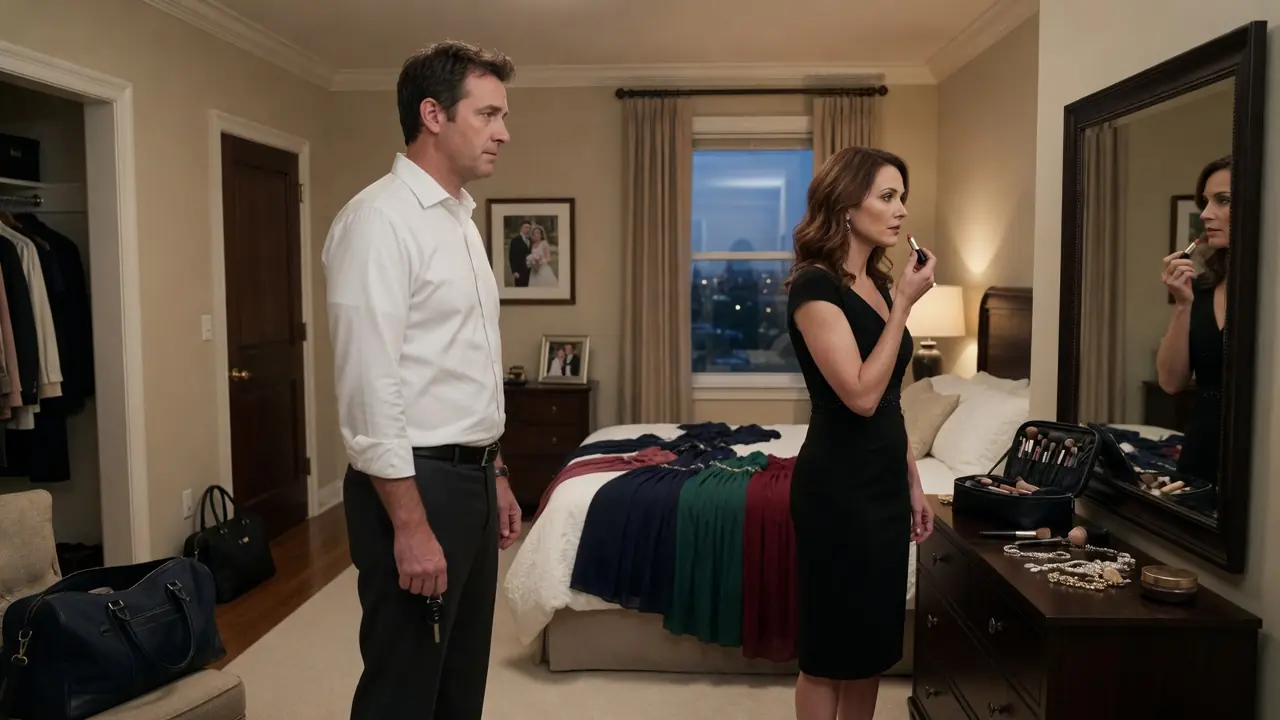
Not some harmless office gathering she had forgotten to mention.
A date.
She had said the word herself.
The woman I had loved for twelve years stood there in a black dress I had once told her made her look beautiful enough to stop traffic. She was fastening a pair of pearl earrings I had bought her for our tenth anniversary, tilting her head slightly as she checked the angle in the mirror. Her makeup was soft, careful, the kind she wore when she wanted to feel noticed. Her perfume, jasmine and vanilla, drifted through the room like a memory that no longer belonged to me.
I stood in the doorway with my work bag still hanging from one shoulder.
For a second, I honestly thought I had misunderstood.
Maybe she had said meeting.
Maybe she had said dinner.
Maybe exhaustion had twisted the word into something sharper than it was.
But then Vanessa looked at me through the mirror, calm as anything, and said, “Daniel, just accept it.”
Those four words landed harder than shouting ever could have.
My name is Daniel Brooks.
I was forty years old then, a financial consultant, the sort of man people trusted with retirement accounts, business plans, inheritance disputes, and the long, quiet fears hidden inside money. I had built a career out of patience. Listening. Asking questions. Reading patterns before they became disasters. Helping people see the consequences of decisions before those consequences arrived at the door.
Ironically, I had failed to do that in my own marriage.
Or maybe I had seen the signs and chosen not to name them.
Vanessa Brooks was thirty-eight, confident, sharp, beautiful in a way that did not ask permission. When we first met, she worked in marketing for a mid-sized logistics company and could hold a room with nothing more than a raised eyebrow and a well-timed sentence. She was funny, ambitious, and honest to the point of discomfort. At least, that was what I had believed.
We had met at a charity auction in downtown Chicago.
I was there because one of my clients had bought a table and insisted I come. Vanessa was there because her company had sponsored part of the event. I remember watching her talk to a group of executives twice her age and somehow make all of them laugh while still getting exactly what she wanted from them.
She noticed me standing alone near the silent auction table, pretending to care about a framed baseball jersey.
“You look like a man trying to calculate whether charity can be deducted emotionally as well as financially,” she said.
I looked over.
She was holding a glass of white wine, smiling like she already knew I would not have a good comeback.
“I was actually wondering who pays six hundred dollars for a signed jersey from someone who batted .214,” I said.
She laughed.
That was the beginning.
For the first few years, loving Vanessa felt easy.
We were both busy, both ambitious, both determined to build something stable after growing up in families where stability had been more wish than reality. I came from a home where money problems were discussed in whispers after children were supposed to be asleep. Vanessa came from a home where her mother changed jobs every year and her father made promises that never quite became rent money.
We understood hunger for security.
We understood wanting to become the sort of people no one could dismiss.
When we married, we did not have much. We rented a small apartment with thin walls, bad water pressure, and a kitchen so narrow that two people cooking together became a full-contact sport. We ate cheap pasta, saved aggressively, fought about laundry, made up quickly, and dreamed loudly.
Back then, Vanessa used to sit cross-legged on the living room floor with marketing proposals spread around her while I reviewed client portfolios at the coffee table.
“Someday,” she said once, tapping her pen against her notebook, “I want a house with stairs.”
I looked up. “That’s the dream? Stairs?”
“Yes. Stairs mean options. Apartments don’t have options.”
“Stairs mean vacuuming.”
“See, this is why I handle vision and you handle numbers.”
Years later, we bought a house with stairs.
Three bedrooms.
Two and a half baths.
A maple tree in the front yard.
A kitchen Vanessa said had “good morning light.”
I remember standing in the empty living room on closing day, holding the keys, feeling like we had crossed some invisible line into adulthood. Vanessa cried. I wrapped my arms around her and told her we had done it.
And for a while, I believed we had.
Marriage, of course, is not a single achievement. It is daily maintenance. It is small repairs before the structure cracks. It is noticing when silence changes shape. It is choosing not to let comfort become neglect.
I knew that in theory.
In practice, life became crowded.
My consulting business grew. Vanessa changed companies twice, each move bringing better titles, bigger salaries, and more pressure. We talked about children, then delayed the conversation because the timing was wrong. Then the timing stayed wrong long enough that we stopped bringing it up unless someone else asked.
We were not miserable.
That was what made everything harder to see.
We still laughed sometimes. Still shared bills, errands, holidays, and Sunday grocery runs. Still slept in the same bed. Still kissed each other goodbye in the morning, though sometimes those kisses became more habit than hunger.
I told myself all marriages settled.
I told myself comfort was not the same as distance.
Then Vanessa started her new job.
The company was called Northbridge Strategy Group, a glossy consulting firm with glass walls, expensive coffee, and employees who used phrases like “brand architecture” and “market disruption” in normal conversation. Vanessa was hired as a senior director, a role she had wanted for years. I was proud of her.
Genuinely proud.
On her first day, I made breakfast before she came downstairs.
Eggs.
Toast.
Coffee in her favorite mug.
A sticky note beside the plate that said, Go scare them professionally.
She came into the kitchen wearing a cream blouse and dark trousers, her hair sleek, her eyes bright with nerves.
“You are adorable,” she said, reading the note.
“I prefer supportive and handsome.”
“Supportive, yes.”
I clutched my chest. “Cruel.”
She smiled and kissed my cheek.
That morning, I thought we were still us.
I did not know Northbridge would become the place where my wife began building a life I was no longer invited into.
At first, the changes were small.
She came home later.
That was understandable. New job. New responsibilities. New expectations.
Then she started guarding her phone.
Not dramatically. Just enough.
A screen tilted away when I entered the room. A notification cleared too quickly. A password changed without mention. A smile appearing at her phone, then vanishing when she realized I had noticed.
I asked about it once while we were clearing dinner plates.
“Everything okay?”
She rinsed a glass without looking at me.
“Why wouldn’t it be?”
“You seem distracted lately.”
“I have a demanding job, Daniel.”
“I know. I’m not criticizing.”
“It feels like you are.”
That became a pattern too.
A simple question became pressure.
Concern became accusation.
My confusion became her evidence.
“You’re imagining things,” she said more than once.
The first time, I believed her.
The second time, I wanted to.
By the third time, I started hearing the sentence beneath the sentence.
Stop noticing.
Then there was Eric Lawson.
At first, he was just a name.
Eric said the Henderson pitch needs more edge.
Eric thinks leadership will approve the campaign.
Eric has a ridiculous espresso machine in his office.
Eric used to work in New York.
Eric knows everyone.
Eric, Eric, Eric.
He appeared in stories before he appeared in person.
When I finally met him, it was at a company holiday mixer in December.
He was forty-one, tall, athletic, silver beginning at his temples in a way that looked expensive rather than aging. He had a firm handshake, white teeth, and the casual confidence of a man who had never wondered if he belonged in any room. He wore a navy suit without a tie and made it seem intentional rather than incomplete.
“Daniel,” he said warmly, gripping my hand. “I’ve heard a lot about you.”
I glanced at Vanessa.
“Hopefully not the financial spreadsheet stories.”
Eric laughed.
“Actually, Vanessa says you’re the calmest person she knows.”
Vanessa smiled, but something in her smile bothered me.
Not because she looked guilty.
Because she looked pleased that he remembered.
That night, on the drive home, I asked, “You and Eric work together a lot?”
She looked out the passenger window.
“He’s on my team.”
“You seem close.”
“We work long hours.”
I nodded.
“I’m not accusing you.”
“Then why does it sound like you are?”
That was when I first felt it clearly.
Not suspicion.
A wall.
Something had come between us, and every time I reached toward it, Vanessa blamed my hand for touching the bricks.
The next few months were a slow unraveling.
Vanessa began dressing differently for work. Sharper. More intentional. New perfume. New lipstick. New earrings I had not seen before.
She stopped telling me about office frustrations but laughed into her phone in the hallway.
She started going to “team dinners” that ended close to midnight.
When I suggested joining her for lunch near her office one day, she said, “This week is insane.”
When I suggested the next week, she said, “Maybe later.”
Later became never.
One Saturday morning, I found her sitting at the kitchen island, smiling at a text.
I poured coffee and asked, “What’s funny?”
She set the phone face down.
“Work thing.”
“What work thing?”
“Daniel, please don’t interrogate me before breakfast.”
I stared at her.
“I asked one question.”
“You ask one question in a way that makes it feel like ten.”
I set my mug down carefully.
“Vanessa, something is wrong.”
She closed her eyes, already tired of the conversation.
“No, nothing is wrong. You are uncomfortable because I have a life outside this house.”
“That’s not fair.”
“Isn’t it?”
“No. I’ve never tried to stop you from having friends, work, goals, anything.”
“You don’t stop me,” she said. “You just make me feel like I have to explain everything.”
I did not know how to answer that.
Because explaining was not the problem.
Secrecy was.
But the more I tried to say it, the more she made me feel like I was being controlling. I began to doubt my own instincts. That is one of the quietest forms of damage in a relationship. Not being lied to directly, but being made to feel unreasonable for recognizing that truth has changed its clothes.
One evening in April, Vanessa came home after eleven.
I was in the living room with the lights low, reviewing reports on my laptop.
She stepped inside quietly, as if hoping I would be asleep.
“Long dinner?” I asked.
She froze.
Then removed her coat.
“Yes.”
“With the team?”
“Yes.”
There was a pause.
I looked up.
“You smell like cologne.”
Her face hardened immediately.
“Do you hear yourself?”
“Yes.”
“It was a restaurant, Daniel. People sit close together. Servers wear cologne. Clients wear cologne. The entire world contains scent.”
“Was Eric there?”
She laughed once, bitterly.
“There it is.”
“Was he?”
“Yes, Eric was there. So were six other people.”
“Why didn’t you answer that first?”
“Because I should not have to defend myself in my own house.”
“Our house,” I said quietly.
She looked at me then.
Really looked.
For a moment, I saw something in her face that frightened me.
Not guilt.
Resentment.
As if our house, our marriage, our history had become restraints she could no longer bear but did not yet have the courage to name.
After that night, I stopped asking.
Not because I trusted her more.
Because I was tired of being turned into the problem.
Friday, May 14, began like any other day.
I remember that because ordinary mornings become strange in memory when they end in rupture.
I woke at six.
Made coffee.
Checked the markets.
Answered client emails.
Vanessa came downstairs in workout clothes, barely spoke, and left for the gym. She had started going early, though I suspected the gym was not always the gym. I did not say that. I kissed her cheek when she passed. She let me, but she did not lean in.
At work, a client canceled an afternoon meeting, so I came home earlier than usual.
I thought maybe I would surprise Vanessa with dinner.
That thought seems almost pathetic now, but at the time, I still believed effort could close distance if I found the right kind.
I stopped at the grocery store.
Bought salmon.
Asparagus.
The dark chocolate she liked.
A bottle of wine.
I imagined lighting candles and asking her, gently this time, to tell me what was happening. Not accusing. Not pleading. Just opening the door.
When I pulled into the driveway at 5:40, her car was already there.
Music played upstairs.
Not loud.
Just enough that I could hear it from the entryway.
Something soft, expensive, unfamiliar.
I carried the groceries into the kitchen, set them down, and walked upstairs.
The bedroom door was half open.
Dresses were spread across the bed.
Black.
Red.
Emerald.
The closet light was on.
Vanessa stood at the mirror in the black dress, the one I loved. Her hair fell over one shoulder in loose waves. She had done her makeup carefully. Her heels were set beside the dresser. A small clutch lay near her perfume bottle.
She looked surprised when she saw me in the mirror.
“I thought you’d be home later,” she said.
I tried to smile.
“Meeting got canceled.”
She turned back to the mirror and adjusted her earring.
“Going somewhere?” I asked.
Silence.
Not long.
But long enough.
“I’m meeting Eric,” she said.
The name did not surprise me.
The lack of hesitation did.
I nodded slowly.
“Work dinner?”
“No.”
She met my eyes in the mirror.
“It’s a date.”
For a moment, I heard nothing.
The music continued.
A car passed outside.
Somewhere downstairs, the refrigerator hummed.
I stared at her reflection, waiting for the correction.
Waiting for her to laugh.
Waiting for her to say, God, Daniel, your face, I’m kidding.
She did not.
I laughed nervously because my body needed somewhere to put the panic.
“That’s not funny.”
“I’m not joking.”
The room seemed to shrink around us.
The bed.
The dresses.
The mirror.
The perfume.
The woman wearing my anniversary earrings to meet another man.
I asked the only question that came to mind.
“So you’re ending our marriage?”
She looked down at her lipstick, then capped it carefully.
“I don’t know.”
“You don’t know?”
“I want to see where this goes.”
I stared at her.
“With him.”
“Yes.”
“And what am I supposed to do while you see where this goes?”
She exhaled, irritated.
“Daniel, please don’t make this dramatic.”
That sentence cut so sharply I almost stepped back.
“Your wife is telling you she is going on a date with another man, and you think I’m making it dramatic?”
She finally turned from the mirror.
Her expression was not cruel exactly.
That would have been easier.
It was worse than cruelty.
It was impatience.
As if my pain was inconvenient.
“I have been unhappy for a long time,” she said.
“Then why didn’t you tell me?”
“I tried.”
“No, Vanessa. You withdrew. You dismissed me. You made me feel insane for noticing.”
She crossed her arms.
“You’re doing it again.”
“Doing what?”
“Turning everything into an analysis.”
I almost laughed.
“What would you prefer? That I applaud?”
“I would prefer that you accept the truth.”
“The truth being that you want to date your coworker while staying married to me?”
Her jaw tightened.
“I don’t want to blow up my entire life just because I need to figure out what I feel.”
I stared at her.
That was when I understood.
She did not want freedom.
Not fully.
She wanted permission.
She wanted the safety of our marriage while she explored the excitement of someone else. She wanted me to remain at home, loyal and available, while she decided whether I was still worth choosing.
It was not just betrayal.
It was entitlement.
“You expect me to stay here,” I said slowly, “while you go out with him.”
She looked away.
“I expect you to understand that things are complicated.”
“No. They’re painful. That doesn’t make them complicated.”
Her eyes flashed.
“Daniel, just accept it.”
There it was.
The sentence that ended the marriage as it had existed up to that moment.
Not because she said she was meeting Eric.
Not because she wore the dress.
Not because she had been texting and lying and drifting away for months.
Those were wounds.
But “just accept it” was something else.
It was a demand that I participate in my own humiliation.
I looked at the woman I had spent over a decade loving.
The woman I had built a home with.
The woman whose coffee I still made every morning, whose tired eyes I still worried about, whose laughter I still missed even when she was sitting beside me.
And for the first time, she felt like a stranger.
I did not shout.
I did not insult her.
I did not ask whether she loved him.
I did not ask whether she had already crossed lines I could not forgive.
I simply turned and walked out of the bedroom.
“Daniel?” she called after me.
I went into my home office, closed the door, and stood there for a moment with both hands on my desk.
My heart was pounding.
My throat hurt.
I wanted to collapse.
Instead, I opened the closet and pulled down my small travel bag.
Two shirts.
Jeans.
Socks.
Toiletries.
Phone charger.
Medication.
Laptop.
A folder with copies of important documents.
Not because I was planning war.
Because I had spent my adult life teaching people that panic makes poor decisions, and I refused to make one.
When I came back downstairs, Vanessa was in the hallway.
She had put on her heels.
She looked confused.
“Where are you going?”
I picked up my keys from the entry table.
“You told me to accept your decision.”
She nodded slowly.
“I did.”
“I’ve accepted it.”
Something shifted in her face.
“Daniel, that’s not what I meant.”
“I know,” I said. “You meant I should accept being disrespected quietly.”
Her eyes widened.
“That is not fair.”
“No,” I said. “What you’re doing is not fair.”
She stepped closer.
“Can’t we talk after I get back?”
After I get back.
The words sealed something.
“If you leave this house to go on a date with him,” I said, “there is nothing to talk about tonight.”
She swallowed.
“I told you, I need to figure out what I feel.”
“Then figure it out without me waiting here like furniture.”
Her eyes filled suddenly.
Maybe with fear.
Maybe with anger.
Maybe because she had not expected consequences to have a suitcase.
“You’re really leaving?”
“Yes.”
“Over one dinner?”
“No, Vanessa. I’m leaving because my wife asked me to accept a level of disrespect no marriage should survive unchanged.”
She looked down.
For one second, I thought she might apologize.
Instead, she whispered, “You’re being cold.”
That almost broke me.
Because I was not cold.
I was using every ounce of strength I had not to fall apart in front of her.
“I am being clear,” I said.
Then I opened the front door and walked out.
I did not slam it.
That mattered to me.
I would not give the house that sound.
I drove to my older brother Marcus’s place, twenty-five minutes away.
He opened the door wearing sweatpants and a faded Bulls T-shirt, holding a bowl of cereal despite it being nearly seven in the evening.
He took one look at my face and stepped aside.
“Guest room’s made up,” he said.
I stood in his entryway.
“You don’t even know what happened.”
“You look like a man who either needs a bed or a shovel. I’m hoping bed.”
That made me laugh.
Barely.
Then I cried.
Not dramatically.
Not loudly.
Just one sharp break in the chest that became tears before I could stop them.
Marcus put the cereal down and hugged me.
My older brother had always been the kind of man who showed love by pretending not to be sentimental. But that night, he held me like I was fifteen again and had just lost something I did not know how to name.
When I finally told him everything, he listened without interrupting.
That was rare.
Marcus interrupted weather reports.
When I finished, he leaned back on the couch, jaw tight.
“She said just accept it?”
I nodded.
“She’s lucky you’re the calm brother.”
“I don’t feel calm.”
“Good. Calm would be concerning.”
My phone started buzzing around nine.
Vanessa.
I watched her name appear.
Disappear.
Appear again.
Then messages.
Please answer.
We need to talk.
I didn’t go.
Daniel, please.
I’m sorry.
I didn’t think you’d actually leave.
That last one hurt most.
I did not answer.
Marcus noticed.
“You want advice?”
“No.”
“Good. Because I’m giving it anyway.”
I looked at him.
He leaned forward.
“Do not go back tonight. Not because you’re punishing her. Because you need to know the difference between her regretting the consequence and her understanding the wound.”
I stared at my phone.
“She says she didn’t go.”
“Maybe she didn’t. But that doesn’t erase getting dressed.”
No.
It did not.
That weekend was one of the longest of my life.
I stayed in Marcus’s guest room, staring at the ceiling, replaying every sign I had minimized.
The turned phone.
The late nights.
Eric’s name.
The cologne.
The defensiveness.
The way Vanessa had spoken about happiness as if I had stolen hers by existing in the same house.
By Saturday afternoon, Vanessa had sent twenty-three messages.
By Sunday, she stopped.
That silence scared me more than the buzzing had.
On Monday morning, I went to my office early.
I had not slept much, but work gave me structure. Numbers made sense. Clients had solvable problems. Markets moved for reasons that could at least be studied.
At 10:15, my assistant knocked softly.
“Daniel? Vanessa is here.”
My hands froze over the keyboard.
“Did she say why?”
“She said she needs five minutes.”
I looked at the spreadsheet on my monitor.
Then at the door.
“Send her in.”
Vanessa entered wearing jeans, a gray sweater, and no makeup. Her hair was pulled back. She looked exhausted in a way I had rarely seen. Not messy exactly. Stripped down.
The woman from Friday night had been polished for battle.
This woman looked like she had lost one.
“Hi,” she said.
I nodded.
She stood near the chair but did not sit.
“I never met Eric.”
I stayed quiet.
“I drove to the restaurant,” she said. “I sat in the parking lot for almost an hour. I kept looking at the door, and all I could hear was what you said.”
She wiped her cheek quickly.
“That I wanted you to wait at home like furniture.”
I looked down.
She continued.
“I didn’t go in. I called him and told him I couldn’t do it.”
“What did he say?”
Her mouth tightened.
“He said you were manipulating me.”
I laughed once, without humor.
“Of course he did.”
“He said if I was really unhappy, I should have the courage to find out what we could be.”
“And?”
“I hung up.”
Silence settled between us.
Then she sat.
Not across from me like an opponent.
Lower.
Smaller.
“Daniel, I am not here to excuse myself. I don’t even know how to explain what I became without sounding like I’m blaming you.”
“Try telling the truth,” I said.
She nodded slowly.
“I was unhappy.”
The words hurt, but I let her continue.
“I felt invisible. Not because you were cruel. You weren’t. You’re kind. Responsible. Loyal. But somewhere along the way, we stopped seeing each other. We became efficient. Bills paid. House clean. Calendar managed. Dinner eaten. Goodnight said. Repeat.”
I swallowed.
She was not wrong.
“But instead of telling you that,” she said, “I built a private world where I could feel interesting again.”
“With Eric.”
“Yes.”
“Did it become physical?”
“No.”
She answered immediately.
I wanted to believe her.
I did not know if I could.
“But it was emotional,” she said. “Flirting. Messages. Lunches I didn’t mention. Conversations I should have been having with you.”
Her voice cracked.
“I let him make me feel like the version of myself I thought I had lost.”
I leaned back.
“And I was the obstacle.”
“In my head, yes,” she whispered. “And that was unfair. I turned you into the symbol of everything I was frustrated with because it was easier than admitting I didn’t know how to ask for more from my life.”
I looked at her for a long moment.
“Why the date?”
She closed her eyes.
“Because I wanted control. I wanted to force the truth into the open without having to be brave enough to end anything first. I thought if I told you, maybe you would fight for me.”
The sentence made me colder than anger.
“You wanted me to compete.”
She opened her eyes.
“I think I did.”
“Like I was one option on a table.”
“I know.”
“No, Vanessa. I need you to really understand that. You were asking me to audition for a role I had already spent twelve years honoring.”
She broke then.
Not loudly.
Her face crumpled, and she covered it with both hands.
“I know,” she said. “God, Daniel, I know. The moment you walked out, I realized what I had done. I kept thinking you would argue, beg, ask me not to go. I never thought you would just choose yourself.”
“Neither did I,” I admitted.
She looked at me.
That honesty surprised us both.
I continued.
“I wanted to beg. I wanted to tell you not to go. I wanted to ask what he had that I didn’t. But then I heard you say just accept it, and something in me understood that if I stayed, I would never respect myself the same way again.”
She nodded through tears.
“I am so sorry.”
I wanted those words to fix something.
They did not.
But they mattered.
“What do you want now?” I asked.
She breathed shakily.
“I want to save our marriage.”
I looked at her.
“You almost ended it.”
“I know.”
“You humiliated me.”
“I know.”
“You made me question my sanity for months.”
Her face tightened with shame.
“I know.”
“I don’t trust you.”
She closed her eyes.
“I know.”
There was no defense.
That, more than anything, kept me from shutting the conversation down.
“I don’t know if I can do this,” I said.
“I understand.”
“No. I need you to understand clearly. If we try, it will not be because you got scared when I left. It will not be because you decided Eric was not worth it. It will not be because you feel guilty for a week. It will be months of work. Transparency. Counseling. Boundaries. Your phone. Your job. Eric. All of it.”
She nodded.
“I’ll do anything.”
“Do not say that unless you mean it after it becomes inconvenient.”
“I mean it.”
I studied her face.
I had known Vanessa for twelve years.
I had seen her lie to clients politely, smile through family tension, perform confidence when she was scared.
This was different.
She was not performing.
She was ashamed.
There is a difference between a person embarrassed they were caught and a person horrified by what they became.
I saw the second.
That did not make forgiveness automatic.
But it made a door.
A narrow one.
We started marriage counseling the next week.
The therapist’s name was Dr. Elaine Porter, and she was a woman in her sixties with silver hair, calm eyes, and absolutely no interest in letting either of us hide behind polished language.
During our first session, Vanessa said, “I made a mistake.”
Dr. Porter looked at her and said, “A mistake is forgetting an appointment. What you are describing was a series of choices.”
Vanessa went still.
I liked Dr. Porter immediately.
The sessions were brutal.
Not dramatic.
Brutal in the way honesty is brutal when it has been avoided too long.
We talked about Eric.
About the emotional affair.
About the messages.
Vanessa handed me her phone one evening without being asked. Then she gave me passwords. Email. Social media. Work chat. Not because I wanted to become her jailer, but because secrecy had become poison and transparency was the antidote.
She requested not to be assigned to Eric’s projects.
Then, after two weeks of awkward office tension, she transferred departments.
Eric sent one final message.
You’re making a mistake. He will never understand you like I do.
Vanessa showed it to me immediately.
Then blocked him.
I wish I could say that felt like victory.
It did not.
It felt like removing a knife and realizing healing had not begun yet.
For months, I struggled with images my mind invented.
Vanessa in the black dress.
Vanessa in the parking lot.
Vanessa at dinner with Eric in some version of the night she said she abandoned.
Sometimes trust broke over ordinary things.
A late meeting.
A delayed text.
Her smiling at her phone.
Once, three months into counseling, she came home twenty minutes late without warning me because her meeting ran over. She walked into the kitchen and saw my face.
Her shoulders dropped.
“I’m sorry,” she said immediately. “I should have texted.”
I nodded.
“I know traffic happens.”
“But your body doesn’t know yet.”
That was exactly it.
My mind understood explanations.
My body remembered betrayal.
We learned new rules.
Not rules like prison.
Rules like scaffolding.
Phones face up.
No private lunches with people either of us felt uncomfortable about.
Weekly check-ins that were not about schedules or bills, but feelings.
Real feelings.
The kind that sound embarrassing at first.
I feel lonely when we sit in the same room and do not talk.
I feel afraid to need too much.
I feel angry that you made me the responsible one for so long.
I feel ashamed that I looked outside our marriage instead of reaching for you.
We fought.
We cried.
We sat in silence.
We learned that reconciliation is not one apology stretched over time.
It is changed behavior repeated until the injured part of the relationship stops bracing for impact.
Some days, I wanted to quit.
Marcus reminded me I was allowed to.
“You know that, right?” he said one night when I called him after a hard session. “Trying does not obligate you to stay forever.”
“I know.”
“Do you?”
“I’m learning.”
He was quiet for a moment.
“Do you still love her?”
I closed my eyes.
“Yes.”
“Does she love you well now?”
That question stayed with me longer than the first.
Love as a feeling had never been enough.
Love had to become behavior.
For a long time, Vanessa had loved the security of me more than the person of me. She loved that I stayed. That I was patient. That I was predictable. That I could absorb discomfort. She had mistaken my loyalty for unlimited permission.
Now she had to love me with respect.
That was harder.
That was real.
Six months after the night I left, Vanessa and I went away for a weekend.
Not to some grand romantic resort.
Just a small lakeside inn two hours north, quiet and plain, with wooden chairs on a porch and coffee that tasted slightly burnt. Dr. Porter suggested we spend time somewhere not marked by old patterns.
On Saturday morning, we walked along the lake.
The air was cool.
The water was gray.
Vanessa wore a thick sweater and no makeup. I wore an old jacket she used to tease me about. We walked for almost an hour before she spoke.
“I need to tell you something ugly.”
I glanced at her.
“All right.”
“When I told you to accept it,” she said slowly, “some part of me wanted to punish you.”
I kept walking.
She continued.
“I felt neglected, but I did not know how to say that without sounding needy. So I wanted you to feel small too. I wanted you to feel what I felt.”
I stopped.
The wind moved over the water.
“That is ugly,” I said.
“I know.”
“Thank you for telling me.”
Her eyes filled.
“I hate that version of myself.”
“You should,” I said.
She looked down.
I softened my voice.
“But hating her is not enough. You have to understand her so you do not become her again.”
She nodded.
“I’m trying.”
I believed that.
For the first time in months, I fully believed it.
Not because trust had returned completely.
Because effort had become consistent.
A year after that night, Vanessa and I sat at our kitchen table eating dinner.
Nothing special.
Chicken.
Rice.
Roasted carrots.
The kind of meal married people eat on a Tuesday because life continues even after emotional earthquakes.
The house felt different.
Not like before.
Not innocent.
But honest.
The black dress was gone.
Vanessa donated it without making a ceremony of it. The pearl earrings stayed in a drawer for a long time. Eventually, she asked if I wanted her to get rid of them too.
I thought about it.
Then said no.
“They are not the problem,” I told her.
She never wore them again anyway.
That night at dinner, she looked at me across the table.
“Thank you,” she said.
“For dinner?”
“For refusing to accept less than you deserved.”
I set down my fork.
She continued.
“I used to think love meant you would stay no matter what. That if you really loved me, you would absorb anything until I figured myself out. But that was not love. That was me trying to make you responsible for my confusion.”
I listened.
“When you left, I thought you were abandoning me. Now I understand you were protecting yourself. And maybe protecting us too, because if you had stayed that night, I think I would have lost respect for both of us.”
I looked down.
That was hard to hear.
But true.
“I didn’t leave to save us,” I said.
“I know.”
“I left because I could not stay.”
“I know,” she said again. “That’s why it mattered.”
We did not become a perfect couple after that.
Perfect couples are usually either fictional or lying.
We still had hard days.
There were moments when suspicion returned without warning. Moments when Vanessa became defensive and had to catch herself. Moments when I used calmness as armor instead of honesty. Moments when the old distance tried to grow back in familiar corners.
But now we named things sooner.
We repaired faster.
We stopped treating silence as peace.
Two years later, I can say that we are still married.
Not because betrayal is harmless.
Not because emotional affairs should be minimized.
Not because every marriage can or should survive what ours almost did.
We are still married because Vanessa stopped before crossing a final line, told the truth, accepted responsibility, changed her life, and did the long humiliating work of earning trust back.
And because I learned something too.
I learned that patience without boundaries can become self-abandonment.
I learned that loyalty does not mean staying while someone disrespects you.
I learned that respect is not something you beg for from a person who loves you. It is something they either choose to practice or they do not.
That Friday night, when Vanessa told me to just accept it, she believed I would choose comfort over self-respect.
For years, I had been the steady one.
The forgiving one.
The reasonable one.
The man who stayed calm.
But calm is not the same as passive.
And love is not the same as surrender.
Walking out was the hardest thing I had ever done in my marriage.
It was also the first honest thing either of us had done in months.
Sometimes, the strongest way to fight for a marriage is not begging someone to stay faithful.
It is refusing to participate in the thing that would destroy you.
It is picking up your keys.
Packing a bag.
Walking out without screaming.
Letting the silence you leave behind say what your pleading never could.
You are free to choose.
But so am I.
And if a marriage is going to survive, it cannot be because one person accepts humiliation and calls it love.
It survives when both people finally face the truth.
Before it is too late.
Before the date happens.
Before the lie becomes a life.
Before “just accept it” becomes the final sentence.
In our case, the door closed behind me that night.
But it did not close forever.
It closed loudly enough to wake us both up.