The words hit me so hard that, for a moment, I forgot how to breathe.
“You’re going to be a father again.”
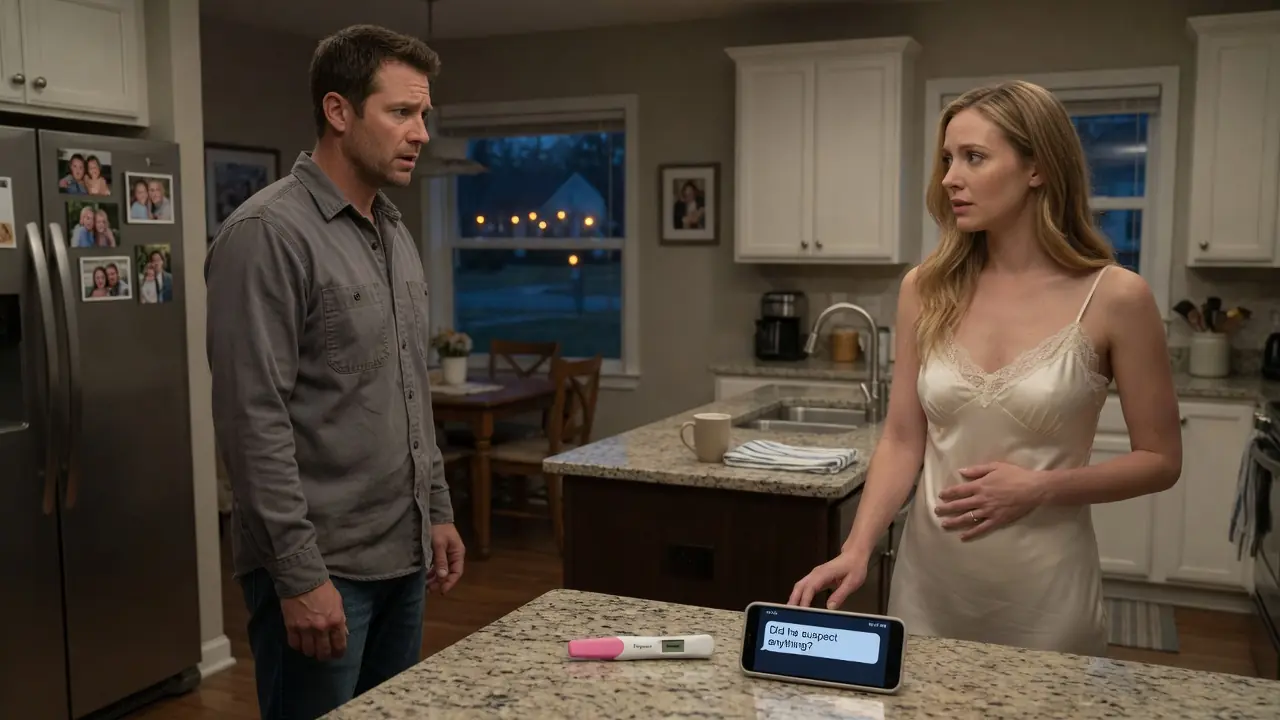
My wife, Lauren, said it in our dim kitchen on a Thursday night, one hand pressed against her stomach, the other gripping the edge of the counter as if the whole house had started tilting beneath her feet.
She tried to smile.
It trembled and broke before it reached her eyes.
I stood across from her in my work boots, still wearing the navy jacket from the warehouse, my lunchbox hanging from one hand. I should have dropped everything and pulled her into my arms. I should have cried, laughed, asked a hundred questions.
Instead, I stared at her.
Because we had not been close in months.
Not really.
We shared a house, a bed, bills, groceries, Sunday chores, and the quiet performance of a marriage that had not yet admitted it was failing. But touch had become rare between us. Conversation had become practical. Love, if it was still there, had been buried under exhaustion and resentment so long that neither of us knew where to dig.
So when Lauren told me she was pregnant, joy was not the first thing I felt.
Fear was.
Then suspicion.
Then shame for feeling both.
“How long have you known?” I asked.
Her fingers tightened against her stomach.
“A little while.”
“A little while?”
She looked away.
“I wanted to be sure.”
Something in her answer sounded rehearsed. Not false exactly, but polished too smooth, like a stone turned over in her mind a thousand times before she handed it to me.
I set my lunchbox on the table.
“Lauren, look at me.”
She did, but only for half a second.
That was when her phone lit up on the counter.
No name.
Just a number.
Her eyes flickered to it, then quickly back to me.
Too quickly.
“Who’s that?” I asked.
“No one.”
“No one keeps calling you after dark?”
“It’s work.”
“You don’t take work calls outside in the driveway.”
Her face changed.
Just a little.
But I saw it.
For weeks, I had been watching my wife become a stranger in small pieces. Late trips to the grocery store that lasted two hours. Evening walks that stretched long after sunset. Her phone always face down beside her pillow. A new password. Deleted message threads. Tara, her best friend, suddenly unable to meet my eyes whenever I saw her.
At first, I told myself stress had changed Lauren.
Then I told myself grief had.
We had lost a baby years earlier, a loss we barely spoke about because speaking of it opened a room in our house neither of us knew how to enter without falling apart. After that, something in Lauren had folded inward. Something in me had hardened. We kept living, but not entirely together.
Still, a man knows when the air in his own home changes.
And ours had.
“Is there something you need to tell me?” I asked.
Lauren’s eyes filled.
“Not tonight.”
The answer landed heavier than any confession could have.
I stepped back.
She reached for me, then stopped herself.
“I know this is a shock,” she whispered.
“A shock?” I laughed once, but there was no humor in it. “Lauren, we’ve barely touched each other in months, and now you’re telling me I’m going to be a father again while someone keeps calling you from a number you won’t explain.”
“It’s not what you think.”
“Then tell me what it is.”
That was when something inside me went cold.
Not angry.
Cold.
The kind of cold that does not shout because it is too busy memorizing everything.
Lauren went to bed early that night, though I knew she did not sleep. I lay beside her in the dark and listened to her breathing shift every few minutes, uneven and tense.
Around two in the morning, she got up and went to the bathroom.
Her phone remained on the nightstand.
I stared at it.
I had never been the kind of husband who checked his wife’s phone. Even in our worst months, I had believed privacy was part of trust. But trust had already started bleeding through the floorboards.
When she flushed the toilet, I grabbed the phone.
It opened.
She had forgotten to lock it.
There were almost no messages.
Too clean.
But one deleted thread still held a single surviving line.
Did he suspect anything?
My chest tightened so sharply I had to sit down on the edge of the bed.
The bathroom door opened.
I dropped the phone back where it had been.
Lauren stood in the doorway, pale.
“Daniel?”
I looked at her.
She looked at the phone.
Neither of us said anything.
The next morning, she packed a small bag.
“Where are you going?” I asked from the kitchen doorway.
“Tara’s.”
“Why?”
“I need space.”
“You need space after telling me you’re pregnant?”
She zipped the bag with shaking hands.
“I need time to think.”
“About me? Or about him?”
She froze.
The silence answered before she did.
“There isn’t a him,” she whispered.
But she would not look at me.
When she left, she took her coat, her overnight bag, and her phone.
She left her wedding ring on the bathroom shelf.
That detail nearly broke me.
Lauren never took off that ring. Not when she baked bread. Not when she washed dishes. Not even in winter when her hands swelled and the gold pressed into her skin.
I stood in the bathroom holding it in my palm, staring at the small circle that had once meant forever.
Then I began looking.
I am not proud of that.
But heartbreak is not polite.
I checked drawers, purse pockets, receipts, laundry baskets, the glove compartment of her car. I found a receipt from a gas station two towns over, dated after midnight on a Tuesday she had claimed to be asleep. I found a second phone charger hidden behind detergent in the laundry room. I found a folded note under her sweaters written in handwriting I did not recognize.
He still doesn’t know, does he?
I read it again and again until the words no longer looked like English.
That afternoon, I drove to the clinic where Lauren worked part-time as a billing assistant. I parked across the street and watched people go in and out.
A tall man in navy scrubs came out around five.
He was good-looking in the easy way some men are when they know they are being looked at. Dark hair. Sharp jaw. A badge clipped to his pocket.
Adrian Mills.
I had heard the name once or twice from Lauren.
Always casually.
Always too casually.
He stood near the employee entrance, checked his phone, then looked toward the parking lot like he was waiting for someone.
My stomach turned.
I drove home before I did something I could not undo.
That evening, Mrs. Collins from next door was taking her trash out when I pulled into the driveway.
“Daniel,” she called softly.
I turned.
She looked uncomfortable.
“I don’t mean to interfere.”
That sentence never means anything good is coming.
“What is it?”
She glanced toward my house.
“I saw Lauren last week. Tuesday night, I think. A car dropped her off two streets over. She walked the rest of the way.”
“What kind of car?”
“Dark gray sedan. Not one I recognize.”
“Did you see the driver?”
“Only a little. A man.”
I thanked her and went inside.
The house felt wrong without Lauren. Too still. Too full of objects that belonged to both of us but suddenly seemed to accuse me.
Her coffee mug in the sink.
Her cardigan on the chair.
The pregnancy test still wrapped in tissue in the bathroom trash.
I sat at the kitchen table with the folded note in front of me and waited.
Lauren came home a little after nine.
Her face was drawn. Her eyes were swollen. She looked as if she had spent the whole day carrying something too heavy.
When she saw the note on the table, her body went still.
“Who is he?” I asked.
She set her bag down slowly.
“Please don’t do this right now.”
“You have one chance to tell me the truth.”
“Daniel.”
“One chance.”
Her mouth trembled.
“There was someone I was talking to.”
The room seemed to narrow around us.
“Adrian?”
She closed her eyes.
“Yes.”
I laughed once, sharp and empty.
“Of course.”
“It wasn’t what you think.”
“You keep saying that.”
“Because it’s true.”
I stood so fast the chair scraped hard against the floor.
“Then tell me what it was. Tell me why another man is asking if I suspect anything. Tell me why you’re taking calls outside. Tell me why you’re pregnant and scared to look me in the eye.”
She covered her face.
“I didn’t sleep with him.”
I waited.
“I swear to you, Daniel. I didn’t.”
“But?”
She lowered her hands.
“But I let him get too close.”
There it was.
The confession that was not the worst possible truth, but still enough to wound.
Lauren told me Adrian was a senior nurse at the clinic. He had noticed she was struggling. He asked questions I had stopped asking. He listened when she cried in her car during lunch breaks. He told her she deserved to be seen. He told her silence was not marriage.
One night, after too much wine and too many private messages, she met him behind the grocery store.
“Did you kiss him?” I asked.
She shook her head.
“Almost.”
Almost.
That word was a knife with a soft handle.
“I pulled away,” she said quickly. “I panicked. I knew it was wrong.”
“But you kept talking to him.”
She looked down.
“Yes.”
“Because he made you feel seen.”
Her face twisted.
“I know how that sounds.”
“No,” I said quietly. “I know exactly how it sounds.”
I had been standing beside her for years. Paying bills. Fixing sinks. Taking her car in for oil changes. Making sure the furnace worked before winter. I had thought responsibility was proof of love.
Maybe it was.
But responsibility without tenderness becomes furniture.
Useful.
Silent.
Taken for granted.
“And the baby?” I asked.
Lauren’s tears returned.
“It’s yours.”
I wanted to believe her.
God help me, I wanted to.
But my trust had been dragged across too many broken stones.
“How do you know?”
“Because nothing happened with Adrian.”
“That isn’t enough.”
Her face crumpled.
“I know.”
Then her phone buzzed.
She flinched.
The screen lit up on the table before she could grab it.
No name.
Just a message.
He’s asking questions.
I picked up the phone before she could.
“Daniel, don’t.”
“Too late.”
There were hidden messages in a locked folder. Not many. Most had been erased. But enough remained.
If he finds out about the appointment, we’re both finished.
Don’t drag old records into this.
You need to tell him before he hears it from someone else.
My skin crawled.
“What appointment?”
Lauren’s face went white.
She sat down as if her legs had given out.
“I was going to tell you.”
“Tell me what?”
She reached into her bag and pulled out a folded paper.
An ultrasound image.
She set it on the table.
Then another paper.
A photocopied hospital discharge form from years earlier.
The year we lost the baby.
I stared at it.
My name was typed near the bottom.
Daniel Carter.
Spouse notified.
Follow-up declined.
I looked up slowly.
“What is this?”
Lauren’s voice broke.
“I never showed it to you because I didn’t understand it. I thought you knew more than you said. I thought maybe the hospital called you. I thought maybe you agreed not to talk about it because you couldn’t handle it.”
My mind went blank.
“I never saw this.”
“I know that now.”
“No,” I said, louder. “Lauren, I never saw this.”
She began to shake.
“That’s what Marcus said.”
“Who is Marcus?”
Her phone rang before she could answer.
The same number.
This time, she put it on speaker with trembling fingers.
A man’s voice filled the kitchen.
“You still haven’t told him about the file.”
I stepped closer to the phone.
“Who the hell is this?”
A pause.
“My name is Marcus Hale. I work in patient advocacy at St. Catherine’s Hospital. Mr. Carter, your wife came to us requesting old records.”
“Why are you calling her from an unlisted number?”
“Because someone in the system has been watching requests connected to that file.”
Lauren lowered her head into her hands.
I gripped the table.
“What file?”
Marcus exhaled slowly.
“The pregnancy loss from six years ago. The record attached to your wife’s case was altered.”
The words seemed to hang in the air like smoke.
“What do you mean altered?”
“I mean the discharge summary Lauren received was not the original version. A prior version indicates there may have been a medication-related complication that required further review. That version was replaced. The replacement contained your name, Mr. Carter, stating you had been notified and declined follow-up.”
“I did not.”
“I believe you.”
Lauren sobbed once.
Marcus continued, voice careful.
“Mrs. Carter spent years blaming herself for something that may not have been her fault.”
The room went completely still.
For years, Lauren had believed her body had betrayed us. For years, I had believed grief had simply made her unreachable. For years, we had been living inside a lie neither of us knew how to name.
Then Marcus said the part that made my blood turn cold.
“There is one more thing. Someone signed the first correction request using your initials.”
I sat down slowly.
“My initials?”
“Yes. D.C.”
“I didn’t sign anything.”
“I know.”
“How?”
“Because the signature does not match your driver’s license or any later hospital forms. But it was accepted at the time.”
Lauren looked at me, eyes wide with horror.
“Daniel.”
I could barely hear her.
Marcus went on.
“Mrs. Carter came back for prenatal care this month. When the pregnancy reopened parts of the old chart, someone noticed the inconsistency. That is when she began receiving anonymous warnings.”
“From whom?”
“I don’t know yet.”
“Adrian?” I asked.
Lauren’s head snapped up.
Marcus was silent too long.
“What about Adrian?” I demanded.
“Adrian Mills had access to the old records. He was not in patient advocacy at the time of the first incident, but he worked in records support. His name appears as a witness on the later update.”
Lauren stared at the phone.
“No.”
“I’m sorry,” Marcus said. “I was going to ask you both to come in tomorrow. Together. This should not be handled over the phone.”
I looked at Lauren.
She looked like someone had taken the floor from under her.
Adrian had not been the father.
But he had still stood too close.
He had still listened to her pain while knowing he might be connected to the lie that created it.
I ended the call and sat in silence.
Lauren moved toward me.
I stepped back.
The hurt in her face nearly undid me, but I could not let it.
“I need air,” I said.
“Daniel, please.”
“I need air.”
I walked out to the porch.
The Ohio night was cold. The kind of cold that made every breath visible.
I stood there in the dark, hands gripping the railing, thinking about everything I had been angry about and everything I had missed.
Lauren had lied.
That was true.
She had hidden appointments, deleted messages, entertained emotional comfort from another man, and left me believing I had been replaced in my own marriage.
But beneath that betrayal was another wound.
A larger one.
Someone had rewritten part of our life and let us suffer inside the wrong version of it.
The next morning, we drove to St. Catherine’s Hospital together.
We did not hold hands.
That felt important.
Not cruel.
Honest.
Marcus Hale met us in a small conference room near the records office. He was in his forties, tired-eyed, with a folder already open in front of him.
Adrian Mills was there too.
The moment I saw him, anger rose so fast I had to press both palms to the table.
He looked smaller than he had outside the clinic. Less charming. Less sure.
Lauren could not look at him.
Marcus began.
“Six years ago, Mrs. Carter was treated after losing a pregnancy. A medication review should have been triggered. The first report recommended an internal investigation. That report was replaced within seventy-two hours.”
“By who?” I asked.
Marcus placed a copy on the table.
Adrian’s face drained of color.
The signature at the bottom was not his, but beside it was his printed name as witness.
Adrian Mills.
Records assistant.
Lauren’s voice shook.
“You knew?”
Adrian closed his eyes.
“I was twenty-nine. I was new. Dr. Rhodes told me it was a clerical correction.”
“Don’t,” Marcus said sharply. “Not anymore.”
Adrian opened his eyes.
His mask fell.
“She said the hospital could be ruined over one mistake,” he whispered. “She said the patient was stable. She said the family didn’t want questions. I didn’t know the form had Daniel’s name forged until later.”
“And when you did?” I asked.
He looked at me.
“I said nothing.”
Lauren made a sound like a breath breaking.
Adrian turned to her.
“When you came back pregnant, I recognized your name. I panicked. I thought if you requested the old file, everything would come out. Then you started talking to me, and I…”
“You what?” Lauren whispered.
“I liked feeling like I could help you.”
Her face hardened through her tears.
“You were helping yourself.”
He lowered his head.
“Yes.”
The room went silent.
That was the ugliest honesty of all.
He had not touched her. He had not fathered her child. But he had taken her loneliness, her fear, and his own guilt, and braided them into something that nearly destroyed us.
I stood.
“If you ever contact my wife privately again, I will involve every lawyer I can find.”
Adrian nodded.
“You should.”
Marcus slid another folder toward us.
“This contains the corrected records, the original report, and instructions for filing a formal complaint. Dr. Rhodes is retired now, but the hospital is still responsible for records integrity. I strongly recommend legal counsel.”
Lauren stared at the folder.
“Was it my fault?” she whispered.
Marcus’s face softened.
“No. Based on what I’ve seen, no.”
She covered her mouth and cried.
Not loudly.
Not dramatically.
Just a quiet collapse of six years of blame.
I wanted to reach for her.
I did not.
Then I did.
Not because everything was fixed.
Because no one should hear that kind of truth alone.
I put my hand over hers.
She held on like she was falling.
The weeks that followed were not romantic.
They were not clean.
We hired an attorney. The hospital opened a review. Adrian was suspended during the investigation. Dr. Rhodes, the retired physician whose name appeared on the original file, was contacted. Marcus kept his word and handed over every document he could legally provide.
Lauren and I started marriage counseling.
The first session was terrible.
She cried. I snapped. She apologized. I rejected apologies that came too easily. I admitted I had been cold for years. She admitted she had been lonely and had chosen secrecy instead of courage.
At one point, the counselor asked, “Do you both want this marriage?”
Neither of us answered right away.
That scared me.
Then Lauren whispered, “I do.”
I stared at the floor for a long time.
Finally, I said, “I don’t know how yet. But I want to want it.”
The counselor nodded as if that counted as a beginning.
Maybe it did.
The baby kept growing.
At the twelve-week appointment, the doctor turned the monitor toward us. A small shape moved on the screen, impossibly tiny, impossibly alive.
Lauren cried.
So did I.
I did not care who saw.
Later, in the parking lot, Lauren said, “I’ll do a paternity test if you need it.”
I leaned against the car.
“I hate that I need it.”
“I understand.”
“I hate that you understand.”
“I know.”
We did the test.
When the results came back, I sat alone at the kitchen table before opening the envelope.
Lauren stood across from me, face pale.
I read the page.
Probability of paternity: 99.99%.
I closed my eyes.
Relief did not feel like joy at first.
It felt like exhaustion leaving my bones.
Lauren began to cry softly.
I handed her the paper.
Then I said the truth.
“This proves the baby is mine. It doesn’t prove we’re okay.”
She nodded.
“I know.”
“But maybe,” I said, “it proves we have a reason to try.”
For the first time in months, she reached for my hand.
This time, I let her hold it.
The hospital eventually settled quietly. There was an apology letter, a corrected record, and a policy review with words like accountability and procedural reform.
No letter can return years.
No settlement can give back the child you lost or the marriage you might have had if grief had been met with truth instead of altered paper.
Still, the correction mattered.
Lauren framed nothing. Celebrated nothing.
She simply took the old false summary, folded it once, and placed it in a box with other things we were not ready to throw away but no longer wanted to live inside.
The day our daughter was born, Lauren named her Hope.
I almost laughed when she said it.
Not because it was silly.
Because it was brave.
Hope Carter arrived on a rainy Tuesday morning with a furious cry and tiny fists clenched like she had come into the world ready to argue.
When the nurse placed her in my arms, I thought about all the nights I had believed she belonged to someone else. All the pain I had let grow teeth inside me. All the ways truth had arrived late but still arrived.
Lauren watched me from the bed, exhausted and afraid to ask what I felt.
I looked down at Hope.
Then at my wife.
“She has your mouth,” I said.
Lauren’s face crumpled with relief.
“And your stubborn forehead,” she whispered.
Three months later, Lauren handed me a sealed envelope after one of her follow-up appointments.
“What is this?” I asked.
“Marcus gave it to me. He said it was the last corrected copy.”
I opened it.
Inside was the complete amended report from six years earlier.
Attached to it was a handwritten note.
Someone else signed the first version.
No name.
No explanation.
Just that one line.
I looked at Lauren.
The old fear passed between us, but it did not own the room anymore.
“What do you want to do?” she asked.
I looked toward the living room, where Hope was sleeping in her bassinet, one small hand open beside her face.
Then I looked at the woman across from me.
My wife.
Not innocent.
Not ruined.
Human.
“We keep it,” I said. “We don’t chase ghosts tonight.”
Lauren nodded.
“And tomorrow?”
“Tomorrow we call the attorney.”
She almost smiled.
“That sounds like us.”
“No,” I said. “That sounds like who we’re becoming.”
Trust did not return like lightning.
It returned like winter thaw.
Slowly.
Drop by drop.
Lauren changed her number. Adrian never contacted her again. We kept going to counseling. Some nights we still argued. Some mornings we still sat in silence, but the silence was different now. It was no longer a locked door. It was a room we were learning how to enter carefully.
One evening, I found Lauren standing in the kitchen with Hope against her shoulder, humming off-key.
She stopped when she saw me.
“What?” she asked.
“Nothing.”
But it was not nothing.
It was the sight of my wife under the kitchen light, tired and real, holding our daughter in the house that had nearly broken apart and somehow remained standing.
I walked over and kissed Hope’s head.
Then I kissed Lauren’s forehead.
She closed her eyes.
“I’m sorry,” she whispered.
“I know.”
“I’ll probably say it for years.”
“I’ll probably need to hear it for years.”
She gave a small, sad laugh.
“Fair.”
I looked at Hope, sleeping between us.
“I’m sorry too,” I said.
Lauren opened her eyes.
“For what?”
“For being there without being present. For letting grief turn me into furniture. For thinking paying bills meant I was loving you well enough.”
Tears filled her eyes.
“You were hurt too.”
“Yes,” I said. “But that doesn’t mean I didn’t hurt you.”
That was the night I understood something I had not wanted to know.
Sometimes marriage does not break because one person stops loving.
Sometimes it breaks because both people are wounded and each waits for the other to bleed first.
The old file never gave up all its secrets.
Our attorney kept digging. Marcus kept helping. There were names we learned, signatures we questioned, and people who suddenly claimed they did not remember decisions that had changed our lives.
Maybe one day, every answer would surface.
Maybe not.
But the most important truth had already found us.
The baby was mine.
The grief was not Lauren’s fault.
The emotional betrayal was real.
The love was damaged.
And damaged did not always mean dead.
Years later, when Hope was old enough to ask why her mother sometimes touched an old scar of sadness behind her smile, Lauren told her something simple.
“Before you were born, your father and I had to learn how to tell the truth.”
Hope, who was five and busy coloring a purple elephant, looked up.
“Was it hard?”
Lauren looked at me.
I looked back.
“Yes,” I said. “Very hard.”
Hope nodded seriously.
“But you did it.”
Lauren reached for my hand under the table.
“Yes,” she said. “We did.”
That night, after Hope fell asleep, I opened the box where we kept the corrected report, the old note, and the paternity results.
I read the handwritten line again.
Someone else signed the first version.
For years, that sentence would have haunted me.
Now it reminded me of something else.
A lie can enter your life without permission.
It can twist your memories, poison your marriage, and make innocent people carry guilt that was never theirs.
But truth, even late truth, has a way of standing in the doorway until someone finally lets it in.
I closed the box.
Then I went upstairs, where Lauren was already asleep beside Hope’s baby monitor, one hand resting on the empty space where mine belonged.
I climbed into bed.
And for the first time in a long time, I did not wonder who had almost taken my place.
I thought instead about the life still waiting for us.
Not perfect.
Not untouched.
But ours.
And that, after everything, was enough to begin again.