Rachel was sitting upright in bed when she said the words that ended my marriage.
The bedside lamp was still on, throwing soft yellow light across the pale green walls, the rumpled white pillows, and the dark blue blanket twisted between us like a line neither of us could cross.
Her dark curls were messy, her makeup was smudged at the edges, and one of her earrings was missing. She had one hand raised slightly, palm out, like she was arguing a case in front of a judge.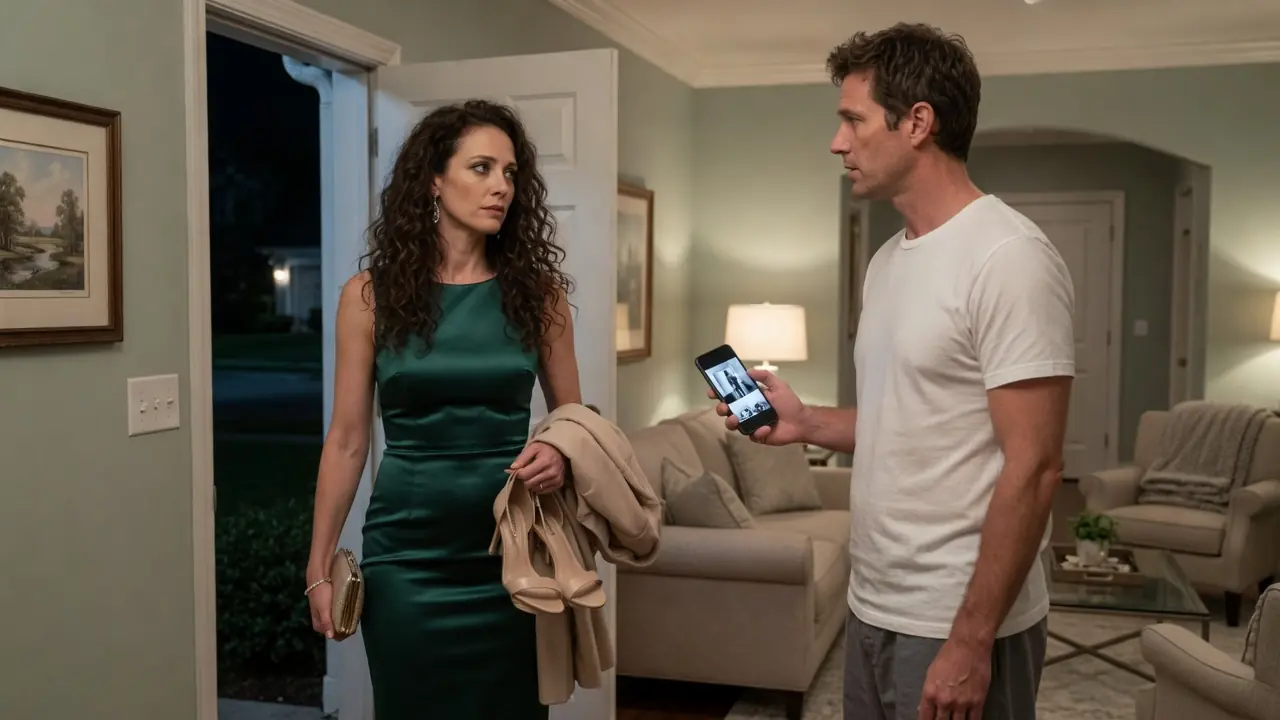
I stood beside the bed in a white T-shirt and pajama pants, arms folded across my chest, too tired to shout and too awake to pretend I did not already know something was wrong.
It was 3:17 in the morning.
I knew the exact time because I had been sitting downstairs watching the doorbell camera on my phone, waiting for her headlights to sweep across the driveway again. I had watched the empty street for so long that every passing car made my heart climb into my throat.
At 2:58, her car finally turned onto our road.
At 3:01, she pulled into the driveway without turning the headlights fully toward the garage, like she was trying not to wake the house.
At 3:02, she sat in the car.
At 3:05, she was still sitting there.
At 3:06, the driver’s side door opened.
She stepped out slowly, carrying her heels in one hand, phone in the other. Her movements were careful. Not drunk exactly, but measured in the way people move when they know they are being watched by something, even if they do not know what.
When she came inside and found me sitting in the living room, she jumped like a person caught doing something she had already rehearsed denying.
“Where were you?” I asked.
My voice was calm, but only because anger had burned itself out somewhere between midnight and 2:00 a.m. By then, fear had already become certainty, and certainty had become something colder.
Rachel rolled her eyes and walked past me toward the stairs.
She did not answer.
That small thing told me more than a paragraph would have.
I followed her to the bedroom because something in me knew that if I let the question die that night, I would lose more than an argument. I would lose the final piece of myself still willing to ask for respect.
For four months, her late nights had become part of the house.
At first, they arrived with explanations.
Client dinners.
Networking events.
Emergency meetings.
Physician appreciation mixers.
Last-minute conferences.
Work calls that somehow stretched past midnight.
Rachel worked in pharmaceutical sales, so I tried to be reasonable. Her job involved dinners, drinks, doctors, clients, long conversations, and people pretending business became more important after dark. I knew enough about sales to know that charm often got dressed up as strategy.
I was not a jealous husband by nature.
I had never checked her purse.
Never followed her.
Never demanded her passwords.
Never treated marriage like a prison.
I asked normal questions because I thought normal couples still owed each other basic truth. When the person you sleep beside disappears until three in the morning, “Where were you?” is not control. It is the smallest possible request for respect.
But the pattern had changed.
Three late nights a week became four.
Weekend errands became overnight stays near conference hotels.
Her perfume changed before she left.
Her clothes became more careful.
Her phone became sacred.
Her stories changed when she came home, always vague, always impatient, always shaped like an answer designed to punish me for asking.
“How was dinner?”
“Fine.”
“Who was there?”
“Clients.”
“What clients?”
“Nathan, I don’t have the energy for this.”
That was how it worked.
I would ask one ordinary question, and she would turn it into a trial where I was already guilty.
I learned to hear the shift in her tone before she even finished speaking. The clipped patience. The little laugh under her breath. The sigh that said I was embarrassing both of us by needing an answer.
That night, as she sat on our bed with the blanket around her waist, she looked at me like I was the problem.
“I don’t have to tell you where I’ve been, Nathan,” she said. “I’m a grown woman.”
I remember the silence after that sentence more clearly than anything else.
The clock on the nightstand glowed red.
A glass of water sat beside a box of tissues.
Behind her, our wedding photo hung crooked on the wall, the two of us smiling in a life that suddenly felt like it had belonged to strangers.
“You’re right,” I said.
Rachel blinked.
Not agreement.
“You don’t have to tell me anything anymore.”
Her eyes narrowed.
“What is that supposed to mean?”
I looked at her for a long moment and felt something inside me go cold and still.
“It means tomorrow, this house starts respecting the freedom you keep demanding.”
She scoffed and looked away, as if my calmness bored her.
“Whatever, Nathan. I’m showering.”
She climbed out of bed, grabbed clothes from the chair, and went into the bathroom without another word.
The door shut.
The water turned on.
I stood in the middle of the bedroom and listened.
For seven years, I had been married to Rachel Coleman. Seven years of birthdays, holidays, mortgage payments, dentist appointments, family cookouts, arguments about paint colors, and long talks at the kitchen table when we were young enough to believe talking could fix anything.
We had bought furniture together.
Planned holidays together.
Put off having children together because careers came first and timing was never right.
I had loved her in quiet ways. In oil changes. In soup when she was sick. In coffee made before she woke. In sitting through work events where I knew no one, smiling while she moved through the room like she belonged to a shinier world than the one we had built together.
But in that moment, with the bathroom water running behind a locked door, I understood something I should have understood sooner.
She had not been asking for freedom.
She had been daring me to accept how little I mattered.
That was the difference.
Freedom in a marriage means two people choosing trust without chains.
What Rachel wanted was access without accountability.
She wanted to leave when she pleased, return when she pleased, disappear when she pleased, and still find me standing there with concern in my hands like an idiot.
I sat on the edge of the bed for a long time after she went into the bathroom.
My chest hurt, but not in the way it had hurt before. Not from panic. Not from the twisting fear of losing her.
This was different.
It was the pain of finally seeing something clearly.
The next morning, Rachel left for work wearing a clean cream suit and the expression of someone who believed last night’s argument had already been filed away. Her hair was smoothed back. Her makeup was fresh. Her phone was tucked into her purse, where it buzzed twice while she poured coffee and pretended not to notice.
She kissed the air near my cheek, not my face.
“I’ll be late again tonight,” she said. “Client dinner.”
I looked at her.
“No problem. Take your time.”
She paused.
For one second, suspicion crossed her face.
Then she smiled faintly, like she had decided I was being passive-aggressive and therefore beneath response.
“Don’t wait up.”
“I won’t.”
She walked out.
I watched through the front window as she got into her car and backed out of the driveway.
When her taillights disappeared, I took my coffee to the kitchen table and sat there for ten minutes, letting the house settle around me.
Then I made the first call.
Not to Rachel.
Not to my mother.
Not to a friend.
A locksmith.
I did not call the neighborhood guy who rekeys apartment doors and fixes sticky handles. I called a security specialist from a commercial company outside downtown Columbus. The kind of company with uniformed technicians, licensing numbers, and locks most people did not think about unless they had reason to.
“I need a front door lock replaced today,” I said.
“What kind?”
“Grade 1 deadbolt. Restricted keyway. Something that can’t be copied at a hardware store by someone smiling and pretending they have permission.”
There was a pause.
Then the man said, “We can be there this afternoon.”
“Good.”
After that, I called my attorney.
I had used Gregory Miles once before, years earlier, when a business partnership I almost entered needed reviewing. Gregory was a blunt man with silver hair, expensive glasses, and the personality of a locked filing cabinet. He was not warm. He was not dramatic. He did not waste words on outrage when documentation would do.
His receptionist put me through because he remembered me.
“What happened?” Gregory asked.
“My wife has been coming home after midnight for months. Last night she came home at 3:17 a.m. and told me she does not have to tell me where she’s been because she is a grown woman.”
Gregory was quiet for one beat.
“Is the house in your name?”
“Yes.”
“Purchased before marriage?”
“Yes.”
“Deed only you?”
“Yes.”
“Mortgage paid from what account?”
“My separate account. Always.”
“Good. Do not do anything stupid. Do not destroy belongings. Do not threaten her. Do not prevent her from collecting personal property. Document everything.”
“I already planned to.”
“Then you’re smarter than most men who call me angry before breakfast.”
“I’m not angry anymore.”
“That worries me less.”
He gave me a list.
Photograph everything.
Pack her belongings carefully.
Do not open personal journals or sealed items.
Do not access her accounts.
Do not send emotional messages.
Save all communications.
Change the locks if I had a legal basis and safety concern, but be prepared for her to make it ugly.
Then he said, “People who lose control often try to win sympathy instead.”
I wrote that down.
Not because it was legal advice.
Because I knew it was true.
The locksmith arrived at 1:15 p.m.
He was a thick-necked man named Curtis with a gray beard and the calm demeanor of someone who had seen enough domestic disasters to stop being surprised by anything. He measured the front door, examined the frame, and brought in a case of hardware.
The lock he installed looked ordinary from the outside.
That mattered to me.
I did not want a fortress.
I wanted a boundary.
While Curtis worked, I started moving Rachel’s personal belongings into the garage.
I did not throw anything away.
I did not break anything.
I did not cut clothes, dump cosmetics, burn photographs, or perform some dramatic revenge scene like people imagine when emotions get ugly.
I folded clothes into boxes.
I wrapped cosmetics in towels.
I packed her books, framed photos, coffee mugs, shoes, work bags, spare chargers, hair tools, jewelry case, and the stack of unopened skin care packages she kept ordering because late-night shopping had become another habit I had stopped questioning.
I labeled every box.
Clothes.
Shoes.
Bathroom.
Office.
Personal.
Kitchen items.
I took photographs of each box before sealing it.
Then photographs of the garage after arranging everything neatly along the wall.
I worked slowly, with the patience of a man preparing evidence instead of revenge.
The strangest part was how little of her was actually in the house anymore.
Her presence had become concentrated in surfaces and performance. The makeup tray. The perfume bottles. The dresses. The shoes by the closet. But her real self, her attention, her warmth, her curiosity, had already moved somewhere else months ago.
By 4:00 p.m., Curtis was finished.
He handed me two restricted keys in a sealed envelope and a card with the lock registration number.
“Only authorized copies through us,” he said. “Nobody gets a duplicate without your approval.”
I nodded.
He studied my face for a second, then glanced toward the boxes visible through the open garage door.
“Security breach?” he asked.
I almost said no.
Because at the time, I was thinking of jewelry, cash, electronics, things insurance could name.
Instead, I told him the truth without realizing it.
“My peace of mind.”
Curtis nodded once.
“Worth protecting.”
After he left, I sat at the kitchen table and wrote the note.
Not by hand.
Handwriting looked too emotional.
I typed it.
Grown women find their own place to live.
Your belongings are in the garage.
You have thirty days to collect everything.
I printed it.
Then I laminated it.
That detail was petty, maybe. I can admit that now. But I wanted no rain damage, no tearing, no claim that she could not read it.
I taped it inside the storm door at eye level.
Then I photographed that too.
That night, Rachel texted around 10:04 p.m.
Client dinner running late. Don’t wait up.
I replied, No problem. Take your time.
I was already in bed when she came home at 2:47 a.m., but I watched the doorbell camera on my phone.
Her car pulled into the driveway quietly.
She sat there for two minutes.
Then she stepped out, again carrying her heels in one hand.
The camera caught her face when she reached the door. Tired, irritated, impatient. The face of someone expecting the world to open because it always had before.
She tried her key once.
Then again.
Then harder.
As if the lock might give up if she made enough noise.
I watched confusion turn into irritation, then irritation into anger, and then anger into panic when she saw the note.
She leaned close to read it.
For a moment, she did not move.
Then she rang the bell.
Once.
Twice.
Then she knocked.
Then she pounded on the door with the side of her fist.
“Nathan, open the door!”
I did not move.
My phone lit up with her call.
Then another.
Then another.
Outside, she yelled that it was freezing, though the temperature was in the low fifties, and I wondered how many times she had exaggerated the truth simply because she expected me to accept the emotion over the facts.
“Nathan, this is insane!”
I watched from upstairs.
I did not answer.
I was not proud of how satisfying it felt for the first five minutes.
Then the satisfaction faded.
What remained was quiet.
After twenty minutes, she called her sister Teresa.
Through the camera, I heard broken pieces of the conversation.
Changed the locks.
Won’t answer.
I don’t know why.
Can I stay with you?
When she finally left, rolling a suitcase she must have taken from her trunk, the house went quiet in a way I had not felt in months.
Not happy.
Not peaceful yet.
But empty of waiting.
I slept badly, but I slept.
By morning, my phone had over a hundred texts, dozens of missed calls, and voicemails that shifted from fury to negotiation to insult to apology and back again.
Rachel’s first message called me insane.
Her fifth said we needed to talk.
By sunrise, she was threatening lawyers.
By breakfast, she was asking whether we could just calm down.
At 8:30 a.m., she arrived with Teresa and two men I did not recognize. Later I learned they were Teresa’s husband and a friend from church who owned a pickup truck.
Rachel tried the key again.
That told me more about her than she probably meant it to.
Even after reading the note, even after calling me insane, even after leaving the night before, some part of her still expected the old key to work if she simply tried again in daylight.
When it failed, she rang the doorbell and stood there with her jaw tight, trying to look wronged instead of exposed.
I answered through the intercom.
“Your things are in the garage,” I said. “Code is 0909.”
Rachel stepped closer to the camera.
“Open the door, Nathan. We need to talk.”
I looked at her face on the screen and felt nothing that resembled surrender.
“No, we don’t. You made it clear you don’t need to explain anything to me, and I’m respecting that boundary.”
Teresa leaned into view, already offended on her sister’s behalf.
“Nathan, this is ridiculous. You can’t just kick your wife out over one argument.”
“I’m not kicking her out,” I said. “I’m acknowledging that she is a grown woman who does not need to answer to me.”
Rachel’s eyes flashed.
“This is my house too.”
“The deed says otherwise.”
That part mattered.
I had bought the house three years before the marriage, when Rachel and I were still dating but not engaged. I had made the down payment with money from my late father’s small insurance payout and savings from years of living in a cheap apartment. After we married, Rachel contributed to groceries, utilities, vacations, and furniture, but the mortgage remained paid from my separate account.
At the time, keeping her name off the deed had felt like paperwork.
Later, it felt like the only accidental wisdom I had ever possessed.
They spent two hours moving her belongings from the garage.
Rachel made sure to slam boxes into the back of Teresa’s SUV loudly enough for the neighbors to notice. Mrs. Delaney from across the street stood behind her curtains, pretending badly not to watch. Mr. Pike next door watered the same patch of grass for twenty minutes.
I watched from inside.
Not hiding.
Not interfering.
Just documenting.
That was the first morning I understood how useful calm can be when someone else expects chaos.
By noon, her lawyer called me.
The woman introduced herself as Marissa Vale with the polished tone of someone trying to sound powerful before asking questions she already knew might be inconvenient.
She claimed I had illegally denied Rachel access to the marital home.
I told her the property was purchased before marriage, the deed was in my name, the mortgage was paid from my separate account, and Rachel had removed her belongings with witnesses present.
Ms. Vale warned me that things would escalate.
I told her to file whatever she needed to file.
Then I called Gregory again.
Within days, Rachel filed for divorce and requested exclusive use of the home.
Gregory read the motion in his office while I sat across from him under framed diplomas and shelves of legal books that looked like they had never been touched.
When he finished, he removed his glasses.
“This is ambitious.”
That was his polite way of saying desperate.
He told me the house issue would likely fail, but he also told me to prepare for Rachel to rewrite the story.
“She will not say, ‘I stayed out until three in the morning and refused to answer basic questions,’” he said. “She will say you became controlling, punitive, unstable, and dangerous.”
“I never touched her.”
“I did not say facts would stop her.”
That was when I hired a private investigator.
Not to chase her.
Not to punish her.
Not because I needed emotional confirmation of what I already suspected.
Gregory wanted documentation of her current living situation for court. If Rachel claimed I made her homeless, we needed to know where she was actually staying.
The investigator was a woman named Carla Voss. She had short gray hair, sharp eyes, and the unamused expression of someone who had caught too many people lying in too many parking lots.
“I am not here to give you drama,” she told me. “I am here to give your attorney evidence.”
“That’s all I want.”
“Good. Men who say that are often lying.”
“I understand.”
“Nobody does until the invoice arrives.”
The report came nine days later.
Gregory called me and said, “You should come in.”
I knew from his voice that it was bad.
Rachel was not staying with Teresa.
She had spent one night there.
After that, she moved into a downtown penthouse owned by Harrison Garrett, one of her pharmaceutical clients.
The photos were painfully clear.
Rachel entering the building at night.
Rachel on the balcony in the morning with coffee.
Rachel’s garment bags being carried upstairs.
Rachel kissing a man who was definitely not a client in the way she had described.
Harrison Garrett was fifty-one, wealthy, and married.
His wife, Ellen, was out of state caring for her sick mother, which explained the sudden availability of the penthouse.
My wife, who had told me she was grown and owed no answers, had been building a second life in another woman’s home.
Gregory looked through the report without changing expression.
“That will help the narrative.”
I stared at one photograph.
Rachel standing on the balcony in Harrison’s shirt, holding a mug, smiling at something inside the apartment.
The smile hurt less than I expected.
Maybe because it was not the smile of a woman stolen from me.
It was the smile of a woman I had not had in a long time.
“When did it start?” I asked.
Gregory looked up.
“Does it matter legally?”
“Maybe not.”
“Then ask yourself whether knowing will help you or only give your imagination better tools.”
I put the photo down.
The hearing about the house came quickly.
Rachel arrived in court wearing a navy designer suit I had never seen before and the expression of someone who had practiced looking wounded in a mirror. Her curls were pinned back neatly, and her makeup was soft, tasteful, designed to make her look tired but dignified.
Teresa sat behind her.
Not as confidently as before.
I noticed that.
Rachel’s lawyer argued that I had locked her out with no warning and created instability. She used phrases like “emotional volatility,” “sudden exclusion,” and “marital residence” as if enough formal language could turn the deed into fiction.
Gregory responded with property documents.
Then the doorbell footage.
Then her text messages.
Then evidence that she had moved into Harrison Garrett’s residence almost immediately.
The judge was an older woman with silver hair and a voice that did not need volume to command the room.
She asked Rachel where she went the night I changed the lock.
Rachel said her sister’s house.
Then the judge asked where she was staying now.
Rachel hesitated.
That hesitation was the loudest truth in the room.
Gregory stood and presented the investigator’s documentation.
Rachel’s lawyer objected.
The judge overruled.
When the judge asked if she was staying with Harrison Garrett, Rachel said it was temporary.
The judge asked again.
Finally, Rachel said yes.
Her motion was denied.
She had suitable housing, no ownership claim to my property, and no immediate legal basis to remove me from a house I had purchased before marriage.
Rachel walked past me after the hearing with tears in her eyes, but they were not the kind of tears that ask forgiveness.
They were the kind that ask why consequences had arrived so soon.
After court, she escalated in smaller, meaner ways.
She used old saved credit card numbers for streaming services, wine deliveries, meal subscriptions, and random purchases just annoying enough to steal my time. Nothing catastrophic. Nothing dramatic. Just petty charges appearing in my account like little reminders that she could still touch my life if she wanted to.
I canceled cards.
Reported charges.
Changed passwords.
Set up two-factor authentication.
Updated beneficiaries.
Removed her from emergency contacts.
Forwarded documents to Gregory.
I learned that betrayal does not always arrive as one dramatic blow.
Sometimes it becomes a thousand paper cuts.
Then she came to my office.
I worked as an operations director for a regional medical supply company, not glamorous work, but stable and demanding. My office had glass walls, a view of a parking garage, and a receptionist named Janice who could detect trouble faster than any security system.
Reception called during a meeting and said my wife was there claiming an emergency.
I knew it was not an emergency.
But refusing to see her would only give her another scene to describe later.
I sent her to my office and arrived five minutes later to find her sitting behind my desk.
That little power move almost made me laugh.
Rachel stood when I walked in, then immediately sat again as if she had changed her mind about appearing desperate.
“We need to talk,” she said.
I closed the office door but stayed standing.
“We are talking.”
She said the lock change was cruel.
She said I had overreacted.
She said she should have communicated better, which was the kind of apology people offer when they want credit for sounding mature without admitting what they did.
I asked one question.
“Where were you that night?”
She sighed.
“With friends.”
I looked at her until she understood I already knew.
“Was Harrison Garrett’s wife there?”
Her face changed.
That moment told me more than the investigator’s photos ever could, because guilt rearranges the eyes before the mouth catches up.
“You had me followed?” she snapped.
“I had your living situation documented for the divorce. The rest was your choice.”
Rachel stood.
“You are unbelievable.”
“No,” I said. “I am informed.”
She called me a name loud enough that two coworkers heard through the door.
Security escorted her out when she refused to leave.
Janice did not ask questions afterward. She only placed a cup of coffee on my desk and said, “You looked like you could use this.”
I said thank you.
She said, “For what it’s worth, people who show up at offices to create scenes usually already know they’re losing the argument.”
That was the closest thing to gossip Janice ever allowed herself.
The next part was almost too predictable to feel satisfying.
Ellen Garrett returned home early.
Her mother’s condition had stabilized, and she came back to Columbus three days ahead of schedule. She found Rachel’s clothes in the guest closet, cosmetics in the primary bathroom, and one of Rachel’s sales binders on the kitchen island.
I know this because Ellen’s attorney sent Gregory a letter requesting confirmation of certain timeline details related to Harrison and Rachel’s involvement.
Harrison, who had promised Rachel a future, suddenly remembered he loved his wife.
He remembered his marriage.
His reputation.
His money.
His prenup.
Most importantly, he remembered that Ellen’s prenup had an infidelity clause.
Harrison had far more to lose than Rachel did.
Within forty-eight hours, Rachel was moved from the penthouse to a hotel.
Then from the hotel to a corporate apartment.
Then out of Harrison’s life entirely.
He told her it had been a mistake.
He told her he needed to save his marriage.
He told her the same kind of convenient half-truths she had once brought home to me at three in the morning.
Rachel called me crying after he threw her out.
For the first time in months, her voice had no sharp edge.
“He said he loved his wife,” she whispered. “He said I complicated everything.”
I sat in the quiet house, looking at the new lock on the front door.
“What do you want me to say?”
“I need to come home.”
I closed my eyes.
Not because I was tempted.
Because part of me mourned the woman I once thought existed.
“No, Rachel. You need to find your own home.”
She sobbed.
“Nathan, please. I made a mistake.”
“No. You made a life. It just didn’t hold.”
“That’s cruel.”
“It’s accurate.”
She apologized then.
Really apologized, or at least close enough that the old version of me might have mistaken it for repair.
She said she had been stupid, selfish, confused, lonely, flattered by Harrison’s attention, and addicted to the thrill of feeling chosen by someone powerful. She said she thought she was in love. She said Harrison made her feel wanted. She said she did not know how badly she had misread him.
But she had not only misread Harrison.
She had misread me.
She thought I was stable enough to betray and soft enough to keep.
She thought I would ask questions forever, accept non-answers forever, and keep the porch light on for a woman who treated marriage like an address she could return to after experimenting with freedom.
The divorce finalized faster than I expected.
Rachel had little ground to fight from once the facts became clear. She lost leverage when the court saw the housing issue for what it was. She lost more when Ellen Garrett’s legal team began circling Harrison’s assets and nobody wanted Rachel’s name repeated in court more than necessary.
I kept the house.
My retirement.
My savings.
The furniture I wanted.
The peace I had almost forgotten how to recognize.
Rachel kept her car, her belongings, some debt, a damaged job situation, and a new life she kept calling a fresh start online.
Her employer moved her to a different department after Ellen Garrett’s lawyers sent letters about inappropriate client relationships. Her salary dropped. Her territory changed. The doctors she used to wine and dine were reassigned to other reps.
Teresa, who had defended her at my doorstep, eventually stopped defending her in private.
I know because Teresa called me once, months after the divorce, and apologized.
“I believed her,” she said.
“She’s your sister.”
“That doesn’t make it okay.”
“No,” I said. “But I understand.”
There was a pause.
Then Teresa said, “She told us you were controlling. That you locked her out because she wanted independence. She left out Harrison.”
“People usually leave out the parts that ruin the speech.”
Teresa sighed.
“She’s staying with our mother now.”
“I hope she’s safe.”
“You don’t have to be kind.”
“I’m not being kind. I’m being done.”
That was the truth.
Rachel texted sometimes.
Usually late.
Usually with some version of I miss us.
I never answered.
Not because I enjoyed cruelty, but because silence was the only boundary she had ever respected.
The same woman who said she did not have to tell me where she had been now wanted emotional access to the man she had trained herself to dismiss.
That door was closed too.
For a while, the house felt strange.
Not haunted exactly.
More like it was waiting to see who I would become inside it without her.
I repainted the bedroom first.
The pale green walls had been Rachel’s choice. She called the color “sage mist,” and I had never cared enough to disagree. After the divorce, I painted it warm gray. Not because I loved warm gray. Because I wanted one visible sign that the room was mine now.
I moved the bed.
Took down the wedding photo.
Replaced it with a framed black-and-white photograph of the Scioto River at sunrise.
I changed the curtains.
Bought new sheets.
Repaired the squeaky hinge on the closet door that Rachel always said bothered her but never enough for either of us to fix.
Small things.
Ordinary things.
But each one gave the house back to me.
At night, I stopped checking the doorbell camera.
That took longer than I want to admit.
For months, any sound outside made me reach for my phone. I would see a delivery driver, a neighbor’s cat, a passing car, and feel foolish afterward. Trauma is not always loud. Sometimes it is a thumb moving automatically toward an app because part of you is still waiting for headlights at 3:00 a.m.
The high-security lock is still on my front door.
Sometimes friends ask why I never replaced it with something normal after the divorce ended.
I tell them it works fine.
I do not tell them that every time I turn that key, I remember the night Rachel stood outside trying hers over and over, shocked that words could become consequences.
A year after the divorce, I saw Harrison Garrett once.
He was at a downtown restaurant, sitting across from Ellen. She looked elegant, composed, and cold enough to lower the room temperature. He looked smaller than in the investigator’s photos. Less powerful. More like a man who had seen the cost of being caught and confused it with remorse.
He saw me at the host stand.
His face changed.
I expected anger.
Instead, he looked away.
That was more satisfying than any confrontation would have been.
Two years after the divorce, Rachel emailed me.
Not texted.
Emailed.
The subject line said Apology.
I almost deleted it unread.
Then I opened it, not because I needed closure, but because curiosity is one of the last weeds to die.
She wrote that she had been in therapy. That she was beginning to understand how entitlement had disguised itself as independence. That she had used feminist language to protect selfish behavior. That being a grown woman did not mean being free from accountability. That she was sorry for making me feel controlling when I was asking for honesty.
She did not ask to meet.
She did not ask to come back.
She did not ask for forgiveness.
At the end, she wrote:
I understand now that you did not lock me out because I came home late. You locked the door because I had already left the marriage and still expected a key.
I read that sentence three times.
Then I closed the email.
I did not reply.
Some apologies are real and still do not require access.
That was another thing I learned.
Forgiveness does not always reopen doors.
Sometimes forgiveness is simply no longer standing behind one, listening for a key.
My life became quiet in a way I did not know I wanted.
I hosted Sunday dinners for my brother’s family.
I planted tomatoes badly, then learned to plant them better.
I bought a new couch without asking anyone whether the color was too dark.
I adopted a senior dog named Murphy from a rescue outside Dayton. He had cloudy eyes, stiff hips, and the personality of a retired judge. He did not care about my divorce. He cared about walks, soft blankets, and cheese.
That helped.
Peace, I discovered, is not dramatic.
It does not announce itself.
It arrives as a full night of sleep.
A clean kitchen.
A key turning smoothly in a door.
A phone that can buzz without making your stomach drop.
A Saturday morning where no one is lying to you and no one needs you to pretend you do not notice.
Eventually, I dated again.
Slowly.
Clumsily.
With the caution of a man who had learned that charm can be expensive.
Her name was Julia. She was a history teacher with a dry sense of humor and an old Subaru full of canvas grocery bags. On our third date, she told me she valued directness because she had no interest in making adults guess their way through relationships.
I laughed.
She asked why.
I said, “That might be the most attractive thing anyone has ever said to me.”
We took our time.
When she was running late, she texted.
When plans changed, she explained.
When I asked a question, she answered without acting like the question itself was an insult.
The first time she came to my house and saw the heavy deadbolt, she touched it lightly and said, “That is serious hardware.”
“It is.”
“Bad history?”
“Some.”
She nodded.
“Locks are allowed to have stories.”
I liked her more after that.
Years have passed now.
The house no longer feels like the place where my marriage ended. It feels like the place where my life resumed. The front door still has the Grade 1 deadbolt. The storm door still closes with a firm click. The garage no longer holds boxes of Rachel’s belongings. It holds gardening tools, Murphy’s old leash, and shelves I built badly but stubbornly.
Sometimes, when people hear the short version of what happened, they focus on the lock.
They say it was harsh.
They say I should have talked longer.
They say marriage deserves patience.
I usually let them talk.
Because people love patience when they are not the ones being lied to.
They imagine patience as softness, as nobility, as staying seated while someone keeps returning home with another life on their skin.
But patience without boundaries is just self-abandonment with better manners.
Rachel was right about one thing.
She was a grown woman.
She could choose where to go, who to see, what to hide, and what kind of marriage she thought she could return to at the end of the night.
But grown people do not get to control the consequences of their choices once they hand them to someone else.
She made her choice at 3:17 in the morning.
I made mine the next day.
New lock.
Same house.
Better life.
The locksmith once told me locks like that were usually installed after a security breach.
He asked if I had valuables to protect.
Back then, I thought the answer was no.
Now I know the answer was yes.
My sleep.
My dignity.
My mornings.
My silence.
My right not to wait by a camera for headlights that should have been home hours ago.
My peace of mind.
And peace of mind, once you understand its value, is not something you leave under the doormat for someone who already proved they would use the key to disrespect you.
So the lock stayed.
The house stayed.
I stayed.
But the man who kept waiting for Rachel to come home did not.
He left at 3:17 in the morning, even though his body did not walk out the door.
By sunrise, all that remained was the man who finally understood that a boundary is not revenge.
It is the moment your life stops asking permission to belong to you again.