The threat carried across the elderberry rows while fourteen white geese crowded against the temporary fence behind Ethan Harper. Their necks stretched high, their eyes fixed on Wade Collins as though they remembered his truck from the previous night. Ethan stood between the birds and the neighboring farmer, holding three weatherproof harvest tags in his palm. Each tag carried the Harper farm identification number beneath a fresh adhesive label bearing Wade’s company name.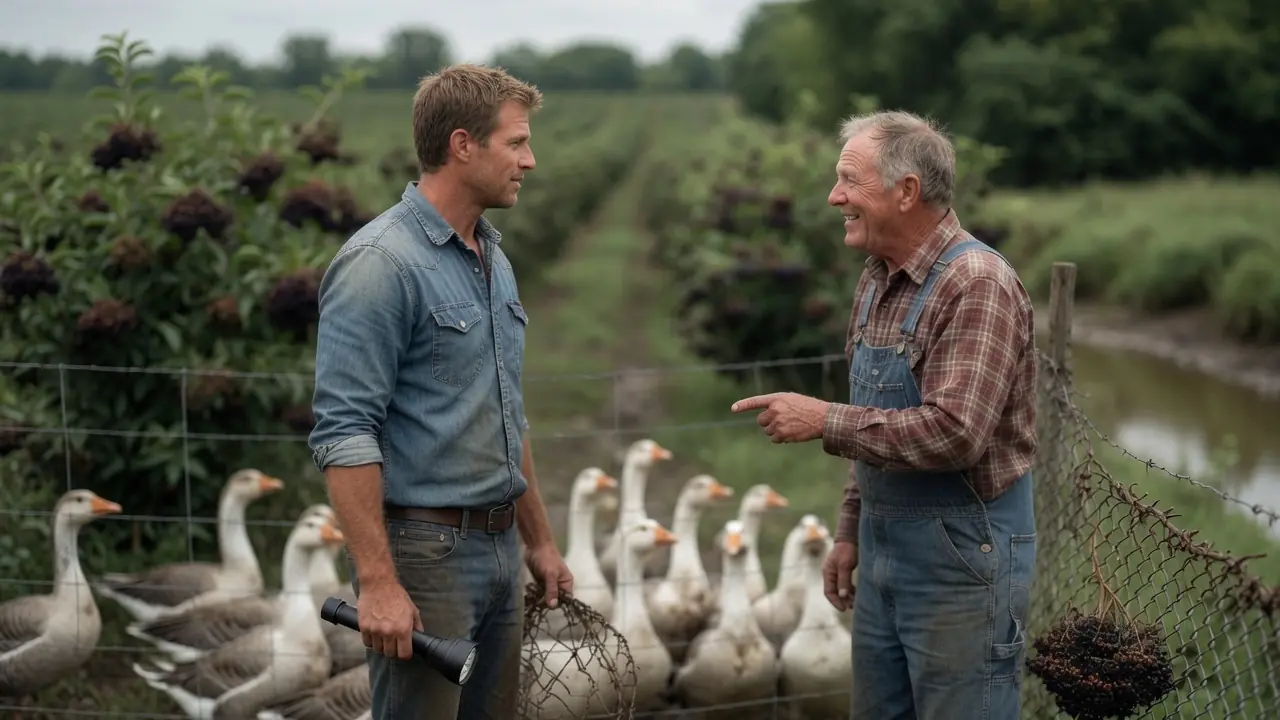
Wade looked toward the gravel road, where a sheriff’s vehicle had just turned between the fields. For the first time that morning, the older farmer’s confidence weakened. He had arrived expecting to frighten a younger man into destroying the only witnesses that could never be bribed, threatened, or persuaded to forget what they had heard.
Ethan was thirty-six years old, broad-shouldered and lean from years of fieldwork, with short dark-blond hair, blue eyes, and light stubble across a square jaw. He wore a faded denim shirt with the sleeves rolled above his forearms, dark work jeans, and mud-stained boots. Most people in Cooper County described him as handsome before they described him as stubborn, but Wade had learned that Ethan’s appearance was the least dangerous thing about him.
Three years earlier, Ethan had inherited Harper Ridge Farm after his father’s unexpected death. The property covered ninety-four acres in central Missouri, though only eighteen acres had been planted in cultivated elderberries. His father had begun growing the crop as an experiment, believing a specialized fruit could keep a smaller family farm profitable while corn and soybean margins narrowed.
The experiment had worked. A regional processing company purchased nearly every pound the Harpers could produce for syrups, extracts, and frozen ingredients. The dark-purple fruit required careful timing, however, because fully ripened clusters could be stripped by deer, raccoons, birds, or thieves within hours.
Ethan expanded the crop by six acres during his second year. He installed stronger perimeter fencing, trail cameras, and motion lights near the creek. The equipment recorded plenty of nighttime activity, but it rarely prevented damage before sunrise.
Then entire harvest crates began disappearing.
The first incident involved only four crates. Ethan assumed a worker had moved them to another cooler or mistakenly loaded them onto the wrong truck. The inventory sheets showed the berries had been weighed and tagged, yet the processor never received them.
The following season, eleven crates disappeared during the busiest week of harvest. A camera near the packing shed mysteriously lost its wireless signal for forty-three minutes, exactly when the crates vanished. Ethan blamed outdated equipment and installed a hardwired system with battery backup.
That system captured nothing useful when the theft happened again. The camera angles showed empty roads, closed gates, and undisturbed locks. Yet seven hundred pounds of premium berries disappeared from a refrigerated trailer without any visible intruder entering the property.
Ethan began sleeping in the farmhouse’s downstairs room with his boots beside the bed. He added tamper alarms, changed padlocks, and required two workers to verify every harvest load. The losses stopped briefly, then returned along the north field.
Wade Collins owned the neighboring farm and operated Collins Agricultural Storage, a licensed cooling and transport warehouse ten miles away. He had known Ethan’s father for more than twenty years and offered advice freely after the funeral. Wade repeatedly warned Ethan that specialty crops attracted unreliable workers and dishonest buyers.
“Your father understood people,” Wade said one afternoon. “You understand plants. Those aren’t the same skill.”
Ethan did not argue. Wade had more experience, stronger business connections, and contracts with several regional processors. He also controlled the nearest commercial cold-storage warehouse, making him difficult to avoid during harvest emergencies.
When the Harper refrigeration system failed one August afternoon, Wade stored twelve pallets overnight without charge. The gesture seemed generous until the processor later claimed the shipment contained several crates labeled as Collins fruit. Wade dismissed the discrepancy as a warehouse error and blamed temporary workers.
Ethan accepted the explanation, though something about Wade’s confidence stayed with him. The older farmer did not examine records or ask employees what had happened. He simply knew the mistake was harmless before anyone investigated it.
The guard-geese idea began during winter. Ethan was researching living alarm systems after discovering that motion sensors reacted constantly to wind, branches, and small animals. He read about geese recognizing routines, reacting loudly to unfamiliar movement, and gathering toward disturbances instead of merely producing random noise.
He purchased twenty young geese from a breeder and divided them into groups around the field perimeter. He kept the cameras, fences, and alarms, understanding that no single measure could protect the farm. The geese would provide immediate attention, while cameras and electronic logs would help explain what caused each alarm.
The county treated the plan as entertainment. Farmers slowed along the road to photograph the birds, while the feed-store crowd joked that Ethan should issue them badges and place one behind the steering wheel of his pickup. Wade laughed louder than anyone.
“You inherited a farm, not a petting zoo,” he told Ethan.
“They’re not pets.”
“Then what do they produce?”
“Warning.”
Wade shook his head. “Warning doesn’t pay invoices.”
The first month nearly proved him right. The geese reacted to delivery trucks, loose feed buckets, low aircraft, stray dogs, and workers carrying unfamiliar tools. Their calls woke Ethan several nights without revealing any meaningful danger.
Instead of abandoning the experiment, Ethan studied the different reactions. Routine irritation produced scattered honks while the birds continued eating. Serious alarms caused the flock to gather, raise their necks, spread their wings, and face one direction.
He adjusted the enclosures, moved them away from branches, and trained workers to avoid approaching through unrecognized paths. False alarms decreased as the geese learned the farm’s rhythm. By midsummer, Ethan could distinguish a passing truck from movement near the tree line without leaving the porch.
The first important warning came during a storm. The southern flock began calling shortly before sunset, and Ethan found a branch pressing down a section of fence. Deer tracks stopped less than twenty feet away.
Two weeks later, the creek group alerted him to a raccoon moving toward the ripening fruit. The animal turned away before reaching the rows. Ethan could not prove the birds had frightened it, but no berries were lost.
Wade stopped joking in public after that. Instead, he began questioning whether geese around food crops created contamination risks. He mentioned droppings, feathers, and disease during conversations with growers who sold to the same processor.
Ethan’s birds never entered the production rows during harvest. Their fenced zones remained along field edges, and all fruit-handling areas followed written sanitation procedures. County inspection records found no violations, but rumors spread more quickly than reports.
The processor’s quality manager called Ethan twice asking whether the birds had direct access to fruit. Ethan provided maps, photographs, testing records, and inspection documents. The manager accepted them, yet the calls made Ethan wonder who kept raising the issue.
Then he discovered Wade had applied for an exclusive elderberry supply contract with the processor. If approved, Collins Agricultural Storage would become the central collection point for several smaller farms. Independent growers like Ethan would lose direct delivery rights and become dependent on Wade’s weighing, cooling, and transportation system.
Ethan requested the processor’s proposal criteria. The contract favored suppliers with consistent volume, documented security, and no unresolved food-safety concerns. Sudden thefts or contamination rumors could make Harper Ridge appear unreliable.
The pattern changed shape. Wade might not merely be mocking the geese; he might be building a reason to remove Ethan from the market.
Ethan installed small identification transmitters inside reusable harvest crates. The devices were legal because the crates belonged to Harper Ridge, but he told only his foreman and attorney. Each transmitter recorded location and temperature without revealing itself externally.
He also replaced paper labels with serialized waterproof tags linked to weight records. The processor could scan each number and confirm where and when the fruit had been harvested. If another crate disappeared, it would carry a trail.
For three weeks, nothing happened. Harvest began, crews worked from dawn until early afternoon, and refrigerated trailers left according to schedule. Wade drove past several times but did not stop.
Then, at 1:47 on a moonless Thursday morning, every goose along the north field began screaming.
Ethan woke immediately. The sound came in sharp, synchronized bursts, the alarm pattern he had learned never to ignore. He pulled on jeans and boots, grabbed a flashlight, and drove toward the field without activating the truck’s exterior lights.
The geese crowded against the north enclosure, facing the drainage strip beside the creek. Ethan stopped behind the equipment shed and continued on foot. Through the trees, he saw two narrow beams of covered flashlights moving near the fence.
One figure cut the wire while another pulled it aside. A dark utility vehicle waited beyond the brush with its engine running. The men entered carrying empty plastic harvest crates.
Ethan did not confront them. He called the sheriff, activated the farm’s silent security alert, and began recording from behind an irrigation tank. The geese continued calling, forcing the men to move quickly.
They ignored the ripe plants and headed directly toward the refrigerated staging trailer. One produced a copied key. The other carried a roll of Collins Agricultural Storage labels.
The men removed eight Harper crates and covered the original tags with new labels. They placed empty containers inside the trailer to disguise the missing weight. Their actions showed planning, not opportunity.
Before deputies arrived, the thieves heard sirens on the county road. They abandoned two crates beside the drainage ditch and escaped through the cut fence. Their utility vehicle disappeared toward Wade’s property.
The sheriff’s department recovered footprints, tire impressions, tools, replacement labels, and the two abandoned crates. Ethan provided video showing the men’s movements, but their faces remained hidden by caps and scarves.
Wade arrived shortly after sunrise, claiming he had heard about the attempted theft through a deputy’s cousin. He examined the geese from outside the fence and suggested their noise might have caused the intruders to panic and contaminate the field.
“You need to get rid of them before the buyer hears this,” Wade said.
“The buyer needs to hear somebody entered with your company’s labels.”
“Anyone can print a label.”
“These came from a numbered commercial roll.”
Wade shrugged. “Then one of my employees lost it.”
Ethan watched him carefully. The sheriff had not told anyone about the labels. Ethan had mentioned only that intruders entered the property, yet Wade already knew the evidence could be connected to an employee.
The recovered harvest crates contained the hidden transmitters. Six stolen crates had already stopped moving inside Collins Agricultural Storage before deputies reached the farm. The location data showed they entered the warehouse at 2:11 a.m.
Sheriff Lucas Bennett secured a search warrant before noon. Wade tried to block the inspection, claiming the location signal could be inaccurate and that dozens of farms used identical containers. The warrant covered the specific crate serial numbers, temperature logs, tags, and surveillance footage from the previous twelve hours.
Inside Wade’s refrigerated warehouse, deputies found the six Harper crates stacked behind pallets bearing Collins labels. The original serialized tags had been peeled away but not destroyed. They lay inside a trash bin beneath scraps from earlier relabeling.
The warehouse contained more evidence than anyone expected. Investigators found Harper Ridge tags dating back three seasons, along with labels belonging to four other small growers. Weight sheets showed fruit entering under one farm’s name and leaving under another’s.
Wade had not simply stolen berries. He had been operating a volume-manipulation scheme.
Collins Agricultural Storage purchased lower-grade fruit at reduced prices, mixed it with premium shipments, and sold the combined load under whichever farm had the strongest quality record. When premium berries were stolen, Wade relabeled them as Collins produce and used the added volume to qualify for larger contracts.
He also changed shipment records to make competing growers appear inconsistent. Missing crates, incorrect labels, and rejected deliveries damaged their reliability scores while improving his own position.
The processor’s exclusive contract would have completed the scheme. Once every small grower depended on Wade’s warehouse, he could control weights, quality classifications, delivery records, and access to buyers. Farms that complained could be labeled unreliable or unsafe.
The sheriff did not arrest Wade immediately. Investigators needed financial records, employee statements, and proof connecting him personally to the instructions. Wade used the delay to launch a counterattack.
He called the processor and claimed the stolen crates had been delivered to his warehouse by unknown men attempting to frame him. He accused Ethan of using unapproved tracking devices in food containers and suggested the geese had contaminated the recovered berries.
Wade also sent photographs of the birds to regional buyers. He warned that Harper Ridge lacked professional biosecurity and claimed Ethan’s emotional reaction to theft made him dangerous to work with.
The processor temporarily suspended both farms pending investigation. Ethan lost access to his largest buyer during the most valuable week of harvest. More berries ripened each day while refrigerated space filled.
Wade visited the north field the following morning. He wore a clean work jacket despite the heat and carried a printed copy of the processor’s suspension notice. His expression suggested he still believed Ethan would surrender before the evidence became public.
“Kill those geese by sundown, or I’ll tell the buyer your entire harvest is contaminated,” Wade said.
Ethan stepped closer. “You don’t fear the birds—you fear they screamed when your men cut my north fence.”
“A broken wire won’t prove I stole a single berry.”
Ethan opened his hand and displayed the recovered tags. “No—but the harvest labels your men switched at 1:47 already led the sheriff to your warehouse.”
Wade’s eyes shifted toward the road. Sheriff Bennett’s vehicle approached with two state agriculture investigators behind it.
The investigators served Wade with warrants for his phone, business computer, delivery records, and financial accounts. One of his warehouse employees had begun cooperating overnight. The man admitted Wade instructed them to cut the Harper fence, remove selected crates, and leave deer tracks near the damaged wire.
The deer tracks were meant to create a believable explanation for missing fruit. Wade had used the same method before, releasing feed near vulnerable fences so animals would enter after his crew removed produce. Farmers blamed wildlife while Wade sold their harvest under another name.
The cooperating employee also revealed why Wade hated the geese. During two earlier attempts, the north flock had reacted before his men reached the field. They retreated both times, believing Ethan had installed hidden human patrols.
Wade ordered them to return only after studying Ethan’s schedule and learning he slept in the farmhouse nearly half a mile away. He assumed the geese were too far from the house to matter. At 1:47, they proved otherwise.
Phone records linked Wade to both men during the break-in. Messages instructed them to use Collins labels, take only premium crates, and enter through the drainage strip where hoofprints were common. One message read, “If the birds start, move faster. He never comes on the first alarm.”
Wade had mistaken Ethan’s early false alarms for indifference. He did not understand that the farmer had spent months learning the language of the flock.
State inspectors cleared Harper Ridge of contamination within forty-eight hours. Tests, field maps, and sanitation records confirmed that the geese remained separated from production areas. The processor restored Ethan’s contract and purchased the delayed harvest at the agreed premium price.
Collins Agricultural Storage lost its license pending a full audit. The processor canceled Wade’s exclusive-supply application and suspended every shipment associated with his warehouse. Four growers recovered records showing that their crops had been relabeled or deliberately downgraded.
The investigation expanded across five seasons of transactions. Wade had diverted nearly three hundred thousand dollars in fruit, transportation payments, and manipulated quality deductions. Some growers had nearly abandoned elderberries because they believed their yields and grades were declining.
Wade eventually faced charges connected to theft, conspiracy, fraud, evidence tampering, and falsified agricultural records. The two men who entered Ethan’s property pleaded guilty and testified against him. Collins Agricultural Storage entered court-supervised liquidation to repay affected farms.
Ethan used his portion of the settlement to build a cooperative cooling facility owned jointly by six growers. Every crate received a serialized tag at harvest, and no single farmer controlled weighing or shipment records. The system allowed buyers to trace fruit directly to each field.
The cooperative hired independent inspectors and published all handling fees. Growers who once competed quietly began comparing information before small discrepancies became large losses. Wade’s scheme had survived because each victim believed he was failing alone.
The geese remained at Harper Ridge.
Ethan reduced the flock to fourteen birds, improved their shelters, and moved water stations farther from production rows. He continued using cameras, transmitters, stronger fencing, and nightly patrols during harvest. He never claimed the birds replaced any of those systems.
They performed one job: noticing change.
A regional farm reporter visited the following summer and asked Ethan whether the geese had saved his business. The birds stood behind him near the north fence, watching the unfamiliar visitor with their necks raised.
“No,” Ethan said. “Evidence saved the farm.”
The reporter glanced toward the flock. “Then what did they do?”
“They told me when to start looking.”
That answer became more important than the dramatic version printed in local headlines. The geese did not identify Wade, understand labels, or follow stolen crates to a warehouse. They created a few critical minutes in which Ethan could observe the crime while it was happening.
Those minutes connected the cut wire to the men, the men to the crates, the crates to the tags, and the tags to Wade’s warehouse.
Months after Wade’s conviction, Ethan stood beside the repaired north fence as the elderberries darkened toward harvest. The field no longer felt vulnerable in the same way, though he knew no farm was ever completely safe.
One of the geese suddenly called. The others raised their heads but did not gather or spread their wings. Ethan listened for a moment and continued checking the fence.
A delivery truck appeared on the gravel road thirty seconds later.
Ethan smiled. He knew that sound now.
The county had once laughed because a handsome young farmer trusted a flock of loud, stubborn birds to guard a valuable crop. Wade laughed because he believed noise without human understanding was useless.
He was almost right.
The geese could not expose a thief alone. But they could wake the one man patient enough to understand what they were trying to say.
And at 1:47 in the morning, that was all the farm needed.