By the time the fourth man began recording, Caleb Turner had stopped pretending not to hear them.
He stood waist-deep in a rectangular pit cut into the wet edge of his Louisiana farm, both hands wrapped around a shovel polished bright by mud. Humid afternoon air pressed against the swamp. Tangled water oak and cypress crowded a narrow creek beyond the pit. Exposed roots twisted over black water. Reeds leaned without wind.
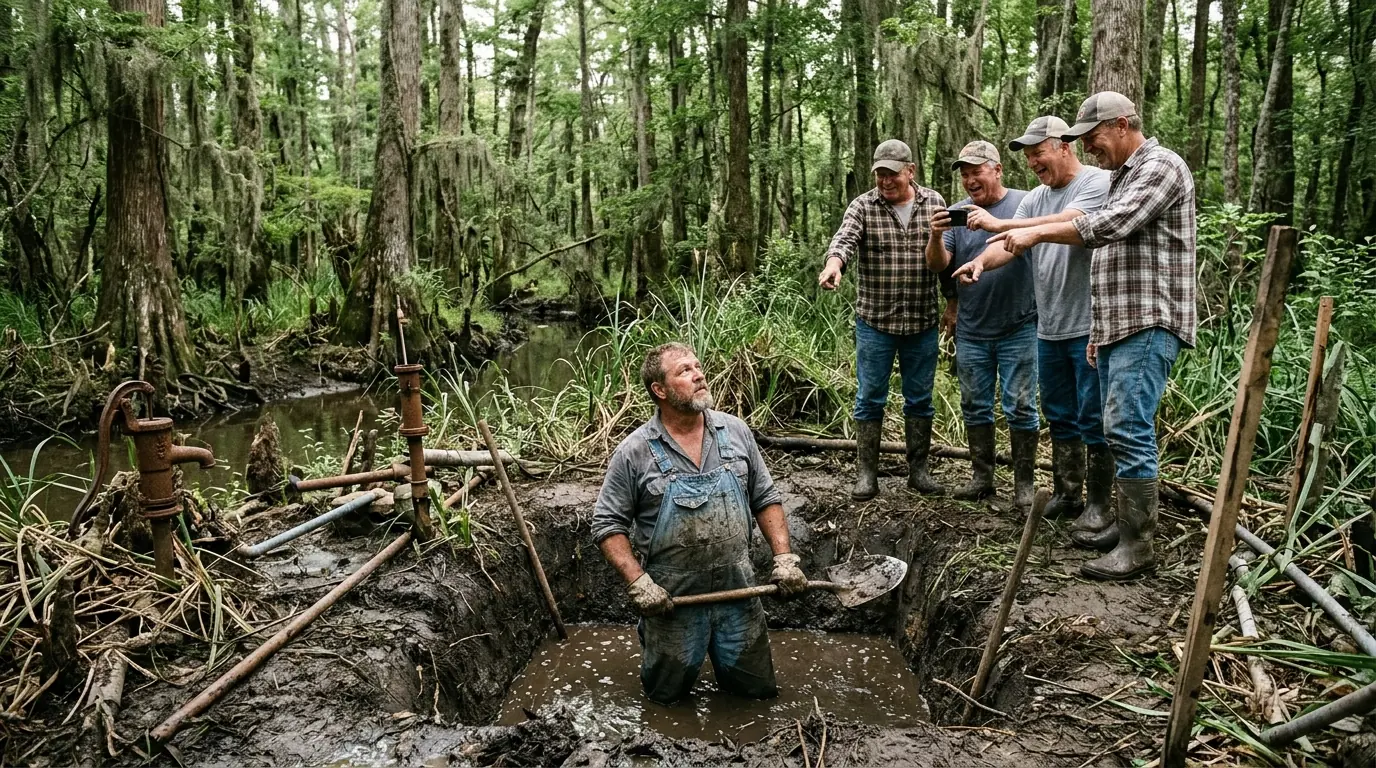
Above Caleb, four neighboring farmers lined the rim in rubber boots.
Russell Boudreaux held the phone. Dwayne Landry pointed at Caleb’s soaked overalls. The LeBlanc brothers, Curtis and Nolan, laughed loudly enough to disturb an egret downstream.
Caleb drove the shovel into heavy clay and threw another load over the edge.
Russell kicked some of it back.
“You’ve finally dug yourself a grave, Caleb!”
The loose dirt struck the wall and slid around Caleb’s boots. He looked up once, his graying beard dark with sweat and swamp water.
“Keep laughing.”
Dwayne gestured toward the field behind them. It was only twelve acres, the last ground on the Turner farm that had produced a respectable soybean crop before three seasons of flood, drought, and salt-touched water. Wooden stakes marked narrow trenches across it. Thick black pipes lay beside an old diesel pump Caleb had rebuilt from parts. To anyone arriving without explanation, the property looked as if a desperate man had begun several projects and understood none.
“You think that hole will save this farm?” Dwayne asked.
Caleb set one boot against the wall and forced the shovel beneath a dense gray band of clay.
“When I finish, every man laughing today will regret it.”
Nolan whistled. “Put that in the bank file.”
The Turner farm was already in the bank file. Forty-seven acres remained from the hundred and sixty Caleb’s grandfather bought after the Second World War. Cane gave way to soybeans, soybeans to rice, and rice to a patchwork of whatever could survive weather and prices. Caleb’s father sold land after a hurricane. Caleb mortgaged more when his wife, Marie, developed kidney disease. She died four years earlier. Hospital debt and two failed crops left the remaining acreage one bad season from foreclosure.
The pit looked exactly like the kind of decision a bank could use to justify taking it.
Caleb knew what the neighbors saw. He also knew what lay beneath the clay because he had spent eighteen months measuring water instead of arguing about it.
He leaned into the shovel. The clay lifted in a single slab, smooth on the underside. Dark water appeared through a crack no wider than a pencil.
At first it seeped.
Then the crack lengthened.
The men stopped laughing.
Caleb dropped the shovel and cleared clay with both gloved hands. Muddy water threaded through the opening, but it did not pour into the pit from the creek. Water around his boots began sliding toward the crack.
Russell lowered the phone.
A deep rushing sound grew beneath the swamp, muffled by earth and old roots.
Curtis stepped backward. “What did you hit?”
Caleb opened the passage another inch. The water at his knees turned, carrying floating leaves toward the wall. Behind him, the shallow pool in the pit dropped enough to expose a dark line on his overalls.