The cast-iron skillet struck the kitchen wall with a crash that shook dust from the rafters.
Thirteen hungry ranch hands crowded outside the open doorway, all of them suddenly too frightened to breathe. A cloud of spoiled flour drifted above the enormous wooden barrel in the middle of the room, while the dead rat Nora Mercer had pulled from it lay stiff across an old grain shovel. Beside the barrel stood Nora herself, dressed in a deep forest-green work dress and a flour-streaked beige apron, her dark hair pinned into a loose bun and her furious eyes fixed upon the man who had brought her there.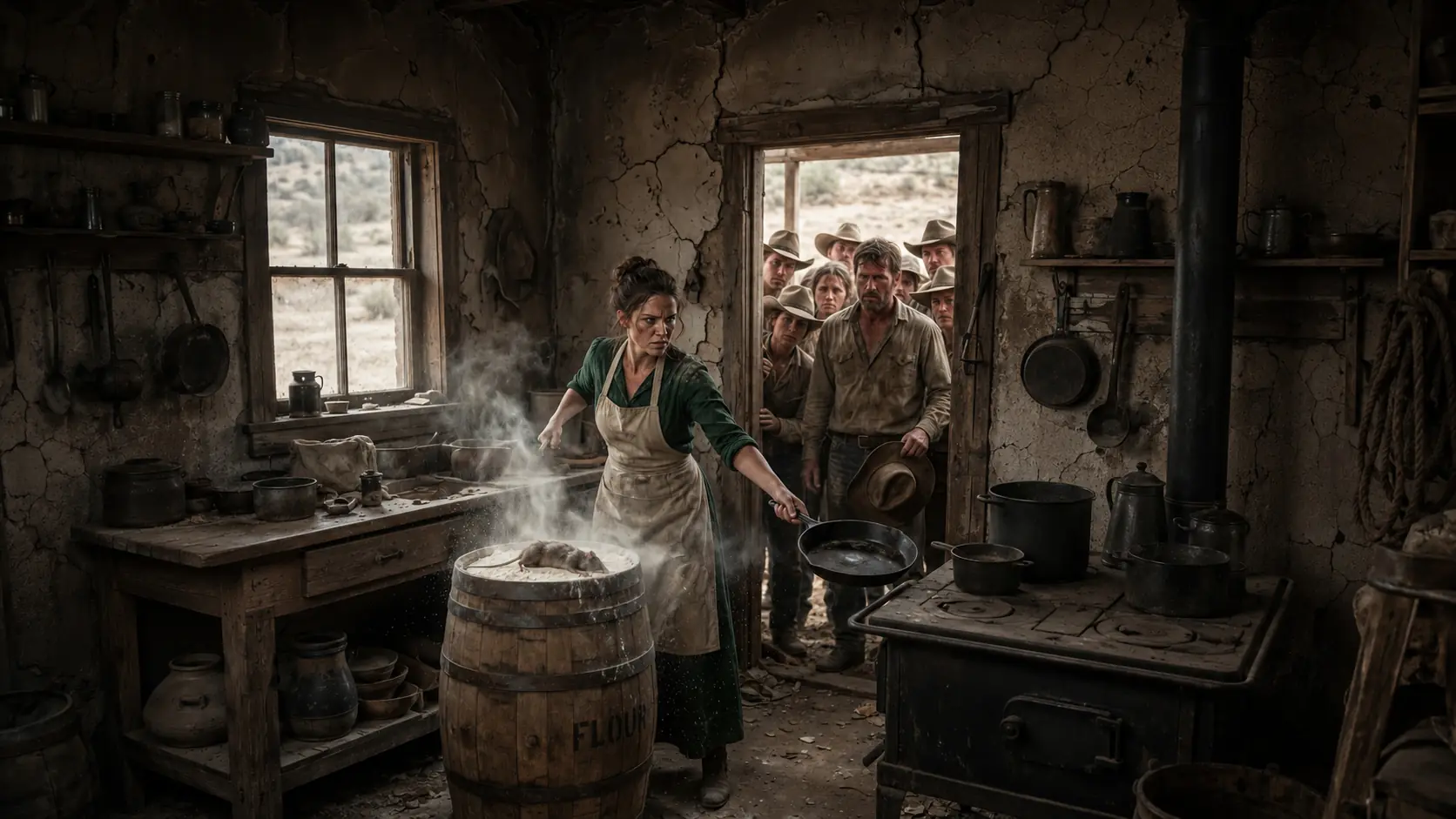
Clay Mercer remained in the doorway with his hat hanging from one hand.
At thirty-eight, Clay possessed the strong body and weathered face of a rancher who had spent years fighting drought, winter, debt, and animals determined to die at inconvenient times. Dust covered his faded shirt, and exhaustion had carved dark hollows beneath his eyes. Yet as his new wife pointed toward the contaminated flour, even he looked like a schoolboy caught lying to his teacher.
“You wanted me to feed thirteen men with this?” Nora demanded. “I found a dead rat in your flour.”
Clay’s pride reacted before his judgment could stop it. “Watch your tone, woman. This ranch stood before you came.”
“Stood?” Nora looked around the filthy kitchen. “This place is rotting, and your men look half-starved.”
One of the ranch hands shifted outside.
Nora pointed at the rat. “Get me a shovel, clear this room, and speak only if you’re ready to help.”
The order landed harder than the skillet.
Clay’s jaw tightened, but he did not shout back. He looked at the cracked shelves, the grease coating the iron stove, the empty hooks where cured meat should have hung, and the men waiting beyond the doorway. Then he picked up the grain shovel.
“Where do you want it buried?”
Nora’s anger faltered for the first time. “Far from the well.”
Clay carried the rat away.
The thirteen ranch hands immediately began retreating, each man hoping Nora might forget he existed. She stepped into the doorway before the first could escape.
“Stop.”
They froze.
Nora surveyed them one by one. Some were young, some gray-haired, and all were thinner than working men should have been. Their shirts hung loosely from their shoulders, their faces looked hollow, and the youngest among them—a freckled seventeen-year-old named Jimmy Pike—kept one protective hand over his stomach.
“Search the ranch,” Nora ordered. “Bring me every scrap of food you’ve hidden, forgotten, or stolen.”
A tall hand named Amos frowned. “Stolen?”
“Ranches do not starve overnight. First, people stop counting what they have.”
“No one’s stealing from Clay,” another man said.
Nora folded her arms. “Then you have nothing to fear from an inventory.”
The men looked toward Clay, who had returned with the empty shovel.
He gave one reluctant nod. “Do what she says.”
The search began.
Nora opened every window despite the cold morning air and ordered the men to carry the flour barrel outside. She removed the stove plates, scraped years of burned grease from the iron, and dragged every spoiled sack into the yard. Clay tried twice to help, but she sent him first for lye soap and then for fresh water, refusing to let him stand uselessly in the room simply because it belonged to him.
By noon, the kitchen floor had been scrubbed until the original boards appeared beneath the dirt.
The shelves stood empty, the stove shone black, and smoke from the fire escaped properly instead of filling the room. Nora had located three mouse holes, one broken window latch, and a gap beneath the pantry wall large enough for a fox to enter. She wrote each problem inside a small notebook she carried from Iowa.
Then the ranch hands returned.
Amos brought half a sack of pinto beans from beneath his bunk. Another man carried a smoked ham hidden inside an unused saddle chest. Someone produced six onions, two jars of peaches, a sack of shriveled potatoes, and enough dried chilies to season a month of meals.
Nora said nothing until Jimmy entered last.
The boy held an old nail keg against his chest. He placed it on the table and removed the lid, revealing nearly ten pounds of coffee beans.
“Old Walt said thieves never search where they find nails,” Jimmy explained.
Nora turned slowly. “Who was Old Walt?”
Every man looked toward Clay.
Clay set down the bucket in his hand. “He was our cook.”
“Where is he?”
No one answered.
Nora studied the uncomfortable faces around her. “Did he die?”
Jimmy lowered his eyes. “Not exactly.”
Clay moved toward the table. “Walt left three months ago.”
“Why?”
“He said he was tired.”
Amos laughed bitterly. “He said the ranch was cursed.”
Clay shot him a warning look.
Nora opened the keg and examined the coffee. The beans were old but dry, protected from dampness by the sealed wood.
“Why would a departing cook hide valuable supplies?”
Again, no one spoke.
She looked at Clay. “What are you not telling me?”
The rancher’s shoulders stiffened. “This is not the time.”
“It became the time when I found death floating in your flour.”
Clay dismissed the men with a glance.
Nora stopped them. “No. They eat here, work here, and clearly know more than I do. Whatever happened concerns all of us.”
The ranch hands remained.
Clay appeared ready to argue, but the memory of the skillet striking the wall apparently changed his mind.
“Walt accused someone of stealing provisions,” he said. “He kept saying the numbers didn’t match.”
“Were there records?”
“He refused to keep any.”
Nora touched the notebook in her apron. “Then how did he know?”
“He had cooked here twenty years. He knew what thirteen men should consume.”
“Who purchased supplies?”
“My foreman.”
“Which one is your foreman?”
Silence answered her.
Clay looked toward the empty doorway. “Russell Dane is in Billings collecting feed.”
“When does he return?”
“Tomorrow.”
Nora closed the coffee keg. “Then tomorrow, Mr. Dane and I will count everything.”
Clay shook his head. “Russell manages ranch business. You manage the kitchen.”
“The kitchen is ranch business when your workers are starving.”
“You arrived yesterday.”
“And I found more problems before noon than your foreman has admitted in months.”
Clay stepped closer. “Be careful, Nora.”
She looked directly into his eyes. “Is that a warning from my husband or an order from my employer?”
The question silenced him.
Their marriage had begun through letters exchanged by a respectable matrimonial agency in Iowa. Clay wrote that he owned a Montana cattle ranch, needed a capable wife, and could offer honest work, a private home, and mutual respect. Nora replied that she was not delicate, decorative, or interested in a man who expected obedience without partnership.
His letters had been blunt but never cruel.
He told her the ranch struggled after two hard winters. He did not tell her the kitchen was crawling with vermin, the workers were starving, or the house roof leaked above their bedroom.
Nora had expected hardship.
She had not expected concealment.
Clay lowered his voice. “It was not an order.”
“Good.”
“What will you feed them?”
Nora looked at the rescued supplies.
“Beans, fried potatoes, ham gravy, and cornbread without rat.”
A few men smiled.
She pointed toward them. “No one eats until every hand is washed.”
Their smiles vanished.
By sunset, the scent of roasting chilies and hot cornmeal filled the ranch house. Nora soaked the driest beans near the stove, fried the potatoes with onions and small pieces of ham, then stretched the remaining fat into rich gravy. She ground corn from the chicken stores after confirming the kernels were clean and mixed it with sour milk, salt, and two eggs discovered beneath a brooding hen.
The skillet she had thrown against the wall went into the oven last.
When Nora placed it on the long table, the thirteen men stared at the golden bread as though she had created it from stones. She cut equal portions, then added a slightly larger piece to Jimmy’s plate because he was still growing. No one complained about the beans or the limited meat.
Clay remained standing near the wall.
Nora noticed. “Sit.”
“There are only thirteen chairs.”
She looked around.
The ranch hands counted themselves. Someone began to rise, but Clay stopped him.
“I’ll eat later.”
Nora carried her own plate to the table, then pushed the reinforced bench sideways. “There is room.”
Clay sat beside her.
It was their first shared meal as husband and wife.
The men ate with such concentration that almost no one spoke. Jimmy finished his first piece of cornbread and looked hopefully toward the skillet, but lowered his eyes when he saw only three portions remaining.
Nora placed another piece on his plate.
“Thank you, ma’am.”
“Tomorrow you help me repair the pantry.”
His face fell.
“You thought the bread was free?”
The men laughed, and this time Nora allowed herself a small smile.
Clay watched her throughout the meal.
She felt his gaze and finally turned. “What?”
“You fed fourteen people from what they had hidden.”
“Fifteen.”
“I did not see you eat.”
Nora looked down at her plate. She had served herself beans and potatoes but no bread.
Clay lifted the last piece from the skillet and placed it before her.
The gesture was quiet enough that no ranch hand commented.
Nora ate it slowly.
Russell Dane returned the following afternoon.
The foreman was a thick-waisted man in his late forties with a red beard, expensive boots, and a heavy coat better suited to a wealthy cattle buyer than a failing ranch employee. He rode into the yard beside a wagon carrying grain, flour, coffee, salt pork, and several barrels supposedly purchased in Billings.
Nora stood near the kitchen steps with her notebook.
Russell dismounted and looked her over. “You must be the bride.”
“You must be the man who buys rotten flour.”
His welcoming smile vanished.
Clay approached from the corral. “Russell, this is Nora.”
“So I gathered.”
Nora walked to the supply wagon and examined the first flour sack. The cloth was stamped with a mill date nearly two years old. Another sack showed water stains along the lower seam.
“How much did this cost?”
Russell frowned. “Ranch accounts are not women’s concern.”
“Then answer the ranch owner.”
Clay looked at the foreman. “How much?”
“Standard price.”
“That is not a number,” Nora said.
Russell climbed into the wagon and retrieved a folded receipt. Nora reached for it, but he handed it directly to Clay.
She read over her husband’s shoulder.
The amount listed could have purchased twice the supplies present.
Nora opened a barrel marked salt pork. Inside were spoiled scraps packed beneath a thin layer of acceptable meat.
Russell’s face darkened. “You calling me dishonest?”
“I’m calling this rancid.”
“The men have eaten worse.”
“Which explains why they look starved.”
Clay lifted one of the coffee sacks. It contained barely half the weight listed on the receipt.
“Russell?”
The foreman’s hand moved near his belt. “Someone at the supplier cheated us.”
“Which supplier?” Nora asked.
“Dawson Mercantile.”
“Then we will return everything.”
Russell stepped closer. “You’re not taking this wagon anywhere.”
Nora did not move. “Why?”
“Because I said so.”
The ranch hands had begun gathering around them.
Clay’s voice became cold. “You do not speak to my wife that way.”
Russell looked at him. “You married a stranger and now you’ll let her accuse the man who kept this ranch alive?”
Nora glanced toward the hungry workers. “You did not keep them alive. They kept themselves alive by hiding food from your accounts.”
Russell’s eyes moved toward Jimmy.
The boy stepped behind Amos.
Nora saw the reaction.
“You knew about the coffee keg.”
Russell lunged toward her notebook.
Clay caught his wrist.
The two men stood chest to chest.
“Let go,” Russell said.
Clay tightened his grip. “Step away from her.”
Russell smiled without humor. “You need me.”
“No.”
“This ranch falls apart without me.”
“It was already falling apart with you.”
Clay removed the foreman’s revolver before releasing him.
Nora opened her notebook.
During the previous evening, she recorded every recovered item and compared their probable use with the quantities Clay claimed to purchase each month. The missing food was too consistent to be accidental. Russell had been ordering full loads, delivering partial supplies, and keeping the difference.
Old Walt had discovered it.
“What happened to the former cook?” Nora asked.
Russell spat into the dirt. “He left.”
“Did he?”
The foreman’s expression hardened.
Jimmy spoke from behind Amos. “I saw blood by the smokehouse.”
Every head turned toward him.
The boy trembled but continued. “The night Walt disappeared. Russell said a steer cut itself.”
Amos looked at the foreman. “There wasn’t an injured steer.”
Russell reached for the weapon that was no longer there.
Clay raised the revolver.
“Where is Walt?”
The foreman ran.
He made it three steps before Amos and two other ranch hands tackled him into the mud.
The search began before darkness.
They found Walt’s body beneath a shallow layer of dirt near the dry creek bed, wrapped inside a ruined feed tarp. His skull had been fractured, and one hand still clutched a torn piece of paper listing supply amounts and dates.
Russell had not merely stolen from the ranch.
He had killed the man who noticed.
The county sheriff arrested him the following morning. A search of his room revealed money, forged receipts, several ranch deeds, and letters proving he had been working with Preston Hale, Clay’s largest creditor.
Hale intended to purchase the Mercer Ranch after its collapse.
Russell’s task was to accelerate the process.
He stole food, ordered spoiled supplies, sold healthy cattle secretly, and allowed equipment to deteriorate. Hungry workers became weak and careless. Injured animals went untreated. Clay borrowed more money each month while believing winter alone was destroying him.
Old Walt discovered the scheme.
Russell silenced him.
Clay stood beside the creek after the sheriff removed the body. Snow had begun to fall in small, dry flakes.
Nora approached but did not touch him.
“I should have listened,” he said.
“To Walt?”
“To everyone.”
“Did anyone else speak?”
“Men complained about food. I thought they were ungrateful. Walt accused Russell without proof, and Russell said he was drinking.”
“You trusted the wrong man.”
“I wanted to.”
“Why?”
“Because admitting he betrayed me meant admitting I failed to see what happened beneath my own roof.”
Nora looked toward the ranch house.
“I arrived and found a dead rat.”
Clay gave a bitter laugh.
She continued. “You looked at the rat and saw shame. I looked at it and saw evidence.”
“What is the difference?”
“Shame tells you to hide something. Evidence tells you where to begin.”
Clay finally faced her.
“Why did you stay?”
“I haven’t decided that I will.”
The answer hurt him, but she refused to soften it.
Their marriage existed legally, yet trust could not be created through a stagecoach journey and signed letters. Clay had promised honesty while concealing how close the ranch stood to ruin. Nora had a right to leave after her thirty-day trial, taking her full wages and returning to Iowa.
Clay nodded. “You should decide freely.”
“I intend to.”
“What do you need from me?”
“The truth. Even when it makes you look weak.”
He looked toward the house where thirteen men waited for their next meal.
“You will have it.”
Nora spent the next month rebuilding the ranch’s provisions while Clay rebuilt everything around them.
They returned Russell’s spoiled supplies to Dawson Mercantile and exposed the forged receipts. The store owner, horrified that his business name had been used, replaced the entire order without charge. Nora purchased sealed grain bins, repaired the pantry, and created a ledger recording every pound of flour, beans, coffee, meat, and sugar.
No person removed food without marking it down.
She assigned each ranch hand one kitchen duty every week. Amos carried water, Jimmy tended the chickens, and two men who mocked washing dishes learned that Nora possessed no hesitation about handing them scrub brushes.
The ranch grew cleaner.
Then it grew stronger.
Nora discovered a neglected smokehouse, twenty bushels of potatoes hidden beneath straw, and an orchard that could produce preserves if properly pruned. She sold extra pies and cornbread in town, using the money to purchase medicine and seed.
Clay stopped making decisions alone.
Each evening, he placed the ranch accounts on the kitchen table and reviewed them with her. At first, he struggled to admit what he did not know. Eventually, he began asking her opinion before pride could interfere.
Nora’s thirty-day trial ended during a March snowstorm.
Clay found her packing the same traveling trunk she brought from Iowa.
He stopped in the bedroom doorway.
“You’re leaving.”
“I’m moving.”
His face became still.
Nora closed the trunk and pointed toward the larger room across the hallway. “The roof above this room leaks, and I’m tired of waking with snow on my pillow.”
Clay exhaled.
She almost smiled. “Did you think I was returning to Iowa?”
“I thought you had every reason.”
“I do.”
“Then why stay?”
Nora looked at the man before her.
Clay remained proud, stubborn, and sometimes infuriating. Yet he had buried Walt with dignity, testified against Russell, worked beside his men, and confessed every debt without hiding a single number. More importantly, he no longer referred to the ranch as his whenever discussing their future.
He called it ours.
“I have work here,” she said.
“Only work?”
“Do not become greedy.”
His mouth lifted faintly. “I married a woman who threw iron at my wall. I learned caution.”
“I missed you deliberately.”
“I know.”
“You did not flinch.”
“I was afraid moving would make you correct your aim.”
She laughed.
Clay crossed the room but stopped before touching her.
“I wrote the agency because I needed a capable wife,” he said. “That was the truth, but not all of it.”
“What else?”
“I needed someone who would not disappear when the ranch became difficult.”
“You should not ask a wife to endure what you refuse to repair.”
“I know that now.”
“What are you asking?”
Clay’s voice softened. “Stay because you choose this life. Not because a paper says you belong to me.”
Nora studied him.
“And if I choose it?”
“Then I spend the rest of my life proving I deserve the choice.”
She closed the distance and placed one flour-dusted hand against his cheek.
“You may begin by fixing the roof.”
Clay kissed her.
It was not the formal kiss they exchanged after their hurried wedding ceremony in Billings. That kiss had belonged to two strangers honoring a contract. This one belonged to two tired people standing inside a damaged house they had decided to rebuild together.
Spring came slowly to Montana.
Grass returned first along the creek, followed by small flowers beneath the fences. The surviving cattle gained weight, and the ranch hands regained color in their faces. Nora expanded the garden, planted herbs beside the kitchen, and converted Russell’s former room into a storehouse.
The ranch’s first profitable cattle sale in two years occurred that autumn.
Clay placed the payment ledger before Nora.
“After debts and wages, we have three hundred and twelve dollars.”
She checked his arithmetic.
“Three hundred and fourteen.”
“I knew that.”
“You wrote twelve.”
“My handwriting is artistic.”
“Your handwriting is dishonest.”
Clay leaned against the table. “What should we buy?”
“A new roof.”
“Anything less sensible?”
“Two milk cows.”
“Anything for yourself?”
Nora looked toward the cast-iron skillet hanging above the stove.
“I already brought what I needed.”
During the celebration dinner, thirteen ranch hands gathered around the long table. There was beef stew, roasted potatoes, jars of peaches, fresh biscuits, and a large skillet of cornbread in the center.
Jimmy, now eighteen and no longer painfully thin, stood to make a toast.
“To Mrs. Mercer,” he said, raising his cup. “Who came here, found a rat, and decided we were worth more trouble than leaving.”
The men lifted their cups.
Nora shook her head. “I stayed because none of you knew how to wash a pan properly.”
Amos laughed. “Whatever helps you sleep, ma’am.”
Clay stood last.
He looked around the table, then at Nora.
“To my wife, who found this ranch dying and refused to treat death as normal.”
The room fell quiet.
Nora’s eyes moved toward the repaired wall where her skillet had struck months earlier. Clay had replaced the broken board but left a small iron mark visible near the stove.
She had asked why.
“Because that was the moment the ranch began getting better,” he told her.
The men drank.
Years later, visitors to Mercer Ranch often heard the story incorrectly. Some said Nora discovered the dead rat, became furious, and saved the ranch through cooking alone. Others claimed Clay’s love transformed an angry mail-order bride into a devoted frontier wife.
Nora corrected both versions.
Food had not saved the ranch by itself.
Attention had.
The rat revealed neglect. The hidden coffee revealed fear. The missing supplies revealed theft. Walt’s records revealed murder, and the hunger of thirteen men revealed how long everyone had accepted suffering because they believed survival required silence.
Nora did not rescue Clay by becoming obedient.
She rescued the ranch by refusing to be.
Clay did not win her love by offering protection.
He earned it by learning to stand beside her instead of above her.
The skillet remained in Nora’s kitchen for the rest of her life. Its handle grew smoother, its surface darker, and its bottom carried a shallow scar from striking the wall. She used it to bake thousands of loaves of cornbread for ranch hands, children, travelers, and neighbors who arrived hungry.
Whenever someone asked whether she regretted throwing it, Nora gave the same answer.
“I did not throw it at my husband.”
Clay, listening nearby, would add, “Only because she knew the wall needed fixing first.”
Then Nora would place another golden skillet of bread on the table, and the rancher who had once told her to watch her tone would quietly move aside—because he had learned that when Nora Mercer took command of a kitchen, a household, or a dying ranch, wise men gave her room to work.