“Hey, who let you into this room? This floor is for executives, not some dressed-up nobody wandering in for attention.”
Victor Lang’s fist tightened around the collar of Marcus Cole’s ivory-white suit. The newly promoted regional manager stood inches from Marcus’s face, his voice echoing through the glass-walled boardroom of Grand Meridian Hospitality. Around the long walnut table, six employees watched in stunned silence.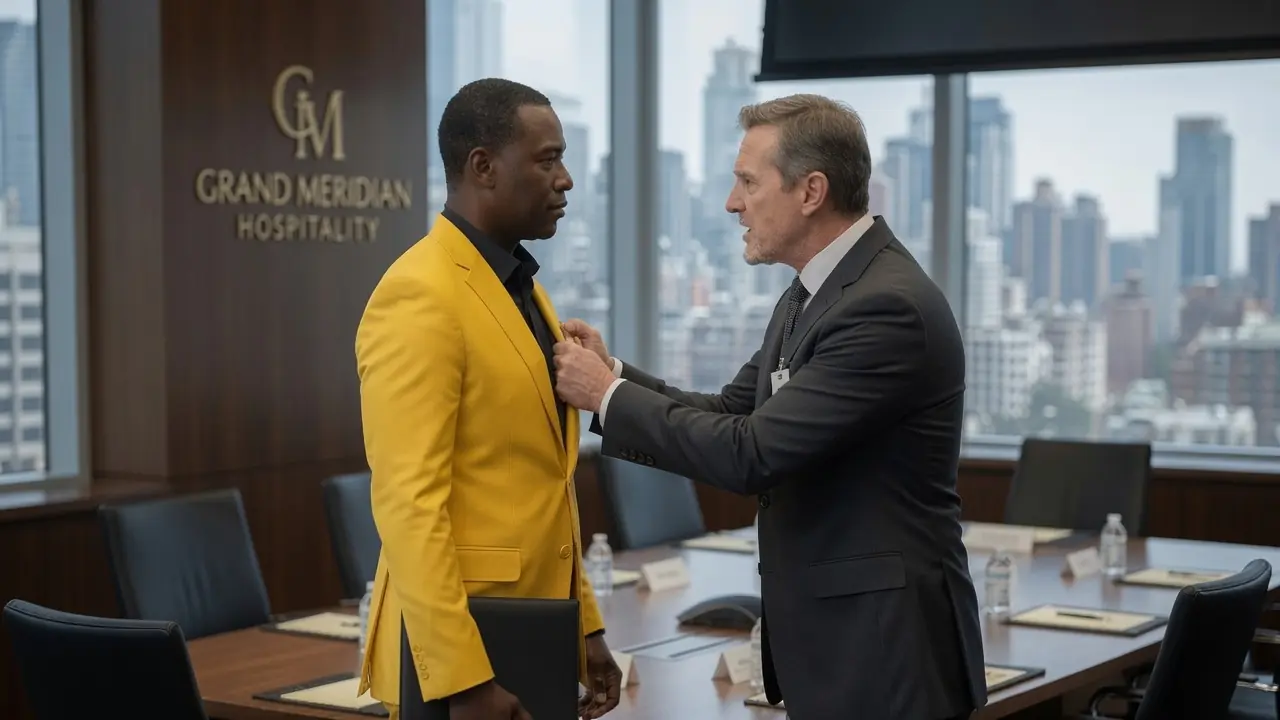
Marcus did not raise his voice.
“Remove your hand before your new position ends in it.”
Victor shoved him backward hard enough to crease the expensive fabric. “I’ll have security throw you onto the street before the real CEO sees this pathetic costume.”
Marcus calmly lifted the slim black portfolio he had been carrying. “The real CEO is holding your promotion contract—and deciding whether to tear it in half.”
Victor’s hand loosened.
For a moment, the only sound in the room was the distant traffic moving forty floors below. Chicago’s skyline stretched beyond the floor-to-ceiling windows, bright and indifferent, while the gold letters of GRAND MERIDIAN HOSPITALITY reflected across the polished wall.
Victor looked at Marcus, then at the portfolio.
“You’re not the CEO.”
Marcus straightened the collar of his suit. “That is the first fact you should have verified before putting your hands on me.”
Victor laughed, though the sound lacked confidence. He turned toward the others, expecting someone to support him, but every person at the table had suddenly become fascinated by the folders in front of them.
Only one woman met Marcus’s eyes.
Her name was Elena Ruiz, director of property operations. She had stood halfway from her chair when Victor grabbed him, but a warning glance from Victor had stopped her. Now regret was visible across her face.
Victor pointed toward the door. “I don’t know what game you’re playing, but this meeting is confidential.”
“So was your evaluation.”
“What evaluation?”
Marcus placed the portfolio on the table.
Victor’s name appeared across the first page.
The document was not merely an employment agreement. It was the final executive authorization for Victor’s promotion from general manager of one hotel to regional vice president overseeing eleven Grand Meridian properties.
The signature line at the bottom remained blank.
Marcus’s signature line.
Victor stared at it.
“You could have printed that anywhere.”
Marcus pressed a button on the conference-room control panel. The large presentation screen behind them came to life, displaying the company’s secure executive portal.
A biometric verification request appeared.
Marcus placed his thumb on the reader built into the table.
The screen flashed green.
MARCUS COLE
FOUNDER, CHAIRMAN, AND CHIEF EXECUTIVE OFFICER
GRAND MERIDIAN HOSPITALITY GROUP
Victor’s face emptied of color.
Marcus Cole had founded Grand Meridian eighteen years earlier with one neglected hotel near Detroit’s airport. He had grown the company slowly, purchasing failing properties that larger corporations considered worthless and rebuilding them through disciplined management and careful investment.
Grand Meridian now controlled thirty-eight hotels, six conference centers, and three luxury resort developments.
Yet Marcus rarely appeared in public.
He avoided magazine profiles, delegated most media interviews, and permitted the company website to display only a simple black-and-white photograph taken nearly a decade earlier. He preferred employees to follow standards rather than a personality.
That privacy had created the perfect test.
Victor Lang had been recommended for promotion by two senior executives who described him as decisive, profitable, and commanding. Under his leadership, the Grand Meridian Lakeshore had increased revenue by twenty-two percent in eighteen months.
But the complaints had also increased.
Junior staff described Victor as humiliating, dismissive, and obsessed with status. Several Black employees said he assumed they belonged to housekeeping or maintenance, even when they wore management badges. Female supervisors reported being interrupted during meetings and later hearing their ideas repeated by Victor as his own.
Each complaint had been closed by Victor’s regional supervisor.
No clear violation.
Insufficient evidence.
Leadership style misunderstood.
Marcus did not trust the summaries.
He had decided to attend Victor’s final promotion meeting without an entourage, executive badge, or formal introduction. The white suit was deliberate—distinctive enough to attract attention, but not proof of authority.
Marcus wanted to see how Victor treated a man whose title he did not know.
The answer had arrived in less than two minutes.
Victor stepped away from him.
“Mr. Cole, I sincerely apologize.”
Marcus looked at the hand that had gripped his collar.
“For which part?”
“The misunderstanding.”
“There was no misunderstanding.”
Victor swallowed. “I believed you were unauthorized.”
“You did not ask my name.”
“I was protecting a confidential executive meeting.”
“You did not request identification.”
Victor’s mouth opened, but Marcus continued.
“You insulted my clothes, called me a nobody, threatened to have me thrown into the street, and physically grabbed me.”
“I reacted too quickly.”
“You reacted exactly as you wanted to.”
Victor glanced toward the boardroom table.
Elena lowered her eyes.
Two hotel directors had been laughing with Victor moments before Marcus entered. Their expressions were now rigid with fear.
Victor attempted to regain control. “With respect, sir, you entered without introducing yourself.”
Marcus’s gaze hardened. “Does every unidentified person in this building get assaulted?”
“No.”
“Then why did I?”
Victor’s silence answered more clearly than words could.
Marcus picked up the promotion contract.
Victor watched his fingers move toward the corner of the document.
“Please,” he said. “My performance record speaks for itself.”
Marcus paused.
“It does.”
Hope entered Victor’s face.
Marcus opened a second folder.
Inside were employee turnover reports, anonymous complaints, security summaries, and exit interviews collected from the Lakeshore property.
“Your hotel produced excellent financial numbers,” Marcus said. “It also lost forty-one employees in fourteen months.”
“Hospitality has high turnover.”
“Not entirely from one department.”
“Some employees cannot handle demanding standards.”
Marcus read from a statement.
“‘Mr. Lang called me room service during a management presentation and laughed when I corrected him.’”
Victor looked around the room.
Marcus read another.
“‘He told me guests would trust me more if I changed my natural hair.’”
“That comment has been misrepresented.”
Another page.
“‘After I reported him, my schedule was changed from daytime supervision to overnight inventory.’”
Victor’s jaw tightened. “Disgruntled employees say things.”
“Forty-one disgruntled employees?”
“You cannot build a luxury brand by protecting weak workers from criticism.”
Marcus closed the folder.
“Leadership is not measured by how confidently you humiliate people who cannot challenge you.”
Victor gestured toward the financial reports on the table. “I transformed the Lakeshore property.”
“You improved its profit.”
“That is the purpose of business.”
“It is one purpose.”
Marcus looked toward the skyline before turning back.
“A profitable hotel built on fear is not successful. It is merely waiting for the cost to appear.”
Victor’s expression hardened again.
The apology had failed, so resentment returned.
“You had already decided against me before entering this room.”
“No.”
“You came here disguised.”
“I wore a suit.”
“You concealed your identity.”
“I entered my own boardroom and waited to see whether you would ask who I was.”
Victor pointed toward the screen. “This was a trap.”
“A trap requires someone else to create the misconduct.”
Marcus stepped closer.
“I did not put your hand on my collar.”
Victor’s breathing became heavier.
The boardroom door opened.
Chief Legal Officer Miriam Shaw entered with corporate security director Anthony Bell and board vice chair Lena Park. They had been watching the meeting through the secure internal camera after Marcus activated a silent signal on his watch.
Miriam looked first at Marcus’s creased collar.
“Were you injured?”
“No.”
“Did Mr. Lang make physical contact?”
“He grabbed and shoved me.”
Victor lifted both hands. “I was removing an unauthorized intruder.”
Anthony’s expression remained flat. “You are not authorized to physically remove anyone.”
“I believed he was a security threat.”
Marcus held up the black portfolio. “I was carrying a folder.”
Victor looked toward the table for support.
“Elena, tell them. He walked in without saying anything.”
Every face turned toward her.
Elena stood slowly.
“He entered quietly and sat near the end of the table.”
Victor nodded rapidly. “Exactly.”
Elena continued. “I asked whether he was joining the meeting. Before he could answer, Victor came in and started shouting.”
Victor’s eyes narrowed.
“You never asked him to identify himself?” Miriam asked.
“No,” Elena replied. “Victor assumed he did not belong.”
“Did anyone attempt to intervene?”
Elena’s face tightened. “I started to.”
“But you stopped.”
“Yes.”
“Why?”
She looked at Victor.
“Because he has punished employees for embarrassing him.”
Victor turned toward her. “That is a lie.”
Elena flinched, then forced herself to continue.
“He removes people from projects, changes schedules, and excludes them from leadership meetings. Everyone knows it.”
One of the hotel directors finally spoke.
“She’s right.”
Victor stared at him.
The man’s voice trembled, but he continued. “At Lakeshore, managers learned not to disagree with him publicly.”
Another employee nodded.
Victor looked from one person to another as the room he had controlled began rejecting him.
“You cowards,” he said. “You laughed with me five minutes ago.”
Marcus turned toward them.
“That is also true.”
The employees lowered their eyes.
Marcus did not intend to pretend that Victor alone had created the scene. His cruelty had been encouraged by people who laughed because they believed the target lacked power.
“Everyone who participated will be interviewed,” Marcus said. “Silence and laughter have consequences too.”
Victor gave a bitter smile.
“So now everyone loses their career because the CEO’s feelings were hurt?”
Marcus studied him.
“My feelings are not the issue.”
“You were embarrassed.”
“I was informed.”
Marcus pointed toward the folders.
“You revealed what these employees had been trying to report for more than a year.”
Miriam placed a formal suspension notice on the table.
“Victor Lang, effective immediately, your managerial authority, building access, and company system privileges are suspended pending investigation.”
Victor did not touch the paper.
“You cannot suspend me before the board votes.”
Lena Park answered. “The promotion committee has not approved your new position.”
Victor glanced toward the unsigned contract.
His promotion had never officially begun.
Marcus picked it up and tore it once through the center.
The sound was quieter than everyone expected.
It still seemed to fill the entire room.
“Now it never will,” Marcus said.
Victor stared at the separated pages.
“I gave this company twelve years.”
“You were paid for twelve years of work.”
“I sacrificed everything for that hotel.”
“And expected everyone below you to sacrifice their dignity.”
Victor’s voice rose. “You think you built this company alone?”
“No.”
Marcus looked around the boardroom.
“That is why I refuse to promote a man who treats most of the people who built it as disposable.”
Anthony requested Victor’s executive badge.
He hesitated.
The badge had been issued that morning, even though the promotion remained subject to final approval. Victor had worn it into the room like a medal, showing it to every employee he passed.
Now he unclipped it slowly.
Before handing it over, he looked at Marcus’s white suit.
“I truly did not know who you were.”
Marcus accepted the badge.
“That is the point.”
Victor was escorted to his office to collect personal belongings under supervision. Marcus refused to let security parade him through the lobby. Accountability did not require public humiliation.
But Victor would not return to the boardroom.
After he left, Marcus remained standing near the long table.
The employees waited for him to speak.
“You laughed,” he said to the two directors.
Neither denied it.
One finally answered. “I thought Victor knew him.”
“Knew what?”
“That you were not supposed to be here.”
Marcus stepped toward him. “And the insult about my clothes?”
The director looked down.
“I shouldn’t have laughed.”
“You laughed because you thought I had no authority.”
“Yes.”
“That is not the same as thinking the joke was funny.”
The man’s face reddened.
Marcus turned toward Elena.
“You wanted to intervene.”
“I did.”
“But you didn’t.”
“No.”
“Why should I trust you with operations affecting thousands of employees if fear prevents you from speaking when one person is being mistreated five feet away?”
Elena absorbed the question without defending herself.
“You shouldn’t trust me yet,” she said.
Marcus’s expression softened slightly.
It was the first fully honest answer anyone had offered.
The investigation began that afternoon.
Victor’s emails, messages, performance reviews, scheduling decisions, and complaint records were preserved. Investigators interviewed current staff and contacted former employees who had left the Lakeshore hotel during his tenure.
The results were worse than Marcus expected.
Victor had created an informal hierarchy based on how useful employees appeared to his ambition. Those connected to wealthy guests, senior executives, or luxury partnerships received praise and access.
Housekeepers, maintenance workers, drivers, servers, and junior managers were treated as replaceable.
One supervisor reported that Victor refused to learn the names of cleaning staff despite working beside them for years. He called every Black male security employee “Marcus” until one complained, after which Victor moved him to overnight parking duty.
A young concierge named Jamal Brooks described entering an executive dining room to deliver confidential guest documents. Victor assumed he was a waiter, ordered him to clear dishes, and later laughed when Jamal explained his actual position.
The incident appeared in no official record.
Victor’s supervisor had told Jamal not to “turn an awkward moment into a racial issue.”
Another complaint came from Angela Tran, former director of guest experience. Victor had repeatedly interrupted her during budget meetings, then presented her proposals to executives without credit.
When she challenged him, he removed her from the regional development project that would have qualified her for promotion.
She resigned three weeks later.
Financial success had protected Victor from consequences.
Each time someone complained, senior leaders pointed toward improving occupancy rates and guest spending. They called him difficult but effective.
Marcus hated the phrase.
Cruelty often survived inside companies because effectiveness was measured narrowly enough to exclude the people being damaged.
The investigation also reached beyond Victor.
His regional supervisor had closed seven complaints without interviewing witnesses. Human resources staff altered language in two reports, replacing “racial insult” with “communication conflict.”
Three executives knew Victor’s promotion file contained unresolved concerns and chose not to mention them during committee review.
All faced disciplinary hearings.
Victor appeared before the conduct committee six weeks later with an attorney and a prepared statement.
He apologized for grabbing Marcus but insisted the contact had been brief and motivated by security concerns. He described himself as demanding, not discriminatory, and argued that former employees were exploiting the CEO incident to settle personal grievances.
Marcus listened without interrupting.
Victor’s attorney presented charts showing revenue growth, improved guest satisfaction, and reduced operating costs.
When the presentation ended, Marcus placed one photograph on the screen.
It showed Victor gripping his collar.
“Why did you touch me?” Marcus asked.
“I believed you were unauthorized.”
“Why did you call me a dressed-up nobody?”
Victor paused. “Poor choice of words.”
“Why did you say security would throw me into the street?”
“I was angry.”
“Why were you angry?”
“Because you challenged my authority.”
Marcus nodded.
“That is the answer.”
Victor frowned.
Marcus continued. “You believed authority entitled you to contempt. When I did not obey immediately, you escalated from insult to physical force.”
“That interpretation ignores context.”
“The context is worse.”
Marcus displayed another image from security footage.
Elena was shown rising from her chair while Victor glared at her.
“You did not only attack the person you assumed lacked power. You used fear to prevent others from helping.”
Victor’s attorney objected to the language.
Marcus did not withdraw it.
“You built obedience,” he said. “Not leadership.”
Victor’s employment was terminated for physical aggression, discriminatory conduct, retaliation, manipulation of complaints, and abuse of authority.
His regional supervisor was also dismissed.
The executives who concealed the complaints lost their positions on the promotion committee, while the human resources department was placed under independent review.
Elena received a formal warning for failing to intervene.
She also received something unexpected.
Marcus asked her to lead a six-month project rebuilding the company’s internal reporting system.
She initially refused.
“You said I wasn’t ready to be trusted.”
“I said not yet.”
“I failed in that room.”
“Yes.”
“Then why give me authority?”
“Because when questioned, you admitted the failure without protecting yourself.”
Marcus placed the project file before her.
“Courage is not proven by claiming you never felt fear. It is proven by what you do after fear exposes you.”
Elena accepted.
Grand Meridian created a reporting channel outside hotel management. Employees could report harassment, discrimination, and retaliation directly to an independent ethics office.
Managers were prohibited from changing a complainant’s schedule, assignment, or evaluation without outside approval during an active investigation.
Promotion committees were required to review employee turnover, internal complaints, and exit interviews—not only profit and guest-revenue figures.
Marcus added another rule personally.
Any executive candidate who treated service employees as invisible would be removed from consideration.
Several board members called the standard subjective.
Marcus disagreed.
“How someone treats a person who cannot advance their career is one of the clearest measurements we have.”
Months later, Marcus returned to the same boardroom.
This time, he wore a navy suit and his executive badge. Elena sat at the table with housekeepers, property directors, chefs, security officers, and maintenance supervisors from multiple hotels.
The meeting concerned the new reporting system.
Before beginning, Marcus stood beside the chair where Victor had grabbed him.
The memory no longer angered him in the same way.
Victor had believed Marcus’s white suit was a costume, an attempt by an outsider to imitate importance. He never imagined the quiet Black man carrying a portfolio had built the company whose executive room he guarded so fiercely.
Yet Marcus knew the story’s power reversal could be misunderstood.
Victor’s conduct would have been wrong even if Marcus had been a lost visitor, an applicant, a delivery worker, or a new employee.
Ownership did not create dignity.
It merely made Victor’s mistake impossible for the company to ignore.
At the end of the meeting, a young maintenance supervisor approached Marcus.
“I saw the video,” he said.
Marcus nodded.
“Everyone talks about how he grabbed the CEO.”
“Yes.”
“But my father asked something different.”
“What?”
“He asked what would have happened if you weren’t the CEO.”
Marcus looked toward the city beyond the windows.
“That is the question the company should have asked years ago.”
The supervisor extended his hand.
Marcus shook it.
Victor Lang had entered the boardroom believing his new title gave him the right to decide who belonged there. He grabbed a stranger’s collar because he assumed the man had no power to resist.
The promotion vanished in seconds.
But the deeper loss had begun long before Marcus walked through the door.
Victor had already lost the position every time he humiliated an employee, punished disagreement, or treated authority as permission to become cruel.
Marcus did not destroy his career.
He simply entered the room quietly enough for Victor to reveal what kind of leader he had always been.