Wyoming Territory, December 1879.
The wind swept through Powder Creek with enough force to shake the shutters of Edith Mayburn’s one-room cabin. Snow curled around the doorstep, white against dark timber, while rabbit stew simmered over the fire and filled the small room with the scent of thyme and bone broth. Edith stood at the stove with flour on her hands, her thick chestnut curls pinned loosely behind her head and her blue work dress stretched over a beautiful, severely obese body weighing nearly one hundred and fifty kilograms.
Three hard knocks struck the door.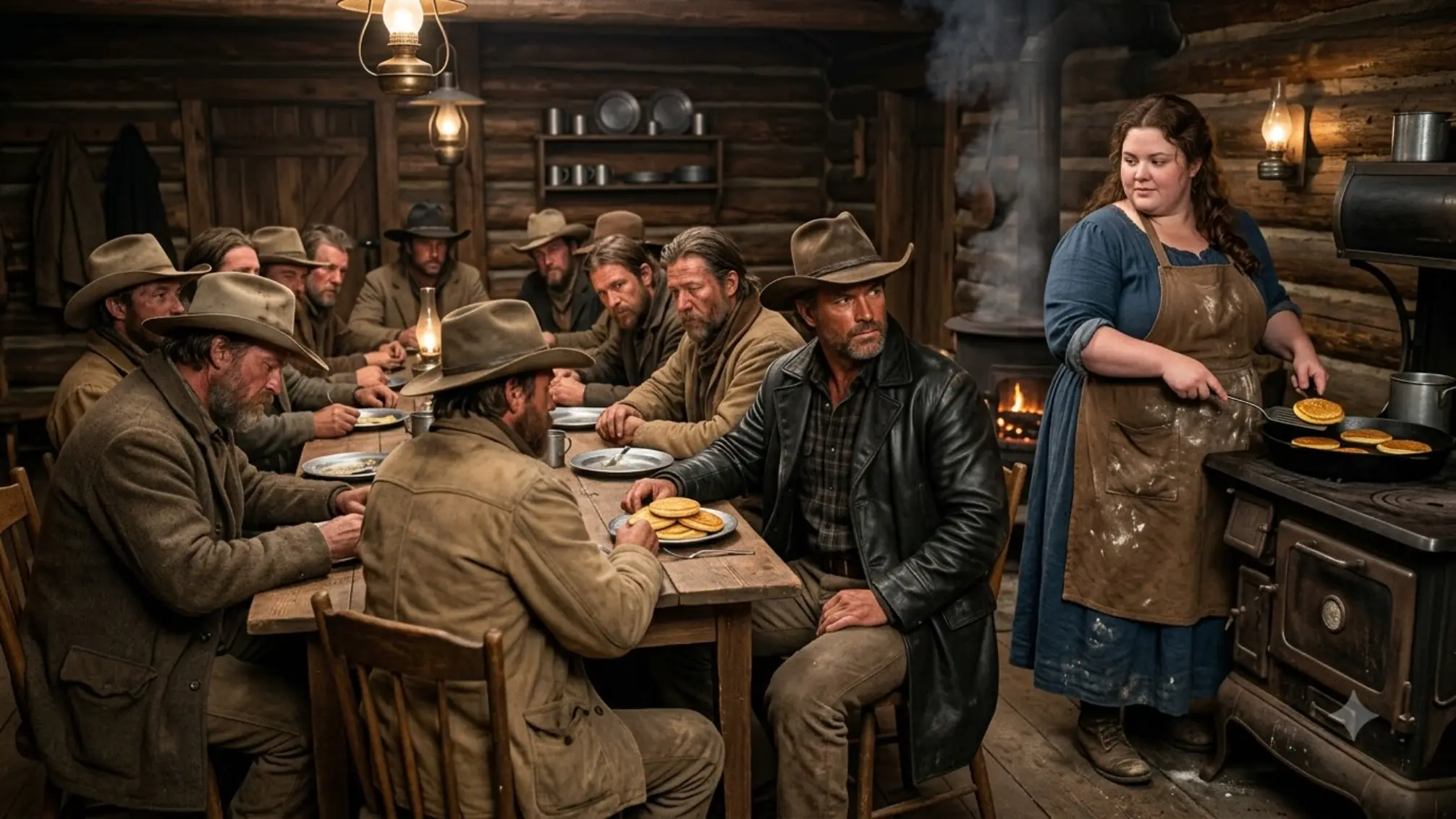
Edith wiped her hands against her apron before opening it. A tall American rancher stood outside beneath a weathered black hat, snow clinging to his broad shoulders and the dark wool coat covering his powerful frame. He appeared to be about forty-one, with a sun-browned face, dark hair touched with silver, a short beard, and eyes carrying the exhaustion of a man who had stopped expecting life to become easier.
“Edith Mayburn?” he asked.
“Yes, sir.”
“My name is Coulter Grady. I own the ranch west of town.”
Edith knew the name. Grady Ranch supplied cattle to mining camps and railroad crews across the territory, though rumor claimed two brutal winters had nearly destroyed it. She also knew Coulter had once been engaged to the most admired woman in Powder Creek, until she abandoned him for a wealthy banker when his cattle died during a drought.
“I heard you can cook,” he continued.
Edith glanced behind her at the stew. “I can.”
“For thirteen ranch hands?”
Her courage shrank. She had fed six girls at the orphanage and occasionally cooked for travelers passing through town, but thirteen hardworking men required barrels of flour, mountains of potatoes, and more confidence than she possessed.
Coulter waited without smiling.
Edith looked down at herself. Her full arms, broad waist, heavy hips, and round cheeks had been treated like public property for as long as she could remember. Children pointed. Men laughed. Women offered advice disguised as concern. Even employers expected gratitude because they believed a woman her size should accept any place that kept her from becoming a burden.
“No one marries a fat girl, sir,” she whispered, her voice breaking despite her effort to steady it. “But I can cook.”
Coulter did not laugh.
He looked at her—not through her, not around her, and not toward the stew as though her usefulness were the only thing keeping him at the door.
“I’m not asking you to marry me, Miss Mayburn,” he said quietly. “I’m asking whether you can feed thirteen hungry men well enough to remind them life is still worth getting up for.”
Edith lifted her eyes.
“I pay twenty dollars a month,” Coulter continued. “You’ll have a private room, control of the kitchen, and authority over anyone who enters it.”
“Even you?”
“Especially me.”
He placed his hat back on his head.
“A wagon will come at sunrise. It leaves with or without you.”
Then he turned and disappeared into the snow.
Edith remained in the doorway until the cold forced her inside. She looked around the cabin she had occupied for five lonely years: one bed, one stove, three chairs, and shelves holding the preserves she traded for buttons, soap, and lamp oil. Nothing waited for her there except another winter of whispers.
Before sleeping, she packed her knives, spices, cast-iron skillet, four dresses, and the small recipe book she had begun at the orphanage.
The wagon arrived before dawn.
Grady Ranch appeared beneath an iron-colored sky three hours later. The property spread across a wide valley, with three barns, a weathered main house, corrals full of restless cattle, and a bunkhouse releasing thin smoke into the bitter air. Thirteen ranch hands stopped working as the wagon approached, their faces hardened by wind, labor, and hunger.
Edith climbed down slowly.
Every eye moved across her body.
A narrow-faced ranch hand nudged his companion. “Boss hired us a cook or a whole winter’s supply?”
Several men laughed.
Another called, “Hope she doesn’t eat the wages before payday.”
Heat flooded Edith’s cheeks. She wanted to climb back into the wagon, return to Powder Creek, and lock herself inside the little cabin where ridicule at least arrived from a distance.
Then she saw Coulter standing near the barn.
He had heard them.
His face remained unreadable.
Edith waited for him to defend her, but he said nothing. The silence hurt more than the jokes, yet she understood something as she looked at the ranch hands. If Coulter forced their respect before she earned it, they would obey him publicly and mock her privately.
She lifted her trunk herself.
“Which building is the kitchen?”
Coulter pointed toward the low timber hall beside the main house.
Edith walked through the men without lowering her head.
The kitchen was worse than she expected. Cold ashes filled the stove, old grease coated the pans, onions had sprouted inside a damp crate, and mice had chewed through two flour sacks. A pot of beans stood abandoned beneath the window, covered with a skin thick enough to lift with a fork.
Edith opened every cupboard.
“Who managed this room?”
A young hand named Will leaned through the doorway. “Old cook got sick.”
“This kitchen was neglected longer than two days.”
Will shrugged. “Men don’t complain when the alternative is cooking.”
“They will now.”
She handed him a bucket. “Water.”
He blinked. “I’m a ranch hand.”
“And I am the cook. Mr. Grady said I control this room.”
Will looked toward Coulter.
The rancher nodded.
By evening, Edith had scrubbed the stove, burned spoiled grain, sealed the mouse holes, and counted every edible item. She found cornmeal, smoked pork, dried chilies, butter, sour cream, and enough eggs for one serious breakfast.
She slept four hours.
Before sunrise, she lit the fire and began cooking.
The bunkhouse bell rang at six. Thirteen men entered laughing, rubbing cold hands, and complaining about the weather. Then the smell reached them.
Conversation faded.
Golden cornmeal cakes filled three cast-iron skillets, crisp around the edges and soft at the center. Edith served them beneath cream gravy flavored with smoked pepper and nutmeg, adding fried eggs and small portions of pork. The men approached suspiciously, each remembering what he had said when she arrived.
The first bite changed the room.
Chewing slowed. Eyes widened. Men who had entered talking loudly now studied their plates with almost religious concentration. Edith stood beside the stove, hands clasped behind her apron, pretending their silence did not matter.
The narrow-faced man who had made the first joke finished before anyone else. He returned with his empty plate and stopped in front of her.
Edith waited.
He did not apologize.
He simply held out the plate.
“More?”
He nodded without meeting her eyes.
She gave him another cake.
By the end of breakfast, every skillet was empty.
Coulter had eaten last, seated at the far end of the table. His plate remained untouched for several minutes because he spent the meal watching his men, not Edith. When the final ranch hand left, Coulter carried his plate toward the wash basin.
“You don’t have to bring that,” Edith said.
“I dirtied it.”
“You own the ranch.”
“That doesn’t make my plate walk.”
He rolled up his sleeves and began washing dishes.
Edith stared.
“The boss doesn’t wash pans.”
“I know what the boss does.” Coulter passed her a rinsed plate. “You fed thirteen men. I can clean after one.”
That became their routine.
Edith rose before daylight, cooked three meals, managed the pantry, and learned the needs hidden behind each man’s silence. Jed disliked onions but ate them rather than complain. Amos developed swelling whenever he ate black pepper. Sixteen-year-old Sam slipped into the kitchen after midnight because he was growing faster than his wages could feed him.
Edith began leaving two biscuits wrapped in cloth near the stove.
The cloth always returned neatly folded.
The insults faded within a week. No one offered a spoken apology, but a ranch hand repaired her pantry hinge. Another left wildflowers inside a tin cup. Jed carved her a wooden spoon, placed it beside the stove, and claimed he had merely needed practice.
Coulter continued washing dishes each night.
Sometimes they spoke. More often they worked in comfortable quiet, moving around each other without collision. Edith learned that Coulter drank coffee without sugar, carried a scar beneath his right sleeve, and became nearly gentle whenever discussing injured horses.
He learned that Edith hummed when bread rose properly and went silent whenever someone praised her appearance.
One night, as she prepared dough, Coulter said, “You look pretty when you’re angry.”
Edith’s hands stopped.
“Are you mocking me?”
“No.”
“Then don’t say things you don’t mean.”
Coulter placed the plate he was drying on the shelf. “I don’t.”
He left before she could answer.
The winter storm arrived three days later.
Wind slammed against the dining hall, ripped one barn door from its hinge, and sent the cattle crashing against their enclosure. The ranch hands ran into the white darkness while Edith bolted the shutters and built the kitchen fire higher.
Then she heard a voice outside.
It was faint, nearly lost beneath the wind.
“Help.”
Edith opened the door.
A small American boy stood in the snow wearing a thin shirt and torn moccasins, his dark hair frozen against his face. He could not have been older than seven. Edith rushed into the storm, lifted him against her chest, wrapped him inside her shawl, and carried him toward the fire.
Coulter entered moments later, covered in snow.
He looked from the child to Edith’s soaked clothing.
“I heard him,” she said defensively. “I couldn’t leave him.”
“You did right.”
Those three words softened something inside her.
Coulter knelt near the boy and warmed his hands while Edith prepared broth. They remained awake through the night until a neighboring Lakota American family arrived at dawn, frantic after searching for the child since the storm began.
When the family left, Edith sank into a chair beside the dying fire.
Coulter approached from behind and placed a thick wool blanket around her shoulders. His hand rested there for one brief moment before withdrawing.
“You could have frozen,” he said.
“So could he.”
“Yes.”
“You sound angry.”
“I am.”
“At me?”
“At the thought of finding you in that snow too late.”
Edith looked up.
Coulter’s expression was open for only a second. Then he turned toward the stove and added another log.
After the storm, their quiet attachment deepened.
He carried water beside her when the pump froze. She repaired the lining of his coat. They laughed when a barn cat leaped into an open flour sack, coating both of them in white dust. For the first time in years, Edith experienced laughter that did not require her humiliation.
One evening, Coulter found her in the storage shed.
He carried a worn leather notebook wrapped in oilskin.
“This belonged to my mother,” he said. “Recipes, household accounts, and thoughts she didn’t want forgotten.”
He handed it to Edith.
“I can’t take this.”
“I’m giving it.”
“Why?”
“My mother said love isn’t what remains on the plate. It’s what remains after the meal is gone.”
Edith’s breath caught.
Coulter glanced away. “I thought you might add something.”
She pressed the notebook against her chest.
“Thank you.”
Neither spoke about love.
They did not need to—not yet.
Spring brought mud, green shoots, and rumors.
People in Powder Creek noticed Coulter spending evenings in the kitchen. Men joked that Edith had mixed something stronger than nutmeg into his meals. Women whispered that a lonely rancher could mistake comfort for affection if the cook kept him well fed.
Then Caroline Ash arrived.
She stepped from an elegant carriage wearing a green velvet dress, polished boots, and a smile sharpened by old confidence. Caroline had once been Coulter’s intended bride. She left him after drought destroyed his herd, but now rumors suggested Grady Ranch had recovered.
Coulter met her on the porch.
“You shouldn’t have come.”
“I heard you were doing well.”
“I did poorly without you. I learned from it.”
Caroline looked toward the kitchen. “And I heard about her.”
She entered before Coulter could stop her.
Edith had just removed a pie from the oven. Caroline looked her over slowly, making no attempt to hide her disgust.
“So this is who you settled for.”
Edith placed the pie on the counter.
“Can I help you?”
Caroline laughed. “I suppose when a man’s pride breaks, he reaches for comfort food.”
Several ranch hands had gathered outside.
Edith felt their attention.
Caroline stepped closer. “Do you know what Powder Creek calls you?”
“I don’t care.”
“The hog at the hearth. A pig in an apron.”
The words found every wound Edith believed had begun to heal. She looked toward the doorway, where two ranch hands stared at the ground. Their silence became confirmation of every fear.
Edith removed her apron.
“I’ll pack my things.”
Coulter appeared in the doorway. “No.”
Caroline smiled. “Let her keep some dignity.”
Edith pushed past both of them and walked toward the trees beyond the barn. She did not stop until the ranch disappeared behind her.
Coulter found her seated beside a stump.
“I should go,” she whispered. “I’m not worth this trouble.”
“Look at me.”
“She’s beautiful.”
“So are you.”
“Don’t.”
“I won’t lie because you’re afraid to believe me.”
Edith’s eyes filled. “You loved her.”
“I thought I did. Then I learned the difference between being wanted and being used.”
He turned toward the ranch.
“Come with me.”
Coulter walked into the courtyard where Caroline still stood among the ranch hands. Edith followed at a distance, uncertain whether she wanted to witness what came next.
Coulter stopped before everyone.
“Caroline, you left because I didn’t have enough money.”
Her smile vanished.
“Edith stayed when this ranch had barely enough food.”
He faced the men.
“Any man who mocks the woman who has fed him, cared for him, and kept this ranch alive may collect his wages and leave before sunset.”
No one moved.
Jed removed his hat. “She fed me when I was sick.”
Amos spoke next. “She noticed the pepper before the doctor did.”
Young Sam swallowed nervously. “She leaves food when she thinks nobody knows.”
One by one, the men stood beside Edith.
Coulter turned toward her and removed his hat.
“You want to leave, I won’t stop you. But don’t leave believing I kept you here because you cook.”
His voice lowered.
“You are the only person who ever walked into this broken place and saw what it might become. You looked at thirteen rough men and found thirteen human beings worth caring for. You looked at me and saw more than failure.”
Tears ran down Edith’s cheeks.
Coulter stepped closer but did not touch her.
“If you stay, stay knowing I choose you. Not from pity. Not from hunger. Because you are the woman I want beside me.”
Caroline climbed into her carriage without another word.
Edith remained.
Yet love did not become easy merely because someone declared it publicly.
Weeks later, sickness spread through the bunkhouse after contaminated meat arrived from a northern supplier. One man collapsed after breakfast. Two more developed fever by evening. By the next morning, nine ranch hands were vomiting and shaking beneath sweat-soaked blankets.
The doctor offered little help.
“Keep them drinking,” he said. “Hope the strongest survive.”
Edith refused to accept that.
For three nights she boiled water, prepared thin porridge, cleaned bedding, and worked beside a Lakota American healer from upriver who brought willow bark, yarrow, and sage. Coulter carried buckets, emptied basins, and held fevered men upright while Edith fed them spoon by spoon.
On the fourth night, Edith collapsed.
She woke beneath a quilt near the kitchen fire. Coulter sat on the floor beside her, his face hollow with exhaustion.
“The men?” she whispered.
“Alive.”
“All of them?”
“Yes.”
“I should get up.”
Coulter placed one hand over hers.
“No.”
“They need—”
“They need you breathing.”
Edith began crying. “I couldn’t do more.”
“You did everything.”
His callused fingers curled around hers.
“I watched you wear yourself thin for men who once laughed at you. For a ranch that did nothing to deserve you. For a man who waited too long to say thank you.”
Coulter’s voice broke.
“If you are the hearth keeping this place alive, let me be the roof. Let me keep the storm off your back.”
Edith squeezed his hand.
She could not answer with words.
By midsummer, the ranch had recovered.
The men presented Edith with a deep-green apron stitched by several ranch wives. Across the front were the words:
KEEPER OF GRADY’S HEARTH
Every ranch hand had signed his name beneath them.
Edith held the apron against her chest and wept openly. This time, no one looked away from discomfort or laughed at her softness. They stood quietly while the woman they once mocked understood that she had become family.
That evening, Coulter led her to the ridge overlooking Grady Ranch.
The setting sun turned the fields gold. Smoke curled above the buildings, cattle moved slowly across the valley, and laughter drifted from the bunkhouse.
“I come here when I forget why I started,” Coulter said.
Edith stood beside him. “Do you remember now?”
“I haven’t forgotten since you arrived.”
He removed his hat.
“I don’t want the kind of wife Powder Creek calls proper. I don’t care about dress sizes or which woman looks best entering church.”
Edith’s eyes filled again.
“I want the woman who wakes thinking about other people’s hunger and ends the day making a home where none existed.”
He stepped closer.
“I want you.”
“No one marries a fat girl,” she whispered, repeating the words she had spoken at her cabin door months earlier.
Coulter shook his head.
“A foolish man marries a shape and wonders why his house stays cold.”
He took her hand.
“A wise man marries the woman who brings warmth wherever she stands.”
Edith looked across the ranch.
“I’ve never believed someone like you could love me.”
“Then give me the rest of my life to prove it.”
He kissed her gently beneath the fading sun.
One year later, Grady Ranch was known for more than cattle. Travelers rode miles to eat in the timber dining hall Edith opened beside the barn. Her cornbread, hickory chicken, and spiced stews became famous throughout the territory.
Coulter washed the final plates every night.
Sometimes he tucked prairie clover behind Edith’s ear while she cleaned the counter. Sometimes they stood beside the stove without speaking, content in the life built from small acts of care.
The thirteen ranch hands still sat at the same long table.
But one thing had changed.
A strong chair now stood beside Coulter’s at the head of it.
It belonged to Edith.
She no longer remained beside the stove while everyone else ate. She served the meal, removed her apron, and sat beside the man who had never considered her invisible.
Years later, people told the story as if Edith’s cooking had persuaded a rancher to overlook her body.
Coulter corrected them every time.
“I overlooked nothing,” he would say. “I saw a beautiful woman, a brave heart, and the finest cook in Wyoming.”
Then Edith would place another skillet of cornbread on the table and shake her head at him.
But she always smiled.
Because the girl who once believed no man could marry someone her size had finally learned the truth.
She had never been too large for love.
The people around her had simply carried hearts too small to hold it.