The heavy rain swallowed the bus station in the late afternoon. A poor boy stood waiting under the shelter, clutching his last few coins. Amid the rushing crowd, he saw an old woman soaked, lost, and ignored by everyone.
Without hesitation, he stepped forward to help and walked five miles through the rain to take her home, never realizing that this small act would spark a chain of events that would change both of their lives forever.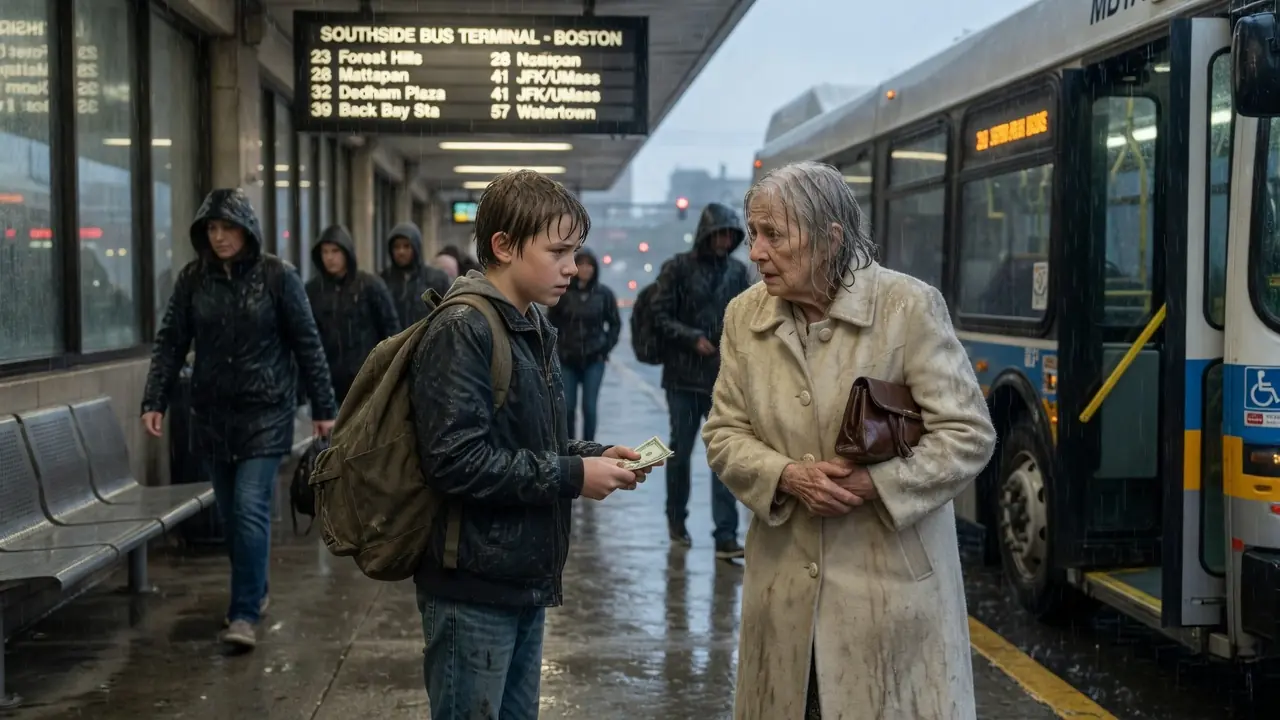
The sky over Boston had been threatening rain all afternoon, but by 4:30, the clouds had made good on their promise. Heavy drops began to fall slowly at first, then faster, harder, until the streets glistened with rushing water and the air itself seemed to turn gray with the downpour.
At the Southside Bus Terminal, people hurried past each other with their heads down. Newspapers were held overhead. Jacket collars were turned up against the wind. Everyone was in a rush to get home, to get dry, to get somewhere warm.
Everyone except one small figure standing perfectly still near the covered bench area.
Noah Carter was twelve years old, though he often felt much older. Life has a way of making you grow up fast when you are the only child of a single mother working double shifts at the hospital. He stood there in his worn but clean jacket, one hand clutching the strap of his backpack, the other deep in his pocket, where he could feel the two crumpled dollar bills and handful of change that represented his bus fare for the next two days.
His father had taught him to read the sky before he passed away three years ago. Dad would point up at the clouds and say, “See those dark edges, Noah? That means rain’s coming. Maybe in an hour, maybe less. You’ve got to learn to read the signs, son. Weather, people, situations. Everything gives you signals if you pay attention.”
Noah had been paying attention today. He had seen those dark clouds gathering since lunchtime at school, but he had not hurried. He never did. There was something peaceful about taking his time, watching the world, noticing the small details that most people rushed right past.
That was probably why he noticed her.
At first, she was just another person at the bus stop, an elderly woman in an elegant but now thoroughly soaked coat, her gray hair plastered to her head, her hands trembling slightly as she gripped her purse. But while everyone else seemed to know where they were going, this woman looked utterly lost.
She turned in a slow circle, her eyes scanning the posted bus routes on the terminal wall, then the street signs, then back to the routes again. Her confusion was visible, a tangible thing that seemed to hang around her like a fog separate from the rain.
Noah watched as person after person walked right past her. A businessman in an expensive suit. A young couple sharing an umbrella. A group of teenagers laughing about something on someone’s phone.
They all saw her. He was sure of it.
How could they not?
But they kept walking, kept moving, kept their eyes carefully averted.
His mother’s voice echoed in his head.
“Noah, baby, I need you to be careful out there, especially when it gets dark. You know there are neighborhoods we don’t go through, right? You promise me you’ll always take the bus. Always stay in safe areas.”
He had promised. He always kept his promises to Mom.
But this woman needed help.
Noah took a deep breath and walked over to her.
Up close, he could see that her coat, despite being drenched, was expensive, real wool with mother-of-pearl buttons. Her purse was leather, well-made, the kind that lasts decades. Everything about her spoke of a life well lived, of dignity and grace.
Everything except the fear in her eyes.
“Excuse me, ma’am,” Noah said softly, not wanting to startle her. “Are you okay? Do you need help?”
The woman turned to him, and for a moment, her face was blank, as if she was trying to remember who he was, or perhaps who she was. Then her eyes focused, and Noah saw something that made his chest tighten.
Relief mixed with shame.
“I...” she started, then stopped. Her hand went to her forehead as if trying to physically pull the words from her mind. “I don’t... I’m supposed to be somewhere. I live somewhere, but I can’t...”
Her voice trailed off, and she looked at Noah with such profound confusion that he felt his own eyes start to sting.
“It’s okay,” Noah said gently. “Do you have any ID? Maybe something with your address.”
The woman looked down at her purse as if seeing it for the first time. Her hands shook as she opened it. Inside was a jumble of items, a wallet, some tissues, a small pill bottle, a few receipts.
Noah waited patiently as she pulled things out one by one, setting them on the bench beside her. Finally, she found her wallet.
Inside was a driver’s license, though it had an expired sticker on it.
Noah looked at the address.
1720 Beacon Hill Avenue.
Beacon Hill.
Noah knew that area. It was one of the wealthiest neighborhoods in Boston, with beautiful old Victorian houses and tree-lined streets. It was also about five miles away from where they stood, in a completely different direction from his own neighborhood.
“Mrs. Dilacqua,” Noah read from the license. “Margaret Dilacqua. Is that you?”
“Yes,” the woman said, and relief flooded her face again. “Yes, I’m Margaret. Margaret Dilacqua.”
She repeated her own name as if testing it, as if making sure it still fit.
“Okay, Mrs. Dilacqua,” Noah said. “I’m going to help you get home. Your address is 1720 Beacon Hill Avenue. Do you remember that?”
“Beacon Hill,” Margaret repeated slowly. “Yes. Yes, I think there are trees. Big trees outside. And steps. Stone steps up to the door.”
“That sounds right,” Noah encouraged. “We’re going to take the bus there. It’s going to be okay.”
He looked at the bus route map on the wall. To get to Beacon Hill, they would need to take the number 47 bus, which would arrive in about ten minutes. The fare was three dollars per person.
Noah’s hand went back to his pocket, feeling the bills and coins there.
Six dollars total.
That was exactly what he had for the next two days. Three dollars today, three dollars tomorrow. If he used it all now to get Mrs. Dilacqua home safely, he would have nothing left.
He would have to walk to school tomorrow and the next day. That meant leaving home at six in the morning instead of 7:30. It meant walking through neighborhoods his mother had specifically told him to avoid. It meant getting to school exhausted, his feet probably blistered, his body worn out before classes even started.
But looking at Mrs. Dilacqua, standing there soaked and confused and afraid, Noah knew there was only one choice he could make.
“Come on,” he said, offering her his arm the way he had seen people do in old movies. “Let’s get you home.”
Margaret took his arm gratefully, and Noah could feel how much she was leaning on him, how much she needed this support. They stood together under the terminal shelter as the rain continued to pound down around them.
When the number 47 bus pulled up, Noah helped Margaret up the steep steps. He pulled out all his money, counted out six dollars exactly, and pushed it through the fare box.
The driver barely glanced at them as he handed over two transfers.
Noah guided Margaret to a seat near the front and sat down beside her. The bus was warm and smelled like wet clothes and diesel fuel. Outside, the city rolled past in a blur of gray rain and blurred lights.
“What’s your name?” Margaret asked suddenly. Her voice was clearer now, more present.
“Noah. Noah Carter.”
“Noah,” she repeated. “Like the ark. The flood. The rain.”
She gestured to the window and smiled. And for a moment, Noah saw past the confusion to the person she must have been before, sharp and witty.
“Yes, ma’am,” Noah said, smiling back.
They rode in comfortable silence for a while. Noah watched the neighborhoods change outside the window. His own area gave way to downtown. Then downtown gave way to nicer residential streets. Then those gave way to Beacon Hill, where the houses got bigger, the trees got taller, and everything looked more established, more permanent.
“This is our stop,” Noah said after forty-five minutes, recognizing the street name from his mental map.
He helped Margaret down from the bus, and they stood on the sidewalk in the rain. It had lessened somewhat, no longer the deluge it had been, but still steady and cold.
Margaret looked around, and Noah watched as recognition dawned on her face.
“I know here,” she said, pointing down the street. “I know these houses.”
“Which one is yours?” Noah asked.
Margaret walked forward with more confidence now, and Noah stayed close beside her. They passed several grand houses, each more beautiful than the last.
Finally, Margaret stopped in front of a stunning three-story Victorian painted a soft cream color with dark green shutters. Stone steps, just as she had remembered, led up to a heavy wooden door with an ornate brass knocker.
Noah helped her up the steps.
Before they could knock, the door flew open, and a man in his sixties, wearing a vest and tie, rushed out.
“Mrs. Dilacqua!” he exclaimed, his voice thick with relief and worry. “Oh, thank God. We’ve been looking everywhere for you. When you didn’t come back from your walk, we were so worried.”
“I got a bit turned around, James,” Margaret said apologetically. “But this young man helped me.”
The man, James, looked at Noah for the first time. Really looked at him. His eyes took in Noah’s soaked jacket, his worn sneakers, his tired face.
Then they softened.
“Son, I don’t know how to thank you,” James said. “You brought Mrs. Dilacqua home safely. Please come inside. Let us give you something, a reward.”
“No, thank you,” Noah said quickly. “I’m just glad she’s home safe. I should get going.”
“But it’s still raining,” James protested. “At least let me call you a car or...”
“I’m fine,” Noah insisted. “Really. Take care of Mrs. Dilacqua.”
He turned to leave, but Margaret caught his hand.
“Noah,” she said, and her eyes were completely clear now, completely present. “Thank you. You have a good heart. Don’t ever lose that.”
“I won’t,” Noah promised.
He walked down the stone steps and back out into the rain. Behind him, he heard the heavy door close, and then there was just the sound of water hitting pavement and the distant rumble of thunder.
Noah looked around, getting his bearings.
He was five miles from home. It was 5:15 now, and the sky was already getting dark thanks to the storm. He had no money left for the bus.
He would have to walk.
He set off, head down against the rain, retracing the bus route in reverse. His sneakers squelched with every step. Water dripped down his neck from his soaked hair. The backpack on his shoulders felt like it weighed a hundred pounds.
The first mile was not too bad. He was still in Beacon Hill, where the streets were well lit and people occasionally passed by safely under umbrellas.
But as he walked, the neighborhoods changed again, going backward through the progression he had watched from the bus window.
By mile two, he was in an area his mother had specifically warned him about. The streetlights were fewer and farther between. Some of them were broken. The houses were smaller, many of them dark.
Groups of men stood on corners, their eyes following Noah as he passed. He kept his head down, walked fast, tried to look like he knew exactly where he was going.
A dog barked from behind a chain-link fence, making Noah jump. His heart was pounding now, and not just from the walking.
Every shadow seemed threatening. Every sound made him turn his head.
By mile three, his legs were aching. His feet had developed painful blisters inside his soaked sneakers. He was shivering uncontrollably, his teeth chattering so hard it hurt his jaw.
By mile four, he was not sure he was going to make it.
He stopped under an overpass to catch his breath. Leaning against the cold concrete wall, his whole body was shaking. He felt dizzy, and his chest hurt from breathing hard, but he could not stop for long.
It was not safe here.
Nowhere was safe here.
He pushed off from the wall and kept walking.
By the time he reached his own neighborhood, it was 8:45 at night, nearly five hours since he had left the bus terminal. The rain had finally stopped, but Noah barely noticed.
He could see his apartment building up ahead, the lights from their third-floor window like a beacon.
He climbed the stairs slowly, each step an effort. His hand shook as he pulled out his key and unlocked the door.
His mother was in the kitchen, still in her nurse’s scrubs from the hospital. She turned when she heard the door, and her face went through a rapid series of expressions.
Relief.
Confusion.
Then anger.
“Noah Benjamin Carter,” she said, her voice rising. “Do you have any idea... It’s 8:45. You were supposed to be home by six.”
“I’m sorry, Mom,” Noah said.
His voice came out weak.
“My phone died.”
“Where have you been? I was about to call the police.”
Grace Carter crossed the room in three quick strides and grabbed Noah’s shoulders. Then she felt how wet he was, how cold. Her anger immediately shifted to concern.
“Noah, you’re soaked through. What happened? Why didn’t you take the bus?”
That was when the whole story came tumbling out.
Noah told her about Mrs. Dilacqua, about her confusion and fear, about using his bus money to get her home safely, about the long walk back through the rain and the dangerous neighborhoods.
As he spoke, Grace’s face changed again. The anger melted away completely, replaced by something Noah could not quite read.
Pride.
Sadness.
Both.
When he finished, Grace pulled him into a tight hug, not caring that he was getting her scrubs all wet.
“Oh, baby,” she whispered. “What you did was beautiful and brave and kind. But Noah, you could have been hurt. Those neighborhoods...”
“I know, Mom,” Noah interrupted. “I know it was dangerous, but I couldn’t just leave her there. Nobody else was helping.”
Grace pulled back and looked at her son’s face. Really looked at it.
When had he gotten so mature? When had her baby boy become someone who would sacrifice his own safety and comfort for a stranger?
“You’re right,” she said finally. “You did the right thing. I’m proud of you, Noah. So proud. But now we need to get you into dry clothes and warmed up. You’re shivering.”
She helped him out of his wet jacket and shoes. His feet were red and raw with blisters. His skin was pale and cold to the touch.
Grace ran him a hot bath and made him sit in it until the shivering stopped, then wrapped him in warm pajamas and made him drink hot tea with honey.
But by then, the damage was done.
Noah woke up the next morning feeling like he had been hit by a truck. Every muscle in his body ached. His throat was sore. His head felt fuzzy and hot.
“Mom,” he called out, his voice barely above a whisper.
Grace came into his room immediately. One look at his flushed face told her everything she needed to know. She pressed her hand to his forehead and winced.
“You’re burning up, baby,” she said.
She went to get the thermometer and came back. When she checked it, her mouth pressed into a thin line.
“One hundred and one degrees. You’re staying home from school today.”
“But Mom,” Noah started to protest.
“No buts. You walked five miles in the freezing rain yesterday. Your body needs to rest.”
Grace looked at the clock. It was 6:30 in the morning. Her shift at St. Mary’s Hospital started at seven. She was supposed to be getting ready to leave right now, but there was no way she could leave Noah alone like this.
She picked up her phone and called the hospital, asking for Linda Moore, her nursing supervisor.
“Linda, I’m so sorry, but I can’t come in for my shift today,” Grace explained, keeping her voice calm even though her stomach was twisting with anxiety. “Noah is really sick. His fever is 101, and he can’t go to school. I need to stay with him.”
There was a long pause on the other end of the line. Then Linda’s voice came back cold and professional.
“Grace, you’ve already used your sick days for the year and your personal days. You called out twice last month.”
“I know,” Grace said, glancing toward Noah’s room. “But Linda, he’s twelve years old. I can’t leave him alone like this. He needs me.”
“Grace, we all have responsibilities. If you can’t fulfill your commitments to this hospital, then maybe you need to reconsider whether this position is right for you.”
The threat was clear.
Grace felt tears prick at her eyes, but she blinked them back.
“I understand,” she said quietly. “But I still can’t come in today. My son needs me.”
“Then I’ll mark it as an unexcused absence,” Linda said. “You know what that means for your record?”
“Yes,” Grace said. “I know.”
She hung up the phone and sat down at the kitchen table, putting her head in her hands.
She could not afford to lose this job. She was a single mother with no savings, no family to fall back on. The hospital job was everything. Their rent money, their food money, their health insurance.
Without it, they would have nothing.
But looking toward Noah’s room, where she could hear him coughing weakly, she knew she had made the right choice.
He came first.
He would always come first.
Grace spent that Wednesday taking care of Noah. She made him drink water and take medicine. She used cool cloths on his forehead to try to bring the fever down. She checked his temperature every hour, watching with growing concern as it climbed higher and higher.
By noon, it was 102 degrees.
By three in the afternoon, 103 degrees.
Grace’s nurse training kicked in.
Fever climbing this high, this fast. Wet cough developing. Chest pain when he breathed. Chills despite the fever.
This was more than just a cold.
This was potentially pneumonia.
She sat beside his bed as the afternoon faded into evening, monitoring his breathing, watching his color, trying to decide what to do. They had no money for an emergency room visit. She had just been threatened with losing her job.
But Noah was getting worse, not better.
By eight that evening, Grace knew she had to call the hospital again, not to go to work, but to ask for advice, to see if there was any way they could help Noah without it costing thousands of dollars they did not have.
She called Linda Moore’s direct line again.
“Linda, it’s Grace again. I’m so sorry to bother you, but Noah is much worse. His fever is 103 and climbing. He’s coughing up mucus. I think he might have pneumonia. Is there any way...”
“Grace,” Linda interrupted, her voice even harder than it had been that morning. “I’m going to stop you right there. You called out today, leaving us short-staffed and scrambling to cover your patients. That’s the third unexcused absence in two months. I’ve spoken with HR, and we’ve made a decision. We’re terminating your employment. Effective immediately.”
The words hung in the air like a physical blow.
“You’re firing me?” Grace whispered.
“We’re ending your employment due to repeated violations of our attendance policy. You’ll receive a formal email within the hour with all the details. I’m sorry, Grace, but this is a hospital. We need reliable staff.”
“But my son is sick,” Grace said, her voice breaking. “He’s really sick. He needs me.”
“I understand that,” Linda said, though her tone suggested she did not. “But your personal situation doesn’t change hospital policy. The decision has been made.”
The line went dead.
Grace sat there, phone still pressed to her ear, unable to process what had just happened.
She had been fired.
She had lost her job.
She had lost their income, their insurance, their stability, all because she had stayed home to care for her sick child.
She let herself cry for exactly one minute, then wiped her eyes, straightened her shoulders, and went to check on Noah again.
His fever had climbed to 104 degrees.
The email from Linda Moore arrived thirty minutes later, cold and official.
Dear Grace Carter,
This letter is to inform you that your employment with St. Mary’s Hospital is hereby terminated, effective immediately, due to repeated violations of our attendance policy. Your final paycheck will be processed and mailed to your address on file. Please return all hospital property, including your ID badge and any keys, to Human Resources within five business days.
Sincerely,
Linda Moore
Nursing Supervisor
Grace read it three times, each word feeling like a small knife.
Terminated immediately.
Attendance policy.
As if staying home with a seriously ill child was some kind of moral failure.
She saved the email and closed her laptop. Then she went to check on Noah again.
He was worse, much worse. His breathing was labored, his chest rising and falling rapidly. When she lifted his shirt to listen to his lungs with the stethoscope she kept in her medical bag, she heard the distinctive crackle of fluid.
Pneumonia.
Definitely.
He needed antibiotics, probably intravenous ones. He needed proper medical care.
Grace sat beside Noah’s bed all night Wednesday, dozing in the chair, waking every time his breathing changed, checking his temperature every hour. The fever would not break. If anything, it was getting worse.
By Thursday morning, when the pale gray light started filtering through the curtains, Grace knew they were out of options.
Noah’s fever was now 104.2 degrees. His lips had a slight blue tinge. His skin was gray and clammy. He was barely conscious, drifting in and out of a feverish haze where he saw his father standing at the foot of his bed, pointing at the clouds and talking about reading the signs.
“Dad,” Noah mumbled, his eyes unfocused. “Dad, I can’t read the clouds. They’re too dark. I can’t see the signs.”
Grace felt her heart breaking.
She could not wait any longer.
Insurance or no insurance. Job or no job. Money or no money.
She had to get Noah to a hospital.
Now.
“Noah, baby, we’re going to the hospital,” she said gently, helping him sit up. “Can you stand? Can you walk to the car?”
Noah tried, but his legs were too weak.
Grace ended up half carrying him, supporting most of his weight as they made their way slowly down the stairs to their old car parked on the street. She bundled him into the passenger seat, wrapping him in blankets.
Even though the morning was not particularly cold, he was shivering violently, his teeth chattering, his whole body trembling.
The drive to St. Mary’s Hospital took only fifteen minutes. Grace knew it well. She had made this drive five days a week for the past five years.
She knew the ER doctors there. She knew the nurses. And she knew Sophia Ramirez, one of her closest friends, would be working the morning shift.
As she pulled into the hospital parking lot, Grace made a decision. She could not afford pride right now. She would call Sophia and beg for help if she had to.
Her son’s life was more important than her dignity.
She parked as close to the emergency entrance as possible and pulled out her phone, dialing Sophia’s number.
“Grace,” Sophia answered on the second ring, sounding surprised. “I heard what happened. I’m so sorry. Linda had no right.”
“Sophia,” Grace interrupted, her voice shaking. “I need your help. It’s Noah. He’s really sick. I think it’s pneumonia. His fever is 104. I just got fired, so we have no insurance, and I don’t know what to do. Please, please help me.”
There was no hesitation in Sophia’s response.
“Bring him to the ER right now. I’m working triage today. I’ll meet you at the doors. We’ll figure something out.”
“Sophia, you could get in trouble.”
“I don’t care. Bring him in.”
Grace hung up and looked at Noah, who was slumped against the passenger door. His eyes were closed, his breathing shallow.
“Okay, baby,” she whispered. “Sophia is going to help us. It’s going to be okay.”
She got out and hurried around to help Noah out of the car. He could barely stand. She had to support his entire weight as they moved slowly toward the emergency room entrance.
Sophia was there waiting just inside the doors, still in her scrubs, her face etched with concern. When she saw Noah, her professional mask slipped for just a moment, and Grace saw genuine alarm in her friend’s eyes.
“Oh, Grace,” Sophia breathed. “Come on, quickly.”
Sophia did not take them to the main triage area where dozens of people sat waiting. Instead, she led them down a side hallway away from the crowded emergency room, moving quickly and purposefully.
“Where are we going?” Grace asked, practically carrying Noah now.
“Exam room three,” Sophia said quietly. “It’s tucked away. I’ll examine him there.”
She opened the door to a small examination room and helped Grace get Noah up onto the exam table. He lay there limply, his eyes half closed, his breathing raspy and labored.
Sophia moved with practiced efficiency, pulling on gloves, grabbing a thermometer, wrapping a blood pressure cuff around Noah’s thin arm.
“One hundred and four point two,” Sophia read from the thermometer, her mouth tightening with worry. “Blood pressure is low. Respiration rate is way too high.”
She pressed her stethoscope to Noah’s chest, listening carefully, moving it from spot to spot.
“Definite crackles in both lungs. This is bacterial pneumonia. Grace, he needs IV antibiotics immediately. He needs to be admitted.”
“Can you help him?” Grace asked, her voice barely a whisper. “Please, Sophia, I know we don’t have insurance anymore, but he’s so sick. He needs help.”
Sophia looked at her friend’s desperate face and squeezed her hand.
“Let me get the IV supplies and antibiotics. I’ll start treatment right now, and we’ll figure out the rest later. Okay?”
Grace nodded, tears of relief streaming down her face.
“Thank you. Thank you so much.”
Sophia slipped out of the room, closing the door softly behind her.
Grace sat on the edge of the exam table, holding Noah’s hot, dry hand. His breathing was so fast, so shallow. His lips had a blue tinge that terrified her.
“Hang on, baby,” she whispered. “Just hang on. Help is coming.”
Five minutes passed.
Then ten.
Grace kept glancing at the door, expecting Sophia to return with the IV equipment and medication.
Fifteen minutes.
Twenty.
Something was wrong.
Finally, after twenty-five minutes, the door opened.
But it was not Sophia who walked in.
It was Linda Moore, her face set in hard, angry lines. Behind her stood a hospital security guard, a young man who looked distinctly uncomfortable.
Grace stood up instinctively, positioning herself between Linda and Noah.
“Miss Carter,” Linda said, her voice cold and formal. “You need to leave this hospital immediately.”
“My son is sick,” Grace said, keeping her voice calm despite the panic rising in her chest. “He has pneumonia. He needs treatment.”
“Then you should take him to a free clinic or the emergency Medicaid office,” Linda replied. “This is a private hospital. We cannot provide services without insurance coverage or payment guarantee. You know that. You used to work here.”
“He’s a child,” Grace said, her voice shaking now. “He’s twelve years old. He can barely breathe. Please, just look at him. He needs help.”
Linda’s expression did not change. She did not even glance at Noah lying on the exam table.
“Hospital policy is very clear on this matter. Without insurance or the ability to pay, we cannot admit patients except in cases of immediate life-threatening emergency that requires stabilization before transfer.”
“He has pneumonia,” Grace said, her voice rising despite herself. “His fever is 104. His oxygen levels are low. How is that not an emergency?”
“It’s a serious condition that requires treatment,” Linda said, her tone suggesting she was reciting from a manual. “But it’s not an immediately life-threatening emergency requiring stabilization in the next few minutes. He’s stable enough to be transported to a facility that accepts uninsured patients. Boston General has a charity care program. You should take him there.”
“Boston General is forty-five minutes away,” Grace said, disbelief and desperation mixing in her voice. “He might not have forty-five minutes. And you work here. You’re a nurse. Doesn’t that mean anything to you? Doesn’t his suffering mean anything?”
For just a moment, something flickered in Linda’s eyes. But then her jaw tightened and her expression hardened again.
“What it means is that I understand how hospitals operate. We have limited resources. We cannot provide free care to everyone who walks through our doors, no matter how sympathetic their situation. If we did that, we’d go bankrupt and wouldn’t be able to help anyone. That’s reality, Miss Carter. That’s how the health care system works.”
“The health care system is broken,” Grace said quietly.
“Perhaps,” Linda acknowledged. “But that’s not something you and I can fix today. What we can do is follow proper procedures. You need to take your son and leave. If you’d like, I can have the receptionist give you a list of facilities that offer sliding-scale payment options.”
Grace looked at Linda Moore, really looked at her, and saw someone who had spent so long following rules that she had forgotten why the rules existed in the first place. Someone who had built walls around her heart so thick that a child’s suffering could not penetrate them.
There was no point in arguing.
No amount of pleading would change this woman’s mind.
“Okay,” Grace said softly, defeated. “We’ll go.”
She turned back to Noah, who had been watching and listening with fever-dulled eyes.
“Come on, baby,” she said gently, helping him sit up. “We have to leave.”
“But Mama,” Noah whispered, his voice so weak it barely carried across the small room. “I can’t breathe good.”
“I know, sweetheart. I know. We’ll find another hospital. I promise.”
The security guard stepped forward to help, but Grace held up her hand.
“I’ve got him,” she said quietly. “Thank you.”
She supported Noah’s weight as he slowly climbed down from the exam table. His legs were shaking. He could barely stand. Grace wrapped her arm around him, taking almost all his weight, and together they moved toward the door.
As they passed Linda Moore, Grace stopped for just a moment.
“I hope you never have to watch someone you love suffer and be turned away,” she said softly. “I hope you never have to feel what I’m feeling right now.”
Linda’s face remained impassive, but Grace saw her swallow hard.
The security guard led them out through a side exit, not the main emergency room doors where other patients might see, but a back door that led directly to the parking lot, as if they were something shameful that needed to be hidden.
The morning sun was bright and harsh after the dim hospital hallway. Noah shielded his eyes and leaned heavier against Grace.
“I’m sorry, Mama,” he whispered. “I’m sorry I’m sick.”
“Grace,” she corrected gently, fighting back tears. “You have nothing to be sorry for. Nothing.”
They made their slow way across the parking lot toward Grace’s old car. Each step felt like a mile. Noah’s breathing was getting worse, not better. His skin was gray. His lips were blue.
Grace got him into the passenger seat and wrapped the blankets around him again. Then she closed the door and leaned against the car, her mind racing.
Boston General was forty-five minutes away.
The free clinic did not open until noon.
The emergency Medicaid office would take hours of paperwork before any treatment could start.
Noah did not have hours.
He might not even have forty-five minutes.
She did not know what to do.
For the first time in her life as a mother, Grace Carter had absolutely no idea how to save her child.
She stood there in the parking lot, one hand pressed against the car, feeling the weight of complete and utter helplessness crushing down on her.
And then she heard it.
The quiet, elegant purr of an expensive engine.
Grace looked up and saw a black Rolls-Royce gliding into the parking lot. It moved slowly, almost carefully, and stopped in the space directly in front of her car.
For a moment, Grace felt nothing but confusion.
Who drove a Rolls-Royce to a hospital at 9:30 in the morning?
The back door opened, and an elderly woman stepped out.
She was elegant in a way Grace had only seen in movies. A navy wool coat with pearl buttons, matching pearl earrings, her gray hair styled in a perfect silver bob. Everything about her spoke of wealth and refinement. She carried herself with quiet authority.
And when she turned toward Grace’s car, her eyes were sharp and alert.
Those eyes found Noah through the passenger window, and Grace watched as recognition flashed across the woman’s face, followed immediately by concern.
The woman walked over quickly, her gaze never leaving Noah.
“Excuse me,” she said, and her voice was cultured, warm, but worried. “Is that Noah Carter?”
Grace blinked in surprise.
“I... yes. How do you know my son?”
The woman’s expression softened into something tender and grateful.
“Because three days ago, your son saved my life,” she said simply. “My name is Margaret Dilacqua. I’ve been searching for him ever since.”
Grace felt her heart skip.
This was her.
The woman from the bus stop.
The confused elderly woman Noah had helped home in the rain.
“Mrs. Dilacqua,” Grace breathed.
Margaret looked through the car window at Noah, and her face changed as she took in his flushed skin, his labored breathing, his obvious illness.
“What happened?” she asked, turning back to Grace with alarm in her eyes. “Is Noah sick?”
That was when Grace broke.
She did not mean to. She had been holding everything together, the fear, the desperation, the helplessness, but Margaret’s genuine concern, her kindness, cracked something open inside Grace.
The tears came, and with them the whole story tumbled out.
“He walked home in the rain,” Grace said through her sobs. “After helping you, he used all his bus money to get you home safely. So he had to walk. Five miles through the storm, and he got sick. Pneumonia. His fever is 104. He can barely breathe. I brought him here, but we don’t have insurance, and they just turned us away. They said he’s not sick enough. They said to take him somewhere else, but I don’t know where to go. I don’t know how to help him.”
Margaret’s face transformed. The concern became something harder, sharper.
Fury mixed with determination.
“They turned him away,” she repeated, her voice low and dangerous. “They turned away a child with pneumonia.”
“Hospital policy,” Grace said bitterly. “No insurance, no treatment.”
Margaret was quiet for a long moment, but Grace could see the tension in her jaw, the fire in her eyes.
“Come with me,” Margaret said finally.
It was not a request.
“Both of you, come with me right now.”
She opened the passenger door of Grace’s car and knelt down so she was at eye level with Noah.
“Noah, sweetheart,” she said gently. “Do you remember me?”
Noah’s eyes opened. He looked at her with confusion for a moment. Then something like recognition flickered across his face.
“The lady,” he whispered. “Bus stop.”
“Yes,” Margaret said, her voice thick with emotion. “I’m the lady from the bus stop. You helped me get home when I was lost and scared. You were so kind to me, and now I’m going to help you. I’m going to make sure you get the treatment you need. I promise you.”
She stood and turned to her driver, who had remained in the Rolls-Royce.
“Thomas, call Dr. David Newman. Tell him I need him standing by immediately. Tell him I’m bringing in a critical pediatric patient, and I want him personally overseeing the care. Tell him I’ll be there in two minutes.”
“Right away, Mrs. Dilacqua,” Thomas said, already pulling out his phone.
Margaret looked at Grace.
“Follow my car. We’re going back inside.”
“But they said...” Grace started.
“I don’t care what they said,” Margaret interrupted, her voice firm. “Your son needs help, and he’s going to get it now. Follow me.”
The Rolls-Royce pulled forward, leading the way back toward the hospital entrance. Grace got into her car, her hands shaking, not understanding what was happening, but feeling something like hope for the first time since they had been forced to leave.
Margaret did not go to the emergency room. She went straight through the main entrance, across the polished lobby, directly to the reception desk.
Grace hurried after her, supporting Noah’s weight, watching in amazement as Margaret approached the receptionist with the bearing of someone who owned the place.
“I need Linda Moore here immediately,” Margaret said, her voice carrying authority that made several people in the lobby turn to look. “Tell her Margaret Dilacqua is here and requires her presence. Now.”
The receptionist’s face went pale.
“Yes, Mrs. Dilacqua. Right away.”
She grabbed the phone and spoke urgently.
Less than ninety seconds later, Linda Moore appeared, walking quickly across the lobby with a professional smile on her face.
But when she saw Margaret standing there, and saw Grace and Noah beside her, she stopped dead.
The smile vanished.
The color drained from her face.
“Mrs. Dilacqua,” Linda said, and her voice had lost all its earlier coldness. Now it was nervous, uncertain. “I didn’t know you were here. How can I...”
“You can explain,” Margaret interrupted, her voice cutting like a knife, “why you just refused emergency medical treatment to this child.”
Linda’s mouth opened and closed, her eyes darting to Grace and Noah, then back to Margaret.
“There was... the patient has no insurance coverage, and hospital policy requires...”
“This child,” Margaret said, and her voice was rising now, filling the lobby, making people stop and stare, “has bacterial pneumonia. His fever is 104 degrees. He can barely breathe. And you sent him away. You told his mother to take him somewhere else. You valued your policy over his life.”
“Mrs. Dilacqua, if I had known you were involved, I would have...”
“That is exactly the problem,” Margaret cut her off, her eyes blazing. “You would have helped if you had known I was involved. But you didn’t help when it was just a sick child and his frightened mother. You didn’t help because they couldn’t pay. You saw a person in need, and you turned away.”
Linda was sweating now. Her face flushed.
“I was following hospital protocol.”
“Let me tell you about this boy,” Margaret said, her voice dropping lower but somehow becoming even more powerful. “Three days ago, I had an episode. My Alzheimer’s. Yes, I have Alzheimer’s, Miss Moore. It left me confused and lost at a bus stop in the rain. I didn’t know where I was. I didn’t know how to get home. I was terrified, and dozens of people walked right past me. They saw me, and they kept walking.”
She paused, her hand moving to rest gently on Noah’s shoulder.
“But this twelve-year-old boy stopped. He helped me. He used his last dollars, money he needed for bus fare to get to school, to make sure I got home safely.”
Margaret’s voice was shaking with emotion now, but her words were clear and strong.
“And you turned him away. You saw this kind, brave, compassionate child suffering, and you sent him away because of policy, because of insurance, because of money.”
Linda looked like she wanted to disappear. People in the lobby were watching openly now, some with phones out recording.
“I didn’t know the full situation,” Linda tried.
“You didn’t ask,” Margaret said simply. “You didn’t care to ask. You saw an uninsured patient and made your judgment. Well, let me tell you something about this hospital, Miss Moore. My great-grandfather founded St. Mary’s in 1872. My family has funded it for four generations. I sit as the chair of the board of directors, and I did not spend my life supporting this institution so that people like you could turn away sick children in their moment of greatest need.”
She stepped closer to Linda, her voice dropping to something quieter but infinitely more dangerous.
“Noah Carter will receive immediate and comprehensive medical care. He will be admitted to the finest room we have. Dr. David Newman will oversee his treatment personally. Every resource this hospital possesses will be made available to him. All costs will be billed to my personal account.”
Linda’s lips trembled.
“And Miss Moore?”
“Yes, ma’am,” Linda whispered.
“You and I will be having a very long conversation with the board about your understanding of what this hospital stands for. But that conversation will wait until this child is safe and recovering. Do you understand me?”
“Yes, Mrs. Dilacqua,” Linda said, her voice shaking completely.
“Then make it happen now.”
Linda turned to the receptionist, her hands trembling.
“Page Dr. Newman stat. Prepare room 407. Get a pediatric team up there immediately.”
Within moments, Noah was in a wheelchair being pushed toward the elevators. A nurse Grace did not recognize guided them efficiently. Grace walked alongside, one hand on Noah’s shoulder, hardly able to process what had just happened.
Margaret walked with them, calm and composed now, her earlier fury contained but still visible in the set of her jaw.
They rode the elevator to the fourth floor in silence. The doors opened to the pediatric ward, and they were led to room 407, a beautiful, spacious suite with a real bed, comfortable furniture, large windows with views of the Boston skyline.
The nurses worked quickly, getting Noah into the bed, starting his vital signs monitoring, preparing for the IV line.
Dr. David Newman arrived within minutes, a distinguished man in his fifties with kind eyes and calm, confident movements. He greeted Margaret with obvious respect, then turned his full attention to Noah.
He conducted a thorough examination, asking Noah gentle questions, listening to his lungs, checking his oxygen levels. Grace stood by answering questions about symptoms and timeline.
“Bacterial pneumonia, significant hypoxia, dehydration,” Dr. Newman said, his tone serious but reassuring. “We’ll start oxygen support immediately. IV antibiotics, IV fluids. I want chest X-rays and blood cultures. We’ll monitor him closely. With aggressive treatment, he should start improving within twenty-four to forty-eight hours. He’ll need to stay with us for several days, but he’s going to be fine.”
Grace felt her knees weaken with relief.
“Thank you,” she whispered. “Thank you so much.”
Dr. Newman smiled warmly.
“That’s why we’re here.”
He left to order tests, and the nurses began their work. Oxygen cannula placed gently in Noah’s nose. IV lines started in his arm. Monitors beeping softly as they tracked his heart rate and oxygen levels.
Grace sat on the edge of Noah’s bed, holding his hand, watching as the oxygen helped his breathing ease, as the IV fluids began to work, as color slowly started to return to his face.
Margaret stood by the window, giving them space. But Grace could see her wiping tears from her eyes.
After a few minutes, when Noah had drifted into a more peaceful sleep, Grace stood and walked over to Margaret.
“Mrs. Dilacqua,” she started.
Margaret held up her hand.
“Please. Call me Margaret.”
“Margaret,” Grace said, her voice breaking. “I don’t know how to thank you. You saved his life. You saved my son’s life.”
Margaret turned to face her, and Grace saw tears streaming down the older woman’s face.
“No,” Margaret said firmly. “Your son saved mine first. He saved me when I was lost and scared and alone. He showed me kindness when no one else would. And if I can help him now, if I can make sure he gets the care he needs, then I’m not saving him. I’m just trying to balance the scales a little, to give back what he gave me.”
She reached out and took Grace’s hands in hers.
“What happened downstairs, what they tried to do to Noah, that should never happen. Not to him. Not to anyone. A child should never be turned away from medical care. Ever. No one should. And I’m going to make sure it doesn’t happen again at this hospital.”
Grace squeezed Margaret’s hands, overwhelmed with gratitude and emotion.
“Thank you,” she said again. “Thank you for seeing him, for caring, for being here.”
Margaret smiled through her tears.
“Thank you for raising such a remarkable young man. He’s special, Grace. Truly special, and I’m honored to know him.”
They stood there together, two women from completely different worlds, connected now by a twelve-year-old boy who had simply chosen to be kind when kindness was needed.
And in the bed behind them, Noah slept peacefully for the first time in days, finally getting the care he so desperately needed, finally safe and healing.
The circle of kindness, broken for a moment by cruelty and indifference, had been restored by one woman’s determination to honor a child’s compassion.
The ripples continued to spread.
Three days later, Noah was released from the hospital. His pneumonia had responded well to the antibiotics. His fever had broken, and Dr. Newman declared him ready to go home with oral medication to complete his recovery.
Margaret visited every day during his stay, bringing books and games and just sitting with him and Grace, talking about everything and nothing.
She told them about her late husband, who had passed away ten years ago, about her career as a teacher before she retired, about her diagnosis and how frightening it was to feel her mind slipping away sometimes.
“I never had children,” she told them on that last day, sitting on the couch in Noah’s room while he packed up his things. “My husband and I tried, but it never happened. I’ve wondered sometimes what it would have been like having a child, someone to care for, to love, to leave my legacy to.”
She looked at Noah with such affection that Grace felt her throat tighten.
“But maybe,” Margaret continued, “maybe family isn’t just about blood. Maybe it’s about the connections we make, the people who show us kindness when we need it most.”
Noah looked up from the bag he was packing.
“My dad used to say that family is the people who show up for you when everything’s falling apart.”
Margaret smiled, tears glistening in her eyes.
“Your father sounds like he was a wise man.”
“He was,” Noah said simply.
On their way out of the hospital, they passed through the main floor and encountered Sophia Ramirez. She stopped when she saw them, her face breaking into a huge smile.
“Noah, you look so much better.”
She gave him a careful hug, mindful of his still-healing lungs.
“Thanks to you,” Grace said.
“Sophia, if you hadn’t tried to help us...”
“Anyone would have done the same,” Sophia protested.
“No,” Margaret said, stepping forward. “Not everyone would have. Not everyone did. You risked your job to help a friend and her sick child. That takes courage and compassion.”
She reached into her purse and pulled out a business card.
“My name is Margaret Dilacqua. I’d like to talk to you about a position on the hospital’s board of directors. We need more people like you making decisions about patient care.”
Sophia took the card, looking stunned.
“I... thank you. I’d be honored.”
As they walked to the car, Margaret carrying Noah’s bag despite Grace’s protests, Noah suddenly stopped.
“Mrs. Dilacqua,” he said.
“Yes, dear?”
“What happened to Miss Moore? The supervisor who threw us out.”
Margaret’s expression became serious.
“Linda Moore is no longer employed by St. Mary’s Hospital. Her actions demonstrated a fundamental lack of compassion and judgment that is incompatible with health care leadership. She’s been replaced by someone who better understands that our mission is to help people, not to exclude them.”
“I hope she finds another job,” Noah said softly. “I hope she learns to be kinder.”
Both women stared at him.
Here was a boy who had every reason to be angry, to want revenge, and instead he was hoping his tormentor would become a better person.
Margaret knelt down so she was at eye level with Noah.
“You know what? I hope so, too. And I think maybe she will because of you, because she saw what real kindness looks like, and she saw how her lack of it affected real people. Sometimes we need to see our mistakes reflected back at us before we can learn from them.”
Noah nodded, satisfied with this answer.
The weeks that followed were transformative for the Carter family.
Grace accepted the position as director of nursing, though she negotiated to keep some clinical hours because she loved direct patient care. Her new salary meant they could move to a better apartment, one where Noah had his own room and there were trees outside the windows.
But more than the financial change, there was an emotional shift.
Grace had always felt like she was scrambling, always one emergency away from disaster, always afraid.
Now, for the first time in years, she felt secure. She felt valued. She felt like she could breathe.
Noah recovered fully, though Dr. Newman recommended he stay home from school for two weeks to fully regain his strength. During that time, Margaret visited often. She would bring lunch and sit with Noah while Grace was at work, talking with him about books and history and life.
One afternoon, Margaret arrived with a small velvet box.
“Noah,” she said, sitting beside him on the couch. “I want to give you something. It belonged to my father.”
She opened the box, revealing a silver medallion on a chain. Engraved on the medallion were the words:
Service above self.
“My father wore this every day of his adult life,” Margaret explained. “He was a doctor, and he believed that the purpose of life was to serve others. He said that when you put service above self, when you help others even when it costs you something, that’s when you truly live. I want you to have it.”
Noah took the medallion carefully, feeling its weight in his palm.
“I can’t take this. It was your father’s.”
“And now it’s yours,” Margaret said firmly. “You exemplify what those words mean better than anyone I’ve ever met. You put service above self when you helped me, even though it cost you your bus money, your safety, and ultimately your health. You deserve this.”
Noah put the chain around his neck, tucking the medallion under his shirt where he could feel it against his skin, right over his heart.
“Thank you,” he said, his voice thick with emotion.
Margaret pulled him into a hug.
“No, sweet boy. Thank you.”
Three months after Noah’s hospitalization, Margaret made an announcement.
She was establishing the Noah Carter Scholarship Fund, a full-ride scholarship to the college of the recipient’s choice, awarded annually to a student who demonstrated extraordinary acts of service and compassion.
“Noah showed me that true character is revealed not in what we do when people are watching,” Margaret said at the press conference announcing the fund, “but in what we do when no one is watching. When he helped me, he thought no one would ever know. He thought he would walk home in the rain, get sick, and that would be the end of it. He didn’t help me for recognition or reward. He helped me because it was the right thing to do. This scholarship honors that spirit.”
The first recipient of the Noah Carter Scholarship was, of course, Noah himself, though it would be held in trust until he graduated high school.
But the impact of the scholarship went far beyond one boy.
It inspired others.
Students at Noah’s school started a kindness club, sharing stories of small acts of service they performed each week. Teachers created curriculum around the theme of compassion and community care. Local news picked up the story, and soon similar scholarship funds were being established in other cities.
One act of kindness, one twelve-year-old boy helping one confused elderly woman, had created ripples that spread far and wide.
Grace watched her son navigate all of this attention with the same quiet humility he had always shown. He was interviewed by local news stations, invited to speak at school assemblies, even featured in a national magazine article about youth philanthropy.
But he remained unchanged, still the thoughtful, observant boy who had learned from his father to read the signs and from his mother to care for others.
The only thing that bothered him, he told Grace one night, was that people treated what he had done like it was exceptional.
“It shouldn’t be exceptional to help someone who needs help,” he said, sitting at their new kitchen table in their new apartment. “It should just be normal. It should be what everyone does.”
Grace smiled at her wise-beyond-his-years son.
“You’re right. It should be. But it’s not. Not yet. Maybe by showing people it’s possible, by being an example, you can help make it normal. You can help create a world where kindness is the default instead of the exception.”
Noah considered this.
“I hope so,” he said finally.
Margaret became a regular presence in their lives, almost a member of their small family. She joined them for dinners, helped Noah with his homework, attended his school events.
On her good days, she was sharp and funny and full of stories about Boston’s history and her years as a teacher. On her bad days, when the Alzheimer’s clouded her mind, Noah would sit patiently with her, helping her remember, never making her feel ashamed or frustrated.
“You’re so good with her,” Grace observed one evening after Margaret had gone home following a particularly difficult visit where she had forgotten where she was several times.
“She was scared when I met her,” Noah said simply. “She’s still scared sometimes, even though she’s home now. I just want her to know she’s not alone, that someone’s there to help her find her way back.”
Grace pulled her son into a hug, marveling at his compassion.
One year after Noah had helped Margaret at the bus stop, St. Mary’s Hospital held a community appreciation event. Grace, now well established in her role as director of nursing, had helped organize it.
The goal was to celebrate the hospital’s commitment to compassionate care and to announce new policies that Grace had championed.
No child would ever be turned away from emergency care, regardless of insurance status. A sliding-scale payment system would be implemented for low-income families, and a patient advocate position would be created to ensure that anyone who felt they had been treated unfairly would have someone to turn to.
These changes were a direct result of what had happened to Noah and Grace, and Margaret had used her influence on the board to push them through.
At the event, Noah was asked to speak.
He stood at the podium, now thirteen years old and a bit taller, still thin but healthy, the silver medallion visible at his throat.
“A year ago,” he began, his voice steady despite the large crowd, “I met a woman at a bus stop. She was scared and confused and lost, and nobody was helping her. I didn’t know who she was. I didn’t know if helping her would cost me anything. I just knew she needed help, and I could give it.”
He paused, looking out at the audience, finding his mother’s face in the crowd, then Margaret’s.
“What I didn’t know was that helping her would change my whole life. That it would lead to me getting sick, my mom losing her job, and us facing the hardest few days we had ever experienced. If someone had told me all that would happen, would I still have helped? I like to think I would have. Because the thing is, kindness isn’t about what it costs you. It’s about what it costs the other person if you don’t help.”
There was a ripple of emotion through the crowd, and Noah saw several people wiping their eyes.
“Mrs. Dilacqua saved my life after I helped save hers,” Noah continued. “She showed me that kindness creates a circle. When you help someone, you’re not just helping that one person. You’re creating a ripple that spreads out and touches other people. Mrs. Dilacqua helped my mom and me. My mom is helping other families by changing hospital policies. Those families will go on to help others. The circle keeps expanding.”
He looked directly at Margaret now.
“A wise woman once told me that family isn’t just about blood. It’s about the people who show up for each other, who help each other, who love each other. Mrs. Dilacqua showed up for me and my mom when we needed it most. She’s family now, as far as I’m concerned. And every person in this room has the power to be family to someone else. Every person here can choose kindness, can choose to stop when someone needs help, can choose to be the person who shows up.”
He paused, then added, “My dad used to tell me to read the signs, to pay attention to what’s happening around me. I think one of the most important signs we can learn to read is when someone needs help. And once we see that sign, we have a choice. Keep walking or stop and help. I hope we all choose to stop. I hope we all choose kindness, because that’s how we change the world. One bus stop at a time. One person at a time. One act of kindness at a time.”
The applause when he finished was thunderous. People stood. Some were openly crying.
Noah stepped away from the podium and was immediately enveloped in hugs from his mother and Margaret.
“That was beautiful, baby,” Grace whispered, holding him tight.
“Your father would be so proud,” Margaret added, her own voice thick with emotion.
After the event, as they were leaving, a young woman approached them. She looked to be in her early twenties, dressed in business casual clothes, her hair pulled back in a neat ponytail.
“Excuse me,” she said to Noah. “My name is Ashley. I just wanted to tell you that your speech really affected me. I’m a nursing student, and I got into health care because I wanted to help people. But lately, I’ve been so stressed about grades and exams and student loans that I had kind of forgotten why I started. Your story reminded me it’s about the people. It’s about being there when someone needs help. Thank you for that reminder.”
Noah smiled at her.
“You’re going to be a great nurse,” he said with the certainty of someone much older. “Because you remember why you started, and you’re willing to be reminded when you forget. That’s what matters.”
Ashley’s eyes filled with tears, and she nodded, unable to speak. She shook his hand, thanked him again, and walked away.
“You know,” Margaret said, watching the young woman leave. “You’re going to spend your whole life doing that, Noah. Reminding people of what matters. Inspiring them to be better. That’s your gift.”
“I just tell the truth,” Noah said. “People do the rest themselves.”
Two years after the bus stop incident, when Noah was fifteen years old, St. Mary’s Hospital held its annual health care innovation conference. Grace had been promoted to chief nursing officer, making her one of the highest-ranking staff members at the hospital.
Margaret, though her Alzheimer’s had progressed somewhat, still served on the board of directors and attended most meetings with her housekeeper James by her side to help her when she got confused.
Noah had been asked to give the keynote speech at the conference. He had grown even taller. His voice had deepened, but his eyes still held that same thoughtful, observant quality that had always defined him.
He stood at the podium in the main conference hall, looking out at hundreds of health care professionals, administrators, and board members from hospitals across the country.
“When I was twelve years old,” he began, “I made a decision that changed my life. I decided to help a stranger. It was a simple decision, really, an obvious one, at least to me. But the consequences of that decision taught me something important about kindness, about health care, and about being human.”
He went on to tell the full story. Margaret at the bus stop, the walk in the rain, getting sick, his mother losing her job, being turned away from the hospital, and then Margaret’s intervention.
“The system failed us,” he said plainly. “Not because the system is filled with bad people, but because the system had forgotten that health care is about people, not just policies and procedures and insurance coverage. When my mom and I were at our lowest point, when I was desperately sick and we had nowhere to turn, the system said no. It took one person, Mrs. Dilacqua, to say yes. One person to remember that compassion has to come before bureaucracy.”
He paused, letting that sink in.
“But here’s the thing. It shouldn’t take a wealthy benefactor to ensure that sick children get treatment. It shouldn’t take a member of the hospital board to override policies that prioritize payment over care. The system itself should be built on compassion from the ground up. That’s what my mom has been working toward as chief nursing officer. That’s what many of you are working toward in your own hospitals, and that’s what I’m committing my life to as well.”
He looked directly at the audience.
“I’m going to medical school when I graduate high school,” he announced. “I’m going to become a doctor, and I’m going to spend my career fixing the system that failed me and my mom and countless other families. I’m going to work to create health care that sees people first, that leads with compassion, that never turns away a child who needs help.”
The applause was immediate and sustained. Noah smiled and waited for it to die down before continuing.
“Mrs. Dilacqua established the Noah Carter Scholarship Fund three years ago. That scholarship has so far helped fifteen students pursue careers in health care and social services. Each of those fifteen people is now out in the world helping others, creating their own ripples of kindness. Each of them represents hundreds or thousands of lives that will be touched, helped, maybe even saved.”
He gestured to Margaret, who was sitting in the front row with James beside her.
“Mrs. Dilacqua taught me that kindness isn’t a one-time thing. It’s not a single act that ends when the act is complete. Kindness is a circle that keeps expanding. When I helped her, she helped me. When she helped me, my mom was able to help other families through policy changes. When those families were helped, they went on to help others. The circle never ends. It just keeps growing, touching more and more lives.”
Noah’s voice grew stronger, more passionate.
“Every person in this room is part of that circle. Every patient you treat, every policy you implement, every decision you make, you’re creating ripples. The question is, what kind of ripples do you want to create? Do you want to create ripples of compassion and care, or ripples of bureaucracy and exclusion? Do you want to be the person who says yes when someone needs help, or the person who hides behind policy and says no?”
He looked around the room, making eye contact with as many people as he could.
“My dad told me to read the signs, to pay attention. The biggest sign in health care is when someone is suffering and needs help. That sign should never be ignored. That sign should never be buried under paperwork and insurance requirements. That sign should be the loudest, clearest, most important sign you read every single day.”
Noah reached up and touched the silver medallion at his throat.
“Service above self. That’s what this medallion says, and that’s what I choose to live by. When I’m a doctor, I’ll choose to see the person before the policy. I’ll choose compassion before cost. I’ll choose to be the kind of health care provider who creates ripples of kindness that spread far beyond my individual interactions.”
He leaned forward, his voice dropping to something more intimate, more personal.
“Here’s what I know for sure. Kindness costs something. It cost me my bus money, my health, and my mom her job, at least temporarily. But you know what kindness creates? It creates more kindness. It creates a world where people help each other. It creates systems that prioritize human dignity over profit margins. It creates health care that actually heals, not just physically, but emotionally and spiritually too.”
He straightened up, his voice strong again.
“So I’m asking all of you. Choose kindness in every interaction, every decision, every policy you create or enforce. Choose kindness. Choose to see people. Choose to help. Choose to be the person who stops when someone needs you instead of walking past. Because that’s how we change health care. That’s how we change the world. One choice at a time. One person at a time. One act of service at a time.”
When Noah finished, the entire audience rose to their feet. The ovation lasted several minutes. Many people were crying openly.
Noah stepped away from the podium and was immediately surrounded by health care professionals who wanted to shake his hand, thank him, and tell him their own stories of why they had gone into health care and how his words had reminded them of their purpose.
Margaret made her way through the crowd to him, James supporting her arm. She was crying, but she was smiling, too.
“Noah,” she said, cupping his face in her hands. “You magnificent, beautiful boy. You’re going to change the world. You’re already changing it.”
“We’re changing it together,” Noah corrected gently. “All of us. That’s how it works.”
Grace joined them, wrapping her arms around both Noah and Margaret.
“Family,” she said simply.
“Family,” Margaret and Noah echoed.
Standing there in that conference hall, surrounded by hundreds of people who had been moved and inspired by Noah’s story and his words, the three of them represented everything that health care should be.
Compassion.
Connection.
And an unwavering commitment to helping those in need.
Noah’s story spread far beyond that conference. Videos of his speech went viral online. News outlets picked it up. He was invited to speak at medical schools, nursing programs, and hospital board meetings across the country.
The Noah Carter Scholarship Fund expanded to include multiple scholarships at dozens of institutions.
But perhaps the most significant impact was harder to quantify. It was in the individual choices made by individual people who heard his story.
The nurse who advocated more strongly for a patient who could not advocate for themselves. The administrator who pushed for policy changes that prioritized care over cost. The medical student who remembered why they had chosen medicine in the first place. The stranger who stopped to help another stranger even when it was inconvenient or costly.
Because that is what kindness does.
It multiplies.
It spreads.
It creates circles that expand outward, touching more and more lives, creating more and more ripples until the whole world is just a little bit kinder than it was before.
Five years after Noah helped Margaret at that bus stop, he graduated high school as valedictorian. Margaret, now struggling more significantly with her Alzheimer’s but still present and engaged on her good days, attended the ceremony with James and Grace.
In his valedictorian speech, Noah did not talk about academic achievement or future goals. Instead, he talked about his father, who had taught him to read the signs. He talked about his mother, who had shown him what it meant to sacrifice for others. And he talked about Margaret, who had demonstrated that true wealth is not measured in money, but in the impact you have on other people’s lives.
“The most important thing I’ve learned,” he said to his graduating class, “isn’t anything I learned in a classroom. It’s this. We’re all connected. We’re all part of the same story. What we do matters, not just to us, but to everyone whose lives we touch. And we have a choice every single day about what kind of story we want to create. Do we want to create a story of indifference and isolation, or a story of connection and compassion? Do we want to be the people who walk past those who need help, or the people who stop, who notice, who care?”
He paused, looking out at his classmates, many of whom he had known since elementary school.
“You all know my story by now. Most of you have heard it more times than you probably wanted to,” he said with a slight smile.
There was warm laughter from the audience.
“But here’s the thing. It’s not just my story anymore. It’s our story. Because every single one of you has the power to create the same kind of ripple I accidentally created when I was twelve. You don’t need to wait for some dramatic moment or some grand gesture. Kindness happens in the small moments, the everyday choices, the simple decision to see someone who needs help and to be the person who helps them.”
He looked directly at the faculty section, where several of his teachers sat, many of them with tears in their eyes.
“Our teachers taught us math and science and literature. But the most valuable lesson wasn’t in any textbook. It was in how they treated us, how they saw us, how they cared about us as people, not just students. That’s the lesson I’m taking forward. That’s the education that really matters.”
Then he turned his attention back to his fellow graduates.
“We’re heading out into the world now. Some of us to college, some to the workforce, some to the military, some to other paths. But wherever we go, whatever we do, we carry with us the power to create change. Not through grand gestures or big public acts, though those have their place, but through the daily, consistent choice to show up for each other. To be kind. To help. To care. To see the people around us and recognize that their needs matter just as much as our own.”
Noah touched the medallion at his throat, the one Margaret had given him years ago.
“Service above self. That’s been my motto since I was twelve. I hope it can be yours, too. I hope that when you see someone who needs help, you’ll stop. I hope that when you have a choice between convenience and compassion, you’ll choose compassion. I hope that you’ll create your own ripples of kindness that spread out and touch lives you’ll never even know about.”
He smiled, a genuine, warm smile that lit up his whole face.
“Thank you for being part of my story. Now, let’s go write our next chapters. Let’s make them good ones. Let’s make them kind ones. Let’s make them stories that matter.”
The applause that followed was the loudest of the entire ceremony. Students stood, threw their caps, cheered, and cried. Watching from the audience, Grace and Margaret held hands and cried, too, proud beyond words of the young man Noah had become.
After the ceremony, during the reception, Noah was surrounded by classmates, teachers, and family friends. But he kept glancing over at Margaret, who was sitting in a chair with James, looking tired but happy.
Finally, Noah excused himself and went to sit beside her.
“How are you feeling?” he asked gently.
“Good,” Margaret said.
She looked at him, and her eyes were clear, fully present.
“I’m so proud of you, Noah. So very proud.”
“I wouldn’t be here without you,” Noah said. “You saved my life.”
“No,” Margaret said firmly. “You saved mine first. Everything that came after was just me trying to balance the scales, though I don’t think I ever truly can. What you gave me that day at the bus stop was more than just help getting home. You gave me dignity. You saw me when I was confused and lost and scared, and you treated me with respect and kindness. You made me feel like a person, not just a confused old woman to be pitied or ignored. That’s a gift beyond price.”
Noah took her hand.
“You’re not just a person to me. You’re family.”
Margaret’s eyes filled with tears.
“Family,” she repeated. “Yes. Family.”
Grace joined them, sitting on Margaret’s other side.
“Group photo,” she suggested, holding up her phone.
The three of them squeezed together, James kindly taking the phone to snap several pictures.
In the photos, they were all smiling. Noah in his graduation gown. Grace in her best dress. Margaret in an elegant lavender suit.
They looked happy.
They looked like family.
Because they were.
That summer before Noah left for college on his full scholarship, he spent most of his time with Margaret. Her Alzheimer’s had progressed to the point where she needed full-time care. She had moved in with Grace and Noah, unable to live alone anymore, and James came daily to help care for her.
On her bad days, Margaret did not always remember who Noah was. She would look at him with confusion, sometimes fear. But Noah would sit with her patiently, telling her stories about her own life, about the school where she taught, about her late husband, about the day they had met at the bus stop.
Slowly, recognition would dawn.
She would remember.
“My Noah,” she would say, touching his face. “My sweet boy.”
“I’m here,” he would assure her. “I’ll always be here.”
On one of her good days, about a week before Noah was set to leave for college, Margaret asked him to sit with her in the living room.
“I want to tell you something,” she said. “While I can still express it clearly.”
Noah sat beside her on the couch, holding her hand.
“I’ve been thinking about legacy,” Margaret continued. “About what we leave behind when we’re gone. I have money, property, investments. Those things will go to charities and institutions I care about. But my real legacy isn’t in any of that. My real legacy is you.”
“Mrs. Dilacqua,” Noah started, but she held up her hand.
“Let me finish. You were twelve years old when you helped me. You were a child, but you had more wisdom and compassion than most adults I’ve known. You didn’t help me because you thought you’d get something out of it. You helped me because I needed help, and you could give it. That’s pure kindness, Noah. That’s the rarest thing in the world.”
She squeezed his hand tightly.
“Because of you, I’ve gotten three more years of life that I might not have had if I’d kept wandering lost that day. Three more years to watch you grow. Three more years to be part of your family. Three more years to try to make the world a little better. You gave me that. Your kindness gave me that.”
Tears were streaming down Noah’s face now.
“But more than that,” Margaret continued, “you inspired me to be better, to do more. The scholarship fund, the hospital policy changes, all of it came from wanting to honor what you did, wanting to create more kindness in the world like the kindness you showed me. You started something, Noah. A movement of compassion, and it’s going to outlive both of us. That’s legacy. That’s what matters.”
“You’re going to be okay,” Noah said, though he was not sure if he was reassuring her or himself.
“Maybe,” Margaret said honestly. “Or maybe not. This disease is going to take me eventually. We both know that. But before it does, I want you to know that knowing you, being part of your life, being part of your family, has been the greatest gift of my life. You saved me, Noah. Not just that day at the bus stop. Every day since, you saved me.”
Noah could not speak. He just held her hand and cried.
Margaret reached up and touched the medallion around his neck.
“Service above self,” she read. “You live that every day. Keep living it. Keep being exactly who you are. The world needs more people like you.”
“I promise,” Noah whispered.
That moment, sitting in the living room with Margaret, was one Noah would carry with him forever. It was one of the last truly clear conversations they would have.
In the weeks and months that followed, Margaret’s condition deteriorated significantly. She had fewer good days and more bad ones. Eventually, she needed to move to a specialized memory care facility where she could receive round-the-clock professional care.
Noah visited her every time he came home from college. Sometimes she knew him. Sometimes she did not. But he always came. He always sat with her. He always held her hand and told her stories.
Grace continued to visit daily, bringing updates about the hospital, about policy changes, about the Noah Carter Scholarship recipients and the amazing work they were doing in their communities.
Margaret passed away peacefully two years later, with Grace and Noah by her side.
She was eighty-three years old.
At her funeral, Noah delivered the eulogy. He talked about meeting her at the bus stop, about her clarity and confusion, about her kindness and generosity, about how she had become family.
“Mrs. Dilacqua once told me that family isn’t just about blood,” Noah said, his voice steady despite his grief. “She was right. Family is about showing up for each other. It’s about caring for each other through the good times and the hard times. It’s about choosing love over convenience. She chose me and my mom. We chose her. And because of those choices, all of our lives were infinitely richer.”
He paused, looking out at the packed church. It seemed like everyone whose life Margaret had touched had come to say goodbye.
“The last clear conversation I had with Mrs. Dilacqua, she talked about legacy. She said her real legacy was me, but I think she had it backward. She’s my legacy. She’s all of our legacies, because she showed us what it means to be truly generous. Not just with money, though she was certainly generous with that, but generous with compassion, with time, with love. She saw people. She helped people. She changed people’s lives.”
Noah touched the medallion at his throat.
“Service above self. She gave me these words. She gave me this reminder to wear close to my heart. But more than that, she showed me what those words look like in action. She served others above herself. She used her privilege and her resources to make the world more just, more kind, more compassionate. And in doing so, she created ripples that will continue long after she’s gone.”
He looked at the casket covered in white lilies.
“Thank you, Margaret. Thank you for stopping at that bus stop. Thank you for looking for me afterward. Thank you for saving my mom and me. Thank you for being our family. Thank you for teaching me that kindness is never wasted, that compassion always matters, that service to others is the highest calling. I promise to carry forward everything you taught me. I promise to create my own ripples of kindness. I promise to be worthy of the love you gave me.”
There was not a dry eye in the church.
After the funeral, people came up to Noah and Grace, sharing their own stories of how Margaret had helped them. A former student who had become a teacher because of Margaret’s encouragement. A hospital employee whose medical bills Margaret had quietly paid when they fell ill. A young mother whose children Margaret had sponsored through college.
On and on, story after story, each one a testament to a life lived in service to others.
“She touched so many lives,” Grace said as they drove home later that evening.
“She did,” Noah agreed. “And now it’s our responsibility to keep touching lives in her memory. To keep the circle going.”
True to his word, Noah dedicated himself to becoming the kind of doctor Margaret would have been proud of. He excelled in medical school, not just academically, but in his clinical work. Professors noted his unusual compassion, his ability to truly see and hear patients, his commitment to treating the whole person rather than just symptoms.
When he completed his residency, instead of joining a prestigious practice or pursuing a lucrative specialty, Noah opened a community health clinic in one of Boston’s poorest neighborhoods.
It was called the Margaret Dilacqua Community Health Center, and its mission was simple.
Provide comprehensive, compassionate health care to everyone, regardless of ability to pay.
Grace had retired from her position as chief nursing officer, and she came out of retirement to work with Noah at the clinic.
Together, mother and son built something beautiful. A place where people were seen, heard, and cared for. A place where no one was ever turned away. A place where kindness was the foundation of every interaction.
Within five years, the Margaret Dilacqua Community Health Center had expanded to three locations across Boston, serving thousands of patients annually.
On the tenth anniversary of Margaret’s death, Noah stood in the main clinic’s waiting room, looking at the large portrait of Margaret that hung on the wall. In the painting, she was smiling, her eyes bright and clear. The way Noah liked to remember her.
“We did it,” he said softly to the portrait. “We created something that matters. Something that helps people. Something that would make you proud.”
He felt a hand on his shoulder and turned to find his mother standing beside him.
“She would be proud,” Grace said. “She is proud. I’m sure of it.”
They stood there together, looking at Margaret’s portrait, thinking about kindness and ripples and the way one decision made by a twelve-year-old boy at a bus stop had changed so many lives.
“Do you ever regret it?” Grace asked. “Using your bus money that day? Everything that happened after?”
Noah did not even have to think about his answer.
“Never,” he said. “Not for a second. Because yes, I got sick. Yes, you lost your job. Yes, we went through some really hard times. But we also gained Margaret. We gained purpose. We gained a mission. And now we’re helping hundreds of families avoid what we went through. We’re creating a health care system that puts people first. How could I regret that?”
Grace smiled through tears.
“You know what your father would say if he could see you now?”
“What?”
“He’d say you learned to read the signs better than he ever could. He’d say you’re making the world better, one person at a time. He’d say he’s proud of you, just like I’m proud of you.”
Noah hugged his mother tightly.
“I learned from the best,” he said. “From Dad. From you. From Margaret. All of you taught me what really matters.”
They stood there in the clinic, surrounded by families waiting to be seen, by staff members dedicated to serving them, by walls covered with photos of smiling patients and thank-you cards and children’s drawings.
This place, this community, this mission, it was all built on a foundation of kindness.
One act of kindness multiplied and expanded until it became something that would outlast all of them.