“You have forty-eight hours to get out of that city. After that, I stop being polite.”
That was the last text Preston Vale sent before Tessa Roland grabbed everything she owned, stuffed it into a duffel bag, and drove until the city lights disappeared in her rearview mirror.
She had three thousand eight hundred sixteen dollars in cash, a cracked phone screen, and no plan.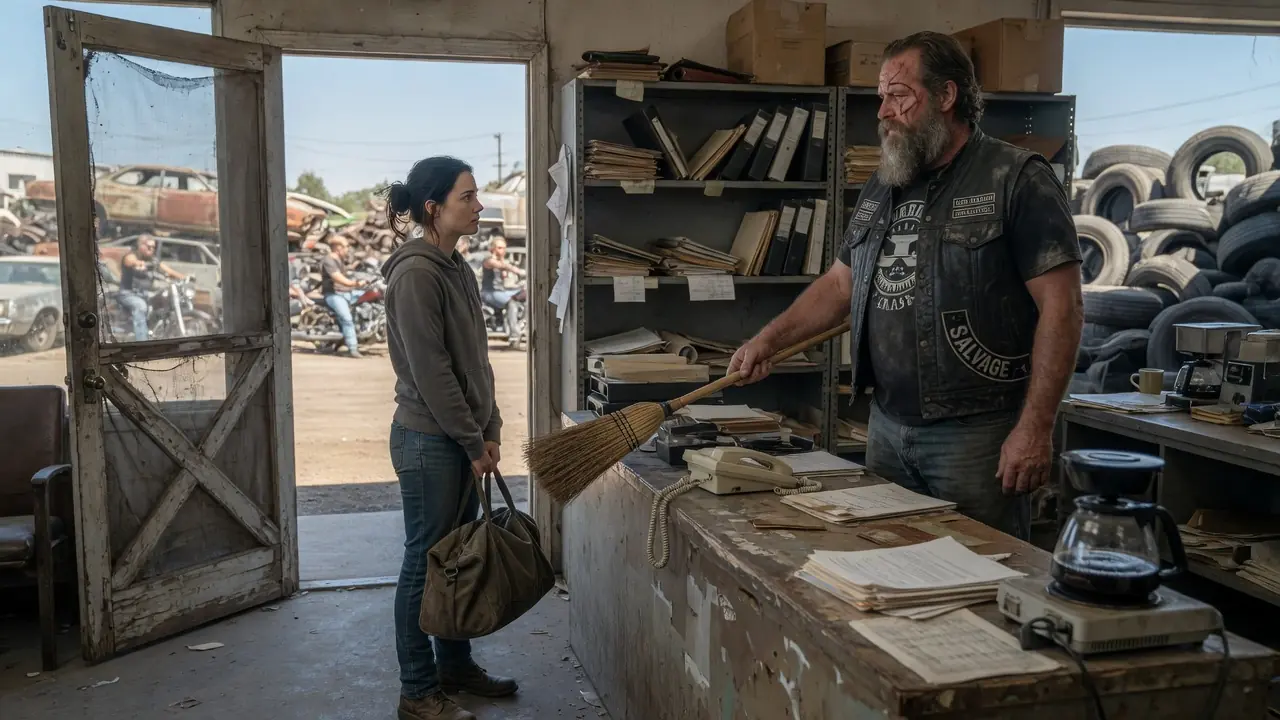
What she found instead was a scrapyard full of Hell’s Angels bikers and a gray-bearded man who handed her a broom like it was a weapon.
She had no idea it would save her life.
The morning Tessa Roland walked into Iron Meridian Auto Salvage, she was running on two hours of sleep, cold coffee from a gas station sixty miles back, and the particular kind of fear that does not shake your hands. It goes still inside you, quiet and hollow, like the moment before a car crash. Your body already knows what is coming, but your brain has not caught up yet.
She almost did not stop.
She had driven past the entrance twice, slowing down both times, looking at the hand-painted sign that hung crooked over the chain-link gate.
Iron Meridian Auto Salvage. Established 1987. No Trespassing.
Both times, she had thought, No. This is not the place. This is not safe. Keep driving.
But she had also done the math three times on a gas station napkin somewhere outside Bakersfield, and the math kept coming out the same way. If she kept driving, she would be down to under three thousand dollars by the time she crossed into Nevada. If she crossed into Nevada, Preston would find her within a week.
He had people in Nevada.
He had people in a lot of places.
So she turned around.
She pulled her car, a 2009 Honda Civic with a cracked left taillight and a bumper held on with zip ties, into the gravel lot of Iron Meridian Auto Salvage. She killed the engine and sat there for a full four minutes, just breathing.
The yard was big, bigger than she expected. Mountains of crushed and twisted metal rose on all sides, organized in a way that only made sense if you had been there long enough to learn the logic of it. There were rows of cars stripped to their frames, towers of engine blocks, and walls of tires stacked six high.
Moving between all of it, slow and deliberate, were men. Big men, mostly, with leather vests and road-worn faces. Men who did not look up when a strange car pulled into the lot.
That was the first thing that struck her.
None of them looked up.
She had expected hostility. She had prepared herself for it, rehearsed the small smile she would use, the voice she would keep steady. What she had not prepared for was indifference, the particular kind that comes not from cruelty, but from a world that has its own rules, its own gravity, and simply does not orbit around strangers who drive up unannounced.
At 7:42 in the morning, Tessa got out of the car.
She was thirty-one years old, five foot four, with dark hair she had pulled back into a knot because there had not been time to do anything else with it. She wore jeans, a gray pullover, and boots she had bought at a Goodwill outside Fresno because her own shoes had been left behind in the apartment she had shared with Preston, along with most of her clothes, her good coat, and three years of her life she was never getting back.
She walked to the front office, which was a low building with a metal roof and a screen door that hung at a slight angle. There was a handwritten note taped to the glass.
Ring bell or don’t.
Either way, she rang the bell.
Nothing happened for a long moment.
Then the screen door swung open, and Rafe Calder walked out.
She had heard of men who commanded a room without saying a word. She had always figured that was the kind of thing people said about politicians or executives, men who had bought their authority in expensive suits and leather offices.
She had not expected to feel it standing in a gravel lot in front of a scrapyard, facing a man in a worn Hell’s Angels vest with a gray beard that came down to his collarbone and a scar that ran from the corner of his left eye to his jaw like a crack in old concrete.
Rafe Calder was fifty-eight years old. He stood six foot two and moved the way large old things moved: slowly, without hurry, with the absolute confidence of something that had never needed to rush because it had never been afraid of being late.
He looked at her, not through her, not past her, but at her, the way you look at a piece of machinery you are trying to figure out.
Not unkind.
Precise.
“Help you?” he said.
Two words.
Flat.
Not warm.
Not cold.
“I heard you were hiring,” she said. “For the office. Records, intake, filing.”
He looked at her for another long moment.
“Where’d you hear that?”
“Flyer at the truck stop on Route 14.”
“About three weeks old.”
He said nothing.
“I know it’s been a while since the posting,” she said, “but I figured if the position was filled, you would have taken the flyer down.”
Something moved across his face.
Not a smile exactly.
More like the internal acknowledgement of a point well made.
“You got experience?” he said.
“Accounts receivable, inventory logging, permit compliance. Two years at a municipal waste-management contractor in San Diego. Before that, three years handling logistics documentation for a freight company.”
She paused.
“I’m organized. I work fast. And I don’t ask questions that aren’t my business.”
That last part, she knew, was a gamble.
It was also the truest thing she had said.
She had learned the hard way that in certain kinds of places, the ability to stay in your own lane was worth more than any credential.
Rafe studied her for another five seconds.
Five seconds is a long time when someone is looking at you that carefully.
Then he turned around and walked back inside.
“Come on,” he said.
She followed him.
The inside of the office was a wreck.
That was the only word for it.
A long counter ran the length of one wall, and behind it were shelves. Metal industrial shelves, the kind you would find in a warehouse, absolutely buried in paper, folders, binders, loose receipts, manila envelopes, and plastic bins overflowing with forms.
On the counter itself were two old computers, a receipt printer that looked like it predated smartphones, a coffee maker, and a landline telephone that was actually corded. On the floor, shoved into the corner behind the door, were cardboard boxes, six of them, maybe seven, taped shut and labeled in marker with dates going back to 2014.
Tessa looked at it all.
She kept her face neutral.
“Previous girl quit four months ago,” Rafe said without looking at her.
He was moving behind the counter, pulling out a drawer, rifling through it.
“One before her lasted three weeks. One before that…”
He stopped.
He found what he was looking for.
A ring of keys, maybe twenty of them, on a heavy steel ring.
He set them on the counter.
Then he reached into a different drawer and pulled out a broom.
He set that on the counter too.
“One before that didn’t make it through the first day.”
He looked at her.
“Three things,” he said. “You don’t touch anything you don’t understand. You don’t make copies of anything without asking me first. And if somebody comes in and asks questions about the yard, about the inventory, about anybody who works here, you tell me before you tell them anything.”
“Understood.”
“Pay is sixteen-fifty an hour to start. Cash weekly. You work eight to five, Monday through Saturday. You get a half hour for lunch. You take it at the counter. You don’t go into the yard without telling somebody.”
He paused.
“Questions?”
“One,” she said. “What’s the broom for?”
He looked at her with an expression she could not quite read.
Then he picked up the broom and handed it to her.
“Start with the corner behind the filing cabinet. Hasn’t been swept since March.”
That was the interview.
That was the whole thing.
She picked up the broom and went to work.
The corner behind the filing cabinet had not, in fact, been swept since March. There were drifts of grit and metal shavings, a mouse trap that had been sprung and never cleared, three receipts from 2019 that had apparently fallen and been forgotten, and a single red-handled screwdriver that she placed carefully on the counter without comment.
She swept.
While she swept, she watched.
Men came in and out of the office throughout the morning. Some handed paperwork to Rafe, who glanced at it and put it somewhere on the counter without filing it. Some asked questions in low voices that she could not quite hear. Some looked at her, most just once, sizing her up and then moving on, which told her she had passed some basic test simply by not flinching when they walked in.
One of them, a man with a shaved head and forearms covered in faded tattoos, came in just before nine and stopped when he saw her.
He looked at Rafe.
“New girl?”
“New intake clerk,” Rafe said without looking up from the form he was reading.
The man looked at Tessa.
“You know what you got into?”
“A job,” she said.
He thought about that for a second.
Then he smiled, small and genuine, the kind you cannot fake, and walked out.
By 9:30, Tessa had finished sweeping, located the trash bags under the counter, third cabinet from the left, cleared the dead mouse trap, and begun to understand the scope of what she was looking at.
The filing system, if you could call it that, was a disaster.
Not a chaotic disaster.
Not disorganized from the start.
It was a disaster of accumulation, the kind that happens when a system that worked fine for one person gets handed to someone new who does not understand it, then handed again to someone who does not care, and then left alone for four months while nobody handles it at all.
There was a logic buried in here somewhere.
She could feel it the way you can feel the structure of a building, even when the walls are covered in damage.
She pulled a stool to the end of the counter and started with the most recent box.
“What are you doing?” Rafe said.
He was standing with his back to her, pouring coffee.
“Starting with the newest records and working backward,” she said. “If there are any compliance issues, inspection tags, permits, environmental certifications, they’ll show up faster if I start with the most recent documents.”
A pause.
He turned around.
“You know about permit compliance for scrap operations?”
“I know about permit compliance for operations that handle hazardous materials and mixed waste,” she said, “which is most of what a yard like this generates. Fluids, batteries, tires, catalytic converters. Regulations vary depending on the state. In California, the oversight requirements changed in 2021. If the records haven’t been updated to reflect that, there could be exposure.”
He was looking at her the way he had when she first walked up to the door.
That precise, calculating look.
“You said you worked waste management two years.”
“I did.”
“The compliance part wasn’t exciting, but I paid attention.”
He looked at the box she had opened.
He looked at her.
Then he poured a second mug of coffee and set it on the counter near her without saying a word.
That was how Rafe Calder said, You’re not just passing time here.
She understood it immediately.
She drank the coffee and kept working.
By 10:15, she had found the first problem.
It was not huge, not on its own.
A batch of scrap intake tickets from the previous year had been flagged for secondary inspection but had never received documented follow-up. In a properly maintained system, each flagged ticket should have had a corresponding clearance form attached within thirty days.
These did not.
Forty-three tickets.
No clearance forms.
She pulled a yellow legal pad from a stack near the printer and began a list.
Rafe came by at 10:30, refilling his coffee, and glanced at the pad.
“What’s that?”
“Documentation gaps,” she said. “I’m cataloging them before I start correcting anything. That way, if someone asks what the status was when I started, I have a baseline record.”
He was quiet for a moment.
Then he said, “Smart.”
She did not look up.
“I’ve worked for people who created the problems and then blamed the person who came in after. I document everything.”
A silence settled between them.
Not uncomfortable.
The kind that forms between two people who have each, at some point, been left holding a bag that was not theirs to carry.
“I’ll get you a second legal pad,” he said.
By eleven, she had filled most of the first one.
The scale office, her corner of it, the worst corner, the one with the broken desk chair and the overhead light that flickered every forty seconds, had begun to take shape. She had three separate stacks going: documents in order, documents with gaps, and documents that were simply in the wrong place entirely and needed to find their way to a different file.
She had labeled each stack with a sticky note. She had found a staple remover, two working pens, and a roll of red flagging tape in the supply cabinet, and used the tape to mark the folders that needed immediate attention.
At 11:20, a man she had not met yet leaned against the door frame and watched her work. He was younger than most, maybe forty, with a short dark beard and the particular kind of stillness that very controlled people have.
“You’re really going through all that?”
It was not a question.
“Working through it, yes,” she said.
“Why?”
She looked up for the first time.
“Because if I don’t understand what’s here, I can’t protect it. And if I can’t protect it, I’m just taking up space.”
He held her gaze for a moment.
She went back to work.
At noon, Rafe appeared with a paper bag from somewhere: a sandwich, a bag of chips, a bottle of water. He set it near her elbow.
“Half hour,” he said.
She ate without leaving the counter.
She was on her fourth legal pad by 1:30.
The picture she was assembling was complex, but not incomprehensible. Iron Meridian had been running for thirty-seven years. In that time, it had accumulated a compliance history that was honestly not bad for a yard of its size and age. There had been real effort here at certain points.
Someone, maybe five years ago, had clearly understood the documentation system and maintained it well. But then something had shifted. The careful hand had been removed, and in the absence of that care, the cracks had widened.
She found misclassified hazardous materials forms. She found permits that had been renewed but whose renewal paperwork had not been attached to the original applications. She found inspection certificates that referenced vehicles not in the current inventory, which could mean the vehicles had been processed and the records lost, or it could mean something more complicated.
She started a separate column on her legal pad.
Possible liability exposure.
She kept it in shorthand, clinical and unalarming.
She was not here to create panic.
She was here to build clarity.
By two o’clock, Rafe was watching her more often.
She noticed it the same way she had learned to notice everything about Preston. The shift in someone’s attention. The way their weight changes when they are paying closer attention than they are letting on.
But Rafe’s attention was different.
Preston’s attention had always felt like a trap, like a searchlight that would eventually pin her to a wall. Rafe’s attention felt like assessment, like a mechanic checking torque.
Not warm.
But not threatening either.
Just honest.
At 2:15, one of the older bikers, a man she had come to think of as the one with the silver braid because that was what distinguished him from the others, stopped at the counter and looked at her stacks.
“You going to finish all of that today?”
“I’m going to get through the audit baseline today,” she said. “The corrections will take longer, but I want to know what I’m dealing with before I start changing anything.”
He scratched the back of his neck.
“Previous girls in here just filed stuff wherever and called it done.”
“I know,” she said. “I can tell.”
He laughed.
It was a real laugh, short and surprised.
Then he shook his head and walked away.
At 2:40, Tessa’s phone buzzed.
She kept it face down on the counter, which she had been doing all day. But the buzz had a different quality to it, longer, more insistent, and she knew before she turned it over what she was going to see.
She was right.
The message was from a number she did not recognize, which meant nothing. Preston had a way of getting new numbers. He had used eight different numbers in the last six months.
The message said:
Heard you left the city. Interesting choice. We should talk about the things you took when you left.
Her hands went still on the papers in front of her.
She had not taken anything.
She had left with the clothes on her back and the cash she had saved quietly over fourteen months in an account he did not know about. She had not taken anything that was his. She knew better. She had known for a long time that the day she left, she needed to leave clean.
Nothing he could use as a reason to come after her legally.
Nothing he could hold up and say she stole.
But Preston had never needed a real reason.
He made them.
She set the phone back down, face down.
She kept working.
By 3:30, she had built something she had not had when she walked in that morning.
A picture.
A real, clear, documented picture of the yard’s compliance status, its gaps, its risks, and most importantly, its strengths.
Because there were strengths.
The core operational permits were solid. The primary hazardous waste certifications were current. The fundamental documentation structure that Rafe himself had apparently maintained for years was sound. The problems were in the accumulation zone, the last two years, the transitional period, the aftermath of turnover.
She could fix this.
She knew exactly how to fix this.
At four o’clock, Rafe came to stand beside her at the counter. He looked at the legal pads. He looked at the stacks. He looked at the list of documentation gaps, which now ran to sixty-one items, cross-referenced, dated, prioritized by risk level.
“You did this in one day,” he said.
“I didn’t fix anything yet,” she said. “I just mapped it.”
“Mapping it is the part nobody ever does,” he said.
She nodded once.
He was quiet for a moment.
Then, very carefully, the way people say things they mean but have not said before, he said, “You’re not here just because you needed a job, are you?”
It was not quite a question.
Not quite a statement either.
It sat somewhere in between, the way the most important things often do.
She kept her eyes on the papers in front of her.
“I needed a job,” she said. “I also needed somewhere I could think. Somewhere I could breathe. Somewhere somebody coming through the gate looking for me would have a harder time than they expected.”
Another silence.
“Somebody like who?” Rafe said.
She looked at him then, straight on, no flinching.
“His name is Preston Vale. He’s going to come here. I don’t know when, but when he does, he’s going to try to make it sound official. He’s going to wave papers around and talk about forms and violations because that’s how he does it. He makes himself sound like the reasonable one, the one following the rules. And he’s very good at it.”
Rafe looked at her for a long time.
“Can he find something real?” he said.
He meant in the records.
In the compliance gaps.
“He could have this morning,” she said. “He’s going to have a harder time tonight.”
The corner of Rafe’s mouth shifted.
Not quite a smile.
Something more settled than that.
“Finish what you’re doing,” he said. “Then we’ll talk about tomorrow.”
She turned back to her work.
Outside in the yard, the late afternoon light cut low through the towers of metal, and the men moved through it the way they always did, like shadows with purpose, quiet and deliberate.
One of them paused near the gate just for a moment, looking out at the road.
Nothing was on the road yet, but something was coming.
Tessa Roland had spent three years learning to feel it before it arrived, and she felt it now the same way she had felt it the morning she finally left.
That hollow, still certainty.
He was coming.
She filed the forty-third gap document, clipped it together with the clearance form she had reconstructed from the backup records, and set it in the correct stack.
Let him come, she thought.
Let him come and find out what I’ve built.
The next morning, she came back.
That was the thing nobody expected.
Not the man with the silver braid, who had paused near the gate at 7:58 and watched her car pull in without saying anything. Not the younger one with the dark beard, who was leaning against the front wall of the office drinking coffee and stopped mid-sip when he saw her headlights. Not even Rafe, who had his back to the door when she came in but went still for just a fraction of a second.
The kind of stillness that means you were listening for something and just heard it.
She had come back.
She hung her bag on the hook behind the door. She had found it yesterday, a single coat hook screwed into the wall at an angle like somebody had put it in fast and never straightened it.
Then she went to the counter and picked up exactly where she had left off.
“Coffee’s on the burner,” Rafe said without turning around.
“Thank you,” she said.
That was the whole conversation.
But it meant something.
Both of them knew it meant something.
She poured the coffee, pulled the first legal pad toward her, and read her own notes from the day before the way a surgeon reviews the chart before going back into the operating room. She needed to remember exactly where she was, exactly what she knew, and exactly what was still exposed because the text from last night, the one from the number she did not recognize, was still sitting in her phone like a stone in a pocket.
She had not answered it.
Not answering it meant something too.
It meant she was choosing the next move carefully. It meant she was not going to be rushed. She had learned that lesson slowly and at significant cost: the moment you let someone else control the pace, you have already lost the first round.
By 8:20, she had resumed the filing corrections, cross-referencing the clearance forms she had started rebuilding the previous afternoon.
The process was painstaking. Each form had to be matched to its original intake ticket, dated accurately, and attached in the correct sequence so that any audit trail would read cleanly from start to finish. It was the kind of work that required you to hold three things in your head at once while your hands did a fourth.
She had always been good at that.
Good at splitting her attention without losing any of it.
At 8:45, the man with the silver braid came in.
His name, she had learned yesterday afternoon, was Dutch. He had been with the yard for eleven years. He handled incoming vehicle assessments, drove anything that could still move, documented what could not, and had a memory for part numbers that Rafe said was better than any computer they had ever tried to use.
“You sleep here?” Dutch said.
“Drove back in this morning,” she said.
“From where?”
“Motel on Route 14.”
She did not look up.
“It’s fine. Clean enough.”
Dutch poured himself coffee and leaned on the counter. Not close enough to crowd her, but close enough that she understood this was his space too, and he was choosing to share it.
“You know, Rafe doesn’t let people stay in motels when they’re working here. Not long term.”
She did look up then.
“There’s a room above the parts warehouse,” Dutch said.
He was not looking at her.
He was looking at his coffee.
“Cot. Sink. One window. It’s not the Ritz, but it’s on-site and it’s got a deadbolt.”
A deadbolt.
He had said the word deadbolt the same way you say it when you know someone is counting locks.
“I’d have to ask Rafe,” she said.
“Already asked him,” Dutch said.
He set his mug down, pushed off the counter, and walked back out.
She sat with that for a moment.
Then she turned back to her work.
At 9:15, her phone buzzed again.
This time, it was a different number, but the message carried the same voice. She knew his voice in text, the same way she knew it in person, the particular cadence of someone who believes the right arrangement of words can make you feel like the unreasonable one.
I know you’re still in state. You should call me before this gets complicated. I’m trying to be fair.
She put the phone in her bag and zipped it.
Fair.
The word sat in her chest like a cough.
She had heard Preston use that word so many times in so many different situations, always to mean the same thing.
Fair, to Preston, meant whatever version of events made him look reasonable and her look unstable. Fair meant whatever outcome he had already decided on before the conversation started.
She pulled the next folder and kept working faster now.
By ten o’clock, she had corrected twenty-nine of the sixty-one flagged gaps.
Each correction was documented on a separate running log.
Date of original error.
Nature of discrepancy.
Corrective action taken.
New document reference number.
The log was clean enough that any regulator who walked in could follow it without asking a single question.
That was the point.
You did not just fix the problem. You built the story of how the problem got fixed so that no one could come in later and claim it had never been addressed.
Rafe came by at 10:20 and stood at the end of the counter, looking at the log. He read it the way a man reads something that surprises him, not because the content is shocking, but because he did not know to expect it at all.
“You made a correction ledger,” he said.
“If someone challenges a document, you need to show the chain of custody,” she said. “The original record, the identified error, the fix, the date. Without the ledger, it’s just a pile of corrected papers with no explanation.”
He looked at the log for another moment.
Then he said, “Where’d you learn to think like this?”
She was quiet for a beat.
Then she said, “The same place you learn most things. By watching somebody use the system against you and deciding you were going to understand it better than they did.”
He did not ask who.
She did not say.
But something passed between them.
Recognition, maybe.
The particular kind that exists between people who have both, at different points in their lives, been on the wrong side of a process that was supposed to be neutral.
He poured himself coffee and went back to his desk.
At eleven, the young one with the dark beard came in. His name was Marco. She had figured that out because people said it when they came looking for him.
Marco had a habit of asking questions in a way that sounded casual but was not. She had noticed that about him on day one. The questions came sideways, the way a poker player bets sideways when they are holding something.
“How many documents did you get through yesterday?” he said, sitting on the edge of the counter the way men do when they are trying to look relaxed.
“Mapped sixty-one gaps,” she said. “Corrected about a third of them before I left.”
“And today?”
“Twenty-nine corrections by ten. I’ll have the full compliance baseline finished by end of day.”
He was quiet for a moment.
“That’s fast.”
“The filing isn’t hard once you understand the system,” she said. “The system here is actually logical. It just got neglected.”
“You figured out the system in one day.”
“I figured out the bones of it in one day,” she said. “The logic somebody used when they built it. Once you understand that, everything else is pattern recognition.”
Marco looked at her.
He had dark eyes that did not give a lot away.
“Rafe built that system himself in 1997. Nobody’s ever described it as logical before.”
She almost smiled.
“Tell him I said it’s solid. The problems aren’t structural. They’re maintenance.”
Marco looked at her for another moment.
“I’ll tell him,” he said.
He said it in a way that meant he actually would.
Then he left.
She kept working.
By 11:45, she hit the first real problem.
Not a documentation gap.
Those she could fix.
This was different.
This was a permit.
Specifically, it was the secondary hazardous materials storage permit, the one that covered the fluid containment bays in the back section of the yard. The permit itself was valid, current, signed, and appropriately referenced. But attached to the back of it, filed out of sequence, which was why she had almost missed it, was a conditional notice issued eight months ago requiring a site inspection to confirm the installation of upgraded containment barriers, which had been mandated as a condition of the permit renewal.
She read the notice twice.
Then she read it a third time.
The inspection had never been scheduled.
Or if it had been scheduled, there was no record of it here.
That meant there was either a missing document or a lapsed condition on an active permit.
A lapsed permit condition was not a small thing. It was the kind of thing a determined regulator or a determined person with a lawyer could use to challenge the entire permit’s validity.
She set the notice on the counter very carefully, the way you set something down when you do not want it to know you found it.
“Rafe,” she said.
He looked up from his desk.
“Come look at this.”
He came and stood beside her.
She pointed to the conditional notice.
He read it.
His jaw tightened just slightly.
Just enough.
“Did you know about this?” she said.
She kept her voice completely neutral.
Not accusatory.
Just asking.
“Somebody told me it was handled,” he said.
The words came out measured, but there was something under them, the particular flatness of a man realizing he was told something that was not true.
“Do you know who handled it?”
A pause.
“Previous office manager,” he said. “The one who quit four months ago. The one before her.”
Tessa nodded once.
“Okay,” she said. “Here is where we are. The permit is valid. The condition is lapsed, but it is not expired, meaning we’re in a grace window. If I can document that the site work was actually done, physically done, even if it was never formally inspected, we can file for a retroactive inspection and close the condition out. That’s a fixable situation.”
“How long would it take to document the work?”
“A few hours if we can find anybody who was present when it was done. To file for the inspection, I can have the application ready by tomorrow morning.”
Rafe was quiet for a moment.
“You know how to file for a retroactive inspection.”
“I’ve done it before,” she said. “It’s not common, but it’s a recognized process. Regulators prefer it to discovering the gap themselves. It shows good faith.”
He looked at her.
“You showed up yesterday with a broom.”
“You didn’t ask me what else I knew how to do,” she said.
Another one of those silences.
The kind that was not empty, but full.
He picked up the conditional notice, looked at it one more time, and set it back down.
“Find out who can speak to the site work,” he said. “Dutch was here when most of the physical upgrades happened. Start with him.”
She nodded.
She wrote Dutch — containment bay work at the top of a fresh page.
She had twelve items on that page before noon.
Dutch, it turned out, not only remembered the containment bay installation, he had photographs of it on his phone from when he had been documenting a different equipment upgrade happening at the same time.
He brought the phone to the office at 12:30, and she spent fifteen minutes going through the images with him, identifying each one, cross-referencing it with the site diagram attached to the original permit application, and building a photo log with dates and descriptions.
“You want to print these?” Dutch said.
“Please.”
He looked at the ancient receipt printer on the counter.
“Not on that,” she said. “Do you have a color printer anywhere on-site?”
“Parts warehouse. Back room.”
He paused.
“It mostly works.”
“Mostly?”
“Eighty percent.”
“I’ll take eighty percent,” she said.
They walked to the parts warehouse together, Tessa with her notes and Dutch with his phone. It was the first time she had left the office all day, and the air outside hit her differently than she expected.
Sharp.
Metal-edged.
The yard felt different from inside it than it had from the parking lot that morning. Bigger. More layered. The men moving through it had a rhythm she was beginning to read: who moved with urgency, who moved with deliberate ease, who paused where and for how long.
None of it was random.
Everything here had a logic, the same way the filing system had a logic. It had taken thirty-seven years to build, and the fact that the paperwork had decayed did not mean the foundation had.
She was going to prove that.
That day, the printer worked.
Eighty percent was enough.
She had the photo log assembled and cross-referenced by 1:15.
At 1:45, she was back at the counter building the retroactive inspection application when the front gate intercom crackled.
The voice on it was smooth.
Smooth the way expensive things are smooth. The kind of smoothness that comes from practice, from knowing exactly how to modulate your tone so authority sounds inevitable and resistance sounds unreasonable before anyone has even heard what is being resisted.
“Good afternoon. I’m looking for the owner or manager of record for Iron Meridian Auto Salvage. I have some documents I need to discuss regarding compliance status.”
Tessa’s hands stopped moving.
She did not turn around.
She did not reach for her phone.
She just stopped.
In that stillness, that precise, familiar, hollow stillness, she knew.
She knew the voice.
She had heard it in conference rooms and parking lots and once in a courthouse hallway where he had stood close enough that she could smell his aftershave and said very quietly that she was making a mistake.
She had heard it on voicemails and through doors and in her sleep, the way sounds attach themselves to fear and follow you past the point where fear is even conscious anymore.
Preston Vale was at the gate.
He had not waited forty-eight hours.
He had waited fourteen.
Rafe was already moving toward the intercom. His hand went to the response button, and he looked back at Tessa. A single look, fast and direct.
She saw in his face that he had understood what that voice meant before she said a word.
She lifted her chin barely.
Just enough.
He pressed the button.
“Come to the office,” he said.
She turned back to the counter.
She had approximately four minutes before Preston walked through the door.
Four minutes to decide exactly what posture she was going to hold, exactly which documents she was going to have visible, and exactly how much of what she had built in the last day and a half she was going to let him see before she showed him what it meant.
She pulled the correction ledger to the center of the counter.
She set the photo log on top of it.
She opened the permit file to the page that showed the conditional notice, and beside it, the retroactive inspection application she had been building, half-finished but already more thorough than anything Preston’s lawyer had probably expected to find in a yard like this.
She folded her hands on the counter.
She breathed.
Behind her, she heard Rafe’s voice low, directed at someone near the door.
“Tell Dutch and Marco. Now.”
She did not look back.
She did not need to.
The screen door opened.
Preston Vale walked in.
He was exactly what he always was: tall, well-dressed, carrying a leather portfolio that cost more than Tessa’s first month of rent had in the apartment they had shared. He wore a tie. He was the only person in a thirty-meter radius wearing a tie.
He looked around the office with the expression he always used when entering a space he considered beneath him. Not disdain exactly. More like tolerance. The performance of a man temporarily lowering himself on his way to winning something.
His eyes found her in under two seconds.
She watched them change.
Not much.
Preston was too controlled for it to show much.
But she knew his face.
The way you know the face of someone who had power over you for three years.
Every micro-shift.
Every recalibration.
What she saw in those two seconds was not what he had expected to find.
He had expected to find her small.
Cornered.
Caught.
He found her standing behind a counter covered in organized documents, in a yard full of men who had not been told to leave, next to a man built like a stone wall who had not offered his hand or his name.
Preston reset.
She watched him do it.
“Tessa,” he said.
His voice was warm.
Practiced warm.
“I didn’t expect to find you working.”
“Hello, Preston,” she said.
“I’m actually here on a professional matter,” he said.
He opened the portfolio.
“I represent a party with a compliance interest in this property, and I have some documentation that I think the management here needs to—”
“What party?” Rafe said.
Preston looked at him.
The tolerance expression tightened very slightly.
“I’m sorry?”
“You said you represent a party,” Rafe said. “What party?”
A pause.
Preston closed the portfolio slightly.
“That’s a matter I’d prefer to discuss privately with—”
“This is my office,” Rafe said. “My office has one conversation style. You want to talk about my yard’s compliance, you talk here with her present because she’s my records manager, and she knows this yard’s documentation better than anyone in this room.”
He paused.
“Including you.”
Preston looked at Tessa again.
She could see him running the calculation.
The new calculation.
The one that accounted for variables he had not walked in with.
She let him run it.
She did not move.
She did not smile.
She just looked at him the way she had spent the last fourteen months learning to look at him.
Clearly.
Directly.
Without flinching.
His portfolio opened again.
“Fine,” he said. “Let’s start with the hazardous materials storage permit.”
“Let’s,” Tessa said.
She put her hand on the permit file.
“Which section did you want to begin with?”
He pulled a document from the portfolio.
She recognized it.
It was a copy of the conditional notice, the same conditional notice she had found that morning.
He held it up.
“This condition has not been met,” he said. “The inspection was required within ninety days of permit renewal. It’s been eight months.”
“That’s a lapsed condition,” Tessa said, “which means the permit is in a grace window. Under California regulatory guidance, a lapsed inspection condition on an existing valid permit enters a contestable grace period during which the permit holder may file for retroactive inspection, provided they can demonstrate substantive compliance with the underlying condition.”
She turned the correction ledger to face him.
“The site work was completed. I have photographic documentation dated and cross-referenced to the permit diagram, and I have a retroactive inspection application that will be filed tomorrow morning.”
Preston stared at the ledger.
He was still standing.
He was still holding the conditional notice.
But something had gone out of his posture.
Not all of it.
Not yet.
Preston did not collapse.
He regrouped.
She knew this.
She was ready for the regrouping.
“That application hasn’t been filed yet,” he said.
“No,” she said. “But the documentation exists. The compliance exists. The filing is a procedural formality.”
She looked at him steadily.
“You’re welcome to wait until it’s submitted if you’d like to revisit this conversation with accurate information.”
He looked at her for a long moment.
“There are other issues,” he said quietly.
“I’m sure there are,” she said. “I’ve identified sixty-one documentation gaps in this yard’s records. I’ve corrected forty-one of them in the last day and a half. I have a running correction ledger with every change documented, dated, and cross-referenced. Whatever you think you found, I found it first, and I’ve been fixing it.”
The room was very quiet.
Somewhere outside, something metallic shifted and settled.
The ordinary sound of a scrapyard doing what scrapyards do.
And in that ordinary sound was something that felt to Tessa Roland like the ground holding steady under her feet for the first time in a very long time.
Preston closed his portfolio.
He did not leave yet.
There was more coming.
She knew there was more coming.
Preston never came with one card.
But the first card had landed in the wrong place, and they both knew it.
The knowing of it had changed the shape of the room.
Rafe stood beside her like a wall that had been there forever and was not going to move. Dutch appeared in the doorway, and Tessa kept her hands folded on the counter, steady as everything she had built in thirty-six hours, and waited for whatever came next.
Preston did not sit down.
That was the first tell.
Tessa had watched him in enough rooms to know that Preston Vale always sat down. It was part of the performance. The deliberate settling into a chair. The way he arranged his portfolio on the table in front of him. The slight lean back that said, I am comfortable here, and you are not.
He used furniture the way other men used height.
He made himself at home in every room he entered because making himself at home was how he communicated ownership.
He did not sit down here.
He stood just inside the door, portfolio held in front of him with both hands, and scanned the room in a way that was almost imperceptible. Quick, practiced, the kind of assessment you only notice if you have been watched by the same eyes long enough to recognize the pattern.
He was counting.
Counting men.
Counting exits.
Counting variables he had not accounted for when he drove up.
Tessa counted them too.
Dutch in the doorway.
Marco somewhere she could not see, but could feel. She had learned in two days that Marco was always within range when something was happening, never announcing himself, never visible unless he chose to be.
Rafe to her left, close enough that she could feel the solidity of him without looking.
Outside, through the screen door, the ordinary sounds of the yard had not changed at all, which meant the men out there were continuing to work, which meant they had been told to continue working, which meant someone had made a quiet decision that the best show of strength here was the complete absence of theater.
She respected that.
Preston cleared his throat.
“I want to be clear that I’m not here in any adversarial capacity.”
“Nobody said you were,” Rafe said.
“I’m here on behalf of a compliance review organization that has identified potential violations at this property. The intent is to give the owner of record an opportunity to respond before any formal regulatory contact is initiated.”
“What organization?” Rafe said.
Preston paused.
The pause was a tenth of a second too long.
“Pacific Rim Environmental Compliance Group.”
Tessa wrote the name on her legal pad.
She did not look up when she wrote it.
She kept her face completely still.
“Never heard of them,” Rafe said.
“They’re relatively new,” Preston said. “They contract with—”
“Who licenses them?” Tessa said.
Preston looked at her.
“I’m sorry?”
“Private compliance organizations operating in California require a licensing arrangement with a state regulatory body or a bonded legal entity. Who do they contract with? Which agency?”
Another pause.
Fractionally longer this time.
“That information is in the documentation I brought.”
“Can I see it?” she said.
He opened the portfolio and pulled out a single sheet.
He set it on the counter.
She looked at it without touching it for a moment, reading from where she stood, taking it in, feeling the shape of it.
Then she picked it up.
It was formatted to look official.
She would give him that.
Clean header.
Seal-style logo.
Regulatory language that sounded correct on first pass.
But she had spent two days reading actual California regulatory documentation, cross-referencing real permit language with real code citations. The difference between that and a document that was trying to sound like those things was the same as the difference between a key that opens a lock and a key that is the right shape but the wrong cut.
“This references the wrong compliance category,” she said. “That section covers a different class of unified program facilities. Iron Meridian’s permit category operates under a different certification pathway.”
She set the document back on the counter, facing him.
“This citation is wrong for this yard.”
Preston’s jaw moved just once.
“The broader applicability—”
“Doesn’t apply,” she said. “The citation is specific. If the citation is wrong, the authority to conduct a compliance review under this document is wrong.”
She kept her voice absolutely level.
Not aggressive.
Not triumphant.
Just clear, the way facts are clear when you have done the work to know them.
“If Pacific Rim Environmental Compliance Group wants to conduct a legitimate review of this property, they need to come back with documentation that correctly identifies the regulatory pathway and the licensing authority. This isn’t that document.”
The room held its breath.
Preston looked at the document.
Then he looked at her.
In the very precise, very small recalibration of his face, she saw something she had never seen in three years of living inside his orbit.
She saw him not know what to do next.
It lasted about two seconds.
Then he reached into the portfolio again.
“There are additional items,” he said.
His voice had shifted, not dramatically, but enough.
The warmth was gone.
What was underneath was not cold exactly. It was the particular temperature of a man who has decided the pleasant approach is no longer efficient.
“The vehicle inventory records for calendar year 2023 show a discrepancy in title transfer documentation.”
“Which vehicles?” Tessa said.
He read off four VIN numbers from a sheet in his hand.
She pulled the inventory binder she had reorganized yesterday afternoon. It had every vehicle record from the last three years cross-indexed by VIN, date, and processing status.
She found the first VIN in under fifteen seconds.
“Title transfer filed February 14, 2023. DMV confirmation receipt attached.”
She found the second.
“Title transfer filed March 2, 2023. Confirmation receipt attached.”
Third.
“This one has a gap. The original transfer form is here, but the confirmation receipt is missing. I flagged it yesterday. It’s on my correction ledger, item thirty-seven. The receipt can be obtained from DMV with a records request, which takes about a week.”
She looked at him.
“What was the fourth VIN?”
He read it.
She looked.
Found it.
“Title transfer complete. Both the form and the receipt are here. The form is misfiled under the wrong year, which is why it appeared missing. But it’s not missing.”
She closed the binder.
Preston stood very still.
Dutch in the doorway had not moved at all.
He was just there the way a fence post is there.
Not threatening.
Not advancing.
Just absolutely present and immovable.
“The battery disposal records,” Preston said.
His voice was quieter now.
Not softer.
Quieter in the way things get quiet when the energy behind them is running differently.
“Current,” she said. “Certified disposal contractor. Annual contract. Service logs on file.”
“The tire manifest for current—”
“Preston,” she said.
She said his name the way she had when he first arrived.
Not warm.
Not cold.
Just direct.
“I’ve been through this yard’s records for two days. I know what’s here. I know what was missing. I know what I’ve corrected. I know what the legitimate gaps are, and I know the remediation path for each of them. Whatever you came here with, I’ve already found it. Most of it, I’ve already fixed.”
She paused.
“If there’s something in that portfolio that I haven’t covered, show me. I’ll tell you exactly what the status is. But we’ve been standing here for fifteen minutes, and everything you’ve raised has either been a misapplied citation or a document I’ve already addressed. So if there’s something real in there, let’s see it.”
The silence that followed was different from the silences before it.
The others had been taut, full of what was about to happen.
This one had a different quality.
It was the silence of a prepared argument meeting a wall it did not expect and not having a contingency.
Rafe spoke.
His voice was even, almost casual, which she had already learned was when he was most serious.
“I want to ask you something.”
Preston looked at him.
“Pacific Rim Environmental Compliance Group,” Rafe said. “I’m going to make a phone call this afternoon to the California Department of Toxic Substances Control and ask them if they have any record of that organization. I’m going to make a second call to the State Bar of California to confirm your license and any disciplinary history. I’m going to make a third call to the County Assessor’s Office to confirm whether any compliance complaint has been formally filed against this property in the last twelve months.”
He looked at Preston with the flat, clear eyes of a man who had seen exactly this kind of thing before and knew precisely how it ended.
“You want to change anything you’ve told me before I make those calls?”
Preston’s hand tightened on the portfolio.
Tessa watched it happen.
That tightening.
And she felt something move in her chest.
Not triumph.
Something quieter than triumph.
Something closer to the feeling you get when you have been holding your breath for a very long time and finally let it out.
The feeling of oxygen.
“I’m acting within my legal rights,” Preston said.
“I didn’t say you weren’t,” Rafe said. “I asked if you wanted to change anything.”
Marco appeared, not from the doorway where Dutch stood, but from the side, through the internal door that led back through the parts inventory room, which meant he had been in the building the whole time and she simply had not known it.
He did not say anything.
He just came and stood near Rafe.
The geometry of the room shifted in a way that had nothing to do with aggression and everything to do with presence.
Preston looked at the three of them.
Rafe.
Marco.
Dutch in the doorway.
Then he looked at Tessa.
Really looked at her, the way he had not let himself look since he walked in and found her not where he expected her to be.
She looked back.
She held it.
She did not let herself feel anything in her face that she had not decided to put there.
What she had decided to put there was nothing.
Not defiance.
Not fear.
Not the particular desperate composure she had used for three years when she was trying not to give him anything to grab onto.
Just steadiness.
The steadiness of a woman who had spent forty-eight hours building something solid under her feet and was now standing on it.
“You’re making a mistake,” he said.
Quiet.
Directed at her.
“I’ve made mistakes before,” she said. “I’ve learned to recognize them pretty early.”
She held his gaze.
“This isn’t one.”
He closed his portfolio.
He looked around the room one more time.
That same assessment.
That same counting of variables.
But the count was coming out differently now than it had when he walked in, and they both knew it. The knowing of it was visible in the small decisions his body was making. The slight straightening, the repositioning of the portfolio under his arm, the tiny shift toward the door that had not happened yet but was about to.
“I’ll be in touch,” he said.
It was directed at Rafe.
“You have our address,” Rafe said.
Preston walked out.
The screen door swung behind him.
They heard his shoes on the gravel, measured and unhurried because Preston Vale did not hurry. Even in retreat, he moved like a man who was choosing to leave.
They heard his car door.
They heard the engine.
They heard the crunch of gravel as he pulled out.
Nobody moved for about five seconds.
Then Dutch exhaled through his nose and said, “Huh.”
Marco looked at Tessa.
“Pacific Rim Environmental Compliance Group,” he said. “That’s not a real organization.”
“No,” she said. “It’s not.”
“You knew that when he said it.”
“I suspected it when he said it,” she said. “I was more certain when I saw the document.”
Marco looked at Rafe.
Something moved between them, a communication she was not fully part of, the kind that exists between people who have known each other long enough that the shorthand runs below words.
Rafe looked at Tessa.
“He made that up,” he said. “The whole compliance review.”
“The document was designed to look real enough to intimidate someone who didn’t know the regulatory framework,” she said. “If I hadn’t been here, if whoever was working this desk hadn’t known what to look for, he probably could have used it to demand access to your records. Once he had access to the records in their original state, he’d have had something real to work with. The gaps were real. He just needed a way in.”
“He came here for you,” Rafe said.
“He came here because of me,” she said. “But the play was against the yard.”
She paused.
“That’s how he works. He doesn’t come at the thing directly. He comes at what’s around it. He came here to find something he could use as leverage. Something that would make you want him gone badly enough to hand me over to make it happen.”
The room was very quiet.
“That’s a particular kind of person,” Dutch said slowly, like he was deciding how many words to spend on it.
“Yes,” she said. “It is.”
Rafe walked to his desk. He opened the top drawer and pulled out a spiral notepad, the old-fashioned kind, cheap, the pages slightly wavy from moisture.
He wrote something on the top page, tore it off, and walked back to the counter.
He set it down in front of her.
It was the name and phone number for a county-level regulatory contact. Below that, the State Bar number. Below that, a third number she did not recognize.
“That third one is a lawyer,” he said. “Friend of the yard. Good at what she does. She won’t overcharge you.”
He paused.
“You should make those calls today if you can.”
She looked at the paper.
She looked at him.
“Rafe—”
“Don’t,” he said, not unkindly. “Don’t make a thing of it. You worked for this. You earned it today. And you’re going to need to build some walls around yourself before he comes back with something better prepared.”
He held her gaze.
“Because he’ll come back.”
“I know,” she said.
“You need walls that don’t depend on me being in the room.”
She understood what he was saying.
He was right.
He was completely right.
The wall she had built in the last two days was real: the compliance baseline, the correction ledger, the documented photo evidence. But all of it would only hold if she had legal standing of her own. If she was just an employee at a yard, Preston could find a way to remove her from the equation and then come back at the yard’s documentation from a different angle.
What she needed was not just to be good at the work.
She needed the work to be formally hers.
“What are you saying?” she asked carefully.
He looked at her for a moment.
Then he went back to his desk.
He opened a different drawer, the bottom one, the one he had not opened in front of her before, and pulled out a printed form. He brought it to the counter and put it down.
It was an employment contract.
Official.
Typed.
Not handwritten.
Two pages.
At the top: Iron Meridian Auto Salvage Employee Agreement — Records and Yard Intake Manager, Temporary Status.
She looked at it.
She did not pick it up immediately.
“Temporary,” she said.
“Ninety days,” he said. “After that, we renegotiate. Twenty-one-seventy-five an hour. Paid weekly cash. Room above the parts warehouse included as part of compensation. No rent charged.”
He paused.
“The title matters. Records and Intake Manager means you’re the documented point of contact for any regulatory inquiry. If Pacific Rim Compliance or anyone like them comes back, they have to go through you officially. That makes your standing here a matter of record.”
She looked at the contract.
She looked at him.
“You had this ready.”
“Dutch told me last night you were good,” he said. “I wanted to see how good.”
He paused.
“Now I know.”
She picked up the contract and read it.
She read it carefully the way she read everything. Not rushing. Not performing the speed-read she could have done. Just actually reading every word because she had learned that the words that matter are usually the ones that come after you have already decided to trust something.
It was clean.
Straightforward.
No traps.
She looked up.
“I’m going to read it again tonight.”
“Take your time,” he said.
“And I’m going to call that lawyer before I sign anything.”
Something in his face shifted at the very edge of satisfaction.
“Good,” he said. “That’s what you should do.”
She folded the contract and put it in her bag.
Her hands were completely steady.
She had not noticed them becoming steady.
It had happened at some point in the last forty minutes without her permission, the same way certain things heal.
Not when you decide to heal, but when the conditions finally allow it.
“I’m going back to the correction ledger,” she said.
“You’ve got nineteen gaps left,” he said.
He said it the way you say it when you have already counted and you want the other person to know you have been paying attention.
“Eighteen,” she said. “I finished one while he was talking.”
Dutch made a sound in the doorway that might have been a laugh.
She did not look up.
She pulled the ledger toward her and picked up her pen.
Outside, the yard kept moving.
The sounds were the same sounds they had been all morning: the drag and clang of metal, the rumble of equipment, the occasional call of a voice carrying across the open ground. But something had shifted in the way she heard them.
They were the same sounds, but they were hers now in a way they had not been before.
Not because she had done anything extraordinary.
Because she had done something precise.
Something meticulous.
Something that required everything she had.
And it had been enough.
At 3:15, she found the last gap on the list: a single misfiled receipt from 2022, a battery disposal certification that had been placed in the wrong binder and therefore appeared absent from the main compliance record.
She pulled it, cross-referenced it, attached it correctly, and wrote the final entry on the correction ledger.
She set down her pen.
She sat back on the stool.
She had built in forty-eight hours something that previous record managers had allowed to deteriorate over years. She had not restored it to what it was. She had built it into something better than it had been.
She had made it defensible.
She had made it legible.
She had made it the kind of documentation that would hold up to scrutiny, not just from a fake compliance organization run by her ex, but from any actual regulator who walked through that door.
She had done it with a broom, four legal pads, and a determination she had not known she still had.
Her phone buzzed.
She looked at it.
A new number again.
She was getting tired of new numbers.
The message said:
You think one conversation ends this. You’re wrong. I know things about that yard that you don’t. Call me.
She read it twice.
Then she set the phone face down on the counter and picked up the number Rafe had given her.
The lawyer.
She dialed.
It rang twice.
A woman’s voice answered, businesslike and direct.
“This is Karen Selby.”
“My name is Tessa Roland,” she said. “I was given your number by Rafe Calder at Iron Meridian Auto Salvage. I need to talk to someone about a situation involving a person who is using fraudulent compliance documentation to access a private business property, and I think there may be a harassment component that needs to be addressed before he finds a better angle.”
A pause.
Then Karen said, “Are you somewhere safe right now?”
Tessa looked at the counter in front of her. At the correction ledger. At the permit file with the retroactive inspection application paper-clipped to the front. At the keys on the hook by the door.
Rafe’s keys.
The ring he had handed her on day one like it was an ordinary thing.
Like handing a stranger a ring of keys was something you just did.
“Yes,” she said. “I’m somewhere safe.”
She meant it.
But in the back of her mind, in the part that had been running calculations since the moment she read Preston’s last message, something was turning over slowly, working its way toward the surface.
He had said, I know things about that yard that you don’t.
It was not an empty threat.
Preston did not make empty threats.
He made threats that sounded larger than what he had, yes, but underneath the inflation, there was always something real. Something he had found or been told or worked out through the same methodical, predatory patience he applied to everything.
She had sixty-one gaps in the original record.
She had corrected sixty of them.
Sixty.
The retroactive inspection application, the one for the containment bay condition, was still sitting on the counter half-finished.
Not yet filed.
Not yet filed.
She looked at it.
“Ms. Roland?” Karen Selby said on the phone.
“I’m here,” Tessa said. “I’m sorry. Can I call you back in two hours? There’s something I need to finish first.”
She hung up.
She pulled the application toward her.
She picked up her pen.
She was not going to leave a single open door.
Not one.
She finished the retroactive inspection application at 4:07.
It was eleven pages.
Every section filled.
Every supporting document attached in the correct sequence.
The photo log Dutch had helped her build.
The cross-referenced site diagram.
The original permit renewal.
The conditional notice.
The correction ledger entry.
She had written the narrative summary herself in the plain, precise language that regulatory bodies respond to, the language that says, We know what we are doing, and we have nothing to hide.
She had cited the correct code section.
Not the one Preston had used.
The wrong one.
The one designed to sound right to someone who did not know better.
The right one.
The one that applied to this yard, this permit category, this specific remediation pathway.
She put the completed application in a manila envelope, wrote the address of the California DTSC regional office on the front, and set it next to the outgoing mail tray.
Then she called Karen Selby back.
The conversation lasted thirty-eight minutes.
Tessa sat at the counter with a fresh legal pad and wrote down everything Karen said because Karen Selby spoke the way good lawyers speak when they are being genuinely useful.
Fast.
Specific.
No padding.
She covered three things.
What Preston had done that was potentially actionable.
What Tessa needed to document to make it actionable.
And what the realistic timeline looked like if they decided to move forward formally.
The potentially actionable list was longer than Tessa had expected.
Using a fraudulent organizational identity to gain access to private business property. Misrepresenting regulatory authority in a written document. A pattern of contact through unknown numbers that could be characterized as harassment depending on documented frequency and content.
And then there was the one that surprised her, the one Karen said quietly and carefully.
The possibility that, if Preston had obtained the yard’s address or details about her employment through surveillance or unauthorized access to her personal communications, that opened a different door entirely.
“Has he ever accessed your phone or your accounts without your knowledge?” Karen asked.
Tessa was quiet for a moment.
“I don’t know for certain,” she said. “There were times when he knew things he shouldn’t have known, things I hadn’t told him. I never had proof.”
“If you still have any devices that were in the shared space during your relationship, don’t factory reset them,” Karen said. “Bring them to me, and I’ll have someone look at them.”
Tessa looked at her cracked-screen phone on the counter, the one she had had for two years, the one that had charged on the nightstand in Preston’s apartment for fourteen months.
“I have one device,” she said.
“Keep it,” Karen said. “Don’t reset it. And forward me screenshots of every message you’ve received from unknown numbers in the last seventy-two hours.”
After she hung up, Tessa sat for a moment with the phone in her hand, looking at it differently than she had before.
She had thought of it as a threat.
The buzzing.
The unknown numbers.
The voice she recognized in text.
She had not thought of it as evidence.
Evidence was different.
Evidence was something you held instead of something that held you.
She forwarded the screenshots to Karen’s number.
Then she put the phone in her bag and went back to work.
At 4:45, Rafe came to the counter and looked at the envelope addressed to the DTSC office.
He picked it up, felt the weight of it, and set it back down.
“This the inspection application?”
“Complete,” she said. “Ready to mail tomorrow. Or I can drive it to the regional office directly if you want it logged as received.”
“Drive it,” he said. “I’ll have Marco go with you.”
She looked at him.
“I don’t need—”
“I know you don’t need,” he said. “Marco needs the drive. He’s been on-site for nine days straight, and he’s getting on people’s nerves.”
The flatness in his voice was so complete that it took her a full second to realize it was a joke.
A small one.
But real.
She almost smiled.
“Fine.”
He started to walk back to his desk, then stopped and turned around halfway.
“Preston Vale,” he said. “That his real name?”
“Yes.”
“What does he do for work?”
“He calls himself a consultant,” she said. “Private compliance advising, regulatory navigation, that kind of thing. He works with businesses that are trying to manage regulatory exposure. Helps them understand what they’re at risk for. Helps them negotiate with agencies.”
She paused.
“He knows the system well enough to use it. He just sometimes uses it in the wrong direction.”
Rafe was quiet for a moment.
“So he knew about compliance documentation before he walked in here.”
“He’s known about it for years,” she said. “That’s how we met. I was working compliance at the freight company. He came in as a consultant on a regulatory review. He was…”
She stopped.
She chose the next words carefully.
“He was very good at seeming like the most competent person in the room.”
“Seeming,” Rafe said.
“Seeming,” she confirmed.
He nodded once and went back to his desk.
At five o’clock, the yard began its end-of-day process of winding down. That had its own rhythm, its own sequence. She had been watching it for two days now, and she understood the shape of it. The equipment going quiet in a particular order. The men coming through the office to log their hours on a handwritten sheet that she had already identified as a compliance gap.
Payroll documentation needed to be more formalized for both tax purposes and labor law.
But she had put that on the second-tier list.
The things to address after the primary compliance baseline was fully secured.
Dutch came in to log his hours and saw the DTSC envelope on the counter.
He looked at it, then at her.
“You finished it?”
“Finished it an hour ago,” she said.
He made the same sound he had made in the doorway after Preston left, the short almost-laugh.
“You know what the last person who sat at that desk used to do at five?” he said.
“What?”
“Leave,” he said. “Just leave mid-document sometimes. Chair still warm.”
She looked at the clock on the wall.
An old round school clock.
The hands slightly crooked but accurate.
5:03.
“I’ve got a few more things I ought to close out,” she said.
He looked at her for a moment.
“You eat dinner?”
“I have crackers in my bag.”
“That’s not dinner,” he said.
He said it like a statement of fact, not a judgment.
“There’s a place on Route 14 about two miles past the motel. Opens at six. Marco goes most nights. You should go tonight. Not by yourself.”
He paused.
“Not because you can’t. Because you’ve been in this office for two days straight, and you should eat something that isn’t crackers, and you should be somewhere normal for an hour.”
She looked at him.
Dutch was not, she had concluded, a man who said things he did not mean. He also was not a man who said more than he meant. This was exactly what it appeared to be: someone telling her to take care of herself in the plainspoken way of people who have watched other people not take care of themselves and seen how that ends.
“Okay,” she said. “Tell Marco 6:30.”
Dutch nodded and left.
She stayed at the counter until 5:45.
She locked the correction ledger, the permit file, and the completed application in the filing cabinet, the second drawer, which she had reorganized and for which she now had the only key besides Rafe’s.
She covered the legal pads with a manila folder. She straightened the counter until it was clean.
She picked up the ring of keys.
Twenty keys on a steel ring.
She had spent two days learning which one opened what: the file cabinets, the parts inventory room, the scale office, the gate lock. She held the ring in her hand for a moment before dropping it into her bag.
She walked out of the scale office and across the yard to the parts warehouse.
She climbed the outside stairs to the room above it.
The room was exactly what Dutch had described.
A cot.
A sink.
One window.
A deadbolt.
It was clean.
Somebody had cleared it out in the last twenty-four hours. She could tell by the smell of it.
Fresh.
Somebody had also left a folded towel on the cot and a bar of soap on the edge of the sink, and neither of those things had been there the day before.
She stood in the middle of the room and looked at the deadbolt.
She turned it.
Heard the solid, definitive click of it engaging.
She sat on the edge of the cot for the first time in seventy-two hours.
She let herself feel the weight of what she had been carrying.
Not everything.
She was not ready for everything.
But some of it.
The three years of calibrating herself to someone else’s moods.
The fourteen months of quiet saving, quiet planning, the performance of normalcy while she built an exit he could not see coming.
The morning she left, when she had sat in her car three blocks away from the apartment for eleven minutes before she could make herself drive.
The three thousand eight hundred sixteen dollars in her bag.
The crackers.
The zip-tied bumper.
She had walked into a scrapyard full of Hell’s Angels bikers with nothing but her knowledge and her nerve, and she had turned it into something she could stand on.
She lay back on the cot and looked at the ceiling.
She was asleep in four minutes.
She woke at 6:15 with the particular start of someone whose nervous system has been set to high alert for too long. Fully awake. Heart rate elevated before she even knew where she was.
Then she felt the deadbolt.
She heard the yard below her.
Quiet now.
The end-of-day sounds finished.
She felt the specific solidity of this room.
She got up.
She washed her face.
She went to dinner.
Marco was already at the table when she arrived, a corner table, back to the wall, which she noticed immediately and which told her something about how Marco navigated the world that aligned with everything else she had observed about him.
He had two waters on the table and a menu he had clearly already read.
“Dutch said 6:30,” she said, sitting down.
“I’m always early,” he said.
They ordered.
The food came.
For a while, they just ate, which was its own kind of comfort.
The simple, ordinary act of a meal after two days of sustained intensity.
Then Marco said, “He’s going to come back.”
“I know,” she said.
“With something better.”
“I know that too.”
Marco looked at her across the table. He had the directness of someone who does not believe in the social contract that says you ease into difficult things.
“What does he actually have? Not the fake compliance stuff. What does he actually know that he thinks gives him leverage?”
She had been sitting with that question since the moment she read his text.
I know things about that yard that you don’t.
She had turned it over and over for hours.
Now, sitting across from Marco in a diner on Route 14 with actual food in front of her, she said the thing she had not said out loud yet.
“Before I left,” she said, “there were about three weeks when he knew I was planning something. He didn’t confront me. That’s not how he operates. He got quiet and he watched. During those three weeks, he had access to my laptop. I know he looked through it because he referenced something once, casually, that was only on my laptop. An email I’d sent.”
She paused.
“During that same period, I had been doing research. Looking at job postings in different counties. I had a search history.”
Marco’s eyes did not change expression.
“What kind of search history?”
“Nothing specific to this yard,” she said. “I hadn’t found this place yet. But I had been searching general terms. Scrapyards. Salvage operations. Industrial compliance positions within a hundred-mile radius.”
She paused.
“If he reconstructed that search history, if he found where I landed, he might also have found something else I came across in that search. Something I didn’t pay attention to at the time because it seemed like old news.”
“What?”
She kept her voice even.
“There was a county environmental enforcement record. From 2019. Iron Meridian was cited for a secondary containment failure during a routine inspection. They paid the fine. The violation was resolved, but the resolution documentation…”
She stopped.
Marco’s jaw tightened just slightly.
“The resolution documentation?”
“I don’t know for certain that it’s complete,” she said. “I didn’t find a problem with it in my audit, but I also didn’t find the original citation notice filed with the county. I found the fine payment receipt and the follow-up inspection clearance, but not the initial notice itself. That could mean it was filed separately, which is common, or it could mean it was never formally attached to the main compliance record, which would create a gap in the chain of documentation.”
She held Marco’s gaze.
“If Preston found that citation in the public enforcement database, and if he knows the notice isn’t in the main record, he could use it to argue that the 2019 violation was never properly resolved. That the fine was paid, but the documentation chain is broken.”
Marco was quiet for a moment.
“Is that a real problem?”
“The violation was genuinely resolved,” she said. “The clearance inspection is there. But a broken documentation chain can look like an unresolved violation if you’re presenting it to someone who doesn’t look closely. A regulator under time pressure. A legal proceeding. A public complaint filing.”
She stopped.
“It’s enough to cause trouble. Maybe not permanent trouble, but enough to get a formal inquiry opened.”
“And a formal inquiry means outside access to the yard’s records,” Marco said.
“And once someone has outside access to the records, they can find the other things,” she said. “The things I corrected. The things that are fixed now, but were real problems before I fixed them.”
“The corrections are documented,” she said quickly. “The ledger shows everything was addressed proactively before any inquiry. That matters. But it’s cleaner if I find the original 2019 notice and attach it properly before any inquiry gets opened.”
She paused.
“I need to look for it first thing tomorrow.”
Marco looked at her for a long moment.
“You figured all this out while you were eating dinner.”
“I figured it out while I was supposed to be sleeping,” she said. “I’ve been working through it for the last three hours.”
He leaned back in his chair.
“You want to know something?” he said.
“What?”
“When Rafe told me there was a new person starting, I told him it was a bad idea. Not because of you specifically. He didn’t know you yet. Just in general.”
He looked at his water glass.
“The last three people who sat at that desk, I watched them. The first one was fine but green. Didn’t understand the yard. Got spooked by the environment. The second one was competent, but she was also running from something, and she ran from us too eventually.”
He stopped.
“The third one, I think, was actually placed here by someone who wanted access to the records.”
Tessa went still.
“Placed here?”
“I can’t prove it,” he said. “But she stayed three weeks. She was very interested in specific documents. The inventory transfers. The title records. Then she quit without notice on a Wednesday morning about four months ago.”
He paused.
“Same week, we had a vehicle in the yard that I had never seen Rafe so careful about documenting.”
She processed this.
“Was the vehicle connected to anyone Preston might know?”
“I don’t know who Preston knows,” Marco said. “But I know the vehicle came in through a third-party broker, and I know Rafe handled the title transfer himself rather than going through the regular intake process. And I know that after the third office manager quit, Rafe pulled that file and held it personally for two weeks before putting it back in the records.”
She was quiet for a moment.
“Is that file in the cabinet I have access to?”
“Yes,” Marco said. “Third drawer. Rafe put it back himself about a month ago.”
She looked at him.
“Does Rafe know you’re telling me this?”
Marco met her eyes.
“I’m telling you because you need to understand the full picture if you’re going to protect this yard. And Rafe…”
He paused, choosing the next part carefully.
“Rafe trusts people slowly. It takes him a long time to decide somebody’s real. But once he decides, he doesn’t take it back.”
He picked up his water glass.
“He gave you the contract today. That’s his version of decided.”
She sat with that.
The weight of it.
The significance of what had been placed in her hands without being named out loud.
Because that was how trust worked in a place like this, she was learning.
Not announced.
Demonstrated.
Handed to you in the form of a keyring, a second cup of coffee, a folded contract from a bottom drawer.
“The 2019 file,” she said. “The vehicle Rafe was careful about. If Preston knows about that file, then he didn’t just come here because of me.”
Marco said, “He came here because of what you might have found.”
He set his glass down.
“Or what he hopes you haven’t found yet.”
The diner was warm and ordinary around them. Other tables with other people eating dinner. A television in the corner running the local news. A waitress refilling coffee at the counter.
All of it completely normal.
And in the middle of it, Tessa Roland felt the shape of the situation she was actually in.
Not just a woman protecting herself from an ex.
Not just a records manager fixing a compliance problem.
Someone standing at the intersection of two different things that were converging in a way she had not fully seen until this moment.
She thought about Preston’s last text.
I know things about that yard that you don’t.
He was not bluffing.
He knew about the 2019 citation, and he might know about the vehicle. He was planning to come back with both of them as leverage, not just against her, but against Rafe, against the yard itself, against the people who had given her a deadbolt and a keyring and a cot above the parts warehouse when she had nothing.
She picked up her fork.
She took a deliberate bite of her food.
She chewed, swallowed, and set the fork down.
“I need to be in that office by 6:30 tomorrow morning,” she said.
“I’ll drive you,” Marco said without hesitation.
“I need to find that 2019 notice before Preston files anything with the county. If I can locate it and attach it properly before any formal complaint is registered, the chain is unbroken. He loses the angle.”
“And the vehicle file,” Marco said.
She looked at him steadily.
“I need to look at it. I need to understand what’s there before he uses it. I’m not going to touch anything that shouldn’t be touched, but I need to know what I’m defending.”
Marco nodded once.
“There’s one more thing,” she said.
He waited.
“The third office manager. The one who quit on a Wednesday.”
She kept her eyes level on his.
“If she was placed here, she was looking for something specific. Did she find it?”
Marco looked at her for a long time.
“That,” he said quietly, “is the question Rafe has been asking himself for four months.”
The diner hummed around them.
The television in the corner moved to a weather report.
Outside, night had come down fully, and Route 14 ran through it like a dark thread connecting things still being worked out.
Tessa paid for her own dinner.
She always had.
She walked to Marco’s truck, got in, and looked straight ahead through the windshield at the road back to Iron Meridian.
She did not let herself think about fear because fear was the thing Preston had always counted on, the variable he had built all his calculations around.
Fear made people reactive.
Fear made people give things away.
She was not going to give anything away.
She was going to walk into that office at 6:30 tomorrow morning. She was going to find that 2019 citation notice. She was going to close the last open door before Preston Vale could walk through it.
And then, whatever else was in that third drawer, whatever Rafe had been holding carefully for four months, whatever the third office manager had been sent to find, she was going to understand it fully and clearly.
Because you cannot defend what you do not understand.
She had not come this far, had not built this much, had not earned this ring of keys to be caught unprepared by a question she could have answered if she had looked.
Marco started the truck.
They drove back in silence.
The comfortable kind.
The kind between people who have just said everything important and do not need to fill the space after it.
The yard was quiet when they arrived. The lights above the gate were on. The gate itself was locked. Tessa used the key third from the left on the ring. She knew them all by feel now, and it opened cleanly.
She went upstairs.
She turned the deadbolt.
She sat on the edge of the cot, and in the quiet of the room above the parts warehouse, she made a list in her head of everything she needed to do by eight o’clock the following morning.
It was a long list.
She started memorizing it.
She was at the counter by 6:19.
Marco had knocked on the door of the room above the parts warehouse at 6:05, which meant he had been up earlier than that, which meant he had not slept much either. She had already been dressed and ready, the list she had memorized the night before running through her head in the same clean sequence she had laid it out.
First, the third drawer.
Then the 2019 citation file.
Then the retroactive inspection envelope to the regional office.
Then Karen Selby.
That was the order.
She held it like a map.
The scale office was cold in the early morning, the way low buildings get cold overnight when nobody has been in them. She did not bother with the overhead light at first, just the desk lamp, focused and direct, the way a surgeon works.
She unlocked the filing cabinet.
Second drawer first.
The correction ledger.
The permit file.
The completed application.
All exactly where she had left them.
All intact.
Then the third drawer.
It opened with the slight resistance of a drawer that had been opened carefully many times by someone who was paying attention to how it moved.
She understood immediately why Rafe had handled this file personally.
It was set apart from the other records, not filed under a vehicle VIN the way the regular intake records were, but in a plain manila folder with no label on the tab. Just a folder, as if the absence of a label was itself a kind of label.
She took it out and opened it on the counter.
The vehicle was a 2018 black Mercedes-Benz E-Class.
The intake form was dated fourteen months ago.
The broker who had processed the transaction was a company called Crestline Vehicle Services.
She wrote the name down immediately.
The title transfer documentation was present and correct, signed and dated, filed through standard DMV channels. Everything looked clean on the surface. Everything looked exactly like any other high-value vehicle that came through the yard for processing.
But Rafe had held this file personally for two weeks before returning it to the drawer.
She read more carefully.
The vehicle had come in with a secondary form attached, not standard intake documentation, but a supplemental chain-of-custody form, the kind used when a vehicle has had multiple registered owners in a short period.
This one showed the Mercedes had changed hands three times in eight months.
First owner: a private individual in San Diego.
Second owner: Crestline Vehicle Services.
Third owner: the party that had transferred it to Iron Meridian, a holding company called Pacific Coast Asset Management, LLC.
She read that name twice.
Pacific Coast Asset Management, LLC.
She wrote it down.
She underlined it.
Then she went back to the documentation Preston had brought in yesterday.
The fraudulent compliance organization letterhead.
Pacific Rim Environmental Compliance Group.
She looked at the two names side by side on her legal pad.
Pacific Coast.
Pacific Rim.
Different names, but the same construction, the same type of name, the hollow corporate naming pattern of entities built to sound legitimate without being traceable.
Her pen stopped moving.
She thought about what Marco had said at dinner.
The third office manager placed here, looking for something specific.
The vehicle Rafe had been so careful about.
Preston arriving with fake compliance documents using the wrong regulatory citations.
A man who knew compliance frameworks well enough to build a convincing fake.
A man who also apparently knew about the 2019 citation before he walked in.
How had he known about the 2019 citation?
She had assumed he had found it in the public enforcement database. It was a reasonable assumption. County environmental citations were public record.
But the database search would only tell you that a citation existed.
Not the details of the documentation chain.
To know specifically that the original notice was missing from the main compliance file, to know that particular gap, you would need to have seen the inside of the records or talked to someone who had.
Someone like the third office manager.
Tessa set down her pen and looked at the ceiling for exactly three seconds.
Then she picked up her pen and kept working.
By 7:15, she had pulled everything connected to Crestline Vehicle Services and Pacific Coast Asset Management that existed in the yard’s records. There was not much. The Mercedes transaction was the only one, but the supplemental chain-of-custody form had a notary stamp on it, and notary stamps were traceable.
She photographed it with her phone.
She wrote down the notary commission number.
She would run it through the California Secretary of State notary database as soon as the office opened at eight.
At 7:30, Rafe came in.
He looked at the third drawer standing open.
He looked at the manila folder on the counter.
He looked at Tessa.
His face did not change, but something in his posture asked a question.
“I needed to understand the full picture,” she said. “Before he comes back.”
Rafe came to the counter. He stood beside her and looked at what she had laid out, the vehicle file, her legal pad, the two company names underlined side by side.
He was quiet for a long moment.
“You see it,” he said.
“Pacific Coast Asset Management,” she said. “Who are they?”
Rafe picked up the chain-of-custody form.
He held it the way you hold something you have held many times before, already knowing its weight.
“I’ve been trying to answer that question for fourteen months,” he said. “The broker, Crestline, checked out clean on the surface. Standard vehicle processing company. Legitimate licensing. No violations on record. Pacific Coast is registered in Delaware. I had a lawyer look at it six months ago. The trail goes cold after two shell companies.”
“Delaware registration means minimal disclosure requirements,” she said. “Two shells is enough to make beneficial ownership almost impossible to trace without a formal legal process.”
She paused.
“But the notary stamp on the chain-of-custody form, that’s a real person. A licensed notary who was physically present when this document was signed. That’s a thread.”
Rafe looked at her.
“You found that this morning.”
“I’ve been here since 6:19,” she said.
He set the form back down.
He looked at it for another moment.
Then he said, “The previous office manager, the one who quit on a Wednesday.”
“Marco told me,” she said.
She kept her voice steady.
“I think she was looking for this file.”
“I think so too,” he said. “I think someone sent her here to confirm whether we still had the documentation or whether it had been lost in the turnover.”
He paused.
“If the file was lost, if we couldn’t document the chain of custody for that vehicle, then someone could claim the title transfer was fraudulent and attempt to reclaim the vehicle.”
He paused again.
“Or attempt to implicate the yard in handling a vehicle with a clouded title.”
“And if the file was intact,” she said, “then they needed a different approach.”
He said, “They needed to find a legitimate compliance vulnerability they could use to force a regulatory inquiry, which would give them legal access to the records under external authority.”
He looked at her.
“Enter Pacific Rim Environmental Compliance Group.”
The room was very still.
“Preston didn’t come here just because of me,” she said.
It was not a question anymore.
She had known it since dinner last night, but saying it out loud in this room with Rafe beside her made it fully real.
“He came here because someone hired him to or pointed him here and gave him what he needed,” Rafe said. “He’s a tool. A good one, but a tool.”
He looked at her.
“When did you start working for the freight company? The one where you met him?”
“Five years ago,” she said.
“And he came in as a consultant on a regulatory review.”
“Yes.”
“Tessa.”
He said her name the way he said everything.
Flat.
Direct.
No decoration.
“Did you ever wonder why that particular company hired that particular consultant for that review?”
She looked at him.
She had not wondered that.
She had never wondered that.
She had met Preston in a professional context, and for three years she had believed completely that it was coincidence. That she had been unlucky. That she had simply made bad choices with someone who turned out to be a bad person.
The alternative, that she had been identified, approached, cultivated, was a different thing entirely.
A colder thing.
The kind of thing that changed the shape of three years in a way she was not entirely ready for before eight o’clock in the morning.
“I don’t know,” she said.
Her voice was completely level.
“Neither do I,” Rafe said. “But I think it’s a question worth asking.”
He picked up his coffee mug.
“Call Karen Selby. Tell her about Pacific Coast Asset Management. Tell her about Crestline. Give her the notary number.”
He paused at the edge of the counter.
“And Tessa.”
She looked up.
“You did the right thing opening that drawer,” he said. “I should have shown it to you myself. I was waiting until I trusted you enough.”
He held her gaze.
“I waited too long.”
He walked back to his desk.
She picked up the phone and called Karen Selby.
Karen was already at her desk.
Tessa gave her everything: Pacific Coast Asset Management, Crestline Vehicle Services, the notary commission number, the two company names and their structural similarity, the timeline of the third office manager’s arrival and departure.
Karen asked three sharp questions, took down everything, and said, “I’m going to need two hours. Don’t sign anything. Don’t respond to any contact from Vale or anyone associated with him. And don’t leave that yard until I call you back.”
“I’m not going anywhere,” Tessa said.
She hung up.
She looked at the clock.
7:58.
She went back to the correction ledger.
She had one item left.
The 2019 citation notice.
She pulled the public enforcement database up on one of the old office computers, which took three minutes to load fully and another minute to navigate because the browser was two versions out of date.
She found the Iron Meridian citation from 2019. She downloaded the public-record version of the original notice. She printed it on the parts warehouse printer Dutch had shown her how to connect to remotely, which had taken fifteen minutes and required Dutch’s patience and her persistence in roughly equal measure.
She attached the printed notice to the 2019 permit file in the correct sequence.
She added an entry to the correction ledger.
Documentation gap closed.
Source.
Date.
Method.
She closed the ledger.
Sixty-one gaps.
Sixty-one corrections.
Done.
At 8:45, Dutch appeared in the doorway.
“Car on Route 14,” he said. “Black sedan parked about a quarter mile past the gate. Been there since eight.”
She did not look up immediately.
She finished the sentence she was writing on her legal pad.
Then she set the pen down and looked at Dutch.
“How long has he been sitting there?”
“Forty, forty-five minutes,” Dutch said.
Rafe had come out from behind his desk.
Marco appeared from the back room.
She still did not know how he moved so quietly in a building full of metal.
“He’s waiting for something,” Marco said.
“Filing confirmation, maybe,” Tessa said. “If he filed a complaint with the county this morning, he’d wait to see if there was a response.”
“Did he file?” Rafe asked, looking at Tessa.
“I don’t know yet. Karen’s working on it.”
She looked at her phone.
No call yet.
“If he filed this morning at eight when the county office opened, the earliest a response would be issued is…”
She calculated.
“Forty-eight hours for a standard environmental complaint acknowledgement. He knows that, which means he’s not waiting for a response.”
“He’s waiting to come back in,” Marco said.
“For what?” Dutch asked.
“To try again,” she said. “He came in yesterday with a compliance approach, and it didn’t work. He’ll come back today with something different, something that requires a direct response, something that puts me or Rafe in a position of either engaging with him or appearing to refuse a legitimate inquiry.”
She paused.
“He needs to be inside this office. Whatever he’s looking for, whatever Pacific Coast Asset Management sent him to find or to do, he needs access he didn’t get yesterday.”
The room held for a moment.
Four people.
One counter.
The weight of everything that had been built here and everything that was trying to get through the door.
Then Rafe’s phone rang.
He looked at the screen.
He answered it immediately and turned half away, his voice dropping to the low register he used for conversations that mattered.
She caught fragments.
A name she did not recognize.
A question about documentation.
A pause where he listened to something long.
“Then you’re certain.”
Another pause.
“All right. Thank you.”
He turned back around.
He looked at Tessa with an expression she had not seen on his face before.
Not surprised exactly.
Something more like the face of a man who has just had a suspicion confirmed that he had not wanted to be right about.
“That was a contact at the county assessor’s office,” he said. “Someone filed an environmental complaint against Iron Meridian this morning at 8:03. The complaint references the 2019 citation and claims the remediation documentation is incomplete.”
He paused.
“The complaint was filed by a representative of Pacific Coast Asset Management, LLC.”
“Not Preston,” Marco said slowly. “Pacific Coast Asset Management directly.”
She looked at Rafe.
“He escalated.”
“He didn’t file through Preston,” Marco said, thinking out loud. “He filed directly, which means he has standing as a documented party of interest.”
“The vehicle transfer,” Tessa said. “He can claim the compliance status of the yard affects the validity of his transaction.”
Marco looked at Tessa.
“Can he do that?”
“In theory,” she said.
Her mind was already moving, already three steps ahead, already working the problem the way she worked every problem.
Find the frame.
Find the flaw.
Find the thread that unravels it.
“A party with a documented interest in a property transaction can file a compliance inquiry if they believe violations affect the integrity of the transaction. It’s a real mechanism. Rarely used, and almost never successful, but real.”
She paused.
“But it only works if the documentation gap is real and unaddressed. If the gap is closed, if the 2019 notice is properly attached and the file is complete, the foundation of the complaint collapses. There’s nothing for the inquiry to find.”
“You closed that gap this morning,” Rafe said.
“At 8:31,” she said. “Twenty-eight minutes after he filed.”
“Will that hold?” Marco asked.
“The correction ledger timestamps the fix,” she said. “It’s dated and documented. Yes, it will hold.”
She picked up her phone.
“I need to call Karen right now and make sure she files a response to the county complaint today, before the forty-eight-hour window, while the timeline of corrections is still fresh. The response needs to include the completed correction ledger, the retroactive inspection application, and the attached 2019 notice. All of it together tells a story. This yard identified its own gaps, corrected them proactively, and documented every step. The complaint has no remaining basis.”
She was already dialing.
Karen answered on the first ring.
“I was about to call you,” Karen said. “Pacific Coast Asset Management filed a county complaint at 8:03 this morning.”
“I know,” Tessa said. “We need to file a response today. I have everything you need.”
She opened the correction ledger on the counter.
“Do you have a direct contact at the county environmental compliance office?”
“I do,” Karen said. “Better than a fax. Give me what you have.”
Tessa walked Karen through every document in sequence: the correction ledger, the 2019 file, the retroactive inspection application, the photo log, the permit status summary she had built yesterday afternoon.
Karen asked precise questions, and Tessa answered each one without hesitation because she had built this. She knew every piece of it. She had held it in her head for three days until it was as solid as anything she had ever made.
At 9:45, Karen said, “I’m filing the response in the next twenty minutes. The complaint will be reviewed as submitted with the documented corrections and evidence. Based on what you’ve given me, there is no actionable basis for a formal inquiry. The county will almost certainly close this within five business days.”
A pause.
“Tessa.”
“Yes?”
“The work you did here, the correction ledger, the timestamped fixes, the proactive application for the retroactive inspection. That’s the reason this works. If you had arrived at this yard and those gaps had been sitting open, we’d be having a much harder conversation right now.”
Another pause.
“You understand what I’m saying?”
“I understand,” she said.
“Good,” Karen said. “I’ll call you when the response is filed.”
She hung up.
The office was quiet.
Rafe.
Marco.
Dutch.
They had been in the room for the whole call, not crowding her, not interrupting, just there, the way the yard was always there.
Present.
Deliberate.
Steady.
She set the phone on the counter.
For a moment, nobody said anything.
Then Dutch said, “The sedan’s still out there.”
Rafe walked to the window.
He looked out for a moment.
Then he picked up the office phone, the corded landline, and dialed a number from memory.
The call lasted forty-five seconds.
Tessa heard him say the name Pacific Coast Asset Management. She heard him say the words attorney of record. She heard him say, “Tell him the response has been filed and the complaint has no basis. And tell him the next contact from any party associated with that organization, directly or through a representative, will be met with formal harassment and fraud complaints filed with the proper authorities.”
A pause.
“Yes. Today.”
He hung up.
He turned back around.
“Who was that?” Tessa asked.
“The people who called this morning. They’ll get the message.”
He said, “Preston is a consultant. He works for people. When those people know the approach has failed and the exposure is real, they pull him back.”
He paused.
“He won’t come through the gate today.”
“He might come back another way,” Tessa said.
“He might,” Rafe agreed. “And when he does, we’ll handle it the same way we handled it today.”
He looked at her directly.
“Because you’ll still be here.”
She looked back at him.
“You don’t know that yet.”
“I gave you a contract two days ago,” he said. “You haven’t signed it.”
She reached into her bag and pulled out the contract.
She had read it three times.
Once the night he gave it to her.
Once at the diner.
Once that morning before six.
She had called Karen about it yesterday afternoon in the thirty-minute gap between the retroactive inspection application and the end of the day. Karen had read it in ten minutes and said, “Clean. Fair. Sign it.”
She put it on the counter.
She picked up a pen.
She signed her name at the bottom of page two in the space provided, in the steady handwriting of a woman who had decided something and was not taking it back.
She put the pen down.
Rafe looked at the signature.
He picked up the contract, looked at it once, and set it back down.
Then he extended his hand.
She shook it.
His hand was large, rough, and completely solid.
The handshake of a man who meant everything he had agreed to.
She had shaken hands with people her whole life without feeling much of anything about it.
This one, she felt.
Marco made a sound that was almost definitely a laugh, quickly suppressed.
Dutch said nothing, but she could hear in his silence that he was satisfied in the deep, uncomplicated way of someone who had been watching things go wrong for a while and was relieved to watch something go right.
At 10:15, Karen called back.
“Response filed,” she said. “Received and logged. You’re on record.”
“Thank you,” Tessa said.
“Thank yourself,” Karen said. “Call me if anything else comes through.”
She hung up.
At 10:22, Dutch came back to the doorway.
“Sedan’s gone,” he said.
Just that.
Sedan’s gone.
Three words that held an entire morning inside them.
The filing.
The phone call.
The response.
The contract.
The handshake.
Three words that meant the immediate pressure had lifted.
Not permanently.
She was not naive enough to think this was over, and neither was anyone else in the room.
But today’s version of it was done.
She exhaled.
She had not realized she was still holding tension in her shoulders until she let it go. When she let it go, she felt the full weight of four days settle through her like water finding level.
She was tired.
Not the desperate, cornered tired of the woman who had driven to this yard four mornings ago.
A different tired.
The kind that comes after you have done something real.
Marco put a mug of coffee on the counter near her elbow.
She had not heard him make it.
She looked at it, then at him.
“You should eat something,” he said.
“You said that yesterday.”
“It was true yesterday too.”
She almost laughed.
Almost.
The shape of it was there, pulling at the corner of her mouth.
She picked up the coffee.
Rafe came back from his desk with a fresh legal pad.
He put it on the counter in front of her.
At the top, in his blocky handwriting, he had written:
Phase Two.
She looked at it.
“What’s phase two?”
“Everything else,” he said.
He sat down at his desk.
“Payroll documentation. Intake process formalization. The DMV records request for the incomplete title receipt. The tire manifest update. The insurance rider for the new containment bay.”
He opened a drawer and pulled out a folder.
“I’ve been carrying this list for eight months.”
She looked at the legal pad.
She looked at the folder.
She looked at the clock on the wall.
10:31 in the morning on the fourth day in the office nobody had wanted to work in.
She pulled the legal pad toward her.
She picked up her pen.
“Start with the payroll documentation,” she said. “It has the broadest liability exposure, and it’s the one most likely to be flagged in any future inquiry. If we build that correctly, it protects everything else downstream.”
“I’ll have Dutch pull the hours logs from the last three years,” Rafe said.
“Good.”
She wrote payroll at the top of the first page.
“And I want to talk about the vehicle intake process. The chain-of-custody form on the Mercedes was technically complete, but it was filed separately from the main intake record. In the future, all supplemental documentation should be physically attached to the primary intake form before it enters the system. That way, there’s no possibility of a gap between what the form says and what the file contains.”
“Agreed,” Rafe said.
She wrote that down too.
By noon, she had filled four pages of phase two items, organized by priority and risk level. She had the outline of a new intake protocol, a payroll documentation template she had started building from scratch, and a timeline for the remaining permit-related follow-ups.
She had also written a one-page summary of the Pacific Coast Asset Management situation: what was known, what was still unclear, what documentation existed. She gave it to Rafe to hold alongside the vehicle file in case the issue resurfaced through a different channel.
Dutch brought lunch.
Real lunch.
Sandwiches from the place on Route 14, which she was beginning to understand was the yard’s unofficial off-site canteen.
He set the bag on the counter without ceremony and went back to work.
She ate at the counter.
She had stopped waiting to be told it was okay to eat at the counter.
It was her counter.
She worked here.
This was where she ate.
At two o’clock, Marco knocked on the door frame.
“Something you should see,” he said.
She followed him out to the yard, the first time she had been fully in the yard, not just crossing it. He walked her to the far end, past the rows of stripped frames, past the tire walls, to the containment bay, the one from the permit, the one the photo log had documented, the one the retroactive inspection application had been built around.
She looked at the containment bay.
She had seen the photos.
Seeing it in person was different.
The installation was real.
Solid.
Properly constructed.
Exactly what the compliance documentation said it was.
“They did good work,” she said.
“2021,” Marco said. “Rafe contracted a licensed environmental contractor. Cost him forty-eight thousand dollars.”
He looked at the structure.
“He paid it because it was the right thing to do, not because an inspector was watching.”
She understood why he was showing her this.
Not the containment bay specifically.
The information inside it.
The information that said, This is what this yard is. This is what the man who runs it is.
Not the Hell’s Angels vest.
Not the scar.
Not the flat voice and the two-word conversations.
This.
Forty-eight thousand dollars spent on the right thing when nobody was watching.
“I know,” she said quietly.
Marco nodded.
They walked back.
At four o’clock, Rafe came to the counter one more time.
He looked at the phase two legal pad. He looked at the organized files. He looked at the counter, clean and functional and ordered in a way it had not been since, she suspected, the person who built the original system had been the one maintaining it.
“When Karen calls about the complaint closure,” he said, “make sure she sends a written confirmation we can file with the county records. I want a paper trail showing the complaint was reviewed and dismissed.”
“Already on the list,” she said.
She pointed to item fourteen on page two of the phase two pad.
He looked at it.
He looked at her.
Then, for the first time since she had walked through the screen door four days ago, Rafe Calder did something she had not seen him do before.
It was small.
Just the very edge of a smile.
The kind a person gives when they have stopped performing the absence of feeling and let one through, just briefly, just enough.
“Good,” he said.
He went back to his desk.
She turned back to the counter.
She had three items to close out before five, and she was going to close all three of them because that was how she worked. Not leaving things open. Not letting gaps accumulate. Not handing tomorrow a problem that today could fix.
Outside, the yard moved in its late afternoon rhythm.
The men who had watched her arrive four mornings ago with a cracked phone, three thousand eight hundred sixteen dollars, and nothing else were still there doing what they had always done.
Working.
Moving.
Making this place run the way it ran.
None of them had given her anything she had not earned, and she had earned it the only way it can really be earned.
By showing up.
By paying attention.
By caring about the work more than she cared about whether the work was easy.
Her phone buzzed.
She looked at it.
A message from a number she recognized this time.
Karen Selby:
County complaint response submitted and logged. You’re clean. Call me tomorrow re: harassment documentation. I think we have enough to move forward.
She set the phone down face up.
Face up.
She let herself notice that.
Four days ago, she had put it face down because every notification was something to brace for.
Now it was face up on the counter of her office, in the yard where she worked, below the room where she slept, in the place she had made into something solid by the simple and extraordinary act of refusing to be less than she was.
She picked up her pen.
She closed out item one.
Item two.
Item three.
She put the pen down.
She looked at the keyring hanging on the hook by the door.
Twenty keys.
Each one, a door.
Each one, something she had been trusted with.
She looked at the correction ledger, completed now. Every gap addressed. The record of what had been broken and what she had fixed written clearly in her own hand.
She looked at the signed contract in the tray by the printer, both copies waiting for Rafe’s filing system and for her own.
Tessa Roland had arrived at Iron Meridian Auto Salvage with three thousand eight hundred sixteen dollars, a cracked phone, and a threatening text from a man who believed fear was the most reliable tool there was.
She was leaving today, walking up those outside stairs, turning that deadbolt, sleeping in that room with a title, a weekly paycheck, a lawyer who answered on the first ring, a phase two list that would take months to complete, and the absolute knowledge that she had not been rescued.
She had built this herself.
With her own hands.
In four days.
Out of sixty-one documentation gaps and a broom.
And the particular kind of courage that does not look like courage from the outside.
The kind that looks like showing up.
Staying at the counter.
Reading the document one more time.
Not flinching when the door opens.
That was what she had.
That was everything.
And it was enough.