The restored red tractor sat in the middle of Miller Equipment like a beautiful machine that had forgotten how to breathe. Fresh paint gleamed beneath the fluorescent lights, new tires framed the rear axle, and polished metal reflected the faces of eight frustrated mechanics gathered around it. The hood carried the proud white letters FARMALL, and a silver exhaust pipe rose above the engine like a monument. Yet every time someone pressed the starter, the 1948 tractor turned over without producing even one honest burst of life.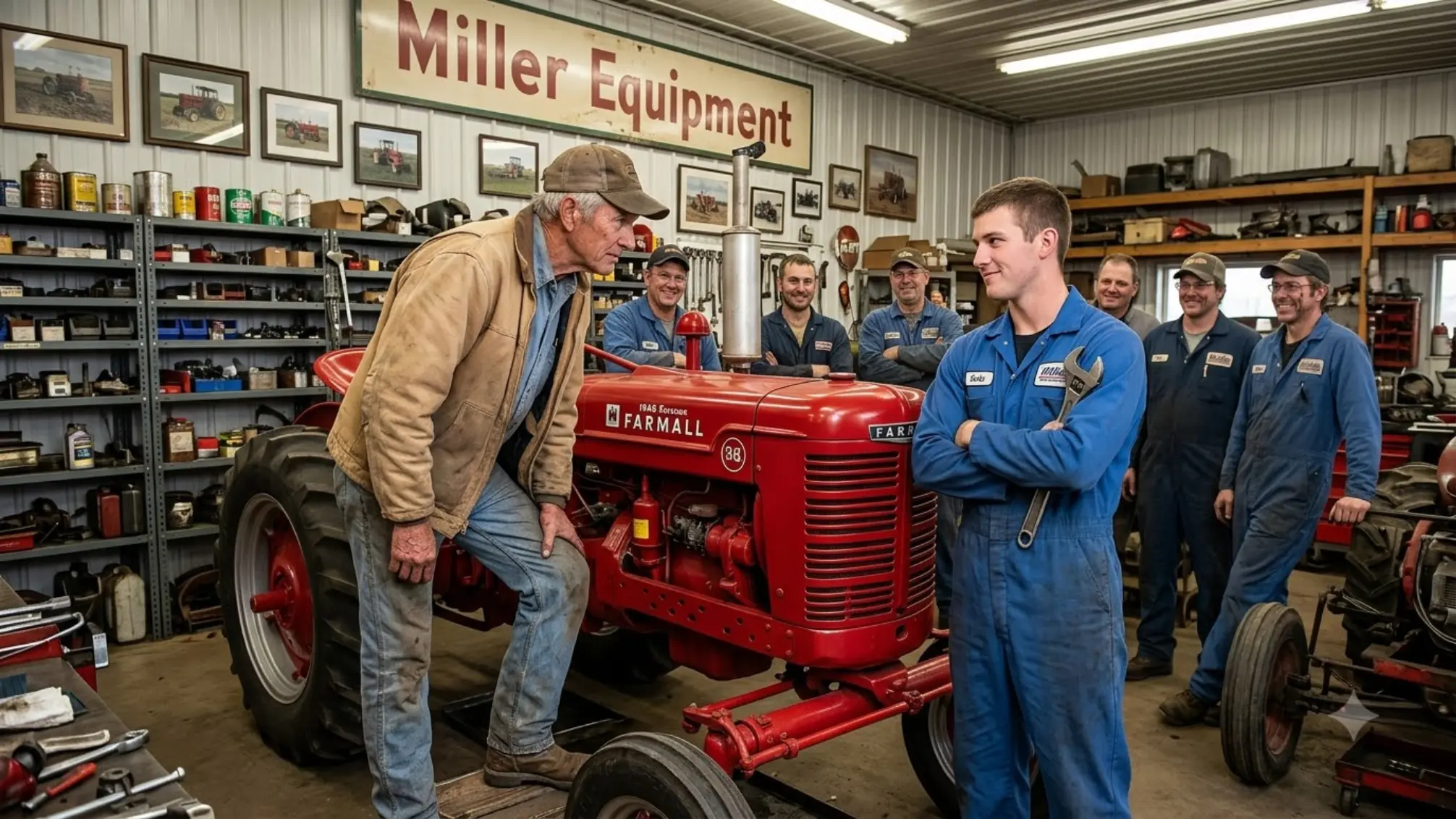
Cody Miller stood beside the left rear tire with a large wrench folded against his chest. At twenty-four, he was the youngest service manager the shop had ever appointed, and he carried that title with more confidence than patience. His blue coveralls were clean except for one streak of grease near his shoulder, and his short brown hair remained carefully shaped despite three hours beneath the tractor’s hood. Six mechanics watched him, waiting for another instruction none of them believed would work.
Near the open service door stood Margaret Lawson, the tractor’s owner. The sixty-year-old widow held her handbag tightly against her chest while watching the men dismantle pieces her father had protected for most of his life. She had paid Miller Equipment nearly twenty-three thousand dollars to restore the tractor for Bellwether County’s Harvest Heritage Parade. The parade began the following morning, and the Farmall had not started once since arriving at the shop.
Cody lowered the wrench and exhaled through his nose.
Cody Miller (angrily, looking around the workshop): “New battery, rebuilt carburetor, fresh plugs, clean fuel line. What else is left?”
A mechanic named Lucas shrugged.
Lucas Perry (frustrated, wiping his hands): “Compression is good. Spark looked weak, so we replaced the coil again.”
Cody stared at the silent tractor as though it had personally challenged his authority.
That was when Walter Briggs entered the shop.
The seventy-two-year-old farmer wore a faded brown cap, an old tan canvas jacket, and boots carrying dried soil from his fields. His shoulders had narrowed with age, but his hands remained broad and steady. Deep lines crossed his sun-worn face, and a gray stubble covered his jaw. He walked through the doorway without announcing himself and stopped beside Margaret.
She turned toward him with sudden relief.
Margaret Lawson (quietly, touching his sleeve): “Walter, thank goodness.”
Cody looked over.
He knew Walter by reputation. Everyone in Bellwether County did. Walter had farmed two hundred acres west of town since before Cody was born, repaired his own machines, and refused to replace equipment simply because a salesman called it outdated.
Cody did not know why Margaret had invited him.
Cody Miller (dismissively, lowering the wrench): “Mrs. Lawson, I told you we’re still diagnosing it.”
Margaret looked toward the clock.
Margaret Lawson (worriedly, tightening her grip on her bag): “You’ve been diagnosing it for six weeks.”
Cody’s face hardened.
Cody Miller (defensively, gesturing toward the tractor): “This machine is seventy-eight years old. Restoration isn’t magic.”
Walter slowly walked around the Farmall. He did not touch the paint, the tires, or the polished exhaust. Instead, he studied the bolts, the wiring, and the spaces where old metal met new parts. Several mechanics watched him with amused expressions.
Cody stepped into his path.
Cody Miller (taunting, crossing his arms): “Ten mechanics failed. You think listening will start it?”
Walter Briggs (coldly, touching the engine): “It isn’t broken. Your timing is.”
Cody Miller (angrily, tossing him the wrench): “Start it—or get out of my shop.”
Walter Briggs (deadly calm, turning toward the tractor): “Stand back. Ten seconds from now, you won’t be laughing.”
A few mechanics exchanged smiles.
Walter ignored them.
He climbed onto the metal platform, settled into the narrow seat, and placed one weathered hand near the controls. He asked Lucas to press the starter while he listened from beside the engine. Cody shook his head but signaled for Lucas to proceed.
The starter turned.
Walter closed his eyes.
One second.
Two.
The engine rotated with a steady mechanical rhythm. There was fuel, compression, and movement, but Walter listened past those obvious sounds.
Five seconds.
A faint metallic click came from beneath the distributor housing, followed by silence where another sound should have been.
Eight seconds.
Walter lifted one finger.
Ten.
Lucas released the starter.
The shop became quiet.
Walter stepped down and reached beneath the side of the engine. His fingers rested against the magneto housing, then moved toward the timing marks hidden behind a clean metal cover. He asked for a narrow screwdriver and a hand crank.
Cody laughed.
Cody Miller (mocking, shaking his head): “You heard all that in ten seconds?”
Walter Briggs (calmly, removing the cover): “I heard what wasn’t there.”
The older mechanics stopped smiling.
Walter pointed toward the magneto.
Walter Briggs (firmly, looking at Cody): “The impulse coupling should snap before the engine reaches the firing position. Yours is releasing late.”
Cody crouched beside him.
Cody Miller (skeptically, examining the housing): “The timing was set to the manual.”
Walter Briggs (coldly, tapping the replacement part): “Not to this tractor.”
He removed the cover and rotated the engine carefully by hand. A small timing mark appeared, but the magneto had been installed one tooth out of alignment. It created a spark, just as the mechanics had observed, but the spark arrived too late to ignite the fuel properly during startup.
Cody stared at the mark.
Lucas leaned closer.
Lucas Perry (surprised, pointing at the gear): “He’s right.”
Cody’s face reddened.
Cody Miller (angrily, looking at his team): “Who installed it?”
Nobody answered.
Walter continued examining the assembly. He loosened the mount, reset the gear, and adjusted the position using movements so precise they appeared rehearsed. He did not consult a manual or ask for measurements. His hands remembered the engine even when the shop did not.
After several minutes, he stood and wiped his fingers against a cloth.
Walter Briggs (calmly, offering Cody the starter switch): “Try it.”
Cody remained still.
Walter looked toward Margaret.
Walter Briggs (gently, nodding toward the tractor): “You should do it.”
Margaret’s eyes widened.
Margaret Lawson (nervously, looking at the seat): “I haven’t driven it since I was sixteen.”
Walter Briggs (softly, holding out his hand): “Your father taught you. Machines remember patient hands.”
He helped her onto the tractor.
The mechanics gathered closer as Margaret placed one foot near the clutch and rested her hands on the wheel. Walter showed her the correct position of the throttle, then stepped away.
Margaret pressed the starter.
The Farmall turned once.
A deep burst rolled through the exhaust.
The engine caught on the second rotation and settled into a strong, steady rhythm that filled the entire workshop. Tools trembled against the walls, the silver exhaust vibrated, and the red tractor seemed to wake beneath the bright lights.
Margaret covered her mouth.
Tears filled her eyes as the engine continued running.
The mechanics stared at Walter.
Cody said nothing.
Outside, two customers heard the tractor and came through the service door. Another worker emerged from the parts room. Within seconds, nearly everyone inside Miller Equipment had gathered around the machine.
Walter listened for several more moments.
Then his expression changed.
He raised one hand.
Walter Briggs (seriously, looking toward Margaret): “Turn it off.”
Margaret hesitated but obeyed.
The engine fell silent.
Cody moved toward Walter.
Cody Miller (irritated, spreading his hands): “It runs. What’s the problem now?”
Walter crouched beside the magneto again. He removed a small flashlight from his jacket and examined the casting number. His jaw tightened.
Walter Briggs (coldly, pointing at the housing): “This isn’t the part that came off Margaret’s tractor.”
Cody looked at the number.
Cody Miller (defensively, shaking his head): “We replaced the original because it failed.”
Margaret climbed down slowly.
Margaret Lawson (confused, looking between them): “You told me the original had been rebuilt.”
Cody turned toward her.
Cody Miller (uneasily, glancing toward the office): “That’s what the service order says.”
Walter moved to the workbench and picked up the rebuilt carburetor box. The part number printed on the label did not match the unit attached to the tractor. He checked the generator, the seat bracket, and the steering wheel.
Each inspection made his expression harder.
Walter Briggs (quietly, facing Margaret): “They didn’t restore your original parts.”
Margaret stared at the tractor.
Margaret Lawson (shaken, touching the steering wheel): “My father kept everything original.”
Cody looked toward his mechanics.
Cody Miller (furiously, raising the service order): “Who approved these substitutions?”
The men shifted uncomfortably.
Lucas finally pointed toward the glass office at the rear of the workshop.
Inside, Ray Miller sat behind a desk speaking on the phone. He was Cody’s fifty-eight-year-old uncle and the financial manager of Miller Equipment. Ray had handled customer contracts, parts purchasing, and restoration estimates since Cody’s father became ill.
Walter already knew his name would surface.
Ray noticed everyone staring and ended his call.
He left the office wearing a clean work shirt and an expression of controlled annoyance.
Ray Miller (impatiently, approaching the tractor): “Why is the whole shop standing around?”
Cody held up the service order.
Cody Miller (furiously, stepping toward him): “Why are Margaret’s original parts missing?”
Ray barely glanced at the paper.
Ray Miller (dismissively, slipping his hands into his pockets): “Because old parts fail. We replaced what couldn’t be trusted.”
Walter held out his hand.
Walter Briggs (coldly, displaying the magneto number): “This replacement came from a cheaper model and was installed incorrectly.”
Ray looked at him for the first time.
Ray Miller (contemptuously, narrowing his eyes): “And you are?”
Walter Briggs (steadily, meeting his stare): “The man who rebuilt this Farmall with Margaret’s father in 1971.”
The room became quiet.
Margaret turned toward him.
Walter had never told her.
When her father, Henry Lawson, purchased the tractor secondhand, it barely moved under its own power. Walter was twenty-seven and working nights as a mechanic while trying to save his struggling farm. Henry paid him to rebuild the engine in a small shed behind the Lawson barn.
The job lasted three months.
During that time, Henry taught Walter how to negotiate feed contracts and introduced him to the banker who later financed his first forty acres. Walter never forgot the kindness.
Margaret looked toward the tractor with fresh emotion.
Margaret Lawson (softly, touching Walter’s arm): “You worked on this with Dad?”
Walter nodded.
Walter Briggs (gently, watching the machine): “That tractor pulled his first profitable harvest. He said he’d never sell it.”
Ray rolled his eyes.
Ray Miller (impatiently, gesturing toward the running tractor): “Sentimental stories don’t change the invoice. We installed functional replacements.”
Walter faced him.
Walter Briggs (coldly, stepping closer): “Where are the original parts?”
Ray did not answer.
Cody repeated the question.
Ray Miller (angrily, pointing toward the office): “You manage the service floor. I handle the business.”
Cody Miller (furiously, refusing to move): “This is my family’s shop.”
Ray laughed once.
Ray Miller (mocking, leaning toward him): “Your name is on the sign because your grandfather built it. I’m the reason the doors are still open.”
Walter looked toward the storage shelves. Several customer tractors waited in different stages of repair, many missing carburetors, generators, lights, or metal badges. Some parts were normal removals during service.
Others had been replaced by cheap reproductions.
Walter walked toward an old green tractor near the wall.
He checked the generator mount.
The original unit was gone.
Then he moved to a blue tractor awaiting transmission work. Its rare factory seat had been replaced with a modern copy, though the service order mentioned nothing about the change.
Walter faced the mechanics.
Walter Briggs (sternly, pointing across the shop): “How many customer parts disappeared during restorations?”
Nobody spoke.
Ray moved toward him.
Ray Miller (threateningly, lowering his voice): “Get out before I call the sheriff.”
Walter Briggs (deadly calm, holding his ground): “Call him. Tell him to bring someone who understands stolen property.”
Ray’s confidence cracked.
Lucas stepped forward.
Lucas Perry (nervously, removing his cap): “There are crates in Warehouse Two.”
Ray spun toward him.
Ray Miller (furiously, pointing at the young mechanic): “Keep your mouth shut.”
Cody stepped between them.
Cody Miller (angrily, blocking his uncle): “You don’t order anyone to stay silent in my shop.”
Ray’s face hardened.
Ray Miller (coldly, staring at him): “You still think this is your shop?”
He removed a folded document from his pocket and placed it on the tractor’s hood. It was a notice from Bellwether Community Bank showing that Miller Equipment had missed three major loan payments.
Ray had been negotiating to sell the property to a regional equipment chain.
The agreement required the shop to close its restoration department, liquidate vintage parts, and dismiss most of the mechanics. The valuable original components removed from customer machines had been sold privately to cover debts and increase Ray’s commission before the sale.
Cody read the document twice.
His hands began shaking.
Cody Miller (quietly, looking up): “You were selling the shop?”
Ray Miller (defensively, folding his arms): “I was saving it.”
Cody Miller (furiously, crushing the paper): “By stealing from customers?”
Ray Miller (angrily, stepping closer): “By replacing obsolete parts nobody can verify and keeping forty people employed.”
Margaret looked toward the other tractors.
Her sadness turned into anger.
Margaret Lawson (firmly, facing Ray): “My father’s parts were not yours to sell.”
Ray dismissed her with a glance.
That expression ended whatever uncertainty remained among the mechanics.
Lucas walked toward a locked cabinet and removed a ring of keys from his pocket. He explained that Ray ordered employees to place valuable original components inside Warehouse Two after hours. Workers were told the parts had failed inspection and would be scrapped.
Nobody saw them again.
Ray rushed toward the rear exit.
Walter stepped into his path.
Ray was larger and younger, but the old farmer did not move.
Walter Briggs (coldly, standing before the door): “You told Cody to throw me out for hearing what you missed.”
Ray Miller (furiously, clenching his fists): “Move.”
Walter Briggs (deadly calm, staring him down): “You should have left when the tractor was still silent.”
The mechanics surrounded them.
No one touched Ray, but no path remained open.
Cody called the sheriff himself.
Deputies entered Warehouse Two and discovered dozens of labeled crates containing original tractor parts removed from customer machines. Several boxes had shipping documents addressed to collectors in other states. Investigators also found sales ledgers, copied signatures, and altered service records.
Margaret’s original magneto was located inside a padded container prepared for shipment to a buyer in Ohio. Her father’s carburetor, generator, and factory steering components were found in separate crates.
The total value of the stolen parts exceeded four hundred thousand dollars.
Ray was arrested before sunset.
The equipment chain canceled its purchase agreement after learning about the investigation. Bellwether Community Bank prepared to seize the shop property, leaving Cody with less than thirty days to repay the missed loans or close Miller Equipment permanently.
Cody sat alone beside the Farmall after everyone left.
Walter found him staring at the tractor.
The young mechanic no longer looked arrogant. His shoulders sagged beneath his coveralls, and grease covered both hands after he spent hours reinstalling Margaret’s original components.
Cody Miller (regretfully, looking at the floor): “I should’ve known.”
Walter Briggs (quietly, leaning against the workbench): “You trusted family.”
Cody Miller (bitterly, shaking his head): “I trusted the numbers because I didn’t understand the machines well enough to question them.”
Walter studied him.
Cody had inherited a respected name but not the years of experience beneath it. His father’s illness forced him into management before he was ready, and Ray used that insecurity to control the business.
Cody looked toward Walter.
Cody Miller (ashamed, lowering his voice): “I laughed when you said you could hear the problem.”
Walter Briggs (calmly, folding his arms): “You heard an old man. You didn’t hear experience.”
Cody nodded slowly.
Cody Miller (earnestly, meeting his eyes): “Teach me.”
Walter did not answer immediately.
The following morning, Margaret drove the 1948 Farmall at the front of Bellwether County’s Harvest Heritage Parade. The restored engine ran smoothly, and the original components remained exactly where Henry Lawson had placed them decades earlier.
Walter sat beside her on a small parade seat.
When they passed Miller Equipment, the mechanics stood beneath the old sign and applauded.
Cody remained behind after the parade.
He opened every customer file, contacted every owner, and explained what had happened. Some demanded their tractors immediately. Others agreed to let the shop correct the work after Cody promised independent inspections and complete documentation.
Honesty did not erase the damage.
It gave the shop a chance to survive it.
Walter brought together forty local farmers who had depended on Miller Equipment for decades. They formed a community cooperative, purchased the bank’s loan, and prevented the regional chain from acquiring the property.
Cody retained management of the service floor.
The cooperative controlled the finances.
Walter accepted no salary, but he took a workbench near the front window and arrived every Tuesday and Thursday wearing the same faded cap.
He taught the younger mechanics how to listen before replacing parts. He explained that engines spoke through rhythm, pressure, vibration, and silence. A missing sound could reveal more than a loud one.
Cody became his most serious student.
Six months later, a teenage apprentice struggled with an old tractor that refused to start. He replaced two electrical components before Walter stopped him.
Walter Briggs (patiently, handing him a clean cloth): “Close the toolbox.”
Teenage Apprentice (confused, looking at the engine): “But we haven’t found the failed part.”
Cody walked over and smiled.
Cody Miller (calmly, folding his arms): “Listen first.”
The apprentice stood beside the engine while the starter turned.
Ten seconds later, he raised one finger.
Teenage Apprentice (excitedly, pointing toward the distributor): “The spark is late.”
Walter nodded.
Across the workshop, the red 1948 Farmall rested beneath the Miller Equipment sign. Margaret had loaned it to the shop as a permanent reminder of the day it saved far more than a parade.
A small plaque beside the tractor carried no mention of Ray, the investigation, or the money recovered from stolen parts.
It contained only one sentence:
Before replacing what looks old, listen to what it still knows.
Cody read the words every morning.
He remembered the day he stood with a wrench against his chest, surrounded by mechanics who believed their training made an old farmer irrelevant. He remembered challenging Walter to start a machine ten professionals could not understand.
Walter needed only ten seconds.
Not because he possessed magic.
He understood that a polished machine could still hide dishonest work, that a respected business could lose its purpose, and that experience mattered only when someone was humble enough to hear it.
Nobody inside Miller Equipment had been able to start the 1948 Farmall.
The old farmer listened to it.
And when the engine finally came alive, so did every truth the shop had tried to keep silent.