The metal tailgate struck the truck bed with a crack that silenced the Texaco station for half a second. Inside the glass-and-steel hauling tank, hundreds of young channel catfish churned through oxygenated water, their dark bodies flashing beneath the morning sun. Hazel Trigg stood beside the aging Chevrolet in fitted denim work clothes and polished brown farm boots, staring at the three men who had laughed at her purchase. She was only twenty, but the four-acre pond waiting on her farm had already taught her more about patience than the men holding coffee cups would ever understand.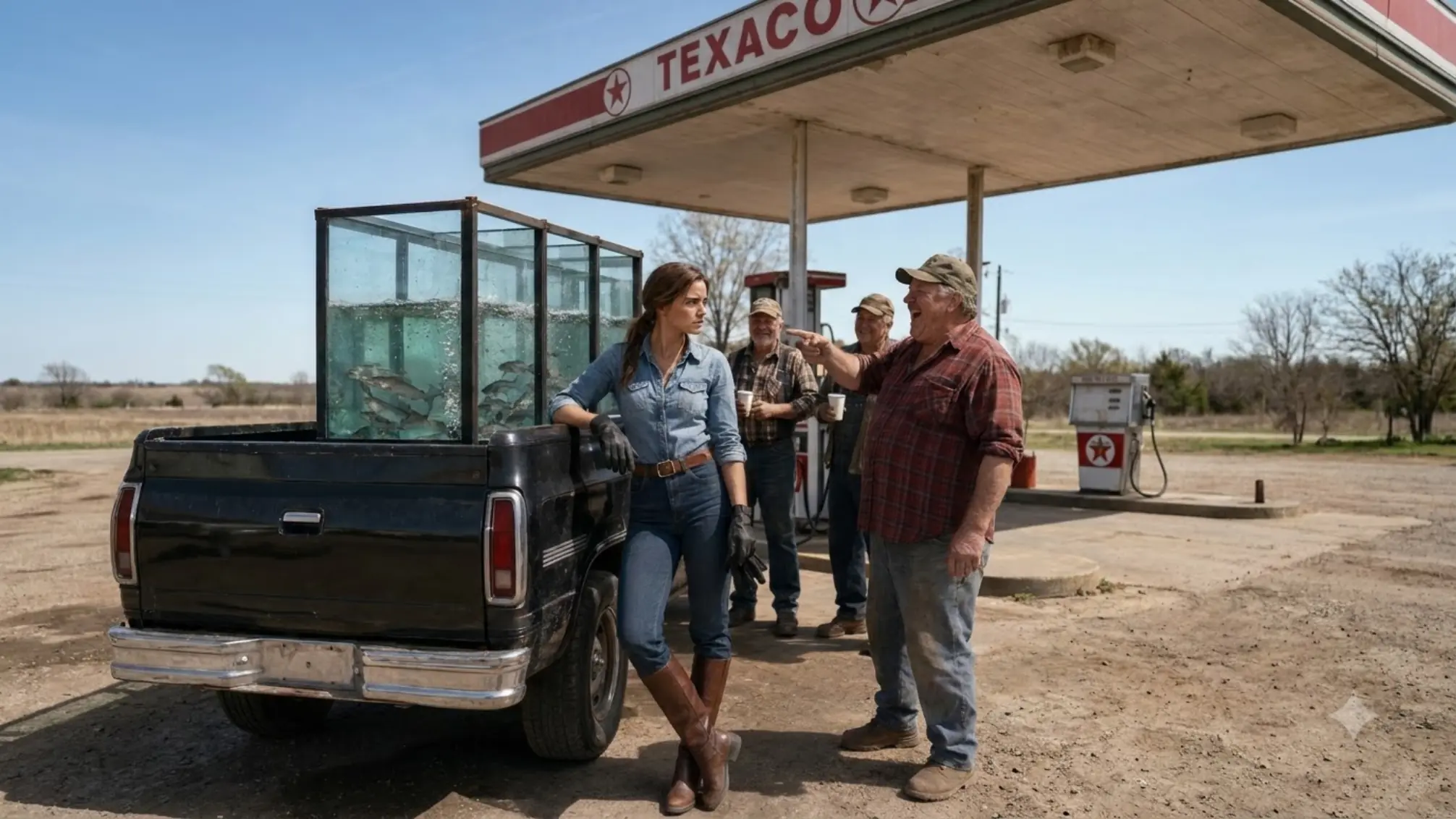
Buford Hollis recovered first and laughed even louder. He owned more than three hundred acres of cotton and had spent most of his life believing land could produce only what men like him expected from it. Beside him, Wendell Ashmore shook his head while the station owner leaned against the doorway with an amused smile. They all knew Hazel had spent nearly every dollar she possessed on the fingerlings moving inside that tank.
“Your father tried saving that pond for years,” Buford said. “The spring underneath it is gone.”
“My father stopped checking after the drought,” Hazel answered.
“You think you know more than he did?”
“I know water was pushing through the clay when everyone called it dry.”
Buford glanced toward the other men. “A wet patch does not make a fish farm.”
Hazel tightened the black glove around her right wrist. “Neither does a large field make a good farmer.”
The station owner coughed to hide a laugh, but Buford’s face darkened. Hazel finished fueling the pickup, checked the pump connected to the hauling tank, and climbed behind the wheel. As she pulled away, the men resumed laughing, certain that by July the pond would smell of dead fish and poor judgment.
Hazel did not look back.
She drove seventeen miles south to the fifty-six-acre farm her mother had left her after dying the previous winter. The property included a weathered farmhouse, an equipment shed, two failing cotton fields, and the pond everyone in Sunflower County considered useless. Three years of drought had reduced it to cracked clay, weeds, and a shallow muddy depression where frogs gathered after storms.
Hazel had walked that basin every week.
Even during the driest month, she found moisture beneath the deepest clay. Water still entered through a narrow underground spring, but the pond lost it faster than the spring could replace it. Instead of accepting that the pond was dead, Hazel spent six months clearing the drainage channel, repairing the western bank, and deepening the central basin with a borrowed tractor.
Winter rain did the rest.
By March, the pond held four acres of dark water.
Hazel had tested its depth with a weighted rope, mapped the bottom in a school notebook, and sent water samples to an agricultural extension office. She studied oxygen levels, acidity, feeding rates, and stocking density at the county library. Every night, she copied information by hand because she could not afford most of the books.
She understood the risk.
She also understood that cotton prices would not save her farm.
The bank expected a fourteen-thousand-dollar payment before the following spring. Hazel’s remaining fields could not produce enough profit to cover seed, fertilizer, repairs, and the note. Selling the property would settle the debt, but it would erase the only home her mother had ever owned.
The pond was not simply water.
It was the one part of the farm whose value nobody else had already calculated.
Hazel backed the truck toward the eastern bank and lowered a wide hose from the hauling tank. The fingerlings flowed into the pond in a silver-black stream, disappearing beneath the surface almost immediately. She knelt at the edge until the final fish slipped from the hose.
“Don’t make me a liar,” she whispered.
The first month nearly proved the men right.
Several fish floated dead after an unexpected temperature drop. Hazel found more along the bank after a week of heavy rain disturbed the pond chemistry. Each loss felt personal because she could still hear Buford predicting that every fish and every dollar would rot.
She recorded the deaths instead of hiding them.
Every morning at sunrise, Hazel measured the water temperature, dissolved oxygen, acidity, and clarity. Every evening, she measured them again. When oxygen levels fell during warm weather, she started the used paddle-wheel aerator she had rebuilt from parts found at an abandoned fish farm.
The machine shook violently during its first run.
A bearing overheated, one paddle broke, and the belt flew into the water. Hazel spent the entire night repairing it beneath a hanging work light while mosquitoes covered her arms. By dawn, the aerator was turning again, beating oxygen into the pond.
The fish survived.
Word of Hazel’s project spread through the county. People began driving slowly past her farm to see whether dead catfish covered the water. Some neighbors asked polite questions, but others treated the pond as a public countdown toward humiliation.
Buford visited in June.
He parked beside the equipment shed without permission and walked toward the bank. Hazel was broadcasting feed from a wooden platform she had built herself. Hundreds of catfish disturbed the surface, striking the floating pellets with loud, sudden splashes.
Buford stopped.
“You stocked too many,” he said.
“You haven’t counted them.”
“The pond cannot support that density.”
“It can with aeration and controlled feeding.”
“You’re burning electricity every night.”
“Less than your irrigation pumps burn keeping cotton alive.”
His mouth tightened. “When the summer heat settles over this water, oxygen will collapse.”
“That’s why I test before sunrise.”
“You think notebooks control weather?”
“No. They stop me from pretending I understand conditions I haven’t measured.”
Buford looked toward the pond again. He had expected weak fish gasping near the bank. Instead, he saw active feeding, clean water, and a young woman who appeared more prepared than many experienced farmers he knew.
He refused to admit it.
“October will tell,” he said.
Hazel nodded. “October usually does.”
The real crisis arrived three weeks later.
A brutal heat wave settled across Mississippi, pushing daytime temperatures above one hundred degrees. The pond water warmed rapidly, algae spread across the surface, and dissolved oxygen dropped dangerously low during the hours before dawn. Hazel started the aerator earlier each evening, but the old motor began overheating.
At four o’clock one morning, the motor failed completely.
Hazel woke to silence.
She ran from the farmhouse without lacing her boots and found catfish gathering near the surface. Their mouths opened in slow, desperate movements as oxygen levels collapsed. If the sun rose before she restored circulation, she could lose almost the entire pond.
Hazel pulled the motor apart under the beam of her pickup headlights. A damaged winding had burned through the insulation, leaving no quick repair. The nearest replacement was more than an hour away, and no store would open until morning.
She needed another way to move water.
Hazel hitched an old irrigation pump to the tractor, ran an intake pipe into the pond, and aimed the discharge hose upward from the bank. Water shot through the air and crashed back across the surface. The system was inefficient, loud, and dangerous to leave unattended, but it created circulation.
She ran two additional hoses from the pickup.
By sunrise, oxygen levels had stabilized.
Hazel stood in the mud beside the roaring pump, soaked from head to toe, while the catfish disappeared back into deeper water. Her hands shook from exhaustion, yet she opened the notebook and recorded the morning reading before changing clothes.
Three days later, Dr. Calvin Whitlock from the agricultural extension office arrived unexpectedly. Hazel had mailed him questions about the heat wave, expecting only a letter in response. Instead, the fifty-two-year-old aquaculture specialist drove nearly ninety miles to inspect the operation.
He spent six hours walking the pond.
Dr. Whitlock examined the feeding logs, water records, depth map, aeration schedule, and mortality calculations. He asked Hazel questions intended to expose weaknesses in her understanding. She answered most immediately and admitted without embarrassment when she did not know something.
Finally, he closed the notebook.
“Who designed this system?”
“I did.”
“Who taught you?”
“The library.”
Dr. Whitlock looked toward the repaired aerator. “Most commercial operators twice your age do not keep records this clean.”
Hazel waited, unsure whether the statement was praise or warning.
“You are losing feed along the north bank,” he continued. “The prevailing wind is pushing pellets into shallow water. Move the feeding dock twenty yards south and reduce each feeding by eight percent until temperatures fall.”
She wrote it down.
“You also need backup aeration.”
“I cannot afford another motor.”
“Can you build a tractor-powered paddle wheel?”
Hazel looked toward the equipment shed. “Probably.”
He smiled. “That answer is why I drove here.”
With Dr. Whitlock’s help, Hazel improved the operation through the rest of the summer. She built emergency aeration equipment from a salvaged axle, replaced the weak fence surrounding the pond, and adjusted feeding according to fish weight rather than guesswork. Mortality slowed, growth increased, and the water remained stable.
By October, the surviving catfish averaged nearly one pound each.
Hazel invited no one to witness the first sample harvest.
She pulled a small seine net through a corner of the pond with help from a nineteen-year-old farmhand named Demetrius Holloway. When they lifted the net, thick channel catfish thrashed inside it, their bodies stronger and heavier than Hazel had predicted.
Demetrius stared at them. “How many pounds do you think?”
“Enough to prove the pond works.”
“That is not a number.”
“Then help me weigh them.”
The sample confirmed that the pond was on track to produce thousands of pounds during the following season. Hazel sold a small batch to a processor in Belzoni and used the check to purchase feed and a second aeration motor. It was not enough to silence the bank, but it was the first income the pond had produced.
The men at the Texaco heard about the sale.
When Hazel stopped for fuel, Buford sat on the same bench.
“Heard you sold a few fish,” he said.
“Eleven hundred pounds.”
His coffee cup paused near his mouth. “That many?”
“First partial harvest.”
Wendell leaned forward. “What did they pay?”
“Sixty-eight cents per pound.”
“That hardly makes you rich.”
Hazel replaced the fuel nozzle. “The fish are still growing.”
Buford laughed, but the sound was shorter than before. “One good harvest doesn’t create a business.”
“No,” Hazel said. “That’s why I’m planning the next five.”
She drove away before they could answer.
During the second year, Hazel doubled down on the pond. She reduced her cotton acreage, leased two additional acres beside the water, and converted the equipment shed into a small maintenance and feed-storage area. Demetrius began working twenty hours each week, learning water testing, feeding calculations, net repair, and equipment maintenance.
The farm still looked poor from the road.
The pickup remained dented, the farmhouse needed paint, and Hazel repaired her boots with waterproof adhesive rather than replacing them. Yet below the surface of the pond, thousands of pounds of marketable fish grew every month.
Then the agricultural economy shifted.
Falling beef prices and rising demand for affordable regional protein pushed catfish into grocery stores, restaurants, and institutional kitchens. Large producers signed enormous contracts, leaving wholesalers desperate for smaller farms capable of supplying clean fish consistently.
One of those wholesalers was Vernon Morrissey from Atlanta.
He arrived at Hazel’s farm in February wearing a gray suit inappropriate for the mud. He found her inside the equipment shed welding a rectangular hauling tank from sheet steel. Sparks bounced across the floor while Demetrius held a panel in place.
Vernon waited until Hazel lifted the welding helmet.
“Miss Trigg?”
“That depends who’s asking.”
“Vernon Morrissey. Atlanta Wholesale Fish.”
Hazel removed her gloves. “How did you find me?”
“The Belzoni processor said you have clean fish and available capacity.”
“What do you need?”
“Between fifteen hundred and two thousand pounds every six weeks. Delivered alive to Atlanta.”
Demetrius stopped working.
Hazel kept her expression neutral. “Price?”
“One dollar and ten cents per pound.”
She did the calculation instantly. A two-thousand-pound delivery would earn twenty-two hundred dollars, significantly more than the local processor paid. A standing yearly order could clear the farm debt and finance expansion.
“What are your quality standards?”
Vernon opened a leather folder and handed her the specifications.
Hazel read every page.
“Your transport-loss limit is one percent.”
“Yes.”
“That requires continuous oxygenation and temperature control.”
“Can you provide it?”
Hazel glanced toward the unfinished tank. “That is what I’m building.”
Vernon studied the steel panels and battery-powered pump system. “You designed this?”
“Yes.”
He looked around the equipment shed, then toward the pond through the open doors. “Can you deliver in five weeks?”
“Give me three days to answer.”
“You either have the fish or you don’t.”
“I have the fish. I need to determine whether I can move them responsibly.”
Vernon smiled slightly. He had spent years dealing with suppliers who promised whatever a buyer wanted before calculating whether they could perform. Hazel’s refusal to answer immediately impressed him more than confidence would have.
“Three days,” he agreed.
That evening, Hazel covered the kitchen table with notebooks, feed records, harvest estimates, and transportation costs. She calculated pond capacity, growth rates, delivery schedules, fuel expenses, ice requirements, oxygen supplies, and replacement stock. The contract could save the farm, but one failed delivery could destroy her reputation before it existed.
Demetrius sat across from her.
“We can do it,” he said.
“We can harvest it.”
“And transport it.”
“If the tank works.”
“It will.”
Hazel looked toward the equipment shed visible through the kitchen window. “Faith is not a pressure test.”
They tested the tank the following morning.
The first trial revealed leaks along three welds and insufficient circulation near the rear corners. Hazel rebuilt the intake system, added baffles, and installed a second battery pump. During the final test, water circulated evenly for ten consecutive hours.
She called Vernon.
“I accept.”
The first Atlanta delivery began before sunrise five weeks later. Hazel and Demetrius pulled the seine net through the southern pond, transferred more than thirteen hundred pounds of catfish into the hauling tank, and monitored oxygen levels while loading. Only after every fish was secured did Hazel wake her younger brother, who would monitor the pond while she was gone.
The journey took six hours.
Hazel stopped twice to test the water and inspect the pump. At the Atlanta loading dock, warehouse employees stared at the young woman climbing from the old Chevrolet. Vernon walked outside holding a clipboard.
“You drove this yourself?”
“They’re my fish.”
The unloading took forty minutes.
Only four fish failed to survive transportation, far below the contract limit. Vernon inspected the rest, weighed the load, and signed a check for more money than Hazel had ever earned at one time.
He handed it to her.
“Your fish are cleaner than those from farms ten times your size.”
Hazel looked at the amount but did not smile yet. “Does that mean you want the next delivery?”
“It means I want twelve months.”
“Same price?”
“If the quality remains.”
“It will improve.”
Vernon extended his hand.
Hazel shook it.
She drove directly from Atlanta to the bank. Her clothes smelled of pond water, diesel, and fish when she entered the lobby carrying the check. The loan officer looked from her muddy boots to the amount written across the paper.
“Where did this come from?”
“The dead pond.”
He looked up sharply.
Hazel deposited most of the money and made the largest payment she had ever placed against the farm note. It did not erase the debt, but it changed the conversation. The bank no longer spoke of immediate foreclosure.
By her fourth Atlanta delivery, the story had traveled through Sunflower County.
The laughter at the Texaco disappeared.
Buford no longer described Hazel as the girl ruining her mother’s farm. Wendell stopped repeating the story about the fingerlings. The station owner began asking when local restaurants might serve her fish.
Hazel gave none of them the satisfaction of confronting them.
The work was already answering.
One Saturday morning, Wendell drove to her farm. He stood beside his pickup holding his cap with both hands while Hazel approached from the pond.
“I owe you an apology,” he said.
“For what part?”
“All of it.”
Hazel waited.
“I laughed because Buford laughed. Then everyone else did, and it seemed easier to join them than admit I didn’t know anything about raising fish.”
“You could have stayed quiet.”
“I should have.”
She looked toward the pond, where catfish broke the surface around the feeding dock.
“Did you come for forgiveness or information?”
Wendell appeared surprised. “Information?”
“You keep staring at the water.”
“My lowest cotton field floods every spring. I wondered whether it could hold a pond.”
Hazel almost laughed.
Instead, she invited him to walk the bank.
She showed him the aeration equipment, testing schedule, feed storage, and harvest records. She also showed him the losses, repair costs, and emergency systems. She refused to let success become a fantasy as dishonest as the laughter had been.
“This isn’t easy money,” she warned.
“I understand.”
“No, you understand the price of fish. That’s different.”
Wendell nodded. “Then teach me the rest.”
Hazel agreed to advise him after he completed extension training and tested the soil. She charged him for her time. He paid without complaint.
By the end of the third year, Hazel’s farm produced more than twenty-eight thousand pounds of catfish annually. She leased a second pond, hired Demetrius full-time, and upgraded the truck with a larger hauling tank. The Atlanta contract expanded to include restaurants and two school districts.
The bank note disappeared.
Hazel framed the final receipt but kept it inside the equipment office rather than the farmhouse. She wanted it near the notebooks, test kits, repair manuals, and mud-covered tools that had actually paid the debt.
Buford arrived several months later.
Unlike Wendell, he did not remove his cap.
“I heard you’re leasing pond space.”
“I am.”
“I have twelve acres of low ground.”
“Then contact the extension office.”
“I thought you might inspect it.”
“My consulting rate is fifty dollars an hour.”
He laughed automatically, then realized she was serious.
“You charge farmers now?”
“I charge people asking for what took me years to learn.”
“We’ve known each other your whole life.”
“You laughed for free. Advice costs money.”
Buford’s face reddened.
Hazel held his stare until he finally reached for his wallet.
“Two hours,” he said.
She inspected his land the following week.
Five years after the morning at the Texaco, Hazel owned three productive ponds and supplied buyers across two states. Her operation employed seven people during harvest season, and Demetrius managed daily water testing when Hazel traveled. She paid higher wages than neighboring farms because she remembered exactly what it meant to need skilled help and possess almost no money.
The old pickup remained in service.
Hazel could afford a newer truck, but the Chevrolet had carried the first fingerlings, the first hauling tank, and the first Atlanta delivery. She replaced the engine, repaired the frame, and repainted the cab while leaving one dent in the tailgate untouched.
That dent came from the morning she slammed it beneath the Texaco canopy.
Years later, Hazel stopped at the same station while hauling another delivery. The bench remained outside, though the men occupying it had grown older. Buford sat with Wendell and the station owner, their coffee cups arranged exactly as before.
This time, no one laughed.
Buford stood and walked toward the truck.
“Atlanta load?”
“Twenty-four hundred pounds.”
He looked through the tank window at the fish moving beneath the aerated water. “Vernon still buying?”
“His buyers are competing for volume now.”
“You said our buyers would call you first.”
“I remember.”
Buford lowered his eyes. “So do I.”
Hazel waited.
“You were right.”
“No,” she said. “I did the work until being wrong became impossible.”
She returned to the driver’s seat.
The farm had not survived because Hazel won an argument at a gas station. It survived because she tested the pond before sunrise, recorded every loss, repaired equipment in darkness, studied information nobody handed to her, and refused contracts she could not fulfill safely.
The men’s laughter lasted forty-five seconds.
Her answer took years.
When Hazel drove away, the hauling tank caught the morning sunlight. Thousands of dollars in living inventory moved behind her, raised inside the pond everyone had declared dead.
The pond had never been dead.
It had been waiting for someone patient enough to measure what remained beneath the cracked clay—and brave enough to build a future before anyone else could see the water.