The paperback rested open across Daniel Mercer’s knees beneath an old maple tree in Riverside Park. Its pages shifted gently in the midday breeze while sunlight moved between the branches and scattered across the paved path. For the first time in weeks, the city sounded far away, reduced to distant traffic, bicycle bells, and children laughing near the fountain.
Daniel had selected the bench because it faced the river and sat far from the crowded cafés surrounding the courthouse district. He wore dark jeans, clean running shoes, a white henley shirt, and a gray-green coat that had belonged to his father. Nothing about him demanded attention.
That was precisely what he wanted.
He had spent every morning that week inside conference rooms filled with attorneys, city officials, and police commanders. His afternoons disappeared into reports documenting questionable arrests, unsupported searches, and complaints that had been closed without meaningful review. Reading alone in the park was supposed to give him one hour in which no one knew his position or expected an answer.
A shadow fell across the book.
Daniel raised his eyes slowly, keeping one finger between the pages.
Officer Curtis Malloy stood directly in front of the bench. He was a broad, silver-haired white officer in his late fifties with a square jaw and the rigid posture of a man accustomed to receiving immediate compliance. His right hand rested beside his duty belt while his eyes moved from Daniel’s face to his clothes and back again.
Officer Malloy (coldly, staring down at him): “What are you doing here?”
Daniel looked briefly at the open book.
Daniel Mercer (calmly, holding his place): “Reading.”
Malloy did not smile.
He looked toward the walking path, where a white woman pushed a stroller past them without slowing. Two college students sat on the grass with their backpacks open, and an elderly man fed pieces of bread to birds near the fountain. None of them received the same question.
Officer Malloy (sharply, extending his hand): “Identification.”
Daniel closed the book but kept it on his lap.
Daniel Mercer (evenly, meeting his eyes): “Why do you need it?”
Something tightened in Malloy’s face.
Officer Malloy (warningly, stepping closer): “Don’t make this difficult.”
Daniel had heard that phrase hundreds of times in interviews with people who had filed complaints against police officers. It often arrived before the officer explained the legal basis for the encounter. Sometimes it replaced the explanation entirely.
Daniel Mercer (firmly, remaining seated): “I’m sitting in a public park. Am I suspected of committing a crime?”
Officer Malloy (impatiently, scanning the area): “We received complaints about a suspicious man.”
Daniel glanced toward the families and joggers moving freely around them.
Daniel Mercer (quietly, lifting the book): “A man reading?”
Officer Malloy (angrily, pointing at him): “A man matching your description.”
Daniel waited.
Malloy offered nothing else.
No height. No clothing description. No location of an alleged offense. No indication that the unidentified man was armed, violent, wanted, or even accused of breaking the law.
Only suspicious.
Daniel removed his wallet slowly and handed over his driver’s license. He did not reach for the second credential concealed behind it. Malloy barely examined the license before looking at Daniel again.
Officer Malloy (suspiciously, holding the card loosely): “You live across town.”
Daniel Mercer (calmly, folding his hands): “That doesn’t prevent me from visiting this park.”
Officer Malloy (pressing, narrowing his eyes): “Why this park?”
Daniel Mercer (dryly, glancing toward the river): “It has benches.”
A teenage boy walking nearby laughed before quickly covering his mouth. Malloy turned toward him, and the boy hurried away.
When the officer faced Daniel again, his embarrassment had hardened into anger.
Officer Malloy (demanding, gripping the license): “Are you waiting for someone?”
Daniel Mercer (steadily, watching him): “No.”
Officer Malloy (accusingly, leaning closer): “Selling something?”
Daniel Mercer (coldly, closing the paperback): “No.”
Officer Malloy (raising his voice): “Carrying anything I should know about?”
Daniel Mercer (firmly, holding his gaze): “A book.”
Malloy’s hand moved toward the radio on his shoulder.
Daniel recognized the moment the officer stopped investigating and began building a justification. It appeared in the slight change in his wording and in the way his gaze shifted toward the people now watching from the path.
Officer Malloy (loudly, reaching for his cuffs): “Stand up and put your hands behind your back.”
Daniel did not move immediately.
Daniel Mercer (controlled, placing the book beside him): “Am I under arrest?”
Officer Malloy (furiously, stepping forward): “You match a suspect’s description.”
Daniel Mercer (sharply, rising from the bench): “Which suspect?”
Malloy gave no answer.
He seized Daniel’s wrist, turned him toward the bench, and locked one steel cuff around his hand. Daniel did not resist, but Malloy pushed his shoulder forward as though forcing down a struggling man.
A woman near the fountain stopped walking.
Bystander (nervously, holding her phone): “He was just sitting there.”
Officer Malloy (shouting, looking toward her): “Stay back and mind your business.”
The woman lowered her phone but did not put it away.
Malloy secured the second cuff and tightened both until the metal pressed painfully against Daniel’s wrists. Daniel stared at the paperback lying open on the bench, one page folding beneath the wind.
Officer Malloy (smugly, gripping his arm): “Could’ve avoided this by cooperating.”
Daniel Mercer (coldly, turning his head): “I gave you identification. You never read it.”
Malloy pulled him toward the patrol cruiser.
People watched from the grass and walking paths. Some whispered. Others recorded discreetly. Not one person stepped between the officer and the man he had handcuffed for reading.
Daniel did not blame them entirely.
A uniform, a weapon, and a raised voice could convince decent people that intervention was more dangerous than silence. He had seen that fear throughout his career. He also knew silence allowed bad decisions to become official facts.
Malloy opened the rear door and pushed Daniel inside.
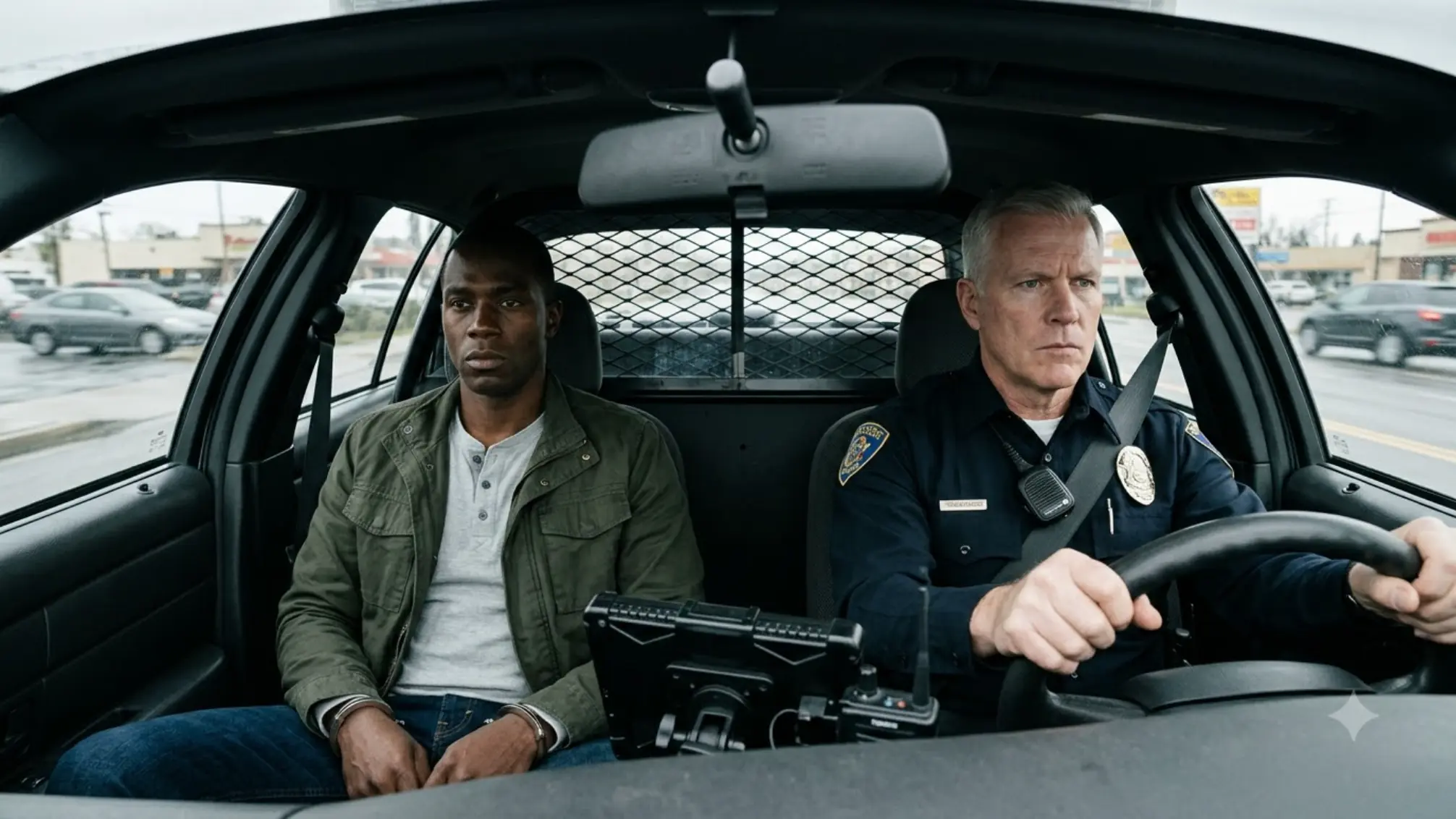
The cruiser smelled of vinyl, old coffee, and cleaning chemicals. A scratched plastic partition separated the back seat from the front. Daniel sat upright with his cuffed hands behind him while Malloy returned to the park bench and retrieved the driver’s license.
He left the book.
When Malloy climbed behind the wheel, he looked at Daniel through the rearview mirror.
Officer Malloy (coldly, starting the engine): “You should’ve talked in the park. Now you answer at the station.”
Daniel Mercer (calmly, leaning back): “You didn’t want answers. You wanted cuffs.”
Malloy tightened his grip on the steering wheel.
Officer Malloy (angrily, pulling into traffic): “You matched the description, and I’m done debating it.”
Daniel Mercer (coldly, holding his gaze in the mirror): “Keep driving. Your captain is about to tell you who you arrested.”
For the first time, Malloy hesitated.
It lasted less than a second. Then he looked back at the road and accelerated.
The city passed beyond the windows in hard sections of brick, glass, and concrete. Daniel remained silent while Malloy repeatedly checked the mirror. The officer’s movements grew sharper with every block.
He radioed dispatch and claimed he had detained a noncompliant subject connected to a suspicious-person complaint.
The dispatcher requested a case number.
Malloy did not have one.
He changed the description, saying Daniel might be connected to a reported theft near the park. When dispatch asked for details about the theft, Malloy replied that he would provide them after booking.
Daniel listened without reacting.
Malloy glanced into the mirror again.
Officer Malloy (defensively, lifting his chin): “You got something to say?”
Daniel Mercer (quietly, sitting perfectly still): “Your body camera already heard enough.”
Malloy looked down at the device on his chest.
His jaw tightened.
The Riverside Central Precinct came into view twelve minutes later. Malloy drove through the secured gate, parked beside the booking entrance, and removed Daniel from the rear seat.
Inside, two desk officers looked up.
Malloy kept one hand wrapped around Daniel’s upper arm as he walked him past the booking counter.
Desk Sergeant Helen Price stepped into their path. She was a serious Black woman in her early forties who had spent enough years inside the station to recognize when paperwork was arriving after the arrest instead of before it.
Desk Sergeant Price (suspiciously, looking between them): “What’s the charge?”
Officer Malloy (dismissively, pulling Daniel forward): “Captain needs to see this one.”
Desk Sergeant Price (firmly, blocking the hallway): “I asked for the charge.”
Officer Malloy (irritated, lowering his voice): “Suspicious person matching a description. Possible theft connection.”
Sergeant Price looked at Daniel.
He stood calmly with his wrists restrained behind him. His clothing was clean, his expression controlled, and no property bag accompanied him.
Desk Sergeant Price (carefully, turning toward Malloy): “Where’s the complainant?”
Officer Malloy (angrily, stepping around her): “I’m handling it.”
He continued toward the captain’s office before she could stop him.
Malloy needed someone important to confirm that his instincts had been correct. Captain Marisol Kent had questioned his arrest reports twice during the previous month. If he delivered a suspect directly to her office and framed the event before anyone checked the records, he believed he could force her to support him.
He shoved open the office door.
Captain Kent sat behind a broad desk covered with reports and digital evidence summaries. She was a fifty-year-old Latina police captain with dark hair pulled into a low bun and the controlled authority of someone who rarely needed to raise her voice.
Her eyes moved first to Malloy.
Then to the handcuffs.
Then to Daniel’s face.
For one long second, no one spoke.
The folder in her hand slipped onto the desk.
Captain Kent (furiously, rising from her chair): “Get those cuffs off him right now.”
Malloy froze.
Officer Malloy (confused, gripping Daniel’s arm): “Captain, he matched a description near Riverside Park.”
Captain Kent (shouting, slamming her palm on the desk): “Release him!”
Malloy reluctantly removed the key from his belt.
Daniel remained still while the cuffs opened. Red marks circled both wrists. Captain Kent stared at them before looking at Malloy with an expression that emptied the officer’s face of confidence.
Captain Kent (coldly, pointing toward the wall): “Place your badge, radio, weapon, and department phone on that table.”
Officer Malloy (stunned, stepping backward): “For what?”
Captain Kent (fiercely, moving around the desk): “Because you just dragged the city’s independent police monitor into my office without a charge.”
The hallway outside became silent.
Malloy looked at Daniel.
Officer Malloy (disbelieving, shaking his head): “He never said that.”
Daniel rubbed one wrist slowly.
Daniel Mercer (coldly, meeting his eyes): “You never asked my name after I gave you the license.”
Captain Kent opened the office door fully.
Captain Kent (commanding, looking toward Sergeant Price): “Lock down all body-camera footage, dispatch audio, park surveillance requests, and vehicle video connected to Malloy’s shift. Nobody edits, uploads, or closes anything without my written approval.”
Sergeant Price nodded and turned toward the communications room.
Malloy’s breathing became heavier.
Officer Malloy (defensively, raising both hands): “Captain, this is being twisted. I had a lawful reason to investigate.”
Captain Kent (furious, stepping into his face): “The actual suspect was arrested forty minutes before you reached that park.”
Malloy stared at her.
Captain Kent had received the notice during a command meeting earlier that morning. A man accused of stealing a woman’s purse near Riverside Station had been identified through surveillance footage and detained several miles away. He was twenty-two years old, wore a red hooded sweatshirt, and had a large tattoo along the right side of his neck.
Daniel was thirty-eight, wore a gray-green coat, and had no visible tattoo.
Captain Kent had not merely recognized Daniel.
She knew the suspect Malloy claimed to be pursuing was already in custody.
Captain Kent (coldly, pointing toward Daniel): “Explain what description he matched.”
Malloy opened his mouth.
Nothing came out.
Captain Kent (sharply, refusing to look away): “Height?”
Officer Malloy (hesitating, shifting his weight): “Approximately six feet.”
Captain Kent (pressing, stepping closer): “Clothing?”
Officer Malloy (quietly, looking toward the floor): “Dark outerwear.”
Captain Kent (furiously, pointing at his body camera): “The suspect wore a red sweatshirt. Age?”
Malloy remained silent.
Captain Kent (disgusted, lowering her voice): “You had no description.”
Daniel picked up the driver’s license Malloy had placed on the edge of the desk. The officer had never turned it over.
On the back was a city security endorsement identifying Daniel as Special Counsel Daniel Mercer, Independent Office of Police Accountability.
He had been appointed two months earlier after a federal consent agreement required Riverside to create an outside monitoring office. Only command staff had attended the confidential introductory briefing because Daniel’s first evaluations were supposed to be unannounced.
Captain Kent had met him twice.
Malloy had not.
Daniel had not planned to test anyone that afternoon. He genuinely had gone to the park to read.
Officer Malloy created the test himself.
Captain Kent ordered him into the interview room and assigned two supervisors to remain with him. His weapon and badge were sealed inside an evidence envelope.
When the office emptied, she turned toward Daniel.
Captain Kent (regretfully, examining his wrists): “I’m sorry.”
Daniel Mercer (quietly, rolling down his sleeves): “You didn’t put the cuffs on me.”
Captain Kent (firmly, shaking her head): “He did it under my command.”
Daniel studied her face.
She was angry, but beneath the anger was something heavier. She had suspected Malloy’s reports for months. His stops often involved vague descriptions, unsupported safety searches, and citizens accused of becoming aggressive after asking why they had been detained.
Each complaint ended the same way.
Malloy denied wrongdoing.
His body camera conveniently pointed away during important moments.
Other officers claimed not to remember.
Captain Kent (frustrated, closing the office door): “I tried to place him on administrative review last year. The deputy chief said his arrest numbers were too valuable.”
Daniel Mercer (steadily, looking toward the hallway): “Numbers without lawful cause are liabilities, not achievements.”
Captain Kent nodded.
Daniel asked for his paperback.
No one knew where it was.
Sergeant Price called the park unit and asked an officer to retrieve it from the bench. The woman who had recorded part of the arrest was still nearby and had taken the book to prevent it from blowing away.
She also had video.
By sunset, the accountability office possessed recordings from four bystanders, the park security system, Malloy’s cruiser, his body camera, and station cameras. Every source showed the same sequence.
Daniel had sat peacefully.
Malloy approached without receiving a dispatch call.
Daniel complied with the request for identification.
Malloy invented the theft connection only after placing him in handcuffs.
The evidence became worse when investigators reviewed Malloy’s department phone.
He had exchanged messages with Officer Grant Avery, another patrol officer assigned near Riverside Park. Twenty minutes before confronting Daniel, Avery sent Malloy a photograph taken from across the walking path.
The message read:
Black male been sitting there almost an hour. Keeps looking around. Might be worth checking.
Daniel had been turning pages and occasionally looking toward the river.
Malloy replied:
I’ll move him.
The message contained no mention of a crime.
Investigators expanded the review.
Over the following week, they found thirty-one stops in which Malloy claimed someone matched a description that dispatch could not verify. Twenty-four involved Black men. Six involved Latino teenagers.
One involved an elderly Black professor waiting outside his own university building.
Malloy had arrested five of them for obstruction after they questioned his authority. All five charges were later dismissed.
The arrest numbers that protected Malloy became the evidence proving a pattern.
Two days after the park incident, Daniel returned to Riverside Central Precinct. The red marks around his wrists had faded, but the anger had not.
Malloy sat inside an administrative hearing room with his attorney and union representative. Captain Kent occupied the opposite side of the table.
Daniel placed the paperback in front of him.
Malloy looked at it.
Officer Malloy (bitterly, leaning back): “So this was all a setup?”
Daniel Mercer (coldly, resting one hand on the book): “No. I sat on a bench.”
Officer Malloy (angrily, pointing toward him): “You knew who I was.”
Daniel Mercer (firmly, holding his stare): “I learned your name when you gave an order without explaining the law.”
Officer Malloy (defensively, turning toward the captain): “He deliberately stayed silent to make me look guilty.”
Captain Kent (fiercely, opening the evidence file): “Your own words did that.”
The union attorney argued that Malloy had acted on reasonable suspicion. Daniel asked him to identify the specific facts supporting that suspicion before the encounter began.
The attorney cited Malloy’s experience.
Daniel rejected the answer.
Experience could help an officer interpret facts. It could not replace them.
The hearing ended with Malloy suspended pending termination proceedings and referral to the district attorney. Officer Avery was also removed from patrol after admitting he had sent photographs of people he considered out of place without documenting any criminal conduct.
The story reached the public after the woman from the park released her recording.
The video showed Daniel sitting with a book one moment and being handcuffed the next. It showed bystanders watching, uncertain and frightened. Most importantly, it captured Malloy repeatedly claiming Daniel matched a description he never provided.
Public anger spread quickly.
Some people demanded to know why Daniel had not revealed his position immediately. He answered during a community meeting held at Riverside Library.
Daniel Mercer (thoughtfully, standing before the audience): “A person should not need an impressive title to be treated lawfully.”
The room became quiet.
Daniel Mercer (firmly, looking across the crowd): “The arrest was wrong when I was only a man reading on a bench. My job did not make it wrong. It only made it harder to bury.”
Captain Kent stood near the back wall.
She listened as residents described encounters they had never reported because they believed no one would care. A delivery driver said Malloy searched his van after accusing him of casing homes. A high school coach said he had been stopped three times while jogging.
An elderly man stood last.
He was the professor Malloy had detained outside the university.
Professor Ellis Grant (emotionally, gripping the microphone): “I spent forty years teaching young people to trust public institutions. That night, I went home ashamed because I had begged an officer to believe I belonged outside my own building.”
Captain Kent lowered her eyes.
The testimony transformed the review from one officer’s misconduct into an examination of the system that had rewarded him. Supervisors had praised high stop numbers without checking whether the stops were lawful. Complaint investigators treated calm disagreement as resistance.
Body-camera failures produced reminders instead of discipline.
Captain Kent accepted responsibility publicly.
She introduced a policy requiring officers to document the specific description and reported offense before detaining someone on a match. Supervisors could no longer approve vague phrases such as “suspicious behavior” or “known area.”
Every obstruction arrest connected to a citizen questioning police authority received automatic outside review.
Daniel insisted on one additional change.
New officers would watch the entire park video during training. The lesson would stop before Captain Kent recognized him.
Recruits would be asked whether the arrest was lawful without knowing Daniel’s identity.
The correct answer could never depend on who he turned out to be.
Malloy was dismissed four months later. Prosecutors charged him with falsifying official records and unlawful detention in several cases, including Daniel’s. Additional civil claims forced the city to compensate people whose complaints had previously been rejected.
Captain Kent remained in command.
Some officers resented her for cooperating with the investigation. Others began bringing concerns directly to her instead of hiding them.
Sergeant Price became head of professional standards.
One year after the arrest, Daniel returned to Riverside Park carrying the repaired paperback. The cover had been bent, and one page remained permanently creased, but he refused to replace it.
He sat beneath the old maple.
A patrol officer approached along the path.
Daniel watched him come closer, feeling an instinctive tension he had not experienced before Malloy’s arrest. The officer stopped several feet from the bench.
Young Officer (politely, holding up the book’s missing bookmark): “Mr. Mercer? Someone at the station found this in the old evidence drawer.”
Daniel accepted it.
It was a narrow strip of blue paper his daughter had made for him years earlier.
Daniel Mercer (softly, examining the faded writing): “Thank you.”
Young Officer (respectfully, stepping back): “Enjoy your afternoon, sir.”
The officer continued down the path.
Daniel opened the book and returned the bookmark to its place.
Around him, joggers passed, children played near the fountain, and strangers occupied the benches without being asked to justify their presence. The park looked unchanged.
Daniel knew better.
The greatest changes were not always visible in buildings, uniforms, or written policies. Sometimes change began when one person refused an unlawful order, when one captain preserved a recording instead of protecting a reputation, or when frightened witnesses finally decided their silence had lasted long enough.
Malloy believed the arrest would end when the cruiser doors closed.
He believed Daniel’s silence meant surrender.
Instead, every quiet mile to the precinct carried the truth closer to the one office where it could no longer be ignored.
The officer had arrested a man because he believed nobody important would care.
He learned too late that the law was supposed to care before anyone knew the man’s name.