Daniel Mercer noticed the patrol vehicle three intersections before the red-and-blue lights finally appeared in his mirror. He was driving west toward Lansing after spending nearly twelve hours reviewing an internal misconduct file, and exhaustion had settled behind his eyes even though his mind remained completely clear. He had consumed coffee, bottled water, and half a turkey sandwich since noon, but not a single drop of alcohol. When the cruiser illuminated behind him, Daniel activated his turn signal and pulled into the brightest place available, a twenty-four-hour gas station surrounded by security cameras and customers.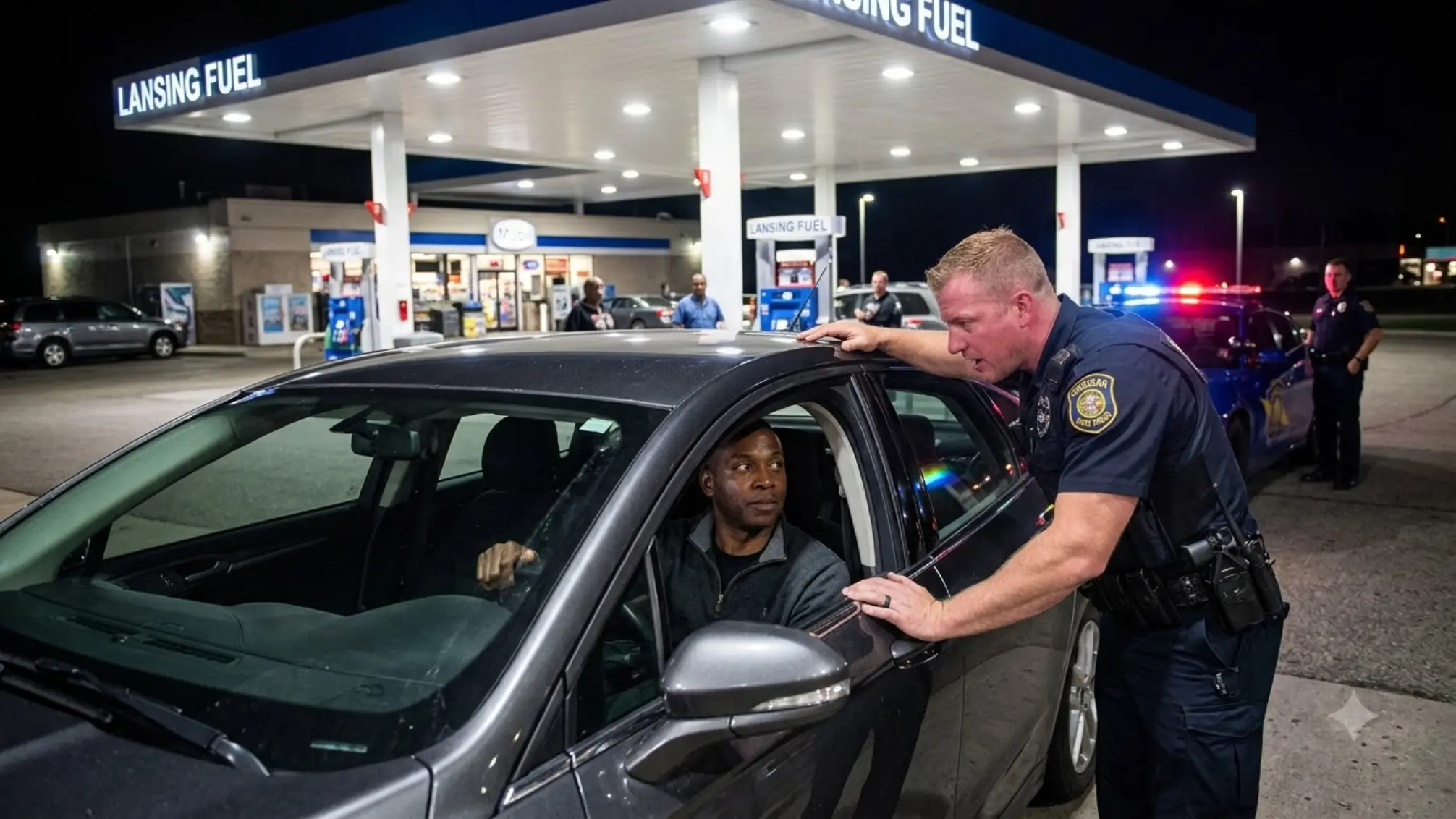
He parked beside the convenience-store entrance, lowered the driver-side window, switched off the engine, and placed both hands high on the steering wheel. Daniel had performed thousands of interviews with officers during his career, and he understood that the first thirty seconds of a police encounter often revealed more than either party realized. The approaching officer walked quickly, shoulders already tight, flashlight pointed directly into Daniel’s face despite the powerful canopy lights above them. Daniel immediately noticed that the officer approached as though he expected resistance rather than information.
“License, registration, insurance.”
Daniel looked at the officer’s nameplate. COLE. The surname registered faintly because Daniel had recently seen it attached to a complaint concerning a disputed vehicle impound, but he did not yet remember the details. “Good evening, Officer Cole. May I ask why you stopped me?”
“You crossed the fog line twice.”
Daniel remembered the road clearly. “I don’t believe I did.”
Cole leaned closer. “So now I’m lying?”
“I didn’t say that.”
“You basically did.”
Daniel breathed slowly through his nose. Arguments at roadside windows rarely improved outcomes, especially after an officer had personalized a simple disagreement. He reached carefully toward his wallet and provided his license before retrieving the registration from the glove compartment. Cole studied the documents beneath his flashlight while Daniel watched his expression.
Daniel’s license identified him only as Daniel Mercer. It did not list his occupation, and nothing about the ordinary sedan suggested that its driver supervised one of Michigan’s most sensitive police-accountability units. Daniel was the Chief Inspector responsible for directing a team that reviewed major internal investigations involving misconduct, evidence handling, use of force, and allegations that could not safely remain within a local command structure. He had deliberately avoided displaying credentials because he believed a traffic stop should proceed according to law, not according to the driver’s professional rank.
Cole handed nothing back. “Where are you coming from?”
“Lansing.”
“Where in Lansing?”
“My office.”
“What office?”
Daniel paused. “Is that related to the traffic violation?”
Cole smiled without humor. “Bloodshot eyes, defensive answers, taking your time pulling over.”
“I pulled into the first safe, illuminated location.”
“You passed two driveways.”
“Both were dark.”
Cole leaned farther through the window. “Anything to drink tonight?”
“No.”
“Nothing?”
“Nothing.”
“Drugs?”
“No.”
“Medication?”
“Nothing impairing.”
Cole stepped backward and looked toward the arriving backup cruiser. A younger officer exited and walked toward them, his body camera blinking red. Daniel noticed Cole’s own camera was also operating, and that detail immediately became important. Evidence preserved arguments more reliably than memory did.
The younger officer approached. “Everything good?”
Cole turned away from Daniel but remained close enough that Daniel could hear him. “Guy’s acting weird, eyes are red, keeps challenging everything I say.” The younger officer glanced toward Daniel and asked whether Cole smelled alcohol. Cole answered, “No, but that doesn’t mean anything.”
Daniel looked straight ahead. His eyes were red because he had spent most of the day staring at evidence-management spreadsheets and interview transcripts, but he knew explanations often became meaningless after suspicion hardened into certainty. Cole returned to the window and ordered him to step out. Daniel unlocked the door.
“I’ll step out,” Daniel said. “But before I do, are you ordering field sobriety exercises?”
“Yes.”
Daniel nodded. “I’m declining voluntary roadside exercises.”
Cole’s eyebrows rose. “You refusing?”
“I’m declining the field exercises. If you believe chemical testing is legally required, I will cooperate with an official breath test.”
Cole laughed. “That’s not how this works.”
Daniel exited slowly with both hands visible.
The younger officer moved several feet away while Cole stood almost chest-to-chest with Daniel. “You know what innocent people usually do?” Cole asked. “They cooperate.”
Daniel looked at him. “I am cooperating.”
“You’re refusing.”
“I’m refusing subjective exercises while offering an objective chemical test.”
Cole’s face reddened. “Talking like a lawyer isn’t helping you.”
Daniel almost told him that he had trained investigators who testified in federal court, reviewed more DUI arrest files than Cole had probably written, and spent years teaching that arrogance damaged otherwise lawful cases. Instead, he kept his tone measured. “Then take me for the certified test.”
Cole stepped closer. “You think you’re smarter than me?”
“No.”
“That sounded like yes.”
Daniel glanced toward the younger officer. His nameplate read MARTIN. Officer Martin looked uncomfortable, but he remained silent.
Cole pointed toward Daniel’s sedan. “Your eyes are bloodshot, you took too long stopping, and your speech is strange.”
“What is strange about my speech?”
“You keep repeating questions.”
“I’m asking you to define your observations.”
“You know what? Turn around.”
Daniel stared at him.
“Am I under arrest?”
“You’re being detained.”
“For what?”
“Turn around.”
Daniel complied.
Cole placed him in handcuffs.
Several customers at the pumps began watching. One man raised his phone, and a woman exiting the convenience store stopped near the door. Daniel felt the metal tighten around his wrists and experienced something that surprised him despite everything he had investigated during his career: humiliation.
He had interviewed citizens who described exactly this moment. Many told him the physical discomfort was secondary to the sensation that strangers immediately assumed guilt because handcuffs were visible. Daniel had understood those accounts intellectually. Standing beneath gas-station lights with Officer Cole telling bystanders that he suspected DUI transformed understanding into experience.
Cole searched him.
He found Daniel’s personal phone, keys, wallet, and a small leather credential case inside the inner pocket of his jacket. Daniel felt Cole’s hand touch it and knew the encounter was about to change. Cole removed the case.
“What’s this?”
Daniel said nothing.
Cole opened it.
The expression on his face disappeared.
Martin stepped closer.
Cole stared at the credentials and then at Daniel.
The identification clearly displayed Daniel Mercer’s photograph, state credentials, and his position overseeing internal police investigations. Beneath the title appeared authority markings that told any Michigan officer exactly what kind of office had issued it. Cole closed the case almost immediately.
Martin whispered, “Oh, man.”
Daniel turned his head slightly. “Something wrong?”
Cole shoved the credentials into Daniel’s property bag. “Badge doesn’t change anything.”
Daniel nodded. “It shouldn’t.”
That answer seemed to bother Cole more than if Daniel had demanded special treatment.
“You’re still going in.”
“If you believe you have lawful grounds, proceed.”
Cole stared at him.
Daniel continued. “And preserve both body-camera recordings.”
Martin looked sharply toward Cole.
Cole grabbed Daniel’s arm and guided him toward the cruiser. “You don’t give orders here.”
Daniel stopped briefly. “No, Officer Cole. Your own evidence policy does.”
Cole pushed him forward.
The sedan was ordered towed.
Daniel immediately asked why a licensed sober passenger could not retrieve it later or why the car could not remain temporarily at the gas station. Cole replied that an arrest required impoundment under departmental procedure. Daniel knew that answer was not universally true, but he did not argue further.
The towing company arrived unusually quickly.
That caught his attention.
The truck bore the name Capital Metro Recovery, a company Daniel recognized from another document he had seen during the previous month. Several complaints alleged that vehicles from questionable arrests were repeatedly routed to that company, accumulating fees before owners could retrieve them. The connection might have been coincidence, but Daniel had spent too many years investigating misconduct to ignore patterns.
He said nothing.
Inside the patrol car, Cole continued talking through the partition. “You inspectors think you can look down on street cops.”
Daniel looked through the window.
“I never said that.”
“You didn’t have to.”
“I started as a patrol officer.”
Cole laughed. “Twenty years ago?”
“Twenty-three.”
“So you forgot what the street is like.”
Daniel turned toward him. “No. That is exactly why I know the difference between suspicion and proof.”
Cole tightened his hands on the steering wheel.
“You keep running your mouth, Mercer.”
Daniel returned his gaze to the window. “Then stop asking questions.”
The remainder of the drive passed mostly in silence.
At the station, Daniel was placed in a processing room while Cole explained the arrest to a desk sergeant. Daniel could hear portions of the conversation from several feet away. Cole described erratic driving, delayed stopping, bloodshot eyes, unusual speech, refusal to perform roadside exercises, and what he called “an argumentative demeanor.”
Officer Martin stood nearby.
The sergeant asked, “Alcohol odor?”
Cole hesitated.
“No.”
“Admission?”
“No.”
“Open containers?”
“No.”
The sergeant looked toward Daniel.
“Then what exactly do we have?”
Cole’s voice hardened. “Impairment.”
Daniel watched Martin’s face.
The younger officer looked at the floor.
The desk sergeant entered Daniel’s information into the system. Within seconds, the screen displayed additional professional identifiers unavailable during the roadside stop. The sergeant read them twice before turning toward Cole.
“Chief Inspector?”
Cole folded his arms. “I already know.”
The sergeant looked at Daniel. “Sir, is this current?”
Daniel answered evenly. “Yes.”
The sergeant shifted uncomfortably. “Do you want me to call someone?”
“I want the same process you would give any other driver.”
Cole scoffed. “See? He’s performing.”
Daniel looked at him. “No. I’m documenting.”
Nobody laughed.
The certified breath-testing room was prepared.
Daniel had been requesting this moment since the gas station. Cole instructed him to sit while the machine completed preliminary checks. A fresh mouthpiece was inserted.
“You know this only detects alcohol,” Cole said.
Daniel nodded. “I understand.”
“So don’t start celebrating if it comes back low.”
Daniel looked at him. “Let’s obtain the result first.”
Cole rolled his eyes.
The technician instructed Daniel to take a deep breath and blow steadily. Daniel leaned forward and exhaled into the mouthpiece. The machine beeped as the sample registered.
They waited.
A second sample was collected according to procedure.
Martin stood near the wall.
The desk sergeant entered halfway through.
Cole looked at the display before anyone else.
His face stopped moving.
Daniel did not ask.
The technician printed the result.
0.00.
Silence filled the room.
Daniel leaned back in the chair.
Cole stared at the paper.
Martin looked from the result to Daniel.
The desk sergeant finally spoke. “Zero?”
The technician nodded. “Zero-point-zero-zero.”
Daniel looked directly at Cole. “That is what I told you it would read.”
Cole’s jaw tightened. “Alcohol isn’t the only intoxicant.”
Daniel nodded. “Correct.”
The officer seemed almost disappointed that Daniel agreed.
“We’re getting a drug recognition officer.”
Daniel looked toward the clock. “Based on what new evidence?”
“Your behavior.”
“My behavior before the zero result?”
“Yes.”
“So the result changed nothing?”
Cole stepped toward him. “You think this is some gotcha moment?”
“I think objective evidence should affect investigative decisions.”
Cole leaned down toward the table. “You’re still not leaving.”
Daniel held his gaze.
“Then document why.”
Martin looked away.
A lieutenant named Gerald Pike entered the room several minutes later. He was in his early fifties and had the cautious expression of a supervisor who already knew something had gone wrong but had not yet decided whether protecting his people mattered more than correcting it. Cole immediately began explaining that Daniel might be impaired by drugs.
Pike looked at the breath result.
“No alcohol.”
“Could be pills.”
“What indicators?”
Cole repeated the same list.
Bloodshot eyes.
Slow stop.
Speech patterns.
Refusal of field tests.
Argumentative demeanor.
Pike turned toward Daniel. “Chief Inspector Mercer, will you submit to a drug-recognition evaluation?”
Daniel answered carefully. “I will comply with any test legally required. I will not answer investigative questions without clarification of whether I am being interrogated as a suspect.”
Pike frowned.
Cole laughed. “There he goes again.”
Daniel looked at him. “Exercising rights is not an impairment symptom.”
Martin’s head rose.
The sentence hung in the room.
Pike ordered Cole into the hallway.
Daniel could hear raised voices outside.
“You arrested the chief inspector with no odor and no field test?”
“He refused.”
“That isn’t what I asked.”
“He drove like he was impaired.”
“Do you have video?”
“Dash cam.”
Pike lowered his voice, but Daniel still caught the next question.
“Does it show the lane violation?”
Silence.
That silence mattered.
Daniel looked toward Martin.
The younger officer avoided eye contact.
A state-certified drug-recognition officer eventually arrived. Before asking substantive questions, he explained Daniel’s rights and advised him that the evaluation could include an interview concerning medication, substance use, medical history, and recent activity. Daniel listened politely.
“Do you understand?”
“Yes.”
“Will you answer my questions?”
Daniel shook his head. “Not without counsel.”
The evaluator nodded.
Unlike Cole, he did not become angry.
“That is your right.”
Cole muttered something from the doorway.
The evaluator turned toward him. “Officer, if he invokes, we stop questioning.”
Cole crossed his arms.
The evaluator reviewed the available information and asked whether chemical testing beyond breath had been authorized. Pike admitted it had not. The evaluator then asked whether anyone had observed physical signs strongly associated with specific drug categories.
Nobody answered.
Martin finally spoke.
“He seemed normal to me.”
Every head turned.
Cole stared at him. “What?”
Martin swallowed.
“At the stop. He seemed irritated, but normal.”
Cole stepped toward him. “You told me his eyes were red.”
“I said they looked tired.”
“You’re changing your story.”
“No.”
Martin’s voice strengthened.
“You changed mine.”
Daniel watched carefully.
Pike asked what Martin meant.
Martin pointed toward his body camera. “Everything’s recorded.”
Cole’s face changed.
That was the second moment that night Daniel saw real fear.
Pike ordered both officers’ cameras uploaded immediately.
Daniel remained at the station while the recordings were reviewed.
The first problem appeared within minutes.
Cole’s dash camera showed Daniel touching the fog line once while navigating a narrow section where construction cones reduced the lane width. It did not clearly show the repeated weaving Cole described.
The second problem was worse.
Daniel activated his turn signal less than two seconds after Cole’s emergency lights came on.
He then drove approximately twelve seconds before entering the illuminated gas station.
Cole’s report described that as an extended refusal to stop.
Pike rubbed his forehead.
Martin’s body camera created a third problem.
It captured Cole telling him, before asking Daniel to exit, “Guy’s probably on something. We’ll get the car either way.”
Daniel looked toward Pike.
The lieutenant stopped the recording.
“Play that again.”
The technician replayed it.
We’ll get the car either way.
Cole immediately protested.
“I meant tow it if he was impaired.”
Daniel said nothing.
Pike continued watching.
The camera captured Daniel agreeing to exit voluntarily and offering to take an official chemical test.
It captured him refusing only roadside sobriety exercises.
It captured Cole repeatedly treating that refusal as evidence of guilt.
Then came something Daniel had not personally heard.
While he was being searched, Cole turned slightly toward Martin and muttered, “Capital Metro’s going to love this one.”
Pike froze the video.
Daniel finally spoke.
“Why would the towing company love it?”
Cole stared at him.
“No idea.”
Daniel leaned back.
“I think you do.”
The room changed.
This was no longer a DUI investigation.
It was becoming an internal investigation.
Daniel asked for his phone.
Pike hesitated.
“You’re technically still detained.”
“Then I am formally requesting counsel.”
Pike immediately understood the implications.
Daniel was no longer speaking as a curious inspector. He was protecting himself as a detained citizen.
An attorney arrived forty minutes later.
So did two investigators from Daniel’s office.
Daniel had not summoned them personally; department protocol automatically generated notification after his identity and custodial status entered state systems. The investigators immediately separated professional issues from the criminal allegation. Daniel would provide no investigative direction concerning Cole while he remained the complainant.
That distinction mattered to him.
He refused to turn his authority into revenge.
The facts would have to survive without his rank.
Before sunrise, prosecutors reviewed the available information and declined to support continued DUI detention absent additional evidence. Daniel was released.
His sedan remained at Capital Metro Recovery.
The towing bill had already begun accumulating.
Daniel went home.
He slept two hours.
Then he reported himself as a conflicted party and formally removed himself from direct supervision of the investigation.
Deputy Inspector Elaine Foster took control.
She began with data.
Capital Metro Recovery had received 68 percent of discretionary DUI-related impounds from Cole’s unit during the previous two years despite being neither the closest nor cheapest approved towing contractor. That number alone proved nothing.
Then Foster examined arrest outcomes.
A surprising percentage of drivers arrested by Cole had later produced low or zero alcohol readings.
Several were subsequently investigated for suspected drugs.
Many were never charged with any impairment offense.
Their cars were still towed.
Foster requested financial disclosures.
Cole had no direct account receiving money from the towing company.
His brother did.
A landscaping business owned by Cole’s younger brother had received repeated “consulting” payments from a company connected to Capital Metro’s owner.
The payments frequently occurred within days of high-value impounds.
Foster widened the investigation.
Lieutenant Pike was horrified when she presented the preliminary pattern.
“How long?”
“At least eighteen months.”
Pike stared through the conference-room window.
“We had complaints.”
“Yes.”
“I thought they were angry drivers.”
“So did everyone.”
Pike looked sick.
Foster continued. “That’s how patterns survive.”
The investigation recovered dozens of body-camera recordings.
Again and again, Cole used the same language.
Bloodshot eyes.
Strange speech.
Delayed stop.
Refusal of roadside exercises.
Possible drug impairment.
The phrases appeared so consistently that investigators began calling them the template.
Some arrests were entirely legitimate.
Others were not.
In several cases, drivers blew 0.00 and were still detained for hours while drug evaluations produced no reliable evidence of impairment.
Capital Metro collected towing and storage fees regardless.
Officer Martin became an important witness.
He admitted he had noticed questionable stops before Daniel’s arrest.
“Why didn’t you report them?” Foster asked.
Martin looked down.
“Because Cole was senior.”
“That isn’t an answer.”
“He trained me.”
“Still not an answer.”
Martin breathed slowly.
“Because everybody said that’s just how he works.”
Foster nodded.
That answer mattered.
Misconduct rarely survived because nobody saw it.
It survived because people saw fragments and convinced themselves each fragment was normal.
Daniel stayed away from the investigative meetings.
He received only information he was legally entitled to receive as the complainant.
At home, he replayed the stop in his memory.
What bothered him most was not the handcuffs.
It was how ordinary the encounter had felt until Cole discovered his credentials.
Daniel wondered how many drivers had sat beneath those same lights without a title capable of making a supervisor nervous.
That question became more important than what had happened to him personally.
Three weeks later, Capital Metro Recovery was searched pursuant to warrants obtained through prosecutors and investigators independent from Daniel. Records showed an unofficial incentive system rewarding certain police referrals through businesses connected to officers’ relatives and associates. The company denied bribing anyone directly.
Investigators followed the money.
They found enough suspicious transfers to trigger a broader criminal inquiry.
Cole was placed on administrative leave.
Pike was not accused of receiving money, but his supervisory decisions came under intense review because complaints involving Cole had repeatedly died inside his command.
One complaint came from a twenty-two-year-old college student who blew 0.00 after being arrested.
Another came from a sixty-three-year-old nurse returning from a night shift.
Another from a construction foreman driving home after working sixteen hours.
Every complaint alleged nearly identical conduct.
Pike had approved findings concluding the arrests were within policy.
Now he read those reports again.
He realized how often conclusions had simply repeated Cole’s wording.
Bloodshot eyes.
Unusual speech.
Slow response.
Refused field exercises.
Pike requested a meeting with Foster.
“I failed.”
She looked at him.
“That will be determined.”
“No.”
He shook his head.
“I don’t mean criminally.”
Foster remained silent.
“I stopped asking questions.”
That admission eventually appeared in the final oversight findings.
The public hearing took place months later.
Daniel attended not in uniform but in a dark suit.
He sat at the same level as ordinary witnesses rather than behind the officials conducting the proceeding.
Cole’s attorney argued that Daniel’s position had transformed a disputed DUI arrest into a political attack.
Daniel expected that argument.
When called to testify, he described every detail of the gas-station encounter.
He did not exaggerate.
He admitted he had questioned Cole repeatedly.
He admitted refusing roadside sobriety exercises.
He admitted being tired.
Then he described offering an official chemical test before arrest.
The attorney leaned forward.
“Chief Inspector, isn’t it true that you knew your title would eventually cause everyone at that station to panic?”
“Yes.”
“Yet you intentionally concealed it?”
“I did not conceal anything.”
“You didn’t announce it.”
“No.”
“Why?”
Daniel paused.
“Because a person’s constitutional protections should not improve after an officer learns that person supervises police investigations.”
The hearing room became silent.
The attorney changed direction.
“You were angry.”
“Yes.”
“You felt humiliated.”
“Yes.”
“So you wanted Officer Cole punished.”
Daniel looked directly at him.
“I wanted Officer Cole investigated.”
“What’s the difference?”
“Evidence.”
The single word stopped the attorney briefly.
Daniel continued.
“If the evidence showed he acted lawfully, my feelings would not change that.”
“And if it showed otherwise?”
“Then my title still should not determine the consequence.”
The breath-test printout was introduced.
0.00.
Then the body-camera recordings.
Then the towing records.
Then the financial transfers.
Then the old complaints.
The picture became difficult to dismiss.
Cole had not simply made one bad judgment.
Investigators concluded that he had developed an enforcement pattern in which vague impairment indicators created justification for arrests that frequently produced vehicle impounds routed toward a favored company.
The criminal financial investigation continued separately.
Administrative findings were more immediate.
Cole was terminated for misconduct involving dishonesty, improper enforcement practices, and violations connected to towing referrals.
Capital Metro was removed from approved state and local rotation lists pending further proceedings.
Several supervisors received discipline.
Pike was demoted for failing to properly review repeated warning signs.
Martin received a written suspension for failing to report earlier concerns but was credited for preserving evidence and ultimately cooperating.
Daniel agreed with that balance.
Late truth mattered.
So did late silence.
The department reopened dozens of Cole’s arrests.
Not every case was dismissed.
Some involved legitimate impairment supported by evidence.
Daniel insisted reviewers separate genuine cases from questionable ones instead of assuming everything Cole ever touched was corrupt.
Accountability required accuracy in both directions.
Several drivers received refunds for towing fees.
Others had records corrected.
A handful pursued civil claims.
The most important change came quietly.
Michigan agencies involved in the review adopted additional auditing requirements for discretionary towing referrals and repeated 0.00 DUI arrests followed by unsuccessful drug investigations.
Patterns would now trigger automatic supervisory review.
Daniel returned to ordinary work months after the case closed.
One evening he found himself driving past the same gas station.
He almost kept going.
Then he pulled in.
The pumps looked exactly as they had that night.
A teenager was buying an energy drink.
A mother was filling a minivan.
Nobody knew what had happened beneath those lights months earlier.
Daniel parked beside the air pump.
He turned off the engine.
For several seconds, he sat with both hands resting on the steering wheel.
Then a patrol cruiser entered the station.
A young officer stepped out.
Daniel recognized Martin.
They saw each other.
Martin hesitated before approaching.
“Inspector.”
“Officer.”
Martin stopped several feet from the car.
“I heard the final review cleared several of the arrests.”
“It did.”
“And overturned others.”
“Yes.”
Martin nodded.
“I keep thinking about that night.”
“So do I.”
“I should’ve spoken earlier.”
Daniel looked at him.
“Yes.”
Martin accepted the answer.
No reassurance followed.
After a moment Daniel added, “But you spoke eventually.”
Martin looked up.
“Does that matter?”
“It matters.”
“Enough?”
Daniel considered the question.
“Enough to change what happens next.”
Martin nodded slowly.
That was all he needed.
He returned to his cruiser.
Daniel remained beside the gas station for another minute.
The breath test had become famous inside police circles because of the simplicity of the number.
0.00.
But Daniel knew the machine had never been the most important evidence.
The crucial evidence was everything that happened after it.
An officer saw proof contradicting his conclusion and searched for another conclusion instead.
A supervisor saw warning signs and initially thought about protecting the unit.
A younger officer saw misconduct and hesitated because speaking carried consequences.
Those choices exposed the deeper problem.
Daniel started his sedan.
His wrists no longer carried marks from the handcuffs.
But he remembered them.
He hoped he always would.
They reminded him that authority felt very different depending on which side of it a person occupied.
They reminded him why complaints that sounded inconvenient still deserved investigation.
And they reminded him why his credentials should never have been the reason anyone cared.
Officer Cole had looked through Daniel Mercer’s window and believed he saw an ordinary driver he could dismiss.
He had been wrong about Daniel’s position.
But that was never the mistake that destroyed his career.
The real mistake came earlier.
Cole believed an ordinary driver’s rights mattered less.
And when Daniel leaned into the certified machine hours later, took a deep breath, and watched the printer produce 0.00, the number did more than prove there was no alcohol in his system.
It forced everyone in that station to ask why the arrest continued anyway.
That question opened one file.
One file opened dozens more.
And by the time investigators finished following the evidence, the traffic stop Cole thought would end with a tow truck had become the investigation that exposed his entire operation.