“Hey, that uniform is fake—take it off before I arrest your ass for impersonating a real officer.”
Officer Rachel Dwyer pointed directly at the four gold stars on the Black man’s collar as if they were cheap decorations bought from a costume store.
The man standing in front of her did not move.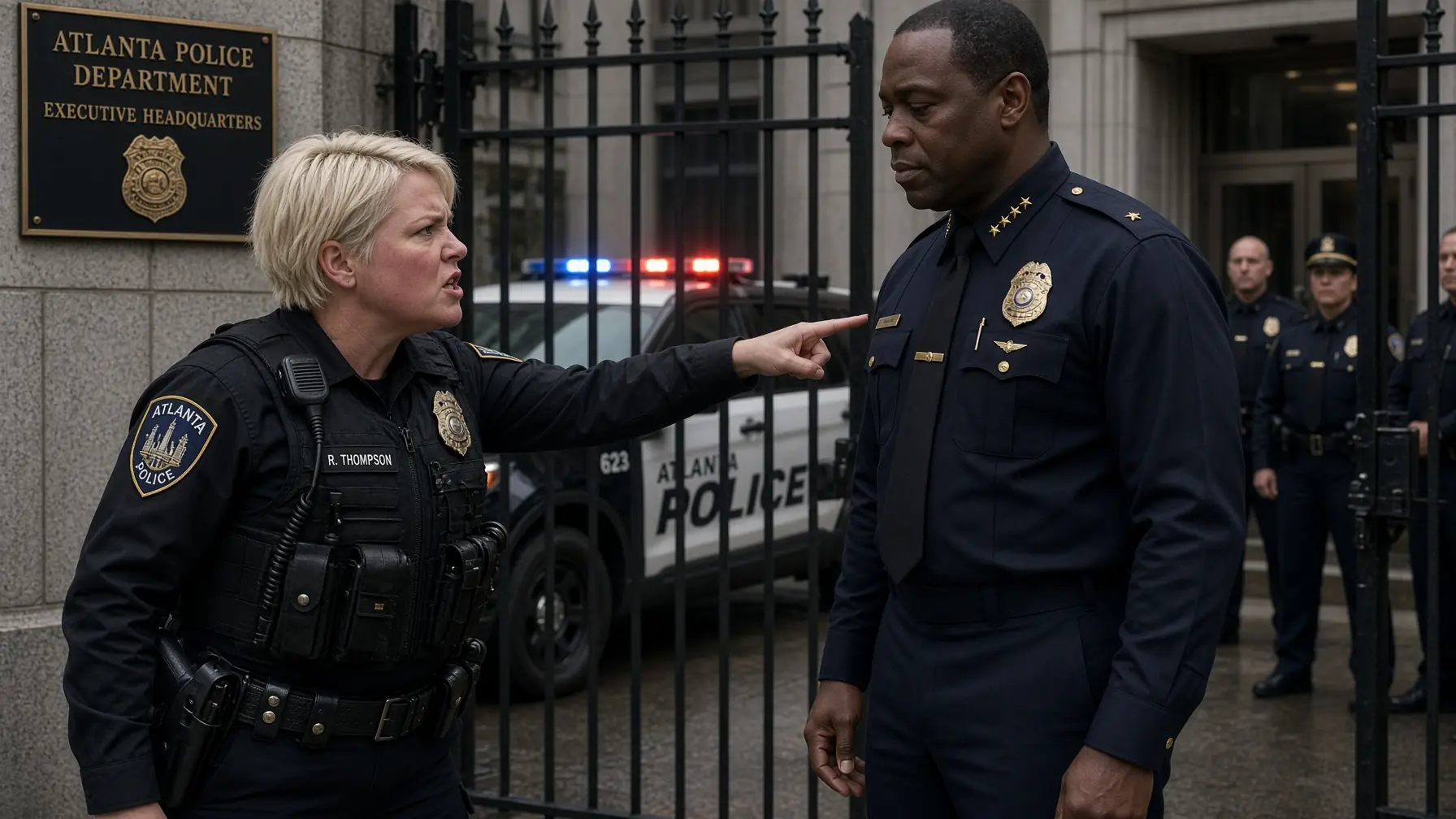
His name was Marcus Grant.
He was forty-eight years old, tall, broad-shouldered, clean-shaven, and dressed in a perfectly pressed dark navy command uniform with polished gold buttons, a command badge, and four gold stars positioned clearly along his collar. His deep-brown skin and close-cropped black hair contrasted sharply against the formal uniform, and his expression was so calm that it seemed to irritate Rachel more than anger ever could.
Behind them stood the iron security gate leading into the Atlanta Police Department’s executive headquarters.
A marked patrol SUV flashed red and blue near the curb.
Several employees entering the building had slowed to watch.
Marcus glanced at Rachel’s pointing finger.
Then at her nameplate.
DWYER.
He looked back into her eyes.
“You’ve stared at four command stars for thirty seconds and still haven’t realized who outranks your entire precinct.”
Rachel laughed.
She was thirty-nine, stocky, pale-skinned, with short platinum-blonde hair and the stiff posture of someone who had learned to turn suspicion into authority before anyone could challenge it. Her dark tactical uniform carried a badge, body armor, radio, and duty belt.
She stepped closer.
“I don’t care what costume jewelry you pinned on. One more word and I’ll put you in cuffs.”
Marcus finally looked past her.
A man in a captain’s uniform had just stepped through the headquarters doorway.
He had stopped dead.
His face had gone pale.
Marcus nodded slightly toward him.
“Then do it.”
Rachel frowned.
“Do what?”
“Cuff me.”
He kept his eyes on the approaching captain.
“Your captain just saw my collar, and judging by his face, he knows exactly whose career you’re gambling with.”
Rachel turned.
Captain David Mercer was walking toward them quickly.
Not casually.
Not confidently.
Quickly.
Rachel’s expression changed.
“Captain?”
Mercer barely looked at her.
His eyes stayed on Marcus.
Then he stopped two steps away, straightened his uniform jacket, and addressed him formally.
“Deputy Commissioner Grant.”
Silence.
Rachel’s mouth opened.
Nothing came out.
Marcus looked at her.
The four stars had not changed.
The uniform had not changed.
Only the person validating them had.
And that was exactly the problem.
Marcus Grant had not planned to arrive dramatically.
There were no cameras waiting.
No press release.
No motorcade.
No ceremonial welcome.
He had deliberately rejected all of it.
Three weeks earlier, Atlanta’s police commissioner had asked Marcus to take over as Deputy Commissioner for Professional Standards and Command Accountability, a newly expanded position created after several troubling audits involving use-of-force reports, supervisor discipline, complaint handling, and internal investigations.
Marcus had spent twenty-five years in law enforcement.
Patrol.
Investigations.
Command.
Regional task-force leadership.
Training reform.
Administrative oversight.
He had been promoted carefully, not quickly.
Every step had come after years of work.
He knew what four stars meant.
More importantly, he knew what they did not mean.
They did not make him more human than the officer at the gate.
They did not make him more deserving of courtesy than a delivery driver, citizen, recruit, maintenance worker, or confused visitor.
What the stars did mean was responsibility.
That was why he wore them.
And that was why Rachel Dwyer’s behavior concerned him before she had even finished insulting him.
The entire headquarters had been told a new deputy commissioner would begin that Monday.
Senior command had been given his photograph.
Security had been provided a credential update.
The front gate had received an executive-access memo.
There was no procedural reason for what was happening.
Yet Rachel had stopped him before he reached the secure entrance.
She had looked first at his face.
Then at the uniform.
Then back at his face.
And decided one of those things could not belong with the other.
Marcus noticed immediately.
“Identification,” she had demanded.
He showed his credential.
She barely looked at it.
“Fake.”
Marcus asked her to scan it.
She refused.
Then came the accusation.
Impersonation.
The threat of arrest.
And finally the sentence that would replay in her disciplinary hearing for months.
“I don’t care what costume jewelry you pinned on.”
Now Captain Mercer stood beside her.
Rachel slowly lowered her hand.
“Sir, I thought—”
Marcus cut her off.
“I know.”
She looked at him.
“That’s the issue.”
Mercer stepped in.
“Deputy Commissioner, I apologize.”
Marcus turned.
“For what?”
“For Officer Dwyer’s behavior.”
“Did you train her?”
“No, sir.”
“Do you supervise her?”
“Indirectly.”
“Then don’t apologize yet.”
Mercer looked confused.
Marcus continued.
“Preserve the gate camera.”
“Yes, sir.”
“Her body camera.”
Rachel glanced down.
Marcus noticed.
“Is it running?”
Rachel touched the device.
The red indicator was dark.
Mercer’s expression hardened.
“Officer?”
Rachel swallowed.
“I thought I turned it on.”
Marcus looked toward the security booth.
“Gate audio?”
The civilian security employee inside nodded nervously.
“Continuous recording, sir.”
“Good.”
Marcus turned back to Rachel.
“Report to your supervisor. Do not discuss this incident with witnesses until your statement is taken.”
Rachel stiffened.
“You’re suspending me?”
“No.”
Marcus picked up the leather portfolio resting beside his feet.
“I’m preserving evidence.”
He walked through the gate.
Captain Mercer followed.
Rachel remained outside.
For the first time since the encounter began, no one was listening to her orders.
Inside headquarters, Marcus entered a conference room where thirteen command officers were waiting.
Nobody mentioned the gate.
Not immediately.
Marcus placed his portfolio on the table.
He removed his cap.
Then looked around the room.
“I had planned to start this morning discussing complaint integrity.”
Several officers exchanged looks.
Marcus continued.
“Instead, I’ve apparently been given a practical demonstration.”
Mercer looked uncomfortable.
The police commissioner, Elaine Foster, sat at the head of the table.
“What happened?”
Marcus described it.
No embellishment.
No anger.
Rachel’s words.
His credential.
The refusal to verify it.
The accusation.
The threat.
The disabled body camera.
Commissioner Foster exhaled.
“How did she not recognize you?”
Marcus looked at her.
“That is not the question I want investigated.”
Foster understood immediately.
“What question?”
“Why did recognition need to happen before professionalism did?”
The room became quiet.
Marcus opened the first file in his portfolio.
“I want Officer Dwyer’s complaint history.”
Mercer shifted.
“There have been a few.”
“How many?”
“I’m not sure.”
Marcus looked at him.
“You’re her captain.”
“She’s assigned under Lieutenant Parker.”
“How many?”
Mercer’s face tightened.
“I’ll get it.”
Marcus shook his head.
“No. Someone else will.”
He looked toward the director of Professional Standards.
“Pull it independently.”
The answer arrived forty minutes later.