“Get on the ground.”
The command exploded across the gas station before Angela Cross fully understood why the officer had stepped toward her.
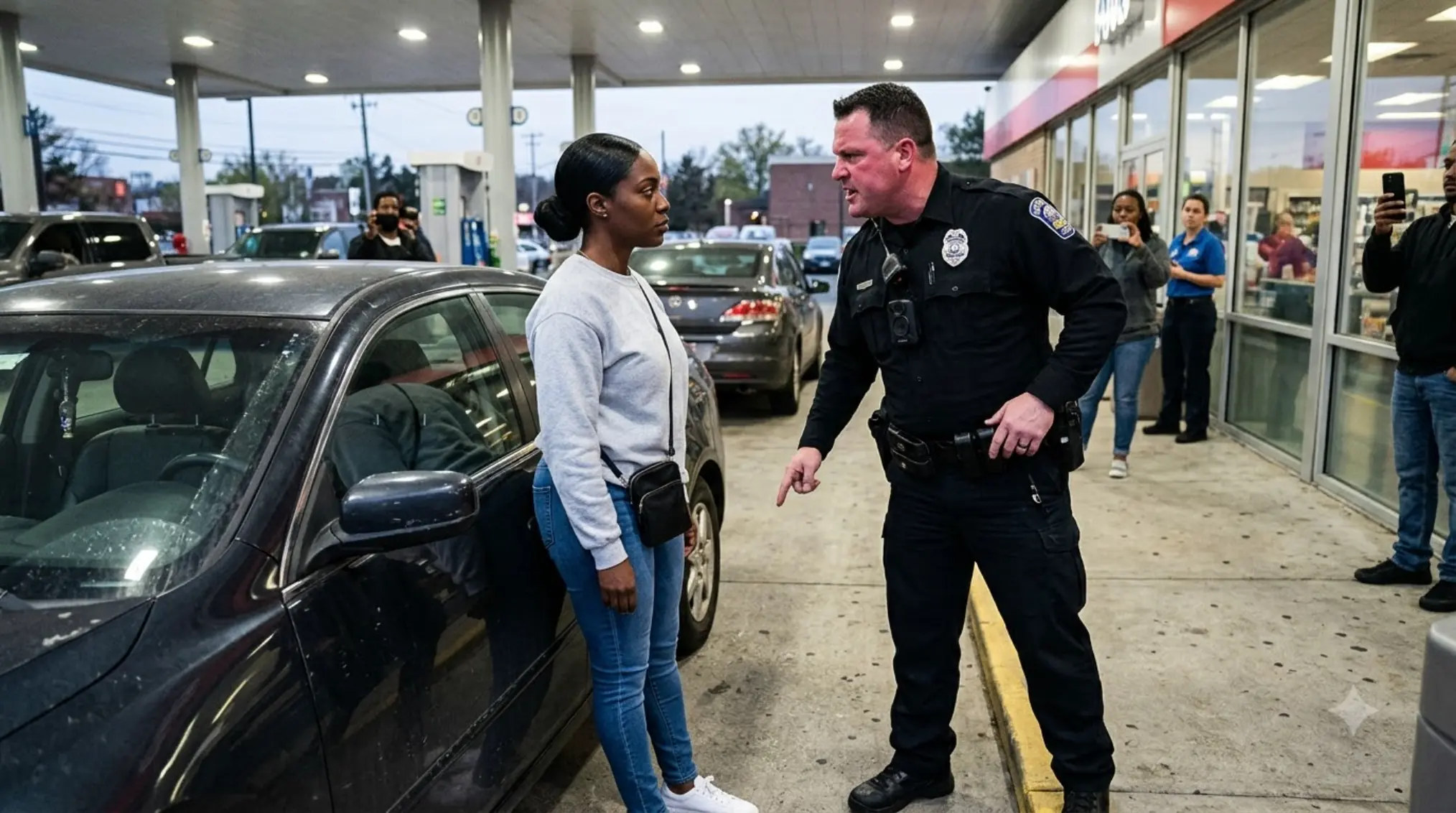
She had been standing beside the passenger door of her dark sedan at a busy station outside Washington, D.C., one hand resting near the small black crossbody pouch at her hip. The fuel pump had clicked off thirty seconds earlier. Her receipt was still sticking out of the machine. A middle-aged man in an olive jacket was fueling his sedan at the neighboring pump, and several customers moved behind the glass storefront carrying coffee and snacks.
Nothing about the afternoon had seemed unusual.
Then Officer Dean Walsh had arrived.
Forty-five years old, broad through the shoulders, short dark hair, heavy jaw, black patrol uniform, body camera, radio, and a duty belt crowded with equipment. His cruiser had entered the station quickly, stopped near Angela’s car, and he had walked toward her without asking whether she needed help.
Now he was standing close enough that Angela could smell coffee on his breath.
“I said get on the ground.”
Angela kept both hands visible.
“For what?”
Walsh pointed toward the pavement.
“Don’t make this worse.”
“I’m asking why I’m being detained.”
“You reached for something.”
Angela glanced at the pouch hanging against her right hip.
“My identification.”
“You reached for a weapon.”
Her expression changed.
Not fear.
Recognition.
That was an important difference.
Angela had spent twelve years working federal investigations. She knew exactly what happened when an officer decided on a conclusion first and began building facts around it afterward.
“You never saw a weapon,” she said.
Walsh stepped closer.
“I know what I saw.”
“No. You saw my hand move toward a pouch.”
“Get down.”
Angela slowly raised her hands higher.
“Then keep your camera running, because you just invented evidence at a gas pump.”
Walsh’s face reddened.
A man near the convenience-store entrance pulled out his phone.
Then a woman behind him did the same.
The customer at the neighboring pump stopped fueling entirely.
Walsh noticed the attention.
Instead of backing down, he leaned closer.
“I’ll tell the judge you came at me armed, and nobody’s taking your word over mine.”
Angela stared directly at the body camera mounted to his chest.
“Perfect.”
Her voice remained calm.
“Say it under oath.”
Walsh frowned.
Angela lightly touched the outside of the sealed pouch without opening it.
“Then I’ll open this badge in front of the judge.”
For the first time, the officer hesitated.
It lasted less than a second.
Then his arrogance returned.
“You think flashing some fake badge scares me?”
Angela said nothing.
She was not supposed to reveal her identity unless necessary.
That rule was not about drama.
It protected an active federal investigation.
For the previous seven months, Angela had been working with a joint task force investigating a network that purchased stolen firearms and falsified law-enforcement equipment through shell companies operating around Maryland and northern Virginia. Several suspects had connections to private security contractors. Two had previously served in law enforcement.
The investigation was delicate.
Angela’s name did not appear on publicly accessible federal directories connected with the operation. Her sedan was unmarked. She was dressed casually in a light-gray sweatshirt, blue jeans, and white sneakers. She looked like any professional woman stopping for gas after work.
That was intentional.
The FBI wanted the suspects to believe she was ordinary.
Officer Walsh believed exactly that.
But he was not part of the investigation.
At least, Angela had not thought he was.
She had been at the gas station because a confidential source was supposed to leave a receipt inside the convenience store containing a locker number. Nothing dramatic. No arrest. No confrontation.
Just information.
Then Walsh arrived.
Angela had seen his cruiser earlier.
Twice.
Once on a side street near the source’s workplace.
Again three blocks from the station.
She had assumed coincidence.
Now she was no longer sure.
Walsh reached toward her pouch.
Angela stepped sideways.
“Do not touch that.”
His expression sharpened.
“There it is.”
“What?”
“Resistance.”
“I moved away from your hand.”
“You’re obstructing.”
“Obstructing what investigation?”
Walsh raised his voice.
“You don’t ask the questions.”
Angela almost smiled.
“That sentence isn’t going to age well.”
The customer at the neighboring pump coughed to hide a laugh.
Walsh spun.
“You got something to say?”
The man shook his head.
“No, officer.”
“Then finish fueling and leave.”
The man left the nozzle hanging in his gas tank.
“I’m staying.”
Walsh’s face tightened.
The customer raised his phone.
“I’m recording.”
“That’s interfering.”
“No, it isn’t.”
Angela watched the exchange carefully.
Walsh was becoming more reckless because witnesses were refusing to act afraid.
That often happened with people accustomed to controlling the emotional temperature of an encounter.
He turned back toward Angela.
“Hands on the car.”
“No.”
The entire station seemed to pause.
Walsh took another step.
“What did you say?”
“I said no.”
“You refusing an order?”
“I’m asking whether I’m detained.”
“Yes.”
“For what crime?”
“Suspicion of carrying a concealed weapon.”
Angela nodded slowly.
“Based on what?”
“You reached toward that bag.”
“That is not probable cause.”
“You nervous?”
“No.”
“You’re arguing.”
“I’m clarifying.”
“You keep touching the bag.”
“You keep referring to it.”
Walsh’s hand moved toward his cuffs.
“That’s enough.”
Angela’s eyes dropped briefly to the movement.
Walsh noticed.
“Turn around.”
She remained still.
“Officer Walsh, before you touch me, I recommend calling a supervisor.”
His mouth curled.
“You know my name.”
“It’s printed on your uniform.”
“You been watching me?”
Angela said nothing.
That answer clearly bothered him more than denial would have.
He reached for her wrist.
Angela did not fight.
She let him take it.
But she spoke clearly enough for every camera to hear.
“I am not resisting.”
Walsh pulled her arm behind her.
“You’re under arrest.”
“For what?”
“Possession of a concealed weapon, resisting, obstruction.”
Angela looked toward the customer recording.
“Did anyone here see a weapon?”
“No,” the man answered immediately.
A woman near the store entrance shouted, “She never pulled anything!”
Walsh snapped around.
“Back up!”
Angela remained calm.
“Officer Walsh.”
“What?”
“Search me only according to department procedure and preserve my property.”
He laughed.
“You’re in no position to make demands.”
He opened the pouch.
Inside was not a firearm.
Not a knife.
Not contraband.
A sealed black credential wallet sat on top of a small notebook and a government-issued phone.
Walsh froze.
Angela felt it in the silence.
His hand stopped.
He stared into the pouch.
Then slowly removed the wallet.
“Open it,” Angela said.
He did.
The gold federal seal caught the afternoon light.
Her photograph appeared beneath it.
SPECIAL AGENT ANGELA CROSS
FEDERAL BUREAU OF INVESTIGATION
Walsh’s face changed.
First confusion.
Then disbelief.
Then fear.
The customer recording whispered, “Oh, man.”
Angela looked at Walsh over her shoulder.
“Now call your supervisor.”
He closed the wallet too quickly.
“This could still be fake.”
Angela almost laughed.
“Then verify it.”
Walsh looked toward his cruiser.
For the first time since arriving, he seemed unsure what to do.
Then he made a decision that made everything worse.
He put the credential back into the pouch.
Closed it.
And said:
“I’m still taking you in.”
Angela stared at him.
“Based on what?”
“You reached for something I reasonably believed was a weapon.”
“You now know it wasn’t.”
“That doesn’t change what happened.”
“It changes your probable cause.”
“No.”
Angela’s voice cooled.
“Then we’ll let a judge decide.”
Walsh did not know how literal that sentence would become.
Within twenty minutes, his supervisor arrived.
Captain Laura Benson stepped from an unmarked department SUV, listened to Walsh for less than a minute, then looked at Angela.
“Ma’am, are you actually federal law enforcement?”
Angela nodded toward the pouch Walsh still held.
“My credential is inside.”
Benson opened it.
She read the identification.
Then looked at Walsh.
“Why is she cuffed?”
“She reached toward the pouch.”
“Did you see a weapon?”
“I believed she was reaching for one.”
“That’s not what I asked.”
Walsh hesitated.
“No.”
Benson looked toward the witnesses.
Then at Walsh’s body camera.
“Was your camera active the entire time?”
He paused.
Angela noticed.
Benson noticed too.
“Officer?”
“Mostly.”
That word changed the mood.
“Mostly?”
Walsh looked down.
“I activated it during the contact.”
Angela immediately said:
“He approached me before it was activated.”
Benson turned toward her.
“Do you have independent recording?”
Angela looked toward the phones.
“At least four people do.”
The man at the neighboring pump raised his hand.
“Mine started when he told her she had a weapon.”
Another woman added:
“I recorded before that.”
Benson closed her eyes briefly.
Then she ordered Walsh to remove the cuffs.
He obeyed.
Angela rubbed her wrists.
Benson returned the credential.
“I apologize.”
Angela shook her head.
“Don’t apologize yet.”
Benson frowned.
“Why?”
“Because I want to know why he was here.”
Walsh’s expression changed again.
Benson turned toward him.
“What does she mean?”
“I was patrolling.”
Angela looked toward the cruiser.
“Twice near Brookland Avenue?”
Walsh stared at her.
“Once near Fulton Street?”
Silence.
Benson’s eyes narrowed.
“Dean?”
He swallowed.
“I was following a suspicious vehicle.”
Angela’s voice sharpened.
“My vehicle?”
“Yes.”
“Why?”
“Anonymous tip.”
“What tip?”
Walsh did not answer.
Benson said:
“Officer Walsh, answer her.”
He looked toward the witnesses.
Then the body camera.
Finally:
“Possible weapons trafficking.”
Angela’s face became still.
That was not random.
The confidential source she was supposed to meet indirectly was connected to weapons trafficking.
Someone knew.
That transformed the encounter from misconduct into a potential compromise of a federal investigation.
Angela reached for her government phone.
Walsh moved instinctively.
Benson stepped between them.
“Don’t.”
Walsh stopped.
Angela made one call.
“Control, this is Cross. Operation may be compromised. Local officer made contact based on a trafficking tip tied to my vehicle. Preserve source location. Move secondary team.”
The response came immediately.
“Copy. Stand by.”
Walsh stared.
Benson stared too.
“What operation?” she asked.
“I can’t discuss it here.”
Angela looked directly at Walsh.
“But somebody may have fed him information that should not have existed outside our task force.”
Walsh’s face lost more color.
“I don’t know anything about your investigation.”
Angela replied:
“I didn’t say you did.”
That answer frightened him even more.
The case reached court four days later.
Not because Angela was being prosecuted.
She was not.
The district attorney dismissed the local charges within hours after reviewing the first witness videos.
The hearing instead concerned preservation of evidence and a motion involving Walsh’s written incident report.
That report claimed Angela had “rapidly reached toward an unknown object consistent with accessing a concealed weapon.”
It said she “refused repeated lawful commands.”
It described her as “increasingly combative.”
It claimed Walsh “observed a hard object inside the pouch.”
There had been no hard object.
The most serious line came near the end.
Subject presented federal identification only after lawful arrest was completed.
That was false.
Witness video showed Walsh opening the credential before he decided to transport her.
Angela sat beside federal counsel inside the courthouse as Walsh took the stand.
Judge Margaret Reeves presided.
She was known for reading every document before entering the courtroom.
That morning, she had read Walsh’s report twice.
“Officer Walsh,” she said, “you believed Ms. Cross had a weapon?”
“Yes, Your Honor.”
“You saw one?”
“No.”
“You saw the outline of one?”
“I believed there was a hard object.”
“Was there?”
Walsh hesitated.
“No.”
“What was inside the pouch?”
“A credential wallet.”
The judge looked over her glasses.
“And that wallet identified Ms. Cross as an FBI special agent?”
“Yes.”
“When did you discover that?”
“After detaining her.”
The federal attorney stood.
“Your Honor, may we play Exhibit Seven?”
The judge nodded.
A large courtroom monitor came alive.
Gas station video.
Walsh standing inches from Angela.
His own voice:
“I’ll tell the judge you came at me armed, and nobody’s taking your word over mine.”
The courtroom became silent.
Angela watched Walsh’s face.
He looked toward the floor.
Then came her response:
“Perfect. Say it under oath—then I’ll open this badge in front of the judge.”
The video continued.
The pouch opened.
Walsh removed the credential.
Read it.
Then continued the detention.
Judge Reeves stopped the video.
“Officer.”
Walsh looked up.
“Your report says the identification appeared after the arrest decision.”
“Yes.”
The judge looked toward the frozen image on the monitor.
“You were holding it before you announced the final charges.”
Walsh swallowed.
“I had already made the decision.”
“Then why didn’t your report say that?”
“I summarized events.”
Judge Reeves’ expression hardened.
“You rearranged them.”
Walsh’s attorney objected.
The judge ignored the tone and continued carefully.
“Did you believe Ms. Cross was an FBI agent after reading the credential?”
“I wasn’t certain.”
“Did you attempt verification?”
“No.”
“Why?”
“I believed officer safety came first.”
“What immediate threat remained after both hands were cuffed and the pouch had been searched?”
Walsh said nothing.
The judge leaned back.
“Officer?”
“No immediate threat.”
The federal attorney stood again.
“Your Honor, we also have evidence concerning the origin of the anonymous tip.”
Walsh’s face changed.
Angela noticed.
The court allowed the evidence under seal.
Phone records showed that Walsh’s “anonymous tip” came from a prepaid number used previously by a private security contractor named Raymond Ellis.
Ellis was already under federal investigation.
More damagingly, Walsh and Ellis had exchanged twelve calls during the previous six months.
Walsh claimed they were social acquaintances.
Federal investigators discovered payments from a company connected to Ellis had covered several expenses for Walsh.
Nothing alone proved a criminal conspiracy.
Together, it justified a much deeper investigation.
Walsh was placed on administrative leave.
His body-camera record was audited.
Investigators discovered the camera had been activated almost ninety seconds after the initial confrontation began.
Department policy required activation before direct enforcement contact whenever practical.
Walsh had not forgotten.
His camera metadata showed several similar late activations across previous stops.
The review expanded.
Eight prior complaints surfaced.
Four involved Black motorists.
Two involved Latino drivers.
Several described nearly identical language.
“Possible weapon.”
“Furtive movement.”
“Reached toward waistband.”
“Officer-safety concern.”
Most cases produced no weapon.
One involved a twenty-two-year-old college student who reached toward his glove compartment after Walsh asked for registration.
Another involved a nurse reaching into her purse for a license.
Both had been handcuffed.
Neither was charged.
Angela read the reports.
She did not feel triumphant.
She felt angry.
Not because Walsh had treated an FBI agent badly.
Because he had apparently treated people badly when he believed nobody powerful would examine the details.
During an internal hearing, investigators asked Angela whether she believed racism influenced the stop.
She answered carefully.
“I cannot tell you what was in his mind.”
“Did his treatment feel discriminatory?”
“Yes.”
“Why?”
“Because I watched ordinary actions become suspicious only after he decided I was suspicious.”
She paused.
“Reaching for identification became reaching for a weapon.”
“Questions became resistance.”
“Standing still became nervousness.”
She looked at the investigators.
“You should examine whether he applied that pattern consistently across citizens.”
They did.
The department’s own data showed substantial disparities in Walsh’s discretionary searches.
That finding became part of the disciplinary case.
Three months later, Walsh was terminated for multiple violations, including inaccurate reporting, body-camera violations, unsupported escalation, and misconduct connected to the investigation into Raymond Ellis.
A separate criminal investigation continued.
Angela refused interviews until the federal operation ended.
Six months later, arrests were announced in the weapons-trafficking case.
Raymond Ellis was among them.
Prosecutors alleged he had used private security connections and personal relationships with several officers to obtain information and create pressure around targeted individuals.
Walsh was not charged with every offense the public speculated about.
Angela insisted on saying that clearly.
“Evidence decides guilt,” she told reporters.
“Not headlines.”
One journalist asked the question everyone wanted answered.
“Did your FBI badge save you?”
Angela thought about the gas station.
Walsh leaning close.
The witnesses recording.
The sealed pouch.
The instant his face changed when he saw the federal seal.
“No.”
The reporter looked surprised.
“It changed the encounter.”
“Yes.”
“So how did it not save you?”
Angela answered:
“Because the badge should never have been necessary.”
The room became quiet.
“I had already kept my hands visible.”
“I had already answered his questions.”
“I had already committed no crime.”
She paused.
“My title did not create my rights.”
The clip circulated widely.
A year later, Angela returned to the same gas station.
Not undercover.
No surveillance team.
No confidential source.
She simply needed fuel.
The station had been renovated.
Different signs.
New pumps.
Same concrete.
Angela pulled beside the island where Walsh had cornered her.
She stepped out.
For half a second, memory tightened her chest.
Then she inserted her card and began fueling.
A young Black woman pulled up on the opposite side.
She was wearing hospital scrubs.
The woman searched inside her bag for a wallet.
A police cruiser passed on the road.
Angela watched it automatically.
The cruiser continued.
Nothing happened.
The nurse found her card.
The pump started.
Ordinary.
Angela smiled faintly.
The clerk inside recognized her when she entered for coffee.
“Agent Cross?”
Angela laughed.
“Unfortunately.”
The clerk smiled.
“I was here that day.”
“You were?”
“Behind the counter.”
He pointed toward the window.
“I started recording after the officer raised his voice.”
Angela studied him.
“Thank you.”
“I didn’t do much.”
“You preserved what happened.”
He shrugged.
“Everyone had phones out.”
“That doesn’t mean everyone presses record.”
He looked down.
Then said:
“People tell the story like the cool part was when you showed the FBI badge.”
Angela nodded.
“I know.”
“I thought the important part was before that.”
She raised an eyebrow.
“What part?”
“When you told him to keep the camera running.”
Angela smiled.
“Yes.”
The clerk handed her the coffee.
“That’s when I knew you weren’t scared.”
Angela shook her head.
“I was scared.”
He looked surprised.
“Really?”
“Of course.”
“But you looked calm.”
“Calm and scared can exist together.”
She picked up the cup.
“Courage is often just deciding which one gets to speak.”
Outside, Angela stood beside her sedan for a moment.
The same type of small black pouch hung across her body.
Her federal credential remained inside.
Nobody could see it.
That was how she preferred it.
Because the lesson of that day had never been that Officer Dean Walsh chose the wrong woman to accuse.
Angela was not dangerous because she worked for the FBI.
She was not deserving of respect because a federal seal sat inside her bag.
The real failure occurred before anybody learned her title.
An officer had taken ordinary movement and called it a weapon.
He had taken questions and called them resistance.
Then he had threatened to carry that invented story into court because he assumed his uniform would make it more believable than her voice.
What ended his career was not one dramatic badge reveal.
It was evidence.
Witness phones.
Body-camera metadata.
The false report.
Phone records.
Previous complaints.
A judge willing to compare testimony with video.
Investigators willing to look beyond one incident.
Angela got into her car.
Before starting the engine, she looked at the crossbody pouch.
Then toward the gas station entrance where another customer was walking inside.
No one there knew who she was.
No one needed to.
That was the point.
Justice worked best when ordinary people did not need extraordinary identities to make the truth matter.
And that was why Angela Cross remembered the courtroom more clearly than the gas station.
Officer Walsh had promised that a judge would believe him over her.
Four days later, he stood under oath, faced the recording, and discovered that evidence did not care which one of them wore the local badge.