“Stop right there.”
The command cut across the polished stone plaza in downtown Columbus just as Dr. Simone Carter stepped past the fountain with a tan legal folder tucked beneath one arm. She was thirty-six, poised and elegant, wearing a soft pink fitted blouse, cream tailored trousers, and carrying a pale pastel handbag over her shoulder. She turned slowly and found Officer Patricia Keller, a stocky white patrol officer in her early fifties, walking directly toward her with one finger already raised as though the decision about who was wrong had been made before either woman spoke.
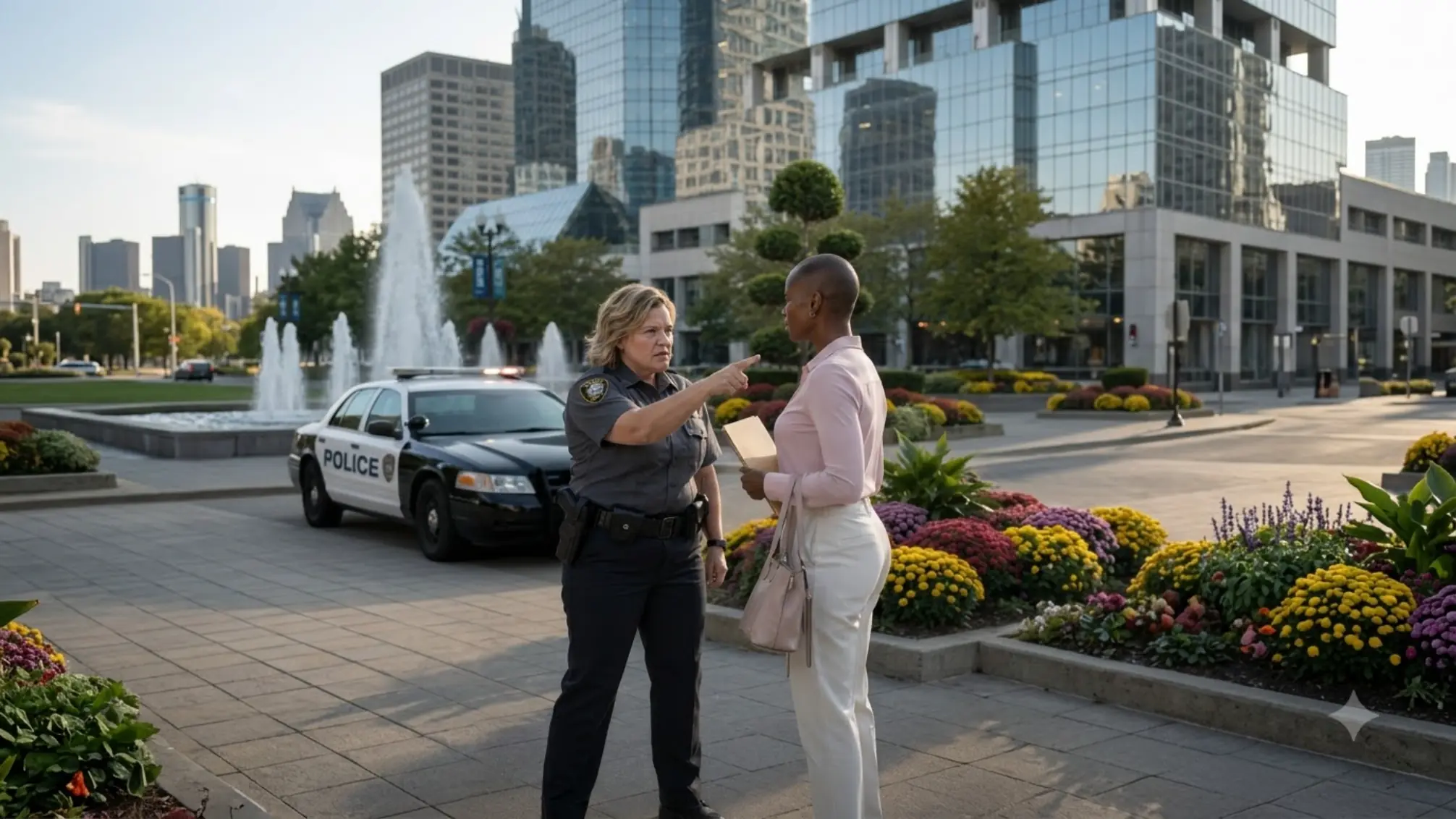
“You ignored my order to stop walking,” Keller snapped. “Now you’re going to explain why you’re acting suspicious in my city.”
Simone looked behind herself.
Office workers crossed the plaza. A man pushed a stroller beside the flower beds. Two women stood near the fountain drinking coffee, and traffic rolled normally beyond the row of mirrored glass buildings.
Then Simone looked back at Keller.
“I was walking to a meeting.”
“Where?”
Simone glanced toward the enormous government building across the plaza.
“That building.”
Keller followed her eyes and gave a short, dismissive laugh.
“You expect me to believe you have business in there?”
Simone’s expression changed slightly.
Not anger.
Recognition.
She had heard versions of that question before.
Officer Keller stepped closer.
“What’s in the folder?”
“Documents.”
“What kind?”
“Confidential ones.”
That answer clearly irritated her.
Keller pointed toward a bench.
“Sit down.”
“Am I detained?”
“You are now.”
“For what?”
“Failure to follow lawful instructions.”
Simone remained standing.
“What lawful investigation are you conducting?”
Keller stared at her.
“You want to play attorney with me?”
“No.”
Simone shifted the tan folder beneath her arm.
“I want you to tell me what crime you believe occurred.”
The officer’s jaw tightened.
Across the street, the patrol cruiser’s lights were still flashing from whatever call Keller had been handling before noticing Simone. Nothing about Simone’s behavior had attracted attention from anyone else. She had simply crossed the plaza after leaving a parking garage and was headed toward the Ohio Civil Rights Commission building for a four o’clock meeting.
Keller looked at Simone’s pastel handbag.
“Open the bag.”
“No.”
That surprised her.
“What did you say?”
“I said no.”
Keller moved closer.
“Drop the attitude, or I’ll detain you right here and make this day a lot worse.”
Simone looked directly into her eyes.
Then she slowly lifted the tan file.
“No, Officer. You’re going to explain why your name is sitting inside this state civil rights file.”
For the first time, Keller stopped talking.
Her eyes dropped to the folder.
A white identification label was partially visible along the edge.
KELLER, PATRICIA — COMPLAINT REVIEW
The officer’s face changed.
Simone noticed immediately.
That reaction mattered.
Because Simone Carter was not walking through downtown Columbus by accident.
And Officer Patricia Keller was not a stranger to her.
Three months earlier, Simone had been appointed senior counsel to a state investigative task force reviewing a collection of civil-rights complaints involving public encounters in Franklin County. Most of the reports were ordinary disputes that could be resolved through policy review, additional training, or insufficient evidence findings.
But eleven complaints stood out.
Same officer.
Same pattern.
Patricia Keller.
One complaint came from a fifty-eight-year-old Black accountant named Bernard Ellis.
Bernard said Keller stopped him outside his own office building after work because she believed he was “waiting around suspiciously.”
He showed identification.
She still questioned him for twenty-three minutes.
No arrest.
No citation.
No official incident report.
Another complaint came from Andrea Miles, a university professor who said Keller demanded to know why she was sitting inside a luxury SUV parked outside an upscale shopping center.
Andrea explained the vehicle belonged to her.
Keller allegedly asked if she could prove it.
A third involved a college administrator named Kelvin Ross.
He had been walking near the riverfront carrying photography equipment when Keller ordered him to stop.
The official report later described him as “nervous and evasive.”
Video showed something different.
Kelvin repeatedly asked why he had been stopped.
He was released after thirty-four minutes.
Nothing illegal was found.
Each complaint alone could be explained.
Together, they bothered Simone.
Then she discovered something stranger.
Six of the eleven complainants had originally alleged that Keller made remarks about whether they “belonged” in particular places.
Those statements disappeared from the internal summaries.
The original complaints said one thing.
The police review documents said another.
Someone was cleaning the language.
Simone requested body-camera footage.
Three files were incomplete.
Two supposedly had technical errors.
One had been deleted under routine retention rules despite the complaint being active.
That was when the task force moved the Keller file from routine review to formal investigation.
Simone spent two weeks interviewing complainants.
Bernard Ellis still remembered every word.
“She looked at my suit,” he told Simone across a conference table. “Then she looked at the building behind me like those two things didn’t match.”
“What happened when you gave her your business card?”
Bernard laughed quietly.
“She asked if it was real.”
Simone wrote that down.
Andrea Miles had a similar story.
“She kept asking where I got the car.”
“Did she accuse you of stealing it?”
“No. She was smarter than that.”
Andrea leaned forward.
“She asked questions designed to make me prove I deserved to be there.”
That sentence followed Simone home.
The investigation expanded.
A former dispatcher provided call logs showing several stops Keller described as responses to citizen reports actually had no corresponding dispatch entry.
In other words, she had initiated them herself.
That still did not automatically mean misconduct.
Police officers could approach people voluntarily.
But Simone noticed another pattern.
When Keller encountered someone who immediately submitted to her questions, the interaction usually ended quickly.
When someone asked why they were being stopped, the encounter escalated.
Questions became commands.
Commands became detention language.
Sometimes handcuffs appeared.
The common factor was not criminal behavior.
It was resistance to Keller’s authority.
Simone prepared a preliminary report.
Her recommendation was not immediate termination.
She believed evidence needed to be collected properly and Keller deserved an opportunity to respond.
A formal interview was scheduled for four o’clock on a Tuesday afternoon.
Keller had not yet been notified.
The notice would be served at three-thirty by her department’s professional standards division.
Simone was carrying the file to the meeting.
Then Keller stopped her in the plaza at 3:07.
The irony would have been funny under different circumstances.
Now Keller stared at the file label.
“What is that?”
“You read it.”
“Where did you get that?”
“That’s not your concern yet.”
Keller’s hand moved toward her radio.
Simone noticed.
“You should probably call your supervisor.”
Keller’s eyes narrowed.
“You think you’re threatening me?”
“No.”
Simone remained calm.
“I think your supervisor is already looking for you.”
That was true.
Professional standards Captain Elaine Brooks had texted Simone ten minutes earlier.
Keller not at station. Attempting location.
Simone had not responded yet.
Now Keller stepped closer.
“Give me that folder.”
“No.”
“That could contain restricted police information.”
“It contains material you are not authorized to seize.”
“Hand it over.”
Simone’s voice sharpened.
“Officer Keller, I strongly recommend you stop making demands until you contact your chain of command.”
A small crowd had begun to notice them.
Not because anyone understood what was happening.
Because Keller’s voice was getting louder.
Two office workers slowed near the flower beds.
A man sitting near the fountain quietly lifted his phone.
Keller saw him.
“Put that away.”
The man frowned.
“I’m on public property.”
Keller pointed.
“I said put it away.”
Simone looked at the man.
“Keep recording.”
Keller turned toward her.
“You don’t tell people what to do during my stop.”
“Your stop?”
“Yes.”
“Of me?”
“Yes.”
“For walking?”
“For suspicious behavior and refusing lawful commands.”
Simone opened her pastel handbag.
Keller immediately stiffened.
“Hands where I can see them.”
Simone stopped moving.
Then she slowly removed a leather identification wallet.
She opened it.
STATE OF OHIO
SPECIAL CIVIL RIGHTS COUNSEL
SIMONE CARTER
Keller looked at the credential.
Then at Simone.
Something close to panic flashed behind her eyes before disappearing beneath anger.
“You expect me to believe this?”
Simone almost smiled.
“You were scheduled to find out at four.”
Keller stared.
“What?”
Simone lifted the tan folder again.
“You are the subject of an eleven-complaint civil-rights review.”
The plaza suddenly seemed quieter.
Keller’s face flushed.
“You’re lying.”
Simone turned the folder toward her.
The case number appeared beneath Keller’s name.
So did the state seal.
Keller took one step backward.
Then her radio crackled.
“Keller, location?”
Captain Brooks.
Keller did not answer.
The radio sounded again.
“Officer Keller, acknowledge.”
Simone raised an eyebrow.
“You should answer that.”
Keller finally pressed the microphone.
“Central Plaza.”
A pause.
“Remain there.”
Keller’s gaze snapped toward Simone.
The officer understood now.
Something was happening beyond her control.
Within four minutes, an unmarked sedan pulled beside the curb.
Captain Elaine Brooks stepped out.
She was a tall Black woman in her late forties wearing business clothes rather than a patrol uniform.
Behind her arrived Lieutenant Mark Dunne from professional standards.
Brooks looked first at Simone.
Then at Keller.
Then at the civilians recording nearby.
“Patricia.”
Keller immediately began explaining.
“She was refusing identification. She was acting suspiciously and—”
Brooks raised one hand.
“Stop.”
Keller stopped.
Brooks looked at Simone.
“Counsel Carter?”
Simone nodded.
“I was walking from the garage to our scheduled meeting.”
Brooks closed her eyes briefly.
“Of course you were.”
Keller stared between them.
“You know her?”
Brooks looked almost tired.
“Yes.”
“How?”
Brooks answered carefully.
“She was supposed to interview you this afternoon.”
The words landed harder than any accusation Simone could have made.
Keller looked down at the pavement.
Then toward the cameras.
Then back at Brooks.
“This was a setup.”
Simone shook her head.
“No.”
“You deliberately walked past me.”
“I didn’t know where you were.”
“You people planned this.”
Brooks’ expression hardened.
“Officer Keller, stop talking.”
But Keller could not.
Years of authority had taught her that speaking forcefully often recovered control.
“This woman refused orders.”
Simone answered.
“I asked whether I was detained.”
“You challenged everything I said.”
“Yes.”
“Exactly.”
The plaza went silent again.
Simone looked at Brooks.
That single word had captured the entire investigation.
Exactly.
For Keller, questions themselves had become suspicious.
Brooks instructed Dunne to collect Keller’s body-camera recording immediately.
Keller touched the device unconsciously.
Simone noticed.
“Was it activated?”
Brooks asked.
“Yes.”
“All of it?”
Keller hesitated.
“Most.”
Dunne looked at her.
“What does that mean?”
Keller did not answer.
They reviewed the preliminary footage thirty minutes later inside a conference room upstairs.
The recording began eleven seconds after Keller first called out to Simone.
That alone raised a policy issue.
Then came the dialogue.
Keller asking where Simone was going.
Questioning whether she had legitimate business inside the state building.
Demanding the handbag.
Escalating after Simone asked for legal justification.
Brooks watched without expression.
Simone sat across the table, still wearing the soft pink blouse and cream trousers.
Her pastel handbag rested beside her chair.
The tan Keller file lay unopened.
When the video ended, nobody spoke for several seconds.
Finally Brooks asked, “Patricia, what specific conduct caused you to initiate this encounter?”
Keller folded her arms.
“She was watching the building.”
Simone frowned.
“I looked at the building after you asked where I was going.”
Keller looked irritated.
“You were lingering.”
“I crossed the plaza continuously until you stopped me.”
Brooks checked the exterior security camera.
Simone was correct.
From the moment she entered the plaza, she walked directly toward the government building.
No lingering.
No unusual behavior.
No interaction with anyone.
Brooks looked at Keller.
“Anything else?”
“She looked nervous.”
Simone almost laughed.
The security footage showed her checking an email while walking.
Nothing else.
Brooks asked another question.
“Would you have stopped her if she had immediately obeyed every order?”
Keller stared.
“That’s irrelevant.”
“No.”
Brooks leaned forward.
“That may be the most relevant question in this room.”
The formal civil-rights interview scheduled for four o’clock was postponed.
The investigation had just gained a new incident.
And this time, the subject of the complaint had walked directly into the investigator assigned to review her.
The story did not remain private for long.
One of the civilians in the plaza uploaded a video.
The clip showed Keller pointing inches from Simone’s face.
Then Simone lifted the tan folder.
Audio captured her saying:
“No, Officer. You’re going to explain why your name is sitting inside this state civil rights file.”
The video spread across Columbus by evening.
National accounts picked it up the next morning.
But Simone refused interviews.
She did not want public outrage replacing actual evidence.
A viral clip could create pressure.
It could not create due process.
She returned to the eleven original cases.
This time, people were more willing to talk.
Three new complainants came forward within a week.
One was Thomas Reed, a fifty-year-old hospital administrator.
Keller had stopped him outside a condominium building two years earlier.
He lived there.
“I didn’t complain,” Thomas admitted.
“Why?”
“I had a job. Kids. Responsibilities.”
He looked embarrassed.
“I figured nothing happened, so why make trouble?”
Simone leaned forward.
“Something did happen.”
Thomas looked at her.
“You were forced to prove you belonged outside your own home.”
His eyes lowered.
“Yes.”
Another complaint came from Monica Hale, a lawyer who had been questioned while waiting for a rideshare outside a downtown restaurant.
She had written the officer’s name in her phone but never reported it.
When she saw the plaza video, she recognized Keller immediately.
Then came evidence from inside the department.
Lieutenant Dunne discovered internal emails.
A supervisor had warned Keller twice about “overly broad pedestrian contacts.”
Neither warning entered her formal disciplinary file.
Another email described her interactions as “high-energy enforcement.”
Simone hated the phrase.
It transformed escalation into enthusiasm.
Then investigators found a spreadsheet.
Keller maintained her own list of stops.
Not official reports.
Personal notes.
Some entries included initials.
Some included locations.
Several contained comments.
Wouldn’t identify employer.
Questioned authority.
Acted entitled.
Claimed lawyer.
Demanded supervisor.
Those comments revealed what Simone suspected.
Keller was not documenting criminal indicators.
She was documenting resistance.
One entry matched Bernard Ellis.
Beside his initials, Keller had written:
Suit. Corporate type. Thought status mattered.
When Simone showed Bernard the note, he stared at it for a long time.
“That’s what she thought of me?”
“It appears so.”
Bernard shook his head.
“She questioned whether my business card was real.”
Simone nodded.
Bernard looked toward the window.
“And she thought I was the one obsessed with status.”
The state investigation eventually reviewed thirty-seven encounters.
Not every one involved misconduct.
That mattered.
Simone insisted on saying so publicly.
Twelve were ordinary.
Seven lacked enough evidence.
Eighteen demonstrated substantial concerns ranging from improper detention to biased assumptions and escalation after citizens questioned authority.
Keller received notice of a formal disciplinary hearing.
Her attorney argued she had been unfairly targeted because of the viral incident.
Simone did not attend the final personnel proceeding.
She had already completed her report.
The department terminated Keller after finding repeated violations of detention policy, failure to articulate reasonable suspicion, inaccurate reporting, and failure to activate recording equipment properly.
But Simone considered something else more important.
The supervisors.
Keller had not operated in isolation.
Warnings existed.
Complaints existed.
Patterns existed.
People had noticed.
The institution treated each one separately until no single incident looked serious enough to force change.
That was the real failure.
Captain Brooks agreed.
The department created a new system flagging officers who generated repeated complaints involving similar conduct, regardless of whether each complaint individually resulted in discipline.
Body-camera activation auditing became automatic.
Pedestrian stops required clearer documentation.
Supervisors could no longer close bias-related complaints without external review.
Months later, Simone returned to the same plaza.
Autumn flowers filled the planters.
The fountain ran behind her.
Glass towers reflected the late afternoon light.
She wore another pink blouse by coincidence.
Her pastel handbag was the same.
This time nobody stopped her.
Bernard Ellis met her near the fountain.
He had been invited to speak at a public listening session upstairs.
“You know,” he said, looking around, “I’ve walked through here hundreds of times.”
“And?”
“Never thought walking could become evidence.”
Simone smiled faintly.
“Neither did I.”
They headed toward the building.
Halfway across the plaza, Bernard asked, “Did you know it was her when she stopped you?”
“Immediately.”
“And you didn’t tell her?”
“She didn’t ask my name until after she’d already decided I was suspicious.”
Bernard laughed.
“That’s almost poetic.”
“No.”
Simone looked toward the government building.
“It’s useful.”
The distinction mattered.
This was not revenge.
Keller losing her job did not erase what happened to Bernard, Andrea, Kelvin, Thomas, Monica, or anyone else.
Accountability was not entertainment.
It was correction.
A year later, Simone testified before a state committee reviewing police complaint procedures.
One senator asked what lesson policymakers should take from the Keller investigation.
Simone thought carefully.
“The important moment was not when Officer Keller discovered who I was.”
The senator waited.
“The important moment happened before that.”
“When?”
“When she believed I was nobody important.”
The room became silent.
Simone continued.
“That is where civil rights are tested. Not when someone recognizes a title, a credential, a lawyer, a judge, or an investigator.”
She looked around the chamber.
“They are tested when the person standing in front of authority appears to have nothing authority needs.”
The statement became widely quoted.
Simone barely noticed.
She returned to work.
There were more files.
More complaints.
Some valid.
Some mistaken.
Some complicated.
Each deserved to be examined on evidence rather than outrage.
Months later, Simone opened a new folder at her desk.
Another officer.
Another county.
Different facts.
Before reading it, she noticed the old pastel handbag sitting beneath her desk.
For some reason, she remembered Keller pointing across the plaza.
You ignored my order to stop walking.
Simone smiled slightly.
She had been walking toward the civil-rights office carrying the officer’s own case file.
Keller believed she had interrupted a suspicious stranger.
In reality, she had walked directly into the one meeting that could change her career.
And she had done something even more damaging than recognizing the wrong person.
She had demonstrated the exact behavior the file already described.
In broad daylight.
On camera.
In front of witnesses.
Before Simone ever had to open the first page.