The handcuff closed around Valerie Jenkins’s wrist with a metallic click that cut through the elegant department store. She stood beside the marble checkout counter holding a printed receipt in one hand and a structured beige handbag in the other. Officer Brian Miller tightened the steel against her skin while wealthy shoppers slowed beneath the winter decorations and pretended not to stare. The red light on his body camera blinked steadily, recording the moment he decided her appearance mattered more than the evidence.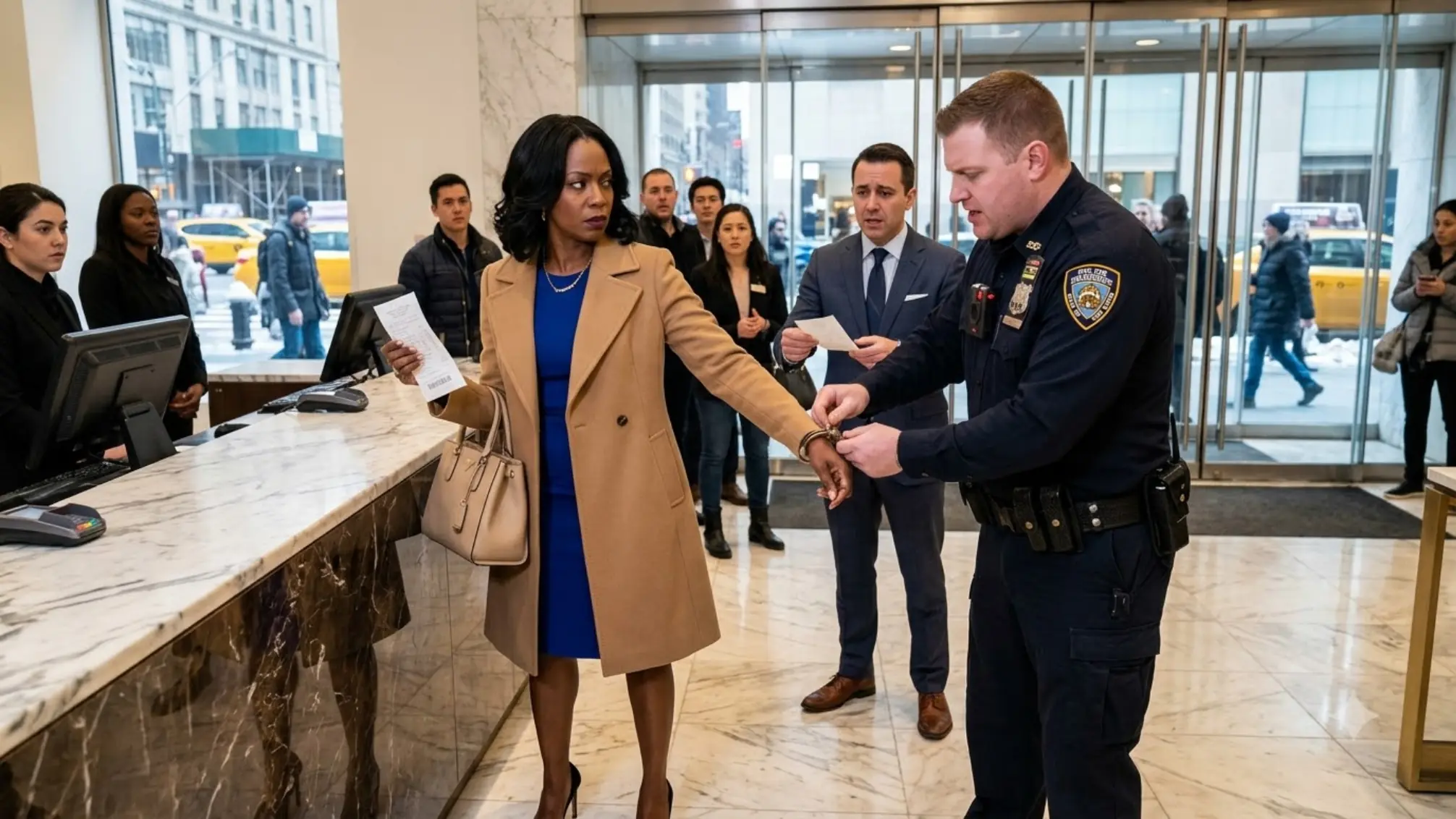
The luxury store occupied four floors of a historic Manhattan building and attracted customers willing to spend more on one coat than many families earned in a month. Sunlight poured through tall glass windows, reflecting from polished displays filled with watches, jewelry, and designer accessories. Valerie had entered during her lunch break to purchase gifts for her mother, her younger sister, and the administrative assistant who had worked beside her during a difficult election campaign. Every item inside her shopping bag appeared on the receipt still raised between her fingers.
Elena Brooks, the store manager, hurried around the counter with a tablet held against her chest. She had already pulled up Valerie’s transaction and could see the payment confirmation, item numbers, register location, and exact time of purchase. Her face tightened when she noticed the handcuff, but she stopped several feet away after Miller turned toward her. Years of customer service had taught Elena how quickly authority could transform an obvious mistake into a dangerous confrontation.
Store Manager Elena Brooks (nervously, displaying the tablet): “Officer, the transaction is here. She paid for everything.”
Officer Brian Miller (dismissively, refusing to look): “I’ll decide whether that record is legitimate.”
Store Manager Elena Brooks (firmly, stepping closer): “The bag, receipt, and payment all match our system.”
Officer Brian Miller (angrily, pointing toward the counter): “Back away before I include you in the investigation.”
Valerie watched Elena retreat, not because the manager agreed with him, but because his hand had shifted toward his duty belt. Around them, shoppers exchanged uneasy glances while two employees stood frozen near the perfume counter. A teenage cashier quietly lifted her phone, then lowered it when Miller looked in her direction. Nobody knew whether recording would protect Valerie or give the officer another excuse to escalate.
Valerie had become New York City’s district attorney only eleven days earlier. Her appointment followed a closely contested election built on promises of transparent prosecutions, independent police review, and evidence-based decisions. The department had circulated her photograph and credentials to every precinct commander before her first official week. Miller either had not attended the briefing or had not believed the Black woman in front of him could possibly be the person in that photograph.
She had not introduced herself because her title was irrelevant to whether the detention was lawful. Miller had stopped her after a security employee mentioned seeing a woman near the handbag display, but no theft had been reported and no merchandise was missing. The officer never asked the employee to identify Valerie, never examined the store records, and never requested the receipt before reaching for his cuffs. He began with guilt and searched for facts afterward.
Valerie shifted her hand slightly as the metal pressed into the bone near her thumb. Miller immediately tightened his grip on her arm and accused her of resisting. She stopped moving and turned her face toward the blinking camera on his chest. Her voice became slower and clearer because she knew every word might later be examined frame by frame.
Valerie Jenkins (controlled, addressing the camera): “Officer, please state the specific crime you believe occurred.”
Officer Brian Miller (defensively, glancing around): “You match the description of a suspected shoplifter.”
Valerie Jenkins (firmly, holding up the receipt): “State the description.”
Officer Brian Miller (irritated, pulling her closer): “You can ask questions at the precinct.”
A woman standing near the escalator frowned and whispered that no description had been announced. Another customer said Valerie had been in line directly ahead of him and had paid with a credit card. Miller ordered everyone to remain back and announced that interfering with an arrest could result in detention. The word arrest surprised even Elena because the officer had not identified any stolen property or named a complainant.
Valerie noticed that Miller had taken only her handbag while leaving two shopping bags belonging to nearby customers untouched. He opened the handbag without permission and began removing personal items onto the counter. A wallet, appointment book, city-issued phone, and leather credential case appeared beneath the bright store lights. Valerie watched his fingers pass over the credential case without opening it.
A security supervisor named Alan Pierce entered from the rear office carrying a printed incident sheet. He had received a radio message claiming that a customer concealed merchandise, but the report contained no name, clothing description, or identified item. The security employee who placed the call had already admitted he never saw anything enter Valerie’s bag. He had become suspicious because she visited the designer counter twice before making her purchase.
Security Supervisor Alan Pierce (uneasily, offering the report): “Officer, our employee never witnessed a theft.”
Officer Brian Miller (hostilely, pushing the paper aside): “Then why did your store call us?”
Security Supervisor Alan Pierce (carefully, lowering his voice): “He reported suspicious behavior, not stolen property.”
Valerie Jenkins (coldly, facing Miller): “Suspicion without facts is not probable cause.”
Miller’s face reddened as several customers nodded. He told Valerie she was not qualified to lecture him on police procedure and pulled the second cuff from his belt. Before he could close it around her other wrist, the glass entrance doors opened behind the crowd. Police Commander Nathan Cole entered with Desk Sergeant Maria Santos and two uniformed supervisors.
Cole had responded because Miller used the radio phrase “high-value retail theft with an uncooperative suspect.” That classification triggered command notification under a new policy intended to reduce wrongful arrests inside major commercial locations. He entered expecting organized theft, fleeing suspects, or missing merchandise. Instead, he saw Valerie standing quietly beside a checkout counter with one wrist cuffed and her receipt still visible.
Commander Nathan Cole stopped so suddenly that Sergeant Santos nearly walked into him. He recognized Valerie from the command briefing, the mayor’s appointment ceremony, and a private meeting about unresolved misconduct cases. His attention moved from her face to the open handbag and then to Miller’s active body camera. Anger transformed his expression before he crossed the marble floor.
Commander Nathan Cole (furiously, approaching them): “Remove that handcuff right now.”
Officer Brian Miller (confused, keeping hold of Valerie): “Commander, she’s suspected of stealing.”
Commander Nathan Cole (shouting, pointing at the cuff): “I said remove it.”
Officer Brian Miller (defensively, stepping backward): “I have probable cause.”
The shoppers fell completely silent as Cole stopped directly in front of him. He asked Miller to name the missing merchandise, identify the witness, and describe the evidence supporting the arrest. Miller repeated that Valerie matched a description but could not provide the description itself. Cole turned toward Elena and asked whether the store had confirmed payment.
Elena placed the tablet in his hands and showed him the complete record. Alan gave him the report stating that no employee witnessed concealment and no product remained unaccounted for. The teenage cashier finally stepped forward and confirmed she personally processed Valerie’s purchase. Cole looked at Miller with the controlled fury of a commander realizing the officer had ignored every available fact.
Commander Nathan Cole (coldly, extending his hand): “Give me the cuff key.”
Officer Brian Miller (stubbornly, touching his belt): “I can explain this at the station.”
Commander Nathan Cole (fiercely, stepping closer): “The explanation begins after you release her.”
Valerie Jenkins (calmly, looking at Miller): “The camera is still recording, Officer.”
Miller removed the key with shaking fingers and opened the handcuff. A red mark circled Valerie’s wrist, already beginning to swell where the steel had pressed against her skin. Cole apologized, but Valerie raised one hand before he could continue. She reached toward the counter and picked up the slim leather credential wallet Miller had ignored.
She opened it slowly enough for him to read every line. The gold city seal appeared above her photograph, full name, and elected position. District Attorney Valerie Jenkins stood printed beneath the seal in bold official lettering. Miller’s face lost color as his eyes moved from the credential to the woman he had just threatened to drag through the store.
Officer Brian Miller (stunned, looking toward Cole): “She never told me.”
Valerie Jenkins (coldly, closing the wallet): “My title is not what makes your arrest wrong.”
Commander Nathan Cole (angrily, facing Miller): “The evidence was in front of you.”
Valerie Jenkins (firmly, touching her injured wrist): “And he refused to look at it.”
Cole ordered Sergeant Santos to secure the scene and preserve every recording. The store’s surveillance system, transaction records, emergency call, body-camera footage, and customer videos were immediately classified as protected evidence. Miller reached toward his body camera as though checking whether it remained active. Cole warned him not to touch it.
Sergeant Santos requested Miller’s badge, weapon, department phone, radio, and access card. He stared at her as if the command were more humiliating than the handcuff he had placed on Valerie. Several officers from his precinct had entered behind Cole and now watched without speaking. Miller slowly surrendered each item while the body camera continued recording from his chest.
Officer Brian Miller (bitterly, removing his badge): “You’re destroying my career over one mistake.”
Valerie Jenkins (steadily, holding his gaze): “The evidence will determine what happens.”
Officer Brian Miller (angrily, placing the badge down): “You know exactly how this will look.”
Valerie Jenkins (coldly, stepping closer): “It will look exactly the way you behaved.”
An internal review supervisor arrived within twenty minutes. Valerie declined immediate medical transport but allowed a paramedic to photograph and examine her wrist. She gave a formal statement in the manager’s office, deliberately using the same procedure available to any other detained citizen. She refused special handling beyond the security required for the city’s chief prosecutor.
The surveillance footage showed Valerie entering the store at 1:13 in the afternoon. It captured her selecting three gifts, speaking with two sales employees, paying at the main register, and receiving the printed receipt. Miller appeared eleven minutes later, spoke briefly with a security employee, and walked directly toward Valerie. He never checked the payment system before closing the cuff.
His body-camera recording revealed something even more damaging. Before approaching Valerie, Miller asked the security employee whether the “Black woman with the expensive bag” was the suspected thief. The employee answered that he was not certain anyone had stolen anything. Miller replied that people who looked too comfortable around luxury merchandise usually had a reason.
The internal review team discovered that the description Miller later claimed to rely upon did not exist until after the arrest. He entered it into his mobile report while Commander Cole was traveling to the store. The description listed a Black woman between forty and fifty wearing a camel-colored coat. Surveillance showed at least four Black women in similar winter clothing inside the store that afternoon.
Valerie requested that the investigation remain independent from her office because she was both the district attorney and the victim. A retired judge was appointed as special counsel, while the state attorney general assigned outside investigators. Valerie publicly explained that she would not direct a case involving her own treatment. Her restraint prevented Miller from claiming that political retaliation controlled the outcome.
The investigation expanded after analysts reviewed Miller’s previous retail arrests. During three years, he detained twenty-seven people for alleged shoplifting when stores reported no missing merchandise. Twenty-two were Black or Latino, and fourteen were released without charges after producing receipts. In eight reports, Miller used nearly identical language about suspects presenting “potentially fraudulent proof of purchase.”
One of those people was a Black nurse named Simone Grant. Miller arrested her outside a jewelry store after she bought an anniversary watch for her husband. She spent nine hours in a holding cell before a detective verified the transaction. Her complaint had been closed because the reviewing supervisor accepted Miller’s statement that she appeared nervous.
Another victim was seventeen-year-old Mateo Rivera, who purchased a designer belt with money saved from his weekend job. Miller accused him of using a stolen credit card and handcuffed him in front of his younger sister. The card belonged to Mateo, and the store confirmed the payment within minutes. Miller nevertheless charged him with disorderly conduct for objecting loudly.
The pattern reached beyond one officer. Investigators found that Miller’s former supervisor encouraged high arrest numbers around luxury shopping districts before holiday seasons. Officers received favorable assignments when their stops produced property seizures, even when prosecutors later declined charges. Complaints were reviewed by the same supervisors responsible for praising those numbers.
Commander Cole testified that he had raised concerns about the system six months earlier. His request for an audit remained unanswered after a deputy commissioner warned that negative findings could embarrass the department. Cole preserved copies of his emails and provided them to the special counsel. Those records transformed the case from an individual mistake into evidence of institutional failure.
Valerie met privately with the earlier victims but refused to promise a specific prosecution. She explained that anger could begin an investigation, but only admissible evidence could support charges. Simone told her that being believed after three years felt almost as important as compensation. Mateo said he wanted the body-camera footage shown to new officers so nobody else would be treated like a criminal for buying something expensive.
Miller’s attorney argued that the department had failed to train him properly. He claimed the store’s vague emergency call created enough uncertainty to justify a temporary detention. Investigators agreed that the initial approach might have been lawful but distinguished it from the decision to handcuff Valerie after seeing her receipt. The refusal to examine proof and the creation of a false description changed the legal analysis.
During the disciplinary hearing, Miller watched his body-camera footage on a large monitor. The room heard him say that people like Valerie always had excuses. It showed Elena presenting verified payment while he refused to turn his head. Finally, it showed him claiming authority over evidence he had never bothered to review.
Special Counsel Rebecca Hale asked him why he ignored the receipt. Miller said experienced officers learned that sophisticated thieves often carried convincing documents. Hale asked whether he had inspected the document to determine whether it was convincing or fraudulent. He admitted he had not.
She then asked why he tightened the handcuff after Valerie requested a legal explanation. Miller said her questioning increased his safety concerns. Hale played the video again, showing Valerie motionless with one hand holding a receipt. No reasonable observer could see an immediate threat.
Miller was dismissed from the department and charged with unlawful detention, falsification of records, and official misconduct. His former supervisor faced separate charges for altering complaint findings and pressuring investigators to close cases. The deputy commissioner resigned after the preserved emails contradicted his testimony. Several past prosecutions were reopened because reports written by the same group of officers could no longer be trusted.
The city compensated Valerie, Simone, Mateo, and the other wrongfully detained customers. Valerie directed her own settlement into a legal defense fund for people challenging unsupported arrests and property seizures. She insisted the money remain independently administered so no prosecutor could use it for publicity. The fund later hired attorneys for more than sixty residents during its first year.
The police department introduced a requirement that officers review readily available proof before making retail-theft arrests. Receipts, transaction records, security footage, inventory checks, and witness statements had to be documented before handcuffs were used unless an immediate safety risk existed. Body-camera recordings could no longer be reviewed solely by an officer’s direct supervisor. Independent civilian examiners received access to every complaint involving alleged bias.
Commander Cole remained in his position and became responsible for implementing the changes. Some officers accused him of betraying Miller, but Cole responded that loyalty to one officer could never outrank the public’s trust. Sergeant Santos was promoted to lead the new evidence-preservation team. Elena’s store became the first major retailer to train all employees on objective reporting standards.
Months later, Valerie returned to the department store to purchase a birthday gift for her mother. The winter decorations were gone, replaced by spring displays and bright flowers near the entrance. Elena recognized her immediately and came around the counter. For a moment, both women looked toward the exact place where the handcuff had closed.
Store Manager Elena Brooks (softly, examining Valerie’s wrist): “I should have stepped in sooner.”
Valerie Jenkins (gently, holding her gaze): “You brought the transaction record and preserved the footage.”
Store Manager Elena Brooks (regretfully, lowering her voice): “I still backed away.”
Valerie Jenkins (firmly, touching her hand): “Fear explains hesitation. What matters is what you did next.”
Valerie selected a silk scarf, paid for it, and waited while the cashier placed the receipt inside the bag. No officer approached her, and no shoppers stopped to watch. The ordinary experience felt strangely significant because dignity often became visible only after someone tried to take it away. She thanked Elena and walked toward the glass doors.
Outside, reporters waited to ask whether Miller’s conviction represented justice. Valerie paused beneath the store’s stone entrance and considered the question. One conviction could hold an individual accountable, but justice required changing the system that allowed his conduct to repeat. She answered that evidence had spoken more clearly than status, anger, or public pressure.
The story was often retold as the day an officer accidentally handcuffed the city’s new district attorney. Valerie corrected that description whenever she heard it. Miller had not made a harmless mistake about her identity. He had made a deliberate choice to disregard proof because he believed the woman presenting it could be dismissed.
Her credential shocked the store because power forced people to pay attention. The receipt mattered more because it had been valid before anyone knew her title. The body camera mattered because it preserved words Miller expected others to forget. The witnesses mattered because several eventually chose truth over comfortable silence.
Valerie never celebrated the end of Miller’s career. She understood that accountability was not revenge, and consequences were not strengthened by humiliation. What mattered was that his authority could no longer erase facts or transform prejudice into official records. The process he tried to control had finally become strong enough to examine him.
The handcuff had closed around Valerie’s wrist in front of dozens of silent shoppers. Miller believed the sound marked the beginning of another easy arrest. Instead, it preserved the moment his assumptions collided with evidence he could not rewrite. By the time the steel opened, the investigation that would expose an entire pattern had already begun.