“Keep fighting me and you’re going face-down!”
Officer Daniel Brooks jerked the handcuffs tighter around Marcus Reed’s wrists as five-year-old Lily wrapped both arms around her father’s leg and screamed.
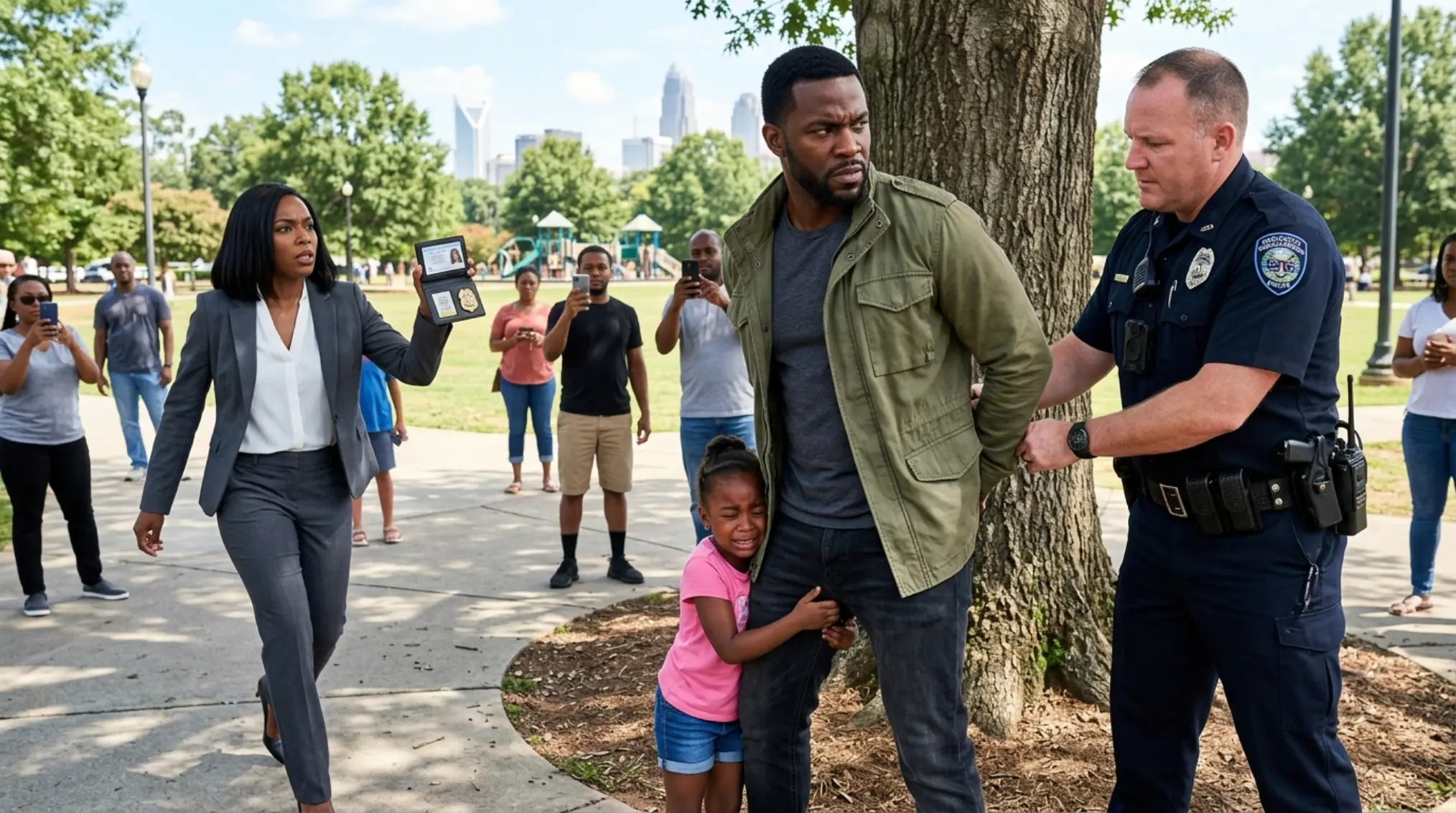
Marcus did not fight.
He had not fought from the beginning.
He stood beneath a massive oak tree in Charlotte’s Freedom Park with his shoulders rigid, his breathing controlled, and his eyes locked on the uniformed officer gripping his arm. His olive-green jacket had been pulled crooked during the arrest, and one cuff was digging so deeply into his wrist that his fingers had begun to tingle.
“Touch my kid again and your bodycam becomes Exhibit One,” Marcus said.
Brooks shoved him toward the nearby patrol cruiser.
“One more word and I’m hauling you both out!”
Then a woman’s voice cut across the park.
“Do it.”
Heads turned.
A striking woman in a charcoal-gray pantsuit was running across the grass, heels sinking into the soft ground. Her sleek black hair moved around her shoulders, and in one hand she held an open leather credential wallet.
“Then explain to the prosecutor about to seize that footage why you cuffed her husband.”
Brooks froze.
Marcus closed his eyes for one brief second.
“Mommy!” Lily screamed.
The little girl released Marcus and ran toward Elena Reed.
Elena dropped immediately, catching Lily against her chest.
“What happened?”
“Daddy didn’t do anything!”
Elena looked over her daughter’s head.
Marcus stood in handcuffs.
Officer Brooks remained beside him.
Around them, at least a dozen people held up phones.
The afternoon had just changed.
An hour earlier, Marcus Reed had been sitting on the grass helping Lily build what she called a “leaf castle.”
It was nothing more than sticks arranged around a pile of oak leaves, but Lily had taken the construction seriously.
Marcus did too.
At thirty-nine, Marcus ran a small commercial electrical company employing seventeen people across Charlotte. His weeks were crowded with inspections, contracts, emergency calls, payroll, and the constant pressure of keeping enough work coming in to support families other than his own.
Saturday afternoons belonged to Lily.
Elena had been working downtown that morning.
She was an assistant state prosecutor assigned to a public-integrity unit and had promised to meet them at the park around four.
Marcus and Lily arrived early.
They bought lemonade.
Fed ducks.
Played near the fountain.
Then Lily saw a little boy crying near the playground.
His mother was nowhere nearby.
Marcus walked over.
“You okay, buddy?”
The boy shook his head.
Lily stood beside Marcus.
“We can find your mommy.”
Marcus crouched several feet away so he would not frighten the child.
“What’s your name?”
“Ethan.”
“Okay, Ethan. We’re going to stay right here where your family can see you.”
That was when Officer Brooks entered the park.
He had been responding to a complaint about teenagers riding electric bikes too fast near the walking path.
From a distance, Brooks saw Marcus near a crying child.
He walked over.
“What’s happening?”
Marcus stood.
“This little guy got separated from his mother.”
Brooks looked at Ethan.
Then Marcus.
“Is this your child?”
“No.”
“Then why are you with him?”
Marcus frowned.
“Because he was crying alone.”
Lily stepped closer to Marcus.
“That’s my daddy.”
Brooks looked down at her.
“Sweetheart, step over here.”
Marcus immediately raised a hand.
“She stays with me.”
Brooks’s expression changed.
“I’m talking to the child.”
“She’s five.”
“I’m aware.”
“Then talk to me.”
Ethan’s mother appeared seconds later, running from the restroom area.
“Ethan!”
The boy rushed toward her.
She hugged him and then looked at Marcus.
“Thank you. I turned around for one second.”
“No problem.”
The misunderstanding should have ended there.
It did not.
Brooks asked Marcus for identification.
Marcus looked at him.
“For what?”
“I need to document the interaction.”
“The child’s mother is here.”
“I still need your ID.”
Marcus glanced toward the mother.
She looked confused.
“You don’t need anything from him,” she said. “He was helping.”
Brooks ignored her.
“Sir, identification.”
Marcus had spent enough time around contracts, inspectors, and legal paperwork through Elena to know that questions mattered.
“What crime are you investigating?”
Brooks stiffened.
“I didn't say you committed a crime.”
“Then why are you demanding identification?”
“I’m conducting an investigation.”
“Into what?”
The officer stepped closer.
“You’re becoming argumentative.”
Marcus almost laughed.
“I asked two questions.”
Several teenagers near the playground had begun watching.
One pulled out a phone.
Brooks noticed.
“Put the phone away.”
The teenager stepped back.
Marcus said, “He can record.”
Brooks turned toward Marcus sharply.
“I wasn't speaking to you.”
“No, but you're giving unlawful orders in front of my daughter.”
That was the moment everything accelerated.
Brooks ordered Marcus to put his hands behind his back.
Marcus stared at him.
“For what?”
“Obstruction.”
“Obstruction of what?”
“Hands behind your back.”
Lily grabbed Marcus’s jacket.
“Daddy?”
Marcus looked down.
“It’s okay, baby.”
Then to Brooks.
“I’m not resisting you.”
“Hands behind your back!”
Marcus obeyed.
The cuffs snapped shut.
Lily began crying.
Brooks tried to move Marcus toward the cruiser.
Lily clung to her father’s leg.
“Stop!” she screamed.
Brooks reached down to separate her.
Marcus twisted instinctively—not toward the officer, but toward his daughter.
“Don’t grab her.”
Brooks tightened his grip.
“Keep fighting me and you’re going face-down!”
And that was the moment Elena reached the park.
Elena stood with Lily pressed against her while studying Brooks.
“What is the basis for detention?”
Brooks looked at her credential.
Then at Marcus.
“This is an active investigation.”
“Of what?”
Marcus almost smiled despite the cuffs.
Same question.
Brooks pointed toward Marcus.
“He interfered with police activity.”
Elena looked around.
“What police activity?”
“A child safety situation.”
Ethan’s mother stepped forward.
“There was no situation.”
Brooks turned.
“Ma’am, stay back.”
“No.”
She pointed at Marcus.
“He found my son. He helped him.”
Elena looked at her.
“You witnessed the entire encounter?”
“Most of it.”
“Please don’t leave.”
Brooks shifted his weight.
“Mrs. Reed—”
“Ms. Reed is fine.”
“All right. Ms. Reed, your husband refused lawful commands.”
Elena’s voice remained level.
“What lawful command?”
“Identification.”
“For what suspected offense?”
Brooks said nothing.
Elena looked at his body camera.
The red indicator light was visible.
“Good.”
Brooks frowned.
“What?”
“Your camera is running.”
“Of course it is.”
“Then don’t turn it off.”
Brooks’s jaw tightened.
“You don’t get to give me operational instructions.”
“No.”
Elena pulled out her phone.
“But I can preserve evidence.”
She photographed his badge number.
Then the patrol vehicle.
Then Marcus’s cuffed wrists.
Brooks moved between her and Marcus.
“Step back.”
Elena looked up.
“Do not interfere with me documenting my husband’s condition.”
“You’re escalating this.”
Marcus laughed once.
Brooks turned toward him.
“You think this is funny?”
“No.”
Marcus looked at Elena.
“I just know what happens when she starts taking pictures.”
Elena ignored him.
Her focus was on the officer.
“Is he under arrest?”
Brooks hesitated.
“He’s detained.”
“Then remove the cuffs if there is no continuing safety threat.”
“I decide that.”
“Correct.”
Elena nodded.
“And your decision will be reviewed.”
A second cruiser pulled into the park.
Then an unmarked police SUV.
Captain Raymond Harris stepped out.
He had been dispatched after another officer radioed that the confrontation was attracting a crowd.
Harris crossed the grass quickly.
Then he saw Elena.
His pace slowed.
He knew her.
Three months earlier, Elena’s public-integrity unit had worked alongside Charlotte command staff on a corruption prosecution involving a former city contractor.
Captain Harris had sat across from Elena during meetings.
“Elena?”
Brooks turned.
“Captain?”
Harris looked at Marcus.
Then the cuffs.
Then Lily crying.
“What happened?”
Brooks answered immediately.
“Subject refused identification and became combative.”
Marcus looked at him.
“Combative?”
Elena raised one hand.
“Captain, before anyone gives you another version, secure every body camera.”
Harris studied her expression.
“What am I walking into?”
“A father was handcuffed after helping a lost child.”
Brooks interrupted.
“That’s not accurate.”
Ethan’s mother spoke from behind them.
“Yes, it is.”
Harris turned toward her.
She explained.
A teenager added that he had recorded almost everything.
Another woman said she had too.
Harris looked at Brooks.
“Why is he still cuffed?”
Brooks responded, “Officer safety.”
Harris stared at Marcus.
Marcus stood quietly.
No threats.
No struggle.
No attempt to flee.
His daughter was sobbing.
“Remove them.”
Brooks hesitated.
“Captain—”
“Now.”
Brooks unlocked the cuffs.
Marcus brought his arms forward.
Red marks ringed both wrists.
Lily ran back to him.
Marcus lifted her immediately.
“I got you.”
She buried her face against his neck.
Elena’s expression changed when she saw the marks.
Harris noticed.
“Officer Brooks, step away.”
Brooks looked stunned.
“You’re taking their side?”
Harris’s eyes hardened.
“I’m preserving the integrity of an investigation.”
“I followed procedure.”
“Then the footage will show that.”
Brooks looked toward his body camera.
That small glance told Elena almost everything.
Within two hours, the park incident had reached Internal Affairs.
Not because Elena demanded special treatment.
She explicitly refused to make a prosecutorial threat.
Instead, she submitted the same formal complaint any citizen could file and attached names of witnesses.
Captain Harris separately initiated a supervisory review.
The teenager emailed his recording.
So did Ethan’s mother.
Three additional videos surfaced before midnight.
The most important evidence remained Brooks’s body camera.
Internal Affairs investigator Nina Shaw watched the footage Monday morning.
It began normally.
Brooks approaching.
Marcus explaining the lost child.
The mother arriving and thanking Marcus.
Then the demand for identification.
Shaw paused.
Rewound.
There was no accusation against Marcus.
No indication he had committed an offense.
No conflict until Brooks insisted he provide ID.
She continued watching.
Marcus asked, “What crime are you investigating?”
Brooks replied, “You’re becoming argumentative.”
Shaw wrote that line down.
Then came the order to handcuff him.
She paused again.
The justification in Brooks’s incident report said Marcus had “adopted an aggressive posture and physically interfered with an active child welfare investigation.”
The video showed Marcus standing with both hands visible.
Shaw pulled up the timestamp.
Then the written report.
The descriptions did not match.
That moved the case from questionable judgment to potential dishonesty.
She searched Brooks’s disciplinary history.
Seven prior complaints.
Two allegations of unnecessary escalation.
Three allegations of retaliatory detention after citizens questioned commands.
Two labeled “insufficient evidence.”
Shaw requested those body-camera files.
What she found concerned her.
In one video, a mechanic questioned why Brooks wanted to search his vehicle.
Brooks described the man later as “belligerent.”
The footage showed irritation, but no threat.
In another, a college student asked whether she was free to leave.
Brooks immediately told her she was “making things difficult.”
In a third, an elderly homeowner questioned why police were standing inside his fenced yard.
Brooks threatened arrest for obstruction.
The cases had something in common.
Brooks handled compliance well.
He handled questions badly.
More troubling was how supervisors had reviewed the complaints.
One closed report said:
Citizen could have avoided escalation by complying promptly.
Shaw stared at that sentence.
She knew exactly what it meant.
Instead of asking whether the officer’s escalation was justified, the department had asked whether civilians could have prevented it by surrendering sooner.
Elena received a call from Shaw three days later.
“We found additional issues.”
“How broad?”
“I can’t discuss open personnel files.”
“I understand.”
“But I can tell you your husband’s encounter is no longer being reviewed in isolation.”
Elena looked across her kitchen.
Marcus sat at the table helping Lily color.
The little girl had drawn three figures.
Mommy.
Daddy.
And a police officer.
The officer had enormous handcuffs.
Elena looked away.
“What about the report?”
Shaw paused.
“What about it?”
“Does the officer’s written narrative match the footage?”
Another pause.
“No.”
That answer mattered.
“Preserve the original metadata.”
“We already did.”
“Good.”
“Elena.”
“Yes?”
“You're talking to me like a prosecutor.”
“I know.”
“Try being a wife for a second.”
Elena became quiet.
Shaw continued.
“Your husband did nothing in that footage that justified what happened.”
Elena closed her eyes.
“Thank you.”
Marcus struggled more than he admitted.
Not with the arrest itself.
With Lily.
For the first week after the park, she cried whenever she saw a police cruiser.
One afternoon she asked Marcus whether officers were going to take him away again.
He knelt in front of her.
“No.”
“Did you do something bad?”
“No.”
“Then why did he put the bracelets on you?”
Marcus had no simple answer.
He could not tell a five-year-old that authority sometimes made mistakes.
He also refused to teach her that every police officer was dangerous.
So he said, “A man made a bad decision while doing an important job.”
Lily frowned.
“Was he a bad man?”
Marcus thought about it.
“I don’t know.”
“Mommy says people have to answer for choices.”
Marcus smiled.
“That sounds like Mommy.”
“Is she going to put him in jail?”
“No.”
“Why?”
“Because Mommy isn't deciding this.”
Lily considered that.
Then returned to coloring.
That conversation shaped Marcus’s view of what should happen next.
When Internal Affairs invited him for an interview, Shaw asked what outcome he wanted.
Marcus said, “I want the truth documented.”
“Anything else?”
“I want you to figure out why asking a question became obstruction.”
Shaw wrote it down.
“That’s it?”
“No.”
Marcus leaned forward.
“My daughter watched a man with a badge treat her father like a threat while I was trying to help another kid.”
His voice tightened.
“You fix whatever teaches officers that questions are disrespect.”
The administrative hearing took place six weeks later.
Brooks arrived with union representation.
His defense was straightforward.
He had responded to a child welfare concern.
Marcus refused identification.
The crowd was increasing.
He made a safety decision.
Then the videos played.
First Ethan’s mother thanking Marcus.
Then Brooks demanding ID.
Then Marcus asking for legal justification.
Then Brooks calling him argumentative.
Finally, the cuffs.
The hearing officer asked Brooks, “What specific physical action made Mr. Reed combative?”
Brooks shifted.
“He turned toward the child.”
“His daughter?”
“Yes.”
“She was holding his leg.”
“He moved while detained.”
The footage played again.
Marcus turned approximately half a step as Brooks reached toward Lily.
The hearing officer asked, “Is that the physical resistance described in your report?”
Brooks said nothing.
Then came the body-camera audio.
“Keep running your mouth and you’re going in cuffs.”
The hearing officer stopped the video.
“Was his speech the reason for the arrest?”
“No.”
“Your own words suggest otherwise.”
Brooks’s representative intervened.
But the damage was done.
Then investigators presented his earlier reports.
Repeated use of words like:
Argumentative.
Belligerent.
Uncooperative.
Aggressive.
The videos frequently showed citizens doing little more than asking questions.
Brooks finally became angry.
“So what are officers supposed to do now? Debate law on sidewalks?”
The hearing officer answered calmly.
“No.”
Then leaned forward.
“But they are expected to know enough law to explain why they’re restricting someone’s freedom.”
Silence.
Brooks was terminated.
Two supervisors received suspensions for inadequate complaint review.
One lieutenant was removed from oversight responsibilities after investigators discovered he had repeatedly signed off on reports without watching relevant camera footage.
But Captain Harris did not stop there.
He ordered a review of every departmental policy using vague terms such as “verbal resistance.”
Training instructors rebuilt portions of academy material around a simple distinction:
Questions are not physical resistance.
Officers were taught that criticism, refusal to consent to voluntary searches, requests for badge numbers, and legal questions could not automatically become justification for escalation.
Body-camera auditing increased.
Supervisors could no longer classify complaints involving “aggressive behavior” without identifying the specific behavior supported by footage.
Reports describing someone as combative required objective details.
Not:
Subject became hostile.
But:
What did the person actually do?
Where were their hands?
Did they threaten anyone?
Did they physically resist?
Were commands lawful?
The reforms were unpopular with some officers.
Others welcomed them.
Officer Jamie Patel, who had arrived during the park encounter but had not participated directly, said during training, “Clear rules protect us too.”
That sentence changed the room.
Accountability was not only about punishing officers.
It was about making good officers less dependent on the judgment of bad ones.
Three months later, Elena attended a community oversight meeting.
Someone recognized her.
A reporter approached afterward.
“Was Officer Brooks fired because he handcuffed the husband of a prosecutor?”
Elena’s expression hardened.
“No.”
“But your position obviously influenced attention.”
“Yes.”
The reporter looked surprised by the admission.
Elena continued.
“That is part of what bothers me.”
“How?”
“My credential made people listen immediately.”
She paused.
“My husband should not have needed my badge.”
The reporter remained silent.
“He was either lawfully detained or he wasn't. My profession did not change that.”
“What do you want people to remember?”
Elena considered the question.
Then said, “If authority only corrects itself when it discovers the victim knows someone powerful, that isn’t accountability. That’s fear.”
The quote spread widely.
Marcus disliked the attention.
Lily enjoyed seeing her mother on television.
“She looks serious,” Lily announced.
Marcus laughed.
“She is serious.”
“Is Mommy famous?”
“No.”
Elena walked into the room.
“Excellent answer.”
Six months after the incident, the Reed family returned to Freedom Park.
Marcus had avoided it.
Not intentionally at first.
Then enough weekends passed that he realized he had been making excuses.
Lily finally asked.
“Can we make another leaf castle?”
So they went back.
Same trees.
Same playground.
Same walking path.
Marcus felt his shoulders tighten when he saw a patrol officer near the fountain.
Lily noticed too.
She grabbed his hand.
The officer was helping an elderly man locate a lost wallet.
Nothing happened.
Marcus relaxed.
They reached the oak tree.
Lily began collecting sticks.
Elena sat beside Marcus on a bench.
“You okay?”
“Yeah.”
“You sure?”
Marcus watched Lily.
“Almost.”
A few minutes later, another family arrived.
Their little boy recognized Lily from preschool.
Soon the children were running around the tree.
Marcus looked toward Elena.
“You know what bothers me?”
“What?”
“If you hadn't walked up…”
Elena already knew.
Marcus continued.
“Would Harris have listened as quickly?”
She did not lie.
“Probably not.”
Marcus nodded.
“That’s the part.”
Elena rested her hand on his.
“But the investigation didn’t end with us.”
“I know.”
“You did that.”
“No.”
“Yes.”
She squeezed his hand.
“You could have demanded revenge.”
Marcus laughed softly.
“You know I hate paperwork too much for revenge.”
Elena smiled.
Then became serious.
“You asked them to fix the reason it happened.”
Marcus watched Lily.
“That’s because she was watching.”
Elena followed his gaze.
Lily was laughing again.
“That day she thought a badge meant somebody could take her father away for asking questions.”
Marcus nodded.
“I wanted the ending to teach her something better.”
“What?”
He looked at Elena.
“That badges answer to rules too.”
A year later, Captain Harris sent Marcus a copy of the department’s annual accountability report.
Complaints involving retaliatory detention had dropped.
Body-camera review compliance had risen.
Several officers had been cleared quickly because improved footage review showed their actions were justified.
Others had received corrective training before conduct became a larger problem.
Inside the report was a handwritten note.
Mr. Reed — You asked us to document the truth. We’re still working on it. — Harris
Marcus placed the note inside a drawer.
He did not frame it.
He did not need to.
What mattered was that one afternoon in a park had become evidence.
Evidence became investigation.
Investigation became policy.
And policy became something larger than a viral video.
Years later, Lily would remember only pieces.
Her father’s green jacket.
Her own crying.
Her mother running across the grass.
The badge in Elena’s hand.
But Marcus hoped she would eventually understand the part that mattered most.
Her mother’s badge did not make what happened wrong.
It only made the wrong impossible to ignore.
Marcus had deserved lawful treatment before Elena arrived.
Before anyone recognized her.
Before the phones began recording.
Before Captain Harris understood who the family was.
That was the lesson Marcus wanted his daughter to carry.
Power did not create rights.
Titles did not create dignity.
And authority did not become correct merely because it was wearing a uniform.
That afternoon, Officer Brooks believed he had the final word because Marcus stood in handcuffs.
Then Elena Reed crossed the grass holding a prosecutor’s credential.
Everyone thought that was the reversal.
It wasn't.
The real reversal came later, when the recordings showed exactly what had happened and an entire department was forced to answer the question Marcus had asked from the beginning:
What law gave you the right to do this?