At 9:10 on a Tuesday morning, Harold “Hank” Delaney parked his gray wheelchair-accessible van in the same disabled space he had used dozens of times before.
The building behind him was the Phoenix VA Medical Center, a place Hank knew well enough that he no longer needed to look for signs.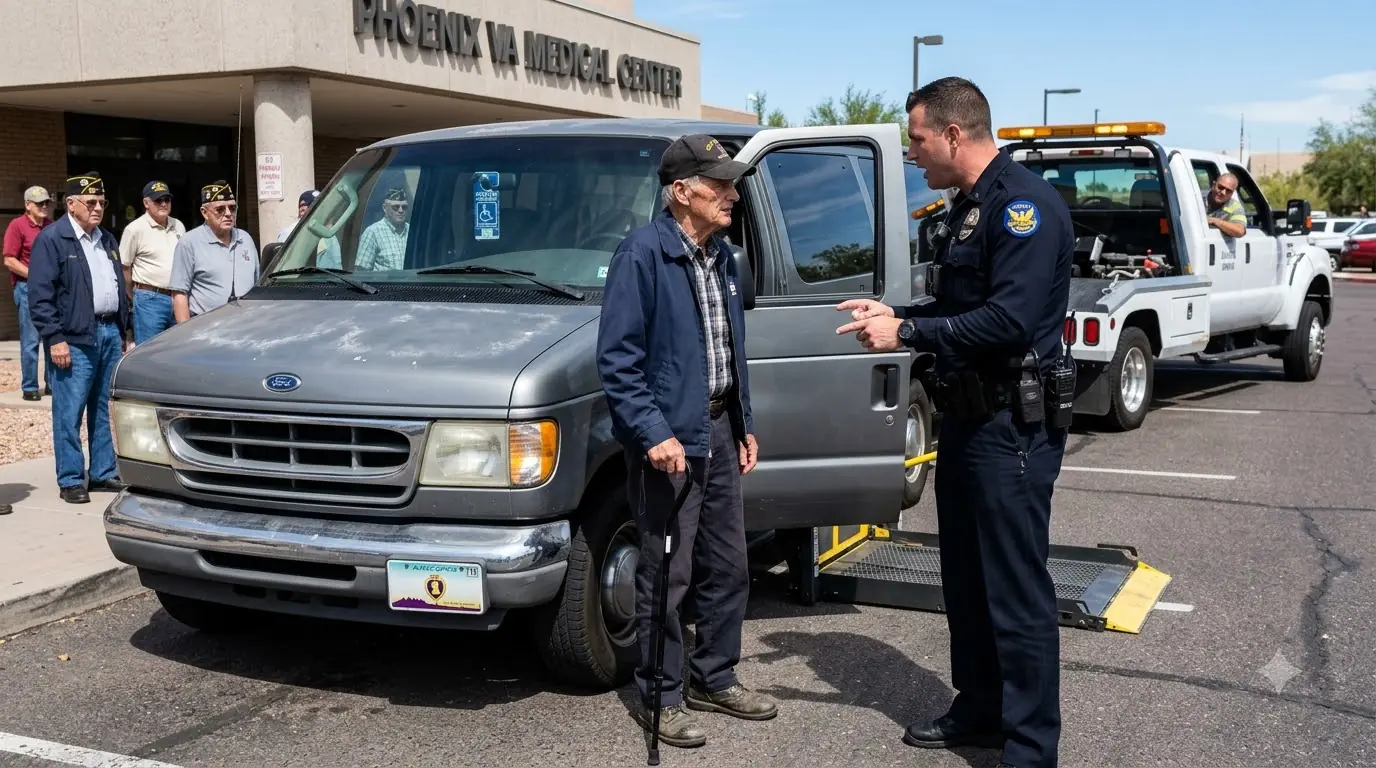
He knew which elevator occasionally stalled.
He knew which security guard kept peppermints behind the desk.
He knew which section of the parking lot flooded during the monsoon season.
And he knew exactly how far he could walk from space 14A to the rehabilitation entrance before the old injury in his left leg began sending pain through his hip.
That morning, the distance already felt longer.
Hank shut off the engine and sat quietly for several seconds.
His right hand rested on the steering wheel.
His left moved toward the cane beside the driver’s seat.
At seventy-one, every movement had become deliberate.
Not fragile.
Deliberate.
He had learned the difference years ago.
The van represented more than transportation.
A hydraulic ramp folded beneath the side door.
Hand controls had been installed for the days when his leg refused to cooperate.
The driver’s seat rotated.
A detachable wheelchair remained secured behind him.
To another person, it was an old gray van.
To Hank, it was independence.
He opened the driver’s door.
Arizona sunlight hit his face.
He wore a faded black cap, navy work jacket, dark trousers, and worn black shoes.
His disability placard hung clearly from the mirror.
The registration was current.
The accessible-space permit had been renewed three months earlier.
The license plate included the Purple Heart designation he had earned decades ago.
Hank did not think any of those details would matter that morning.
Then somebody shouted.
“Hey!”
Hank stopped halfway out of the seat.
“Wheelchair guy!”
The voice carried across the parking lot.
“You can’t park there.”
Hank slowly turned.
Officer Tyler Griggs was walking toward him.
Griggs was thirty-eight, tall, muscular, clean-shaven, with close-cut dark hair and the fast, confident stride of a man who had already decided what was happening.
His uniform was neat.
Badge polished.
Body camera centered on his chest.
Hank noticed the camera immediately.
He also noticed the officer’s expression.
Not curious.
Annoyed.
Hank placed one foot on the pavement.
Then the other.
He pulled himself upright using the cane.
Griggs stopped approximately six feet away.
“That placard yours?”
“Yes.”
“Registered to you?”
“Yes.”
“Let me see your license.”
Hank studied him.
“Can I ask what the problem is?”
Griggs pointed toward the windshield.
“The problem is people using disabled spaces when they don’t belong there.”
Hank looked at his cane.
Then at the accessible van.
Then back at Griggs.
“I’m disabled.”
“Everybody says that.”
Hank’s eyes narrowed slightly.
“Officer, you can run the placard.”
Griggs laughed.
“I’ve seen these scams.”
Hank remained calm.
“The registration is in the glove compartment.”
“I didn’t ask about registration.”
“You questioned the placard.”
“And I’m telling you I think it’s fake.”
Several people walking toward the hospital had slowed.
One elderly man wearing a faded veterans cap stopped beside a bench.
Another man using a walker looked over his shoulder.
Hank could feel attention gathering.
He disliked that.
He did not want a scene.
He wanted an appointment.
“My documents are valid.”
Griggs stepped closer.
“Then move the vehicle.”
Hank stared.
“Why?”
“Because I told you.”
“That is not a reason.”
Griggs’s jaw tightened.
“There it is.”
“What?”
“The attitude.”
Hank almost smiled.
He did not.
Instead he opened the driver’s door wider and carefully reached toward the glove compartment.
Griggs immediately raised his voice.
“Stop!”
Hank froze.
“Hands where I can see them.”
Hank slowly brought his hand back.
“My paperwork is inside.”
“I didn’t tell you to reach.”
“You told me the placard was fake.”
“Do not argue with me.”
Hank looked at Griggs’s body camera.
Still active.
Good.
“Officer, I am trying to show you the documents you say are fake.”
Griggs pointed toward the van.
“I don’t need some computer printout you made at home.”
Hank’s expression hardened.
“You have not seen anything yet.”
“I know how this works.”
“No.”
Hank’s voice remained level.
“You know how you think it works.”
That sentence changed Griggs’s posture.
He stepped closer.
“You want to keep pushing?”
Hank leaned slightly on his cane.
“I want to get to my medical appointment.”
“Then you should have parked legally.”
“I did.”
“Not if that placard is fraudulent.”
“Run it.”
Griggs stared at him.
“Run the plate.”
No answer.
“Run my license.”
Silence.
“Call the VA parking office.”
Griggs’s face flushed.
Hank continued.
“You have five different ways to verify what I’m saying.”
“You haven’t used one.”
The older veteran near the bench muttered:
“He’s right.”
Griggs turned.
“Sir, stay out of this.”
The man lifted both hands.
“Just saying.”
“I said stay out of it.”
Hank looked toward him.
“Don’t.”
The veteran glanced at Hank.
Hank shook his head.
Not worth it.
Griggs noticed.
“You directing people now?”
“No.”
“Looks like it.”
Hank took a breath.
The pain in his leg was increasing.
Standing still was often worse than walking.
He shifted his weight.
Griggs immediately pointed.
“Stop moving.”
Hank looked down at his cane.
“My leg hurts.”
“That what you’re going with?”
Something inside Hank became cold.
Not angry yet.
Cold.
“What exactly do you think I am going with?”
Griggs gestured toward the disability placard.
“The old-man routine.”
“The cane.”
“The specialty van.”
“Purple Heart plate.”
“All of it.”
Hank stared at him.
“You think I built an accessible van to steal a parking space?”
Griggs smirked.
“You’d be amazed what people do.”
Hank looked toward the hospital entrance.
Another three people had stopped.
One woman in medical scrubs was quietly holding her phone.
A hospital employee in a reflective vest had begun walking toward them.
Hank lowered his voice.
“Officer Griggs.”
The officer blinked.
“How do you know my name?”
“It’s on your chest.”
Griggs glanced toward the nameplate.
Hank continued.
“Run the documents.”
“If I am wrong, I will move.”
“If you are wrong, you leave me alone.”
Griggs laughed.
“You don’t negotiate with me.”
Hank’s grip tightened around the cane.
“I am not negotiating.”
“I’m giving you a way to stop embarrassing yourself.”
That did it.
Griggs stepped within arm’s reach.
“You think that old uniform history makes you somebody?”
Hank did not answer.
“Purple Heart plates don’t make you special.”
The parking lot became strangely quiet.
Hank had heard worse things.
Far worse.
But something about the casual contempt in Griggs’s voice landed differently.
The medal was not something Hank displayed proudly in conversation.
He rarely discussed where it came from.
Rarely mentioned the men who had not returned.
Rarely described the hospital room where he had awakened decades earlier and learned that walking would never feel normal again.
The plate existed because his daughter had insisted.
She had filled out the paperwork herself.
Hank looked directly at Griggs.
“I never said I was special.”
“Good.”
“I said I’m legally parked.”
Griggs pointed again.
“Move.”
“No.”
The word came softly.
Griggs stared.
Hank repeated:
“No.”
“You refusing a lawful order?”
“I’m refusing an unsupported demand to surrender a disabled space that I am legally entitled to use.”
Griggs laughed.
“You really rehearsed that?”
“No.”
“I had a long life.”
“I learned English.”
A few people nearby laughed quietly.
Wrong moment.
Griggs heard them.
His face changed.
Hank saw it immediately.
Humiliation.
And men who could not tolerate humiliation often became dangerous.
Griggs pulled out his phone.
Hank watched.
“What are you doing?”
“Solving the problem.”
Griggs searched for a number.
Then called.
“Towing company?”
Hank became still.
“Yeah.”
“Phoenix VA north lot.”
“I’ve got an unauthorized vehicle in a disabled space.”
Hank closed his eyes briefly.
Griggs continued.
“Gray accessible van.”
“Yes.”
“Driver is refusing to move.”
The hospital employee in the reflective vest reached them.
His name badge read MARTIN VEGA — FACILITIES.
“Officer?”
Griggs covered the phone.
“What?”
Martin pointed toward the van.
“That vehicle is registered with our mobility office.”
Griggs stared.
“You sure?”
“I’ve seen it.”
“Hank comes here twice a month.”
Hank said nothing.
Griggs lowered his hand from the phone.
“Do you personally administer the placard system?”
“No.”
“Then stay out of my investigation.”
Martin frowned.
“This is VA property.”
“And I’m handling a parking violation.”
Martin looked toward Hank.
Then at the plate.
Then the disability placard.
“Have you called security?”
“No.”
“Parking office?”
“No.”
“Arizona MVD?”
“No.”
Griggs’s face reddened further.
“Back away.”
Martin hesitated.
Hank said:
“Martin.”
The employee looked toward him.
“Go inside.”
“Hank—”
“I’m fine.”
Martin clearly did not believe him.
But he stepped away.
Griggs returned to the phone.
“Yes.”
“Come remove it.”
Then he ended the call.
Hank stared at him.
“You actually called a tow truck.”
Griggs slipped the phone into his pocket.
“I gave you a choice.”
“No.”
“You gave me an order.”
“And refused every piece of evidence offered to you.”
“You don’t tell me how I investigate.”
Hank looked toward the body camera.
“I suppose that camera will.”
Griggs smiled.
“You think complaints scare me?”
“No.”
“I think facts should.”
The tow truck arrived at 9:24.