Danielle Carter had been kneeling beside her grandmother’s rose bushes for almost twenty minutes when she realized gardening required a patience completely different from police work.
A criminal investigation rewarded persistence, evidence, and the ability to notice inconsistencies. Roses seemed to reward people who were willing to spend an entire Saturday pulling weeds from beneath thorns while pretending not to notice the mud working its way through expensive gardening gloves. Danielle was still deciding whether she respected that system when the sprinkler timer clicked behind her.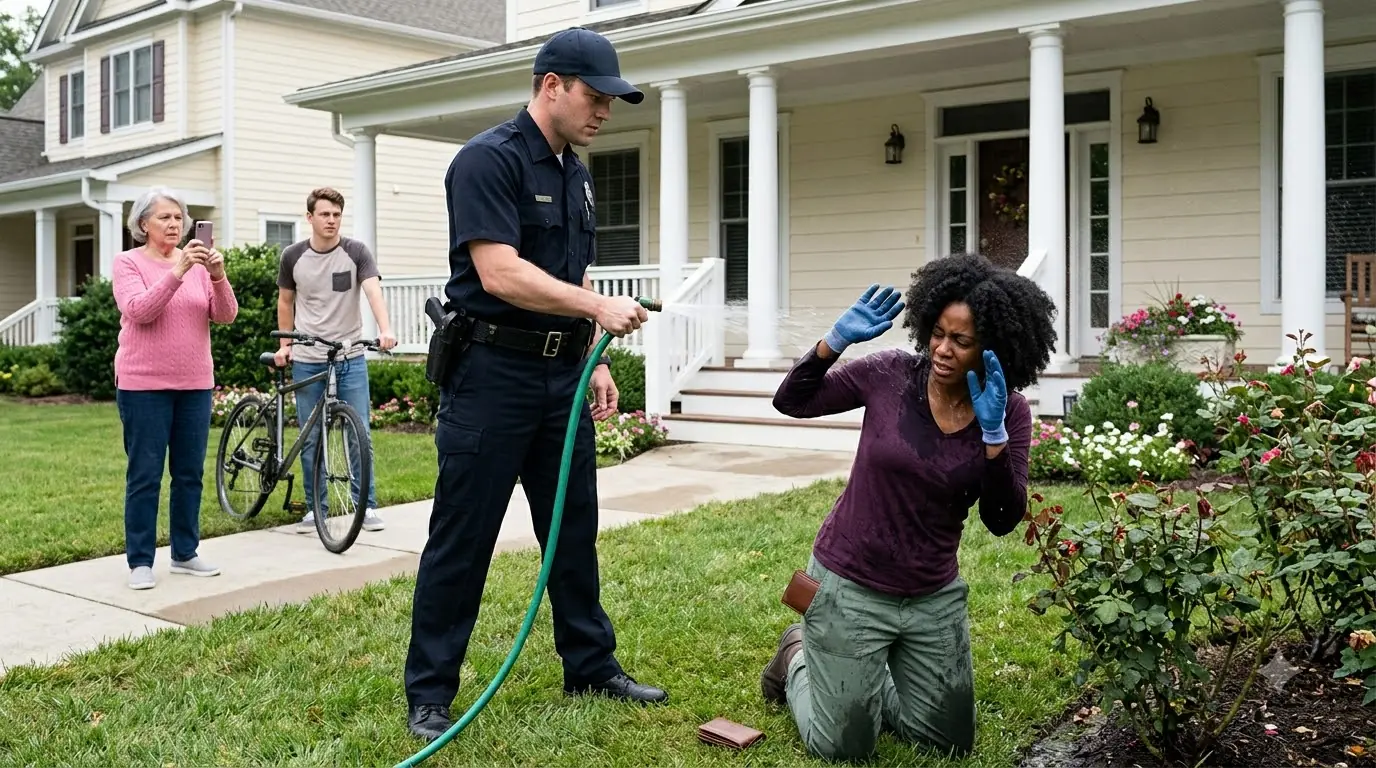
She smiled.
Her grandmother would have laughed.
Evelyn Carter had owned the cream-colored two-story house in Maple Ridge, Georgia, for thirty-seven years. She planted the first red rose bush beside the porch the year Danielle was born and added another every time something important happened in the family.
Graduations.
Weddings.
Births.
Promotions.
Funerals.
By the time Evelyn died the previous winter, the front flower beds contained more than forty rose bushes.
Danielle inherited the house.
She also inherited the roses.
For five months, she had avoided touching them.
Work provided an easy excuse. At thirty-eight, Danielle had just accepted the most complicated assignment of her career: commander of a newly reorganized Professional Standards and Public Integrity Task Group created after a series of lawsuits, citizen complaints, and internal investigations damaged public trust across several county agencies.
The title sounded grander than the actual work.
Most days meant reading reports nobody wanted reopened.
Interviewing officers who resented being questioned.
Comparing body-camera footage with statements.
Looking for patterns.
Asking why complaints disappeared.
Asking why some supervisors remembered nothing.
Asking why the same names appeared again and again.
Danielle preferred cases where the evidence was ugly but clear.
Institutional problems were rarely clear.
They accumulated quietly.
A missed report here.
A warning ignored there.
An officer described as “aggressive but effective.”
A civilian described as “uncooperative.”
A supervisor deciding another investigation would create too much paperwork.
Eventually the system became less about what happened and more about what everyone had learned not to challenge.
That was why Danielle needed Saturday.
No uniform.
No command briefings.
No lawyers.
No interviews.
Only an old house, a pair of gardening gloves, a dark purple blouse, muted green work pants, and the roses her grandmother had loved.
At 10:17 a.m., Danielle heard a bicycle tire rolling slowly along the sidewalk.
She looked up.
Her neighbor’s son, Noah Bennett, twenty-two, coasted past the driveway.
“Morning, Ms. Carter.”
“Morning.”
“You attacking the roses?”
“They attacked first.”
Noah laughed.
He had known Danielle since childhood.
His family moved into the neighborhood when he was six.
He pointed toward the hedge.
“Mrs. Franklin says your grandmother used coffee grounds.”
“Mrs. Franklin says many things.”
“That is also true.”
Danielle smiled.
An elderly woman across the street raised her phone.
Margaret Franklin, seventy-two, had been documenting practically everything since her grandchildren taught her how to record videos.
“Danielle!” Margaret called.
Danielle looked over.
“Why are you filming me?”
“For Evelyn’s garden group.”
“There is no garden group.”
“There will be when I create one.”
Danielle shook her head.
“You people need hobbies.”
Margaret laughed.
None of them noticed the dark patrol SUV turn onto the street.
Officer Ryan Keller slowed as he passed the Carter house.
He was thirty-two, white American, athletic, with short brown hair and a face that looked younger until he frowned. He had been on patrol for four years after leaving a private-security job, and his personnel file described him with phrases that supervisors often considered positive.
Assertive.
Command presence.
Proactive.
Confident under pressure.
Other words appeared in citizen complaints.
Impatient.
Condescending.
Escalating.
Disrespectful.
Those words rarely survived into final evaluations.
At 10:14, Keller had received a dispatch call.
Possible suspicious person.
Female.
Front yard of 63 Waverly Court.
Caller claimed the woman had been walking around the house, handling landscaping equipment, and possibly attempting to access the property.
No weapon reported.
No emergency.
No burglary observed.
Dispatch classified it as a suspicious-person check.
The anonymous caller never said the woman was Black.
But Keller saw Danielle before he heard the full update.
He stopped.
She was kneeling near the roses with dirt on her gloves and a garden hose stretched across the lawn.
The first thing Keller did was not check the property records.
He did not ask dispatch whether the caller knew the homeowner.
He did not observe whether any door or window had been damaged.
He did not notice the gardening tools arranged neatly beside Danielle.
He got out.
Danielle heard the vehicle door close.
She looked over her shoulder.
Keller approached across the sidewalk.
“Ma’am.”
Danielle stood slowly.
“Morning.”
“What are you doing here?”
The question struck her as strange.
She looked at the roses.
Then at the house.
“Gardening.”
Keller did not smile.
“Do you live here?”
“Yes.”
“Identification.”
Danielle removed one glove.
“My wallet’s inside.”
Keller looked toward the front door.
“You don’t have identification on you?”
“I’m gardening in my own yard.”
“I asked if you have ID.”
“And I answered.”
Noah stopped his bicycle.
Margaret lowered her phone slightly.
Danielle noticed both.
Her instincts changed.
Not fear.
Professional attention.
She had spent enough years interviewing people to know when an ordinary interaction was beginning to develop structure.
Question.
Answer.
Answer rejected.
Second demand.
Tone increasing.
Keller gestured toward the porch.
“Who owns this property?”
“I do.”
“Name?”
“Danielle Carter.”
He reached toward the radio microphone on his shoulder.
“Dispatch, confirm registered resident at sixty-three Waverly.”
Danielle waited.
The dispatcher answered.
Property databases were not immediate enough to settle everything, but the name associated with recent utility and emergency-contact records was Danielle Carter.
Keller heard it.
Danielle heard it too.
He still did not relax.
“How long have you lived here?”
Danielle frowned.
“Why?”
“Answer the question.”
“It was my grandmother’s house.”
“That isn’t what I asked.”
Danielle studied him.
“You received a suspicious-person call.”
Keller’s expression changed slightly.
“How do you know?”
“Because you arrived alone without urgency and started asking whether I live here.”
“That doesn’t answer my question.”
Danielle took off the second glove.
“I inherited the house five months ago.”
Keller looked toward the door.
“You said you live here.”
“Yes.”
“But now you say you inherited it five months ago.”
“Those statements are compatible.”
His jaw tightened.
“Don’t get smart with me.”
Danielle almost laughed.
Instead she remained calm.
“I’m trying to understand what you need.”
“Identification.”
“It’s inside.”
“Then go get it.”
Danielle looked toward the front door.
Keller stepped sideways.
“Slowly.”
Something about the movement bothered her.
Danielle stopped.
“You just told me to get my identification.”
“Yes.”
“And now you’re positioning like I’m being detained.”
“You are being investigated.”
“For gardening?”
“For suspicious activity.”
“What suspicious activity?”
“Don’t argue.”
Danielle felt the first real irritation.
Her grandmother had warned her about anger.
Evelyn used to say anger was useful only if you owned it before somebody else did.
Danielle breathed slowly.
“My name matches the residence.”
Keller answered, “That doesn’t prove anything.”
“What exactly are you investigating?”
“A possible trespass.”
“On property registered to me.”
“You said inherited.”
“Yes.”
“And you have no ID.”
Danielle looked at him.
“No ID in my pocket.”
“Same thing.”
“No, it isn’t.”
Keller stepped closer.
Margaret raised her phone again.
Noah moved his bicycle onto the grass.
Keller noticed him.
“You need something?”
Noah shook his head.
“No, officer.”
“Then keep moving.”
Danielle spoke immediately.
“He can stay.”
Keller turned.
“I wasn’t asking you.”
Danielle’s eyes hardened.
“He’s standing on a public sidewalk.”
Keller looked back toward Noah.
“Move along.”
Noah hesitated.
Danielle gave him the smallest shake of her head.
Do not escalate.
Noah understood.
He moved several yards away but did not leave.
Margaret continued recording.
Keller finally noticed.
“Ma’am, stop filming.”
Margaret replied, “I’m on my own sidewalk.”
Danielle almost smiled.
Keller did not.
“Everyone wants to turn everything into a show.”
Danielle said quietly, “Then don’t give them one.”
That was the wrong sentence for a man already interpreting calm resistance as disrespect.
Keller stepped toward her.
“Turn around.”
Danielle stared.
“Why?”
“Turn around.”