The first thing Officer Grant Harlan noticed was the motorcycle.
Not the stalled traffic.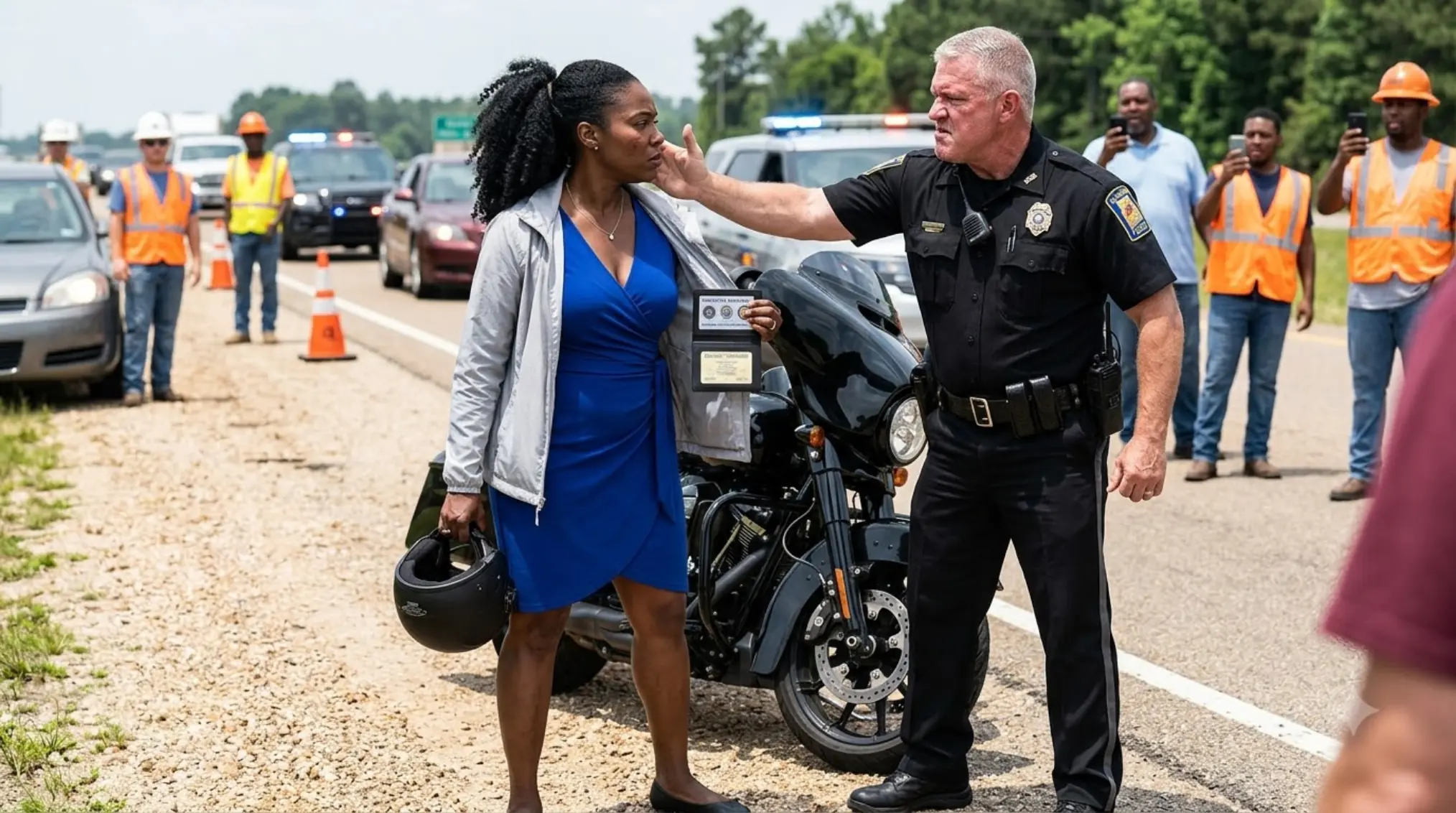
Not the road crew waving vehicles around a temporary lane closure.
Not the black government sedan parked farther down the shoulder.
He noticed the motorcycle because it did not belong where he thought it should be.
A glossy black cruiser stood near the orange cones on the shoulder of State Route 80 outside Montgomery, Alabama, sunlight flashing from chrome handlebars and a round headlamp. Beside it stood a Black woman in a royal-blue wrap dress, light-gray jacket, and dark flats, holding a black helmet beneath one arm.
She did not look frightened.
That bothered Harlan immediately.
He was fifty-two, broad through the shoulders, sun-weathered from years of roadside patrols, and known around the department for handling traffic stops quickly. His coworkers sometimes called him “old school.” He preferred “efficient.”
He walked toward the woman with his jaw already tight.
“Move the bike.”
The woman looked toward the lane closure.
“There’s construction equipment blocking the shoulder ahead.”
“Then move it backward.”
“There’s a semi behind me.”
Harlan glanced toward the truck.
It was true.
A large transport vehicle had stopped thirty yards back, and traffic was beginning to collect.
He looked at her again.
“I didn’t ask for an explanation.”
The woman’s expression changed slightly.
Not fear.
Assessment.
“My motorcycle is already as far off the roadway as it can safely go.”
Harlan stepped closer.
“Lady, don’t tell me how to run a traffic scene.”
Her name was Dr. Lena Brooks.
He did not know that.
He also did not know that Lena had spent the previous fourteen months investigating complaints involving roadside enforcement, falsified incident reports, improper property seizures, and misconduct inside several county departments.
Most importantly, he did not know why she was there.
Lena had not randomly pulled onto that shoulder.
She was meeting an investigator from the Alabama Office of Public Integrity at a nearby staging area to review records tied to a transportation-contract investigation. Her position was intentionally kept low-profile during active field inquiries.
She wore no badge on her clothing.
No official jacket.
No marked vehicle.
Only a sealed credential wallet inside the inner pocket of her gray jacket.
That was exactly how she preferred it.
People behaved differently around visible authority.
Lena needed to see how they behaved when they believed none was present.
Officer Harlan gave her that answer quickly.
“License.”
“My identification is in my jacket.”
“Then get it.”
Lena set the helmet carefully on the motorcycle seat.
Before she could reach inside her jacket, Harlan snapped, “Slow.”
She stopped.
“You just told me to get my identification.”
“I told you slow.”
Lena stared at him.
Behind Harlan, Officer Peter Dawson stood near the patrol SUV, dark sunglasses covering his eyes. Two highway workers had paused near the cones. Another man leaned against a utility truck, watching.
Lena deliberately moved one hand toward her jacket.
Harlan moved closer.
“What were you doing inside the restricted lane?”
“I wasn’t inside it.”
“I saw you.”
“You saw me standing beside my motorcycle.”
“Don’t play word games.”
“I’m not.”
The exchange had already begun attracting attention.
A truck driver lowered his window.
A highway worker pulled out his phone.
Lena noticed Harlan’s body camera mounted to his uniform.
A tiny light indicated it was active.
Good.
“Officer,” she said, “if you believe I crossed into a restricted area, tell me exactly where.”
Harlan’s face hardened.
“You think this is court?”
“No.”
“Then stop interrogating me.”
“I asked one question.”
“You’re getting an attitude.”
Lena inhaled slowly.
That sentence was familiar.
She had heard versions of it in dozens of complaints.
Citizens asked why they were being stopped.
Officers wrote “became argumentative.”
Citizens requested a supervisor.
Reports said “refused verbal command.”
Citizens attempted to clarify instructions.
Reports described “escalating behavior.”
Language could turn a calm person into a threat after the fact.
Lena had spent years reading how that happened on paper.
Now she was watching it happen to her in real time.
Harlan pointed toward the motorcycle.
“Move it now.”
“I cannot safely move until that truck backs up.”
“Not my problem.”
“It becomes your problem if I get hit.”
Harlan stepped forward.
“Get that bike off my road before I drag you away with it.”
Lena looked directly at him.
“This is a public highway.”
He slammed his palm against the motorcycle mirror.
The mirror twisted inward.
Several bystanders reacted audibly.
Lena’s voice lowered.
“Do not damage my property.”
Harlan laughed.
“Property?”
He pointed at the motorcycle.
“This thing is obstructing an active scene.”
“No, it isn’t.”
He stepped closer again.
“You want to keep arguing?”
“I want you to stop touching my motorcycle.”
Officer Dawson finally moved forward.
“Grant.”
Harlan glanced at him.
“What?”
“Maybe let me talk to her.”
“I’ve got it.”
Dawson stopped.
That small moment mattered later.
Everyone would remember it.
The second officer recognized escalation and chose not to interfere.
Lena looked at Dawson.
Then back at Harlan.
“May I request your supervisor?”
Harlan’s mouth pulled into a humorless smile.
“There it is.”
“What?”
“People like you always think asking for a supervisor changes the rules.”
Lena’s expression went still.
“What do you mean by people like me?”
Harlan realized the sentence had landed badly.
Instead of retreating, he doubled down.
“People who think they can argue their way out of following simple instructions.”
Lena nodded once.
“Your camera recording?”
Harlan looked down at it.
“Why? Planning to complain?”
“I asked whether it’s recording.”
He moved into her personal space.
“You should worry less about my camera and more about following orders.”
Lena glanced toward one of the highway workers.
His phone was unmistakably recording now.
Another motorist had done the same.
Three cameras.
Possibly more.
Lena returned her attention to Harlan.
“You just hit the wrong woman in front of three cameras.”
The officer’s face darkened.
“You threatening me?”
“No.”
“What was that?”
“A statement of fact.”
Harlan lifted one hand.
For half a second, Lena believed he was pointing.
Instead, his open palm struck the side of her face.
The impact turned her head sharply.
There was no blood.
No collapse.
But the shock of it froze the road.
A woman standing beside a stopped SUV gasped.
One of the highway workers shouted, “Hey!”
Officer Dawson stepped forward immediately.
“Grant!”
Lena steadied herself against the motorcycle.
Her cheek burned.
Her eyes watered reflexively.
She did not shout.
She did not swing back.
She did not reach for Harlan.
Instead, she straightened slowly.
Harlan’s arm was still half raised.
His own face showed a flicker of surprise, as though he had not expected himself to go that far.
Then instinct took over.
He needed the situation to become something that justified what everyone had seen.
“Stop resisting.”
Lena stared at him.
“I’m standing still.”
“You’re interfering with an officer.”
“How?”
“You refused lawful orders.”
“I asked to move my motorcycle safely.”
“You became aggressive.”
A highway worker shouted from behind them.
“She wasn’t aggressive!”
Harlan spun.
“Back up!”
The worker did not move.
His phone stayed raised.
Dawson took another step toward Harlan.
“Grant, let’s slow this down.”