Officer Olivia Coles thought she was just putting a wandering civilian in check outside the 21st District precinct on the South Side of Chicago.
She let her arrogance take over, pointing a sharp finger and delivering a casually cruel command.
“You need to know your place.”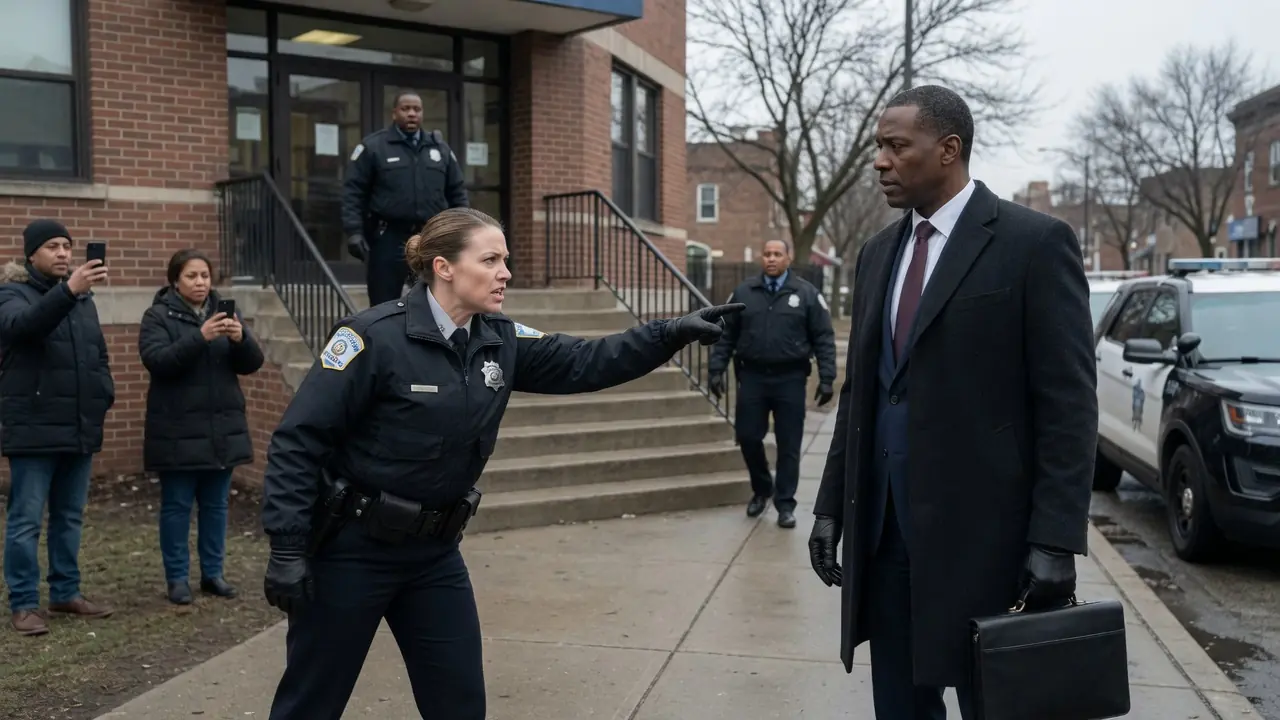
She did not know that the composed man she was publicly humiliating was not just a local resident to be bullied.
Officer Coles thought she was simply asserting her authority on a routine weekday morning. She had no idea that before her shift ended, her recorded insult would ignite a viral firestorm, threatening not just her badge, but the deeply ingrained culture of the entire Chicago Police Department.
This is the story of the six words that sparked a city’s reckoning.
Would one man’s quiet dignity be enough to confront a broken system?
Officer Olivia Coles was standing near the hood of a patrol SUV, one hand resting on her belt, the other already rising, index finger extended, aimed in his direction like a citation being issued before any words had been exchanged.
She was in her mid-thirties, compact, with the practiced posture of someone who had spent years making sure people understood who held the authority in any given space.
“This is a restricted area,” she said, stepping forward. “You need to move along.”
Jamie stopped.
He looked at her calmly, the way a man looks at something he has seen before and already understands.
“I’m heading inside,” he said simply.
Something in his tone, measured and unbothered, seemed to irritate her more than defiance would have.
She stepped closer, closing the distance between them with the deliberate confidence of someone who had never once considered that she might be wrong.
“I don’t think you heard me,” she said.
Her voice dropped and sharpened.
“This isn’t a place for you to just wander around. You need to know your place.”
The words landed in the open air and stayed there.
A passing officer slowed near the entrance. Two civilians on the sidewalk stopped walking.
Somewhere to the left, almost imperceptibly, a phone rose.
Jamie did not move.
He did not raise his voice. He did not reach for identification or launch into an explanation.
He simply looked at Officer Coles with an expression that was neither anger nor amusement.
It was something quieter and more unsettling than either.
The look of a man who had just watched someone make a very serious mistake and was deciding in real time what to do about it.
He held her gaze for a long moment.
Then he said, evenly, “I’ll be inside in a minute.”
He walked past her and through the front door.
Olivia stood on the sidewalk, jaw tight, already composing the version of events she would tell later.
The wandering civilian.
The restricted area.
Standard procedure.
She did not notice the phone.
She did not notice the second one.
She did not notice the officer near the entrance who had gone very still, or the desk sergeant visible through the glass who had looked up from his paperwork with an expression she would have recognized had she been paying attention.
She did not know his name yet.
She did not know that the charcoal overcoat and the quiet Oxfords belonged to the man whose name was already on the plaque being installed in the commander’s office upstairs.
She did not know that aldermen had attended his appointment ceremony, that the mayor had personally called him a generational hire, or that half the department had been quietly watching to see what kind of leader he would be.
She did not know any of it.
By noon, she would.
By evening, so would Chicago.
The clip was eleven seconds long.
No sound.
Just a finger pointed at a man in a wool overcoat outside a South Side police station, and six words that, in this city, in this moment, did not need any context at all.
The comments came fast.
Then the shares.
Then the fire.
By 10:47 a.m., the clip had four thousand views.
By noon, it had forty thousand.
By the time the lunch rush emptied out of the soul food spots on 75th Street and the barbershops on Cottage Grove started filling up with the midday crowd, the number had crossed two hundred thousand and was still climbing.
Chicago had seen viral moments before.
The city had a long, complicated memory when it came to police and race.
But something about this one moved differently.
It did not spread the way outrage usually does, loud and immediate and burning itself out by sundown.
It spread the way a slow fire does, quietly, steadily, finding oxygen in every corner it touched.
No caption needed.
No narration.
Just a finger, a face, and six words that the South Side recognized in its bones.
You need to know your place.
The first news truck arrived outside the 21st District precinct at 12:34 p.m.
By 1:15, there were four of them.
Their satellite masts rose above the red brick building like a second skyline.
Reporters in pressed coats stood on the same sidewalk where it happened, gesturing toward the spot near the patrol SUV as though the air there still held the shape of the moment.
Camera operators jostled for angles.
A producer from a national affiliate was already on the phone with her New York desk, talking fast.
Inside the precinct, nobody was talking at all.
The desk sergeant had pulled three officers into the back hallway and spoken in a low, controlled voice about saying absolutely nothing to anyone with a microphone or a notepad.
The watch commander had called the district’s public affairs liaison twice and gotten voicemail both times.
Someone had printed a screenshot from the clip and taped it to the break room bulletin board, not as a joke, but as a warning.
It had been torn down within twenty minutes by someone who understood what it meant for it to be there at all.
Olivia Coles had been placed on administrative desk duty before one o’clock.
She sat in a back office with the door closed, her union rep already on the way, her phone face down on the table in front of her.
She had watched the clip herself by then.
She had watched it the way you watch something you were present for, but somehow do not recognize, searching the eleven seconds for the version of events that matched the one inside her head.
She found pieces of it.
Not enough.
Outside, Chicago was not waiting for her to find them.
The hashtag #KnowYourPlace had been created by a twenty-four-year-old organizer from Woodlawn who had grown up three blocks from the precinct.
She posted the clip at eleven in the morning with four words beneath it.
This city never changes.
By two o’clock, the hashtag had been used over sixty thousand times.
By four, it was the top trending topic in Chicago, then Illinois, then nationally.
Aldermen began posting statements.
A state senator called for an immediate investigation.
A civil rights attorney who had litigated three high-profile CPD cases went on a local radio station and spoke for eleven uninterrupted minutes about pattern and practice.
The Reverend Marcus Dillard, whose congregation sat six blocks from the precinct, and whose voice carried weight on the South Side the way few others did, posted a single sentence on his church’s social media page.
We will be outside at five. Come as you are.
Four hundred people showed up.
They came in coats and work uniforms and church clothes.
They came with handwritten signs and printed ones.
They came with children on their hips and elders in folding chairs brought from someone’s trunk.
As they gathered on the sidewalk where it happened and spilled into the street, the energy was not chaotic.
It was focused.
The particular kind of focused that comes from a community that has been here before and knows exactly what it is doing.
Chants rose and fell in the cold air.
Candles appeared as the sun dropped.
A young woman with a megaphone read the six words aloud and let the silence after them do the work.
Inside the precinct, someone turned the blinds.
But Jamie Evans watched none of it from the sidewalk.
He had been in the building since morning, moving through quiet conversations with senior staff, reviewing files, saying little.
He had seen the clip.
He had read the statements.
He had watched the crowd gather from a second-floor window with his hands clasped behind his back and an expression that gave nothing away.
His phone had not stopped vibrating since noon.
The mayor’s chief of staff.
The superintendent’s office.
Two aldermen.
Maybe a reporter he had spoken to once two years earlier, who had somehow gotten his direct number.
He answered none of them.
Not yet.
He understood what this moment was.
He had spent enough years inside this institution to know that the next forty-eight hours would determine not just what happened to one officer on a sidewalk, but what kind of leader he intended to be, and whether this department, this city, would take him seriously when it mattered most.
The crowd outside grew louder as the evening deepened.
Jamie turned from the window.
He had work to do.
The meeting was scheduled for 8:00 a.m.
It started at 8:00 a.m. exactly because Jamie Evans was the kind of man who understood that punctuality was its own form of communication.
The conference room on the second floor of the 21st District precinct was not a large room, but it felt smaller that morning.
The table seated eight.
Six chairs were filled.
A carafe of coffee sat in the center, untouched.
The fluorescent light above the far end of the table flickered once at the start and then held, acting as though it, too, had decided to pay attention.
Across from Jamie sat Dennis Kowalski, the lead delegate for the Fraternal Order of Police Lodge 7, Chicago’s police union, one of the most politically connected labor organizations in the state.
Kowalski was a broad man in his late fifties with the kind of face that had learned long ago to reveal nothing in rooms like this one.
He had been in dozens of them.
He arrived with two attorneys and a deputy delegate named Reyes, who took notes on a yellow legal pad and never looked up.
Kowalski opened without preamble.
“We want to be clear from the start,” he said, setting both hands flat on the table. “Officer Coles followed standard protocol for a restricted exterior zone. She had no way of identifying the individual in question. What happened on that sidewalk was a miscommunication, not misconduct.”
Jamie let the words sit there for a moment.
“A miscommunication,” he repeated, not as a question.
“That’s correct.”
Jamie nodded slowly, the way a man nods when he is filing something away rather than agreeing with it.
He had a single folder in front of him, closed.
He did not open it.
“I’ve reviewed the body cam footage,” he said. “I’ve also reviewed Officer Coles’s personnel file. I’d like to understand what part of standard protocol includes telling a civilian to know their place.”
Kowalski’s expression did not shift.
“The language was imprecise. Officers make judgment calls in the field under pressure. That’s the nature of the job.”
“The nature of the job,” Jamie said, “is to serve the public without bias. That’s in the oath.”
The attorney to Kowalski’s left leaned forward slightly.
“Commander Evans, with respect, you have been in this role for less than a week. Any disciplinary action taken this quickly, under this level of public pressure, will be challenged as politically motivated. The union will file immediately.”
There it was.
Jamie had expected it.
He had expected all of it.
The framing.
The legal posture.
The quiet threat wrapped in procedural language.
He had sat across from union representatives before, in smaller rooms, over smaller incidents, and he knew how this particular dance was choreographed.
The opening move was always the same.
Make the institution the victim.
He kept his voice even.
“I appreciate the transparency. I want to be equally transparent. This is not a politically motivated action. This is a personnel matter that became a public matter because of what was said and how it was said. The investigation will be thorough. It will be fair. And it will be completed on the department’s timeline, not the news cycle’s.”
Kowalski studied him for a moment.
“The membership is watching this closely.”
“So is the city,” Jamie said.
The meeting ended forty minutes later with nothing resolved and everything understood.
Kowalski shook Jamie’s hand at the door with the firm, measured grip of a man who respected an opponent even while preparing to fight him.
The attorneys gathered their folders.
Reyes tore the top sheet from the legal pad, folded it once, and slipped it into his jacket pocket.
Jamie stood at the window after they left and watched their car pull out of the lot.
The call from the mayor’s office came at 10:15.
It was not the mayor.
It was Deputy Chief of Staff Renata Voss, which meant the mayor was paying close attention but wanted distance.
Voss was efficient and careful with her words in the way that people are when they know everything they say will be repeated.
“The mayor wants you to know he has full confidence in your leadership,” she said.
“I appreciate that,” Jamie replied.
“He also wants you to know that the city is in a delicate moment. There are budget negotiations happening. A federal oversight review coming up in the spring. The last thing anyone needs is a prolonged public battle that makes the department look ungovernable.”
Jamie was quiet for a beat.
“What is the mayor suggesting?”
“He’s not suggesting anything,” Voss said carefully. “He’s providing context.”
“I understand the context,” Jamie said. “I also understand that if I handle this quietly, every officer in this department will understand exactly what that means, and so will every resident on the South Side.”
A pause on the other end.
Longer than a professional pause.
“The mayor trusts your judgment,” Voss said finally.
“Good,” Jamie said. “Then he won’t be surprised by it.”
He ended the call and set the phone face up on his desk.
Outside, the street was quieter than it had been the night before, but the news trucks were still there.
A small cluster of residents stood near the corner with signs, patient and present in the gray morning light.
Jamie looked at them for a long moment.
Then he opened the folder.
The folder contained forty-three pages.
Jamie had requested the full personnel file on Officer Olivia Coles the same afternoon the clip went viral, before the union called, before the mayor’s office called, before the news trucks had finished setting up their satellite masts on South Michigan Avenue.
He had made the request quietly through the department’s internal records division with a single instruction.
Everything.
Complaints.
Commendations.
Use-of-force reports.
Supervisory notes.
Body cam incident logs.
Everything.
The forty-three pages arrived on his desk by nine in the morning the day after the union meeting.
He read them twice before his first coffee was finished.
The body cam footage came separately, flagged and compiled by the department’s technology unit at his direction.
And not just the footage from the morning on the sidewalk, the clip the city had already seen eleven seconds of, but every body cam recording associated with Coles over the previous eighteen months that had been logged under a complaint, a use-of-force notation, or a supervisory review.
There were seven of them.
Jamie watched all seven before noon.
He did not watch them with anger.
He watched them the way a surgeon reviews imaging before an operation, carefully, methodically, looking not just at what was visible, but at what the visible thing indicated about what lay beneath.
The sidewalk incident was the loudest.
But it was not the first.
Fourteen months earlier, a body cam recording showed Coles during a traffic stop on the South Side speaking to a middle-aged man in a tone that the supervising sergeant at the time had noted as assertive but within bounds.
The man had filed a complaint two days later, describing language that was demeaning and racially coded.
The complaint had been reviewed, classified as unsubstantiated, and filed.
The supervising sergeant’s note remained in the system unchanged.
Eight months before that, a community liaison from a neighborhood association on the South Side had submitted a written grievance to the district after an interaction with Coles during a block meeting.
The grievance described a pattern of dismissiveness toward residents, a tendency to speak over community members, and what the liaison called a consistent posture of contempt.
The grievance had been acknowledged, assigned a case number, and quietly closed within three weeks with no documented follow-up.
There were five more.
Each one a variation on the same theme.
Each one processed through the same machinery.
Each one arriving at the same destination.
A file drawer.
A case number.
A closed loop that never connected to the one before it or the one after.
Jamie set the last page down and sat back in his chair.
This was the part that the eleven-second clip had not shown.
This was the part that never made it to the sidewalk, or the news trucks, or the trending hashtag.
The clip had captured a moment.
The folder captured a pattern.
And in Jamie’s experience, patterns were always more dangerous than moments.
Because moments ended.
Patterns did not.
He called in Lieutenant Dara Washington, the department’s internal affairs liaison for the district.
At one o’clock, Washington entered his office.
She was sharp, methodical, and had the particular quality Jamie valued most in people who did difficult work.
She was not interested in being liked by the people she investigated.
She sat across from him with a notepad and no preamble.
“I need a formal audit,” Jamie said. “Not just Coles. I need a review of every complaint filed against officers in this district over the past three years that was closed without documented resolution. Cross-reference with body cam logs, supervisory notes, and any grievances submitted through community channels.”
Washington looked at him steadily.
“That’s a significant undertaking.”
“I know what it is.”
“The union will call it a fishing expedition.”
“The union can call it whatever they want,” he said. “What it is, is an audit. And it starts today.”
Washington nodded once and wrote something on her notepad.
“Timeline?”
“Preliminary findings in ten days. Full report in thirty.”
She left without ceremony.
By Thursday morning, the woman in the red coat had a name.
Her name was Gloria Reeves.
She was sixty-one years old, a retired schoolteacher from Englewood who had lived on the South Side her entire life and had buried a nephew eleven years ago under circumstances that the department had classified as justified and the community had classified as something else entirely.
She had not come to the precinct with a sign.
She had not come with a megaphone or a prepared statement.
She had come because she woke up on Wednesday morning, watched the eleven-second clip on her granddaughter’s phone, and felt something shift in her chest that she recognized from a long time ago.
The particular feeling of a city arriving at a moment that would either mean something or mean nothing, depending entirely on what the people in power decided to do with it.
She had been standing outside the precinct for two days.
By Thursday morning, four hundred people stood with her.
They came from Englewood and Woodlawn, from Auburn Gresham and South Shore.
They came from the churches and the block clubs and the community organizations that had been doing the quiet, unglamorous work of holding the South Side together for decades without much acknowledgement from the city that sat north of them.
They came because Gloria Reeves was there.
They came because Reverend Dillard had spoken again on Wednesday evening.
They came because the clip kept playing and the six words kept landing, and nobody from inside that red brick building had yet walked outside and looked them in the eye.
The signs were handwritten and printed, specific and general.
Accountability now.
Reform CPD.
We are not civilians. We are citizens.
How many more?
A group of high school students from a nearby charter school stood in a line near the curb holding a banner that read in careful block letters, This is our neighborhood, too.
An elderly man in a Korean War veteran’s cap stood near the edge of the crowd, not chanting, just present, which somehow said more than the chanting did.
The news trucks had multiplied to seven.
Jamie watched from the second-floor window for exactly four minutes.
Then he put on his coat.
His deputy, a careful man named Sergeant First Class Andre Tillman, who had been with the department for sixteen years and had the instincts of someone who had survived that long by reading rooms correctly, fell into step beside him in the hallway.
“You’re going out there,” Tillman said.
It was not a question.
“Yes,” Jamie said.
“The union rep called again this morning. He strongly advises against any public statement until the investigation is formally concluded.”
“I’m sure he does,” Jamie said, and kept walking.
He came through the front door alone.
No entourage.
No prepared remarks.
No podium.
He walked to the top of the precinct steps and stopped.
The crowd, which had been mid-chant, also went quiet in the way that crowds go quiet when something unexpected happens and they are collectively deciding what it means.
Jamie stood in the cold morning air and looked out at four hundred faces looking back at him.
He did not raise his hands for silence.
He did not reach for a microphone.
He simply waited with the same stillness he had carried on the sidewalk three days earlier until the quiet was complete.
Then he spoke.
“I grew up six blocks from here,” he said.
His voice was level but unhurried, carrying without effort in the cold air.
“I went to school on this side of the city. I learned to drive on these streets. I became a police officer because I believed this community deserved to be protected by people who understood it, who came from it.”
Nobody moved.
“What happened on this sidewalk on Tuesday morning was wrong,” he said. “I want you to hear me say that clearly, without qualification, without the language of investigation or process or pending review. It was wrong. The words that were spoken were demeaning, and they reflected something that has no place in this department or on these streets.”
A sound moved through the crowd.
Not applause.
Something quieter and more complicated than that.
Recognition, maybe.
The sound of people who had been waiting to hear something true and were still deciding whether to trust it.
“I also want you to know,” Jamie continued, “that what I am doing inside that building is not theater. It is not a response to a news cycle. An audit is underway. A formal investigation is proceeding. And the findings will be made public. Not summarized. Not filtered. Not managed. Public.”
Gloria Reeves, standing in the front of the crowd in her red coat, watched him with an expression that had not yet decided what it was.
“I am not asking for your trust today,” Jamie said. “Trust is not asked for. It is built, slowly, through action, not words. What I am asking for is the space to do the work, and the accountability to be held to it if I don’t.”
He held the silence for a moment.
Then he said, simply, “Thank you for being here. Keep being here.”
He turned and walked back through the front door.
The crowd was quiet for a long moment after he disappeared inside.
Then Gloria Reeves turned to the woman standing next to her and said, in a voice that was not quite a whisper, “All right. Let’s see.”
The hearing was held on a Friday.
Not in a courtroom.
Not behind the closed doors of an administrative office.
It was held in the assembly hall of the 21st District precinct, a choice Jamie had made, and that the union had objected to, and that the mayor’s office had quietly endorsed once the polling numbers came in.
The room held one hundred twenty people.
Every seat was filled by 8:45 a.m., fifteen minutes before the proceedings began.
More people stood along the back wall, three rows deep.
The press had been given twelve seats in a designated section to the left.
Community representatives, including Gloria Reeves and Reverend Dillard, had been given seats in the front row.
Another deliberate choice.
One that the union’s lead attorney had noted in writing as irregular and prejudicial to the proceedings.
Jamie had read the objection, initialed it, and filed it.
Officer Olivia Coles sat at a table to the right with Dennis Kowalski and two attorneys.
She was in full uniform, which her union had advised.
She sat with her hands folded on the table in front of her, eyes forward.
She had not looked at Jamie since he entered the room.
Jamie had not looked at her either.
Not because he was avoiding it, but because she was not the primary subject of what was about to happen.
The pattern was.
Lieutenant Washington presented the audit findings first.
She stood at the front of the room with a composure that filled the space and spoke for twenty-two minutes without notes.
She walked through the seven body cam recordings, describing each incident in precise, clinical language that was somehow more devastating for its lack of drama.
She presented the five community complaints, their dates, their classifications, and their resolutions.
She showed a timeline on a screen behind her that mapped each complaint against the supervisory response it had received.
The visual alone, the consistent gap between what was reported and what was done, produced a silence in the room that was different from the silence before it.
She concluded by placing a single statistic on the screen.
Of the forty-one complaints filed against officers in the 21st District over the previous three years that had been closed without documented resolution, thirty-seven had been filed by residents.
She said nothing after that.
She did not need to.
The body cam footage from the sidewalk played next in full with audio.
Eleven seconds that the city had already seen became something different in that room with that context, after those twenty-two minutes.
The finger.
The words.
The composed man in the charcoal overcoat who did not flinch.
Several people in the community section looked at the screen and then looked at their hands.
A reporter in the press section wrote something quickly and underlined it twice.
Kowalski’s attorney cross-examined Washington for thirty-five minutes, probing methodology, challenging the audit scope, questioning whether the complaint data had been selectively compiled.
Washington answered every question with the same measured precision she had brought to her presentation, conceding nothing that was not accurate and defending everything that was.
At one point, the attorney suggested the audit had been designed to reach a predetermined conclusion.
Washington looked at him calmly and said, “The data reached its own conclusion. I simply organized it.”
The room exhaled.
Jamie spoke last.
He stood without notes, without a podium, at the front of the room.
He wore his dress uniform for the first time since the incident.
Not as theater, but as a statement about what this proceeding was and what authority was being exercised within it.
He looked at the room the way he had looked at the crowd on the precinct steps, steadily, without performance, giving the moment exactly the weight it deserved and no more.
“Rank does not determine respect,” he said. “Conduct does.”
He let that sink in.
“What the audit has shown us is not the story of one officer on one sidewalk on one Tuesday morning. It is the story of a system that processed complaints and closed them, that received signals and ignored them, that had the information it needed to intervene and chose, repeatedly, the path of least disruption.”
He paused.
“That ends today.”
He announced the suspension of Officer Olivia Coles pending the completion of the formal disciplinary process.
He announced mandatory bias and de-escalation retraining for all officers in the district beginning within thirty days.
He announced the expansion of the community complaint review process to include civilian oversight at every stage.
And he announced that the full audit report would be posted publicly on the department’s website by end of business that day.
Kowalski’s jaw tightened visibly.
One of the attorneys leaned over and wrote something on a legal pad, then slid it across the table.
Kowalski read it, set it face down, and said nothing.
Jamie looked at the room one final time.
“This department serves this community,” he said. “Not the other way around. That is not a political statement. It is the job description. And I intend to hold every person in this building, including myself, to it.”
He stepped back.
The room did not erupt into applause.
It did something quieter and more lasting.
It held the moment, turned it over, felt the weight of it.
Gloria Reeves, in the front row, sat very still with her hands in her lap and her eyes bright.
Outside, the news trucks were already transmitting live.
The union’s response came before the hearing transcript had finished uploading to the department website.
Dennis Kowalski held his own press conference at four in the afternoon on the same Friday, on the steps of the FOP Lodge 7 headquarters on West Washington Street, with twelve officers standing behind him in a formation that was not accidental.
He spoke for nine minutes.
He used the words politically motivated four times, due process six times, and war on law enforcement twice.
He announced that the union was filing an immediate grievance challenging the suspension, the audit’s methodology, and what he called the weaponization of an internal review process for public spectacle.
He said the membership had voted that morning to authorize a work slowdown if disciplinary action was finalized without full arbitration.
A work slowdown in Chicago was not a small thing.
The last time the FOP had moved in that direction, response times in certain districts had stretched to forty minutes on non-emergency calls.
Community organizations had documented the impact.
Aldermen had felt it in their inboxes.
The mayor at the time had settled within two weeks.
Kowalski knew the history.
He was counting on Jamie knowing it, too.
By Saturday morning, the slowdown had begun in three districts.
Not the 21st.
That would have been too obvious, too easily connected to the hearing.
It started in districts to the north and west, where response times quietly lengthened and the message traveled without a single word being spoken publicly about cause and effect.
It was the kind of pressure that did not leave fingerprints.
The kind the city had learned to absorb and accommodate and eventually surrender to, because the alternative was always framed as chaos.
Jamie’s phone rang at seven in the morning on Saturday.
It was Renata Voss.
This time, the mayor was on the call.
Mayor Gerald Ashford was a pragmatist in the way Chicago mayors tend to be, shaped by the city’s particular arithmetic of constituencies, favors, and consequences.
He had appointed Jamie because the reform narrative was politically necessary and because Jamie was genuinely the best candidate.
Both things were true simultaneously, and Ashford was honest enough with himself to hold them both.
He came onto the call without preamble.
“The slowdown is going to be front page by Monday,” Ashford said. “I need to know your position before I walk into a room with Kowalski this afternoon.”
“My position hasn’t changed,” Jamie said.
A pause.
“Jamie, I need you to understand the operational reality here. If response times degrade citywide, that is a public safety issue. That becomes my problem and your problem simultaneously.”
“With respect, Mayor, if the union is creating a public safety crisis to protect an officer from accountability, that is also a public safety issue. If we negotiate under that pressure, we are telling them it works. And it will work every time after this.”
Another pause.
Longer.
“What are you asking me to do?”
“Hold the line,” Jamie said. “Let me handle the department side. Don’t offer concessions on the disciplinary process. If the union wants to negotiate the terms of the retraining program or the structure of civilian oversight, I’m willing to have that conversation. But the suspension stands. The audit stands. The public report stands.”
Ashford was quiet for a moment.
In the background, Jamie could hear the faint sound of the city.
Traffic.
Wind.
The particular ambient hum of a Saturday morning in Chicago.
Then the mayor said, “All right. I’ll hold the line. But I need this resolved before the federal oversight review in the spring. I can’t walk into that with an active labor dispute.”
“Understood,” Jamie said.
The meeting at City Hall happened that afternoon in a conference room on the fifth floor, with Ashford at the head of the table, Kowalski and two union attorneys on one side, and Jamie with the department’s legal counsel on the other.
Voss sat against the wall with a notepad and said nothing for two hours.
Kowalski opened with the grievance filing, the arbitration demand, and a thinly veiled reference to the slowdown without naming it directly.
His attorney laid out a legal argument for why the audit’s findings could not be used as the basis for disciplinary action without a separate formal investigation conducted under the union contract’s specific procedural requirements.
Jamie’s counsel responded point by point, citing the department’s authority under the superintendent’s directive and the city’s consent decree obligations from a prior federal settlement.
The legal argument was dense and technical and mattered enormously because it established that Jamie had not acted outside his authority.
He had acted precisely within it.
And he had done so in a way that was difficult to unravel without the union exposing its own procedural vulnerabilities.
Kowalski watched Jamie across the table through most of it.
Not with hostility exactly.
With the particular attention of a man recalibrating.
Near the end of the second hour, Kowalski leaned forward.
“What do you actually want here, Commander?”
Jamie looked at him evenly.
“A department that doesn’t generate these situations in the first place.”
“That’s not an answer.”
“It’s the only answer I have,” Jamie said. “Everything else is process. The process will run its course. But if we leave this room today and nothing changes about how this department handles complaints, how it trains officers, how it engages this community, then we’ll be back in this room in eighteen months over something worse. And you know that as well as I do.”
Kowalski said nothing for a long moment.
Then he picked up his pen and said, “Show me the retraining framework.”
It was not a concession.
Not yet.
But it was a door cracked open just enough to let light through.
Jamie slid the folder across the table.
The framework was forty pages long.
Jamie had been building it quietly for three weeks in the hours before the precinct came alive in the morning and the hours after it went still at night.
He drew on research from consent decree implementations in other cities, conversations with community organizers, input from a criminologist at the University of Chicago who had spent fifteen years studying police culture, and his own two decades of experience inside a system he understood well enough to know exactly where it broke down.
He had not shared it with the mayor’s office before the City Hall meeting.
He had not shared it with the union.
He had not shared it with anyone except Lieutenant Washington and one trusted deputy.
Because he knew that reform documents have a way of being negotiated into irrelevance before they are ever implemented, and he had not spent three weeks building something real just to watch it become a press release.
The framework had a name.
He called it the South Side Standard.
It had four pillars.
The first was complaint transparency.
Every complaint filed against an officer in the district would be logged in a publicly accessible database within forty-eight hours of receipt, assigned a case number, and tracked through every stage of its resolution.
Closed cases would include documented rationale.
Unsubstantiated findings would require supervisory sign-off at two levels above the reviewing officer.
The database would be updated in real time and accessible to any resident with an internet connection.
No more filing drawers.
No more case numbers that led nowhere.
The second pillar was civilian oversight with actual authority.
The existing community oversight board for the district had been, in Jamie’s assessment, a structural courtesy.
A body that received reports, asked questions, and issued recommendations that the department was under no obligation to follow.
The reformed board would have binding review authority over complaints classified as misconduct, the ability to subpoena body cam footage, and a direct reporting line to the superintendent’s office that bypassed district command.
It would be composed of twelve members, eight of them South Side residents selected through a community nomination process, and it would meet monthly in a public session.
The union had objected to the binding authority provision in the City Hall meeting.
Jamie had expected that.
He had built the objection into the framework’s legal architecture, citing the city’s existing consent decree language, which already contemplated expanded civilian review.
Kowalski’s attorneys had spent two days looking for the seam in the argument and had not found one clean enough to pull.
The third pillar was training.
Not a one-time seminar.
Not a half-day workshop on implicit bias that officers sat through and forgot by the following Tuesday.
A restructured, ongoing curriculum built around three core competencies: de-escalation, community engagement, and what Jamie called situational humility.
The practiced ability to recognize when rank and authority were being used as substitutes for judgment.
The curriculum had been developed in partnership with the University of Chicago criminologist and a team of community facilitators from the South Side who had agreed to participate on the condition that their input was not cosmetic.
It would be mandatory for every officer in the district, delivered in rotating cohorts over six months, and repeated on an eighteen-month cycle.
Some supervisors would complete an additional leadership module that addressed the specific failure the audit had identified: the pattern of receiving signals and choosing silence.
The fourth pillar was accountability for accountability.
A quarterly review process in which the district’s complaint data, response time metrics, use-of-force incidents, and community satisfaction surveys would be compiled into a public report and presented at an open community meeting.
Not presented to the oversight board in a closed session.
Presented publicly to residents, with Jamie or his designated deputy standing at the front of the room answering questions in real time.
He presented the framework at a community meeting at a South Side church on a Wednesday evening, three weeks after the City Hall negotiation.
The room held two hundred people.
He walked through all four pillars without slides, without jargon, in plain language that treated the audience as the stakeholders they were.
He took questions for forty-five minutes.
Some of the questions were hard.
He answered them directly, including the ones he did not have complete answers to yet, which he said plainly rather than deflecting.
Gloria Reeves sat in the third row.
She asked one question near the end.
She asked what would happen if the quarterly reviews showed the framework was not working.
Jamie looked at her and said, “Then we fix it, publicly, with you in the room.”
She nodded once and wrote something in the small notebook she had brought with her.
The union ratified a modified version of the framework ten days later, after a final negotiation session in which Kowalski secured two procedural amendments to the complaint database protocol and a phased implementation timeline for the oversight board’s binding authority.
Jamie accepted both amendments.
Neither changed the substance of what the framework was designed to do.
The South Side Standard was formally adopted as district policy on a Tuesday morning, six weeks after a woman in a precinct parking lot had pointed a finger at a man she did not recognize and told him to know his place.
Jamie signed the policy document at his desk alone, without ceremony.
Then he put the pen down, looked out the window at South Michigan Avenue, and thought about the work that was just beginning.
One year later, the sky over the South Side was the kind of clear October blue that Chicago produces exactly twice a season, as if in apology for everything else.
The South Side Community Policing and Accountability Center sat on a corner lot on South Cottage Grove Avenue, on land that had been vacant for eleven years.
A gap in the block that the neighborhood had learned to look past the way you learn to look past anything that stays broken long enough.
The building was not large.
But it was deliberate.
Red brick to match the precinct it was meant to complement rather than replace.
Wide windows faced the street because Jamie had been specific about that in the planning meetings.
He wanted people walking by to be able to see inside, and he wanted the people inside to be able to see out.
A small garden along the south wall had been planted by students from the charter school whose banner had read, This is our neighborhood, too.
It was now tended by those same students as part of an after-school civic engagement program that had grown in six months from twelve participants to forty-seven.
The ribbon was gold.
Someone on the planning committee had suggested blue to match the department colors, and Jamie had gently redirected toward gold because this was not a department building.
It was a community building.
The distinction mattered.
Four hundred people gathered on the sidewalk and spilled into the closed-off street.
The crowd looked different from the one that had stood outside the precinct a year ago.
Many of the same faces.
The same energy underneath.
But the posture had shifted.
A year ago, they had been facing the building, demanding to be seen.
Today, they were beside it, preparing to walk in.
Gloria Reeves stood in the front row in a different coat.
Navy blue this time.
She had been on the oversight board’s inaugural selection committee, had attended every public quarterly review, had asked hard questions at all of them, and had written a letter to the superintendent’s office in month seven noting three specific areas where implementation had lagged behind the framework’s stated timeline.
The letter had received a written response within ten days, signed by Jamie, acknowledging each point and outlining corrective steps.
She had kept the letter.
She had also kept her notebook.
Reverend Dillard offered a brief invocation that managed to be both genuinely spiritual and pointedly political, which was a skill he had refined over forty years of ministry on the South Side.
The students from the charter school stood in a line near the entrance, some of them fidgeting, one of them eating a granola bar with the focused dedication of someone who had been standing outside for forty minutes and had made peace with the situation.
Jamie spoke for seven minutes.
He thanked the community first, specifically and by name.
Gloria Reeves.
Reverend Dillard.
The oversight board members.
The neighborhood association leaders.
The University of Chicago research team.
The community facilitators who had delivered the training curriculum and had done so, he noted, with more patience than the situation sometimes warranted.
He thanked Lieutenant Washington, who stood near the back of the crowd in civilian clothes and received the acknowledgement with a small nod that communicated everything and revealed nothing.
He did not mention Olivia Coles by name.
He did not need to.
Everyone in the crowd knew that she had completed the department’s restorative justice program four months earlier, had participated in two community dialogue sessions in Woodlawn, and had returned to modified duty in a different district under a structured reintegration plan.
The outcome had not satisfied everyone.
It had not been designed to.
It had been designed to be honest about what accountability looked like when its goal was repair rather than punishment, and about the limits of what any single disciplinary process could accomplish against a culture that had been decades in the making.
Jamie said one thing near the end of his remarks that the crowd remembered afterward, that got quoted in the coverage, that Gloria Reeves wrote down in her notebook in full.
“We did not build this center because the problem is solved. We built it because solving the problem requires a place to do the work every day, together, in public, where everyone can see.”
Then he stepped back, picked up one end of the gold ribbon, and handed the other end to Gloria Reeves.
She took it without a word.
They cut it together.
The crowd moved inside.
Jamie stood on the sidewalk for a moment after most people had filed through the doors, hands in his coat pockets, looking at the building.
The wide windows caught the October light and threw it back warm and clear.
Inside, he could see people moving through the space.
Residents.
Officers.
Students.
Organizers.
Occupying the same room without the architecture of confrontation that had defined so many of their previous interactions.
He allowed himself a small smile.
Not triumphant.
Not relieved.
The particular quiet smile of a man who understands that what he is looking at is a beginning, not an ending, and has made his peace with the difference.
The Chicago Tribune ran the story on the front page the following morning.
The headline read, Culture Shift in CPD: How One Sidewalk Moment Changed a Department.
Below it was a photograph.
The gold ribbon.
Two pairs of hands.
A corner lot on South Cottage Grove Avenue that used to be empty.
And a city, still complicated, still imperfect, still Chicago, but watching itself differently now.
That, Jamie had learned, was how it always started.
Not with a single moment of justice, but with the decision to keep showing up for it.
This story is fiction, but the tension it holds is not.
Every city has a sidewalk like this one.
Every institution has a folder with forty-three pages inside it.
Every community has a Gloria Reeves who has been standing outside in the cold, waiting for someone to come through the door and mean what they say.
The question this story asks is not whether power will be challenged.
It always is.
The question is what kind of leader you become in the moment the challenge arrives.
Whether you choose the path of least disruption, or the harder, slower, more honest road toward something that actually lasts.
Jamie Evans chose the harder road.
And Chicago noticed.