Scott Harris had been sitting inside the Pine Hollow Diner for exactly seventeen minutes when Officer Raymond Keller walked through the front door and headed directly toward his booth. Scott had ordered black coffee, scrambled eggs, and toast after spending the morning interviewing a retired dispatcher about a series of complaints involving officers from the neighboring Westbridge Police Department. He wore a plain black T-shirt, dark jeans, and a simple watch, looking more like a construction supervisor taking a late breakfast than a man who had spent twelve years investigating police misconduct. Keller apparently saw only another Black customer sitting alone in a roadside diner and decided that was enough reason to make him move.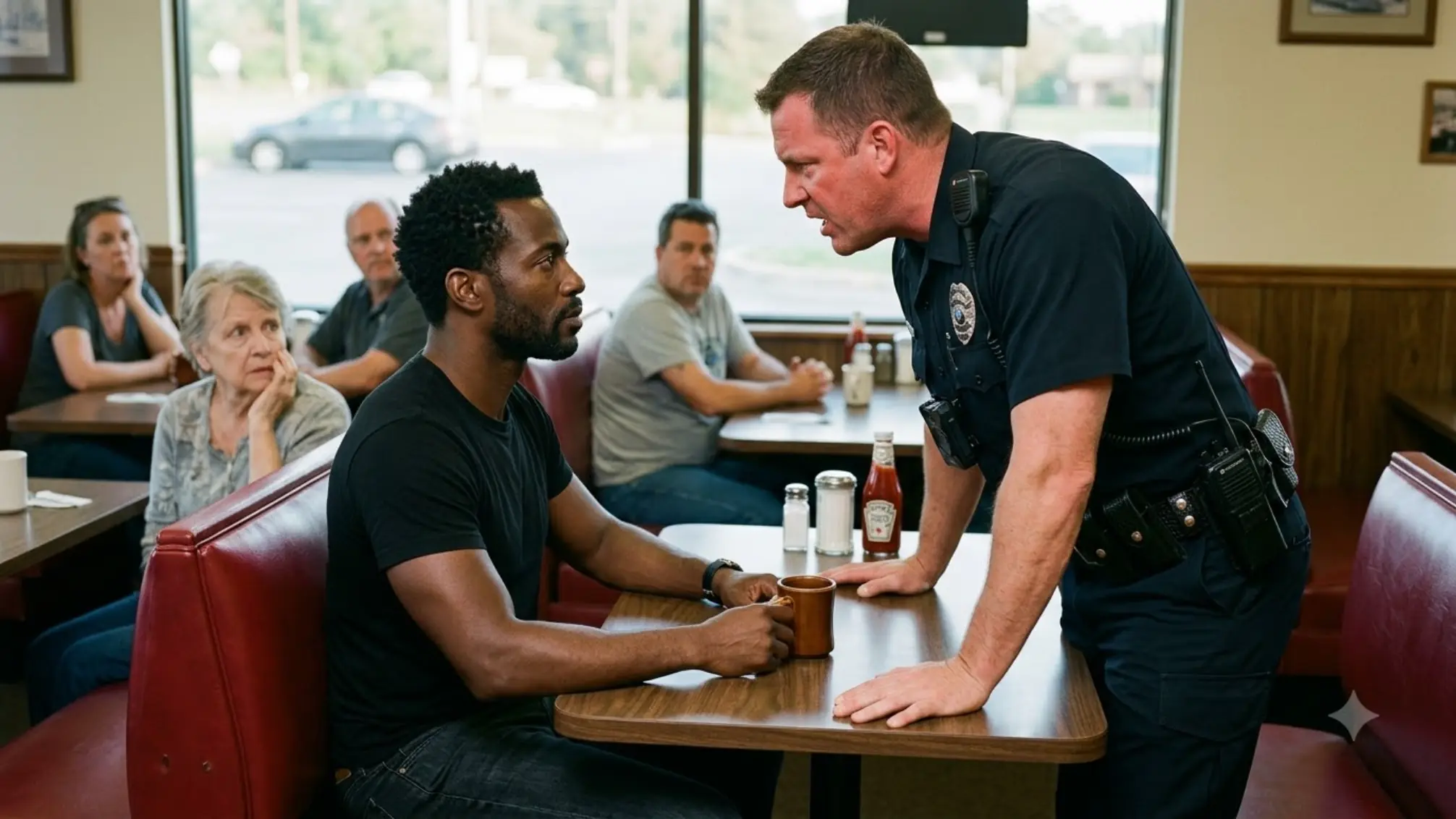
The officer stopped beside Scott’s table and stared down at him. “You need to leave.” Scott looked up slowly, taking in the dark navy uniform, body camera, nameplate, and the flushed irritation already visible across Keller’s face. “Am I breaking a law, Officer?”
Keller planted one hand hard against the table. Coffee trembled inside Scott’s mug while conversations around the diner disappeared almost instantly. “People like you don’t question me,” Keller said. “You leave when I say.”
Scott remained seated. “Then explain the threat clearly for your bodycam.” Keller leaned closer until barely a foot separated their faces. “Keep pushing me, and you’ll leave this diner in cuffs.”
Scott did not smile, but something in his expression changed. Keller interpreted the calmness as weakness, exactly as Scott expected. What the officer did not know was that Scott Harris was a senior Internal Affairs investigator assigned to a regional misconduct task force, and Keller’s name had appeared in five complaint files during the previous eighteen months. Scott had not come to the diner looking for Keller, but now the investigation had apparently walked straight up to his breakfast table.
Three weeks earlier, Scott had been reviewing a complaint filed by twenty-three-year-old college student Jamal Brooks. Jamal claimed Keller stopped him near Pine Hollow after midnight despite committing no traffic violation, searched his car after he refused consent, and threatened to charge him with obstruction when he asked why he had been detained. Keller’s report said Jamal behaved aggressively and appeared to conceal something beneath the passenger seat. Body-camera footage from the first four minutes of the encounter was mysteriously unavailable.
That alone did not prove misconduct. Cameras failed, batteries died, and complaints sometimes omitted details that later changed the entire picture. Scott had learned early in his career that investigators who started with a conclusion usually ended up protecting their conclusion instead of finding the truth. He wanted patterns, corroboration, records, and footage.
Then the second complaint surfaced. A middle-aged Latino contractor named Miguel Santos claimed Keller ordered him out of his truck in the parking lot of a hardware store after accusing him of looking “out of place.” Miguel had been delivering tools to a remodeling crew and possessed invoices for every piece of equipment in the vehicle. According to his statement, Keller searched the truck anyway and became angry when Miguel asked for a supervisor.
A third complaint came from a Black nurse named Alicia Grant. She said Keller followed her from a convenience store, stopped her without explaining a violation, and repeatedly asked why she was driving an expensive SUV. When Alicia told him the vehicle belonged to her, Keller allegedly laughed. No citation was issued.
The complaints shared small details. Keller often approached people already convinced something about them was suspicious. He framed basic questions as disrespect, extended stops after finding no evidence, and repeatedly used vague phrases such as “people like you” or “your type.” None of those phrases alone established a disciplinary case, but together they made Scott curious.
Scott’s task force requested Keller’s traffic-stop statistics. The numbers revealed that Keller conducted significantly more discretionary stops than other officers assigned to the same shift. A much larger percentage ended without citations, arrests, or confirmed violations. His consent-search rate was also unusually high, though the department’s reports did not always clearly distinguish genuine consent from searches officers simply described as consensual.
That was why Scott had spent the morning speaking to former dispatcher Helen Marsh. Helen worked Westbridge communications for twenty-six years before retiring and remembered Keller well. She told Scott Keller developed a reputation for calling in plates after deciding someone “looked wrong” before determining whether any actual violation existed. Supervisors knew he was aggressive but valued his arrest numbers.
Helen asked Scott whether he planned to interview Keller soon. Scott said not yet. “First I want to know whether the pattern exists outside complaints.” Helen gave him one piece of advice before leaving. “If Keller finds out you’re investigating him, don’t expect him to act like the man in his reports.”
Scott had almost laughed then. Now, twenty minutes later, Keller stood over his diner table proving exactly what Helen meant. Scott glanced toward the body camera mounted on Keller’s chest and saw the red indicator illuminated. Recording.
Good.
Keller straightened. “Last chance.” Scott rested both hands openly on the table. “You still haven’t told me why I’m being ordered to leave.”
“Owner doesn’t want you here.”
Scott looked toward the counter. Maggie Palmer, the sixty-one-year-old diner owner, stood frozen beside the coffee machine. She shook her head slightly.
Scott turned back toward Keller. “The owner appears to disagree.”
Keller shot Maggie a warning look. “Stay out of this.”
Maggie’s face hardened. “It’s my diner.”
“Then let me handle the situation.”
“What situation?”
Keller did not answer.
Scott watched the exchange carefully. A waitress named Julie stood near the kitchen holding two plates that were becoming colder by the second. Three customers in another booth stared openly. An elderly man near the window quietly placed his phone against a sugar dispenser with the camera facing Keller.
Scott noticed.
Keller did not.
“You walked in here,” Scott said calmly, “approached my table, ordered me to leave, and threatened me with arrest. What offense are you investigating?”
Keller leaned forward again. “Disorderly conduct.”
Scott looked around the silent diner.
“I was drinking coffee.”
“You’re being confrontational now.”
“Because I asked a question?”
“Because you won’t follow directions.”
Scott’s voice remained level. “A lawful direction requires some legal basis.”
That sentence triggered Keller.
His palm hit the table hard enough to knock Scott’s spoon onto the floor. Julie flinched. Maggie stepped from behind the counter.
“Ray, enough.”
Keller pointed toward her. “I said stay out of this.”
Maggie stopped, not because she agreed but because Keller’s hand had moved toward his duty belt. Scott saw the motion. So did the camera.
Keller looked down at Scott. “Stand up.”
Scott remained seated. “Am I detained?”
“You’re going to be if you keep running your mouth.”
“That wasn’t my question.”
Keller’s face became darker.
Scott repeated, “Am I detained?”
“Yes.”
“For what suspected crime?”
Keller stared at him.
Then he said something that would later matter more than almost anything else recorded that morning.
“People like you always think you can hide behind technicalities.”
The diner went completely still.
Scott felt anger rise inside him, but years of investigative work had trained him to recognize the difference between useful anger and destructive anger. Useful anger sharpened memory. Destructive anger gave people excuses.
He chose the first.
“People like me?”
Keller realized the phrase had landed badly.
“You know exactly what I mean.”
“No.”
Scott’s voice became colder.
“I want you to explain it.”
Keller reached toward Scott’s shoulder. “Stand up before I make you.”
Scott moved just enough to prevent Keller from grabbing him but kept his hands visible. “Do not put your hands on me unless you’re making an arrest.”
“That’s it.”
Keller grabbed Scott’s wrist.
Maggie shouted.
Several customers stood.
Scott did not pull away.
He looked directly at Keller.
“Before you put cuffs on me, I strongly recommend you check your camera.”
Keller tightened his grip.
“My camera?”
“Yes.”
“What about it?”
“It has recorded everything since you walked through that door.”
Keller laughed. “Good.”
Scott nodded.
“Very.”
There was something in Scott’s tone that finally made Keller hesitate. The officer studied him more carefully for the first time. Not his skin. Not his clothes. His posture.
Scott looked completely unafraid.
Keller released his wrist but remained beside the booth. “Who are you?”
Scott picked up his coffee.
“A customer.”
“Don’t play games.”
“You didn’t care who I was five minutes ago.”
Keller’s jaw tightened.
Scott took one sip.
“Why does it matter now?”
Keller looked toward Maggie. “Do you know him?”
“No.”
Then the diner door opened.
Two men in business-casual clothing entered, followed by a woman carrying a leather portfolio. Keller glanced toward them and immediately recognized one.
Captain Laura Bennett, commander of Westbridge Police Department’s Professional Standards Division.
Keller’s face changed.
“Captain?”
Laura did not answer him immediately. She walked toward Scott and stopped beside the booth. “You all right?”
Scott nodded.
“Yes.”
Keller looked between them.
“You know this guy?”
Laura’s expression was unreadable.
Scott placed his cup down and finally reached inside his jacket, which had been folded beside him. He removed a black credential case and placed it on the table.
Keller stared at it.
Scott opened the case.
Internal Affairs Investigator, Regional Public Integrity Task Force.
Keller’s mouth opened slightly.
Nobody in the diner spoke.
Scott closed the credential case again.
“I’m Scott Harris.”
Keller stepped backward.
“This was a misunderstanding.”
Scott looked toward the camera on Keller’s chest.
“No.”
Keller swallowed.
“You didn’t identify yourself.”
“I wasn’t required to.”
“You deliberately let this happen.”
Scott’s expression finally hardened.
“I sat here eating breakfast.”
Keller looked toward Laura.
“He was challenging my authority.”
Laura answered quietly.
“He asked why you ordered him out.”
Keller’s voice rose. “You didn’t see the beginning.”
Scott pointed toward the body camera.
“She doesn’t need to.”
That ended the argument.
Laura instructed Keller to deactivate nothing and touch none of the camera equipment. Another Professional Standards officer secured Keller’s body-camera recording through department procedures while Scott remained at the diner to provide a preliminary witness statement. Maggie immediately volunteered her surveillance footage.
The elderly man by the window raised his phone.
“I recorded it too.”
Scott looked toward him.
“Please don’t upload it yet.”
The man nodded.
“If it helps.”
“It will.”
Keller was ordered back to headquarters and removed from street duty pending review. He left the diner without looking at Scott. The same officer who had walked in expecting everyone to fear him now looked smaller with every step toward the door.
Maggie poured Scott another coffee.
“On the house.”
Scott shook his head.
“I can pay.”
“I know.”
She placed the cup down.
“This one is still on the house.”
Scott accepted.
Three hours later, investigators reviewed Keller’s footage from beginning to end. The recording showed no call for service at the diner. No complaint from Maggie. No disturbance before Keller approached Scott.
That created the obvious question.
Why had Keller entered?
Dispatch records supplied the answer.
Keller had been driving past when he saw Scott through the diner window.
There was no assignment.
No emergency.
No report.
Nothing.
He parked, entered, and initiated the confrontation entirely on his own.
Keller’s written statement claimed Scott “matched the general description of a subject associated with recent theft investigations.” Investigators immediately requested the relevant suspect bulletin.
The description was painfully broad.
Black male.
Late twenties to forties.
Medium-to-athletic build.
Dark clothing.
Scott fit it.
So did thousands of people across Virginia.
More importantly, the suspect was believed to be driving a white cargo van.
Scott’s vehicle was a gray state-issued sedan parked behind the diner.
Keller never mentioned thefts during the encounter.
He never asked Scott’s name.
Never requested identification.
Never questioned him about a van.
Instead, he ordered him out of the diner.
That contradiction became difficult to explain.
Investigators then reviewed Keller’s prior body-camera archive.
What they found transformed Scott’s accidental diner encounter into something larger.
In one stop, Keller told Miguel Santos, “Guys like you always have an excuse.”
In another, he told Jamal Brooks, “Your kind thinks every question is discrimination.”
During Alicia Grant’s SUV stop, Keller could be heard asking another officer, “Since when do nurses drive seventy-thousand-dollar cars?”
The recordings had existed for months.
Nobody had examined them together.
That became the real institutional failure.
Complaints were reviewed individually by different supervisors. One supervisor checked whether Keller technically issued a citation. Another focused only on whether force had been used. Another accepted Keller’s statement that his comments had been misunderstood.
No one assembled the pattern.
Scott’s team did.
Within two weeks, thirteen additional motorists came forward after Westbridge announced an external review of Keller’s conduct. Some complaints were weak or unsupported. Scott insisted they be treated that way.
Not every allegation became true simply because Keller had behaved badly elsewhere.
But several were corroborated.
Security footage.
Passenger videos.
Body-camera audio.
Dispatch logs.
Inconsistent reports.
The investigation became less about Scott and more about a culture that had allowed Keller to operate without meaningful scrutiny.
Captain Bennett was furious.
She discovered that two supervisors had warned Keller informally over the previous three years but avoided formal discipline because his stop and arrest statistics were considered productive. One lieutenant wrote in an email that Keller “sometimes needs his edges smoothed but gets results.”
Investigators compared those “results” with outcomes.
Many searches produced nothing.
Many arrests were later reduced or dismissed.
Several charges began only after citizens questioned Keller’s commands.
That pattern mattered enormously.
Scott removed himself from direct decision-making regarding the disciplinary outcome because he was now a principal witness. He provided his statement and footage analysis but left final recommendations to an independent panel.
Keller’s disciplinary hearing occurred three months later.
The diner footage played first.
Everyone watched him enter.
Approach Scott.
Order him out.
Invent the owner complaint.
Threaten arrest.
Use the phrase “people like you.”
Then reach for Scott after failing repeatedly to identify any offense.
Keller sat beside his attorney watching his own face on the screen.
The arrogance looked different from across the room.
His attorney argued Keller had been attempting proactive crime prevention and became frustrated by Scott’s refusal to cooperate.
A panel member interrupted.
“Cooperate with what investigation?”
The attorney paused.
“The theft bulletin.”
“When did Officer Keller mention the bulletin?”
Silence.
Another panel member asked, “Why did he tell the diner owner that she had requested Scott’s removal when she had not?”
Keller finally spoke.
“I thought she looked uncomfortable.”
Maggie, seated behind the investigators, almost laughed.
The panel member continued.
“You transformed a facial expression into a trespass complaint?”
Keller looked down.
Then came the previous incidents.
Jamal.
Miguel.
Alicia.
Others.
Keller’s defense became increasingly difficult because the same language appeared repeatedly.
“People like you.”
“Your kind.”
“You people.”
The phrases differed slightly, but the attitude did not.
Finally, Keller said something nobody expected.
“I thought nobody would complain.”
The room became silent.
Scott looked up.
Keller stared at the table.
“Most people I stopped just wanted to go home.”
His voice had lost all aggression.
“They knew fighting it would take longer.”
A panel member asked, “So you relied on that?”
Keller hesitated.
“Yes.”
It was the clearest admission in the entire case.
Not that every stop had been consciously planned around race.
Not that every complaint was true.
Something simpler.
Keller knew authority itself could exhaust people into compliance.
He used that fact.
The panel recommended termination.
Chief Robert Miles accepted the recommendation.
Keller’s badge, weapon, and department credentials were collected that afternoon. Separate reviews were opened into several cases involving possible false reporting or unlawful detention, while prosecutors evaluated whether any conduct warranted criminal charges. Scott never celebrated.
When another investigator asked why he seemed almost disappointed, Scott answered, “Because this should’ve been caught before he reached my table.”
That sentence stayed with Captain Bennett.
Westbridge changed its complaint system.
Multiple complaints involving the same officer were automatically linked.
Supervisors were required to review underlying body-camera footage rather than only written summaries.
Discretionary stops without enforcement outcomes were analyzed for patterns.
Body-camera activation failures triggered separate review.
The department also created a policy making it clear that lawful questions from citizens did not constitute obstruction, hostility, or refusal to cooperate.
Six months later, Scott returned to Pine Hollow Diner.
Maggie recognized him immediately.
“You’re famous now.”
“No.”
“You were on the news.”
“Unfortunately.”
She poured him coffee.
“Same breakfast?”
“Yes.”
Scott sat in the same booth.
The table had a small repaired dent where Keller’s hand had struck it.
Maggie noticed him looking.
“I considered replacing it.”
“Why didn’t you?”
“Reminder.”
Scott smiled slightly.
“Of Keller?”
“No.”
She looked toward the front window.
“Of everybody who sat here and said nothing.”
Scott understood.
Maggie sighed.
“I knew he was wrong almost immediately.”
“You eventually spoke.”
“Eventually.”
She looked toward him.
“Next time I’d like to be faster.”
Scott nodded.
“That’s how people change.”
The diner door opened.
Officer Marcus Bell, a young Westbridge patrol officer Scott recognized from the review process, stepped inside for lunch. He saw Scott and hesitated.
Then he approached.
“Investigator Harris.”
“Officer Bell.”
Bell looked uncomfortable.
“I wanted to tell you something.”
Scott waited.
“Keller trained me.”
That explained more than Bell probably realized.
“He told us people lie, people hide things, and if you give them room they control the encounter.”
Scott looked toward him.
“What do you think now?”
Bell considered the question.
“I think control and safety aren’t always the same thing.”
Scott nodded.
“Good answer.”
Bell left him alone.
Outside, traffic moved along the highway.
Inside, forks clicked against plates.
Coffee poured.
Ordinary conversation filled the room.
Nothing dramatic happened.
Scott preferred it that way.
A year later, Keller’s name became part of the curriculum at Westbridge’s training academy. Recruits watched selected clips from the diner encounter and previous stops.
The instructor always paused after Scott’s first question.
Am I breaking a law, officer?
Then the instructor asked the class what should have happened next.
The answer was painfully simple.
Explain the reason for the contact.
If no lawful reason exists, end it.
The entire disaster had grown from Keller’s refusal to accept that citizens were allowed to ask questions.
Scott eventually moved on to other investigations.
Different departments.
Different complaints.
Different people convinced their authority shielded them from consequences.
But he kept one still image from the Pine Hollow footage inside a training folder.
Keller leaning over the table.
Scott sitting calmly beneath him.
The body camera visible between them.
Whenever new investigators asked what made a strong misconduct case, Scott showed them the photograph.
“Not anger,” he said.
“Not reputation.”
“Not even the badge.”
Then he tapped the body camera in the image.
“Evidence.”
Because Keller had walked into that diner believing power belonged to the loudest man standing.
Scott knew something else.
Power could threaten.
Power could intimidate.
Power could make a room silent.
But evidence remembered exactly what power said when it thought nobody important was listening.
And on that ordinary morning inside Pine Hollow Diner, Officer Raymond Keller made the most expensive mistake of his career.
He decided Scott Harris was nobody important.
Then he recorded himself proving exactly why Internal Affairs had been looking for him.