Dr. Marcus Reed had been awake for twenty-one hours when Officer Travis Cole stepped in front of him and told him he did not live there.
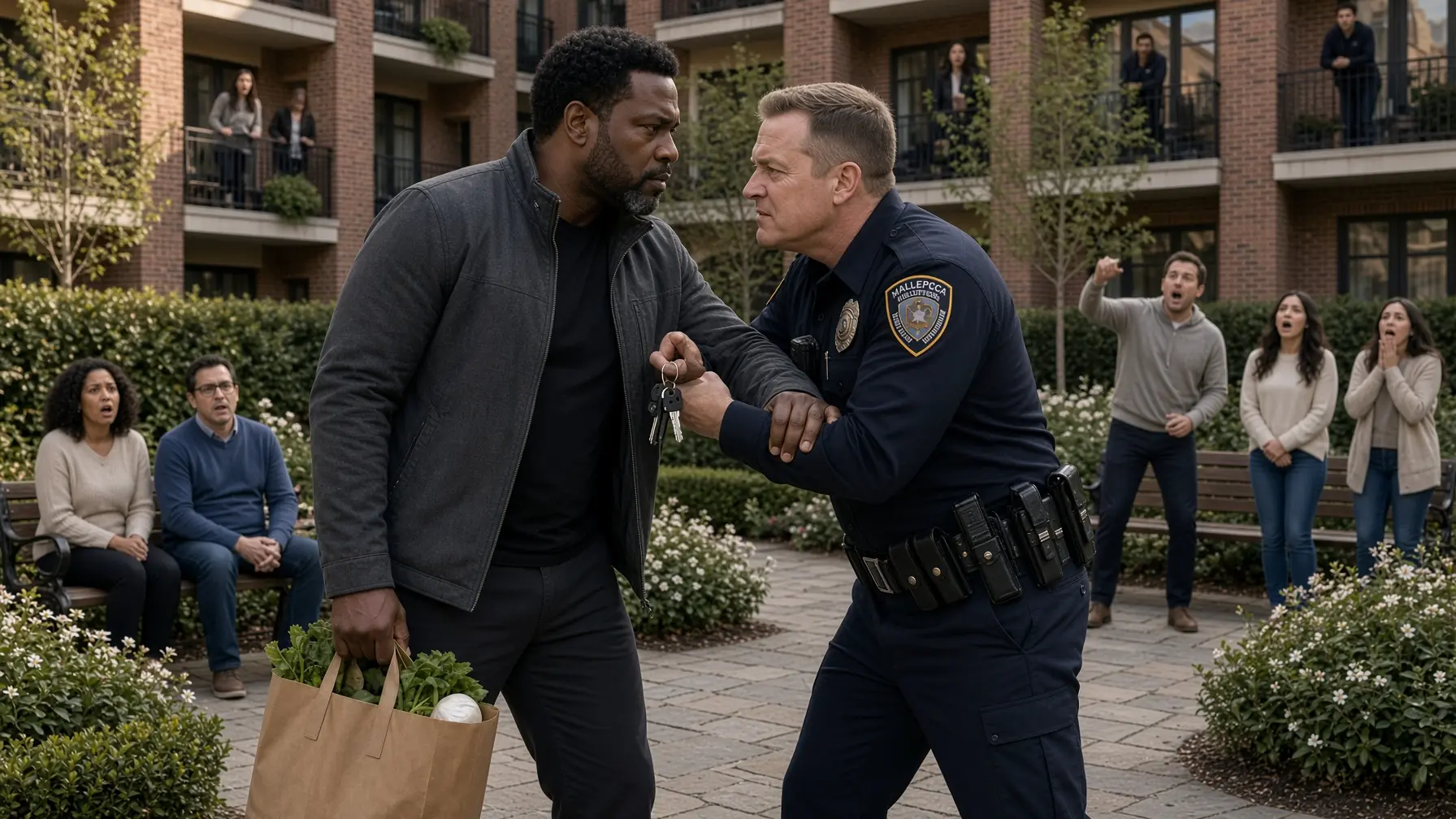
Marcus stopped in the middle of the stone walkway.
For a moment, he honestly thought the officer was speaking to someone else.
The late-afternoon sun still hung above the brick apartment buildings of Hawthorne Place, turning the upper balconies gold and throwing long shadows across the landscaped courtyard. Residents moved between the parking garage and lobby carrying groceries, gym bags, takeout containers, and dog leashes.
Marcus was carrying one paper grocery bag.
Eggs.
Coffee.
Bread.
Bananas.
A frozen pizza he had bought because after twenty-one hours inside St. Catherine Medical Center, cooking had become an unrealistic ambition.
In his other hand were his apartment keys.
He wore navy hospital scrubs beneath a charcoal jacket.
His identification badge was clipped near his waist but partly hidden by the jacket hem.
He had been thinking about exactly three things when he walked through the courtyard gate.
Shower.
Food.
Sleep.
Then the officer stepped into his path.
“You need to head back out to the street.”
Marcus blinked.
“What?”
Officer Travis Cole pointed toward the main entrance.
“You heard me.”
Marcus looked behind himself.
Then back at Cole.
“I’m going home.”
Cole gave him a thin smile.
“You don’t live here.”
Marcus stared.
It was not the first time in his life someone had decided what he was before asking.
But exhaustion made disbelief arrive before anger.
“Apartment 4C.”
Cole looked him up and down.
Not at the keys.
At Marcus.
“Sure.”
Marcus raised the key ring.
“These open the building.”
Cole barely glanced at them.
“Anyone can have keys.”
Marcus’s jaw tightened.
“Then why did you ask whether I live here?”
“I didn't ask.”
“That’s true.”
Marcus looked at the entrance twenty feet away.
“You decided.”
Cole’s expression hardened.
The officer was white, late thirties, broad through the chest, short sandy hair, body camera clipped to the center of his uniform.
One hand rested near his duty belt.
His posture was not defensive.
It was possessive.
As if Marcus had walked into a space Cole considered his to control.
“You need to move along.”
Marcus did not.
“Why?”
Cole sighed.
The sound carried the exaggerated patience of someone explaining something obvious to a difficult child.
“We had reports of somebody wandering around the property.”
Marcus looked down at his groceries.
Then at the hospital parking pass still hanging from his jacket pocket.
“I walked from the garage to here.”
“People who actually live here don't wander around looking lost.”
Marcus almost laughed.
“I’m not lost.”
“You were looking around.”
“Yes.”
“At my building.”
Cole’s eyebrows lifted.
“Your building?”
Marcus caught himself.
“My apartment building.”
“Convenient.”
The irritation finally began to burn through the fatigue.
Marcus held up the keys again.
“Would you like me to open the door?”
“No.”
That answer landed oddly.
Marcus lowered the keys.
“No?”
Cole stepped closer.
“I said go back toward the street.”
Marcus looked at him carefully.
“If opening the resident entrance doesn’t establish that I have access, what exactly are you trying to verify?”
Cole’s face changed.
Marcus recognized the moment.
It happened in emergency rooms too.
A conversation stopped being about the stated problem and became about whether someone would accept being challenged.
Cole pointed toward the gate.
“You don’t get to interrogate me.”
“I’m not interrogating you.”
“You're refusing instructions.”
“I’m refusing to leave my home.”
Several residents had slowed nearby.
A woman walking a small white dog stopped beside a bench.
A man on a second-floor balcony leaned against the railing.
Marcus noticed.
Cole noticed too.
That should have made the officer more careful.
Instead it seemed to make him more determined to win.
“Identification.”
Marcus paused.
“For what offense?”
Cole’s mouth tightened.
“Give me your ID.”
“My apartment key is in my hand.”
“I said ID.”
Marcus shifted the grocery bag.
“I’m not reaching into my pocket while your hand is next to your belt unless you tell me where you want my hands.”
That sentence altered Cole’s expression.
Not because it was threatening.
Because it was careful.
Too careful.
People who expected simple compliance irritated men who had already decided resistance was coming.
“Hands where I can see them.”
Marcus raised both hands slightly.
The grocery bag rustled against his forearm.
“Fine.”
“Now give me your ID.”