The handcuffs clicked shut behind Lieutenant General Anita Wells while Officer Slade Riker laughed directly behind her. Anita stood perfectly upright in the center of Oak Haven Estates, Virginia, dressed in her formal dark-navy command uniform because she had been preparing to leave for an official evening briefing when the patrol cars blocked her driveway. Neighbors had stepped onto porches, phones raised, while two officers stood beside a marked cruiser and watched Riker tighten the cuffs around her wrists. “You really expect me to believe you command anyone?” he sneered. “That costume and fake ID aren’t saving you.”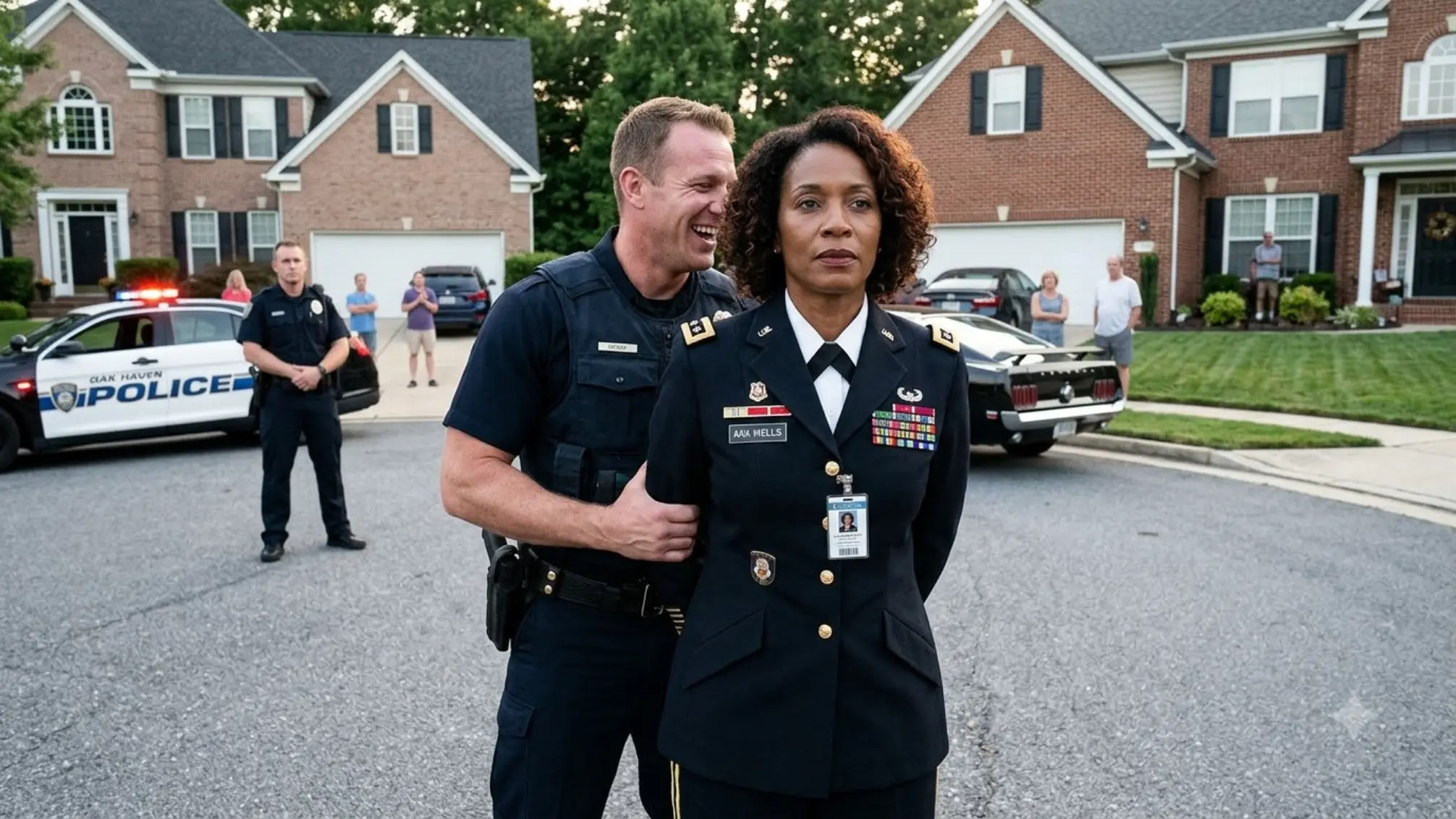
Anita turned her head just enough to meet his eyes. At fifty-two, she had spent more than three decades building a career based on discipline, logistics, strategy, and the ability to remain calm while everyone around her lost theirs. Her deep-brown face showed almost no emotion, but her voice became colder. “Take these cuffs off before your ignorance becomes a federal problem.” Riker shoved her one step forward and answered, “You have no power here. I decide who leaves this street in cuffs.”
Anita looked toward the patrol car. “Then give me my one call,” she said. “And listen carefully when the Pentagon answers.” Riker laughed again, but Sergeant Daniel Knox, standing near the cruiser, did not. Something about the way Anita said the sentence made him look again at the gold insignia on her shoulders, the ribbons on her chest, and the official identification badge that Riker had dismissed without verifying. Knox had been silent until then because Riker was the senior patrol officer on scene, but silence was beginning to feel less like professionalism and more like participation.
Two hours earlier, Anita had been wearing an old gray hoodie and loose cargo pants with grease streaked across both sleeves. Her restored 1969 Ford Mustang sat in the driveway with its hood raised, and a socket wrench rested beside the alternator while Anita worked through a problem she had inherited from her father along with the car itself. The Mustang had been the only thing her father owned that Anita refused to let anyone else maintain. When she worked beneath that hood, meetings, briefings, security protocols, and titles disappeared.
Oak Haven Estates was new to her. Anita had purchased the modern glass-and-stone house only two weeks earlier after years of living close to secure government facilities and temporary assignments. The neighborhood was expensive, quiet, meticulously landscaped, and filled with residents who seemed to know one another’s routines well enough to notice anything unfamiliar. Anita had introduced herself to the neighbors on both sides, but she had not announced her rank because she had no interest in making her profession the first thing people learned about her. She wanted to be the woman fixing an old Mustang in her driveway, not a title people stood straighter around.
At 3:48 that afternoon, a patrol SUV rolled slowly past her house. Anita noticed it but kept working, assuming the officer was checking addresses or responding to a call nearby. Ten minutes later, the same vehicle returned and stopped near the curb. Officer Riker stepped out, looked at the Mustang, looked at Anita, then walked halfway up the driveway with one hand resting near his belt. “Ma’am, is this your vehicle?”
Anita straightened. “Yes.” Riker pointed at the Mustang. “And this house?” Anita removed one glove. “Also mine.” His eyes traveled from her faded hoodie to the expensive home behind her, then toward the Mustang again as though he were trying to reconcile three pieces of information that did not fit the story he had already created.
“We got a report of suspicious activity,” Riker said. Anita glanced toward the street. “What activity?” He answered, “Someone working around a vehicle at a residence where they may not belong.” Anita looked back at him. “You mean me repairing my own car at my own house.”
Riker’s expression hardened. “Identification.” Anita pointed toward the open garage. “My wallet is inside on the workbench.” He told her to retrieve it slowly, so Anita walked into the garage while keeping both hands visible. She returned with her driver’s license, homeowner documentation stored digitally on her phone, and her government identification because she was due to leave shortly for a secure briefing.
Riker examined the driver’s license first. The address matched the house. He looked at the property document. It also matched Anita’s name. Any reasonable question about whether she belonged there should have ended immediately, but instead Riker picked up the government credential and stared at it with open suspicion. “Lieutenant General Anita Wells?”
“Yes.”
Riker laughed. “Three stars?” Anita did not respond. He held the card between two fingers like something dirty. “You expect me to believe this?”
Anita’s expression changed. “That credential can be verified in less than a minute.” Riker turned it over. “Looks expensive.” She stepped half a pace closer. “Do not damage it.”
That was when Sergeant Knox arrived with another patrol unit. He had been dispatched after Riker radioed that he was investigating a possible burglary and vehicle theft, a description that surprised Anita because she had heard Riker make no effort to verify either allegation. Knox walked toward them and asked what had happened. Riker immediately said, “Possible stolen vehicle, suspicious occupant, fake federal credentials.”
Anita looked directly at Knox. “My driver’s license matches this residence. The Mustang is registered to me. My government identification is authentic and verifiable.” Knox looked toward Riker’s hand. “Did you run the vehicle?”
“Working on it.”
Anita’s eyes narrowed. “You called another unit before checking the registration?” Riker snapped, “Stop interrupting.”
Knox took the Mustang’s information and radioed dispatch himself. Less than thirty seconds later, confirmation came back that the vehicle was registered to Anita Wells at the exact address where they were standing. Knox looked toward Riker. “Car’s clean.” Riker did not move.
“House might not be,” he replied. Anita stared at him. “The address is printed on my driver’s license.” Riker turned toward her. “People fake licenses.”
Knox’s discomfort became visible. “Slade, we have matching documentation.” Riker held up Anita’s federal identification. “Except this nonsense.” Anita took one controlled breath. “Run the credential.”
Instead, Riker bent it between his fingers.
Anita’s entire posture changed.
“Do not.”
He smiled. “What happens if I do?”
“That is government property.”
Riker bent it harder until the card cracked near one corner.
Knox stepped forward. “Hey.”
Anita did not raise her voice. “Officer Riker, you have now intentionally damaged an official federal identification credential after being instructed that it was government property.” Riker tossed the damaged card onto the hood of the Mustang. “And you’re still standing here pretending you command a brigade.”
Anita looked down at the cracked credential. For the first time, anger appeared clearly in her eyes. “You are making decisions you are going to spend years explaining.” Riker moved directly into her space. “You threatening me?”
“No.”
She held his stare.
“I’m documenting your choices.”
Riker grabbed her wrist.
Knox immediately said, “Slade, what are you doing?” Riker twisted Anita’s arm behind her back and announced that she was being detained for obstruction and suspected possession of fraudulent government identification. Anita did not resist. She simply allowed him to place her other hand behind her while neighbors began recording.
The handcuffs closed.
That was the moment shown later on every internal review screen, every legal filing, and every hearing connected to what followed. Anita stood in full uniform because she had changed only minutes earlier, her shoulders squared while Riker laughed behind her. Knox stood several feet away looking increasingly alarmed.
“Nice costume,” Riker said. “You buy those stars online too?”
Anita turned her head. “Give me my phone.”
“No.”
“I am entitled to contact counsel.”
“You can call after booking.”
Knox stepped forward. “Slade, we should verify her identity before transporting her.” Riker looked at him. “You buying this act?”
“I’m saying we have a person with matching property documents, matching vehicle registration, and a credential we haven’t checked.”
Riker pointed toward Anita. “Look at her.” The sentence hung there. Knox’s face hardened.
Anita noticed.
“What exactly should he see?” she asked.
Riker did not answer directly. “Someone’s playing games.”
Knox looked at Anita again. He had attended emergency-management briefings where senior officials visited the county, and something about her name now felt familiar. He pulled out his department phone and searched the secure directory available to supervisory officers. Lieutenant General Anita Wells appeared before he finished typing the surname.
His stomach dropped.
Photograph.
Rank.
Assignment.
Protective contact instructions.
Knox looked toward Riker.
“Take the cuffs off.”
Riker laughed. “Not you too.”
“Take them off now.”
Riker’s smile faded. “What did you find?”
Knox held up the screen. “Her.”
Riker looked.
The photograph matched the woman standing three feet away.
For several seconds, nobody spoke.
Anita finally said, “My phone.”
Knox retrieved it from the hood of the Mustang and handed it to her, but Riker still had not removed the cuffs. Anita looked at him. “Either unlock them or Sergeant Knox will.”
Knox stepped forward.
Riker reluctantly removed the restraints.
Red marks circled Anita’s wrists.
The watching neighbors had gone completely silent.
Riker began trying to recover control. “General, this was a misunderstanding.”
Anita rubbed one wrist. “No.”
“We received a suspicious-person call.”
“That explains why you arrived.”
She looked toward her damaged identification card.
“It does not explain everything you did after arriving.”
Riker opened his mouth.
Anita lifted one finger.
“You had my driver’s license. You had my home address. You had vehicle registration. You had a credential you refused to verify. Instead, you destroyed it.”
Riker glanced toward the neighbors.
Anita continued. “Then you arrested me because I insisted you check your own assumptions.”
“I didn’t arrest you.”
“You placed me in handcuffs and told your sergeant you intended to transport me.”
Riker said nothing.
Knox lowered his eyes.
Anita picked up the cracked identification card.
Then her phone rang.
The display showed a secure contact number.
She answered.
“Wells.”
A man on the other end spoke rapidly.
Anita listened for less than fifteen seconds.
“Yes. Delay the briefing fifteen minutes.”
She looked at Riker.
“I’ve encountered a law-enforcement issue at my residence.”
Another pause.
“No, I am not injured.”
The person on the other end apparently asked another question.
Anita replied, “I will send the names.”
Riker’s face changed.
Anita ended the call.
“Who was that?” he asked.
She looked at him coldly.
“The Pentagon liaison you were hoping I invented.”
Within twenty minutes, Oak Haven Police Chief Martin Calder was driving toward the neighborhood personally. His deputy chief was beside him, and Internal Affairs had already been instructed to preserve every body-camera recording, dispatch log, computer query, and message related to Anita’s detention. Nobody at the Pentagon had ordered local disciplinary action, nor could a phone call magically fire officers, but the verified identity of the person Riker had detained guaranteed that every procedural decision would receive immediate scrutiny. That was enough.
Chief Calder arrived to find Anita standing beside her Mustang with her arms folded. Knox had separated Riker from the scene and was speaking with another supervisor. The neighbors were still outside. At least four had complete recordings.
“General Wells,” Calder began, “I’m Chief Martin Calder.”
“I know.”
“I want to apologize.”
Anita shook her head.
“Not yet.”
Calder stopped.
“I don’t need an apology before you know what happened.”
The chief nodded slowly.
“What do you need?”
“Preserve the evidence.”
“It’s already ordered.”
“Good.”
“Body cameras, dispatch audio, vehicle checks, and computer logs.”
“Also Officer Riker’s report history.”
Calder’s eyebrows rose.
“Why?”
Anita looked toward him.
“Because nobody becomes this comfortable ignoring contradictory evidence in one afternoon.”
That sentence followed Calder back to headquarters.
By midnight, Internal Affairs had pulled three years of Riker’s traffic stops and suspicious-person contacts. The first review revealed fourteen citizen complaints alleging aggressive stops, unsupported searches, unnecessary handcuffing, or different treatment after officers discovered the person detained held a respected profession. Several complaints involved Black homeowners or drivers in affluent neighborhoods.
Most had been closed.
One report described a Black dentist stopped while entering his own clinic before sunrise.
Another involved a Black financial adviser questioned beside a luxury car because the officer believed the vehicle “did not fit the subject.”
A third came from a college professor walking through a gated neighborhood where he lived.
Riker appeared in all three.
Chief Calder read until almost three in the morning.
Then he called Internal Affairs.
“Expand the review.”
The next morning, Anita attended her scheduled briefing and said nothing publicly about the arrest. Reporters had already begun contacting her office because a neighbor’s video had reached social media. Anita declined interviews.
Her staff expected anger.
Instead, she requested documents.
She wanted the arrest report.
Body-camera preservation confirmation.
Dispatch records.
Complaint procedures.
Department policies concerning identity verification and handcuffing during investigative detention.
Anita had built her career around systems. One officer losing control interested her less than discovering what allowed him to believe nobody would question it.
Three days later, Chief Calder requested a private meeting at Anita’s house.
She agreed.
Riker had been suspended pending investigation.
Knox had submitted a supplemental report stating he believed the detention should have ended immediately after the vehicle and address were verified.
Calder placed a folder on Anita’s kitchen table.
“You were right.”
“About what?”
“This wasn’t the first time.”
Anita did not look pleased.
That surprised him.
“You expected it?”
“I suspected it.”
Calder opened the folder.
Internal Affairs had identified significant inconsistencies between several of Riker’s written reports and body-camera footage. In multiple cases, he described subjects as aggressive when video showed them speaking calmly. He frequently used phrases such as “did not appear to belong in the area” without documenting any specific conduct supporting that conclusion.
Anita turned a page.
“What did supervisors do?”
Calder hesitated.
“Approved the reports.”
“All of them?”
“Most.”
She closed the folder.
“Then Officer Riker isn’t your only problem.”
Calder nodded.
“No.”
That answer was why Anita eventually agreed to help.
Not as a general.
Not as someone demanding revenge.
As the homeowner whose incident had exposed a weakness nobody inside the department had wanted to measure.
An external investigator reviewed the complaints.
Riker’s body-camera footage from Anita’s driveway became impossible to explain away. It showed her producing documentation, Knox receiving confirmation that the Mustang was legally registered, Anita repeatedly requesting credential verification, and Riker deliberately damaging the identification before placing her in cuffs.
His written report was worse.
Riker claimed Anita had refused identification and behaved aggressively.
The video contradicted both statements.
He wrote that she had attempted to leave.
She never moved more than a few steps.
He wrote that the government credential appeared obviously fraudulent.
Investigators later confirmed its verification features were intact before he cracked it.
Riker was terminated after the administrative investigation concluded that he had engaged in misconduct, made material false statements, and failed to follow department procedures. The state certification board opened a separate review that ultimately prevented him from immediately joining another police department. Two supervisors who repeatedly approved unsupported reports were demoted and reassigned.
Sergeant Knox received no celebration.
He received something more useful.
Responsibility.
Calder appointed him to a working group reviewing field-verification procedures because Knox had made one mistake that mattered: he recognized the problem but waited too long to challenge it.
Knox admitted that publicly.
“I knew something was wrong before I checked her name,” he said during a departmental training session. “I waited because I didn’t want to contradict a senior officer.”
He paused.
“That means I was protecting hierarchy before I was protecting procedure.”
Anita watched the recording later.
That sentence mattered to her.
Six months after the incident, Oak Haven Police adopted new requirements for suspicious-person calls. Officers were required to document objective behavior rather than vague conclusions about whether someone “belonged.” Once verified identification resolved the original reason for contact, continued detention required independently articulable grounds.
Supervisors also began auditing demographic patterns in discretionary stops.
Citizen complaints involving allegations of selective enforcement automatically received body-camera comparison.
The changes were administrative.
Boring, according to television.
Anita considered that a compliment.
Real reforms often looked boring because forms, audits, timestamps, and review requirements did not fit into dramatic headlines.
But they changed what happened the next time someone stood in a driveway.
Nearly a year later, Anita was once again beneath the hood of the 1969 Mustang.
The afternoon was quiet.
Her hands were covered in grease.
She wore the faded gray hoodie again.
A patrol car slowed near the house.
Anita noticed it.
The officer looked toward her.
For half a second, old tension returned.
Then the officer simply waved.
Anita stared.
The patrol car continued down the street.
She smiled faintly and returned to the engine.
Her neighbor, Thomas Reed, walked across the lawn carrying two bottles of water.
“That still bother you?”
“The police car?”
Thomas nodded.
“Sometimes.”
He handed her the water.
“You could probably call the chief personally now.”
Anita laughed.
“That would miss the point.”
“What was the point?”
She looked toward the disappearing patrol car.
“That he didn’t need to know who I was.”
Thomas waited.
Anita wiped grease from her hand.
“I was repairing a car in my own driveway.”
She glanced toward the Mustang.
“That should have been enough.”
The engine turned over ten minutes later.
Its deep vibration moved through the driveway and into Anita’s chest, exactly as it had when her father was alive.
She stood beside the open hood and listened.
Not to rank.
Not to authority.
Not to phones ringing in distant offices.
To the machine.
Months earlier, Officer Slade Riker had looked at Anita Wells and decided her appearance mattered more than every document in front of him. Then he learned her title and suddenly understood that he had made a dangerous mistake.
Anita never considered that the lesson.
The lesson was not that he should have recognized a three-star general.
It was that nobody standing in their own driveway should need three stars, a Pentagon contact, or extraordinary power before an officer decides to verify the facts.
Anita lowered the hood.
The Mustang was finally running exactly the way her father had taught her it should.
And Oak Haven, slowly and imperfectly, was beginning to do the same.