A cold steel bench. The sterile, unforgiving scent of disinfectant.
For nineteen-year-old Leo Nash, this was the end of a night that had begun with charcoal sketches and dreams of art school.
Now he sat handcuffed and processed like a criminal, while every attempt to explain himself had been dismissed with cynical laughter.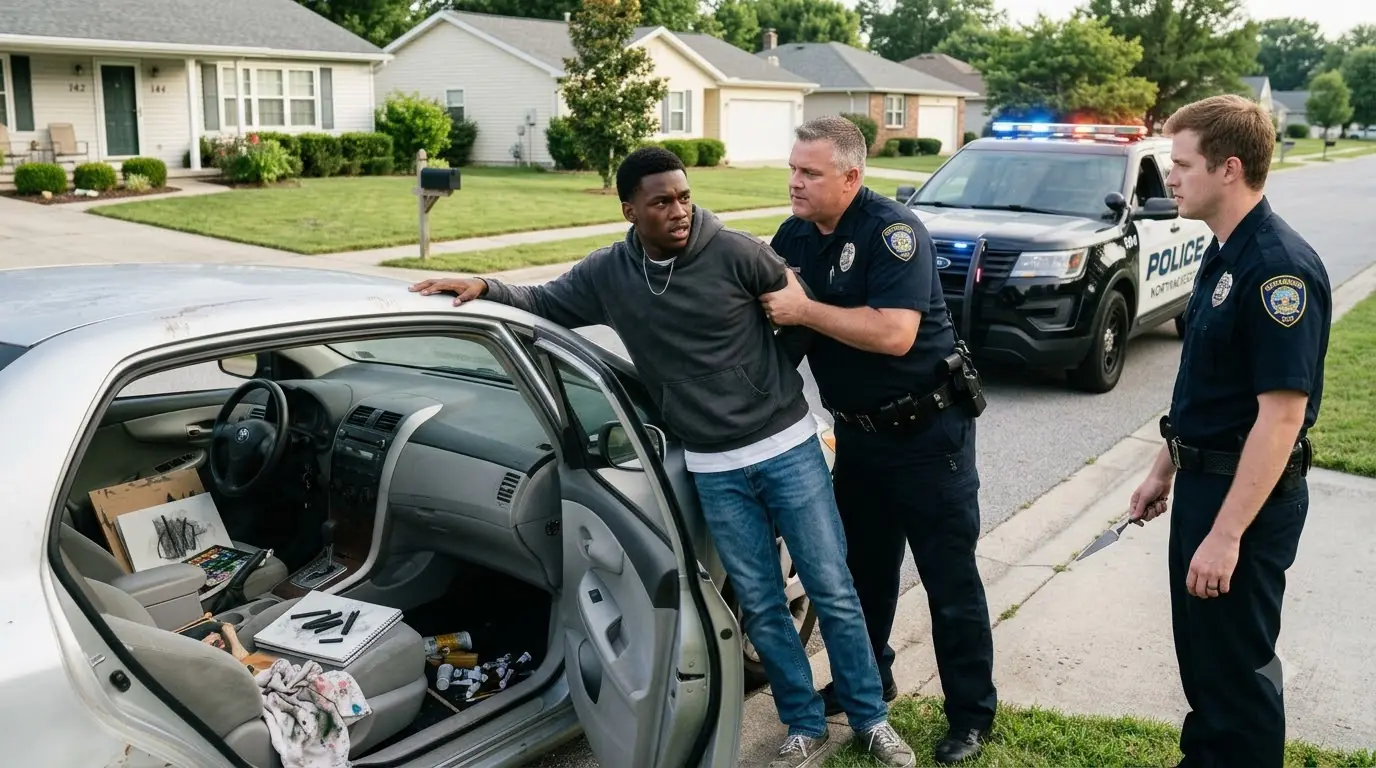
The officers saw a young Black American man in an old sedan and built their own narrative around him before learning anything about who he was. They had no idea that the quiet teenager sitting inside their holding cell was about to make one phone call that would change everything.
They believed their authority would protect them.
They were wrong.
The night had been cool and quiet, the kind of stillness that settled over the suburbs long after the last commuter train had pulled away. Leo drove his mother’s ten-year-old sedan through the dark streets, the familiar sound of the engine almost comforting.
The passenger seat was covered with art supplies. Sticks of willow charcoal, a portfolio filled with sketches, a new set of oil paints he had saved for, brushes wrapped in an old cloth, and several small tools he used while painting.
He was heading home after a late-night session at a friend’s makeshift studio.
His mind was occupied with color theory, composition, and the texture of a canvas he had stretched earlier.
Then the world behind him suddenly exploded in red and blue.
Leo’s heart began pounding.
He checked his speedometer.
Exactly the speed limit.
He signaled, pulled smoothly toward the curb, and stopped. Then he placed both hands where they could clearly be seen on the steering wheel, exactly the way his father had taught him.
Two officers stepped out of the patrol car.
The older one approached the driver’s side. He was broad through the shoulders and carried himself with the confidence of someone accustomed to being obeyed immediately.
His name tag read MILLER.
The younger officer, Carter, remained near the passenger side. One hand rested near his belt as he studied the inside of the vehicle.
“Evening,” Officer Miller said.
His tone was casual but cold.
He leaned down toward the open window.
“You know why I pulled you over?”
“No, officer,” Leo answered. “I don’t.”
“Your left tail light is out.”
Leo knew that was not true.
He and his father had checked the lights the previous weekend.
Still, he understood that arguing on the side of the road would accomplish nothing.
“I’m sorry to hear that, officer. I wasn’t aware.”
“License, registration, proof of insurance. Keep your hands where I can see them.”
Miller’s flashlight moved across Leo’s face and then through the interior of the car.
The beam paused on the art supplies.
Leo moved slowly.
“I’m reaching toward the glove compartment.”
“Go ahead.”
Leo retrieved the documents and handed them over.
Miller barely looked at the name before turning his attention back toward the passenger seat.
“What’s all this stuff?”
“My art supplies, sir. I was at a friend’s house painting.”
“Art supplies?”
Miller gave Carter a skeptical look.
“Right.”
Leo felt his stomach tighten.
“What’s your real business out here tonight?”
“I’m a student. I’m just going home.”
“We’ll see.”
Miller handed the documents to Carter.
“Run his name.”
Then he turned back toward Leo.
“Step out of the car.”
Leo hesitated.
“Officer, am I being detained? What for?”
“For the traffic stop, and because I’m telling you to step out. Slowly.”
Leo complied.
The moment he stood beside the vehicle, Miller pressed him against the side of the car and began searching him.
“You don’t have any reason to do this,” Leo said, struggling to keep his voice calm.
“I’ll decide that.”
Miller searched his pockets.
A wallet.
A phone.
Nothing illegal.
Meanwhile, Carter looked through the passenger area.
“Hey, Cade.”
Carter lifted something from among the supplies.
A metal palette knife.
“Look at this.”
The thin tool caught the flashing patrol lights.
Miller’s expression changed immediately.
“Well, well.”
He took the palette knife.
“Looks like our artist came prepared.”
“That’s a palette knife,” Leo said. “It’s for mixing paint.”
Miller examined it as if he had just uncovered something important.
“You expect me to believe that?”
“You can look it up. That’s literally what it is.”
Miller stepped closer.
“You’re carrying a concealed blade, and you match the general circumstances of someone we’ve been looking for in connection with recent property incidents.”
Leo stared at him.
“What?”
There had been no description mentioned earlier.
No questions connecting Leo to any actual incident.
Nothing.
“This is insane.”
Leo turned toward Carter.
“Tell him you know what that is.”
Carter looked at the palette knife.
Then at Leo.
For one brief moment, Leo thought the younger officer might speak.
Carter looked away.
He said nothing.
Miller pulled Leo’s hands behind his back.
The handcuffs clicked shut.
The sound seemed impossibly loud.
Leo felt something shift inside him.
Minutes earlier, he had been a student driving home with paints and charcoal in the passenger seat.
Now he had become a suspect.
A description.
A story written by somebody else.
Miller guided him toward the patrol vehicle.
The words sounded almost unreal.
Leo looked back toward his mother’s sedan.
Both tail lights were glowing red in the darkness.
Perfectly functional.
The patrol car door closed.
Leo sat in the hard molded seat and watched the familiar car disappear behind him.
At that moment, nobody on the roadside knew who his father was.
That was important.
Leo was not being treated as the son of a governor.
He was being treated as an ordinary nineteen-year-old whom the officers believed they could define however they wanted.
The Northwood precinct smelled like old coffee and industrial cleaner.
Officer Miller brought Leo through the main bullpen with one hand on his shoulder.
Several officers looked up briefly from paperwork and computers, then went back to whatever they had been doing.
“Got another one,” Miller announced.
The desk sergeant was a heavyset, gray-haired man named Peterson.
Miller placed the palette knife inside an evidence bag.
“Found him out late, suspicious circumstances, carrying this.”
Sergeant Peterson looked at the tool.
Then at Leo.
“An artist?”
He gave a short laugh.
“What was he going to do, paint his way into somebody’s house?”
Miller smiled.
“Something like that.”
Leo said nothing.
“Get him processed,” Peterson said.
The next hour felt designed to make him smaller.
His shoes and belt were taken.
His pockets were emptied.
A tube of lip balm.
A few dollars.
His keys.
His phone.
Everything was catalogued and sealed.
He was fingerprinted.
He watched dark residue cover the same fingertips he used every day to hold charcoal.
Then came the photograph.
Front.
Profile.
Another profile.
Leo stared into the camera trying not to show the humiliation he felt.
“You have the wrong person,” he said to Sergeant Peterson afterward. “My name is Leo Nash. My father is—”
Peterson waved him off.
“Yeah, yeah. Everybody has somebody important. Father’s a lawyer. Uncle’s a judge. Cousin works for the mayor.”
“That’s not what I was going to say.”
“You get one phone call after you’re in the cell.”
They led him down a narrow hallway.
A heavy door opened.
The holding cell was small and cold.
A metal bench was bolted to the wall.
Leo sat down.
The cold surface seeped through his jeans.
He lowered his head into his hands.
Elsewhere in the station, Carter sat beside Miller.
Miller appeared energized by the arrest.
“See how easy that was?” he said. “Textbook.”
Carter stared at the desk.
“The palette knife was an art tool.”
“It had an edge.”
“You said there was a bulletin on him.”
“I said he fit the circumstances.”
“There wasn’t a bulletin, Cade.”
Miller leaned back.
“Details. The kid looked suspicious the second I saw him.”
Carter’s stomach tightened.
He had seen this before.
A minor traffic stop became questions.
Questions became a search.
A search became justification for something that had already been decided.
Carter had been an officer for only two years.
Miller was his training officer.
A fifteen-year veteran.
Well connected inside the precinct.
Questioning him meant becoming a problem.
Being called soft.
Possibly ruining his career before it had really begun.
So Carter did what he had done on the side of the road.
Nothing.
But Leo’s expression stayed with him.
Not anger.
Not exactly.
Betrayal.
The look of someone realizing that the person who could have spoken up had chosen silence.
Eventually, Leo was brought to a wall-mounted telephone.
“You get one call,” the guard said.
Leo knew exactly whom he wanted.
He dialed his father’s private number.
It rang.
Once.
Twice.
Three times.
Voicemail.
“You’ve reached Robert Nash. Please leave a message.”
Leo closed his eyes.
His father was probably still trapped inside another late-night budget meeting.
“Dad, it’s me.”
His voice cracked.
“I’ve been arrested. I’m at the Northwood precinct. An officer named Miller stopped me. He said the tail light was out, but it wasn’t. He found my palette knife and called it a weapon.”
Leo swallowed.
“I didn’t do anything.”
He looked over his shoulder toward the guard.
“Dad, please call me back. I don’t know what to do.”
He hung up.
The guard led him back to the cell.
The door closed.
Leo sat down again.
For the first time that night, hopelessness truly reached him.
The person most capable of helping him did not even know what had happened.
At nearly one in the morning, Governor Robert Nash finally left the state budget meeting.
The conference room had become unbearable hours earlier. Fluorescent lights, financial projections, budget compromises, endless negotiations.
Robert walked into his private office and loosened his tie.
He wanted nothing more than to go home.
He picked up his phone and scanned the notifications.
Most were predictable.
Chief of staff.
Department heads.
Legislative aides.
Then he saw Leo’s name.
Missed call.
Voicemail.
A small smile crossed his face.
Leo sometimes called late to ask about borrowing the car or buying another set of paints.
Robert pressed play.
The smile disappeared.
“Dad, it’s me. I’ve been arrested.”
Robert sat upright.
By the time the message ended, the exhaustion from the budget meeting was gone.
He played the voicemail again.
Northwood precinct.
Officer Miller.
Tail light.
Palette knife.
“I didn’t do anything.”
For several seconds, Robert Nash did not move.
Then the governor disappeared.
There was only a father sitting in an office, listening to fear in his child’s voice.
Northwood was a quiet, affluent suburb.
Leo was nineteen.
No criminal history.
An art student driving his mother’s old sedan.
Robert’s mind assembled the possibilities quickly.
A discretionary stop.
An officer who had decided Leo looked suspicious.
An ordinary tool transformed into justification.
Robert had spent much of his public career hearing versions of these stories from families who did not have his phone number.
Now the same machinery had reached his own son.
He felt anger rise.
He did not let it control him.
Instead, he reached for the phone.
His first call was to Colonel Jennings, superintendent of the state police.
“Colonel, this is Governor Nash. Sorry for the hour.”
“Governor. What can I do?”
“I need Chief Frank Brody’s private number. Northwood Police Department. Immediately.”
Jennings became more alert.
“Is everything all right, sir?”
“No. My son is being held at Northwood.”
Silence.
“I want Chief Brody’s number, and I want a state trooper to meet me there. Unmarked vehicle. No spectacle.”
“Yes, Governor.”
Within a minute, Robert received the number.
He called.
Chief Frank Brody answered on the second ring.
“Brody.”
“Chief Brody. This is Governor Robert Nash.”
The sleep disappeared from Brody’s voice.
“Governor. Good evening, sir. Is everything all right?”
“No.”
Robert’s voice was quiet.
“I have just received a voicemail from my son, Leo Nash. According to him, he is currently sitting in one of your holding cells after being arrested by an Officer Miller.”
There was no answer.
Robert continued.
“My nineteen-year-old son, an art student with no criminal record, tells me he was arrested after one of your officers decided his palette knife was a weapon.”
Brody struggled for words.
“Governor, I had no idea. I’m not at the station. I haven’t received any report.”
“Then I suggest you receive one very quickly.”
“Yes, sir.”
“I am on my way there now.”
Robert stood and put on his coat.
“When I arrive, I expect my son to be out of that cell, unharmed, and I expect an explanation supported by evidence.”
“Understood.”
“Chief?”
“Yes, Governor?”
“Do not destroy, alter, or lose a single piece of video, audio, or paperwork connected to this stop.”
Brody swallowed.
“Crystal clear.”
Robert hung up.
At Northwood, Officer Cade Miller sat at a computer writing his report.
The narrative appearing on the screen looked very different from what had happened.
Leo’s confusion became evasiveness.
His questions became belligerence.
The palette knife became a concealed modified blade.
The stop became a proactive response connected to recent neighborhood concerns.
Every sentence strengthened a justification that had not existed on the road.
Ben Carter sat at the neighboring desk.
His own report remained blank.
“You should get that done,” Miller said.
Carter stared at the screen.
“I’m thinking.”
“Don’t think too hard.”
Miller continued typing.
“It was a good arrest. End of story.”
At the front desk, Sergeant Peterson worked on a crossword puzzle.
The phone rang.
He answered.
“Peterson.”
A dispatcher spoke quickly.
“Sergeant, Chief Brody is on his way to the station. Five minutes, maybe less. He wants everything connected to the arrest of Leo Nash.”
Peterson frowned.
“Nash?”
“The young man Miller brought in.”
“What does the chief want with him?”
“I don’t know. But he sounds furious. He wants Miller and Carter in his office when he arrives.”
Peterson hung up and walked toward Miller.
“Chief’s coming in.”
Miller looked up.
“At one in the morning?”
“He wants to see you and Carter about the Nash arrest.”
Miller frowned.
“What, did the kid’s mother complain?”
“No idea.”
Peterson turned away.
“He didn’t sound happy.”
A slight unease entered Miller’s expression.
It did not last long.
He assumed Brody wanted procedure tightened up.
Then the main precinct line rang.
Peterson answered.
Within seconds, his face changed.
He stopped moving.
When he hung up, Carter noticed immediately.
“Who was that?”
Peterson looked at him.
“State police.”
Miller stood.
“What about them?”
“They wanted confirmation that Leo Nash is in our custody.”
Peterson swallowed.
“And they informed me that Governor Robert Nash is on his way here personally.”
The bullpen went silent.
For several seconds, nobody connected the words.
Then Carter’s eyes widened.
Nash.
He remembered the registration.
The name.
Leo Nash.
Registered owner: Leonora Nash.
He had typed it without really processing it.
His face drained of color.
“Cade.”
Miller stared at him.
Carter’s voice dropped.
“His father.”
Miller looked toward the hallway leading to the cells.
For the first time that night, the confidence disappeared completely.
The half-finished report remained open on his computer screen.
A record of every exaggeration he had decided would never be seriously examined.
A vehicle pulled hard into the parking lot.
Doors opened.
Footsteps approached.
Chief Brody entered first.
His face was flushed with anger.
“Where is he?”
Everyone froze.
“Where is the governor’s son?”
Sergeant Peterson moved quickly.
Brody pointed toward the holding area.
“Get him out. Now.”
Peterson grabbed his keys and hurried down the hallway.
Leo looked up when the cell door opened.
Sergeant Peterson stood there.
Behind him was Chief Brody.
The man who had barely been mentioned before now looked deeply unsettled.
“Leo Nash?”
Leo stood.
“Yes.”
“I’m Chief Brody.”
Brody’s voice softened.
“There has been a serious mistake. Please come with me.”
Leo stepped out.
When he returned to the bullpen, he saw Miller and Carter.
Their faces were completely different from the faces on the roadside.
Miller avoided his eyes.
Carter looked sick.
For one brief second, Miller looked directly at Leo.
Leo saw something he had not seen before.
Fear.
“Return his property,” Brody ordered. “Everything. Get him water. Whatever he needs.”
Peterson moved quickly.
Brody turned toward Miller and Carter.
“My office. Both of you. Five minutes.”
Then he faced Leo.
“Mr. Nash, I cannot adequately apologize for what happened tonight. Your father is on his way. We are going to determine exactly what happened.”
The mention of his father made Leo’s knees feel weak.
His belongings were returned.
Wallet.
Keys.
Phone.
Shoes.
Belt.
Brody led him into the chief’s office.
The room was lined with plaques, framed commendations, certificates, and photographs.
Leo sat in a padded chair.
The softness felt almost strange after the metal bench.
Miller and Carter entered several minutes later.
They stood across from Brody’s desk.
The chief did not invite them to sit.
“I just spoke with Governor Nash,” Brody began.
Miller swallowed.
“He tells me his son was arrested for possessing a palette knife.”
Brody looked directly at him.
“Your arrest, Officer Miller?”
“Yes, sir.”
“Explain it.”
Miller forced himself to speak.
“The subject was uncooperative. He was operating a vehicle in an area that has experienced property incidents. During the stop, we located an item that could reasonably be interpreted as a weapon.”
Brody stared at him.
“A palette knife.”
“Yes, sir.”
“You have fifteen years in law enforcement.”
Brody leaned forward.
“You cannot identify a painting tool?”
“It can still have an edge.”
“What else did you find?”
“Nothing, sir.”
“Drugs?”
“No.”
“Stolen property?”
“No.”
“Burglary tools?”
“No.”
“Outstanding warrants?”
“No.”
Brody’s voice rose.
“So you arrested a nineteen-year-old student with no criminal record based on a traffic stop and an art tool?”
Miller tried again.
“There were other indicators.”
“Like what?”
“He appeared nervous.”
Leo almost laughed.
Brody did not.
“You claimed a broken tail light.”
“Yes.”
“You had better hope that dashcam supports you.”
Carter stared at the floor.
Brody looked at him.
“And you?”
Carter’s jaw tightened.
“You were there.”
“Yes, sir.”
“You supported this arrest?”
Carter could not answer.
His silence said enough.
Brody turned back toward Miller.
“You wrote a report?”
“Yes, sir.”
Brody’s expression hardened.
“Wonderful. Because if the report contradicts the footage, you have created an entirely different problem for yourself.”
The office door opened.
A state trooper stood there.
He stepped aside.
Governor Robert Nash entered.
Leo stood.
His father crossed the room immediately.
“Leo.”
He pulled his son into an embrace.
“Are you okay?”
“I’m okay, Dad.”
“Did anybody hurt you?”
“No. I’m shaken up, but I’m okay.”
Robert held him for another moment.
Then he stepped back.
He placed one hand on Leo’s shoulder.
When he turned toward the officers, his expression changed.
Not into theatrical rage.
Into controlled focus.
“Chief Brody.”
“Governor.”
“I believe I’m owed an explanation.”
“Yes, sir.”
“But first, I want the report.”
Brody had already had a copy printed.
He handed it over.
Robert read silently.
Then aloud.
“Upon observing a vehicle with a nonfunctioning tail light, I initiated a standard traffic stop. The driver, later identified as Leo Nash, displayed unusual nervousness and provided evasive answers to routine questions.”
He lowered the page.
“Officer Miller.”
“Yes, Governor?”
“My son’s tail lights were functioning when he left home tonight.”
Miller opened his mouth.
Robert continued.
“You claim the stop was initiated because one was not functioning. That should be very easy to confirm.”
Miller shifted.
“I may have been mistaken about the light, sir, but his demeanor—”
“His demeanor?”
Robert stepped forward slightly.
“My son has been taught since he was fourteen how carefully he must behave during a traffic stop. Hands visible. Voice controlled. No sudden movements.”
He looked toward Leo.
“Tonight, the precautions we taught him were apparently interpreted as suspicious behavior.”
Miller said nothing.
Robert turned toward Carter.
“Officer Carter. You were present.”
Carter looked up.
“Did Leo Nash behave aggressively toward either of you?”
Carter’s lips parted.
Nothing came out.
“Did he threaten you?”
“No, sir.”
Miller glanced sharply toward him.
Robert noticed.
“Did you understand that the object taken from the vehicle was a palette knife?”
Carter closed his eyes for half a second.
“Yes.”
The room went still.
Miller’s head turned.
“What?”
Carter looked at him.
“I knew what it was.”
Robert returned to the report.
“A search of the vehicle’s interior revealed a concealed modified blade.”
He folded the page slowly.
“A palette knife.”
Nobody answered.
“A fork can injure someone,” Robert said. “So can a pen. So can a set of keys. Possibility does not transform an ordinary object into evidence of a crime.”
He looked directly at Miller.
“You saw my son before you knew anything about him. You decided he looked out of place. From that decision, everything else followed.”
Miller tried to interrupt.
“Governor, respectfully—”
“No.”
Robert’s tone remained quiet.
“This is not about you recognizing the governor’s son.”
He gestured toward Leo.
“You did not know who he was. That is precisely why this matters.”
Miller’s expression tightened.
“If Leo had been another young man whose father could not reach a police chief at one in the morning, he might still be sitting in that cell.”
Nobody spoke.
“He might have spent tomorrow trying to convince a public defender that a painting tool was not a weapon. He could have faced pressure to accept responsibility for something he never did because fighting it would cost time and money his family might not possess.”
Robert looked around the room.
“That is the part of tonight I cannot ignore.”
Then he turned toward Chief Brody.
“I want an independent review.”
Brody nodded.
“Yes, Governor.”
“Preserve the dashcam, body camera footage, dispatch records, booking footage, written reports, and every relevant record from this shift.”
“Yes, sir.”
“I expect your internal investigators to cooperate fully with the Attorney General’s office.”
Brody hesitated only briefly.
“They will.”
Robert pointed toward Miller and Carter.
“Until the facts are established, these officers should not be on active patrol.”
Brody looked at them.
“Badges and duty equipment. Now.”
Miller’s face changed.
“Chief—”
“Now.”
Miller slowly removed his badge.
Carter did the same.
Robert placed his arm around Leo.
“Come on, son.”
Leo looked back once before leaving.
Miller stood beside Brody’s desk, staring at the badge he had just surrendered.
Carter looked at the floor.
Leo felt no triumph.
Only relief.
The next morning, two senior investigators from the Attorney General’s office arrived at Northwood.
Their lead investigator was Anne Holloway.
She was experienced, precise, and unimpressed by excuses.
Chief Brody gave her the conference room.
Her mandate was straightforward.
Follow the evidence.
The first thing Holloway requested was the patrol car footage.
The recording began before the traffic stop.
Leo’s sedan appeared ahead.
Both tail lights were plainly visible.
Both functioning.
Then came Miller’s voice.
“Look at this guy. Doesn’t belong around here this late. Let’s see what he’s doing.”
Holloway replayed it.
Then again.
The initial reason written in Miller’s report did not match what the camera showed.
More importantly, the recording captured Miller deciding that Leo was suspicious before there had been any traffic violation or interaction.
Holloway requested all available body-camera footage.
She watched Leo place his hands where officers could see them.
She watched him produce his license and registration.
She listened to his answers.
She watched Miller escalate the encounter.
Then she watched Carter retrieve the palette knife.
There was a moment on the recording when Carter looked at the tool.
His expression changed.
He knew what it was.
He still said nothing.
Holloway scheduled separate interviews.
Miller arrived with a union representative.
The representative began by insisting that officers often had to make rapid decisions under uncertain circumstances.
Holloway allowed him to finish.
Then she placed the transcript from the patrol recording on the table.
“Officer Miller, your report states that you initiated the stop after observing a malfunctioning tail light.”
Miller shifted in his chair.
“Yes.”
“This recording shows both lights functioning.”
“The lighting conditions were difficult.”
“It also records you saying, before activating your emergency lights, that the driver did not belong in the neighborhood.”
Miller stared at the page.
His representative started to speak.
Holloway raised one hand.
“This interview concerns potential falsification of an official record. I suggest we remain precise.”
Miller’s jaw tightened.
“He looked suspicious.”
“For what?”
“The area had experienced incidents.”
“What specific offense connected Leo Nash to those incidents?”
Miller did not answer.
“Was there a current description identifying a nineteen-year-old male driving that sedan?”
“No.”
“A vehicle match?”
“No.”
“Did you find stolen property?”
“No.”
“Did Mr. Nash admit involvement?”
“No.”
“Did he attempt to flee?”
“No.”
“Did he threaten either officer?”
“No.”
Holloway leaned back.
“Then explain why your written report makes his behavior sound threatening.”
Miller tried.
He described Leo as confrontational.
The footage showed otherwise.
He said Leo concealed the palette knife.
The photographs showed the tool lying among art supplies.
He claimed the stop was based on a traffic violation.
The patrol video showed functioning lights.
Each explanation created another contradiction.
When the interview ended, Miller left looking exhausted.
Carter arrived without a representative.
He had barely slept.
Holloway placed the same evidence in front of him.
“You already know what I’m going to ask.”
Carter nodded.
“Tell me what happened.”
He stared at the table.
Then he began.
“He does this.”
“Who?”
“Cade.”
Carter rubbed his hands together.
“He calls it proactive policing.”
Holloway waited.
“He sees somebody he thinks is out of place, then he finds something. A light. A stop sign. Something minor.”
“And if he doesn’t find something?”
Carter looked up.
“He keeps looking.”
For the next two hours, Carter described previous stops.
Some had ended with warnings.
Others became searches.
A few had generated complaints.
Most had been treated as isolated incidents.
Carter admitted he had witnessed questionable decisions before.
“Why didn’t you report it?”
“He trained me.”
“That is not an answer.”
Carter swallowed.
“I was afraid.”
“Of what?”
“Getting labeled. Losing backup. Ending my career before it started.”
Holloway remained silent.
Carter’s eyes filled with shame.
“When Leo looked at me and asked me to say what the palette knife was, I knew.”
“Knew what?”
“That Cade was wrong.”
“Did you tell him?”
“No.”
“Did you tell Sergeant Peterson?”
“No.”
“Did you stop the arrest?”
“No.”
Carter looked away.
“I was a coward.”
The investigation widened.
Holloway reviewed older complaints involving Miller.
Several contained familiar language.
Driver appeared nervous.
Subject seemed out of place.
Officer safety concerns.
Suspicious behavior.
Some had involved people from racial or ethnic minority communities stopped in areas where residents were predominantly white.
Individually, the incidents had been explained away.
Together, they formed a pattern.
The Leo Nash case reached the news before the investigation had finished its first full day.
By noon, the headline appeared across local television.
GOVERNOR’S SON ARRESTED; OFFICERS SUSPENDED PENDING REVIEW.
News vans filled the street outside Northwood Police Department.
Chief Brody held a press conference.
He looked exhausted.
“We are cooperating fully with an independent state investigation. No officer will receive special treatment, and no citizen should receive different treatment because of who their family is.”
Reporters shouted questions.
“Chief, did the officers know Leo Nash was the governor’s son?”
“Is there evidence of racial profiling?”
“How many complaints has Officer Miller faced?”
“Why were those complaints dismissed?”
Brody refused to speculate.
The Nash family experienced a different kind of storm.
Phones rang constantly.
Political allies called.
Opponents called.
Civil-rights organizations requested meetings.
News networks requested interviews.
Robert Nash issued one statement.
“What happened to my son matters precisely because the officers did not know whose son he was. Leo had access to help because of my position. Many families do not. This investigation must therefore be about more than one young man. It must examine the use of authority, the accuracy of police reporting, and whether residents receive equal treatment regardless of background.”
Leo wanted none of the attention.
His face appeared on television.
Photographers gathered outside the family home.
Commentators debated his arrest.
Instead of giving interviews, Leo went to his room.
He picked up charcoal.
The first drawing was the patrol lights reflected in the rearview mirror.
The second was a pair of hands on a steering wheel.
Then handcuffs.
A cold bench.
A cell door.
Officer Miller’s flashlight cutting across a face.
Leo drew for hours.
The fear became lines.
The anger became shape.
The humiliation became texture.
He could not control what people said about him on television.
He could control the page.
Weeks passed.
Holloway’s team finished its report.
It was long.
Detailed.
Damning.
The investigators concluded that Miller’s justification for stopping Leo was unsupported by the recording. His written description of the stop contained material inaccuracies, and the handling of the palette knife exaggerated an ordinary art tool into evidence of criminal intent.
The investigation also documented a broader pattern of questionable discretionary stops and reports involving Miller.
Several older complaints were reopened.
Dashcam recordings were reexamined.
Supervisory reviews were questioned.
Ben Carter’s testimony became central.
He described how Miller operated and admitted his own failure to intervene.
The Attorney General announced disciplinary and criminal referrals.
Cade Miller was terminated from the Northwood Police Department.
His fifteen-year career ended.
Criminal charges followed related to falsification of official records and violation of Leo Nash’s civil rights.
Miller publicly denied intentional wrongdoing.
His attorney said he had made imperfect decisions under difficult circumstances.
The recordings made that defense difficult.
Ben Carter was also dismissed from the department.
The Attorney General declined to pursue the same criminal case against him because of his cooperation and because the evidence showed that Miller had directed the stop and written the false narrative.
Still, the Attorney General’s statement was explicit.
Carter’s silence had been a serious ethical failure.
Cooperation afterward did not erase what he had failed to do on the roadside.
Carter left Northwood.
His law-enforcement career was finished.
Chief Frank Brody resigned several months later.
The state investigation did not find evidence that Brody had personally directed Miller’s behavior.
It did find serious failures in supervision.
Complaints had been reviewed too narrowly.
Patterns had not been connected.
Officers had learned that certain kinds of behavior could survive as long as each case was treated as an isolated event.
Brody accepted responsibility.
“The department did not become this way in one night,” he said during his resignation. “Leadership has to answer for what it allows to become normal.”
Miller’s case went to trial.
The courtroom saw the same evidence Leo had seen only after his release.
Both functioning tail lights.
The patrol audio.
Leo’s calm responses.
The art supplies.
The palette knife.
The written report.
Ben Carter testified.
He looked smaller than Leo remembered.
When asked why he had remained silent, Carter answered simply.
“I was afraid of Officer Miller and afraid of losing my career.”
The prosecutor asked, “And what did your fear cost Leo Nash?”
Carter looked toward Leo.
“His freedom that night.”
Miller maintained that he had acted in good faith.
The jury disagreed.
He was convicted on the charges arising from the falsified report and civil-rights violation.
The court imposed a federal prison sentence.
When Miller was led away, Leo watched quietly.
He did not celebrate.
He had imagined that moment many times.
It felt different when it finally arrived.
Smaller.
Sad, almost.
A man who had once treated Leo as powerless was now facing consequences created largely by his own decisions.
Governor Robert Nash took the broader investigation personally, but he was careful about how he used it.
He knew any reform written solely as revenge for what happened to his son would lose legitimacy.
So his administration worked with civil-rights attorneys, police representatives, prosecutors, community organizations, researchers, and families who had experienced questionable encounters.
The result became known publicly as the Leo Nash Accountability Act.
The legislation strengthened independent review requirements for serious police incidents, increased consequences for knowingly falsifying official reports, expanded preservation of body-camera and vehicle-camera evidence, and funded de-escalation and anti-bias training across the state.
The debate was fierce.
Some argued that the measures would undermine officers.
Others argued they did not go far enough.
Robert repeatedly returned to one point.
“Accuracy protects good officers too. A truthful report should never be controversial.”
The bill passed.
Leo did not celebrate that either.
He was still trying to understand how a traffic stop had transformed his private life into a public symbol.
Six months after the arrest, he held his first major gallery show.
He called it Red and Blue.
The gallery walls displayed charcoal drawings and oil paintings inspired by that night.
One showed an ordinary sedan surrounded by light.
Another showed a palette knife lying beside tubes of paint while a shadow behind it transformed the harmless object into something menacing.
Another showed a young man on a steel bench, his face hidden in his hands.
The centerpiece was a portrait.
A young man’s face divided by two colors.
One side illuminated in red.
The other in blue.
Reflected in his eyes were the vertical lines of a cell door.
Critics called the work raw and direct.
Leo disliked the word “brave” when reporters used it.
“I was scared,” he told one interviewer. “I’m still scared sometimes.”
The reporter asked why he made the paintings.
“Because the report described somebody who didn’t exist.”
Leo looked toward the portrait.
“So I wanted to show the person who was actually there.”
The exhibition became successful.
Leo donated part of the proceeds to legal organizations representing people who could not afford to challenge wrongful accusations.
His life moved forward.
Art school.
Exhibitions.
Work.
Slowly, the night at Northwood became something that had happened to him rather than something still happening every day.
Two years passed.
Leo was now running a small gallery in the city’s arts district.
The space was bright and open, white walls broken by large canvases filled with people, streets, neighborhoods, faces, and movement.
His work had changed.
Red and Blue had been built from fear.
The newer work contained far more color.
One autumn afternoon, Leo was reviewing submissions for an upcoming group show when his assistant brought in the mail.
“More gallery invitations,” she said. “A couple bills. And this.”
She placed a plain white envelope on the desk.
No return address.
Leo looked at the postmark.
He recognized the town.
There was a federal correctional facility nearby.
He stared at the envelope before opening it.
The letter was from Cade Miller.
Leo read the first paragraph.
Then the second.
It was not an apology.
Miller wrote about his lost career.
His reputation.
His family.
His imprisonment.
He blamed politics.
The media.
Chief Brody.
Ben Carter.
Governor Nash.
Eventually, Leo.
“You and your father think you’re heroes,” Miller wrote near the end. “You ruined a good officer’s life over one misunderstanding.”
Leo read the letter twice.
During the first reading, some of the old anger returned.
He remembered the flashlight.
The handcuffs.
The cell.
Carter looking away.
During the second reading, the anger faded.
What replaced it surprised him.
Pity.
Miller still believed the story had happened to him.
He had spent years blaming everyone except the person who had written the false report, made the stop, and ignored every opportunity to reconsider.
Leo folded the letter.
He walked to the industrial shredder used for discarded gallery documents.
He fed the pages into the machine.
The blades pulled them down.
Within seconds, Miller’s accusations became strips of meaningless paper.
Leo returned to work.
A week later, he stopped at a quiet downtown coffee shop with his sketchbook.
He had been overwhelmed with preparation for a new show and wanted somewhere anonymous.
He sat by the window for nearly an hour drawing strangers.
A woman reading.
A tired delivery driver.
A little boy balancing a spoon on his nose while his mother pretended not to notice.
Eventually, Leo went to the counter for another coffee.
That was when he saw the man behind the espresso machine.
Thinner.
Older.
No uniform.
A plain apron.
But unmistakable.
Ben Carter.
Their eyes met.
Carter froze.
The steam wand hissed between them.
“I’ll have someone else make that,” Carter said quickly.
He turned away.
“It’s okay,” Leo said.
Carter stopped.
“I can wait.”
Several minutes later, Carter carried the cup to Leo’s table.
He placed it down carefully.
Neither man spoke at first.
Finally, Carter pulled out the chair opposite him.
“Can I say something?”
Leo nodded once.
Carter sat.
“I’m sorry.”
Leo waited.
Carter looked at his own hands.
“What happened that night was wrong. What Cade did was wrong. What I did was wrong too.”
His voice shook.
“I knew that tool wasn’t a weapon.”
Leo said nothing.
“I knew the stop didn’t feel right. I knew he was pushing it. And when you looked at me and asked me to say something, I looked away.”
Carter swallowed.
“I was afraid of him. Afraid of losing the job. Afraid nobody would back me if I challenged him.”
He looked directly at Leo.
“I let that fear matter more than what was happening to you.”
There was no defense in his voice.
No attempt to shift responsibility.
“I’m not asking you to forgive me.”
Leo studied him.
“What are you doing now?”
Carter glanced toward the counter.
“This.”
He gave a tired smile.
“Working. Paying bills.”
Then his expression became more serious.
“I’m taking night classes.”
“For what?”
“Social work.”
Leo looked surprised.
Carter nodded.
“I don’t know if I’ll be any good at it. I’m trying to figure out who I am without a badge.”
He rubbed his thumb against the edge of the table.
“Maybe I can spend some part of my life helping people instead of standing there while somebody else hurts them.”
Leo thought about Miller’s letter.
Two men had lost their careers because of the same night.
One remained consumed by blame.
The other was sitting across from Leo accepting responsibility without asking for anything in return.
Leo could not erase what Carter had done.
He did not want to.
Accountability did not require pretending the past had disappeared.
“Good luck with your classes, Ben.”
Carter looked up.
That was not forgiveness.
It was not friendship.
It was something smaller.
Recognition.
Carter nodded, his eyes wet.
“Thank you.”
He returned to the counter.
Leo sat alone for several minutes.
His coffee cooled.
He realized that for years he had thought the ending to the story was Miller’s conviction.
Then he thought it was the reform bill.
Then the gallery show.
Now he understood there might never be one clean ending.
People simply continued making choices after the worst moment of their lives.
Some choices hardened them.
Others changed them.
Leo left the coffee shop and walked back toward his studio.
That evening, he stood in front of a massive blank canvas.
The early sketches of the arrest were stored away now.
He did not need to destroy them.
They belonged to him.
But they no longer defined everything he wanted to create.
Around the studio were studies of neighborhoods.
Families.
Strangers helping strangers.
People rebuilding things.
Faces filled with grief, humor, stubbornness, exhaustion, hope, and contradiction.
The world in Leo’s paintings had expanded beyond red and blue.
He squeezed a bright yellow onto his palette.
Then green.
Orange.
Deep violet.
He lifted the brush.
For a moment, he thought about that night two years earlier.
His mother’s old sedan.
The flashing lights.
Miller’s flashlight.
Carter’s silence.
The steel bench.
His father’s voicemail.
The cell door opening.
All of it was still part of him.
But only part.
Leo placed the brush against the canvas.
A line of yellow appeared.
Then another.
The past had already been painted.
The future was still blank.
And this time, Leo Nash would be the one deciding what belonged on it.