A cold steel bench. The sterile, unforgiving scent of disinfectant.
For nineteen-year-old Leo Nash, this was the end of a night that had begun with charcoal sketches and dreams of art school.
He had been handcuffed and processed like a common criminal, while every plea of innocence was answered with mocking laughter.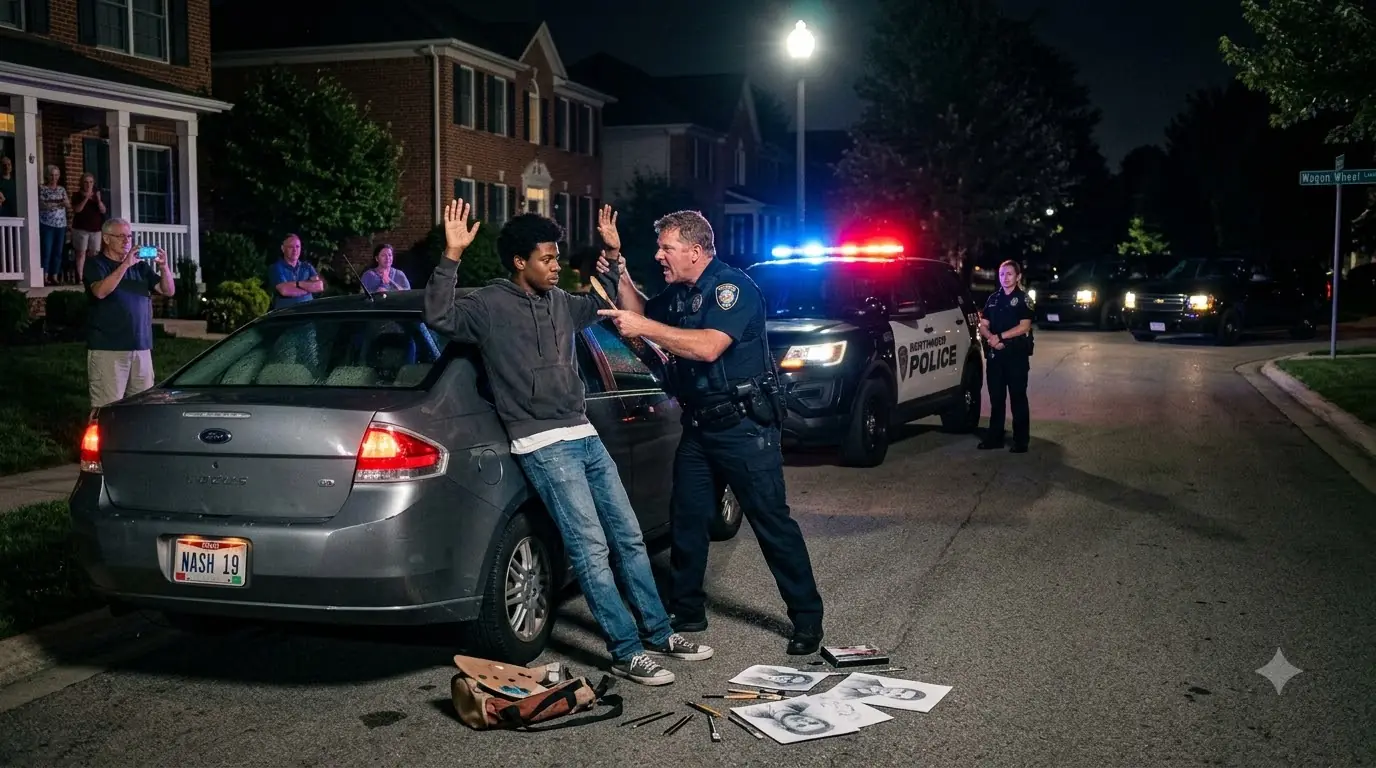
The officers saw a Black American teenager driving an aging sedan and constructed their own narrative of guilt. They did not know that the young man sitting inside their holding cell, the one they had targeted and humiliated, was about to make a single telephone call that would destroy careers, expose a department, and change their entire world.
They locked him away believing they were untouchable.
They were wrong.
The night was cool and quiet, the kind of stillness that settled over the suburbs long after the final commuter train had disappeared. Leo Nash drove his mother’s ten-year-old sedan while the engine hummed a familiar, comforting rhythm.
The passenger seat was covered with art supplies: sticks of willow charcoal, a portfolio of sketches, and a new set of oil paints for which he had saved for months. He was driving home after a late session at a friend’s improvised studio, his mind occupied by color theory, composition, and the texture of the canvas he had stretched earlier.
He was humming along with a song on the radio when the world behind him suddenly exploded into red and blue light.
Leo’s heart hammered against his ribs.
It was the kind of instinctive fear many young Black American men were taught to carry before they were old enough to drive. He checked the speedometer and confirmed that he was traveling exactly at the posted limit.
Leo activated his turn signal, pulled carefully to the curb, and placed both hands on the steering wheel at ten and two, exactly as his father had instructed him hundreds of times.
Two officers stepped from the patrol car, their silhouettes dark against the bright headlights.
The older officer approached the driver’s side. He had a thick neck and carried himself with the swagger of someone who rarely expected to be questioned. The nameplate on his uniform read MILLER.
The younger officer, Carter, remained beside the passenger door. His hand rested near his sidearm while his eyes moved anxiously through the interior of the sedan.
“Evening,” Officer Miller said.
His voice carried a bored condescension as he leaned down and looked inside.
“Do you know why I stopped you?”
“No, Officer, I do not,” Leo replied.
He kept his tone calm and respectful.
“Your left taillight is out,” Miller said.
Leo knew that was false. He and his father had checked every light on the vehicle the previous weekend.
Still, he understood that the roadside was not the place to argue.
“I am sorry to hear that, Officer. I was not aware.”
“License, registration, and proof of insurance.”
Miller directed his flashlight into Leo’s face before sweeping it through the car. The beam lingered over the collection of art supplies.
“Keep your hands where I can see them.”
Leo moved slowly and deliberately.
He opened the glove compartment, retrieved the requested documents, and handed them through the window. Miller took them abruptly, barely glancing at the name before returning his attention to the passenger seat.
“What is all this junk?” Miller asked, pointing his flashlight toward the portfolio.
“They are my art supplies, sir. I am coming from a friend’s house.”
“Art supplies?”
Miller gave a dismissive laugh and exchanged a smirk with Carter.
“Right. What is your real business out here tonight, son?”
The word son was not affectionate. It was intended to put Leo in his place.
“I am a student. I was heading home.”
Frustration began rising beneath Leo’s controlled expression.
“We will see about that.”
Miller handed the documents to Carter.
“Run his name.”
Then he faced Leo again.
“Step out of the vehicle.”
Leo felt his body turn cold.
“Officer, am I being detained? For what?”
“For a broken taillight and because I told you to.”
Miller stepped back.
“Get out slowly.”
Leo complied.
The moment he stood, Miller pushed him roughly against the side of the sedan.
“Spread your feet.”
“You have no reason to do this,” Leo said.
His voice trembled slightly.
“I will be the judge of that.”
Miller searched him with unnecessary force and found nothing except a wallet and a telephone.
While Miller continued the pat-down, Carter began searching through the passenger seat.
“Cade, look at this,” Carter called.
He held up a palette knife, its narrow metal edge reflecting the flashing emergency lights.
“Could be a weapon.”
Miller’s expression brightened with a disturbing sense of victory.
“Well, well. It appears our little artist came prepared for something besides painting.”
“That is a palette knife,” Leo said, his voice rising in disbelief. “It is used to mix paint.”
“You cannot be serious.”
“I am completely serious.”
Miller pulled Leo’s arms behind his back.
“You are carrying a concealed weapon, and you match the description of a suspect connected to recent break-ins in this neighborhood.”
It was a complete fabrication, and both officers knew it.
There was no useful suspect description.
There was only Leo, a Black American teenager traveling through the wrong neighborhood at the wrong hour in front of an officer who had already decided what kind of person he was.
“This is insane,” Leo said.
He looked toward Carter, hoping to find some trace of reason.
“Tell him. You know what that tool is.”
Carter looked away.
His expression revealed nothing.
He remained silent.
The cold click of the handcuffs closing around Leo’s wrists carried a terrible finality. It was the sound of his identity being stripped away and replaced by a profile, an accusation, and a statistic.
Miller pushed him toward the rear of the patrol car.
“You have the right to remain silent,” he began.
The familiar words sounded like a hollow imitation of justice.
Its supposedly broken taillight glowed a steady, unmistakable red in the darkness.
In that moment, Leo was not the governor’s son.
He was not an artist or a student.
He was simply another young Black American man swallowed by the glare of red and blue lights.
The Northwood precinct was a monument to bureaucratic indifference. The air carried the smells of stale coffee, inexpensive disinfectant, and the faint metallic quality of fear.
Officer Cade Miller marched Leo through the main bullpen as though he had captured a dangerous fugitive. His hand remained firmly clamped around Leo’s shoulder.
The officers working the night shift barely looked away from their paperwork. Their faces carried the exhausted cynicism of people who had seen hundreds of detainees pass through those doors and had stopped viewing them as individuals.
“Caught another one,” Miller announced to the desk sergeant.
Sergeant Peterson was a heavyset, gray-haired man nearing retirement.
“Found him prowling around the neighborhood while carrying this.”
Miller dropped the palette knife into a clear evidence bag with a theatrical flourish.
Peterson examined the tool and then looked dismissively at Leo.
“An artist?”
He gave a dry laugh.
“What was he planning to do, paint a masterpiece on the wall of the house he robbed?”
“Something like that,” Miller replied.
He pushed Leo toward the booking desk.
“Let us get him processed.”
The following hour became a sequence of calculated humiliation.
Leo was ordered to remove his shoes and belt. The contents of his pockets, a tube of lip balm, several dollars, and his house key, were recorded and sealed away.
His fingers were pressed into cold ink and then onto a fingerprint card. The dark residue stained the same hands he used to draw and paint.
The camera flashed for his booking photograph.
It captured a suspect rather than a person.
Leo faced forward and then turned for the profile image, his expression caught between disbelief and simmering anger.
Through everything, he tried to maintain his composure.
“You have the wrong person,” Leo told Sergeant Peterson.
His voice remained steady despite the tremor in his hands.
“My name is Leo Nash. My father is—”
Peterson interrupted him with a wave.
“Yes, I have heard it before.”
“My father is an attorney. My uncle is a judge.”
He pointed toward the hallway.
“Save it. You will receive one telephone call after you are inside the cell.”
Leo was led down a short corridor where every footstep echoed against painted concrete walls.
The holding-cell door closed behind him with a deafening metallic crash.
The cell was small, cold, and carried the stale scent of hopelessness. A single steel bench had been bolted to the wall.
Leo sat down.
The cold moved through his jeans while he lowered his head into his hands.
Earlier, during the drive back to the precinct, Officer Ben Carter had sat silently behind the wheel. The tension inside the patrol car felt sharp enough to cut with the palette knife now stored in the evidence bag.
Miller, by contrast, was energized by the arrest.
“See how easy that was?” he said, tapping a rhythm against the dashboard. “Textbook.”
“The kid was argumentative. He had a weapon and matched that bulletin from last week.”
“There was no bulletin, Cade,” Carter said quietly.
He kept his eyes on the road.
“You know that was a painting tool.”
“Details.”
Miller dismissed the concern with a laugh.
“It has an edge, does it not?”
“He is a troublemaker. I knew something was wrong the moment I saw him.”
Miller leaned back.
“My instincts are never wrong.”
“We put a good arrest on the record tonight. The lieutenant will be pleased.”
Carter did not answer.
A knot had formed inside his stomach and was steadily tightening.
He had watched Miller behave this way before. The senior officer would escalate a minor encounter, invent a justification, and pressure his way into an arrest.
Carter had served for only two years, and Miller was both his training officer and a respected fifteen-year veteran. Challenging him meant risking his reputation, being labeled weak, and possibly damaging his own career.
So Carter remained silent, just as he had beside the road.
But Leo’s expression remained fixed inside his memory.
The shock.
The betrayal.
The desperate effort to make one of them acknowledge the obvious truth.
This arrest felt different.
It felt wrong.
Inside the precinct, a guard eventually led Leo from the cell to a grimy telephone mounted on the wall.
Leo dialed his father’s personal number.
His heart pounded with desperate hope.
The telephone rang once.
Twice.
Three times.
Then Robert Nash’s recorded voice answered.
“You have reached Robert Nash. Please leave a message.”
Leo’s throat tightened.
His father was probably inside another late budget meeting with his telephone silenced.
“Dad,” Leo began.
His voice cracked.
“Dad, it is me. I have been arrested.”
“I am at the Northwood precinct. An officer named Miller stopped me.”
“He said my taillight was out, but it was not. He found my palette knife and called it a weapon.”
Leo swallowed hard.
“Dad, I did not do anything.”
“Please call me back.”
“I do not know what to do.”
He replaced the receiver.
Hopelessness moved over him like freezing water.
The guard returned Leo to the cell, and the metal door closed again.
He was alone inside the impersonal machinery of a system that had already decided who he was.
The one person capable of helping him had no idea that he was there.
Governor Robert Nash rubbed his temples beneath the fluorescent lights of the conference room.
The state budget meeting had continued for hours, an exhausting struggle through fiscal projections, agency requests, and political compromises.
At nearly one in the morning, it finally ended.
Robert returned to his private office inside the state capitol and loosened his tie. All he wanted was to go home, pour a small drink, and avoid thinking about deficits until the following morning.
He lowered himself into his leather chair and picked up his telephone.
A long series of missed notifications filled the screen. Most came from his chief of staff and various department heads.
One notification stood apart.
A missed call and voicemail from Leo.
A tired smile touched Robert’s face.
He imagined Leo was calling about his mother’s car or requesting money for another set of art supplies.
Robert pressed play and leaned back.
The sound of his son’s strained, frightened voice pulled him upright.
“Dad, I have been arrested.”
“Northwood precinct.”
“Officer Miller.”
“He said my palette knife was a weapon.”
“I did not do anything.”
The world around Robert Nash went silent.
The budget, the government, and the late hour disappeared.
The governor vanished.
Only the father remained.
His heart tightened with a cold, overwhelming dread.
Robert played the message again, listening to every tremor and desperate pause.
Northwood was a quiet, affluent suburb.
What had happened?
His mind began assembling the likely sequence.
Leo had been driving his mother’s modest sedan through an expensive neighborhood. An officer had profiled him, created a reason for the stop, and escalated the encounter.
It was a story Robert had heard countless times and a reality he had opposed throughout his political career.
He had tried to protect his son from the harsh truth that followed young Black American men through the country.
The world had found Leo anyway.
A wave of fury moved through Robert with enough force to make his hands shake.
He forced it down and transformed it into cold resolve.
Panic was a luxury he could not afford.
Action was required.
Robert did not first call his attorney or security detail.
He contacted the superintendent of the state police, a man he knew well.
“Colonel Jennings, this is Governor Nash. I apologize for the hour.”
“Governor, no apology is necessary. What can I do for you?”
Jennings’s voice became immediately alert.
“I need the private number for Chief Frank Brody of the Northwood Police Department.”
Robert paused.
“Immediately.”
A brief silence followed.
“Is everything all right, sir?”
“No, Colonel. It is not.”
“My son has been arrested and is being held at the Northwood precinct.”
Robert stood.
“I want Chief Brody’s telephone number, and I want a state trooper to meet me there.”
“Unmarked vehicle. No sirens.”
“Right away, Governor.”
Within a minute, Robert received a message containing the number.
He dialed without hesitation.
The call was answered after the second ring.
“Brody.”
“Chief Brody, this is Governor Robert Nash.”
The sleep disappeared instantly from the chief’s voice.
“Governor. Is everything all right?”
“No, Chief.”
Robert’s tone became dangerously quiet.
“I have just received a voicemail from my son, Leo Nash.”
“He tells me that he is currently a guest inside one of your holding cells after being arrested by an Officer Miller.”
Robert tightened his grip around the telephone.
“Perhaps you can explain why my nineteen-year-old son, an art student with no criminal record, was arrested for possessing a palette knife.”
The silence on the other end became profound.
Robert could almost hear Chief Brody’s mind racing through the possibilities and arriving at the terrible answer.
“Governor, I had no idea.”
Brody stammered.
“I am not at the precinct. I have not been briefed on tonight’s arrests.”
“Then I suggest you become informed, Chief.”
Robert’s voice turned to ice.
“I am traveling to your station now.”
“I expect my son to be waiting for me inside your office, unharmed.”
“I also expect a full and complete explanation.”
Robert paused.
“Am I understood?”
“Completely, Governor.”
“I am leaving now. I will handle this personally.”
Robert ended the call.
He stood, took his coat, and left the office.
The political expression was gone.
The calm negotiator who guided legislation through difficult sessions had been replaced by something far more formidable.
A father whose child was in danger.
The Northwood Police Department believed it had arrested an ordinary teenager.
It was about to confront the man who governed the state.
The precinct remained absorbed in routine activity, unaware of the storm gathering outside.
Officer Cade Miller sat at his desk typing the incident report with a satisfied smile.
He embellished the narrative with practiced ease.
A simple traffic stop became a proactive intervention against possible criminal activity. Leo’s confusion became evasiveness, and his insistence on innocence became belligerence.
The palette knife was described as a modified blade concealed inside the vehicle.
The report was fiction designed to justify Miller’s decisions.
It was a fortress of words intended to protect him from scrutiny.
Ben Carter sat at the neighboring desk staring at an empty document.
He had not written a single sentence of his supplementary report.
The discomfort inside him had grown into nausea.
Every false word Miller typed felt like another brick in a wall of deception, and Carter understood that he was being sealed inside it.
“You should finish your report,” Miller said without looking away from the screen.
“The sooner we file everything, the sooner we can forget about this kid.”
“I am thinking,” Carter muttered.
“Do not think too hard.”
Miller continued typing.
“It was a good arrest. End of story.”
At the front desk, Sergeant Peterson was halfway through a crossword puzzle when the telephone rang.
The call came through the chief’s administrative line, which was unusual at that hour.
“Peterson,” he answered.
The dispatcher sounded frantic.
“Sergeant, Chief Brody is on his way to the station. Estimated arrival in five minutes.”
“He is asking for the arrest report involving Leo Nash.”
Peterson frowned.
The name sounded vaguely familiar.
“Nash?”
He thought for a moment.
“The art student Miller brought in an hour ago?”
“What does the chief want with that case?”
“I do not know, but he sounds extremely angry.”
“The chief wants Miller and Carter inside his office the moment he arrives.”
Peterson ended the call and walked toward Miller’s desk.
“Miller, the chief is coming in.”
“He wants to see you and Carter about tonight’s arrest.”
“The Nash kid.”
Miller looked up from his report.
Annoyance flashed across his face.
“What happened? Did the kid’s mother call to complain?”
“It is one in the morning. What is so important?”
“I do not know.”
Peterson turned toward the front desk.
“But the chief did not sound pleased.”
Unease entered Miller’s mind, but he quickly dismissed it.
Chief Brody cared excessively about procedure. He probably wanted to review the paperwork and ensure everything appeared proper.
Then the main precinct telephone rang.
Peterson answered with visible irritation.
After several seconds, his eyes widened.
He pulled the receiver away and stared at it as though it had become dangerous.
“Who was it?” Carter asked.
Peterson swallowed.
His face had gone pale.
“That was Colonel Jennings’s office at the state police.”
Miller stood.
“The state police?”
“What did they want?”
“They asked us to confirm that a young man named Leo Nash is in our custody.”
Peterson’s voice dropped to a whisper.
“They also informed me that Governor Robert Nash is personally traveling to this precinct.”
The name struck the room like a physical blow.
Governor Robert Nash.
Miller stared at Peterson while his mind refused to make the connection.
Nash.
No.
It could not be.
Carter felt the blood leave his face.
The surname had been on the registration, but he had entered it into the database without considering its significance.
Leonora Nash was listed as the registered owner.
Now everything connected with sickening clarity.
Carter looked toward Miller.
The older officer’s confidence had disappeared.
His face showed only terror.
“Cade,” Carter whispered.
“His father.”
Tires stopped abruptly outside the precinct.
A car door closed.
Heavy, determined footsteps crossed the pavement.
Sergeant Peterson looked as though he might collapse.
Miller remained frozen beside the computer, his unfinished report glowing on the screen like a digital monument to the worst decision of his career.
The explosion had already begun.
Chief Frank Brody entered through the main doors.
His face was a mask of fury and panic.
His eyes moved across the room and stopped on the stunned officers.
“Where is he?” Brody shouted.
The force of his voice seemed to shake the windows.
“Where is the governor’s son?”
Chief Brody’s presence filled the precinct with immediate pressure.
He was normally controlled and diplomatic, a politician wearing a police uniform.
Seeing his face flushed and his eyes burning sent a wave of fear through the night shift.
Brody did not wait for anyone to answer.
He hurried past the booking desk toward the holding cells.
“Get him out now,” he ordered over his shoulder.
Sergeant Peterson searched desperately through his keys.
His hands shook enough to make opening the door difficult.
He rushed down the hallway with Brody directly behind him.
Miller and Carter remained in place, paralyzed by the scale of their mistake.
The sound of the holding-cell door unlocking echoed through the bullpen.
Leo had been sitting with his head inside his hands.
He looked up in surprise.
Sergeant Peterson stood before him, accompanied by a man wearing a suit whose expression contained panic, anger, and profound regret.
“Leo Nash?” Chief Brody asked.
His voice softened, though tension remained.
“I am Chief Brody.”
“There has been a terrible mistake.”
“Please come with me.”
Leo slowly stood.
His mind struggled to understand the sudden reversal.
Brody escorted him from the cell and into the main room.
There, Leo saw Miller and Carter standing rigidly beside their desks.
Both officers were pale and sweating.
Miller’s eyes met Leo’s for less than a second.
The arrogance and authority were gone.
Leo saw pure fear.
“Return this young man’s belongings,” Brody ordered.
“Get him water. Give him whatever he needs.”
He turned toward the two officers.
The sharp edge returned to his voice.
Brody walked toward them with slow, deliberate steps.
Each step seemed to land like a hammer.
He stopped directly before Miller.
“My office.”
He looked from Miller to Carter.
“Both of you. Five minutes.”
Brody turned back to Leo.
“Young man, I cannot begin to express how sorry I am.”
“We will determine exactly what happened.”
“Your father is on his way.”
The mention of his father sent another wave of emotion through Leo.
His father was truly coming.
Help was on the way.
Sergeant Peterson returned Leo’s wallet, telephone, keys, shoes, and belt.
Then Leo was brought into Chief Brody’s office.
The room was spacious and filled with plaques, certificates, and departmental commendations. After what Leo had experienced, they looked like artifacts from a different reality.
He sat inside a padded visitor’s chair.
The soft leather contrasted sharply with the cold steel bench of the holding cell.
Several minutes later, Miller and Carter entered.
Their movements were stiff and mechanical.
They stood before the chief’s desk like schoolboys waiting for punishment.
Brody sat behind the desk with his fingers interlocked.
His expression remained grim.
“I have just spoken with the governor,” he began.
His voice sounded deceptively calm.
“He is, to put it mildly, displeased.”
Brody looked directly at Miller.
“The governor tells me his son was arrested for carrying a palette knife.”
“That was your arrest, Officer Miller.”
“Explain it.”
Miller swallowed.
“Chief, with respect, the suspect was uncooperative.”
“He was inside an area with recent break-ins, and he possessed something that could reasonably be considered a weapon.”
“A palette knife?”
Brody interrupted, his voice rising.
“You have served for fifteen years, and you cannot distinguish a dangerous weapon from an artist’s tool?”
“Did you find anything illegal in his possession?”
“Anything at all?”
“No, sir, but—”
“But nothing.”
Brody struck the desk with his palm.
Everyone in the room flinched.
“You arrested a young man with no criminal history for no legitimate reason.”
“You used a false claim about a broken taillight as the basis for the stop.”
Brody leaned forward.
“Do not imagine that I will neglect to examine the dashboard camera.”
“Then you created a charge because you did not like the appearance of the driver.”
“Is that an accurate summary?”
Carter stared toward the floor.
His silence became a confession.
Miller made one final attempt to protect himself.
“Sir, my report documents the probable cause.”
“Your report?”
Brody laughed bitterly.
“Your report is worthless.”
He pointed toward Miller.
“Your career is hanging from a single thread.”
Then he turned toward Carter.
“You stood there and allowed it.”
“You supported this disaster through silence.”
Before either officer could respond, the office door opened.
A state trooper in a sharply pressed uniform stood at the entrance.
He stepped aside.
Governor Robert Nash entered.
The atmosphere inside the room changed immediately.
Robert’s eyes found his son.
He rushed toward Leo and pulled him into a fierce embrace.
It was the protective, relieved hold of a frightened father rather than a public official.
“Are you all right, son?”
“Did they hurt you?”
“I am all right, Dad.”
Leo’s voice thickened with emotion.
“I am shaken, but I am all right.”
Robert held him for several seconds before stepping back.
He straightened his suit jacket.
When he turned toward Chief Brody and the two officers, his expression no longer belonged to a concerned parent.
It belonged to a man who carried the authority of the state and had focused all of it upon them.
The full weight of what they had done finally reached Cade Miller and Ben Carter.
They were not simply facing disciplinary trouble.
Their careers and freedom were in danger.
Silence filled the office, broken only by the faint hum of a computer monitor.
Governor Nash rested one hand protectively on Leo’s shoulder.
His gaze moved across Miller and Carter.
It was not an expression of uncontrolled rage.
It was far more chilling.
It was calm and analytical, as though he were carefully examining the people responsible for threatening his child.
“Chief Brody,” Robert began.
His low, steady voice commanded immediate attention.
“I believe I am owed an explanation.”
He looked toward the desk.
“First, I want to see the report Officer Miller was so carefully fabricating.”
The word fabricating poisoned the air.
Chief Brody passed a freshly printed copy across the desk.
Robert lifted it and read the opening lines.
A muscle moved in his jaw.
He began reading aloud.
“Upon observing a vehicle with a nonfunctioning taillight, I initiated a standard traffic stop. The driver, later identified as Leo Nash, displayed unusual nervousness and provided evasive answers to routine questions.”
Robert lowered the page and looked directly at Miller.
“Officer Miller, the taillight on that vehicle is fully functional.”
“I know this because I personally helped replace the bulb two weeks ago.”
He held up the report.
“I am also familiar with your department’s dashboard-camera policy.”
“I assume the recording from your patrol car will confirm the accuracy of your statement.”
Miller’s already pale face turned gray.
Everyone understood that the video would show both taillights working.
The entire justification for the stop was false.
“I may have been mistaken about the light, Governor,” Miller said.
“But his behavior was suspicious.”
“Suspicious?”
Robert stepped closer.
“My son has been taught since he was fourteen years old how to behave during a police stop.”
“He knows to remain respectful, keep his hands visible, move slowly, and answer clearly.”
Robert’s expression hardened.
“You interpret that as nervousness.”
“I interpret it as the fear carried by a young Black American man who understands that an ordinary traffic stop can become dangerous.”
He paused.
“A fear that appears to have been entirely justified tonight.”
Robert turned toward Carter.
“Officer Carter, you were there.”
“Did you witness the suspicious behavior described inside this report?”
Carter lifted his head.
His eyes widened with panic.
He looked briefly toward Miller and then back at the governor.
His mouth opened, but no words emerged.
The truth remained lodged inside his throat.
Robert did not wait.
He turned to the following page.
“Let us continue.”
He read aloud again.
“A search of the vehicle revealed a concealed modified blade approximately six inches long.”
Robert lowered the paper.
“A palette knife.”
He allowed the words to remain inside the room.
“You arrested my son for being an artist.”
“It could be used as a weapon,” Miller said.
Desperation sharpened his voice.
“A fork could be used as a weapon,” Robert answered.
“A pen. A set of keys.”
“You did not arrest him because he possessed a dangerous object.”
“You arrested him because he was a Black American teenager driving through a neighborhood where you decided he did not belong.”
Robert’s voice remained controlled.
“You looked at him and chose guilt before speaking to him.”
“Then you built a tower of lies to justify a decision born from prejudice.”
Robert dropped the report onto Brody’s desk.
It landed softly.
The sound seemed damning.
“This is not about my son being the governor’s son,” Robert continued.
His voice lowered.
“If he had been anyone else’s child, he would still be inside that cell.”
“He might have been pressured into accepting a plea agreement tomorrow.”
“His education and future might have been permanently damaged because of your instinct.”
Robert looked from Miller to Carter.
“This ends tonight.”
He faced Chief Brody.
“Chief, I want both officers suspended immediately.”
“They will surrender their firearms and badges before I leave.”
“I expect a complete, transparent internal investigation.”
“The attorney general’s office will oversee it to ensure the process is not compromised by departmental bias.”
“Yes, Governor,” Brody replied.
Robert fixed his attention on Miller one final time.
“Let me be completely clear.”
“If the investigation determines that you falsified an official report, I will ensure that the matter is prosecuted to the full extent of the law.”
“Your career in law enforcement is over.”
“The remaining question is whether it ends only with the loss of your pension or with a criminal sentence.”
His words were final.
There was no room for negotiation or appeal.
It was a declaration delivered with surgical precision.
Robert placed his arm around Leo.
“Come on, son.”
“Let us go home.”
As they walked from the office, Leo looked back.
Chief Brody was collecting the badges from two men who appeared completely broken.
For a moment, Leo felt a trace of pity.
It disappeared beneath a deeper sense of relief.
His father’s cold determination had done more than rescue him from the cell.
It had ignited a fire that might expose the failures allowing the arrest to happen.
By the following morning, the Northwood Police Department had become a fortress under siege from within.
Governor Nash kept his word.
At nine o’clock, two senior investigators from the attorney general’s office arrived. The investigation was led by Detective Anne Holloway, a direct and meticulous official known for refusing institutional pressure.
Her team took control of Chief Brody’s conference room and converted it into an investigative command center.
Their mandate was clear.
Find the truth, regardless of where it led.
Detective Holloway began with the evidence.
The first item she examined was the dashboard-camera recording from Miller and Carter’s patrol car.
The video was devastating.
As the patrol car approached Leo’s sedan, both taillights were visibly illuminated, glowing a clear and steady red against the dark street.
The audio captured Miller speaking to Carter moments before activating the emergency lights.
“Look at this kid.”
“He does not belong out here.”
“Let us see what he is doing.”
It was the proof investigators needed.
The stop had been pretextual from the beginning, motivated by Miller’s bias before Leo had spoken a single word.
Holloway interviewed Miller and Carter separately.
Miller arrived accompanied by a police union representative who immediately attempted to control the discussion.
Detective Holloway remained unaffected.
She calmly placed a transcript of the dashboard-camera audio on the table.
“Officer Miller, your report states that a nonfunctioning taillight was the reason for the stop.”
She indicated the transcript.
“This recording, captured moments before you activated the lights, suggests a different motivation.”
“Would you like to explain the discrepancy?”
Miller and his representative stared at the document.
Their faces became pale.
The union representative began talking about context, officer safety, and the pressures of law enforcement.
Holloway interrupted him.
“This is not a discussion about pressure.”
“This is an investigation into possible perjury.”
She looked toward Miller.
“Falsifying an official police report is a felony.”
“Before we continue, understand that this matter involves potential criminal conduct, not only procedural violations.”
Miller’s carefully maintained denial began to collapse.
He contradicted himself repeatedly.
He attempted to describe Leo as hostile and threatening, but every claim failed against the video and audio evidence.
Miller left the interview looking like a man who had seen his future disappear.
Carter’s interview unfolded differently.
He arrived alone and looked as though he had not slept since the arrest.
Guilt was visible across his face.
When Detective Holloway presented the evidence, Carter did not argue.
He broke.
“He does this,” Carter confessed.
His voice shook.
“Cade calls it proactive policing.”
“He sees somebody he believes is out of place, and he searches for a reason.”
“A taillight, an incomplete stop, anything.”
Carter lowered his head.
“He trusts his instincts and then makes the evidence fit.”
During the following two hours, Carter described not only Leo’s arrest but other incidents he had witnessed.
He explained how he had felt powerless to challenge a decorated veteran who also controlled his training and evaluations.
Carter admitted that he recognized the palette knife as an art tool.
He knew the arrest was wrong.
Still, he remained silent because he feared losing his career.
“I knew it was wrong,” Carter said.
Shame thickened his voice.
“When Leo looked at me, I knew.”
“But I did nothing.”
“I am responsible too.”
While the interviews continued, the story reached the media.
Someone inside the investigation or the department contacted a local news station.
By noon, the headline appeared everywhere.
**Governor’s Son Wrongfully Arrested, Officers Suspended**
News vans surrounded the precinct, their satellite equipment rising above the parking lot like accusing fingers.
The damage to the department’s reputation was immediate.
Chief Brody held a press conference and faced questions he could not fully answer.
He appeared exhausted and defeated as he announced the state investigation and promised transparency.
The Nash family endured a separate storm.
Telephone calls arrived from friends, political allies, opponents, journalists, and strangers.
Robert attempted to protect his family while releasing one public statement.
“This incident has exposed the reality many members of our communities face every day.”
“This matter is not important because Leo is my son.”
“It is important because it demonstrates what happens when public authority is abused.”
Robert looked directly into the cameras.
“I will use my office not only to seek justice for Leo, but to help ensure that what happened to him does not happen to another citizen in this state, regardless of that person’s family name.”
Leo became an unwilling public symbol.
His face appeared on television screens and news websites.
Instead of hiding, he turned toward art.
He locked himself inside his room, not to withdraw from the world, but to make sense of it.
Leo began drawing the flashing lights, the steel handcuffs, Miller’s mocking expression, and the isolation of the holding cell.
He transformed fear and anger into images capable of speaking when ordinary language failed.
The investigation would reveal the lies.
Leo’s art would communicate the truth.
Weeks became a month.
Detective Holloway’s team completed a report that was as methodical as it was devastating.
It reconstructed Cade Miller’s career and revealed a pattern of biased stops, escalating encounters, and falsified reports, particularly in cases involving minority drivers.
Ben Carter’s testimony was supported by the dashboard-camera recording and by previous civilian complaints that had been dismissed or quietly buried.
Together, the evidence presented an undeniable pattern of misconduct and abuse.
The attorney general acted quickly.
Officer Cade Miller was terminated from the Northwood Police Department.
His fifteen-year career ended in disgrace.
The consequences continued.
Miller was charged with perjury, falsifying government records, and violating Leo Nash’s civil rights.
The good arrest he had celebrated became the evidence that destroyed him.
Ben Carter faced a different outcome because of his cooperation.
He was also dismissed from the police department.
The attorney general declined to bring criminal charges against him, explaining publicly that Carter’s failure to act represented a severe ethical breach, but his testimony had been essential in exposing Miller’s behavior and securing the case.
Carter left the state.
His dream of a career in law enforcement had ended.
He became a living warning about the cost of complicity.
Chief Frank Brody resigned beneath intense political and public pressure.
Investigators found no evidence that he had known about the details of Leo’s arrest or Miller’s previous misconduct.
Nevertheless, Brody accepted responsibility for a departmental culture in which such behavior had been allowed to continue.
Miller’s trial received national attention.
The dashboard-camera footage was played before the jury.
Ben Carter appeared as a central witness for the prosecution.
Miller attempted to portray himself as an experienced officer making difficult decisions inside a dangerous profession.
Under cross-examination, the narrative collapsed.
The jury convicted him.
Cade Miller was sentenced to three years in federal prison.
The image of the once-confident officer being led away in handcuffs was broadcast across the country.
It became a symbol of accountability.
Governor Robert Nash transformed his anger as a father into political action.
He used the public attention surrounding the case to introduce a comprehensive police reform bill called the Leo Nash Accountability Act.
The legislation required independent review of serious use-of-force incidents, strengthened penalties for knowingly falsifying official reports, and provided statewide funding for de-escalation, civil-rights, and bias-awareness training.
The bill faced intense debate.
Eventually, it passed and became one of the state’s most important law-enforcement reform measures.
Leo, once a private art student, accepted his new public role with quiet dignity.
Six months after the arrest, he opened his first gallery exhibition.
He titled it *Red and Blue*.
The show contained raw charcoal drawings and oil paintings inspired by the night of the arrest.
Its central work was a portrait of a young Black American man’s face, one side illuminated by red light and the other by blue.
Inside the eyes, the viewer could see the reflected bars of a holding cell.
The exhibition became both a critical and commercial success.
Leo pledged part of the proceeds to a legal-defense fund supporting people who had been wrongfully accused.
He had been judged by a man who saw a threat rather than a person.
The officers locked him away believing he was another anonymous statistic.
They had misjudged Leo.
They had also underestimated his father.
The scales of justice, initially tilted by prejudice and authority, had been forced back into balance.
Leo Nash was free not only from the holding cell but gradually from the shadow of that night.
He transformed trauma into a demand for change.
Two years passed.
The seasons changed, and so did the landscape of Leo’s life.
His name, once repeated through frightening headlines, became associated with an artistic movement known for being bold, honest, and deeply narrative.
The success of *Red and Blue* allowed Leo to open his own gallery inside the city’s arts district.
It was a bright, open space that reflected his resilience.
He was no longer the frightened young man inside the rear of a patrol car.
He had taken control of his story.
One autumn afternoon, Leo was arranging a new exhibition when his assistant brought him the day’s mail.
Among gallery announcements and invoices was a plain white envelope with no return address.
The postmark belonged to a town Leo recognized as the location of a federal penitentiary.
His heart reacted before his mind did.
Leo opened the envelope.
The letter came from Cade Miller.
The handwriting was cramped and angry.
It was not an apology.
Miller wrote bitterly about his lost career, damaged reputation, and imprisonment.
He accused Leo of using his father’s authority to pursue revenge.
“You and your father believe you are heroes,” the letter concluded.
“All you did was destroy the life of a good officer over a misunderstanding.”
“I hope you are satisfied.”
Leo read the letter twice.
During the first reading, he felt a flash of the old anger.
During the second, he felt only pity.
Miller had learned nothing.
He remained trapped inside the same cycle of resentment, blame, and prejudice.
His prison was not only built from steel and concrete.
It was the one he had constructed inside his own mind.
He might never escape it.
Leo folded the letter and carried it to the industrial paper shredder inside his office.
He fed the pages into the machine.
Miller’s bitter words became meaningless strips.
Leo would not surrender another moment of his life to that man.
A week later, Leo visited a small coffee shop downtown, hoping to escape the demands of the gallery for an afternoon.
He sat alone sketching until he walked to the counter for another drink.
The man behind the espresso machine was thinner than Leo remembered.
His face showed a weariness that had not existed two years earlier.
He wore a simple apron instead of a police uniform.
Still, Leo recognized him immediately.
Ben Carter.
Their eyes met.
For a moment, everything inside the coffee shop seemed to stop.
Shock and shame moved across Carter’s face.
He froze with one hand above the steam control.
“I will ask somebody else to prepare that for you,” Carter said.
He began turning away.
“It is all right,” Leo answered.
His voice was quiet but firm.
“I can wait.”
When the coffee was ready, Carter carried it to Leo’s table.
His hands trembled slightly.
“Leo, I know you probably do not want to hear from me.”
He remained standing.
“But I need to say this.”
“I am sorry.”
Carter looked directly at him.
“What happened that night was wrong.”
“I was a coward.”
“I allowed my fear of one officer to outweigh what I knew was right.”
“There is not a day when I do not think about it.”
He lowered his eyes.
“I am not asking you to forgive me.”
“I only needed to say it.”
Leo studied his face.
There were no excuses.
Carter did not attempt to reduce his responsibility.
Leo saw genuine remorse.
“What are you doing now?” Leo asked, gesturing toward the café.
“Paying my bills and attempting to understand who I am without a badge to hide behind.”
Carter gave a sad smile.
“I am attending night classes in social work.”
“Maybe I can learn to help people in the way I failed to help you.”
Leo nodded slowly.
He remembered Miller’s letter, filled with anger and blame.
Then he looked at Carter, a man who had accepted responsibility and was attempting to construct something better from the ruins of his old life.
One man had been consumed by the consequences of his actions.
The other was attempting to atone.
“Good luck with your classes, Ben,” Leo said.
It was not forgiveness.
It was not friendship.
It was acknowledgment.
It was closure.
Carter nodded with tears inside his eyes and returned to the counter.
Leo remained at the table while his coffee became cold.
For the first time, he understood that the story had never been only about punishment.
It was also about the possibility of change.
Leo left the coffee shop and returned to his studio feeling lighter than he had in years.
That evening, he stood before a massive new canvas.
The images of his arrest were no longer spread across the floor.
They had been replaced by vibrant studies of community, strength, hope, and complicated human faces.
The red and blue glare had given way to a complete spectrum of color.
Leo selected a brush.
He dipped it into bright yellow paint and made the first mark.
The past would always remain part of his story.
But Leo, and Leo alone, would paint the future.
What began with a lie about a broken taillight ended with the exposure of a corrupt officer and the beginning of a new era of accountability.
Leo Nash’s experience became a reminder that injustice survives most easily in darkness, silence, and unquestioned authority.
Cade Miller believed his badge gave him absolute power.
He eventually learned that power without integrity destroys the person who abuses it.
The case was never important only because Leo was the governor’s son.
It concerned every citizen’s right to dignity, fairness, and equal treatment, regardless of appearance, neighborhood, or family name.
Leo transformed the worst night of his life into art, reform, and a future no officer could take from him.