At 8:17 on a rainy Tuesday morning, Walter Bennett stepped through the glass entrance of Virginia State Public Safety Headquarters in Richmond carrying nothing but a wooden cane and a folded envelope in the pocket of his faded brick-red polo shirt. At seventy-nine, Walter had the thin frame of a man whose strongest years were long behind him, but there was still something disciplined in the way he carried himself despite the damaged left leg that forced him to lean heavily on the cane. His short white hair had thinned almost to the scalp, deep lines crossed his pale face, and his tired blue eyes studied the lobby with the quiet familiarity of someone returning to a place that had changed without him. Twenty-seven years had passed since Walter Bennett had last walked through those doors as an employee.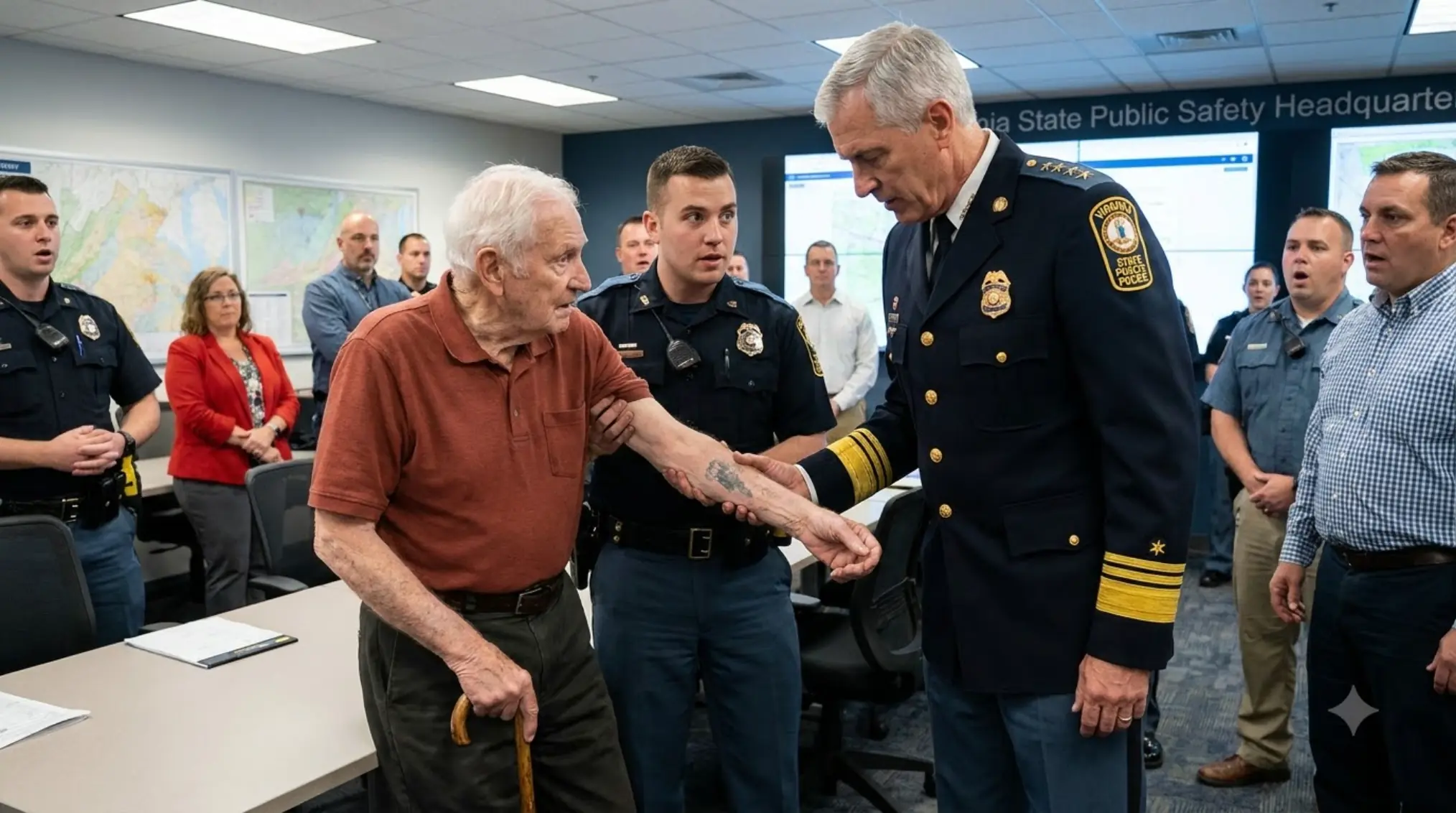
The headquarters he remembered had been smaller, uglier, and louder. There had been gray metal desks, stained ceiling tiles, landline telephones ringing without pause, and filing cabinets so overloaded that clerks sometimes kept case folders stacked on the floor. Now the lobby had polished stone, digital visitor kiosks, security gates, framed photographs of commissioners, and a large wall displaying the department’s modern investigative divisions. Walter stopped in front of that wall and stared at one name longer than the others: Office of Special Investigations and Public Integrity.
He smiled faintly.
That office had once been four desks in a converted records room.
Walter had been given one of those desks.
He had also been told the unit would probably disappear within six months.
It had not.
Walter reached the security desk and presented his driver’s license to a young civilian clerk named Emily Ross. She smiled politely and asked who he was there to see, and Walter removed the folded envelope from his pocket. Written on the front was the name Commissioner Edward Hayes, along with a handwritten appointment time of 8:30 a.m.
Emily checked the visitor list.
Her expression changed.
“Mr. Bennett, I don’t see you here.”
Walter frowned.
“Commissioner Hayes called me himself Friday.”
“Do you have an email confirmation?”
Walter almost laughed.
“I don’t use email much.”
Emily looked uncomfortable.
“I can call upstairs.”
“That would be fine.”
Before she reached the phone, two uniformed officers entered from the security corridor. The first was Officer Grant Keller, thirty-four, broad-shouldered, clean-cut, and visibly irritated at having been pulled away from whatever he had been doing. The second was Officer Lucas Reed, twenty-eight, quieter and several steps behind him.
Keller glanced at Walter.
“What’s the issue?”
Emily explained that Walter claimed to have an appointment but was not on the visitor list.
Walter corrected her gently.
“I do have an appointment. The list appears to be the problem.”
Keller looked him over.
The faded polo.
Old trousers.
Scuffed brown shoes.
Wooden cane.
No briefcase.
No professional identification.
“What business do you have with the commissioner?”
Walter looked at him.
“Private business.”
Keller’s expression hardened.
“This is a restricted government facility.”
“I’m aware.”
“Then answer the question.”
Walter rested both hands on the cane.
“Commissioner Hayes asked me to come.”
“Why?”
“That’s between Commissioner Hayes and me.”
Keller gave a short laugh.
“Sir, this isn’t a social club where you walk in asking to chat with senior leadership.”
Walter’s eyes narrowed slightly.
Emily looked embarrassed.
Officer Reed quietly said, “We could just call upstairs.”
Keller ignored him.
“Do you have official credentials?”
“Not anymore.”
“Employee identification?”
“No.”
“Contractor badge?”
“No.”
“Then you are not entering the building.”
Walter looked toward Emily.
“She was calling the commissioner’s office.”
Keller stepped between Walter and the desk.
“I’m handling it now.”
Walter studied him.
It was not the rejection that bothered him.
Facilities needed security.
People lied about appointments.
Government buildings could not simply accept every visitor’s word.
What bothered Walter was something much more familiar.
Keller had stopped investigating the moment he decided what Walter looked like.
“Officer,” Walter said, “there is a telephone six feet behind you.”
Keller folded his arms.
“And?”
“Use it.”
“You giving me orders now?”
“I’m suggesting you verify the information before deciding I’m lying.”
Reed looked toward Keller again.
“He’s right. Takes thirty seconds.”
Keller’s jaw tightened.
“You want to run security or do you want me to?”
Reed became quiet.
Walter noticed that too.
Keller pointed toward the entrance.
“You need to leave.”
Walter did not move.
“Call upstairs.”
“I said leave.”
“And I said call upstairs.”
That was when Keller stepped closer.
The entire tone changed.
Emily stopped typing.
Reed shifted uncomfortably.
Walter remained still.
Keller lowered his voice.
“Old man, I’m not going to argue with you all morning.”
Walter looked directly into his eyes.
“Then stop arguing and verify.”
Keller reached toward Walter’s cane.
Walter moved it slightly.
“Don’t.”
Keller grabbed it anyway.
He pulled the wooden cane away and placed it against the security desk.
Walter’s balance shifted immediately.
Pain shot through his left leg.
He caught the edge of the counter.
Emily gasped.
“Officer—”
“I’ve got him.”
Walter slowly straightened.
His expression had changed.
“Give me my cane.”
“You can have it outside.”
Walter stared at him.
“That is medical assistance equipment.”
“And you’re using it to stall.”
“No.”
Walter’s voice dropped.
“I’m using it because part of my knee no longer works.”
Keller did not return it.
Reed finally stepped forward.
“Grant, give him the cane.”
Keller turned.
“Back off.”
Reed froze.
Walter watched the younger officer.
Fear.
Not of violence.
Of hierarchy.
That was another old problem Walter recognized.
The wrong person held authority, and everyone nearby had learned that challenging him created trouble.
Keller pointed again toward the exit.
“Move.”
Walter remained beside the counter.
“You took away the thing I use to walk.”
Keller rolled his eyes.
“Fine.”
He grabbed Walter’s forearm.
Walter immediately winced.
The reaction was small.
Keller interpreted it as weakness.
“Come on.”
Walter pulled his arm back.
“Take your hand off me.”
Keller tightened his grip.
“Stop resisting.”
Walter stared at him.
“I am standing still.”
Emily whispered, “I’m calling upstairs.”
Keller snapped his head toward her.
“Don’t.”
That single word changed everything.