Rain streaked across the windshield of the black BMW as Dr. Nia Carter watched Officer Grayson grind her business cards beneath his boot. The gold lettering smeared across the wet pavement, joining the contents of her purse that the officers had dumped beside the curb. Her wallet, keys, makeup, receipts, and court documents were already soaking through. Inside the car, Nia kept both hands on the steering wheel at ten and two, exactly where the officers could see them.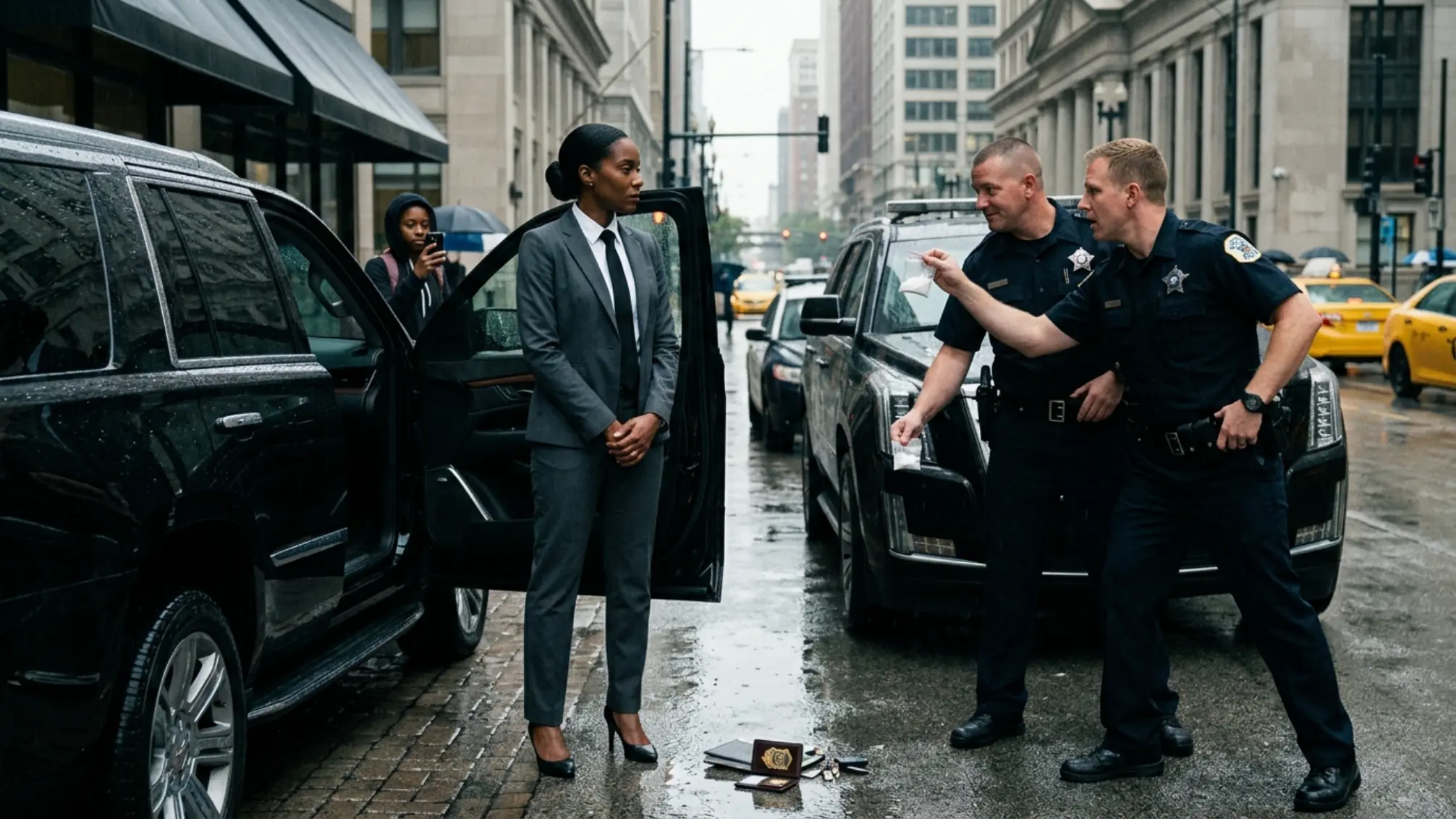
Officer Pike stood near the rear passenger door, filming with his phone while wearing a smug grin. He called it training footage, but his official body camera pointed toward the roadway instead of the vehicle. Officer Grayson leaned through the open driver’s window and examined the leather interior as though the luxury car itself proved wrongdoing. Rush-hour traffic crawled past, and dozens of drivers looked toward the flashing lights before quickly turning away.
“Well, look what we have here,” Grayson said. “Fancy car, expensive suit, downtown address. Let me guess—someone else paid for all of it.”
Nia met his stare without moving her hands. “Why did you stop me?”
“Failure to signal.”
“I did not change lanes.”
Grayson’s smile widened. “Your vehicle also matches a description.”
“What description?”
“A suspicious one.”
The answer was deliberately meaningless. Nia had heard officers use similar language during federal investigations when they needed a reason to justify an action already taken. She had spent fourteen years studying patterns of corruption, fabricated reports, and manipulated evidence. Until that afternoon, she had always observed those patterns from the other side of a federal badge.
Her dashboard clock read 3:47 p.m. In forty-seven minutes, she was expected at the Cook County courthouse to testify during a major trafficking trial. Judge Mercer did not tolerate delays, and the defense attorneys would use any absence to attack the government’s case. Her phone buzzed on the center console, displaying another reminder, but Nia did not reach toward it.
Officer Pike moved around the passenger side, placing his body between the BMW and Grayson’s dash camera. The positioning was subtle enough to look accidental. Nia watched the reflection in the side mirror as Pike opened the passenger door, leaned inside, and lowered one hand near the center console. He remained there for only three seconds.
When Pike stepped backward, he looked at his partner with rehearsed surprise. “Grayson, you should see this.”
The two officers had performed the routine before. Nia could hear it in the timing, see it in the way Grayson reached directly toward one specific location without searching anywhere else. His hand disappeared between the driver’s seat and the console, then returned holding a tiny plastic packet filled with white powder. He raised it into the rain like a magician revealing the final object in a trick.
“Well, well,” Grayson said. “What do we have here?”
Nia felt her pulse against her throat, but her expression did not change. Panic would give them material for the report they were already constructing. Anger would become aggression, confusion would become intoxication, and reaching for her credentials could be described as reaching for a weapon. She understood the danger precisely, which was why she remained still.
Across the street, sixteen-year-old Talia Reed stood beneath the awning of a corner store with her phone raised. She had been walking home from school when the flashing lights caught her attention. At first, she expected to record an ordinary traffic stop for her friends. Then she saw Pike tilt his body camera away and lean into the car before announcing the discovery.
“This is already looking wrong,” Talia whispered to her livestream. “I swear that officer put something inside.”
The viewer count rose from nineteen to forty-seven within seconds. Comments began appearing beneath the video, telling her to remain at a safe distance and keep recording. Talia zoomed in enough to capture the officers without exposing Nia’s face clearly. She did not understand that her decision would soon become one of the most important pieces of evidence in a federal case.
Grayson opened the driver’s door. “Step out of the vehicle.”
Nia remained seated. “I want your supervisor present.”
“Your kind always wants a manager.”
“My kind?”
“People who think money makes them untouchable.”
Grayson pulled a pair of handcuffs from his belt. Pike positioned himself near the open door, creating a narrow space through which Nia would be forced to move. Both officers appeared relaxed because they believed they controlled the scene, the evidence, and the story that would later be written.
“Ma’am, you are under arrest for possession of illegal contraband,” Grayson announced.
Nia looked at the packet in his hand. “That did not come from my vehicle.”
“Of course it didn’t.”
“You reached directly toward it without conducting a search.”
“You’re telling me how to do my job now?”
“I’m describing what happened.”
Pike laughed. “Save it for court.”
In the next lane, pediatrician Dr. Lena Brooks slowed her SUV after noticing the confrontation. She saw Nia’s hands still positioned on the steering wheel and the officers standing unusually close to the vehicle. When Grayson began pulling Nia from the seat, Lena activated her phone camera and mounted it against the dashboard. Years of treating injured families had taught her that documentation often mattered more than memory.
Nia stepped onto the wet street without resisting. Grayson immediately twisted her right arm behind her back, not with enough force to cause visible injury but with enough pressure to provoke a reaction. She gave him none. Pike stood close to her left side, smiling while he recorded on his personal phone.
“You look nervous,” Pike said.
“I’m calculating.”
“Calculating what?”
“How many federal charges you are creating.”
Both officers laughed.
Grayson pushed Nia against the side of the BMW. “Everyone suddenly knows the law once the cuffs come out.”
Nia looked through the rain toward the belongings scattered near the curb. Her leather credential holder lay half submerged beside a puddle, almost hidden beneath several wet court papers. The silver edge of the badge was visible whenever passing headlights reflected across it. Grayson had dumped it from her purse without opening it.
That carelessness gave Nia her first advantage.
“Before you handcuff me,” she said, “I need to ask both of you an important question.”
Pike leaned closer. “Ask away, sweetheart.”
“Are your body cameras currently recording?”
Grayson’s confidence flickered. “They activate automatically.”
“That was not my question.”
“They’re recording.”
Nia looked directly at Pike’s chest. “Yours is pointed at the sky.”
Pike adjusted it quickly. “Equipment moves.”
“And your dash camera?”
“Recording the stop.”
“Officer Pike blocked its view while entering my passenger side.”
Grayson tightened his grip. “You think you’re clever?”
“I think you should call your supervisor.”
“You’re not in charge here.”
Nia glanced toward the badge holder near the curb. “Then pick up the leather case beside my wallet.”
Grayson followed her gaze but did not move. “Why?”
“Because it contains identification you were legally required to inspect before scattering my property across the street.”
Pike stepped toward it. “Probably another fake card.”
He bent down, picked up the soaked holder, and wiped it against his uniform trousers. Grayson kept Nia’s arm pinned while Pike opened the case. The smile disappeared from his face first.
Inside was a gold badge bearing the seal of the United States Drug Enforcement Administration. Beneath it sat a federal identification card with Nia’s photograph, name, clearance level, and title.
Dr. Nia Carter, Supervisory Special Agent.
Pike stared at it as though the words might rearrange themselves if he waited long enough.
Grayson released some pressure from Nia’s arm. “That could be counterfeit.”
Nia turned her head slightly. “Call the Chicago Field Division. Ask for Deputy Special Agent in Charge Michael Reeves.”
Neither officer moved.
“Use the number printed on the identification,” she continued. “Not one you search yourself.”
Pike looked toward Grayson. Their rehearsed confidence had been replaced by silent calculation. If they admitted the badge was real, the stop became catastrophic. If they claimed it was false, they would have to explain that accusation to federal authorities within minutes.
Grayson recovered first. “Federal agents still follow local law.”
“Correct.”
“So your badge does not excuse what we found.”
“You found what your partner placed there.”
Pike stepped toward her. “You better be careful.”
“No, Officer Pike. You should be careful. There are at least three independent cameras recording this scene.”
The officers looked around. They noticed Talia beneath the store awning, Dr. Brooks inside the nearby SUV, and several drivers holding phones through partially lowered windows. Pike’s face hardened.
“Stop recording!” he shouted toward Talia.
She remained beneath the awning. “I’m on public property.”
“Turn it off.”
“No.”
The livestream had surpassed three thousand viewers. Several users were already saving screen recordings in case the original feed disappeared. One viewer recognized the badge and posted the contact information for the DEA Chicago Field Division. Another sent the livestream to a local civil-rights attorney.
Nia watched Grayson’s eyes move between the witnesses and the planted packet. He was trying to construct a new story quickly enough to replace the one collapsing around him. He reached for his radio.
“Dispatch, request supervisor and additional units. Possible impersonation of a federal officer.”
Nia almost smiled. “That transmission is recorded too.”
Grayson glared at her. “You think your title makes you special?”
“No. The Constitution applies whether I carry a badge or not.”
The words struck him harder than a threat. Grayson had expected fear, pleading, or anger. Nia gave him procedure, timestamps, and witnesses. Every attempt to regain control pushed the stop further beyond his reach.
A police SUV arrived eight minutes later. Sergeant Daniel Harlow stepped out wearing a rain jacket over his uniform. He approached with one hand near his duty belt, expecting to find two officers managing a dangerous suspect. Instead, he found a composed Black woman standing beside a luxury car, multiple witnesses recording, and Pike holding an open federal credential case.
“What happened?” Harlow asked.
Grayson answered immediately. “Suspicious vehicle, traffic violation, suspected contraband located during a lawful search. Driver then produced questionable federal credentials.”
Harlow looked toward Nia. “Your account?”
“There was no traffic violation. Officer Pike entered my passenger side after positioning himself outside the dash camera’s angle. Officer Grayson immediately recovered a packet from the location Pike touched. They searched my purse without consent, discarded my federal credentials, and announced an arrest before verifying my identity.”
“She’s lying,” Pike said.
Nia continued calmly. “The stop began at approximately 3:42 p.m. The alleged evidence appeared at 3:49. Officer Pike’s body camera was angled away during the critical period, but the corner store witness has a continuous recording.”
Harlow turned toward Talia.
The teenager raised her phone. “I got everything.”
Pike stepped forward. “She’s interfering with an investigation.”
“She is observing from across the street,” Nia said. “Do not intimidate a witness.”
Harlow’s expression changed. He had supervised Grayson and Pike for nearly three years and had defended them against several complaints. Most involved aggressive searches, missing property, or inconsistent reports from drivers who lacked video evidence. Each time, the officers’ stories matched closely enough to survive review.
Now Harlow wondered whether the matching stories had been coordination rather than consistency.
He took the credential holder from Pike and used his department phone to contact the DEA. The call lasted less than two minutes. When Harlow ended it, his face had become rigid.
“Remove the cuffs,” he ordered.
Grayson stared at him. “Sergeant—”
“Now.”
“She’s under arrest.”
“No, she isn’t.”
Grayson hesitated until Harlow repeated the command. He unlocked the handcuffs and stepped away. Nia rubbed her wrists once, then returned both hands to a visible position.
Harlow addressed her formally. “Agent Carter, your identity has been confirmed.”
“Preserve the packet exactly as it is,” Nia said. “Do not allow either officer to touch it again.”
“This is still a local investigation.”
“That item may contain Officer Pike’s fingerprints, DNA, or trace material from wherever it was stored before being placed in my car. Your department is now on notice of potential evidence fabrication and civil-rights violations.”
Harlow looked at the small packet in Grayson’s hand. “Place it on the hood.”
Grayson did not obey immediately.
“Put it down,” Harlow ordered.
He placed the packet on the BMW’s hood. Rainwater collected beneath it while Harlow retrieved an evidence bag from his vehicle. Nia stopped him before he touched it.
“You need gloves, photographs, and an independent evidence officer,” she said. “The chain of custody is already compromised.”
Harlow called for Internal Affairs.
The courthouse reminder on Nia’s phone sounded again. She had seventeen minutes before the hearing. She requested permission to retrieve the device, and Harlow nodded. Nia called Assistant United States Attorney Rachel Lee, explained the situation briefly, and asked her to inform Judge Mercer.
Rachel became silent when she heard the officers’ names.
“Grayson and Pike?” she asked.
“Yes.”
“Nia, those names appeared in the evidence review we were supposed to discuss after court.”
Nia looked toward the two officers. “What evidence review?”
“Three defendants claimed the same officers discovered identical packets during vehicle searches. We assumed it was defense strategy until laboratory results showed unusual packaging similarities.”
Nia’s gaze settled on the packet lying on her hood. The stop was no longer an isolated attack. Grayson and Pike might have been manufacturing arrests across the city.
“Secure those case files,” Nia said. “Do not contact the department yet.”
“It may already be too late.”
“We have witnesses and video.”
“And you?”
“I’m safe.”
Rachel exhaled slowly. “Judge Mercer is postponing your testimony. Federal investigators are heading to you now.”
Internal Affairs arrived with four officers, followed shortly by two DEA vehicles and an FBI civil-rights investigator. The rainy street transformed into a controlled crime scene. Grayson and Pike were separated, their body cameras confiscated, and their phones placed into evidence bags.
Pike attempted to delete his training video before surrendering the device. A federal agent saw the movement and took the phone from his hand. The attempted deletion became another recorded action.
Talia provided her livestream file directly to investigators. It showed Pike entering the passenger side with one hand closed around a small object. His body blocked the clearest angle, but a reflection in the BMW’s side mirror captured his hand opening near the center console.
Dr. Brooks’s recording provided the second angle. It showed Grayson waiting near the driver’s window while Pike leaned inside. Seconds later, Pike announced the discovery and directed his partner to the exact location.
The officers’ own cameras created additional problems. Pike’s footage pointed upward during the planting but captured a quiet exchange immediately beforehand.
“You got it?” Grayson asked.
“Same place as before,” Pike replied.
They had forgotten that body cameras still recorded audio even when tilted away.
By evening, federal investigators had obtained emergency warrants for the officers’ lockers, vehicles, and homes. Inside Pike’s garage, agents discovered empty plastic packets matching the one recovered from Nia’s BMW. They also found several containers of harmless white powder used to imitate controlled material before laboratory confirmation.
The purpose was simple. A positive field test was not always required before arrest. Officers could claim the material appeared suspicious, seize the vehicle, and pressure the driver into accepting a plea before independent testing exposed the truth.
Grayson’s personal computer contained draft reports for traffic stops that had not yet occurred. Each report used nearly identical language: suspicious vehicle, nervous driver, consent inferred from behavior, evidence discovered near the center console. Names and dates were left blank.
Investigators reopened forty-three arrests connected to the officers. Seventeen defendants remained incarcerated, several after accepting plea agreements to avoid longer sentences. Others had lost jobs, housing, professional licenses, and custody arrangements while waiting for cases built on fabricated evidence to collapse.
Nia spent the night reviewing recordings with federal prosecutors. She thought about how close the officers had come to succeeding. If she had reached suddenly for her badge, they might have claimed she was attacking them. If no witnesses had recorded the stop, the packet and matching reports could have outweighed her denial.
Her federal position accelerated the investigation, but it did not create her innocence. That realization became the center of every decision she made afterward.
The following morning, Grayson and Pike were arrested on federal charges involving civil-rights violations, conspiracy, evidence tampering, obstruction, falsification of records, and witness intimidation. Sergeant Harlow was placed on administrative leave while investigators determined whether he had ignored previous warning signs.
The police department released a short statement describing the officers as individuals whose alleged conduct did not represent departmental values. Nia rejected the language publicly.
“When dozens of complaints receive the same dismissal,” she said, “the problem is not limited to two individuals. A system repeatedly chose their credibility over the people they stopped.”
Talia’s video spread across social media, but Nia asked news organizations not to treat the teenager as entertainment. She had shown courage by recording from a safe location and preserving the original file. The DEA arranged for a digital-security specialist to help protect her identity and family after strangers began contacting her online.
Dr. Brooks also became an important witness. Her recording proved that documentation from multiple angles could reveal details one camera missed. She later helped create a community program teaching people how to record police encounters safely without interfering.
Judge Mercer ordered an independent review of every case involving Grayson and Pike. Seventeen convictions were vacated within three months. Families gathered outside the courthouse as loved ones walked free, some after years behind bars.
One of them was Marcus Bell, a delivery driver arrested during a traffic stop eighteen months earlier. Officers claimed they found a suspicious packet beneath his seat. Marcus had insisted the evidence was planted, but without video or witnesses, prosecutors treated his denial as predictable.
He accepted a plea to avoid a possible ten-year sentence.
When Marcus met Nia outside the courthouse, he struggled to speak. “They believed you because of the badge.”
Nia did not deny it. “They listened faster because of the badge.”
“What about people who don’t have one?”
“That is what changes next.”
She worked with federal monitors, defense attorneys, and community leaders to create new evidence-handling rules. Officers could no longer conduct vehicle searches without continuous body-camera positioning unless an emergency made recording impossible. Any unexplained camera obstruction triggered automatic external review.
Searches involving alleged contraband required immediate photographs before the item was moved. A second officer outside the original unit had to verify the discovery location. Personal phones were prohibited during enforcement actions unless officially authorized.
Most importantly, complaints involving planted evidence could no longer be reviewed solely by the same department that employed the accused officers.
Grayson and Pike eventually faced trial in federal court. Their attorneys argued that the BMW footage was unclear and that Nia used her position to turn an ordinary arrest into a national scandal. Prosecutors answered with audio recordings, mirrored reflections, packaging records, draft reports, witness videos, and dozens of nearly identical cases.
Pike accepted a plea agreement and testified against Grayson. He admitted they had targeted drivers they believed would be easy to discredit—young Black men, immigrants, women traveling alone, and people driving expensive vehicles in neighborhoods officers considered suspicious.
“Why Agent Carter?” the prosecutor asked.
Pike looked toward Nia. “We thought nobody would believe her over us.”
That sentence reached far beyond the courtroom.
Grayson was convicted on all major counts. Before sentencing, several people whose lives had been damaged by the fabricated arrests addressed the judge. They did not speak only about days spent in jail. They described children who stopped trusting uniforms, businesses that failed, marriages damaged by accusations, and years lost proving something that had never happened.
Nia spoke last.
“They believed authority could manufacture truth,” she said. “They were wrong. Authority can delay truth, frighten witnesses, and damage lives, but it cannot permanently control every camera, every document, and every person willing to speak.”
The judge sentenced both officers to federal prison.
A year after the rainy traffic stop, Nia returned to the same street. The corner store awning remained, though a new security camera had been installed above it. Traffic passed without slowing, and no police lights reflected across the pavement.
Talia, now seventeen, joined her with a phone in one hand and a college acceptance letter in the other. She planned to study journalism and criminal justice.
“I almost kept walking that day,” Talia admitted.
“Why didn’t you?”
“Because something looked wrong.”
Nia smiled. “You trusted what you saw.”
“Would they have gotten away with it without the video?”
Nia looked toward the place where her belongings had been scattered across the rain-soaked street. “They had gotten away with it before.”
Talia lowered her phone. “But not that time.”
“No,” Nia said. “Not that time.”
The officers believed they had selected the perfect target: a Black woman alone in a luxury car, trapped between their uniforms and a packet they controlled. They expected fear to make her careless and prejudice to make their story believable.
They never expected the badge in the puddle.
But the badge was not what destroyed their scheme. It merely forced the system to look quickly at evidence that should have mattered for everyone.
What truly ended the deception was a teenage witness who kept recording, a doctor who recognized something wrong, mirrored glass that captured a hidden hand, and a woman who remained calm long enough to make every lie collapse under its own weight.