Jeremy Cole arrived at the Ninth Precinct at 7:18 on a rainy Monday morning carrying a black notebook, a folded newspaper, and absolutely nothing that announced who he was.
That was deliberate.
He wore tan khaki trousers, dark casual shoes, a charcoal short-sleeve polo, and a plain black wristwatch. His close-cropped hair showed more gray than it had five years earlier, though from a distance most people still guessed him to be younger than fifty-four. His shoulders were broad from a lifetime of early-morning exercise, and there was something naturally imposing about the way he moved, but he had learned long ago that authority did not always need to advertise itself.
Sometimes authority learned more by being ignored.
The Ninth Precinct occupied a tired four-story municipal building on the east side of Harrove City, where aging brick apartment blocks gave way to newer condominiums and narrow commercial streets. The precinct had once been known as one of the department’s strongest houses. Twenty years earlier, officers requested transfers there because the leadership was respected, detectives were experienced, and patrol teams operated with a reputation for discipline.
That reputation had changed.
Not dramatically.
Not through one scandal that reached television.
Those were easy to identify.
The real trouble arrived quietly.
Complaints about officers speaking contemptuously to civilians increased.
Body-camera compliance dipped.
Internal surveys showed young officers felt pressure not to challenge senior patrol members.
Two civilian employees transferred after reporting harassment.
A dispatcher resigned.
An officer named Melissa Grant requested reassignment after only eight months and wrote three sentences in her exit report that reached Deputy Commissioner Helen Ward:
There are rules written in policy manuals, and there are rules you learn inside the Ninth. The second set matters more.
Nobody could prove exactly what she meant.
That was what interested Jeremy.
He had spent thirty-one years in law enforcement.
Patrol.
Narcotics.
Investigations.
Internal compliance.
Precinct command.
For the last six years, he had supervised professional standards and field operations across two districts.
He did not enjoy disciplinary work as much as people assumed.
To Jeremy, catching a bad officer after damage occurred was not evidence of a healthy department.
Preventing a culture from producing that officer was better.
Three months earlier, Commissioner Elaine Porter called Jeremy into her office.
“Cole, I need you to take the Ninth.”
He looked at her.
“Why me?”
“Because you asked that instead of saying yes.”
Jeremy smiled faintly.
Elaine pushed a folder across the desk.
Complaints.
Statistics.
Transfer requests.
Training evaluations.
Officer surveys.
A command chart.
The commanding captain, Richard Bowman, had accepted early retirement after a heart attack.
His executive officer was on extended medical leave.
Most day-to-day authority had fallen to Sergeant Frank Nolan and a small group of senior personnel.
Nolan technically did not command the precinct.
In practice, everyone knew which opinions mattered.
Jeremy read.
“What do you think the problem is?”
Elaine answered honestly.
“I don’t know.”
“That’s why you want me.”
“Yes.”
Jeremy turned a page.
“Does Nolan know I’m coming?”
“He knows a new captain starts Monday.”
“Name?”
“Personnel bulletin goes out at eight-thirty.”
Jeremy looked up.
Elaine recognized the expression.
“No.”
“I didn’t say anything.”
“You’re going to do something irritating.”
“I prefer informative.”
“Jeremy.”
He smiled.
“I’m starting Monday at nine.”
“You’re starting at eight.”
“No.”
“I’ll be in the building before eight.”
“But officially?”
“Nine.”
Elaine sighed.
“What are you planning?”
“Breakfast.”
That was all he told her.
At 7:18 Monday, Jeremy entered through the public lobby.
The desk officer barely looked up.
“Help you?”
“Morning.”
“You reporting something?”
“No.”
“Meeting?”
“Yes.”
“Who with?”
“Command.”
The officer glanced at Jeremy’s clothes.
“Upstairs conference room doesn’t open till eight-thirty.”
“That’s fine.”
The desk officer pointed vaguely toward a metal detector.
“Sign in.”
Jeremy did.
He wrote:
J. Cole
No rank.
No title.
He received a visitor badge.
That amused him.
He clipped it to his belt.
The officer never looked at the name.
Jeremy walked deeper into the building.
The cafeteria was on the second floor.
He had chosen it because cafeteria behavior told stories command meetings never did.
People relaxed around food.
Hierarchy became informal.
Jokes revealed boundaries.
Silence revealed more.
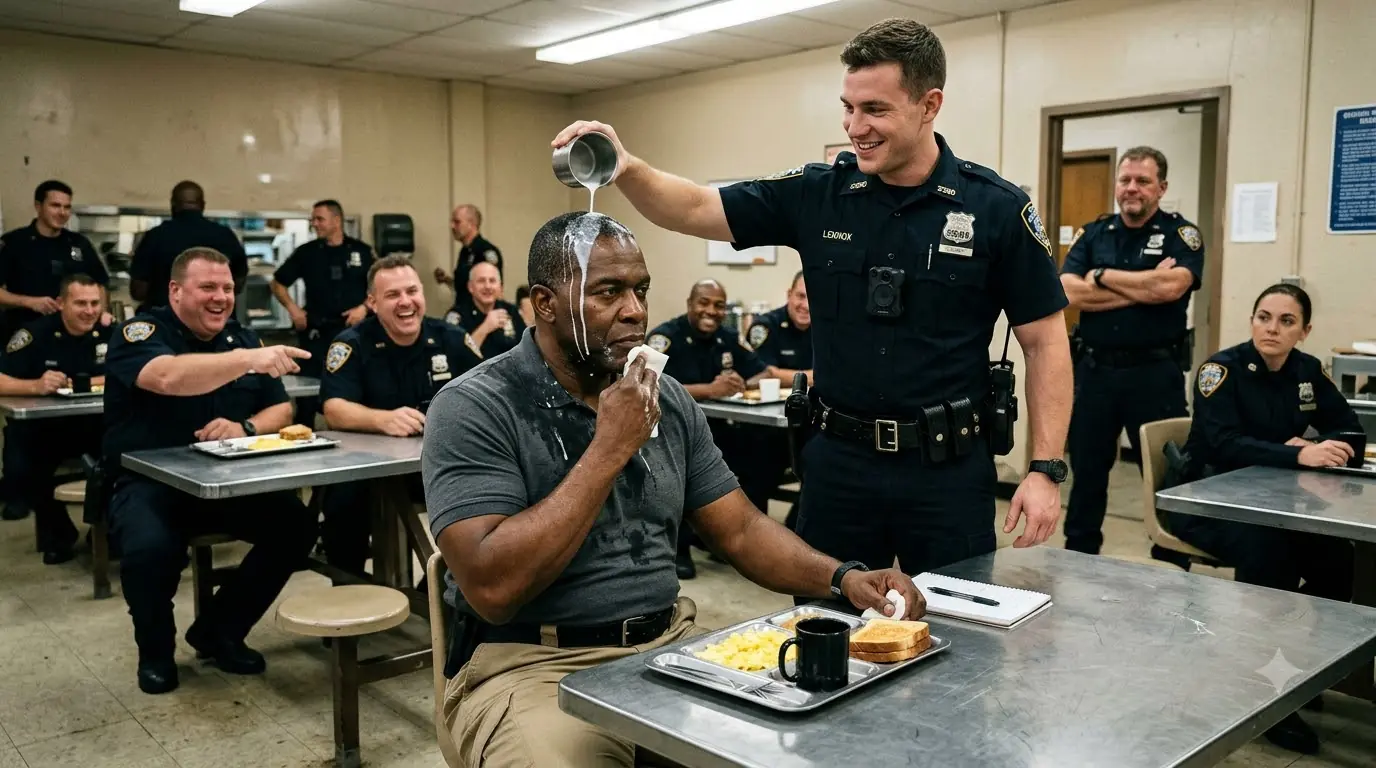
He entered at 7:24.
About twenty officers were already there.
Metal tables.
Institutional lights.
Steam trays.
Coffee machines.
The room smelled like eggs, bacon, industrial cleaner, and over-brewed coffee.
Jeremy stood near the entrance for several seconds.
Nobody noticed.
At one table, four officers laughed loudly over something on a phone.
At another, two detectives quietly ate breakfast.
A civilian records clerk sat near the wall.
One female officer occupied a table alone near the far corner.
She had dark hair pulled into a tight bun, mid-thirties, alert eyes.
Her nameplate read:
KELLER.
Officer Dawn Keller.
Jeremy recognized the name.
No disciplinary history.
Two commendations.
One recent transfer request submitted, then withdrawn.
Interesting.
Jeremy got a tray.
Eggs.
Toast.
Potatoes.
Black coffee.
He paid cash.
The cafeteria worker, Mrs. Alvarez, looked at the visitor badge.
“Meeting?”
“Yes.”
“Good luck.”
Jeremy smiled.
“With breakfast?”
“With this building.”
Then she moved to the next customer.
That sentence went directly into his notebook mentally.
He chose a table near the center.
Not hiding.
Not announcing himself.
He opened the newspaper.
For seven minutes, nothing happened.
Then Officer Bryce Lennox entered.
Jeremy knew him immediately because he had reviewed his personnel file the previous night.
Twenty-nine.
Six years on the job.
Excellent physical fitness scores.
Strong arrest numbers.
Two commendations.
Four civilian complaints.
Three closed as unsubstantiated.
One counseling memorandum for discourteous conduct.
A pattern too small to prove anything.
Maybe.
Bryce entered like somebody expecting the room to notice.
Three officers greeted him.
“Lennox!”
“Golden boy!”
“Late again.”
Bryce laughed.
He was white, muscular, short brown hair, confident face.
He threw one hand onto Officer Gary Ellison’s shoulder and took a cup of coffee from somebody without asking.
Gary protested.
Bryce drank anyway.
Laughter.
Jeremy watched from behind the newspaper.
Then Sergeant Frank Nolan entered.
Different reaction.
The room changed subtly.
Not silence.
Alignment.
Officers straightened.
Some jokes stopped.
Nolan was forty-seven, thick-necked, stocky, short graying hair, weathered face.
He had twenty-two years in the department.
His record looked clean if read quickly.
Three commendations.
No sustained excessive-force complaints.
Strong productivity.
But Jeremy did not read quickly.
He had noticed how often complainants withdrew allegations after Nolan became involved in “informal resolution.”
He noticed junior officers assigned to Nolan either became high-performing members of his circle or transferred within eighteen months.
He noticed Sergeant Nolan’s name appearing in six body-camera supervisory reviews where activation failures were treated as technical errors instead of policy violations.
Nothing criminal.
Nothing dramatic.
Culture lived between lines.
Nolan took coffee.
Bryce greeted him.
“Morning, boss.”
Nolan did not correct the title.
That mattered.
Jeremy folded the newspaper.
A chair scraped behind him.
Bryce and Gary sat at the adjacent table.
Conversation drifted.
Basketball.
Weekend.
An arrest from Saturday.
One officer imitated a confused homeless man they had encountered.
Several laughed.
Dawn Keller did not.
Jeremy noticed.
Then Bryce saw Jeremy.
“Who’s that?”
Gary glanced.
“Don’t know.”
“Detective?”
“No.”
Jeremy kept eating.
Bryce stared longer.
“Security?”
Gary laughed.
“Maybe.”
Nolan looked briefly from the doorway.
No interest.
Bryce called across the room.
“Hey, buddy.”
Jeremy looked up.
Bryce pointed at his visitor badge.
“You lost?”
Jeremy swallowed his food before answering.
“No.”
“Public waiting area’s downstairs.”
“I’m aware.”
“This is employee cafeteria.”
Mrs. Alvarez called from the serving counter:
“Visitors can eat here.”
Bryce looked back.
“Didn’t ask you, Maria.”
The cafeteria worker’s face changed.
She said nothing.
Jeremy noticed that too.
Bryce looked at Jeremy.
“You got business in the precinct?”
“Yes.”
“What kind?”
Jeremy took another sip of coffee.
“Meeting.”
Bryce smiled.
“With?”
“Command.”
Gary laughed.