At 6:42 on a Tuesday morning, Nia Caldwell stepped through the front door of her Richmond home carrying a brown leather briefcase and expecting nothing more difficult than traffic.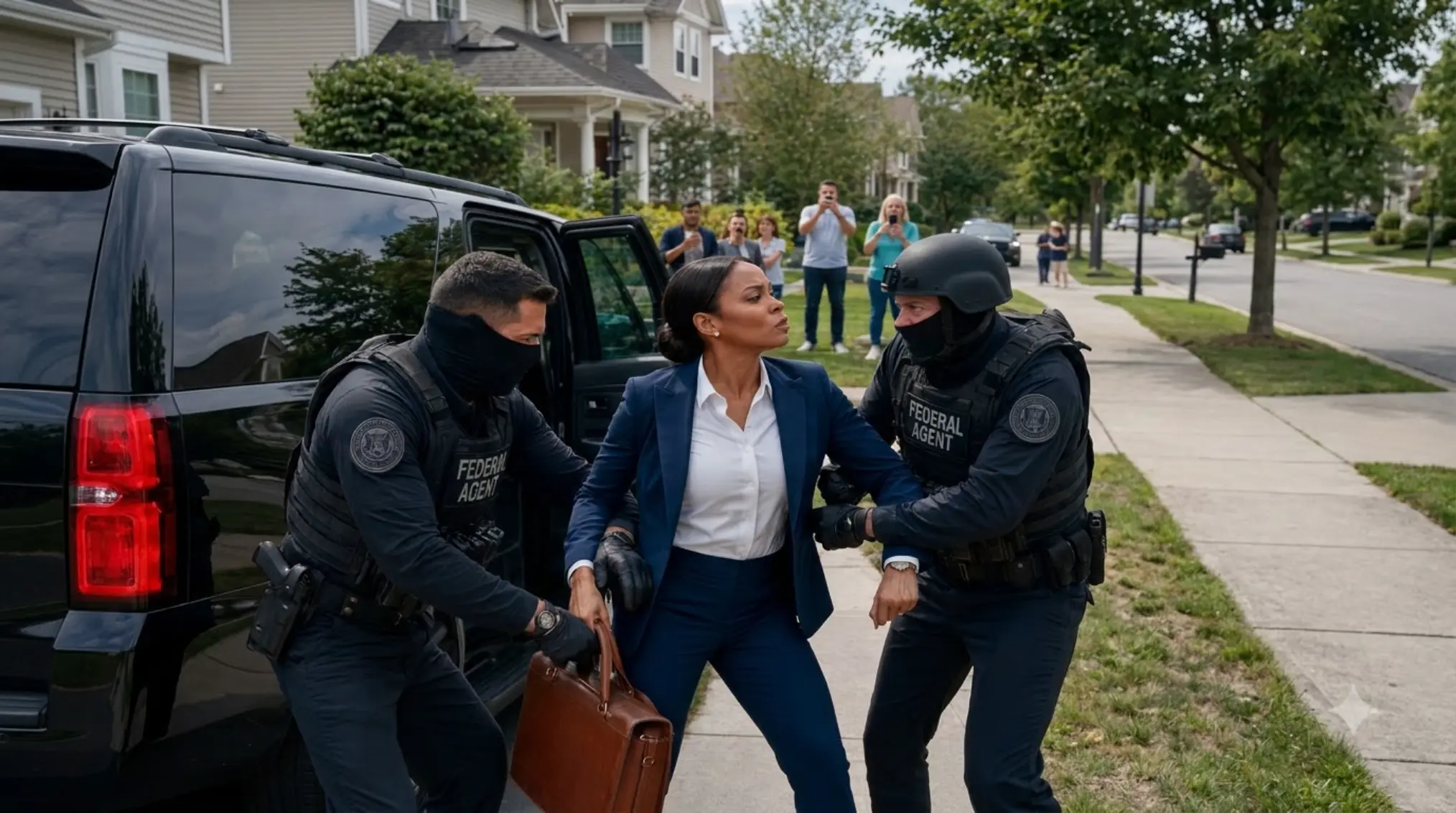
The first black SUV appeared before she reached the sidewalk.
It came fast around the corner, stopped hard beside the curb, and opened three doors almost at once.
Nia stopped walking.
Two men in black tactical clothing moved toward her while another remained near the vehicle.
Their protective vests carried large white letters.
FEDERAL AGENT.
Nia did not run.
She did not reach into her briefcase.
She simply looked from one agent to the other and said, “Good morning. What agency?”
The taller man approached first.
“Ma’am, set the briefcase down.”
Nia’s expression did not change.
“What agency?”
“Set it down.”
Behind her, the front door remained open.
The interior security camera above the entryway had already shifted toward the sidewalk.
Nia knew that because she had installed the system herself after receiving threats during her first year in public office.
Every exterior camera uploaded simultaneously to a remote encrypted account maintained by a private security company.
Local storage could be removed.
Cloud storage could not.
The taller agent pointed toward the ground.
“Briefcase. Now.”
Nia looked at the insignia on his vest.
Not enough.
She could see no clearly displayed agency name.
Only the federal-agent designation.
“Show me credentials.”
The second agent stepped closer.
“You’ll see everything downtown.”
Nia looked toward him.
“That isn’t an answer.”
“Ma’am.”
His voice hardened.
“Do not make this difficult.”
Nia almost smiled.
That sentence had ended badly for many people who thought authority relieved them of explanation.
She had spent sixteen years as a lawyer before entering public service.
Commercial litigation first.
Then state regulatory work.
Then six years advising a bipartisan legislative committee on administrative oversight.
Nia knew exactly how dangerous confidence became when paperwork had not caught up with it.
“What is the legal basis for entering my property?”
The taller agent reached toward her briefcase.
Nia pulled it behind her hip.
“Don’t.”
His expression sharpened.
“Hand it over.”
“Show me the signed warrant.”
“We have authorization.”
“From a judge?”
Silence.
Nia’s eyes narrowed.
“Show me the warrant.”
The second agent moved toward her right arm.
His gloved hand closed lightly around her wrist.
Nia pulled free immediately.
“Why are you touching me when you still haven’t shown a damn warrant?”
Several houses away, a front door opened.
A neighbor stepped onto a porch.
The lead agent glanced toward the movement.
Then back at Nia.
“We have federal authorization. Hand over the briefcase and stop resisting.”
Nia pressed the leather case against her side.
“Then show me the signed order, or get off my property.”
The agent’s jaw tightened.
Nia could see something happening behind his eyes.
Not uncertainty exactly.
Calculation.
He had expected compliance.
Perhaps fear.
He had found questions.
That changed the rhythm.
A second black SUV turned onto the street.
Nia watched it approach.
The lead agent did too.
His voice lowered.
“Who did you call?”
Nia looked directly at him.
“Nobody.”
That was true.
She had not called anyone.
The vehicle stopping behind the first SUV belonged to the private protective-security firm contracted by several state officials who had received credible threats over the previous two years.
Its arrival was automatic.
Nia’s home system detected unidentified armed persons crossing the geofenced front approach and triggered an emergency verification protocol.
No sirens.
No confrontation.
Just documentation.
The security supervisor stepped out wearing a navy suit.
He did not approach immediately.
He began recording from the sidewalk.
“Senator Caldwell?”
The agents turned.
Nia answered.
“I’m fine.”
The supervisor looked toward the tactical team.
“Have you presented legal process?”
The lead agent said, “This does not concern private security.”
The supervisor nodded.
“Understood.”
Then he continued recording.
That seemed to irritate the agent more than an argument would have.
Nia looked toward the SUV.
“Are you planning to enter my house?”
The lead agent answered:
“If necessary.”
“Necessary for what?”
“I’m not discussing an active investigation on the street.”
“Then you’re not entering my house.”
He took a step toward her.
Nia remained still.
“Senator, move away from the door.”
There it was.
He knew who she was.
That removed one possibility.
This was not mistaken identity at the individual level.
Whatever error existed sat somewhere deeper.
Nia asked, “Do you have an arrest warrant?”
“No.”
“Search warrant?”
“We have authority to secure materials.”
“That is not what I asked.”
“Ma’am—”
“Search warrant?”
The agent looked toward the second officer.
Then said, “Not one I’m required to display to you at this moment.”
Nia felt the entire situation change.
She knew enough to know officers executing certain lawful orders did not always need to debate legal details at a doorway.
She also knew people operating lawfully generally knew exactly what authority they possessed.
Vague phrases were warning signs.
Federal authorization.
Secure materials.
Active investigation.
None identified a court.
None identified a document.
None identified a statute.
Nia stepped backward until she was inside the boundary of her porch.
“You are not entering.”
The second agent said, “We’re not asking permission.”
“Then you need a warrant.”
“We have orders.”
“Orders are not a warrant.”
The lead agent’s expression hardened.
“Last warning.”
Nia looked toward the camera above her door.
Then back at him.
“No.”
One word.
Calm.
The agent lifted his radio.
“Team Three, move.”
Two additional agents stepped from the SUV.
The private security supervisor immediately said:
“Everything is being remotely archived.”
The lead agent turned.
“Stay out of this.”
“I am.”
He held up his phone.
“I’m standing on a public sidewalk.”
Nia looked toward the agents.
“If you cross that threshold without judicial authority, the recording is going to be the least of your problems.”
The lead agent responded:
“You think your office protects you?”
“No.”
Nia’s voice became colder.
“The Constitution protects the house.”
That sentence stopped nobody.
But it changed several faces.
The lead agent reached toward his radio again.
Then something unexpected happened.
His phone rang.
He ignored it.
It rang again.
The second agent glanced toward him.
“Sir.”
“I know.”
The phone rang a third time.
The lead agent answered.
“Danvers.”
He listened.
His posture changed.
Nia watched.
“What?”
Silence.
“When?”
Another pause.
“No, we’re on scene now.”
His eyes moved toward Nia.
“What do you mean withdrawn?”
The other agents became still.
Nia said nothing.
Danvers turned away.
“Who withdrew it?”
His expression changed again.
Not anger.
Confusion.
He listened for nearly twenty seconds.
Then:
“Send it to me.”
The call ended.
Nobody moved.
Danvers stared at his phone.
Nia waited.
Finally she asked:
“Problem?”
He looked up.
“We need to verify something.”
Nia nodded.
“That would have been an excellent first step.”
He ignored the remark.
Agents moved back toward the vehicles.
Not leaving.
Repositioning.
Nia stayed on the porch.
Her neighbor across the street now openly recorded with a phone.
Two more residents had appeared.
Nobody spoke.
Several minutes passed.
Danvers received an email.
He opened it.
Read.
Then read again.
Nia watched his eyes move more slowly the second time.
“What does it say?”
He did not answer.
Another agent approached.
Danvers showed him the screen.
The man’s face tightened.