A cold March wind swept across the Sulfur Creek corridor as sixteen-year-old Eli Hargrove stood beside the weathered fence marking the edge of his family farm. Mud covered his faded blue overalls, his hands were dark with wet soil, and an old green ATV idled behind him beside a plastic crate filled with notebooks and water-testing equipment. Across the fence, orange survey stakes marched directly through the lower hollow, where construction workers prepared land recently purchased by Crestfield Energy Group. Drones hovered over the field while men in reflective vests followed maps displayed on expensive tablets.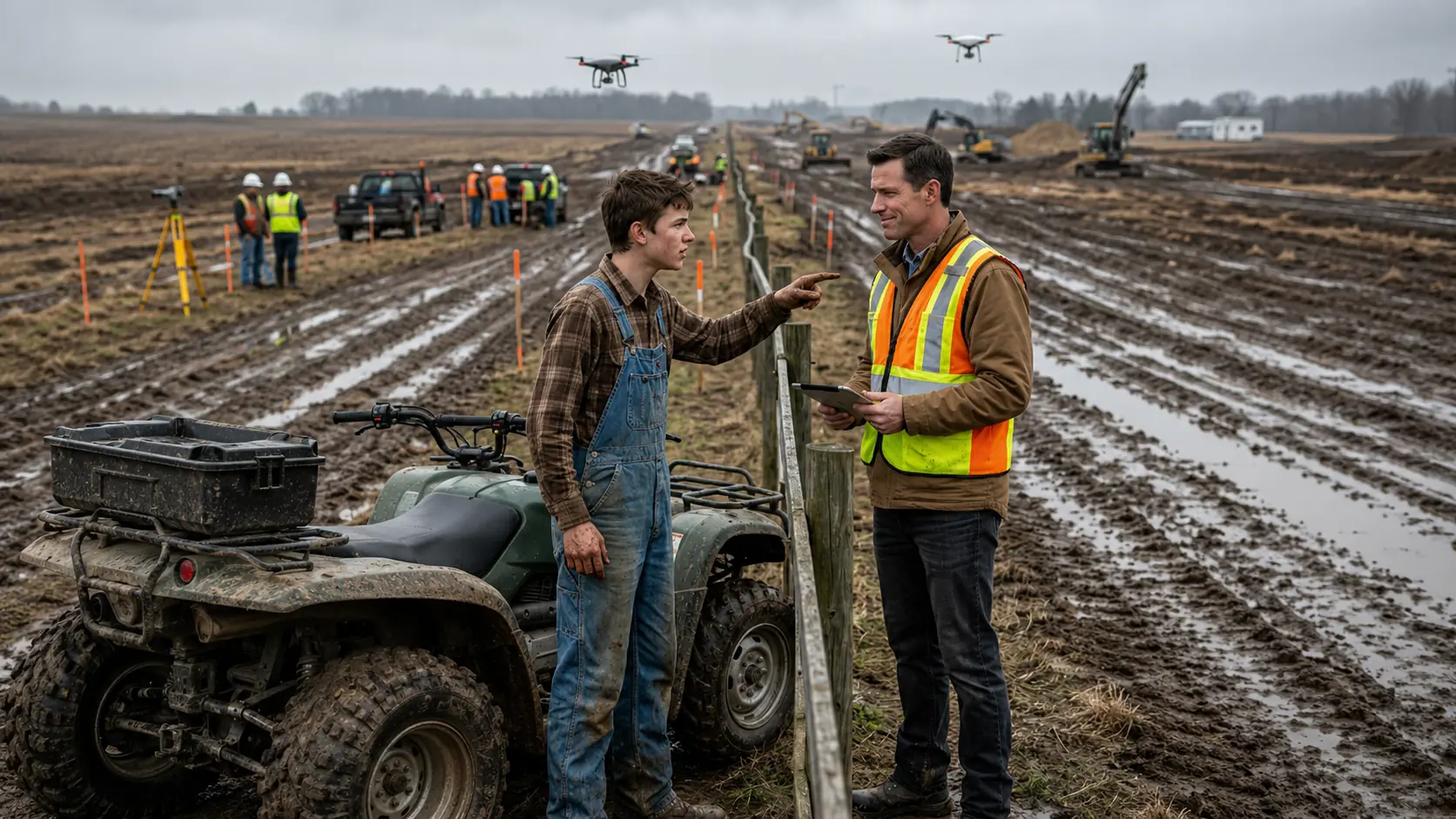
Whitfield, the project’s forty-six-year-old lead engineer, stopped on the company side of the fence and raised his tablet. He had supervised drilling projects in three countries, managed crews larger than the entire population of the nearby town, and trusted the two-hundred-fourteen-page geological report loaded onto the screen in his hand. To him, Eli looked like a muddy farm boy interfering with a professionally planned development. The dismissive smile on Whitfield’s face made Eli’s jaw tighten.
“Our survey corridor came back clean,” Whitfield said. “Move away from the fence.”
Eli pointed at the stakes. “Those stakes are going through the lower run.”
“We don’t stop operations over a ditch reading.”
Eli clenched one muddy fist. “Then remember this when your access road sinks. The weakest ground is right beneath it.”
Whitfield’s smile disappeared for half a second. He glanced toward the hollow, where the soil appeared no different from the thousands of surrounding acres. The ground was brown, flat, and almost featureless beneath the cloudy sky. Nothing visible supported the teenager’s warning except a narrow drainage ditch and a dark patch of grass along the old fence.
“Where did you study hydrology?” Whitfield asked.
“Right here.”
“That is not an answer.”
“It’s the only answer that matters if you’re building on this ground.”
Whitfield turned away, already speaking into his radio. Eli remained beside the fence while the survey crew drove another orange stake into the hollow. He knew the men considered him stubborn, emotional, and far too young to understand a project of this size. What they did not understand was that Eli had been studying that field for most of his life.
The Hargrove farm had belonged to his family for three generations. Eli’s father had died two winters earlier when a tractor rolled on a frozen slope, leaving behind one hundred eighty acres, aging equipment, unpaid loans, and a son forced to become an adult before he had finished high school. The estate still moved slowly through court, but everyone in the county understood that the farm was Eli’s responsibility. He woke before sunrise, fed the cattle, repaired machinery, attended classes, and returned home before dark to finish whatever the morning had left undone.
His seventy-eight-year-old grandfather drove from town twice each week to help, though his knees no longer tolerated long hours in the field. The old man had taught Eli to examine soil not as dirt but as a living record. A change in color revealed minerals moving through water. Grass growing unevenly showed pressure below the roots. Birds nesting lower than usual could warn of a rising water table long before a mechanical gauge detected it.
“The ground always speaks first,” his grandfather often said. “Trouble comes when men believe their machines speak louder.”
Eli kept a spiral notebook behind the seat of his farm truck. Inside were hand-drawn maps of drainage paths, dated water-table readings, sketches of soil layers, and records of which livestock refused to drink after heavy storms. He had tracked the height of barn-swallow nests since he was twelve, noticing that the birds built lower whenever subsurface water began rising. No teacher had assigned the work, and no company had paid for it. He recorded everything because the survival of the farm depended on noticing changes before they became disasters.
The lower hollow had remained wet since September despite months of weak rainfall. An old creek once crossed that section before shifting above ground around 1962, but the buried channel had never completely disappeared. Water continued moving through layers of gravel and silt beneath a thick clay lens. Most years, it traveled quietly toward the river without disturbing the surface.
That autumn, every swallow nest along the southern fence appeared less than four feet above the ground. The creek behind the farm ran slower, and a faint mineral film developed along several stones. Across the property line, grass died in a perfect thirty-foot circle even while the surrounding ground remained damp. When Eli stepped near it, the earth felt hollow beneath his boots.
He marked the location in his notebook. He did not claim to understand every geological process involved, but he knew the signs were connected. The buried channel was carrying more pressure than usual, and something beneath the hollow had begun changing before Crestfield Energy purchased the land.
The company bought eight thousand acres bordering the Hargrove farm and three neighboring properties. Its plan included three extraction wells, a pipeline corridor, an access road, and a massive retention pond for produced water from the drilling operation. The pond would store highly mineralized wastewater above an engineered liner designed to prevent leakage into surrounding soil.
Crestfield’s geological report described the hollow as stable clay-rich ground with ordinary seasonal moisture retention. Satellite records, soil-core samples, and seismic scans showed no major aquifer beneath the proposed pond. The document was professional, detailed, and wrong in one crucial place.
The buried creek did not resemble an underground lake. It followed a narrow gravel channel trapped beneath dense clay. Seismic imaging interpreted the area as a solid layer because the channel remained compressed and inactive under normal conditions. Eli recognized it only because he had observed the land across many seasons.
Construction began the following Monday. Bulldozers stripped the grass, earthmovers reshaped the hollow, and rollers compacted the soil to create a stable base for the retention pond. The weight narrowed part of the underground channel without fully blocking it. Water continued flowing, but its pressure increased as the available path became smaller.
Water did not care about construction schedules. It simply searched for another route.
Six weeks later, the first unmistakable warning appeared on the Hargrove property. A drainage ditch forty yards north of the construction fence began running with clear water despite weeks of dry weather. Eli knelt beside it, dipped a testing strip into the flow, and compared the reading with records taken before Crestfield’s arrival.
The conductivity had risen. The mineral content closely matched water that occasionally surfaced inside the hollow after unusually wet seasons. Eli placed the results in a plastic sleeve and rode his ATV toward the construction entrance.
Whitfield was unavailable, so site supervisor Daniel Greer met Eli beside the fence. Greer was younger than Whitfield and far less patient. He glanced at the ditch from a distance, then shrugged.
“Spring thaw,” Greer said.
“There’s no snow left to thaw.”
“Seasonal water-table fluctuation.”
“The mineral profile changed after your crew compacted the hollow.”
“You ran this test yourself?”
“With the same kit our extension office uses for livestock water.”
Greer folded his arms. “We cannot stop a multimillion-dollar project because a teenager tested a ditch.”
“I’m not asking you to trust one strip. I’m telling you the buried channel is pressurized.”
“Our hydrology report found no buried channel.”
“Then your report missed it.”
Greer laughed. “You believe your notebook is more reliable than professional seismic imaging?”
“I believe the water coming out of the ground.”
Eli pointed beyond the fence toward the nearly completed access road. “The pressure is moving northwest. That road sits over the weakest section. Heavy equipment will make it fail.”
Greer thanked him in the condescending tone adults used when they wanted a young person to disappear without creating a scene. Eli returned to the farm and wrote down every word of the conversation, including the date, time, and names of the men present. His grandfather read the entry that evening and said nothing for a long while.
“Keep copies,” the old man finally said.
“Why?”
“Because people remember warnings differently after consequences arrive.”
The access road began sinking six weeks later.
At first, drivers noticed only a soft section near the northwestern curve. Trucks carrying drilling equipment leaned slightly as they crossed it. Engineers added crushed stone and sent rollers over the area, assuming ordinary settlement beneath the new road. For three days, the surface appeared stable.
Then the soft spot moved twenty feet west.
A forty-thousand-pound excavator sank nearly eight inches on one side, forcing the operator to stop before the machine overturned. Survey stakes shifted overnight despite the absence of construction traffic. Cracks appeared along the road’s edge, and shallow water rose through freshly compacted gravel.
Greer ordered more fill brought in. Eli watched from the fence as dump trucks buried the evidence beneath another layer of stone. Each repair increased pressure below the surface and pushed the problem toward a new weakness.
At the same time, the retention pond liner developed stress along its western seam. The flexible geomembrane could support enormous weight from above, but only if the ground below remained stable. Lateral movement beneath the liner created tension it had not been designed to withstand. Small wrinkles became stretched ridges, and inspection equipment detected several possible microtears.
Whitfield now faced three connected problems: an unstable access road, unexpected groundwater movement, and a pond liner settling unevenly before the facility had even begun full operation. Every day of delay cost the company money. Executives demanded solutions, and Whitfield’s earlier confidence became controlled irritation.
He ordered an internal engineering review and hired Dr. Rebecca Callaway, an independent hydrologist from an environmental consulting firm in the city. Unlike the construction supervisors, she arrived without assuming the existing reports were complete. She spent two days examining the site, collecting soil samples, reviewing well data, and studying the direction of water movement.
On the third afternoon, Dr. Callaway stood near the Hargrove fence and asked Greer who had first reported the drainage anomaly.
Greer hesitated. “The farm kid.”
“What farm kid?”
“The sixteen-year-old next door.”
“The one whose notebook your incident report mentions?”
Greer’s expression tightened. “It was not a formal report.”
“Where is he?”
Eli arrived an hour later with the spiral notebook tucked beneath his arm. Dr. Callaway met him without smiling or dismissing his age. She asked when the lower hollow first showed unusual moisture, how long the dead grass circle had existed, and whether he had historical water readings.
Eli opened the notebook on the hood of her truck. Page after page contained dated observations extending back several years. He showed her maps of the old creek channel, water-test results, soil-color changes, and diagrams comparing swallow nest heights with seasonal groundwater levels.
Dr. Callaway studied the records in silence.
“You collected all of this yourself?” she asked.
“My grandfather helped with the older readings.”
“Why did you track swallow nests?”
“They build lower when the water table rises.”
“That is not normally part of hydrological monitoring.”
“It works here.”
She looked again at the dates. “When did you first warn Crestfield?”
“March.”
“And the access-road warning?”
“Before it failed.”
Greer shifted uncomfortably beside them.
Eli pointed toward the hollow. “Your imaging missed the channel because it runs beneath a clay lens. The machine reads the layer as dense soil, but gravel sits underneath it. Normally the water moves north to south without much pressure. The pond foundation narrowed the route.”
Dr. Callaway looked toward the construction site. “How deep do you believe it is?”
“Between ten and twelve feet near the center. Shallower toward the fence.”
“Why?”
“The soil turns rusty around eighteen inches on our side after wet years. That means the water is rising through iron-rich material before spreading laterally. The strongest pressure should be below the hollow.”
She asked to borrow his records. Eli refused to hand over the original notebook but offered copies. That evening, he photocopied every relevant page at the county library and returned the next morning with a complete file.
Dr. Callaway’s team performed new testing along the proposed corridor. They drilled additional cores, installed temporary monitoring points, and adjusted the equipment to examine the supposedly solid clay formation from several angles. Beneath approximately eleven feet of clay, they found the gravel-filled stream channel exactly where Eli had drawn it.
Her final report confirmed that compaction beneath the retention pond had restricted a relict watercourse. Hydraulic pressure forced groundwater laterally toward the Hargrove property and the construction road. Differential settlement had damaged the pond’s foundation and stressed its liner.
The recommended correction required relocating the pond, rebuilding part of the road, excavating a bypass channel, and delaying the project for four to six months. Estimated cost: more than two million dollars.
Whitfield read the report twice in his trailer. The first time, he searched for errors. The second time, he searched for the teenager’s name.
It appeared throughout the supporting notes.
Local historical observations provided by Eli Hargrove accurately identified the preconstruction moisture anomaly, probable buried-channel alignment, and predicted direction of pressure migration.
Whitfield removed his safety glasses and stared through the trailer window toward the Hargrove farm. Months earlier, he had smiled at the boy and told him to move away from the fence. Now a professional hydrologist had used Eli’s handwritten records to explain what Crestfield’s most advanced survey had failed to detect.
A meeting was scheduled at the same fence line where their first argument occurred.
Whitfield arrived with Dr. Callaway, Greer, and a copy of the report. Eli stood on his side of the boundary with his grandfather beside him. The old man wore faded denim and leaned slightly on a wooden cane, but his eyes remained sharp.
“You identified the buried channel before our construction started,” Whitfield said.
“Yes.”
“You also predicted pressure would move toward the access road.”
“Yes.”
Whitfield glanced at Greer. “And you reported that warning to our site supervisor.”
“Twice.”
The wind moved through the tall grass. A swallow flew low over the hollow, turned sharply near the construction equipment, and disappeared toward the river.
Whitfield opened the report. “Dr. Callaway recommends a complete resurvey before we continue. Her firm would like you to walk the corridor with them.”
Eli looked at him without answering.
“This is a paid consulting request,” Whitfield added. “Your records contain information we do not have.”
“My records aren’t for sale.”
“We’re not asking to purchase them.”
“You bought eight thousand acres and acted like that meant you bought the right to ignore everything around them.”
Greer stepped forward. “Watch your tone.”
Eli immediately moved closer to the fence. “You watched your road sink after I told you where it would happen.”
Whitfield raised one hand, stopping Greer. He understood that authority would not repair what arrogance had damaged.
“We should have listened in March,” Whitfield said.
It was not a polished corporate apology. There were no cameras, executives, or public-relations representatives present. It was simply a professional engineer admitting that a sixteen-year-old farmer had been right.
Eli’s grandfather finally spoke. “Listening after the ground moves is expensive.”
Whitfield nodded. “Yes, sir.”
Eli unfolded one of his maps. “The pond should move fifty yards east. That gets it beyond the confined layer. The old channel needs a bypass so the pressure can move naturally instead of being trapped.”
Dr. Callaway studied the map. “That matches our preliminary alternative.”
“The access road needs drainage beneath both sides, not only the west ditch,” Eli continued. “Water rises farther north during wet years.”
Whitfield looked at him. “Will you walk the corridor with us?”
Eli glanced at his grandfather. The old man gave no instruction. He had always believed decisions meant more when Eli reached them himself.
“I’ll walk it Thursday,” Eli said. “But anything that affects our well or drainage has to be documented.”
“Agreed.”
“And my original notebooks stay with me.”
“Agreed.”
Over the following weeks, Eli joined Dr. Callaway’s team along the proposed route. He showed them where the soil changed color after storms, where cattle avoided standing during wet months, and where the buried channel curved toward the southern pasture. The engineers added his observations to the official survey and verified each one with modern equipment.
For the first time, the ancient creek channel appeared on a professional map.
The retention pond was relocated fifty yards east. Workers excavated a controlled bypass corridor, allowing groundwater to continue along its historical path. The damaged section of the access road was removed and rebuilt over proper drainage infrastructure.
The company’s executives were unhappy about the cost and delay, but the correction prevented something far worse. If the retention pond had been filled before the liner failed, mineralized produced water could have entered the underground channel and moved beneath the Hargrove farm. It might have contaminated livestock wells, neighboring properties, and sections of Sulfur Creek.
By autumn, the north ditch on Eli’s property ran clear again. Conductivity levels returned to their previous range, and the cattle drank without hesitation. Grass began growing around the dead circle near the boundary, though the center remained bare as evidence of how long the ground remembered pressure.
Whitfield returned alone one evening after most construction workers had left. Eli was repairing a section of fence while his grandfather sat inside the truck. The engineer carried a new waterproof field notebook.
“I thought you might use this,” Whitfield said.
Eli looked at it but did not take it immediately. “Company gift?”
“Personal apology.”
“You already apologized.”
“I admitted you were right. That is not exactly the same thing.”
Eli accepted the notebook.
Whitfield looked across the relocated pond site. “Our report was two hundred fourteen pages.”
“I know.”
“You read it?”
“The public permit section.”
Whitfield smiled faintly. “You found what an entire engineering team missed.”
“I had more time.”
“You also knew what to notice.”
“My father taught me some of it. My grandfather taught me the rest.”
Whitfield nodded toward the old man in the truck. “Your grandfather said listening after the ground moves is expensive.”
“He says a lot of things.”
“That one will remain with me.”
Eli placed the new notebook beneath his arm. “The next time a farmer warns you about land he has watched his whole life, don’t ask where he studied.”
“What should I ask?”
“What changed?”
Whitfield extended his hand across the fence. Eli considered it before wiping the mud from his palm and accepting the gesture.
Months later, Crestfield invited Eli to present his records during an environmental-review meeting. He stood before engineers, county officials, landowners, and company executives with the original spiral notebook open in front of him. He explained the rising water, lower swallow nests, mineral shifts, and soil patterns in the same plain language he had used at the fence.
He did not claim to know more science than the trained hydrologists. He explained that their equipment measured conditions during a limited survey window, while his notebook captured years of changes. The two forms of knowledge were strongest when combined rather than forced to compete.
Dr. Callaway supported every conclusion with the company’s new data. Whitfield publicly acknowledged that Crestfield’s original assessment had excluded local historical knowledge and that the omission contributed directly to the failure. New company policy required future projects to include structured interviews with farmers, landowners, and Indigenous or local communities familiar with the area.
Eli returned home after the meeting and placed the waterproof notebook behind the truck seat beside the original one. The official report now recognized the buried creek, but he continued making observations because a map did not end the land’s story.
That winter, swallow nests appeared higher along the southern fence. The lower hollow remained firm beneath the first snow, and the north ditch carried only the water it was supposed to carry. Eli wrote down the changes, dated the page, and drew a small map of the repaired drainage corridor.
His grandfather stood beside him, watching the low winter sun reflect from the field.
“You saved the farm,” the old man said.
Eli shook his head. “The pond never filled.”
“Because you saw what would happen before it did.”
“They nearly didn’t listen.”
“They did eventually.”
“After the road sank.”
His grandfather smiled. “Some people need the ground to shout.”
Crestfield Energy had arrived with drones, seismic imaging, professional reports, and enough money to purchase eight thousand acres. Eli Hargrove had stood behind a wooden fence with mud on his hands and a spiral notebook filled with years of patient observation.
The company’s machines were not useless, and its engineers were not fools. Their mistake was believing technical data made every other form of knowledge irrelevant. They understood the geological structure beneath the property, but Eli understood how that structure behaved through seasons, droughts, storms, and generations.
He knew not only about the land.
He knew the land.
That difference cost Crestfield more than two million dollars, but listening before the final failure saved the company, the farm, and Sulfur Creek from a disaster no amount of money could have easily repaired.