The laughter inside Harrison Metropolitan Bank stopped when the elderly man lowered his battered canvas sack onto the polished marble counter. Dust rose from its stained seams, settling beside an old brass safe-deposit key and a black card bearing a gold crest nobody at the front desk recognized. Seventy-eight-year-old Elijah Harrison stood calmly beneath the towering marble columns, wearing a faded brown overcoat, loose gray trousers, and leather shoes that had been repaired more times than the bank manager could imagine. Across from him, Security Supervisor Mark Dalton kept one arm extended toward the revolving entrance as though Elijah were dirt that needed sweeping outside.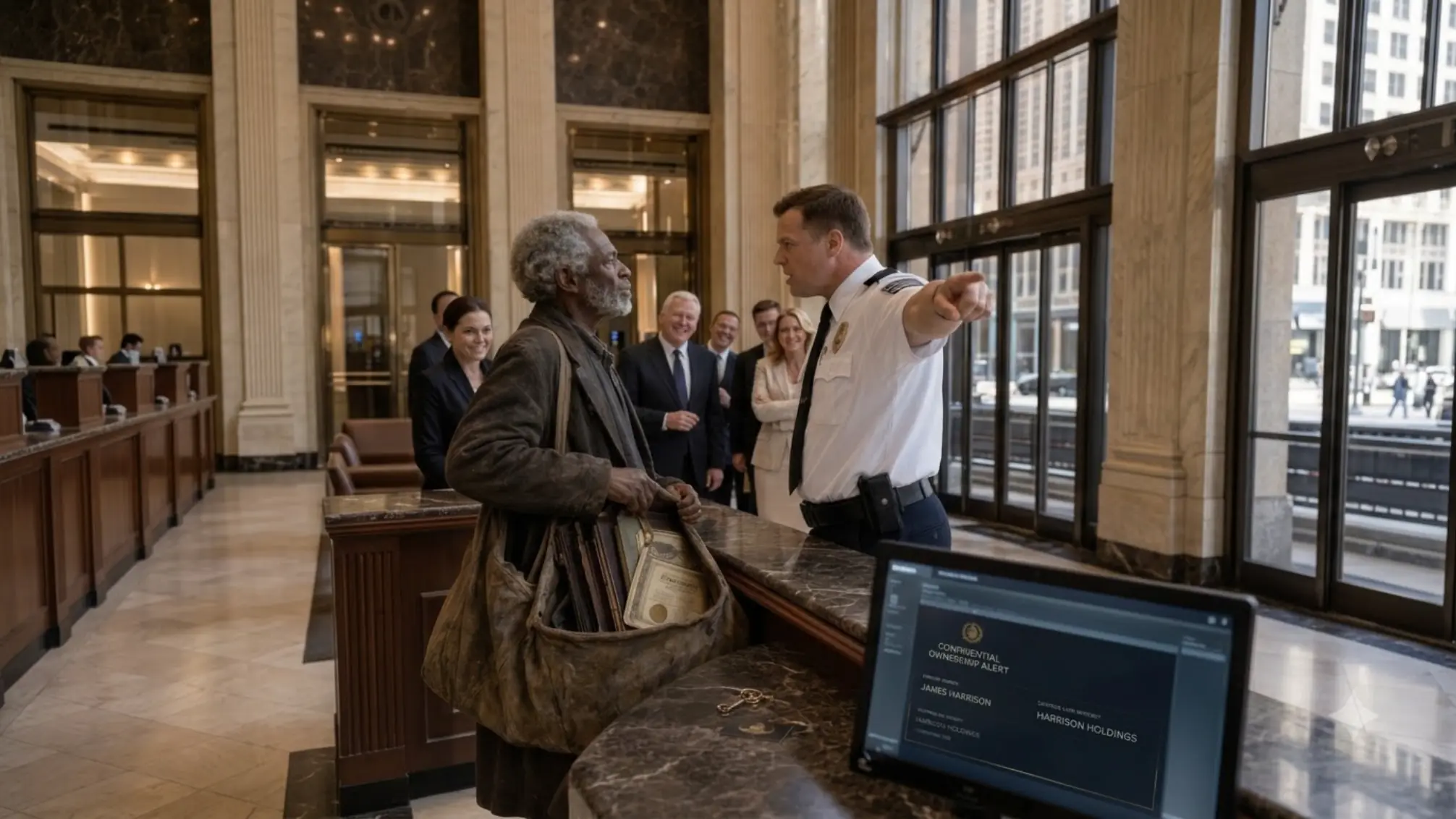
Behind Mark, several wealthy clients watched with open amusement. Two investment executives whispered beside the private-banking counter, while a woman in a cream suit covered her smile with one hand. Bank Manager Vanessa Cole stood among them, holding an expensive leather tablet against her chest. She had already decided Elijah was confused, homeless, or attempting some kind of fraud.
The enormous sack hanging from Elijah’s shoulder had made that decision easy for her.
“You’ve disturbed enough clients,” Vanessa said. “Leave voluntarily, or Mr. Dalton will remove you.”
Elijah looked at the black ownership card resting on the counter. “Have you checked the number?”
Vanessa did not move. “That is not one of our current cards.”
“It predates your current cards.”
“Then it is expired.”
“Ownership doesn’t expire because you redesigned the stationery.”
A younger teller named Rachel Kim glanced from the card to Elijah. Unlike her manager, she did not laugh. She noticed the embossed crest, the unusually heavy material, and a sequence of numbers printed beneath the name E. Harrison Family Trust.
“May I examine it?” Rachel asked.
Vanessa turned sharply. “No.”
Elijah’s eyes settled on Rachel. “You may.”
Mark placed his hand over the card before the teller could reach it. “Nobody is touching anything inside that bag.”
Elijah looked down at Mark’s hand. “Remove it.”
“You’re in no position to give orders.”
“I’ve given orders in this building since before you were born.”
The clients laughed again.
Mark leaned closer. “You walked into Manhattan’s most exclusive private bank carrying a sack that smells like a basement. You expect everyone to believe you own the place?”
“No,” Elijah replied. “I expect your records to prove it.”
Mark’s jaw tightened. He had worked private security for twenty-three years and had developed the dangerous confidence of a man who believed appearance could reveal intention. Tailored clothing meant importance. Worn clothing meant trouble. Hesitation meant guilt, while calmness from someone he considered beneath him felt like defiance.
He reached for Elijah’s arm.
Elijah stepped back before Mark could touch him.
“Don’t make the second mistake before fixing the first.”
Mark grabbed his wrist anyway.
The marble lobby became silent.
Elijah did not struggle. He simply looked at the security supervisor’s hand, then raised his gaze toward Vanessa.
“Your cameras record sound?”
“Yes,” she said cautiously.
“Good.”
Mark released him, but only because several clients had begun lifting their phones. He pointed toward the entrance again.
“Outside.”
Elijah opened the sack.
Inside were sealed leather ledgers, bundles of historical documents, several metal document cases, and a framed black-and-white photograph protected beneath cloth. The top ledger carried the same crest embossed on the black card.
Rachel leaned forward.
Vanessa’s expression changed slightly, but she recovered before anyone else noticed.
“Old papers prove nothing,” she said.
Elijah removed the first ledger and placed it on the marble counter. Its leather cover was cracked with age, but the gold lettering remained visible:
HARRISON & WHITMORE SAVINGS HOUSE — FOUNDING ACCOUNTS, 1948.
Vanessa stopped smiling.
The bank had been established in 1948 under that exact name, though only senior executives and company historians knew it. Modern branding described the institution as the creation of financier Arthur Whitmore. Public displays inside the headquarters included photographs of Whitmore signing incorporation papers, Whitmore opening the first branch, and Whitmore shaking hands with New York officials.
No lobby display mentioned a Harrison.
Elijah opened the ledger.
The first page contained two signatures.
One belonged to Arthur Whitmore.
The other belonged to Elijah’s father, Samuel Harrison.
Rachel read the names from behind the counter. “Samuel Harrison was a founder?”
Vanessa closed the book immediately. “This conversation is over.”
Elijah placed one hand on its cover. “It hasn’t started.”
Mark reached for the ledger, but Rachel spoke before he could touch it.
“Manager Cole, the card number may be searchable through legacy accounts.”
Vanessa stared at her. “Return to your station.”
“We can verify it in less than a minute.”
“That is not your decision.”
“It becomes my decision when a client presents credentials and requests account service.”
Vanessa’s face hardened. “He is not a client.”
Elijah looked toward the main terminal.
“Search Harrison Family Trust, registry number zero-zero-one.”
The lobby appeared to contract around Vanessa.
She knew that registry numbers beginning with three zeros were not ordinary account numbers. They belonged to institutional reserves, founding trusts, and internal control structures created before the modern computer system.
She had never seen registry number zero-zero-one.
“Those records require executive authorization,” she said.
“Then call the chairman.”
“The chairman does not respond to strangers in the lobby.”
Elijah removed a second item from the sack: a sealed envelope bearing Chairman Charles Whitmore’s full name in handwriting.
“He’ll respond to this.”
Vanessa did not take it.
Her refusal was no longer based entirely on disbelief. Fear had entered the decision. If Elijah was telling the truth, she had already allowed a security employee to grab the controlling owner of the bank. If he was lying, opening the envelope might expose her to a more sophisticated fraud.
She chose the option that preserved her authority for another minute.
“Call the police,” she told Mark.
Rachel stared at her manager. “We should verify the registry first.”
Vanessa pointed toward the teller stations. “One more word, and you’re suspended.”
Elijah studied Rachel carefully.
“What’s your name?”
“Rachel Kim.”
“How long have you worked here?”
“Eleven months.”
“Keep your job for the next ten minutes, Rachel. After that, I’ll protect it.”
Vanessa laughed again, but this time no one joined her.
Mark used his radio to request police assistance. Two additional security officers moved toward the lobby, positioning themselves near Elijah as if he had threatened violence. He remained beside the counter with both hands visible.
“Would you like to sit down?” Rachel asked.
Vanessa slammed her palm against the marble. “Stop serving him.”
Elijah gave Rachel a faint smile. “I’ve stood through worse.”
He had stood through much worse.
In 1948, Samuel Harrison was a thirty-six-year-old accountant who had spent a decade helping Black-owned businesses survive banks that refused them loans. He understood finance, risk, and real estate better than most executives who rejected his job applications. Arthur Whitmore possessed family connections and access to wealthy investors, but lacked the operational expertise to build a functioning institution.
The two men formed Harrison & Whitmore Savings House.
Samuel designed its accounting system, recruited its first depositors, and supplied nearly half of the original capital through a network of Black doctors, shop owners, builders, and church organizations. Because discriminatory investors refused to support a bank publicly associated with a Black founder, Samuel’s ownership was placed inside a private family trust.
His name gradually disappeared from advertising.
Arthur promised the arrangement would be temporary.
It lasted seventy-eight years.
Samuel remained involved until his death, quietly controlling a large block of protected shares while allowing Arthur’s family to appear publicly as sole founders. His son Elijah inherited the trust, along with strict instructions never to surrender control unless the bank’s mission remained protected.
For decades, Elijah rarely entered headquarters.
He reviewed reports, attended private board meetings through representatives, and used dividend income to support housing programs, scholarships, and small-business funds. Only the chairman, corporate counsel, and several board members knew the true distribution of ownership.
Most employees had never heard his name.
That morning, Elijah had not arrived to make a dramatic announcement.
He came because three former employees had reported discriminatory treatment inside the flagship branch. Applicants in worn clothing were routinely turned away. Maintenance workers were followed by security. Small account holders were redirected while wealthy clients received immediate attention.
Elijah wanted to see the culture without warning the executives.
He wore the coat he used while restoring his father’s old home in Harlem and carried the historical records he planned to transfer into the bank’s archives. He expected questions.
He did not expect laughter.
The revolving door opened, and two New York police officers entered the lobby.
Mark approached them first.
“Possible trespass and fraudulent ownership claim,” he said. “He refuses to leave.”
The older officer looked toward Elijah. “Has he threatened anyone?”
“He’s disrupting business.”
“That wasn’t my question.”
“No physical threat.”
Elijah raised his wrist, showing a red mark left by Mark’s grip. “I was grabbed after asking them to verify my account.”
The officer looked toward the cameras. “We’ll review the footage.”
Vanessa stepped forward quickly. “This man entered carrying an unidentified sack and claims to own the bank.”
Elijah held out the black card. “I asked them to check registry zero-zero-one.”
The younger officer glanced toward Rachel. “Can you verify it?”
Rachel looked at Vanessa, then at Elijah.
“Yes.”
Vanessa moved to block her path. “You are not authorized.”
The older officer frowned. “Then find someone who is.”
A private elevator opened across the lobby.
Chairman Charles Whitmore emerged with the bank’s general counsel and two members of the executive board. At sixty-four, Charles carried the same narrow face shown in portraits of his grandfather. He walked quickly, his attention fixed on a message displayed on his phone.
One of the ownership systems had generated an alert when Rachel partially entered the registry number.
Charles looked across the lobby.
He saw Elijah standing between security officers.
Then he saw the sack.
Every trace of color left his face.
“Mr. Harrison?”
The wealthy clients stopped whispering.
Vanessa turned toward the chairman. “You know him?”
Charles ignored her and hurried across the marble floor.
“What happened?”
Elijah gestured toward Mark. “Your security supervisor ordered me out.”
Charles looked at the red mark on Elijah’s wrist.
“Did he touch you?”
“He tried removing me before anyone checked the account.”
Mark straightened. “Sir, he arrived dressed like this, carrying—”
Charles turned on him. “Stop speaking.”
The command struck harder than shouting.
Mark fell silent.
Charles picked up the black card carefully, as though it were a historical artifact.
“Why didn’t the terminal identify it?”
Rachel answered. “Manager Cole refused to let me complete the search.”
Charles looked toward Vanessa.
She swallowed. “The credentials appeared fraudulent.”
“Based on what?”
“The card was outdated, and his appearance—”
She stopped too late.
Elijah completed the sentence. “Didn’t match your idea of ownership.”
Vanessa’s hands tightened around the tablet. “I was protecting the institution.”
“From its owner?” Charles asked.
Nobody laughed now.
The woman in the cream suit lowered her phone. The investment executives moved away from the counter, suddenly eager to appear uninvolved.
Charles faced the police officers. “This is Elijah Harrison, principal beneficiary and voting controller of the Harrison Family Trust.”
The younger officer glanced at the bank manager. “So he does own the bank?”
Elijah answered calmly. “A controlling interest.”
The officer looked toward Mark. “Then he can’t trespass in his own building.”
Mark’s mouth opened, but no words came out.
Charles reached for the sealed envelope. “May I?”
Elijah handed it to him.
Inside was a formal notice requesting a special board meeting, an independent review of branch conduct, and the immediate preservation of security footage. Attached were written statements from former employees describing harassment, discriminatory account screening, and retaliation after complaints.
Charles read the first page.
His expression became increasingly grim.
“You came to investigate us.”
“I came to observe.”
“And what did you observe?”
Elijah looked around the lobby.
“A teller willing to do her job. A manager willing to threaten her for it. A security supervisor who grabbed an old man because he disliked his coat. Executives who laughed before learning my name.”
Charles lowered the papers.
“Mr. Harrison, I apologize.”
“An apology is the beginning of accountability, not the end.”
Elijah removed the framed photograph from the sack.
It showed Samuel Harrison and Arthur Whitmore standing outside the original savings house in 1948. Both men held the incorporation certificate between them. Samuel’s hand rested on the door, while Arthur stood beside him smiling.
Elijah placed the photograph near the ledger.
“This bank removed my father from its story.”
Charles looked at the image. “I’ve never seen this.”
“That’s the problem.”
The general counsel opened one of the metal cases. Inside were original trust documents, stock certificates, and handwritten board minutes showing Samuel’s role in financing the institution.
Charles read quickly.
“How many of these records exist?”
“These are the originals.”
“You carried them here in that sack?”
“My father carried his first deposits in the same one.”
The stained canvas bag suddenly appeared different to everyone watching. It was not evidence of poverty. It was part of the bank’s founding history.
Elijah turned toward Mark.
“Why did you call it filthy?”
The security supervisor stared at the floor. “It looked inappropriate for the lobby.”
“This sack entered the first branch before your uniform existed.”
Mark removed his cap.
“I made a mistake.”
“You made several decisions. Calling them one mistake hides the pattern.”
Mark looked up. “I’m sorry.”
“Did you apologize to the maintenance worker you searched last week?”
His face changed.
Elijah had read the complaint.
“Did you apologize to the delivery driver you forced to empty every box while clients walked around him? Did you apologize to the elderly woman you removed because she couldn’t explain her account quickly enough?”
Mark had no answer.
Elijah turned toward Vanessa.
“And you threatened Rachel because she wanted to verify a client’s credentials.”
Vanessa attempted to regain control. “Mr. Harrison, today’s circumstances were extraordinary.”
“No. They were ordinary. Only my identity made the ending extraordinary.”
Rachel looked down, hiding her emotion.
Elijah faced Charles. “Suspend them both pending investigation.”
Charles nodded immediately.
Vanessa stepped forward. “You cannot destroy my career over five minutes.”
Elijah looked at her with cold patience.
“You said I couldn’t afford five minutes inside this building.”
“That was said under pressure.”
“No. It was said while you believed there would be no consequences.”
She looked toward the executives who had laughed with her. None offered support.
Mark removed his security badge and placed it on the counter. Vanessa hesitated until Charles requested her tablet and access card. She surrendered both.
The clients watched them leave through the same doors they had ordered Elijah to use.
The irony pleased no one.
Elijah turned toward the two executives who had been laughing.
“What are your names?”
They answered reluctantly.
“Remain available for interviews.”
One attempted to explain. “We assumed it was a misunderstanding.”
“You found humiliation entertaining before understanding it.”
Neither man responded.
Charles invited Elijah upstairs, but Elijah refused to leave the lobby immediately. He asked Rachel to complete the account search.
Her fingers shook as she entered the registry number.
The terminal changed screens.
A gold-bordered confidential profile appeared, identifying the Harrison Family Trust as the bank’s largest voting shareholder. The balance displayed beneath it represented generations of accumulated holdings, protected reserves, and investment assets.
Rachel stared at the figure.
Elijah did not.
“Is the account active?” he asked.
“Yes, sir.”
“Any restrictions?”
“None.”
“Then the system works when employees are allowed to use it.”
He removed a small folded check from his coat and slid it toward her. It represented a modest deposit from a community property he had recently sold.
Rachel processed it with the same care she would have given any client.
When she finished, Elijah asked Charles to call the entire staff into the lobby.
Within twenty minutes, tellers, advisors, analysts, maintenance employees, and executives gathered beneath the marble columns. Some had already heard rumors. Others stared at the historical photograph on the counter.
Elijah stood beside the battered sack.
“My name is Elijah Harrison,” he began. “My father helped establish this institution in 1948. His ownership was hidden because powerful investors refused to support a bank publicly founded by a Black man.”
The room remained silent.
“The arrangement protected the bank, but it also erased him. That erasure created a culture in which some employees learned to associate wealth, authority, and belonging with a particular appearance.”
He looked toward the cleaning staff standing near the rear doors.
“This morning, that culture ordered the bank’s controlling owner outside.”
Charles lowered his head.
Elijah continued, “Do not misunderstand the lesson. The problem is not that security mistreated a wealthy man by accident. The problem is that they believed mistreatment would have been acceptable if I were poor.”
Several employees nodded.
Beginning that afternoon, Harrison Metropolitan Bank suspended appearance-based client screening and commissioned an independent civil-rights audit. Every complaint from the previous five years was reopened. Security footage was preserved, employee retaliation protections were established, and branch managers were required to document every denied service request.
Rachel received temporary authority to supervise lobby operations.
She tried refusing the promotion.
“I only checked a card,” she told Elijah.
“You defended the process when authority ordered you to abandon it.”
“I was terrified.”
“Courage isn’t the absence of fear. It’s deciding the job matters more.”
The audit lasted three months.
Investigators found that Vanessa had denied or delayed services disproportionately to clients in work uniforms, casual clothing, or visibly worn attire. She had also pressured employees to direct smaller accounts toward online service so the flagship lobby would appear more exclusive.
Mark’s record revealed repeated searches and removals unsupported by actual security threats.
Both were dismissed.
The bank offered settlements and formal apologies to affected clients and workers. Charles accepted responsibility before the board for allowing reputation and luxury branding to replace the institution’s founding purpose.
The lobby changed too.
A new historical display replaced the portrait crediting Arthur Whitmore alone. At its center stood the photograph Elijah had carried inside the sack.
The inscription read:
SAMUEL HARRISON AND ARTHUR WHITMORE
COFOUNDERS, 1948
Beside it, protected behind glass, sat the repaired canvas bag.
Elijah insisted that its stains remain visible.
Six months later, he entered the bank wearing the same brown overcoat and worn shoes. Nobody had been warned that he was coming.
A newly hired security officer greeted him politely.
“Good morning, sir. How may we help you?”
Elijah pointed toward the display. “I’m here to see an old friend.”
The officer looked at the canvas sack behind the glass, then back at Elijah. Recognition slowly appeared in his face.
“You’re Mr. Harrison.”
“Today I’m a client.”
Rachel emerged from behind the counter, now serving as assistant branch manager. She smiled but did not rush past the people already waiting.
“I’ll be with you after the next client.”
Elijah nodded with approval.
“That’s exactly right.”
He took a seat beside a construction worker carrying a dusty lunch bag and an elderly woman holding a small deposit envelope. Nobody moved them away from the private-banking area. Nobody examined their clothing before asking their names.
Charles joined Elijah several minutes later.
“The quarterly review is complete,” he said. “Complaints are down, and small-business account openings have increased.”
Elijah looked across the lobby. “Numbers tell you whether the policy changed.”
“What tells us whether the culture changed?”
“How people behave when they don’t know the owner is watching.”
Charles considered that.
Elijah pointed toward the construction worker. A teller had offered him water while resolving an account issue. Near the entrance, a security officer helped a delivery driver move a heavy package instead of blocking his path.
“Today looks better,” Elijah said. “Don’t confuse better with finished.”
Charles nodded.
The bank eventually established the Samuel Harrison Community Fund, restoring part of the mission erased from its public history. It provided financing to neighborhood businesses that traditional institutions considered too small, too new, or too unfamiliar.
Elijah required every lending decision to remain financially responsible.
He was not interested in symbolic charity.
He wanted capable people judged through evidence rather than appearance—the same opportunity his father had demanded decades earlier.
The black ownership card remained active, though Elijah rarely used it. He preferred taking an ordinary number and waiting with everyone else.
Employees sometimes recognized him.
New clients often did not.
That suited him.
The morning Mark Dalton ordered him out became famous inside the company, but Elijah discouraged employees from retelling it as a simple revenge story. The important moment was not when the chairman identified him or when Vanessa surrendered her access card.
The important moment came earlier.
It came when an old Black man in a worn coat asked the bank to check his account, and nearly everyone decided he was worthless before touching the keyboard.
The balance did not create his dignity.
The ownership documents did not make him deserving of respect.
They merely forced people who had denied that respect to confront how carelessly they distributed it.
Years later, the battered sack remained inside the lobby, beneath Samuel Harrison’s photograph. Clients passed it every day without knowing how heavy it had once been.
It had carried the bank’s first deposits.
It had carried the proof of a founder erased from history.
And on the morning Elijah Harrison returned, it carried enough truth to expose everyone who laughed before checking his name.