The desert does not care how tough a man looks when his engine starts to fail.
Miles “Rivet” Donnelly learned that long before the afternoon his Harley rolled to a stop beside the orange county barricade on County Road 14, six miles outside Tucumcari, New Mexico.
He had learned it in Arizona, when a tire blew under him near Yuma.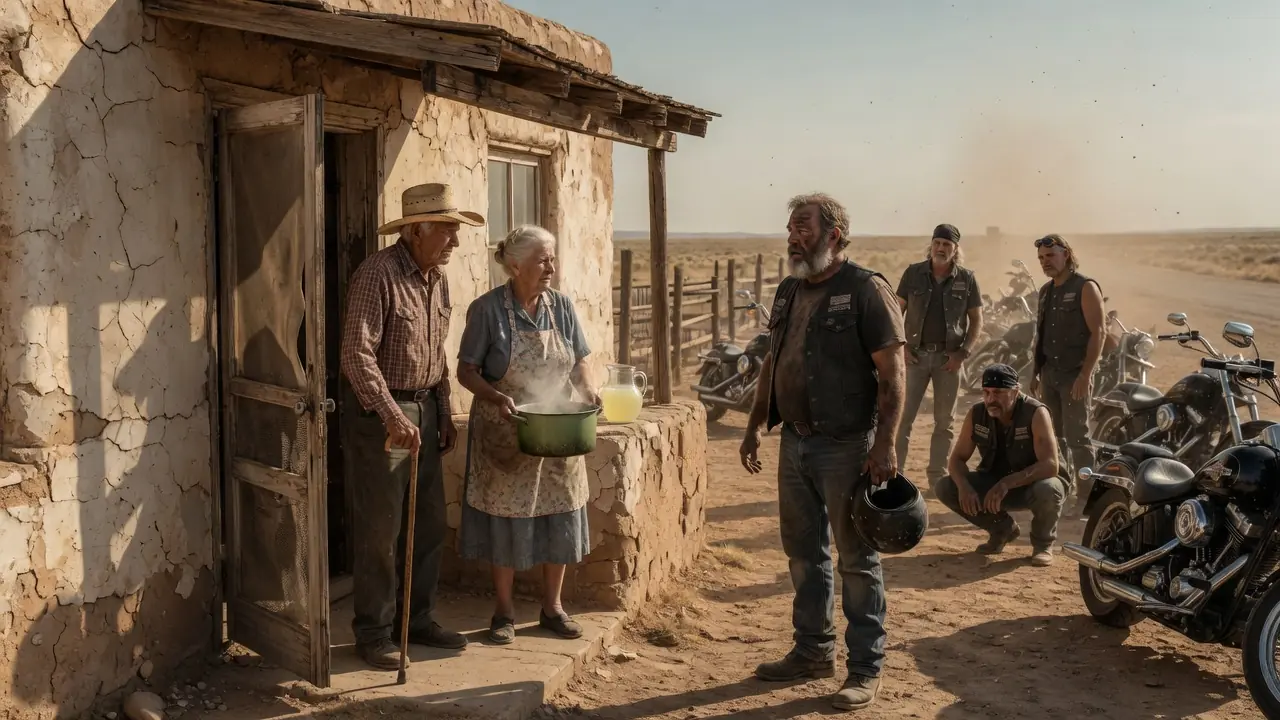
He had learned it in West Texas, when an electrical short left him sitting beside a cattle fence for four hours while heat shimmered across the road like a warning. He had learned it in enough places to know the truth.
The road does not respect pride.
It respects water.
Tools.
Time.
And the person steady enough to use all three.
It was 2:35 on a Friday afternoon, and the heat had climbed to ninety-six degrees. The old Route 66 pavement rose in silver waves under the sun, bending the horizon until the world looked liquid and unreal. The air smelled of hot tar, dry grass, dust, and overheated metal.
County Road 14 was closed at the wash.
The barricade stood crooked across the lane, striped orange and white, with a yellow warning sign tied to it by a piece of frayed rope. Beyond it, the road dipped toward a dry crossing that did not look dry anymore. A flash flood earlier in the week had chewed half the shoulder away and left the asphalt cracked like burnt pottery.
Miles killed his engine and sat still for a moment.
Behind him, three bikes idled low and uneven.
Grant Pritchard, sixty-six, narrow-eyed and patient, took off one glove and looked down the road as if distance could be argued with.
It could not.
The nearest bridge around the wash was thirty-eight miles west, and the gas needle on Leo’s bike was already leaning toward empty like it had given up before the rest of them.
Leo Ramirez, forty-nine, was the youngest of the four and the best with wiring. He leaned over his tank, tapped the gauge once, and muttered something that did not need repeating.
Behind him, Silas “Crow” Mercer let out a dry laugh.
“That needle don’t look optimistic.”
Leo glanced back.
“That needle is a liar.”
Miles stepped off his Harley.
The Hells Angels patch on his back sat dark against the sun. His gray beard was damp at the chin, and his hands were already marked with black oil from a stop they had made near Santa Rosa that morning. He was sixty-two, built broad through the shoulders, with knees that complained in cold weather and a face that had made many strangers decide they knew him before he opened his mouth.
Men like him were expected to make noise when things went wrong.
Curse.
Kick gravel.
Scare the problem into moving.
Miles had learned better.
Temper did not fill a gas tank. It did not cool an engine. It did not reopen a washed-out road or put shade over a man’s head.
He walked to the barricade, studied the crossing, then looked west.
No good.
Then east.
No good either.
Behind the barbed wire fence to the south, a small adobe house sat beyond a strip of pecan trees. Cream-colored walls glowed in the heat. A windmill turned slowly behind it, groaning once every few rotations. The place looked old, quiet, and stubborn, the way some houses look when they have survived more summers than the people who built them expected.
Miles noticed the porch first.
One side dipped lower than it should have.
The roofline sagged near the front beam. A gutter hung loose along the rear corner. Near the kitchen window, a thin crack ran through the adobe plaster, almost invisible from the road unless a man had spent half his life noticing where structures were tired.
Grant noticed it too.
He said nothing.
Across the yard, near the front gate, an elderly woman in a faded blue dress stood with one hand shading her eyes. Beside her, an elderly man leaned on a cane, his straw hat casting a shadow over a face browned by decades of New Mexico sun.
Most people would have gone inside and locked the screen door.
These two did not.
The woman disappeared for a minute, then came back carrying a green enamel pot with both hands. The old man lifted a gallon jug of lemonade from a cooler by the steps.
Miles watched them cross the yard slowly.
Not because they were afraid.
Because age had made every trip across rough ground a negotiation.
Dust moved around their shoes.
The bikers went quiet.
The woman stopped at the fence and looked at Miles, then at Leo’s overheated bike, then at the road closed behind them.
“You boys look stranded,” she said.
Her voice was calm. Almost practical.
Miles glanced at the pot, then back at her face.
Nobody had called him boy in thirty years and made it sound kind.
The old man opened the gate with a rusty squeal.
“Come get out of that sun,” he said. “Stew’s not fancy, but it’s hot, and hot food still beats standing in a ditch.”
Miles looked at the barricade, the dead crossing, the motorcycle ticking beside him, and the old couple waiting by the open gate.
For the first time that afternoon, the road offered them something other than heat.
The gate opened wide enough for one motorcycle at a time, but Miles did not roll through first.
He looked at the woman, then at the man, then at the shaded patch of yard beneath the pecan trees where three metal lawn chairs sat around a weathered picnic table.
The woman was small but upright, with white hair pinned at the back of her head and forearms browned by years of sun through kitchen windows.
The man beside her looked thinner than his voice. His right hand curled around the cane while his left rested near the latch, as if opening that gate still meant something.
Miles removed his gloves before he stepped inside.
So did Grant.
So did Leo.
Silas followed last, taking off his sunglasses and tucking them into his vest.
That was the first rule of accepting kindness from strangers.
You did not carry road dirt into their generosity if you could help it.
The yard smelled of dry grass, pecan leaves, warm adobe, and green chile stew steaming inside the enamel pot. The heat seemed less cruel beneath the trees, though sweat still ran down Miles’s back under his vest.
Mabel Calder set the pot on the picnic table with a folded towel under it. Then she placed a plate of cornbread beside it, cut into uneven squares that looked homemade because they were.
Warren Calder poured lemonade into cloudy plastic cups. His hand shook just enough to make the ice click against the sides.
Nobody mentioned the shaking.
That mattered.
“We don’t want to trouble you,” Miles said, standing with his helmet under one arm.
Mabel gave him a look that could have quieted a church basement.
“Trouble is a man standing in ninety-six-degree heat pretending he’s fine.”
Grant lowered his eyes, almost smiling.
Leo stood near the fence, still listening to the faint ticks from his cooling engine beyond the gate.
The Hells Angels patch across Miles’s back had made plenty of people step away from him over the years. It had made gas station clerks watch him too closely, mothers pull children nearer, men puff themselves up before they even knew his name.
But Mabel moved around it like it was just another piece of clothing that needed dusting.
She handed him a bowl.
“Eat before it gets mean.”
That was all.
Miles took the bowl with both hands.
He had eaten gas station jerky at noon and black coffee before sunrise, but the stew smelled like potatoes, beef, tomato, onion, green chile, and something smoky that settled low in the chest.
He waited until Warren sat before he took the first bite.
The others followed.
Rough men could still know manners.
For a few minutes, the only sounds were spoons against bowls, the whisper of hot wind in the pecan leaves, and the low ticking of motorcycle pipes cooling in the road dust.
Warren asked where they were headed.
“Amarillo by evening,” Miles said. “If County Road 14 hadn’t decided otherwise.”
Warren nodded toward the barricade.
“That crossing fools people. Dry most days. Then one storm comes off the mesa and chews the road out from under itself.”
Silas looked at the wash and shook his head.
“Road crews coming?”
Warren laughed once.
“Eventually. That’s the official speed of county work.”
Mabel ladled more stew into Leo’s bowl before he could refuse.
“Your bike sounded hot,” she said.
Leo looked up, surprised.
“You know engines?”
“I know when a machine’s complaining.”
“Fan relay maybe,” Leo said. “I can limp it once it cools.”
“Then it cools here,” Warren said. “No sense cooking the machine or the man.”
The words were plain.
The kindness was not.
Miles looked at the green enamel pot, the cornbread crumbs on the table, the two old people giving away food as if they had more than enough, and felt something inside him go quiet.
He did not know yet that he would come back.
But something in him had already started keeping count.
By 3:05, the heat had loosened its grip just enough for the shade beneath the pecan trees to feel earned. Bowls were nearly empty. The lemonade jug sat half full on the table, and the men in leather had stopped looking like stranded riders and started looking like guests who were trying to remember how to accept care.
Miles rested his forearms on his knees, helmet near his boots, watching a line of ants work around a crumb of cornbread with more discipline than most road crews he had known.
Grant sat quietly beside him, but his eyes kept returning to the porch.
Grant had framed houses in Colorado before his knees quit liking ladders. He had spent enough years around lumber to know when wood was trying to confess.
Leo had taken the seat closest to the fence so he could hear if his motorcycle hissed again.
It did not.
For the first time since the barricade, nobody was rushing.
Warren leaned back in his metal chair and looked at Miles with the steady curiosity of a man old enough to ask direct questions without dressing them up.
“You always ride with that patch?”
Miles glanced at the Hells Angels letters across his vest, then at Mabel, who was gathering spoons into a chipped ceramic bowl.
“Most days.”
“Makes some folks nervous?”
“Most days.”
Mabel did not look up.
“Some folks are nervous because they never learn to look twice.”
That stopped the table for a second.
Then Warren gave a dry little laugh, the kind that scraped out of the chest and left warmth behind.
Grant took a slow drink of lemonade.
Leo looked down at his hands.
Miles felt something in the yard shift. Not loudly, but enough to be felt.
The couple had not ignored what the bikers looked like.
They had simply decided appearance was not the whole man.
That was rarer than people admitted.
Warren pointed his cane toward Leo’s bike beyond the gate.
“You said fan relay. If you need shade, there’s an old lean-to behind the shed. Used to keep a tractor under it before the starter went bad in 2018.”
Leo stood at once, not because he was eager to leave the table, but because being useful came easier to him than being cared for.
“I can check it there.”
Miles rose with him, but Warren lifted one hand.
“Finish your food first. A hungry man fixes things twice.”
That was true.
They listened.
A gust moved across the yard, rattling the dry pods in the mesquite and lifting the edge of a faded outdoor rug on the porch. The porch answered with a tired creak that lasted too long.
Miles looked at it.
Grant looked at it.
Warren looked away.
Mabel carried the spoons inside before anyone could ask.
Through the open kitchen door, Miles saw a plastic tub under the ceiling, set beneath a brown water stain shaped like a map. Near the doorframe, a single adobe brick sat exposed where plaster had fallen away.
Someone had scratched numbers into it long ago.
Miles saw Warren touch that brick as he passed, two fingers brushing it lightly, almost without thinking.
It was not decoration.
It was memory.
Grant stepped beside Miles and lowered his voice.
“Porch beam is dipping two inches, maybe more. Wall’s pulled near the kitchen window.”
Miles nodded once.
He had seen the same thing.
He did not ask Warren about it in front of everyone.
Pride had bones too, and old pride broke quietly.
Instead, Miles thanked Mabel for the stew, helped carry the empty lemonade cups to the kitchen step, and asked if they could move Leo’s bike under the lean-to before the sun cooked it worse.
Warren nodded toward the back.
“Gate’s stiff. Lift before you pull.”
Miles did exactly that, and the gate opened without screaming.
Small instructions mattered.
So did listening.
The lean-to behind the shed held more shade than strength, but it was enough for Leo to work under. Its tin roof popped softly in the heat, and the ground beneath it smelled of dust, old hay, and sun-baked motor oil from machines that had not run in years.
Leo rolled his motorcycle in slowly while Miles walked beside him, one hand ready near the handlebar, but not touching unless asked.
That was how the brotherhood worked.
Help did not have to crowd a man.
Grant followed with a small tool pouch, his eyes passing over everything.
The leaning fence posts.
The cracked rain barrel.
The sagging gutter along the back of the adobe house.
The place was not falling apart all at once.
It was losing arguments one small corner at a time.
Leo pulled the side cover and tested the relay with a pocket meter he kept wrapped in a red shop rag. Numbers flickered, then dropped.
“Relay’s sticking,” he said. “Fan doesn’t come on when it should.”
Warren stood a few feet away, cane planted in the dirt, pretending not to be interested and failing like a man who had spent his life fixing things.
“I’ve got wire in the shed,” he said. “Some connectors too. Might be old.”
Leo looked at him.
“Old is fine if it conducts.”
Warren almost smiled.
Mabel appeared at the back door with a damp towel for Miles to put around his neck, then stopped when she saw him looking at the orange paper taped near the kitchen window.
It had been partly hidden by a curtain from inside.
But from the yard, the color shouted against the cream adobe wall.
County Housing Safety Notice.
Miles read only the first line before looking away.
He did not stare at another man’s trouble like it was a roadside attraction.
Mabel saw that.
Her shoulders softened, then tightened again.
“It’s nothing for guests to worry over.”
Grant was standing near the porch now, tapping one boot gently against the front support.
The wood answered with a hollow sound.
Not good.
Miles took the towel from Mabel and folded it once in his hands.
“I used to do structural welding and mobile home repairs,” he said. “Grant framed houses in Colorado before his knees quit liking ladders. Leo can make bad wiring confess before breakfast.”
Mabel looked toward Warren, who had turned his face away as if the pecan trees needed his full attention.
“We are not asking,” she said.
Miles nodded.
“I know.”
He let the words rest.
The fan on Leo’s bike kicked on with a rough little whir as Leo bridged the relay for testing.
It sounded like a small victory.
Beyond the yard, County Road 14 shimmered under the afternoon sun. The closed crossing waited. The caution tape twitched in the wind.
Warren finally spoke from beside the shed.
“Water came through after that storm Tuesday. Not high, but fast. Cut a channel right behind the house.”
Grant stepped to the corner and looked down.
The runoff had eaten a shallow trench along the foundation, exposing adobe where packed earth should have held firm.
Forty years of weather could be patient.
One hard rain could be rude.
Miles crouched, rubbed the dry soil between his fingers, and saw the problem clearly.
Water had nowhere else to go.
Mabel still held herself straight, but her eyes had moved to the brick marked 1959 by the door.
Warren had made that house with his hands.
Now his hands could not save it alone.
Miles stood and wiped dust from his palms.
“We can look,” he said. “Just look.”
Warren looked at him for a long second.
Then he gave the smallest nod.
Sometimes permission arrived like a door barely opening.
By 4:18, the closed crossing was still closed, but Leo’s motorcycle was no longer the most important thing in the yard.
He had the fan running with a temporary bypass, safe enough to get them moving once the heat backed off, and he was wrapping the repaired wire with black tape when Mabel stepped inside to refill the lemonade.
The kitchen door swung open behind her.
That was when Miles saw the rest of the notice.
It was pinned under a magnet shaped like a red chili pepper on the refrigerator, folded once, but not enough to hide the Orange County seal.
Warren saw Miles see it.
Neither man pretended otherwise.
Silence can be a clean thing when it does not lie.
“Thirty days,” Warren said from the doorway, his cane tip resting on the worn threshold. “That’s what they gave us.”
Mabel stopped with the pitcher in her hand.
Her eyes closed for half a second.
She had been trying to keep the trouble small by not naming it.
Trouble rarely stays small just because it is quiet.
Grant stepped back from the porch support and removed his hat, not for drama, but because the shade under the roof suddenly felt like a room where a man should show respect.
Miles read only what Warren allowed by leaving it visible.
Structural concern near rear wall.
Water intrusion.
Unsafe porch support.
Follow-up inspection required.
It was not an eviction notice yet.
It was the road toward one.
“We were going to handle it,” Mabel said.
Her voice held steady, but the pitcher trembled.
Warren looked at his right hand, the one curled around the cane.
“I was going to handle it.”
The words came out lower than the others.
Miles looked at the scar near Warren’s wrist, the way his fingers did not close all the way, the way his shoulder guarded his back when he turned. A man who had built with his hands knew exactly what he could no longer lift.
That was its own kind of grief.
“Fell last week,” Warren added. “Moved two bags of mix from the shed. Got as far as the steps.”
Mabel put the lemonade down.
“You fell in the yard.”
Warren did not answer.
He did not need to.
Leo looked toward the shallow wash behind the house, then at the cracked gutter.
Grant crouched near the adobe wall and pressed two fingers against the exposed edge where runoff had chewed away the packed earth.
“Needs drainage first,” he said. “Otherwise anything patched will fail again.”
Miles nodded.
He saw the work in pieces.
A forty-two-foot trench to pull water away.
Fresh gravel near the foundation.
Bracing under the porch.
Sealant along the roof edge.
Mud plaster where the wall had opened.
Some wiring fixed before a wet night turned a small problem into a dangerous one.
Not impossible.
Not small either.
The ferry of their day had changed shape.
It was not a road crossing anymore.
It was a choice.
Miles looked at Mabel, then at Warren.
“We can come back tomorrow morning with tools.”
Mabel shook her head immediately.
“No.”
Warren’s jaw worked once.
Stubbornness rose because it had kept him alive for seventy-nine years and did not know when to rest.
“I don’t take charity.”
Miles accepted that without flinching.
“Good,” he said. “We don’t offer it.”
Mabel looked at him carefully.
“Then what do you call it?”
Outside, Leo’s repaired fan kicked on again, rough and steady under the tin roof.
Miles glanced at the green enamel pot on the picnic table, empty now except for a ring of stew at the bottom.
“A return trip.”
Warren looked at the pot.
Then at the orange notice.
Then at the brick by the door marked 1959.
His hand found the cane.
His pride found a place to sit down without leaving the room.
“Tomorrow,” he said at last. “Eight. If you mean it.”
Miles put his gloves back on slowly.
“Seven forty-five,” he said. “So we’re not late.”
At 7:41 the next morning, the first sound on County Road 14 was not a rooster or a truck.
It was the low, even roll of V-twin engines coming over the rise east of the Calder place. Steady enough to sound like weather arriving on purpose.
Warren was already on the porch in a clean work shirt, cane across his knees, pretending he had not been watching the road since sunrise.
Mabel stood behind the screen door with coffee ready and her hair pinned tighter than usual.
The house looked smaller in the morning light.
The trouble looked bigger.
Miles led the line in slow, his Harley carrying two tool bags strapped behind the seat. Grant followed in an old white pickup with lumber, gravel bags, a wheelbarrow, and a rented compactor tied down in the bed.
Leo came behind him, pulling a small trailer with a generator, extension cords, a circular saw, tarps, and two five-gallon water jugs.
Eight more riders rolled in behind them.
Men between forty-five and seventy.
Gray-bearded.
Sunburned.
Leathered by highways and jobs that made hands thick.
No one revved for attention.
No one shouted.
They were not a crowd.
They were a work crew.
Miles killed his engine by the gate and waited until the last bike went quiet before stepping into the yard.
The sudden silence made the desert seem larger.
“Morning,” he said.
Warren glanced at the sky.
“You’re early.”
“You said eight.”
“Seven forty-one is not eight.”
Miles removed his gloves.
“We heard seven forty-five.”
Mabel came out with a tray of coffee and mismatched mugs, but Leo gently took the tray before she could carry it down the steps.
“Point,” he said. “We lift.”
She gave him a look.
Then surrendered the tray with dignity still intact.
That mattered too.
At 7:58, Hank Sutter appeared at the fence across the lane with two goats nosing at his boots and suspicion written plain across his face. He saw the motorcycles, the pickup, the trailer, the men unloading tools beside the old adobe house, and came over fast for a man in work boots.
“Warren,” he called, “everything all right here?”
His voice was sharp with worry, not cruelty.
Miles turned before Warren could struggle up from the chair. He kept both hands visible.
“We’re here to help with the county notice.”
Hank looked him up and down, taking in the patch, the scars, the leather, the men carrying lumber near the porch.
“Help usually doesn’t arrive with that many bikes.”
Grant set a level against the porch post and did not look up.
“Bad porches don’t care what we rode in on.”
The sentence sat there, dry as dust.
Warren let out one quiet laugh.
Hank did not.
He pulled out his phone.
“I’m calling county housing. Just to make sure nobody’s getting pushed around.”
Miles nodded.
“Good. Ask for Tessa Monroe. Tell her Miles Donnelly is on site and would like a recheck when the bracing is done.”
Hank paused, confused by the lack of anger.
Mabel stepped beside Warren and rested one hand on his shoulder.
“They ate my stew yesterday,” she said. “Now they think they owe me a house.”
Miles looked toward the cracked wall, the sagging porch, the wash behind the kitchen, and the brick marked 1959 waiting beside the door.
“Not a house,” he said. “Just a fair chance to keep the one you built.”
By 8:12, the generator was running, the chalk lines were down, and the brotherhood had divided without needing orders.
By 8:26, the Calder yard had become a job site without losing the feeling of a home.
Grant snapped a chalk line along the sagging porch beam, then tapped the wood with the handle of his hammer and listened to the answer.
Leo ran extension cords from the generator and tested each outlet with a yellow meter, marking the bad ones with blue painter’s tape.
Silas and two others unloaded gravel behind the house.
Miles worked near the rear wall with a shovel, cutting the first line of the drainage trench through hard red soil packed by years of sun and one careless storm.
Nobody wasted motion.
Warren sat in a chair under the pecan tree with a thermos in his lap and a carpenter’s pencil behind one ear, watching men half his age and nearly his age do work his body still remembered.
Every few minutes, someone asked him something specific.
How deep did the old footing run?
Where did the gray water line cross the yard?
Which side of the house caught the worst runoff when storms came from the mesa?
Did the porch boards run original or had he replaced them after the big freeze in 1983?
Warren answered each question with more strength than he had used all morning.
Being needed sat better on him than being rescued.
Mabel moved between the kitchen and the porch with fresh water, but Leo had set a rule before the first board came off.
She could refill cups, but she could not carry lumber, climb steps, or argue with men who had already been out-argued by mothers, wives, and bad knees.
She tried to glare at him.
It did not hold.
Hank Sutter returned with a flatbed trailer, three bags of gravel, and a look that had changed shape since breakfast.
“County said Tessa will come out this afternoon if you’re still here,” he said. “Also said the drainage better be real, not decorative.”
Grant held up his level.
“Decorative is for cakes.”
Hank looked at the porch, then at Warren, then at the men working without cameras or applause. He backed his trailer near the rear yard and started unloading gravel.
Suspicion had become labor.
That was progress.
The porch came apart slower than expected because Miles refused to tear through anything until Warren confirmed what should be saved.
Two boards were too rotten to keep.
One support post had split near the base.
A narrow shelf under the front window, carved by Warren in 1968, was still solid. Grant set it aside carefully on a tarp, not with the scrap pile.
Details mattered.
Around 10:15, Leo killed power to the porch light and opened the old junction box. The wire insulation inside had cracked like dry creek mud.
“This could have gone bad on a wet night,” he said.
He did not say worse.
He did not need to.
Mabel heard enough and pressed one hand flat against her apron.
Miles saw it from the trench and kept digging.
Sometimes comfort was not words.
Sometimes it was finishing the trench before clouds returned.
By 11:30, the drainage line stretched forty-two feet behind the house, angled toward a gravel basin near Hank’s goat fence. Sweat had darkened the backs of leather vests and cotton shirts alike. The air smelled of sawdust, adobe dust, gasoline, hot electrical tape, and damp earth where the first test water ran through the trench.
Warren asked for the mud plaster mix.
Miles brought the wheelbarrow close instead of making him walk.
Warren gave the ratios from memory.
Sand.
Clay.
Straw.
Water added slow.
Grant listened like a student.
Leo mixed like a man who knew machines but respected hands that knew earth.
The first patch went onto the wall at noon, pressed firmly over the damaged adobe and smoothed by Miles while Warren watched every stroke.
“Not too wet,” Warren said.
Miles adjusted at once.
No argument.
By then, the old house had become more than a repair job to the brotherhood.
It was a set of instructions written by two lives, and the men in leather had finally learned how to read it.
At 1:18, the sun had moved over the Calder house and found every tired shoulder in the yard. The new porch brace was up. The trench was lined with gravel, and the patched adobe wall had begun to dry from dark brown to the soft clay color Warren remembered.
A few clouds were gathering west of Tucumcari, not black enough to scare anyone, but heavy enough to make every man on the property work faster without saying so.
Time had weight.
Grant was fitting the last replacement board near the porch steps when one of the younger riders dragged a broken strip of old adobe and wood toward the scrap pile.
It was narrow, dusty, and half coated in fallen plaster.
The kind of piece most people would throw away before lunch.
Warren saw it from under the pecan tree.
His hand moved first, gripping the arms of the chair. His mouth opened, but no sound came out.
Miles caught the change before anyone else did.
He had been tightening a support bracket near the porch and looked up just in time to see Warren’s eyes lock on the scrap pile with the panic of a man watching a memory being carried off.
Miles set down the wrench.
“Hold up,” he said.
Not loud.
The riders stopped at once.
Miles walked over and lifted the dusty piece from the pile, turning it carefully in both hands. Under the dirt and flakes of old plaster, a single adobe brick was still attached to the wood backing.
Near its edge, scratched by a hand much younger than Warren’s was now, were four uneven numbers.
Mabel stepped out of the kitchen and froze on the threshold.
The whole yard seemed to understand before anyone explained.
The generator hummed.
A goat bleated across the fence.
Wind moved through the pecan leaves with a dry whisper.
Warren tried to stand, and Hank Sutter was beside him before pride could refuse completely, offering one elbow and looking away as if he had only happened to be standing there.
Warren took the help.
That was new.
Miles carried the brick to the shade and set it on a folded towel across the picnic table, away from the tools and dust.
He did not ask what it meant.
He waited.
Warren touched the scratched numbers with two fingers, and his hand shook harder than it had all day.
“My father made me mark that one,” he said. “Told me every house needed one brick that remembered when it began.”
Mabel came closer, wiping her hands on her apron, though they were already clean.
“We set it by the door the week before we married,” she said. “I told him it looked crooked.”
Warren looked at her.
“It was crooked.”
“Still is,” she said.
For one second, both of them were young in the same place.
Nobody laughed too loudly.
Nobody made the moment a show.
Miles asked Leo for a soft brush, then Grant for clear masonry sealer from the supplies. They cleaned only what needed cleaning, leaving the scratches, the worn edge, and the small chip in the corner untouched.
Damage was part of the record.
By 2:06, Grant had cut a protected recess beside the repaired doorway, and Miles set the 1959 brick back into the wall with fresh mud plaster packed around it.
Warren sat close enough to guide the angle.
“Left side higher.”
Miles adjusted.
“Not that much.”
Miles adjusted again.
Mabel watched with one hand at her throat, not crying, just holding herself still.
When the brick finally settled in, crooked by maybe an eighth of an inch, Warren nodded.
“That’s it.”
The clouds moved closer, shading the yard for the first time all day.
The old house did not look new.
It looked remembered.
By 4:20, the first drops of rain tapped the tin roof of the shed. Light enough to count, serious enough to make everyone look west.
The sky over Tucumcari had turned the color of worn pewter, and wind pushed red dust low across County Road 14.
Tessa Monroe arrived ten minutes later in a county pickup with a clipboard on the passenger seat and mud already drying along the tires.
She stepped out wearing work boots, not office shoes, and paused at the gate when she saw the yard.
A drainage trench ran clean behind the house, forty-two feet of gravel and packed soil leading water away from the adobe wall.
A porch brace sat square under new lumber.
The patched roof edge was sealed.
The 1959 brick rested beside the doorway, still a little crooked, exactly where Warren wanted it.
Tessa looked at the men in leather, the generator, the tools, the old couple under the pecan tree, and Hank Sutter standing near his flatbed with both arms folded like he had been part of this from the beginning.
“I was told there might be a misunderstanding,” she said.
Miles wiped mud plaster from his hands with a rag and kept his voice even.
“There was. Then it became a workday.”
Tessa started at the porch and tested each step with her boot.
Grant stood nearby with the level, but he did not interrupt.
She checked the support post, the bracing, the repaired wiring cover, and the back wall where the adobe had been reinforced. Leo explained the temporary power shutoff and the new exterior-rated box without making it sound grander than it was.
Hank pointed out the drainage basin beyond the goat fence, proud in spite of himself.
Warren said nothing until Tessa touched the wall near the old brick.
“That piece stays.”
His voice was thin but steady.
Tessa looked at the numbers.
Then at Mabel’s hand resting on Warren’s shoulder.
“It is not structural in the wrong way anymore,” she said. “It can stay.”
The rain came a little harder then, running off the repaired roof instead of dripping through the porch boards.
Everyone watched the water follow the new trench away from the house.
It worked.
Nobody cheered.
They just stood there and let the proof speak.
At 4:52, Tessa signed the notice extension and wrote safe for occupancy pending 90-day follow-up across the bottom of the form.
Not perfect.
Safe.
That was enough.
Mabel pressed one hand over her mouth, then lowered it because she did not want anyone treating her like she might break.
Warren looked at Miles and tried to say something, but the words caught behind years of pride, age, and dust.
Miles spared him the struggle.
He picked up the empty green enamel pot from the picnic table and handed it back with both hands.
“We brought your pot home.”
Warren took it.
Mabel laughed once, soft and tired.
At sunset, the yard was cleaned, the scrap stacked, and the motorcycles lined along the fence with rain shining on their tanks.
The house still looked old.
The paint was still faded.
The screen door still complained.
The desert still waited beyond the road.
But the porch held.
The wall held.
The people inside could stay.
Before Miles left, Warren touched the 1959 brick.
Then he touched the back of Miles’s hand, quick as a man signing his name where words would not do.
The bikers rolled out slowly, their V-twins low under the wet evening air.
Not like a warning.
Like a promise kept.
Mabel stood beside Warren in the doorway, the same doorway he had built for her before they were married, and watched until the last taillight disappeared over the rise.
The bowl of stew had not been much.
It had been enough to begin.
Ninety days later, Tessa Monroe came back.
The sky was clear this time. Winter had taken the worst edge off the desert heat, and the pecan trees stood bare except for a few stubborn leaves that rattled like old paper in the wind.
Warren was waiting on the porch again, but he was standing this time, both hands resting on the railing. Mabel stood beside him in a red cardigan, holding a plate of cornbread wrapped in a towel because she believed any official visit went better with food nearby.
The county pickup stopped near the gate.
Tessa stepped out, looked at the porch, then at the wall, then at the trench behind the house.
She walked the property carefully.
The porch brace had settled firm.
The repaired wiring held.
The drainage line had survived two storms.
The adobe patch around the 1959 brick had cured clean and strong, leaving the numbers visible beside the door like a quiet signature.
Tessa made notes on her clipboard.
Warren watched every movement.
Mabel did not breathe normally until Tessa closed the folder.
“Full clearance,” Tessa said.
Warren blinked once.
Mabel held the plate closer to her chest.
“What does that mean?”
“It means the county has no current safety objection to occupancy.”
Warren looked toward the road.
Mabel’s eyes filled.
The words were not poetic.
They were better.
They were official.
They could stay.
That evening, four motorcycles rolled into the yard just before sunset.
Miles, Grant, Leo, and Silas.
Warren stood on the porch when they arrived, holding up the signed clearance like a man showing off a newborn child.
Miles killed the engine and smiled.
“Well, I’ll be.”
Mabel opened the door.
“Don’t stand in the yard like strangers. I made stew.”
Grant looked at Miles.
“Again?”
Mabel pointed a wooden spoon at him.
“You got somewhere better to be?”
“No, ma’am.”
“Then wash your hands.”
They ate beneath the pecan trees though the air was cool enough that everyone kept jackets on. Warren talked more than he had that first day. He told them how he had built the east wall with his father, how he had married Mabel in the Catholic church in Tucumcari, how their first winter in the house had been so cold they slept in coats and laughed because they were young enough to think hardship was romantic.
Mabel told them how Warren had tried to build kitchen cabinets without asking her where the plates should go, and how that nearly ended the marriage before it got started.
“It was one argument,” Warren said.
“It was three days.”
“You remember things longer than necessary.”
“I remember things accurately.”
Leo laughed so hard he almost spilled lemonade.
Miles listened.
He was good at listening when people spoke from the deep places.
As the sun dropped and the desert turned violet, Warren stood slowly and went inside. He came back with a small wooden box. He placed it on the picnic table and opened it.
Inside were four old metal stars.
Hand-cut.
Rough-edged.
Each with a hole punched at the top.
“I used to make these from scrap when we had nothing to decorate with,” Warren said. “Mabel hung them in the window the first Christmas we lived here.”
Mabel looked at him, surprised.
“I thought those were lost.”
“No,” he said. “Just waiting.”
He handed one to Miles.
Then one to Grant.
Then Leo.
Then Silas.
“Not payment,” Warren said.
Miles closed his hand around the star.
“No.”
“A marker,” Warren continued. “So you remember where the road fed you.”
The sentence made Mabel smile.
Miles looked down at the little star in his palm.
Rough.
Simple.
Made from leftover metal by a young man who had not yet known what age would take from him or what kindness would return.
“I’ll keep it,” Miles said.
“I know,” Warren answered.
The following spring, the Calder place looked different in small ways.
Not new.
Never new.
Miles had made sure of that.
But stronger.
The porch stood level. The gutter ran clean. The trench behind the house had wild grass growing along one edge. The 1959 brick sat beside the doorway, still crooked. Mabel had planted marigolds beneath the kitchen window because she said the repaired wall looked too serious without flowers.
Once a month, bikers stopped by.
Not always the same men.
Sometimes five.
Sometimes twenty.
Sometimes just Miles and Leo with tools in the saddlebag and no particular reason except they had been nearby, though nearby in biker language could mean two hundred miles.
They checked the porch.
They cleaned the gutter.
They brought groceries Mabel pretended not to notice until after she had fed them.
Sometimes neighbors came too.
Hank Sutter brought goat cheese and gossip.
Tessa Monroe came once without a clipboard and ate two bowls of stew.
A young county worker helped replace the old rain barrel.
A teenager from Tucumcari learned to patch adobe under Warren’s instruction and later told his mother he might want to work construction.
By summer, people had begun calling the place the Stew Stop.
Mabel hated the name at first.
Then she put up a hand-painted sign by the gate anyway.
STEW IF THE POT IS ON.
WATER ALWAYS.
Warren added another sign beneath it.
LIFT THE GATE BEFORE YOU PULL.
Miles laughed when he saw that one.
He came alone one August evening, nearly a year after the barricade first stopped him. He parked by the fence and stood for a moment before removing his gloves.
The desert was hot again.
County Road 14 had long since reopened. Cars moved over the repaired crossing without knowing what had happened there, without knowing that a closed road had once rerouted four men into an old couple’s yard and changed the shape of more than one life.
Mabel came out with a towel over one shoulder.
“You hungry?”
Miles smiled.
“Most days.”
“Good. Warren’s been waiting to tell you the trench held through the last storm. He already told everyone else, but he wants to tell you like it’s fresh.”
Miles looked toward the doorway.
Warren stood there beside the 1959 brick, one hand resting on the frame.
The house was still old.
The desert was still hard.
The road still failed men who trusted it too much.
But the porch held.
The wall held.
The people inside stayed.
Miles walked through the gate slowly, lifting before he pulled, because small instructions mattered.
So did remembering.
At the picnic table, Mabel set down the green enamel pot.
The stew smelled like potatoes, beef, tomato, onion, and green chile.
The same as before.
Warren lowered himself into his chair and looked at Miles with that old directness.
“You still riding with that patch?”
“Most days.”
“Still makes folks nervous?”
“Most days.”
Mabel handed Miles a bowl.
“Then folks still need to learn to look twice.”
Miles took the bowl with both hands.
He waited until Warren sat.
Then he ate.
The sun lowered over County Road 14, and the old house glowed in the heat, stubborn and cream-colored, with its crooked brick beside the door and its porch standing straight.
Some kindness arrives loudly.
Some arrives in a pot of stew carried across a dusty yard.
Some returns the next morning on motorcycles with tools, gravel, lumber, and men who understand that accepting help does not make a person weak.
It only proves the road did not get the final word.
And in a small adobe house outside Tucumcari, New Mexico, two old people stayed beneath the roof they had built together because once, on a hot Friday afternoon, they opened a gate for strangers.
Then the strangers came back.