The first snow of autumn arrived quietly in Pine Creek Valley, Colorado, drifting from the Rocky Mountains in thin white flakes that vanished whenever they touched the sun-warmed earth. Sarah Whitfield stood beside the northern pasture fence, pulling the final strand of wire tight while golden grass moved in waves beyond her boots. At thirty-six, she had learned that a ranch did not care whether the hands repairing it belonged to a man or a woman. It demanded work, and Sarah had given it everything since her husband died five years earlier.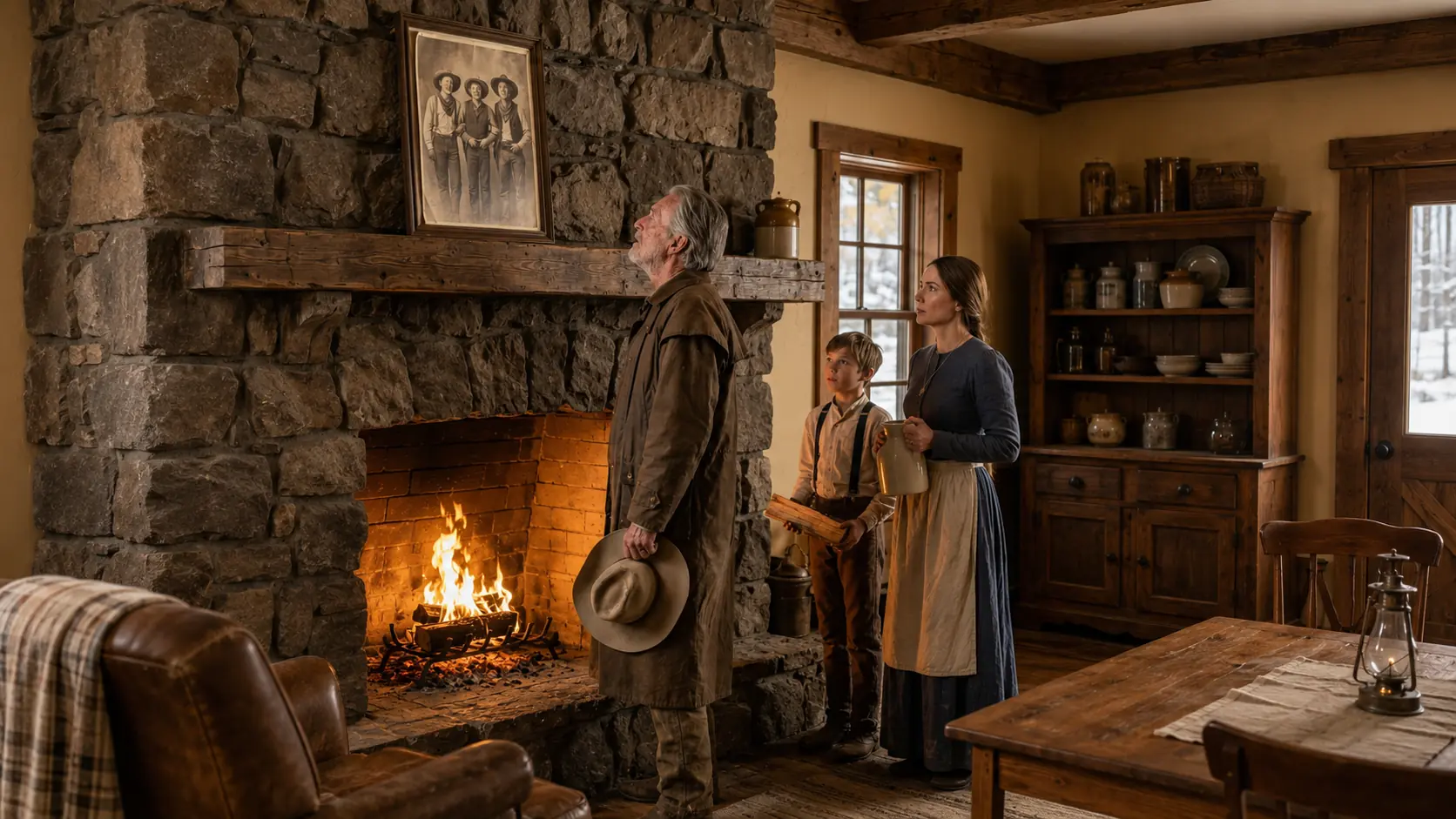
Her faded navy-blue frontier dress was protected by a cream work apron stained with soil and fence oil. Brown leather gloves covered capable hands that had delivered calves, repaired roofs, managed accounts, and defended every acre against buyers who believed a widow would eventually surrender. Beneath her collar, Thomas Whitfield’s silver wedding ring rested on a chain against her chest. She no longer wore it on her finger, but she had never spent a day without carrying it.
Nearby, twelve-year-old Samuel Whitfield carried a wooden bucket toward the horse trough. He had his father’s brown eyes, his mother’s determined jaw, and the restless energy of a boy trying to become useful before childhood had fully released him. His cream work shirt was rolled to his elbows, and dark suspenders crossed his narrow shoulders. When Sarah looked at him, she sometimes saw Thomas so clearly that the sight both comforted and wounded her.
“The fence looks better than yesterday,” Samuel said.
“It should,” Sarah replied. “You did half the work.”
“I handed you tools.”
“Sometimes that’s what keeps a ranch running.”
Samuel smiled and hurried toward the corral, pleased despite himself.
The Whitfield Ranch was not wealthy. Several neighboring families had sold their land after drought, weak cattle prices, and relentless pressure from a businessman named Horace Blackwood. Blackwood had acquired thousands of acres across Pine Creek Valley and repeatedly offered Sarah more money than she had ever seen. Each time, she told him the same thing.
The ranch had belonged to Thomas.
It would remain a Whitfield ranch as long as she could stand.
By late afternoon, the chores were nearly finished. Smoke curled from the stone chimney, chickens wandered beneath the porch, and the first snowflakes drifted through amber light. Samuel carried an armload of firewood toward the house while Sarah gathered her hammer, wire cutters, and leather tool belt. Then both of them noticed movement on the western trail.
A lone rider approached slowly.
The chestnut horse walked with its head lowered, every step showing the weight of many miles. Its rider sat straight despite obvious exhaustion, wearing a long brown trail coat and a weathered tan hat. Gray hair reached beneath the brim, framing a deeply lined face and a neatly trimmed beard. He looked old enough to have crossed half the frontier and tired enough to have felt every mile.
Sarah watched without fear, though she kept the wooden gate between them. The old cowboy carried no threat in his posture. He looked like a man held upright by stubbornness after his body had asked him to stop. When he reached the gate, he removed his hat respectfully.
“Ma’am,” he said, his voice rough from dust and open skies. “Could I trouble you for a drink of water?”
Sarah studied his horse before studying him.
“No one gets turned away thirsty here.”
Quiet gratitude crossed his face.
“I appreciate your kindness.”
Samuel unlatched the gate while Sarah led the chestnut toward the hitching rail. The animal drank greedily when the boy brought a bucket from the mountain-fed well. Sarah filled a metal cup and handed it to the rider, who accepted it with both hands. He drank slowly at first, then emptied it.
“I don’t believe I’ve ever tasted colder water,” he said.
“It comes straight from the mountain spring.”
“You’ve both traveled a long way,” Sarah observed.
“We surely have.”
The old man looked toward the mountains as if measuring the road behind him rather than the road ahead. Snow had begun gathering on the shoulders of his coat, and fatigue made his fingers tremble around the empty cup. Sarah glanced at Samuel. The boy already understood what she intended.
“You’re welcome inside,” she said. “I’ll put on coffee.”
“I don’t mean to impose.”
“You aren’t.”
The warmth of the Whitfield house wrapped around them when the front door closed. The stone fireplace crackled beneath a thick wooden mantel polished by years of careful hands. Shelves held ranch ledgers, leather-bound books, an old cavalry canteen, weathered spurs, and tools that had belonged to Thomas. A preserved saddle stood near the far wall beneath a folded wool blanket.
Samuel added another log to the fire while Sarah poured coffee. The old cowboy removed his hat again and stepped farther into the room, his sharp blue eyes moving from one familiar object to another. He paused beside the canteen, then looked toward the spurs. Something changed in his expression, but Sarah could not yet understand it.
“I’ll bring another mug,” Samuel said.
The stranger barely heard him.
His gaze had moved above the fireplace.
A faded photograph hung inside a dark wooden frame. Three young cowboys stood shoulder to shoulder beneath the Colorado mountains, their clothing dusty and their expressions filled with the careless confidence of men who had not yet learned how quickly life could change. Thomas stood in the middle, younger than Sarah had ever known him. One hand rested on another cowboy’s shoulder.
The old man stopped breathing.
His fingers tightened around his hat. His face lost its color, and the cup Sarah had just placed in his hand trembled enough to disturb the coffee. The fire cracked loudly in the sudden silence.
“Where did you get that photograph?” he whispered.
Sarah followed his stare.
“That’s my husband.”
The old cowboy stepped closer to the mantel as if twenty-five years had disappeared beneath his boots. He lifted one weathered hand and traced the edge of the frame without touching the photograph. His eyes remained fixed on the young man standing beside Thomas.
“We were boys,” he said quietly. “Or at least we thought we knew enough to call ourselves men.”
Sarah exchanged a puzzled glance with Samuel.
“You knew Thomas?”
The stranger slowly nodded.
“My name is Caleb Dawson.”
He pressed his hat against his chest.
“Your husband once saved my life.”
Samuel moved closer.
“My father saved you?”
“He surely did.”
Sarah gestured toward the table.
“I think you should sit down.”
Caleb lowered himself into a wooden chair while Sarah placed coffee before him. He warmed his hands around the mug for several moments, staring into the steam as if deciding where to begin. Outside, snow gathered on the porch rail and drifted across the yard.
“It happened twenty-five years ago,” he said. “We were driving nearly two thousand cattle through Monarch Pass before winter closed the trail.”
Samuel’s eyes widened.
“Two thousand?”
“More than any of us should’ve attempted.”
Caleb explained that three men rode point each morning: Thomas Whitfield, Henry Lawson, and Caleb himself. They were young, proud, and convinced that experience could be measured by the number of dangers they had ignored. Thomas had always been the quietest of them, but he noticed things the others missed. He could read weather in the movement of birds and weakness in a horse before the animal stumbled.
One afternoon, a rockslide frightened the herd along a narrow ridge. Hundreds of cattle surged toward the trail’s edge, and Caleb’s horse lost its footing beneath him. The animal fell sideways, throwing Caleb toward a ravine deep enough that the bottom disappeared in shadow. Thomas moved before anyone else understood what had happened.
“He grabbed my arm,” Caleb said.
The old cowboy looked down at his right hand. A long white scar crossed the skin between his thumb and wrist.
“Thomas wrapped a rope around his own arm and held me while the others pulled. It burned straight through my glove. That scar reminds me how close I came.”
“My father never told us,” Samuel said.
Caleb smiled faintly.
“That sounds like Thomas. He never believed doing the right thing deserved a parade.”
Sarah looked toward the photograph. Thomas had spoken often about cattle drives, storms, and old partners, but Caleb Dawson’s name had never entered their home. She wondered how many parts of her husband’s life had vanished with him simply because he had never thought himself worth discussing.
Caleb reached toward the leather saddlebag resting beside his chair.
“I carried something all these years.”
He removed a faded cloth bundle and placed it on the table. Inside lay a brass compass, a weathered notebook, and a folded trail map. Sarah recognized the compass immediately. Thomas had once described losing it during his years on the cattle trails.
“That belonged to him.”
“It did.”
“You kept it for twenty-five years?”
“Thomas asked me to hold these things while he met a surveyor near the end of our drive. He came back and collected most of them, but he left the map and compass behind.”
“Why?”
“I never knew.”
Caleb unfolded the yellowed map. Rivers, cattle routes, mountain passes, and hand-drawn landmarks covered the paper in Thomas’s precise handwriting. Caleb examined each corner carefully, then frowned.
“There should be another page.”
Samuel leaned forward.
“How do you remember?”
“Thomas always folded two sheets together. This trail continues beyond the edge.”
Sarah studied the empty margin.
“Maybe the other page was lost.”
Caleb shook his head.
“No. Thomas removed it himself.”
“Why would he do that?”
“Because he wanted someone to find whatever was on it.”
The words changed the atmosphere in the room. Sarah folded her arms, watching Caleb carefully. A thirsty traveler had entered her home less than an hour earlier, and now he was reopening a part of Thomas’s life she had never known existed.
“Have you been searching for us?” she asked.
“For years.”
Caleb explained that after the cattle drive, he accepted work in Wyoming and Montana. Years passed before he returned to Colorado and learned Thomas had died. By then, drought had scattered families throughout the valley, county records were incomplete, and every lead ended at an abandoned homestead or an old name no one remembered.
“Why keep looking?”
“I made him a promise.”
“What promise?”
“That if anything happened to him, I’d find his family and finish what he started.”
Caleb smoothed the map flat again. His eyes followed the hand-drawn contour lines until one finger stopped near the lower corner. Almost hidden beneath a cluster of pencil marks was a tiny symbol resembling an arrow crossed by three short lines.
His breathing caught.
“That mark,” he whispered.
“What does it mean?” Samuel asked.
“Only three men ever knew. Thomas, Henry, and me.”
Caleb explained that they had created the mark during the cattle drive. Whenever one of them found water, shelter, or something important along a dangerous route, he carved the symbol where only the others would recognize it. Thomas had drawn it beside a distant mountain bend west of Pine Creek.
“He left something behind,” Caleb said.
Sarah stared at the mark.
“What?”
“I don’t know. But Thomas never used that symbol without a reason.”
Sarah crossed the room and opened the cedar chest beside the fireplace. Inside lay Thomas’s riding coat, his saddle blanket, and the leather bags he carried into the mountains. She lifted the coat, pressing it briefly against her chest before handing it to Samuel.
“We leave at first light.”
Caleb looked toward the windows, where snow was falling more heavily.
“If the weather clears.”
“If Thomas trusted that mark,” Sarah replied, “I trust it too.”
Morning arrived beneath a clear blue sky. Fresh snow covered the high peaks, but the lower trails remained open. Sarah saddled her bay mare while Samuel prepared his sorrel gelding. Caleb checked the chestnut carefully, speaking to the animal in the low voice of someone who understood old bones.
They left after sunrise.
Aspen leaves burned gold along the creek, and the mountain slopes rose around them in layers of pine and stone. Caleb led them along trails half-erased by time. At each turn, he paused to compare memory against Thomas’s map.
“The creek was deeper here,” he said once.
“Were the mountains smaller?” Samuel asked.
Caleb smiled.
“No. We were just more foolish.”
Hours later, the old cowboy raised one hand.
Ahead stood an enormous pine tree with a trunk almost six feet across. Moss covered most of the bark, and one side had been damaged by lightning. Caleb dismounted slowly.
“I tied my horse here the day Thomas showed us the trail mark.”
He brushed away the moss with his glove. At first, only dark bark appeared. Then the edge of a carved arrow emerged beneath the green covering.
Samuel dropped beside him.
“It’s real.”
Sarah touched the carving.
“My husband made this.”
“With his own knife,” Caleb said.
The arrow pointed toward several boulders higher on the slope. They climbed between the rocks and found one large stone resting at an unnatural angle. Beneath branches, soil, and thick moss lay a flatter stone whose edges had clearly been shaped by tools.
Together, they pushed it aside.
A narrow cavity opened inside the mountain.
An iron box sat within it, rusted but intact.
Samuel whispered, “Open it.”
Caleb lifted the lid. An oilcloth bundle filled most of the box, protecting a leather journal, original county surveys, witness statements, land records bearing official seals, and several unopened letters. Sarah touched Thomas’s handwriting on the journal as though touching his hand.
She opened the first page.
If you’re reading this, I wasn’t able to return. Protect the truth and protect our valley.
Sarah closed her eyes. For five years, Thomas had existed only in memory, photographs, and the habits Samuel had inherited. Now his words reached her directly from a place he had prepared for the possibility of his death.
Caleb gathered the papers carefully.
“We found what he wanted protected.”
“What truth?” Samuel asked.
Sarah examined the surveys.
“Something powerful enough to hide in a mountain.”
They secured the iron box behind Sarah’s saddle and began their descent. None of them noticed three riders watching from a distant ridge. One raised a brass spyglass, saw the box, and immediately turned toward Pine Creek.
By early afternoon, Sarah, Caleb, and Samuel entered town. News traveled faster than horses in a frontier settlement, and people gathered before they reached the courthouse. Sheriff Benjamin Hayes stepped onto the porch, studying their expressions and the iron box.
“Sarah?”
She removed Thomas’s journal from her saddlebag.
“My husband left something you need to see.”
Inside, county clerk Abigail Mercer cleared the large oak table and began comparing the recovered documents against official land ledgers. Ranchers, merchants, and families who had known Thomas filled the courtroom. Horace Blackwood entered last, dressed in an expensive black coat and wearing the confident smile of a man accustomed to controlling every room.
“What seems to be the excitement?” he asked.
No one answered.
Abigail examined each map, statement, and seal. The silence grew deeper as she compared Thomas’s original surveys to the county copies. Entire boundary lines had been moved after Thomas filed his work. Ranches had lost hundreds of acres, and valuable water rights had disappeared.
At last, Abigail removed her spectacles.
“These documents are authentic.”
She opened another ledger.
“The official records were altered after Thomas Whitfield completed his surveys.”
“Who benefited?” Sheriff Hayes asked.
Abigail raised her eyes toward Horace.
“One buyer.”
Horace remained still.
“You.”
Whispers moved through the courtroom.
“This is absurd,” Horace said. “Old papers prove nothing.”
“They prove property lines were deliberately changed,” Abigail replied. “Every false transfer led to a company controlled by you.”
Horace stepped closer.
“I’ve been an honest businessman for thirty years. You expect this town to believe a dead rancher over me?”
Caleb rose slowly.
The room fell silent.
He reached into the saddlebag he had carried for twenty-five years and removed a sealed envelope. The paper had yellowed, but the wax remained unbroken.
“Thomas gave me this before we parted.”
Sarah looked at him.
“You never opened it?”
“He told me not to unless he failed to return.”
Caleb handed it to the sheriff.
Benjamin Hayes broke the seal and read the letter silently before addressing the room.
“If this letter is being read, then the evidence I gathered has become more important than my own name. The maps, witness statements, and land records hidden in the mountains reveal every false claim made against the families of Pine Creek Valley. Trust Caleb Dawson. He knows where the truth rests.”
The sheriff lowered the letter.
“There is no doubt.”
Horace’s confidence finally disappeared.
“You knowingly stole land from honest families,” Benjamin said.
Horace glanced toward the courthouse doors, but two deputies had already moved into place. He raised his hands without resistance as the sheriff placed him under arrest for forgery, fraud, and unlawful land transfers.
No one cheered.
The families whose farms had been stolen simply stood together while the truth returned what money and influence had taken. For Sarah, that silence felt more powerful than celebration.
In the weeks that followed, county officials restored the original boundaries. Water rights returned to ranches that had nearly failed, and several families came home to land they had believed lost forever. Horace’s companies were seized while investigators examined decades of transactions.
At the Whitfield Ranch, new fence posts marked the correct property line. Healthy cattle grazed beside the creek, and sunlight once again reached pastures Blackwood had tried to claim. Thomas’s photograph remained above the fireplace, but Sarah no longer looked at it with unanswered questions.
One morning, Caleb saddled his chestnut near the front gate.
Samuel hurried toward him.
“Do you have to leave?”
Caleb smiled gently.
“I’ve spent most of my life riding from one horizon to another.”
He reached into his coat and removed Thomas’s old pocket knife. Its wooden handle was worn smooth by years of use.
“This belongs to you now.”
Samuel accepted it carefully.
“My father’s?”
“He carried it the day he saved my life.”
“I’ll take care of it.”
“I know.”
Sarah stepped from the porch. For a long moment, she and Caleb stood without speaking. Snow had not yet returned, but cold wind moved through the cottonwood leaves and carried the smell of winter from the mountains.
“You came here hoping to keep one promise,” Sarah said.
Caleb looked toward Thomas’s photograph through the window.
“You helped me keep it.”
“You did much more than that.”
The old cowboy placed his hat over his heart.
“So did Thomas.”
Before mounting, Caleb looked at Samuel.
“Your father was the best man I ever knew. Not because he saved me, but because he believed doing right mattered even when nobody would know his name.”
Samuel closed his fingers around the knife.
“I want to be like him.”
“Then be kind when it costs you something. That’s where a man’s character shows.”
Caleb climbed into the saddle. His chestnut turned toward the western road, but before they moved, the old cowboy looked once more through the front window.
“You can rest easy now, Thomas,” he whispered.
He touched his hat and rode away.
Sarah and Samuel remained at the gate until horse and rider disappeared beyond the golden hills. Inside the house, late-morning sunlight fell across the photograph above the stone fireplace. Three young cowboys stood shoulder to shoulder, smiling at a future they could not yet understand.
Twenty-five years had passed.
One friendship had survived distance, grief, and silence.
Thomas had protected the valley by hiding the truth. Caleb had protected Thomas’s promise by refusing to stop searching. Sarah had protected both by offering water to a tired stranger when she had no reason to believe he carried anything more than dust.
The old cowboy had arrived asking for nothing but a drink.
He left having returned a husband’s final legacy to the family who had waited years to understand it.