The auctioneer almost skipped Lot 118. By that late hour, buyers were already drifting toward the doors, coffee had gone cold in paper cups, and most of the serious money had been spent on thick-bodied commercial bulls and heavy replacement heifers. Then thirteen deep-red cattle with black points walked quietly into the sale ring, smaller than the animals that had preceded them but wide through the ribs, firm on their feet, and strangely calm beneath the noise. The auctioneer looked at his paperwork and cleared his throat. “Thirteen registered Pine Ridge Heritage cattle—the final intact breeding group.”
Nothing happened. Someone near the back laughed and called them museum cows, another rancher said they were too small to make money, and a third predicted the breed would disappear within a few years whether anyone bought them or not. Margaret Hale sat without smiling, her green eyes fixed on the cattle as they moved together around the ring. Nathan Briggs, who had managed the Hale Ranch alongside her family for nearly twenty years, leaned closer and whispered, “You’re thinking about it.” Margaret answered without looking at him, “I already decided yesterday.”
When the auctioneer finally asked for an opening bid, Margaret raised one hand. Heads turned immediately, but nobody challenged her, and the auction ended with three almost embarrassed strikes of the gavel. Just like that, the last thirteen registered Pine Ridge Heritage cattle belonged to Hale Ranch. Margaret did not celebrate, because she knew buying them was the easiest part of what came next. The real question was whether she had just protected something valuable or spent good money proving an entire county right.
Dale Harper caught her beside the livestock trailer before she could leave. He was sixty-one, gray-haired, broad through the shoulders, and experienced enough that younger ranchers often repeated his opinions before developing their own. “You really bought them?” he asked, staring through the slats at the cattle chewing hay. Margaret nodded, and Dale folded his arms. “They finish slower, they don’t reach modern weights, and you’ll never compete with improved genetics.”
“We’ll see,” Margaret replied. She climbed into the truck without defending herself further, which irritated Dale more than an argument would have. Behind her, the thirteen cattle stood quietly in the trailer as though they knew nothing about markets, breed associations, or the men predicting their extinction. Margaret drove west toward Hale Ranch with Nathan following behind in another truck. By sunset, everybody at the county diner already knew what she had done.
The Pine Ridge breed had not always been rare. Generations earlier, cattle like these had been scattered across rough ranches where winters were severe, pasture was inconsistent, and veterinary help might be hours away. They had never been bred to win competitions for maximum size; they had been bred by survival itself, selected year after year for feet that held up, cows that mothered calves without help, animals that could walk far for grass, and bodies capable of maintaining condition when easier cattle struggled. Then cattle production changed, and the market rewarded faster gains, larger frames, and heavier finished animals.
Year after year, Pine Ridge herds disappeared. Ranchers sold their cows, breed numbers collapsed, and eventually the remaining registered animals were concentrated in a small conservation program that could no longer afford to continue. When its funding ended, the final thirteen went to auction. Most buyers saw obsolete cattle that could not compete with newer bloodlines. Margaret saw a genetic library that might close forever if no one carried it home.
She had first heard the name Pine Ridge when she was fourteen. Her grandfather, Samuel Hale, had been showing her an old photograph hanging crookedly inside their barn, a faded image of his own grandfather standing beside several red cattle Margaret did not recognize. “They’re smaller,” she had said. Samuel had smiled and answered, “They lived longer too.”
Margaret remembered studying the photograph. “They don’t look weak.” Samuel shook his head. “They weren’t weak. They raised calves on grass when bigger cattle needed grain.” When she asked why everyone had stopped raising them, her grandfather had stared at the photograph for a long time before saying something Margaret never forgot: “Sometimes we chase efficiency until we accidentally lose resilience.”
Years later, at a livestock genetics conference, Margaret sat through a presentation most attendees skipped. The researcher spoke about heritage bloodlines and the traits that vanished when breeds disappeared: disease resistance, fertility, longevity, heat tolerance, efficient forage use, maternal instinct, sound feet, and the ability to remain productive under conditions modern animals had rarely experienced. None of those traits looked exciting on a sale catalog. But once genetics vanished, the speaker warned, they could not simply be manufactured again when producers suddenly needed them.
Margaret filled nearly an entire notebook that afternoon. She did not immediately decide to become a breed conservationist, and she did not begin searching the country for rare cattle. She simply started paying attention. Three years later, when she heard the final Pine Ridge breeding group was being liquidated, she drove to the auction knowing exactly what she would do. The laughter only confirmed how little competition she would face.
The cattle arrived at Hale Ranch after dark. Margaret did not place them in polished show pens or feed them heavily to make them appear larger. The next morning, she and Nathan moved them onto a section of the ranch most cattle rarely used—a rough stretch of broken hills, rocky draws, native bunchgrass, and scattered cedar. Nathan watched the animals spread almost immediately instead of gathering near the easiest water and feed.
“They’re climbing,” he said. Margaret adjusted her tan hat against the wind. “They’ve always climbed.” Within weeks, the thirteen were using parts of the property that Hale Ranch had barely grazed for years, working slowly across hillsides commercial cows generally ignored. When a county grazing specialist visited, he stood with binoculars for nearly an hour before admitting, “They’re harvesting grass I didn’t think was worth counting.”
That observation went into Margaret’s records. She documented grazing areas, weights, body condition, water use, mineral consumption, veterinary expenses, and anything else she believed might matter later. Samuel had taught her never to trust memory where livestock were concerned. “If you think an animal is good, write down why,” he used to say. “If the numbers disagree with your pride, believe the numbers.”
The first calving season arrived with cold spring rain and nights that kept Margaret awake. Pine Ridge cows had been praised historically for maternal ability, but history could become mythology when repeated often enough. Margaret checked the herd constantly, expecting at least one difficult delivery. One calf appeared, then another, then another, each standing quickly and nursing without anyone dragging chains or calling the veterinarian.
Nathan found Margaret watching a red cow clean a newborn calf beneath a cottonwood. “We haven’t pulled one,” he said. Margaret smiled faintly. “Grandpa wrote the same thing.” That evening, she opened Samuel’s old notebooks and found the entries he had made decades earlier when he briefly kept four Pine Ridge cows. The language was plain but consistent: excellent mothers, sound udders, healthy calves, minimal assistance, productive on poor pasture.
Samuel had eventually sold those cows. Not because he disliked them, but because buyers no longer wanted the bulls and he could not justify keeping a tiny isolated group. Near one entry, he had written in heavier pencil: Should have kept the females. Margaret read that sentence several times. She closed the notebook and decided she would not repeat his regret.
The county remained amused. At the Saturday diner, Dale Harper told anyone willing to listen that Margaret was building a history museum with hooves. Other ranchers asked whether she planned to sell tickets for people to visit the antiques. When Margaret entered one morning carrying fencing supplies, the room went suspiciously quiet before Dale smiled and asked, “How are the collector’s items?”
“Settling in,” Margaret said. Dale leaned back. “Planning to charge admission?” She placed her supplies beside the counter and answered, “No. I’m planning to breed them.” The laughter returned, and Margaret let them enjoy it.
The second year was when the joke started becoming less comfortable. Rain disappeared early, pasture browned weeks before normal, and hay prices began climbing fast enough to make even wealthy producers uneasy. Large-framed cows that normally entered summer in excellent condition required supplemental feed sooner than expected. Margaret’s commercial herd needed help too.
The Pine Ridge cattle kept climbing. They moved through the roughest country on the ranch, feeding on native vegetation Margaret had never considered important enough to calculate carefully. Nathan scored their condition twice because he distrusted his first numbers. “They’re holding,” he said. Margaret nodded. “That doesn’t mean they don’t feel the drought. It means we finally know what they were built for.”
She refused to exaggerate the results. The Pine Ridge cattle were not magical, and Margaret never described them that way. They still needed water, minerals, fencing, veterinary oversight, and competent management, but they needed noticeably less supplemental feed to maintain condition than many larger cows. She recorded every bale, every pasture move, and every treatment because sooner or later she knew somebody would accuse her memory of improving the story.
The county veterinarian visited during pregnancy checks that autumn. He went through the animals methodically, examining feet, teeth, udders, condition, reproductive status, and general health. After finishing one older cow, he removed his glove and stared at her for several seconds. “How old?”
“Almost fourteen,” Margaret replied. The veterinarian looked back at the cow. “Still raising one every year?” Margaret nodded, and he gave a quiet laugh. “A lot of modern cows are gone long before that.”
He did not become a Pine Ridge evangelist that afternoon. He simply admitted the old cattle were more functional than he had expected. That was enough. In agricultural communities, curiosity often spreads more effectively than praise, and within months neighboring ranchers started appearing at Hale Ranch asking to see the cattle. Some came prepared to laugh and left asking questions.
One man watched the Pine Ridge cows graze cedar-covered hillsides and said, “They don’t seem interested in your easy pasture.” Margaret pointed toward the lower ground. “They already ate it.” He stared another moment before laughing. “I’ve never seen cattle work this hard for groceries.”
“They don’t know they’re working,” Margaret said.
The first weaned calves did not top the sale. They were not the heaviest and did not suddenly make Margaret richer than everyone who had doubted her. Several conventional buyers passed them without interest. Then a grass-finished beef producer stopped, studied the calves, asked questions about the cows, and wanted to know exactly what breed they were.
“Pine Ridge Heritage,” Margaret told him. The buyer smiled instead of laughing. “I’ve been looking for cattle like this.” He cared about moderate mature size, forage efficiency, calving ease, and cattle that could perform on grass rather than maximum feedlot growth. Nathan watched the conversation from across the pens and later asked Margaret whether she had known that market existed.
“I suspected somebody would eventually remember why these cattle existed,” she answered. The distinction mattered. Margaret was not trying to make Pine Ridge cattle beat commercial breeds at being commercial breeds. She was trying to determine whether their old traits still had value under the conditions they had evolved to handle.
Over the next two years, the thirteen became twenty-two. Twenty-two became thirty-six. Margaret sold very few females, even when buyers offered prices that would have made immediate business sense. She evaluated young bulls carefully and released only animals that strengthened rather than scattered the bloodline.
Nathan once placed a stack of purchase requests on her desk. “You could sell every animal twice.” Margaret continued studying a breeding chart. “That’s exactly why we won’t.” Nathan smiled because he already knew the sentence she was thinking about, one Samuel had written years earlier in bold letters: Never rebuild a rare herd by selling its future.
Margaret structured the breeding program around that rule. Registrations were checked, pedigrees mapped, close matings avoided when possible, and reproductive records tracked carefully. Veterinary observations, weights, pasture performance, calf survival, and longevity all went into the system. The purpose was not simply producing more red cattle; it was preserving the useful diversity that remained inside a dangerously small population.
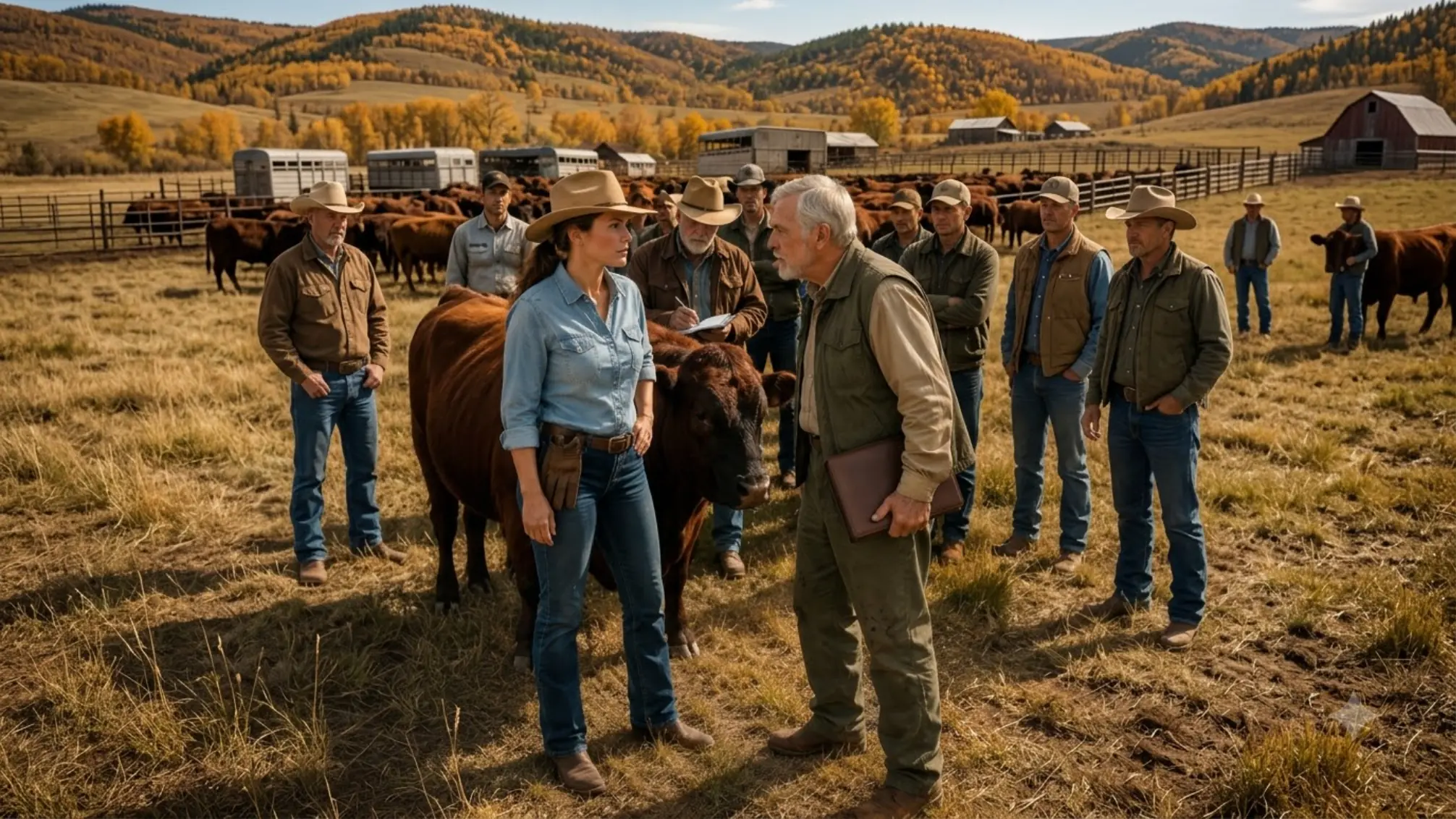
Late one autumn afternoon, a convoy of pickups rolled through the Hale Ranch gate. A livestock geneticist from the state university stepped out with representatives from the state beef association and the director of a livestock conservation organization. Dale Harper came too, carrying a leather folder and looking less amused than he had at the diner years earlier. Margaret stood beside a large Pine Ridge bull while the visitors spread across the pasture.
The conservation director raised binoculars toward cows grazing with calves at their sides. Nathan stood near Margaret, hands in his jacket pockets, while an older field specialist wrote notes on a clipboard. After a long silence, the director lowered his binoculars. “Margaret, do you realize you may now own the largest remaining pure Pine Ridge breeding herd anywhere in the country?”
“I knew we had rebuilt numbers,” she said. The director opened his folder. “You did more than rebuild numbers.” He showed her the registry data and explained that after the most recent calf crop, nearly seventy percent of remaining registered Pine Ridge cattle traced directly to Hale Ranch. Margaret stared across the pasture, not because she felt powerful, but because she finally understood how close the breed had come to disappearing.
Dale stepped toward her. “You paid good money for thirteen museum cows nobody wanted.” Margaret turned. “Then why are you standing on my land asking about them?” He tightened his grip on his folder and replied, “Because smaller cattle still don’t change the market, and one dry year doesn’t prove you were right.”
Margaret held his gaze. “Come back after winter.” Dale's expression hardened. “What happens then?” Margaret looked toward the herd. “Then you can tell me what survived, what it cost, and whether the numbers care who laughed at the auction.”
That winter was difficult but not extraordinary enough to settle the argument. Another summer brought expensive hay, weak pasture growth, and escalating feed costs across the county. Large cattle required earlier supplementation again. The Pine Ridge herd remained remarkably stable on steep native pasture, and Margaret’s records showed they had consumed substantially less winter hay than her commercial cattle.
Dale returned carrying a notebook instead of jokes. He stood at the fence for half an hour before asking, “How much less hay?” Margaret handed him the records. “About forty percent compared with the commercial group under our conditions.” Dale read the figures twice.
“You’re serious?” he said. Margaret pointed at the pages. “Every bale is there.” She placed Samuel’s older notebook beside her own, decades of observations separated by handwriting but describing many of the same tendencies. Dale closed both books slowly. “I thought smaller meant worse.”
“It sometimes means different,” Margaret replied.
The state university proposed a five-year study the following autumn. Margaret agreed on one condition: the work had to measure the cattle as they actually functioned, not design a test meant to prove either side correct. Researchers compared Pine Ridge and commercial cattle under drought, heat, rough grazing conditions, reproductive pressure, and ordinary veterinary management. The data began accumulating quietly.
The Pine Ridge cattle did not dominate every category. Their calves did not suddenly outweigh high-performance commercial calves, and Margaret never expected them to. Instead, the researchers found a broader pattern: the cows traveled farther to forage, required fewer interventions, maintained strong fertility during difficult periods, remained useful later in life, and consistently produced calves with surprisingly little assistance. They were rarely spectacular in one isolated trait, but they were difficult to break.
After reviewing the first major data set, the lead researcher stood beside Margaret overlooking the herd. “You know what’s unusual?” he asked. She waited. “They aren't exceptional at one thing. They’re consistently good at almost everything that keeps a cow working.”
Margaret smiled. “That’s how Grandpa described them.” The researcher looked back toward the cattle. “Modern breeding often pushes hard on traits we can measure quickly.” Margaret nodded. “Samuel worried about the things people only notice after they’re missing.”
Interest accelerated. Grass-finished producers wanted bulls, mountain ranches asked about females, universities requested genetic material, and conservation grazing programs wanted breeding groups. Margaret could have sold aggressively and made a fortune from scarcity. She refused.
Nathan once found her surrounded by letters and offers. “Some of these people will pay almost anything.” Margaret pushed one request aside. “That’s exactly when you have to stop thinking about today's check.” The herd was still vulnerable, and a few disastrous breeding decisions could narrow the genetics faster than natural expansion could restore them.
She sold selected bulls under contracts requiring accurate records. Females remained at Hale Ranch until population numbers became strong enough to support broader distribution. Researchers collected reproductive and genetic information, while Margaret continued doing the ordinary work that attracted less attention: pasture rotations, fence repair, calving checks, health records, winter planning, and keeping animals alive. The breed grew because somebody treated conservation like livestock management rather than nostalgia.
Two years later, the conservation director returned with ranchers from several western states. One stopped beside a sixteen-year-old Pine Ridge cow nursing another healthy calf. “Sixteen?” he asked. Margaret nodded. “Still raising one every spring.”
The visitor shook his head. “Most of mine are gone years earlier.” Another man crouched to examine the cow’s feet and asked how often Margaret trimmed them. “We don’t,” she answered. “These cattle have spent generations walking rocky country.”
Then came the winter that ended most of the laughter. A series of storms moved across the valley, icing roads, burying pasture, and keeping temperatures below freezing for weeks. Equipment failed, feed trucks struggled, and ranchers burned through hay faster than expected. Nobody in the county found it funny.
Margaret prepared the Pine Ridge cattle carefully but resisted the temptation to overmanage them. The herd moved toward cedar ridges on its own, using terrain as shelter, breaking through lighter snow to reach dormant grasses, and staying tightly organized during the worst weather. Cows protected young calves with an instinctive steadiness Margaret had read about in Samuel’s notebooks. Losses remained remarkably low.
Dale arrived after the roads reopened. He leaned on the fence without saying anything for a long time, watching red cows move across snow-covered ground. Margaret eventually walked beside him. “You came back after winter.”
Dale nodded. “You know what finally convinced me?” Margaret waited. “They never panicked.” He watched an older cow lead several younger animals toward shelter. “Not once when the storm got ugly.”
Margaret looked toward the same animals. “They’ve seen winters like this before.” Dale glanced at her. “Not these cattle.” She smiled slightly. “No. Their ancestors did.”
That was the point Margaret had struggled for years to explain. Genetics were memory written into living animals—not conscious memory, but generations of selection for the ability to function under specific pressures. Producers had not been foolish to pursue bigger calves or faster growth; those goals had made economic sense under the systems that rewarded them. The mistake was assuming every trait outside that system had become useless forever.
The university research project ended five years after it began. Its conclusion did not declare Pine Ridge cattle the largest, fastest, or most profitable breed under every production model. Instead, researchers described a population unusually resilient across several practical traits under demanding ranch conditions. The wording mattered to Margaret because it matched what she had seen from the beginning.
Agricultural publications picked up the report. Breed conservation organizations called. Universities created partnerships, ranchers began placing orders for bulls years before those animals were born, and young producers who had never heard of Pine Ridge cattle started asking whether the breed might suit low-input and grass-based operations. The cattle everyone had treated as relics were suddenly relevant again.
Margaret remained cautious. Popularity could destroy a rare breed almost as easily as neglect if breeders chased fashion, narrowed bloodlines, or sold animals too quickly. She created a registry committee with independent genetic advisers and participating ranches. Every participating herd submitted birth records, parentage information, health data, and breeding histories.
Dale surprised her by volunteering. Margaret stared at him across the meeting table. “You’re serious?” Dale shrugged. “I’ve spent enough years telling people what I thought. Maybe I should spend a few learning something.”
“You know I’m going to remind you about the museum cows.” Dale sighed. “Until I die, apparently.” Margaret smiled. “Probably longer if I write it down.”
The first Pine Ridge bull Dale bought came from a cow line Margaret had protected from the original thirteen. He did not replace his commercial herd with Pine Ridge cattle, nor did Margaret encourage him to. Instead, he used the genetics strategically in a part of his operation where feed costs and difficult terrain made moderate, hardy cattle attractive. The results were not miraculous, but they were good enough that Dale purchased another bull two years later.
That pleased Margaret more than an apology would have. She had never wanted Dale humiliated. She wanted ranchers to make decisions based on evidence instead of habit, including herself. If Pine Ridge cattle had failed every test, she would have had to accept that too.
One spring, Hale Ranch received an invitation to exhibit several animals at the state fair. Children crowded around the calm calves, university students asked technical questions, and older ranchers stood reading the breed history board in silence. One elderly man removed his hat as he stared at a red cow with black points.
“My grandfather raised cattle just like these,” he said. Margaret smiled. “He probably knew something we forgot.” The man looked at her for a long moment before nodding. “Or something we thought we’d never need again.”
Late that afternoon, the auctioneer from the original sale found Margaret beside the pens. He looked older but recognized her immediately. “I've thought about that auction more than once,” he admitted. Margaret laughed. “So have I.”
“I almost skipped the lot.” “You nearly did.” He watched a calf nudge its mother. “I thought nobody cared.”
Margaret rested her arms on the fence. “I cared.” The auctioneer shook his head. “No. You cared before everyone else remembered why they should.” He tipped his hat and walked away.
That evening, after the fairgrounds emptied, Margaret stayed beside the oldest cow descended directly from the original group. The animal pressed her nose against Margaret’s shoulder before returning to her calf. Margaret remembered the sale barn, the laughter, the empty bidding cards, and the phrase museum cows echoing through the seats.
People had looked at thirteen animals and seen an ending. Margaret had looked at them and seen traits accumulated over generations that could not simply be rebuilt once lost. She had never tried to prove the past was superior to the present. She had only refused to destroy the past before understanding what it still knew.
Years after that auction, Pine Ridge herds existed on multiple ranches again. University programs stored genetic material, breeders exchanged carefully selected bloodlines, and conservation organizations no longer listed the breed as being dependent on one final group. Hale Ranch still maintained the largest foundational herd, but Margaret considered that temporary by design.
Success meant the breed no longer depended on her. It meant a fire, drought, disease outbreak, financial crisis, or one rancher’s bad decision could never again erase nearly the entire population. So she trained younger breeders, shared Samuel’s records, and insisted every animal leaving Hale Ranch carried more than registration papers. It carried responsibility.
Nathan found her one afternoon repairing a fence beside the pasture where the original cattle had first grazed. He was older now, slower in his steps, but still capable of spotting a loose wire from fifty yards away. “Remember the first day?” he asked.
“When everyone thought I was crazy?” “I didn’t say crazy.” Margaret looked at him. “You definitely thought it.”
Nathan laughed. “I thought you were taking a risk.” Margaret tightened the wire. “I was.” She stood and looked across hundreds of red cattle scattered over the hills, some pure Pine Ridge, others belonging to research and breeding groups bound for new ranches.
“Was it worth it?” Nathan asked. Margaret thought about the question longer than he expected. She could have answered with cattle prices, breeding contracts, research grants, reduced feed costs, or the growing waiting list. Instead, she pointed toward a young heifer climbing a rocky hillside beside her mother.
“That calf exists because thirteen animals got on my trailer when nobody else raised a hand.” Nathan nodded. “Then I suppose that answers it.” Margaret smiled. “For me, it does.”
Dale visited again that autumn. This time no confrontation waited at the gate, and no leather folder held arguments against the breed. He brought his own herd records. Several Pine Ridge-cross cows had remained productive through another poor grazing year, and he wanted Margaret’s opinion on which replacements to retain.
They spread the records over the hood of his pickup. Dale pointed at one line. “This one isn’t the biggest calf.” Margaret checked the dam history. “Her mother is twelve, bred back early, and hasn’t needed treatment in four years.”
Dale stared at the page. “Ten years ago I would’ve sold her.” Margaret nodded. “Ten years ago you were paid to notice different things.” He smiled. “You always have to make it sound reasonable, don’t you?”
“Usually.” “Takes all the fun out of arguing.” Margaret closed the folder and handed it back. “You can still call them museum cows if that helps.”
Dale laughed. “Not anymore.” He looked across Hale Ranch where cattle moved slowly through autumn grass. “Museums keep dead things.”
Margaret followed his gaze. “Exactly.”
By then, Samuel Hale had been gone many years. His old notebooks were kept inside a fireproof cabinet at the ranch office, their pages scanned and copied for researchers and participating breeders. Margaret still preferred holding the originals.
The handwriting reminded her that none of this knowledge had begun with her. Samuel had learned from his father, who had learned from people before him, each generation watching animals survive conditions spreadsheets could only describe afterward. Margaret had simply been the person standing in the auction ring when that chain almost ended.
Near the back of Samuel’s final notebook, she found a sentence she had overlooked when younger. It was written beneath records from a particularly difficult winter. The best cow is not always the one that gives you the biggest number today. Sometimes she is the one still standing there tomorrow.
Margaret copied the sentence onto a card and pinned it above her desk. Visitors occasionally assumed it was sentimental. She never corrected them unless they asked.
Because the entire Pine Ridge story had become a lesson about time. Markets measured pounds this year. Auctions measured value that afternoon. Feed bills measured costs that month.
Resilience measured something slower. It asked which cows bred back after drought, which feet remained sound after years of rocky pasture, which mothers raised calves without intervention, and which animals still performed when conditions stopped being convenient. Those traits were difficult to celebrate until the day everyone needed them at once.
The ranchers had not been wrong that Pine Ridge cattle were smaller. They had not been wrong that they grew more slowly than many modern commercial animals. They had been wrong only when they assumed those facts meant the breed had nothing left to offer. Margaret’s achievement was not proving bigger cattle bad and old cattle good.
She proved that agriculture becomes fragile when it confuses one definition of efficiency with the only definition that matters. A breed could lose one race and still carry traits worth saving for another. Diversity was not nostalgia. Sometimes it was insurance nobody understood until the weather sent the bill.
Long after national attention moved on to other stories, Hale Ranch continued breeding Pine Ridge cattle. Calves were born. Old cows retired. Young bulls left for new herds under careful agreements.
Most days were ordinary. That pleased Margaret. Survival became meaningful only when it eventually stopped looking extraordinary.
One evening she rode alone across the upper pasture as the Montana sun fell behind the hills. Red cows grazed through tall grass while calves moved beside them, their dark faces catching the final light. No reporters were there, no researchers, no conservation officials, and no ranchers waiting to admit they had been wrong.
Margaret dismounted beside an old cedar and listened to cattle pulling grass. Somewhere in the herd walked descendants of every female she had bought at Lot 118. Somewhere on ranches hundreds of miles away, more descendants were doing the same thing.
She thought again of the auctioneer hesitating over the paperwork. Thirteen cattle. No bids. One laugh from the back.
Then she remembered raising her hand.
That small movement had not saved the breed by itself. Records saved it. Careful breeding saved it. Drought data, calving records, university research, responsible sales, and years of refusing easy money saved it.
But none of those things could have happened if somebody had not first been willing to look foolish.
Margaret watched the herd until the light disappeared. Her grandfather’s warning returned to her with the clarity of his voice inside the old barn: sometimes people chased efficiency until they accidentally lost resilience. She finally understood there was another half to the lesson.
Sometimes the future survived because one person refused to throw away what everyone else had stopped valuing.
The county would remember Margaret Hale as the ranch woman who bought thirteen cattle everyone laughed at. Agricultural researchers would remember the Pine Ridge data, conservationists would remember the recovery program, and ranchers like Dale would remember the winters that forced them to reconsider what good cattle looked like. Margaret remembered something simpler.
Thirteen quiet animals had entered a nearly empty auction ring with nobody waiting to save them. She had not known exactly what they would become. She had only known that once the final genetics disappeared, nobody could bid on them again.
So she raised her hand.
And years later, across Montana and beyond, hundreds of red cattle still walked the grass because she did.