“Keep digging, boy—you’re making a fine grave for the farm I’ll buy after your family goes broke.”
Sixty-seven-year-old Silas Crowley crouched beside the trench with a cruel grin stretched across his weathered face. His battered hat cast a narrow line over his pale blue eyes, and the knees of his faded overalls were dark with Kansas dust. Below him, thirteen-year-old Eli Merritt scraped damp soil from the edge of a flat stone buried nearly three feet beneath the dead field.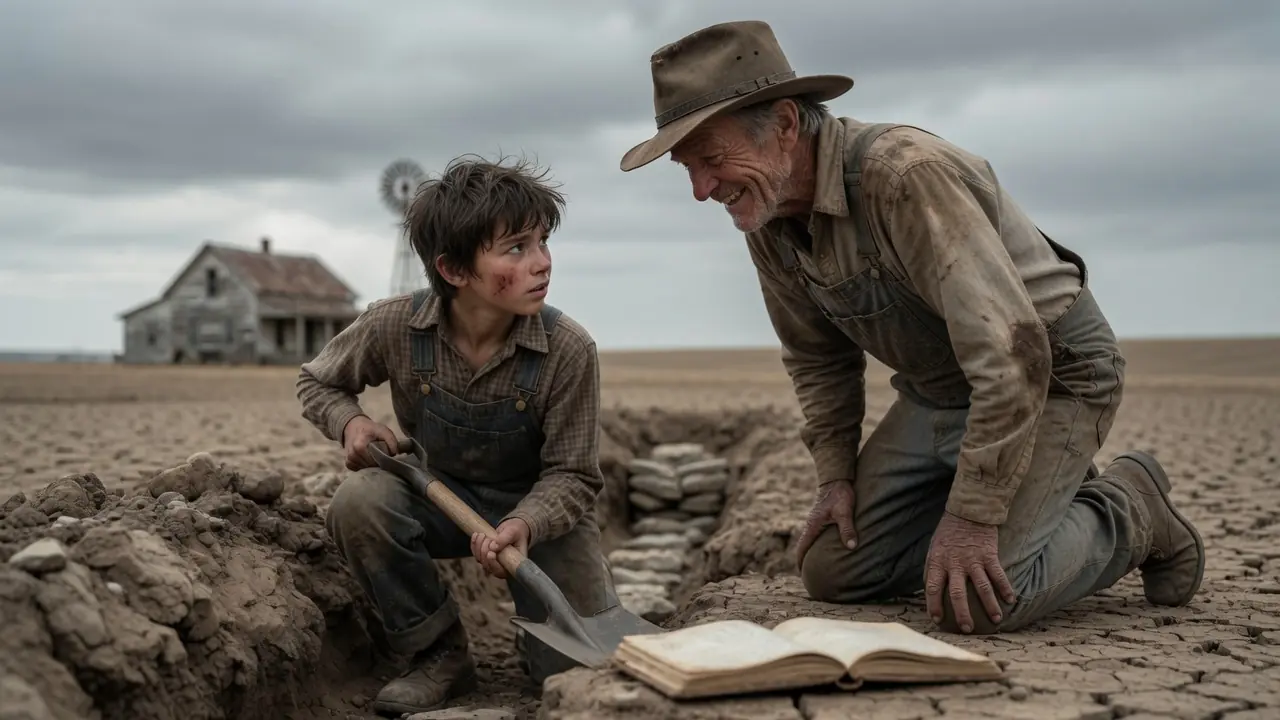
“Stand closer,” Eli said without looking up. “I want the ground to recognize the man who spent forty years lying about what’s beneath it.”
Silas’s grin disappeared.
He reached into the trench and snatched the weathered journal lying beside Eli’s shovel. “Dead dirt doesn’t confess, and dead men don’t leave miracles for stupid children.”
Eli pressed one ear against the newly exposed stones. Beneath the silence of the abandoned back forty, something faint tapped and whispered below the earth.
“Then move your boot, Silas,” he said. “The water you stole is already knocking underneath it.”
The back forty had not produced a decent crop in twenty-two years.
It lay beyond the Merritt family’s working fields, a broad stretch of cracked soil, yellow weeds, and rusted fence posts beneath an old windmill that no longer turned. Eli’s father, Nathan, called it exhausted land. His grandfather had called it cursed.
Silas Crowley called it worthless whenever he visited.
Then he offered to buy it.
For three summers, drought had tightened its grip on western Kansas. The Merritts’ wheat came in thin, their cattle feed costs doubled, and the well beside the farmhouse dropped another six feet. Nathan had begun selling equipment quietly, one piece at a time, hoping his wife and children would not understand how close the bank had moved toward foreclosure.
Eli understood.
He heard the whispered conversations after bedtime. He saw his mother, Rebecca, placing unopened bills beneath a flour tin as if hiding them might slow the dates printed across the top. He noticed when his father stopped filling his own dinner plate until everyone else had eaten.
Silas noticed too.
He owned the farm north of theirs, nearly eight hundred acres of irrigated corn that stayed green while neighboring fields turned brown. His wells remained strangely full, and his drainage ponds never completely dried, though he claimed superior equipment and better planning were responsible.
Every few weeks, Silas arrived in his dust-covered pickup with another offer.
The first was twenty thousand dollars for the back forty.
The second was fifteen.
By August, he offered eight thousand and spoke as though he were doing Nathan a favor.
“It won’t grow anything,” Silas said one evening at the kitchen table. “You’re paying taxes on a graveyard.”
Nathan pushed the papers back. “It belonged to my grandfather.”
“Your grandfather is dead.”
Eli had been standing near the doorway.
Silas noticed him and smiled. “Sentiment is expensive, boy. Remember that when this place belongs to the bank.”
After Silas left, Nathan stared through the window at the dead field.
“He’s right about one thing,” Nathan said quietly. “That land isn’t helping us.”
Eli did not answer.
The following morning, he climbed into the attic above the barn and opened a cedar trunk that had belonged to his great-grandfather, Amos Merritt. Inside were old tax receipts, seed catalogs, black-and-white photographs, and a leather journal tied with cotton string.
Amos had farmed the property during the 1930s and 1940s.
His handwriting leaned sharply across the pages, filled with weather notes, crop yields, and measurements Eli did not understand. Several entries referred to a stone line, the north marker, and something called the buried run.
One sentence appeared three times.
Water remembers the road men forget.
Eli carried the journal outside.
The back forty looked no different than it had the day before, but he began walking it according to Amos’s measurements. Forty-seven paces south of the dead cottonwood. Thirty-two east toward the windmill. Twelve from a stone marker nearly swallowed by soil.
At the end of the count, he found nothing.
He returned the next day and tried again.
This time, he noticed one patch of ground remained cooler beneath his palm than the surrounding soil. The difference was slight, but in the late-August heat, even a little coolness felt impossible.
He marked it with an iron stake.
For six mornings before school, Eli dug.
He used a narrow shovel to remove the first layer of hard soil, then a hand trowel when the trench deepened. The work blistered his palms and filled his boots with dirt. His younger sister, June, brought him water and sat beneath the dead cottonwood, watching without asking whether he expected to find anything.
Nathan discovered the trench on the seventh day.
“What are you doing?”
Eli showed him the journal.
His father read several pages, then rubbed a tired hand across his face. “Amos wrote strange things near the end of his life.”
“He measured something here.”
“He also believed a red sky could tell him which cow was carrying twins.”
“This ground is cooler.”
“Shade.”
“There isn’t any shade.”
Nathan looked toward the unpaid machinery shed and the thin cattle beyond the fence. “Eli, I don’t have time for this.”
“I’m not asking you to help.”
“I’m asking you not to break your back chasing an old story.”
Eli tightened his grip around the shovel. “What if it isn’t a story?”
“Then find me evidence.”
Nathan walked away.
It was not permission, but it was not an order to stop.
Eli continued.
By the third week, the trench extended nearly fifteen feet. He found reddish clay, compacted gravel, and finally the edge of a flat limestone slab positioned too evenly to be natural.
That was when Silas arrived.
The older farmer climbed from his truck and laughed before reaching the field. He asked whether Eli planned to bury the family’s debts inside the trench. Then he offered to purchase the land again, lowering the price to six thousand dollars because the boy had “made a mess of it.”
Eli refused to answer.
Silas’s amusement changed when he saw the stone.
He descended the shallow side of the trench faster than a man his age should have moved. His boot landed directly over the exposed slab, and his eyes fixed on Amos’s open journal.
“What did you find?”
“Nothing worth buying,” Eli replied.
Silas grabbed the journal.
That led to the words neither of them would forget.
“The water you stole is already knocking underneath it.”
For a moment, the old farmer looked genuinely frightened.
Then he threw the journal into the dirt.
“You’ve been listening to fairy tales.”
Eli picked it up carefully. “You knew about the channel.”
“There is no channel.”
“I didn’t say channel.”
Silas’s face hardened.
He climbed from the trench and pointed toward the Merritt farmhouse. “Tell your father my offer expires Friday. When the bank takes this land, I’ll fill your hole before somebody gets hurt.”
“You want it filled before I find where the stones lead.”
Silas stepped closer. “You think being clever will save your family?”
“No.”
Eli looked down at the buried slab.
“But water might.”
Silas returned to his truck and drove away hard enough to scatter dust across the field.
Eli waited until the sound faded before running to the farmhouse.
Nathan was repairing a cracked feed trough when his son told him what happened. At first, he dismissed Silas’s reaction as irritation. Then Eli repeated the exact exchange.
His father set down the wrench.
“He said there was no channel?”
“Yes.”
“Before you called it one?”
“Yes.”
Nathan followed him to the trench.
Together, they cleared another three feet of soil. A second stone appeared, then a third. Each had been placed at a slight inward angle, forming the sides of a narrow underground passage.
The center remained packed with mud.
Nathan knelt and touched one of the stones. “This was built by hand.”
“How old?”
“Older than me.”
They returned to Amos’s journal and found a page that had been folded against the binding. Beneath a sketch of the north field, Amos had drawn a long stone channel beginning near Crowley Creek and crossing beneath both properties before ending at the Merritt back forty.
A note beside it read:
Shared spring run, built 1912. Crowley gate must remain open from March through October.
Nathan read it twice.
Crowley Creek had once crossed the northern boundary before Silas’s father redirected it into a holding pond. The official explanation had always been erosion control. After the change, the Merritt back forty slowly dried until farming it became impossible.
“Silas’s family blocked the water,” Eli said.
“We don’t know that.”
“He knew what I found.”
“We still need proof.”
Nathan photographed every page and called county records the following morning. The clerk found an old water-sharing agreement recorded in 1913 between Amos Merritt’s father and Silas’s grandfather.
Both farms had contributed labor to build a stone-lined irrigation run fed by a natural spring near Crowley Creek. Each family held permanent access rights, regardless of later boundary changes.
The agreement had never been canceled.
Nathan contacted an agricultural attorney named Helen Alvarez.
She arrived two days later with a county surveyor and a soil conservation specialist. Helen was a compact woman with silver-rimmed glasses and the direct voice of someone who disliked wasting words.
She studied the trench, the journal, and the recorded agreement.
“This may establish a legal water right,” she said. “But first, we have to prove the system still exists.”
Eli pointed toward the stones. “It exists.”
“A section exists. We need the source.”
The surveyor followed Amos’s measurements toward the northern boundary. Ground-penetrating equipment detected a continuous stone feature running beneath the back forty and extending toward Silas’s property.
Near the fence, the signal stopped.
The interruption lay directly beneath an earthen berm Silas’s father built forty-one years earlier.
Helen requested access to inspect the Crowley side.
Silas refused.
He claimed the Merritts were inventing a historical system to steal water from his private well. He threatened trespassing charges and accused Eli of damaging county drainage infrastructure.
Then he arrived at the Merritt farm carrying legal papers.
“You stop digging today,” Silas told Nathan. “Or I’ll ask the court for an injunction.”
Nathan read the document. “You’re claiming our trench threatens your property?”
“It could redirect runoff.”
“You said no channel existed.”
Silas’s jaw tightened. “A boy’s pile of rocks is not an irrigation system.”
Eli stood beside his father. “Then why are you spending money to stop us?”
Silas looked at him with open hatred.
“Children who challenge grown men usually learn expensive lessons.”
Nathan moved between them. “Do not threaten my son.”
“I’m warning him.”
“You’re afraid of him.”
Silas laughed, but the sound lacked confidence.
Helen filed an emergency request for access under the old water agreement. The county judge granted a limited inspection because the records showed both families once shared the system.
Silas had no choice but to open the gate.
The inspection team crossed his property on a cloudy Monday morning. Eli walked beside his father while Silas followed with his attorney, complaining about every shovel that touched the ground.
Amos’s measurements led them toward the holding pond.
Behind a line of cottonwoods, the surveyor found a concrete wall buried beneath soil and brush. It had been poured directly across the original stone channel.
A steel pipe carried water away from the blockage and into Silas’s private pond.
The conservation specialist examined it.
“This is not erosion control,” she said. “This is diversion.”
Silas’s attorney stopped speaking.
Helen photographed the concrete, pipe, and old stonework. County records showed no permit for altering the shared system. A faded date scratched into the concrete matched the year the Merritt field began failing.
Nathan looked at Silas. “Your father did this?”
Silas folded his arms. “My father improved his land.”
“With water belonging to both farms.”
“You weren’t using it.”
“Because he blocked it.”
Silas turned toward Eli. “You should have left the dead field alone.”
The boy met his eyes. “You should have left the stones where my great-grandfather put them.”
The county issued a temporary order preventing Silas from changing the site. A full hearing was scheduled for the following month.
That was too late for the Merritts.
The bank’s deadline arrived in twelve days.
Without enough money to make the overdue payment, Nathan would lose the back forty and possibly the equipment secured against the loan. Silas knew it. He submitted another purchase offer, this time for only five thousand dollars.
Attached was a handwritten note.
Take this before the court proves an old ditch is still worth nothing.
Eli watched his father crumple the paper.
“We don’t have time to wait for the judge,” Nathan said.
Helen agreed, but she had another option. The old agreement allowed either family to perform emergency maintenance when obstruction threatened the shared resource, provided county officials supervised.
The concrete could not be removed without a hearing.
The steel diversion pipe could be temporarily closed.
The county approved a test lasting six hours.
Silas fought the decision until the final minute.
On test morning, county workers positioned a valve across the pipe feeding his pond. The conservation specialist opened a narrow passage beside the concrete, allowing spring water to reenter the old stone run.
At first, nothing happened.
The channel had been dry for decades. Mud, roots, and collapsed stones blocked sections along the route. Nathan, Eli, and two county workers began clearing the passage from the Merritt side.
Hour one passed.
No water reached the back forty.
Silas stood near the fence smiling. “You found rocks, boy. That’s all.”
Hour two passed.
A little dampness appeared between two stones, then vanished.
Nathan’s shoulders sagged.
“We may not have enough time.”
Eli opened Amos’s journal again. One passage mentioned three settling chambers built to collect silt before water entered the field. If those chambers were clogged, clearing only the main channel would not help.
He counted from the northern marker.
At the end of the measurement, he drove his shovel into the dirt and struck hollow stone.
They uncovered a square chamber filled with hard-packed sediment.
Everyone began digging.
Even Nathan’s wife and June joined them, hauling buckets away from the opening. The county workers cleared the second chamber near the windmill. Eli found the third beneath a patch of thistles at the field’s edge.
Five hours had passed.
Silas checked his watch. “Your miracle has sixty minutes left.”
Eli climbed into the final chamber and pulled mud free with both hands. The bottom stones were slick and cold.
Then he heard it.
The tapping sound from beneath the trench had become a low rush.
“Dad.”
Nathan stopped digging.
A dark line appeared between the stones.
Cold water pushed through the mud in a thin stream, carrying pebbles and old roots. It filled the base of the chamber, spilled into the next section, and began running south through the forgotten channel.
Silas’s smile disappeared.
The stream strengthened.
Water moved beneath the cracked field along a road built more than a century earlier. It reached the open trench where Eli had first uncovered the stones and rose clear and cold between them.
June screamed with excitement.
Rebecca covered her mouth.
Nathan stood inside the trench while water ran over the toes of his boots. He looked at his son, unable to speak.
Eli turned toward Silas.
The old farmer stared at the flowing channel as if something buried had returned to accuse him.
“This doesn’t prove enough,” Silas said.
Helen held up the recorded agreement. “It proves the system remains functional. It proves your diversion deprived the Merritt property of shared water, and it proves damages may extend back decades.”
Silas’s attorney pulled him aside.
For the first time, the older farmer looked smaller than the boy he had mocked.
The court hearing happened three weeks later.
The judge ruled that the spring and stone channel were jointly owned under the original agreement. Silas was ordered to remove the illegal diversion, restore equal flow, and compensate the Merritts for documented losses.
The damages exceeded what Nathan owed the bank.
Silas appealed, but his own records destroyed his case. Old farm ledgers showed that his father had doubled irrigated acreage immediately after building the concrete barrier. Silas had maintained the diversion for years and even replaced the pipe without notifying county officials.
He had known exactly what lay beneath the soil.
The Merritts kept their farm.
Restoring the back forty took longer.
Water alone could not repair soil abandoned for two decades. Nathan planted cover crops, added compost, and rebuilt the field slowly. Eli monitored the channel every morning, recording flow rates and checking each stone chamber for sediment.
The first year, they planted only ten acres.
The sorghum emerged unevenly but survived.
The second year, they planted twenty-five acres of wheat.
It produced the best stand on the farm.
By the third spring, green rows covered nearly all forty acres. The old windmill still stood rusted beside them, but the field beneath it no longer looked dead.
People came from neighboring counties to see the stone channel.
Some praised Eli for being brilliant.
Others called the discovery a miracle.
He disliked both descriptions.
“It wasn’t magic,” he told a newspaper reporter. “My great-grandfather wrote down where the water went. Everyone else decided the land was dead before checking whether someone had stolen what kept it alive.”
Silas sold part of his farm to pay the judgment.
He remained on the neighboring property, but he stopped driving past the Merritts’ field. When they met in town, he avoided Eli’s eyes.
One afternoon, several years later, Silas appeared beside the restored channel.
Eli was sixteen then, taller and stronger, with Amos’s journal tucked beneath one arm. Silas removed his hat but offered no greeting.
“My father said the channel wasted water,” he said.
Eli waited.
“He believed the Merritts were getting more than their share. So he blocked it.”
“And you kept it blocked.”
Silas looked toward the green field. “I thought reopening it would ruin my farm.”
“It didn’t.”
“No.”
The older man’s voice had lost its old cruelty.
“I spent half my life protecting something my father stole.”
Eli closed the journal. “That doesn’t make it yours.”
“I know.”
Silas stared into the clear water flowing between the stones. “I laughed when you started digging.”
“I remember.”
“You were supposed to fail.”
“So was the field.”
Silas nodded once and walked away.
Eli never received an apology.
He eventually understood that some people preferred living with shame to speaking the words that might release it.
The water continued flowing.
Nathan placed a small wooden sign beside the trench where Eli first struck stone. It carried no explanation about court hearings, water rights, or Silas Crowley.
Only one sentence was carved into it.
THE LAND WAS NEVER DEAD. WE HAD FORGOTTEN HOW TO LISTEN.
Every summer, Eli opened Amos’s journal and added another page.
He recorded rain, harvest yields, water depth, and repairs made to the stone channel. Beneath the final entry each year, he repeated his great-grandfather’s words.
Water remembers the road men forget.
The forgotten road beneath the field did more than revive forty acres.
It saved the Merritt farm, exposed a theft hidden for generations, and proved that the quiet boy digging in dead soil had never been chasing a miracle.
He had been following evidence.
And when cold water finally rose between those buried stones, it did not simply bring the field back to life.
It forced every man who had laughed at Eli to admit that the child with mud on his hands had understood the land better than all of them.