The laughter followed Earl Tasker across the auction yard as he guided the burned safe toward his waiting trailer. Men stood between rusted tractors, wrecked cars, and wooden crates filled with estate goods, watching the sixty-eight-year-old farmer struggle with a chain hoist that looked almost as old as he did. Dale Coburn remained beside the auction platform with one hand on his hip, smiling as though Earl’s ninety-dollar mistake had become the best entertainment of the morning.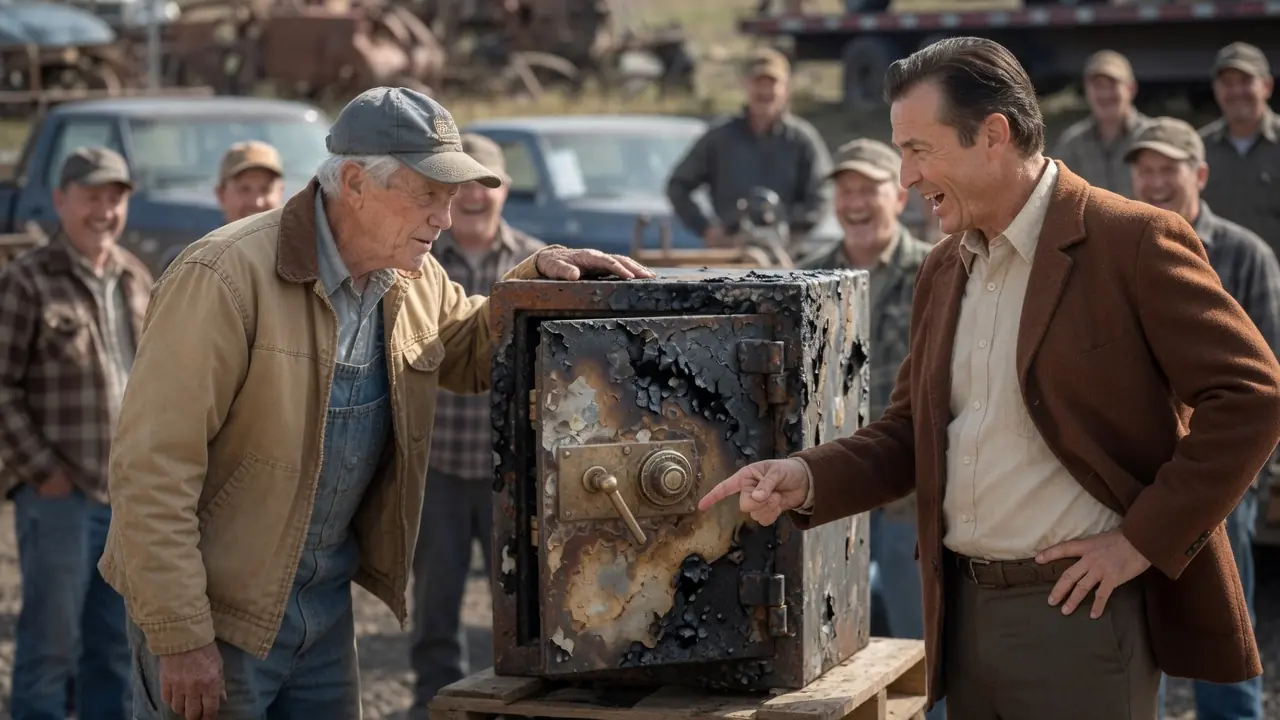
The safe had been recovered from the remains of the Beaumont Hotel, a three-story brick building that burned outside Briar Creek six months earlier. Fire destroyed the roof, most of the guest rooms, and the office where the hotel’s owner, Samuel Bell, kept decades of county records. The county declared the building unsafe, and Dale’s auction company received the contract to sell everything that survived.
Most of it had not survived much.
The safe’s outer steel had blistered black. Its handle was bent, one hinge sagged, and a section of paint had peeled away in bubbles large enough to expose raw metal. Someone had struck the door repeatedly with a sledgehammer, leaving deep silver dents through the soot.
That was what interested Earl.
Fire did not make straight hammer marks.
He had noticed the damage before the bidding began. Whoever attacked the safe had done so after the hotel burned, and they had concentrated every strike around the lock instead of the hinges. They wanted something inside badly enough to risk standing in a fire-damaged building, yet they had failed to open it.
Dale had expected a scrap dealer to buy the safe by weight.
Earl paid ninety dollars instead.
He secured the safe to his trailer with two chains and tested each binder twice. His hands were stiff with arthritis, but they remained steady when he worked. Forty-nine years of repairing tractors, water pumps, balers, and broken gates had taught him that strength mattered less than knowing where pressure belonged.
Dale approached while Earl tightened the final chain.
“You know the county sold that safe empty,” he said.
“Did the county open it?”
“The fire department inspected it.”
“That wasn’t my question.”
Dale’s smile narrowed. “Samuel Bell kept hotel receipts in there. Whatever paper survived belongs to the estate.”
“Then the estate can identify it after I open the door.”
“You should leave it alone.”
Earl looked up.
For the first time that morning, Dale no longer appeared amused. His polished brown shoes were dusty, his sport coat hung open, and a faint pulse moved along his jaw.
Earl climbed into his pickup. “Before sunrise.”
He drove away with the safe behind him and Dale standing motionless beside the auction platform.
The Tasker farm lay eleven miles outside town, beyond two tobacco fields and a narrow creek that flooded every spring. Earl had lived there since the day he was born, first with his parents, then with his wife, Margaret, and finally alone after illness took her eight years earlier. The farmhouse leaned slightly west, the barn needed new siding, and the old dairy shed had become Earl’s workshop.
His granddaughter, Lucy, was waiting near the barn when he arrived.
She was twenty-six, worked at the county records office, and had inherited Earl’s habit of studying a problem before speaking. When she saw the blackened safe chained to the trailer, she removed her glasses and stared at him.
“You bought it.”
“Ninety dollars.”
“You said you were going to look.”
“I looked.”
“And then?”
“I bid.”
Lucy walked around the trailer. “Grandpa, this thing survived a hotel fire.”
“That’s what they said.”
“It also looks like someone tried to murder it with a hammer.”
“That’s what they didn’t say.”
Together, they moved the safe into the dairy shed using a tractor loader and three heavy rollers. Earl positioned it beneath the brightest work lamp, removed his jacket, and began cleaning soot from the dial with kerosene and a soft brush.
Lucy watched him uncover the brass numbers.
“You think something is inside.”
“I know something is inside.”
“How?”
Earl placed his palm against the door. “Listen.”
He turned the handle gently.
Something shifted behind the steel with a low, heavy sound.
“The locking bars are still connected,” he explained. “If the inside had burned through, those bars would be warped solid. This mechanism is moving.”
“You’ve opened safes before?”
“One.”
“When?”
“Forty-one years ago.”
The safe had stood inside the Beaumont Hotel since before Earl was born. Samuel Bell’s father bought it from a closed bank and installed it in the office behind the front desk. In 1977, Samuel asked Earl’s father, Amos Tasker, to repair its slipping handle.
Amos brought Earl along.
For two days, they removed the interior panel, cleaned the locking system, and adjusted the wheels inside the combination chamber. Earl remembered the complicated metal discs, the small fence dropping into aligned gates, and his father explaining that a lock did not resist patience.
It resisted force.
“What was the combination?” Lucy asked.
“I don’t remember.”
She sighed.
“I remember the first number was thirty-two.”
“That leaves several thousand possibilities.”
“Then we should make coffee.”
Earl removed the dial cover and pressed an old mechanic’s stethoscope against the steel. He turned the brass wheel slowly, listening for changes too faint for Lucy to hear. He wrote each possible contact point inside a grease-stained notebook.
Thirty-two.
Seven.
Forty-one.
Then he started again.
At dusk, a black truck slowed on the road beyond the farmhouse. Earl saw it through the shed window. The driver did not turn into the lane but continued toward town after several seconds.
Lucy noticed too.
“Dale?”
“Maybe.”
“You should call Sheriff Warren.”
“Not yet.”
“Why not?”
“Because I don’t want Dale knowing how close we are.”
Lucy folded her arms. “You invited him to come before sunrise.”
“I wanted to see whether that frightened him.”
“Did it?”
Earl turned the dial again. “Enough to send someone past the house.”
At nine that evening, headlights appeared at the end of the lane. Dale’s truck stopped beside the farmhouse, and he entered the shed without waiting for an invitation.
He had removed his sport coat and rolled his sleeves. Two younger men remained near the truck, both employed by Coburn County Auctions.
Dale looked at the safe.
“You haven’t opened it.”
“Not yet.”
“I came to correct a mistake.”
“Whose?”
“The safe should not have been included in the public sale. It was listed as hotel property, but the estate attorney says it may contain confidential documents.”
Earl continued turning the dial. “You said it was empty.”
“We believed it was.”
“For thirty years, you’ve never believed anything unless it made you money.”
Dale placed nine hundred dollars on the workbench.
“Ten times what you paid.”
Lucy stepped closer to Earl. “Why would you pay nine hundred dollars for empty scrap?”
Dale ignored her. “Take the money.”
Earl looked at the bills.
“The auction is final.”
“I am offering you a kindness.”
“No. You’re offering fear with clean edges.”
Dale’s face hardened. “Samuel Bell was an old man who collected papers he had no right to keep. If anything survived, it could contain private financial information belonging to people who are still alive.”
“People like you?”
“You don’t know what you’re touching.”
Earl removed the stethoscope and faced him. “Then tell me.”
Dale glanced toward Lucy, then toward the closed shed doors.
“Your father borrowed money from Briar Creek Mutual Bank in 1979,” he said. “He defaulted. The bank took the north eighty acres. Samuel Bell spent years claiming the foreclosure was wrong because he was bitter over losing his own investment.”
“My father paid that loan.”
“The records say otherwise.”
“The bank records disappeared in the courthouse flood.”
“And your father’s receipt supposedly disappeared in this safe.”
Dale smiled without warmth. “You have been chasing an old man’s story for thirty years.”
The story was older than Lucy.
Amos Tasker mortgaged eighty acres during a drought, then paid the loan after selling a tobacco crop at an unusually strong price. Three months later, Briar Creek Mutual claimed the final payment never arrived. The bank foreclosed, and the land was sold to Coburn Development, a company controlled by Dale’s father.
Amos protested until the stress damaged his health.
Samuel Bell swore he witnessed the payment and kept a duplicate receipt. Before he could testify, the bank closed, the county records disappeared during a courthouse flood, and the Taskers lost their legal challenge.
Dale now owned the eighty acres.
A limestone company had recently offered him nearly two million dollars for quarry rights beneath it.
Earl looked toward the burned safe.
“You knew Samuel kept the receipt.”
“I knew Samuel told stories.”
“Then why burn his hotel?”
Dale’s eyes sharpened. “Watch your mouth.”
“I watched you point at me in the auction yard and call me stupid. Now you’re standing in my shed offering ten times what I paid.”
Dale stepped close enough that Lucy moved between them.
“Some doors should stay closed,” he said.
Earl met his gaze. “Then you shouldn’t have sold me the keyhole.”
Dale swept the money from the bench and walked out. The two employees climbed into his truck, and the vehicle disappeared down the lane.
Lucy locked the shed door.
“You truly think he burned the Beaumont?”
“I think Samuel Bell lived eighty-four years without setting fire to his own office.”
“Then we call the sheriff now.”
Earl shook his head. “Dale has friends in the county. We open the safe first, make copies, and put the originals somewhere he cannot reach.”
They worked through the night.
Lucy searched old hotel records on her laptop while Earl continued listening to the dial. Samuel Bell used family dates for nearly everything. His cattle tags, property locks, and office codes came from birthdays, anniversaries, and the year his parents opened the Beaumont.
At midnight, Lucy found Samuel’s marriage certificate.
He married Rose Bell on July 14, 1952.
“Try fourteen,” she said.
Earl turned the dial left, passed fourteen twice, and listened. The contact sound changed slightly.
“Fourteen is possible.”
They now had thirty-two, fourteen, and an uncertain final number near forty.
Lucy searched Samuel’s family history.
His only son was born on April 6, 1941.
Earl rotated the dial carefully to forty-one.
Nothing happened.
He tried six.
The handle moved less than an inch.
Both of them froze.
“Again,” Lucy whispered.
Earl reset the lock, moving more slowly this time.
Right to thirty-two.
Left past fourteen twice.
Right to six.
He lowered the handle.
A deep metallic click sounded inside the door.
The locking bars withdrew.
It was 4:38 in the morning.
For several seconds, Earl did not pull the door open. He stood with one hand on the handle, breathing as though he had crossed an entire lifetime to reach that moment.
Lucy placed her hand on his shoulder.
“Open it.”
The hinges protested as Earl pulled.
A smell of smoke, metal, and old paper escaped the safe. The outer shelves were empty except for ash and blackened hotel account books. Dale had been right about one thing: the heat destroyed most of what Samuel stored near the front.
But the safe contained an inner steel compartment.
Its smaller door remained closed.
Earl found a key taped beneath the lowest shelf, protected inside a flattened brass tube. The key opened the compartment without resistance.
Inside were six metal document boxes.
Each box carried the name of a local family.
Tasker.
Henderson.
Cole.
Martin.
Reeves.
Walton.
Lucy lifted the Tasker box onto the workbench.
Inside lay Amos Tasker’s original mortgage, every payment receipt, and a notarized release stamped PAID IN FULL. The final payment had been accepted by the bank twelve days before the foreclosure notice was issued.
Earl sat down.
His father had told the truth.
For thirty years, neighbors had treated Amos like a bitter farmer who could not accept losing land through his own mistake. Even Earl sometimes wondered whether grief and pride had changed his father’s memory.
Now the proof rested beneath his hands.
Lucy opened another box.
The Henderson file contained the same pattern: a paid loan, a false default, and a forced sale to Coburn Development. The Cole family file included a letter from the bank manager instructing a clerk to delay posting a payment until foreclosure became legal.
The signature belonged to Dale’s father.
At the bottom of the safe, they found a thick black ledger wrapped in oilcloth. The entries began in 1978 and continued for twenty-five years. It documented payments from Coburn Development to bank officers, county clerks, appraisers, and auction companies.
Dale’s name appeared throughout the later pages.
One entry described the Tasker property:
Release held by Bell. Official copy removed. North eighty transferred below market. Quarry potential confirmed.
Another entry had been written only eight months earlier:
Bell threatening disclosure. Hotel records remain problem. Fire resolves structure; safe to be removed before inspection.
Lucy covered her mouth.
“Grandpa.”
Earl read the line again.
Below it was a payment to Coburn County Auctions for emergency salvage work performed the morning after the hotel fire—before the fire marshal officially released the property.
Dale’s men had entered the ruins and attacked the safe.
They failed to open it.
So Dale placed it in the auction, assuming the fire had destroyed everything inside and expecting a scrap hauler to cut it apart.
Earl looked at the clock.
Five eleven.
“Call Sheriff Warren.”
The sheriff arrived twenty minutes later with a deputy and a body camera already recording. Warren was fifty-three, cautious, and honest enough to understand that honesty required witnesses when powerful families were involved.
He examined the safe, the boxes, and Samuel Bell’s ledger.
“Did anyone else know you opened this?”
“Dale knows we were trying,” Lucy said.
Headlights appeared outside before the sheriff could answer.
Dale’s truck entered the lane, followed by a second vehicle carrying his estate attorney and two auction employees. He stepped into the shed wearing the same confident expression he had displayed before the crowd.
Then he saw the open door.
The confidence vanished.
Earl stood beside the workbench with the Tasker release in his hand.
“You brought the sheriff,” Dale said.
“You recognized what was inside.”
Dale turned toward Warren. “Those files were stolen from Briar Creek Mutual Bank. They cannot be treated as legitimate evidence.”
Sheriff Warren looked at the ledger. “This entry says you paid a county clerk eighteen thousand dollars to remove original mortgage releases.”
“That book could have been written by anyone.”
Lucy placed Samuel Bell’s notarized statement beside it.
Samuel had prepared the document three weeks before the fire. It explained where the files came from, named the officials involved, and accused Dale of threatening him after he contacted the state attorney general.
The final paragraph read:
If this statement is discovered after my death or after damage to the Beaumont Hotel, the fire must be investigated as deliberate. Dale Coburn knows these records can return land his family acquired through fraud.
Dale lunged toward the workbench.
Sheriff Warren caught him before his hand reached the documents. Dale shoved the sheriff, and the deputy immediately pulled him backward.
“Those papers belong to my company!” Dale shouted.
Earl remained still.
“No,” he said. “The land belonged to our families. The papers only remembered.”
The sheriff placed Dale in handcuffs before sunrise.
By eight that morning, state investigators had sealed Coburn County Auctions, Dale’s office, and the warehouse where his company stored estate records. Fire inspectors reopened the Beaumont Hotel case after finding accelerant residue in the office floorboards.
One of Dale’s employees confessed within two days.
Dale ordered three men to enter the hotel at night, pour fuel through Samuel Bell’s office, and remove the safe after the fire. The heat warped their cutting equipment, and the building began collapsing before they could finish.
Dale believed the interior documents had burned.
He never expected Earl Tasker to study the lock.
The black ledger exposed fraudulent foreclosures involving nineteen farms over three decades. Some families had moved away, some original owners had died, and several properties had changed hands more than once.
The truth could not repair every loss.
But it changed who carried the shame.
Amos Tasker’s name was cleared publicly at a county hearing. A judge voided the fraudulent foreclosure and returned the north eighty acres to Earl, along with mineral rights Dale had already promised to the quarry company.
The land was now valued at nearly two million dollars.
Earl refused to sell it.
Instead, he placed it in a family conservation trust and leased part of it to young farmers at rates they could afford. Lucy helped build a legal fund for other families named in Samuel’s files.
Dale Coburn was convicted of arson, fraud, bribery, evidence destruction, and conspiracy. Several retired officials lost pensions or faced charges, while Coburn Development surrendered property and money to a restitution fund.
The county auction yard closed.
One year later, Earl attended its reopening under new cooperative ownership. Farmers now elected the board, every sale contract was public, and no auctioneer could purchase property through a hidden company.
The burned safe stood near the entrance.
Its surface remained blackened. The hammer marks were still visible around the brass dial, and the bent handle had not been repaired. A small plaque beneath it told visitors what had been found inside.
Earl disagreed with one line.
The plaque said the safe contained records that changed the county.
“The records didn’t change anything,” he told Lucy.
“What did?”
“Someone finally opening the door.”
She smiled. “You paid ninety dollars for it.”
“Ninety too much for the steel.”
“And for what was inside?”
Earl looked across the auction yard.
Members of the Henderson family were speaking with an attorney about reclaiming their pasture. The Cole grandchildren held the first complete copy of their grandfather’s loan records. Young farmers inspected used equipment without men in sport coats laughing at their clothes.
“For what was inside,” Earl said, “I’d have paid everything I had.”
At the first cooperative auction, the auctioneer invited Earl onto the platform. The crowd included many of the same men who laughed when he bought the burned safe.
Earl declined to give a speech.
He walked to the safe, placed one hand over the hammer marks, and turned toward the crowd.
“Junk is what people call a thing when they don’t understand its value,” he said. “Sometimes that is a machine. Sometimes it is land. Sometimes it is an old man everyone has already decided to laugh at.”
Nobody laughed now.
Earl stepped away from the microphone and returned to his seat.
Behind him, the safe remained open.
Not because fire, hammers, money, or powerful men had defeated it.
Because patience had.