The auctioneer’s voice carried across the frozen Iowa farmyard as strangers examined the machinery Robert Dutton had once displayed with pride. A red combine stood beside a green John Deere tractor, both marked with white auction stickers, while a wooden FORECLOSED sign leaned crookedly in the churned winter soil. Robert stood beside his old pickup with his fists clenched and his shoulders shaking, though whether from cold or anger no one could tell. Across from him, his seventy-eight-year-old father refused to move.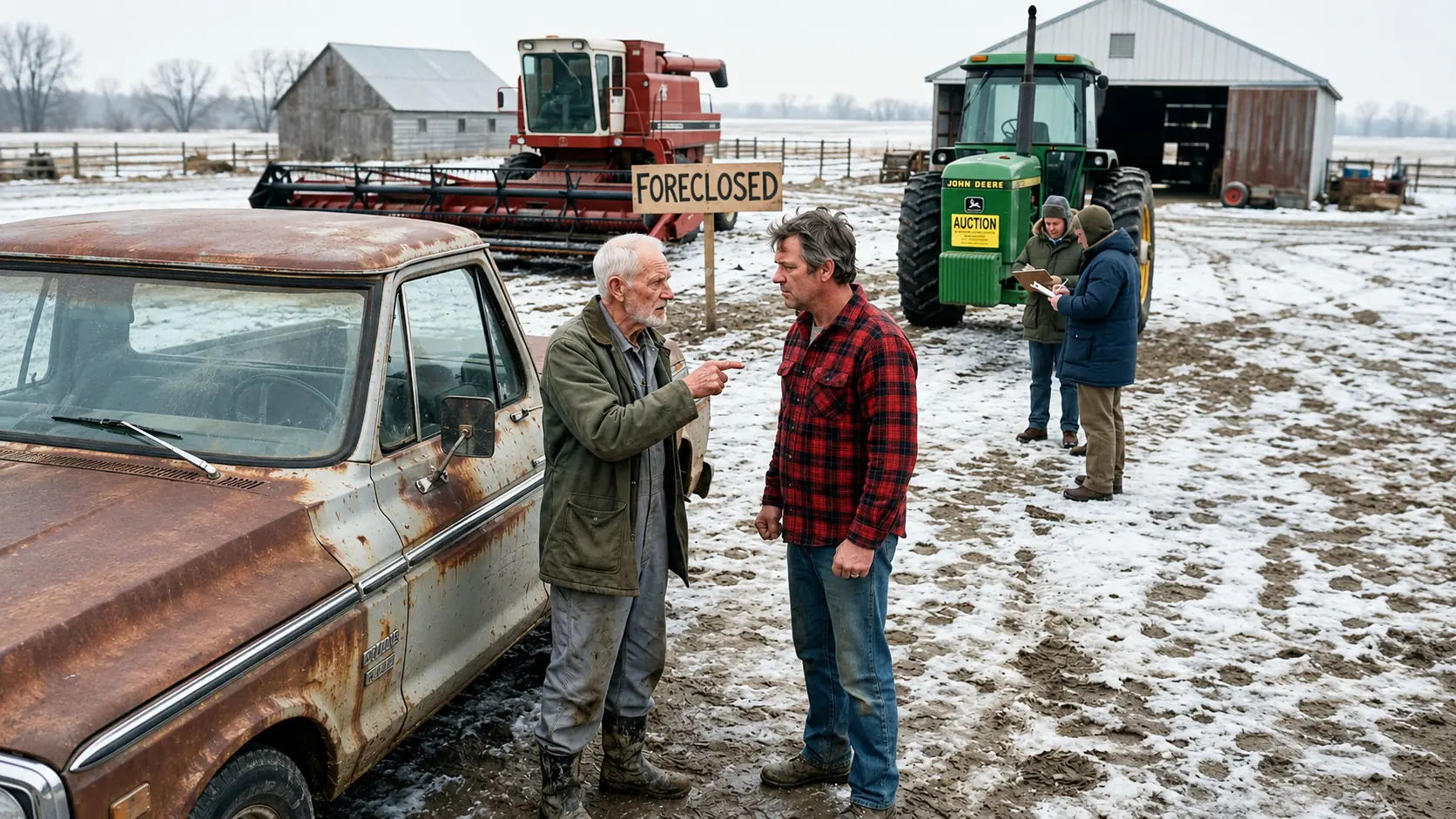
Warren Dutton looked smaller than he had eight years earlier, but age had not softened his gray eyes. His hands trembled now, and his knees made every step painful, yet the old farmer still carried himself like the man who had survived drought, depression, and five decades of harvests. Robert remembered mocking those hands when they held together machinery older than some of the hired men. Now those same hands pointed toward the bank workers preparing to sell everything Robert had financed.
“Your old junk never could’ve farmed four hundred acres,” Robert said, stepping close enough that their coats touched.
“And your shiny iron just cost you every acre.”
“Say that again, and I’ll forget you’re my father.”
Warren did not blink.
“Swing first. Then watch the bank sell what’s left of you.”
Robert’s younger brother Michael stood near the pickup, staring at the frozen ground. He had sold his own farm two years earlier, paid his debts, and escaped with enough money to begin another life. He had not lost everything, but he had lost the one occupation he had expected to carry until death. Their youngest brother, Thomas, stood beside the auction line with a folded bank document inside his coat and said nothing.
Silence had always been Thomas’s strongest answer.
The story of the Dutton farm had begun long before the auction, during a January morning in 1973 when the future still looked endless. Corn prices were high, land values were climbing, and banks treated farmers like men standing beside open vaults. Equipment dealers promised that modern machinery would double production, reduce labor, and turn every ambitious farmer into the owner of an expanding operation. Across Iowa, glossy tractors appeared in fields where patched machines had worked for twenty years.
Warren distrusted all of it.
He called his three sons into the machine shed while winter wind rattled the metal roof. A 1957 John Deere 720 sat beside an old 3010 and an even older John Deere 70. None looked impressive, but every machine belonged to Warren without a bank’s name attached to it.
He had farmed since 1925. He had watched neighbors purchase new equipment during the prosperity of the late twenties, then lose their farms when crop prices collapsed during the Great Depression. Some had worked harder than Warren and owned better land, but their payments continued even when their income disappeared. Warren survived because no lender could repossess what he had already paid for.
At seventy-one, he was ready to divide his four hundred eighty acres. Each son would receive one hundred sixty acres and a fair portion of the equipment. He asked for no payment and demanded no control over how they farmed. He gave them only one warning.
“Never finance tractors and equipment,” he said. “Pay cash or don’t buy.”
Robert folded his arms.
“Dad, times have changed.”
“Prices change. Debt doesn’t.”
“Corn is over three dollars a bushel. Land is gaining value every month.”
“And what happens when corn falls?”
Robert smiled the way a grown son sometimes smiles at an old father he believes the world has left behind.
“Then I deal with it.”
Warren stepped closer.
“The minute you owe money on iron, you’re not a farmer anymore. You’re a debtor working for the bank.”
Michael listened more carefully, though he was not convinced. He agreed that reckless borrowing was dangerous, but believed moderate financing could improve efficiency without risking the farm. Thomas stood near the old 3010, running one thumb across a crack in its faded paint.
“What about you?” Warren asked.
Thomas looked at his father.
“You farmed fifty years and never went broke. That seems worth listening to.”
Robert laughed.
“We’ll see who farms more acres in five years.”
The brothers began independently that spring.
Robert moved first. He borrowed forty-five thousand dollars and purchased a new John Deere 4430, a six-bottom plow, an eight-row planter, a disk, and a grain wagon. The tractor’s cab protected him from dust and heat, while its powerful diesel engine handled work that required several passes with Warren’s old machines. Robert also rented two hundred forty acres from a retiring neighbor, raising his total operation to four hundred acres.
His monthly equipment obligation was approximately seven hundred thirty dollars. That number did not frighten him because his projections showed enormous revenue. With strong yields and corn near three dollars, he believed the machinery would nearly pay for itself during the first few seasons.
Michael chose a more cautious version of the same path. He financed a used John Deere 4020 and a four-row planter, creating a monthly payment of roughly three hundred ten dollars. He farmed only his inherited one hundred sixty acres and kept enough savings for emergencies. Compared with Robert, he appeared conservative.
Thomas bought nothing.
He spent the spring dismantling the old John Deere 3010. He replaced seals, rebuilt the injector pump, adjusted valves, welded weakened metal, and fabricated small parts when replacements cost too much. He searched salvage yards for planter components and used pieces other farmers considered worthless. His tractor remained faded, noisy, and uncomfortable, but it belonged completely to him.
Robert drove past one afternoon in the polished 4430.
“You’ll spend the whole season repairing that relic.”
Thomas wiped grease from his hands.
“Maybe.”
“You could farm twice as much with one good machine.”
“I only own one hundred sixty acres.”
“You could rent more.”
“Then I’d need the machine.”
Robert grinned.
“Exactly.”
Thomas looked beneath the tractor hood.
“That’s how the rope gets around your neck.”
The 1973 season rewarded Robert’s confidence. Rain came at the right time, yields approached record levels, and he sold most of his corn near the peak. After expenses and loan payments, he earned more money than he had ever imagined possible. He bought a new pickup, remodeled his kitchen, and told everyone at the grain elevator that Warren’s advice belonged to another generation.
Michael also had a good year. His smaller operation produced a comfortable income, and the payments seemed manageable. The 4020 allowed him to finish work faster than Thomas and required fewer repairs. He began considering additional acreage if another neighbor retired.
Thomas harvested slightly fewer bushels per acre, but his costs remained far lower. He had no equipment payments and no rented ground. By the time the year ended, he had cleared more than Michael despite using older machinery and producing a smaller crop.
No one celebrated that detail.
Robert’s success was louder.
The next year remained profitable, though corn prices began slipping. Fuel and fertilizer costs moved upward after the oil shock, but Robert believed temporary inflation was the price of expansion. His modern equipment still covered more ground, and land values continued rising.
Warren watched without lecturing.
That worried Robert more than an argument would have.
By 1975, corn had fallen near two dollars and fifteen cents per bushel. Robert still produced a respectable harvest, but his operating expenses had grown sharply. Rent, fuel, chemicals, fertilizer, and machinery payments consumed far more of his income than his original calculations predicted.
Then the 4430 developed a hydraulic problem.
The dealer charged eighteen hundred fifty dollars.
Robert stared at the invoice.
“It’s practically new.”
The service manager shrugged.
“New machines still break.”
Robert paid from his operating account, telling his wife it was a routine expense. Yet the repair reduced an already tightening profit. For the first time since borrowing the money, the monthly payment felt less like a tool and more like a demand.
Michael’s debt remained smaller, but he felt the same pressure. His earnings fell while the loan amount stayed unchanged. He could survive, but he could no longer expand. The equipment he had purchased to create opportunity now required enough income to prevent him from taking risks.
Thomas continued repairing the 3010 himself.
His yields remained slightly lower, but he again earned more than Michael because no lender claimed part of the harvest. Each year, he placed eight to ten thousand dollars into savings. He did not use the money to buy a new tractor.
Robert called that cowardice.
Warren called it patience.
The 1976 season brought late planting, excessive rain, and crop disease. Robert’s yield dropped to ninety-five bushels per acre. His gross income fell, but rent and payments remained fixed. After a full year farming four hundred acres, he kept less than ten thousand dollars.
He sat at his kitchen table that winter with bills spread around him.
His wife, Helen, picked up the equipment statement.
“How many years remain?”
“Four.”
“And if next year is the same?”
“It won’t be.”
“You said that last year.”
Robert pushed back from the table.
“What do you expect me to do? Sell the tractor and crawl back to Dad?”
“I expect you to admit we’re in trouble.”
“We’re not in trouble.”
The bank did not yet agree with Helen, but it had begun asking more questions. Loan officers wanted updated balance sheets, crop projections, and proof that Robert could continue meeting his obligations. The same men who once encouraged him to expand now spoke carefully about risk.
Michael also suffered from the weak harvest. He remained current on his payments, but he stopped discussing expansion. One evening he visited Thomas’s workshop and watched his younger brother repair a worn planter chain.
“Do you ever regret it?” Michael asked.
“Regret what?”
“Not buying better equipment.”
Thomas considered the question.
“I regret fixing this chain for the third time.”
Michael smiled.
“That isn’t what I meant.”
“I know.”
Thomas tested the repaired link.
“I’d rather lose time than choices.”
Michael looked toward the old tractor.
“I thought smaller debt would be safe.”
“It is safer.”
“That isn’t the same as safe.”
“No.”
The difference became clearer in 1977. Corn fell below two dollars while fuel and fertilizer continued rising. Robert’s tractor needed a clutch replacement costing twenty-four hundred dollars. He had no cash left after rent and operating expenses, so he charged the repair and made minimum payments for six months.
The debt had begun reproducing.
One loan created the need for another.
Robert could not reduce acreage because the expensive equipment required scale to justify itself. He could not surrender the rented ground without reducing revenue. He could not sell the tractor because his entire operation had been designed around its power.
Warren’s warning returned to him at night.
A noose around your neck.
Robert hated the memory enough to work harder. He began before sunrise and returned after dark, convinced effort could defeat arithmetic. Yet no amount of labor changed the price of corn, interest, fuel, or repairs.
Michael’s situation was less desperate but equally revealing. He earned enough to support his family and make payments, but not enough to build savings or prepare for a serious failure. Every year had to be at least acceptable. One bad harvest would consume what remained of his cushion.
Thomas continued placing money in the bank.
By 1977, he had accumulated more than sixty thousand dollars. He could have purchased a new tractor outright, but he saw no reason to replace a machine that still performed the necessary work.
Robert confronted him at the grain elevator.
“You’re sitting on enough cash to modernize.”
“I know.”
“Then why don’t you?”
“Because prices are falling.”
“That means equipment will cost more later.”
“Or less.”
Robert shook his head.
“You’re waiting for the world to end.”
Thomas looked at him calmly.
“No. I’m making sure it can’t end me.”
Interest rates climbed brutally near the end of the decade. Farmers with variable-rate loans watched payments rise while commodity prices remained weak. Robert’s primary equipment loan was fixed, but operating debts were not. When he tried refinancing, the bank quoted thirteen percent.
He stared at the loan officer.
“How am I supposed to pay thirteen percent?”
“That’s the rate.”
“You pushed me to expand.”
“We approved the loan based on conditions at the time.”
“You said land would keep rising.”
The younger man behind the desk avoided his eyes.
“Markets change.”
Robert understood then that the bank remembered none of its promises because the promises had never appeared in the contract. The signatures belonged to Robert. The risk belonged to Robert. The lender owned only the right to be paid.
Michael made his decision in 1979.
He called his father and brothers together and announced that he was selling his farm. He was not bankrupt, but he had studied the rising rates and shrinking margins long enough to see what might follow. Land prices were still strong, allowing him to sell his one hundred sixty acres, clear the machinery debt, and leave with substantial money.
Robert accused him of quitting.
Michael faced him across Warren’s kitchen.
“I’m leaving before the bank decides for me.”
“You’re giving away Dad’s land.”
“I’m protecting my family.”
“You’ll regret it.”
“I already regret borrowing against a life I couldn’t control.”
Michael moved to town and invested in an implement dealership. He made a good living and slept without fear of weather, but every spring he watched farmers enter the showroom and felt the loss of fields he had expected his children to inherit.
Robert remained determined.
In 1980, drought reduced his yield to eighty-nine bushels per acre. The John Deere’s engine overheated under heavy work, cracking a piston. The dealer quoted forty-eight hundred dollars for a rebuild.
Robert asked the bank for another loan.
The bank refused.
He drove to Warren’s house that evening. The old farmer listened while Robert described the failed engine and the crop still waiting in the field.
“I’ll loan you the money,” Warren said.
Relief crossed Robert’s face.
“But you sell the tractor after harvest and clear the debt.”
Robert’s expression hardened.
“I can’t sell it.”
“You can.”
“I need it to farm four hundred acres.”
“You want to farm four hundred acres.”
“It’s my operation.”
“No,” Warren said. “It belongs to everyone you owe.”
Robert stood.
“I didn’t come here for another sermon.”
“You came because your banker said no.”
“I came because you’re my father.”
“Then listen like my son.”
Warren’s voice remained calm.
“Farm one hundred sixty acres with something paid for. Make less money and keep it. Or keep chasing four hundred and lose all of it.”
Robert left without the money.
He found a private lender willing to provide five thousand dollars at eighteen percent interest. The tractor returned to the field, but the repair did not rescue him. It merely gave his debts another year to tighten.
By spring 1981, Robert was three months behind on his equipment loan. The bank sent formal notice demanding payment. He sold grain he had been holding for a better price, delayed purchasing fertilizer, and asked Helen’s parents for help.
It was not enough.
In June, repossession trucks arrived.
The bank took the 4430, planter, plow, disk, grain wagon, and every other item pledged against the loan. Robert stood in the yard while workers loaded the machinery he had spent eight years paying for. His payments had not created ownership. They had purchased temporary permission to use equipment until he failed.
The machines sold at auction for less than the remaining balance.
Robert still owed eighteen thousand dollars.
To clear it, he surrendered his land.
That was how Warren, Robert, Michael, and Thomas came to stand together in the frozen auction yard. Men from neighboring counties walked between the tractors, lifting hoods and discussing prices as if the machinery carried no history. Some had also financed expansion. Others waited with cash, hoping the crisis would allow them to purchase what desperate families could no longer keep.
Robert looked at the foreclosure sign and felt humiliation harden into rage.
“Your old junk never could’ve farmed four hundred acres,” he told Warren.
The old man pointed toward the auction.
“And your shiny iron just cost you every acre.”
Robert stepped closer.
“Say that again, and I’ll forget you’re my father.”
“Swing first. Then watch the bank sell what’s left of you.”
Robert’s fists tightened.
Thomas moved between them.
“That’s enough.”
“Stay out of this,” Robert snapped.
Thomas looked at his older brother.
“I’m buying the land.”
The announcement cut through Robert’s anger.
“What?”
“The bank accepted my offer.”
“You?”
“One hundred dollars an acre below market. Cash.”
Robert stared at him.
“You waited for this.”
“No.”
“You sat on your money while I struggled, and now you’re taking my farm.”
“I offered to help clear your operating debt last year.”
“You wanted me to downsize.”
“Yes.”
“You’re no better than Dad.”
Thomas’s eyes hardened.
“That is the first kind thing you’ve said to me today.”
Robert shoved him.
Thomas took one step backward, then stood his ground.
“I am not buying your farm to celebrate what happened,” he said. “I’m buying it so the land stays in the family.”
“It won’t be mine.”
“No. The bank made sure of that.”
Robert looked toward Warren, hoping to find support. The old farmer’s face carried no satisfaction, only grief.
“I warned you because I wanted you to keep it,” Warren said. “Not because I wanted to be right.”
The anger left Robert as quickly as it had risen. His shoulders collapsed, and he turned toward the tractor being sold to a stranger. The auctioneer called another bid. The price climbed, stopped, and ended at a fraction of what Robert had originally paid.
Eight years of payments disappeared beneath one fall of the hammer.
Thomas completed the land purchase and expanded to three hundred twenty acres without borrowing a dollar. He bought used implements at foreclosure auctions for a fraction of their former prices and continued operating the same 1961 John Deere 3010. It was slower than Robert’s tractor, but no lender could take it during a bad season.
The wider farm crisis deepened.
Land values collapsed, interest rates remained punishing, and thousands of Midwest farms disappeared. Families who had appeared wealthy during the boom discovered that rising land prices had never been cash. When values fell, their collateral vanished while debt remained.
Thomas survived.
When crops were weak, he reduced costs. When machinery broke, he repaired it or waited. When desperate farmers sold equipment cheaply, he bought only what he could pay for. His lack of debt gave him something more valuable than modern horsepower.
It gave him time.
Warren died in 1983 at eighty-one years old. His three sons sat together inside the small country church, separated by different versions of the life he had given them. Michael had money but no farm. Robert had work at a grain warehouse and a grief he rarely discussed. Thomas still owned the original land and the acres he had recovered from the bank.
During the funeral, Thomas stood before the congregation.
“My father told us never to finance tractors and equipment,” he said. “Two sons didn’t listen. One did.”
Michael lowered his head.
“My brother Robert lost his farm. Michael escaped before he lost everything, but he had to leave farming. I’m still here, farming the way Dad taught me, and I will pass the land to my children without a penny of debt.”
Thomas looked toward Warren’s plain wooden casket.
“Dad wasn’t old-fashioned. He was right.”
Robert cried in the back pew.
Not only because his father was gone, but because there would never be another winter morning in the machine shed when he could choose differently.
Years later, Warren’s 1957 John Deere 720 still worked around the Dutton farm. Its paint had faded, the seat had been replaced, and its engine required patient maintenance. It could not match the speed, comfort, or power of the tractor Robert had financed.
But it had outlasted Robert’s debt.
Thomas eventually passed the farm to his son with clear titles and paid-for equipment. When the young man asked whether borrowing might help them expand faster, Thomas led him toward the old 720 and placed one hand on its hood.
“That tractor is slow,” he said. “It leaks. It’s loud, and it will make you wish for something better every hot afternoon.”
His son waited.
“But it never took our farm.”
The lesson Warren Dutton had tried to give his sons was never truly about tractors. It was about freedom, patience, and refusing to let prosperity convince a family that tomorrow had already been guaranteed.
Robert had worked as hard as Thomas, perhaps harder.
Michael had been careful, intelligent, and responsible.
Neither failed because he lacked character.
They failed because debt demanded certainty from a profession built on uncertainty.
Weather changed.
Prices changed.
Interest changed.
Machinery broke.
The payment remained.
Thomas did not become the richest farmer during the good years. He became the farmer who still owned his fields after the bad years arrived.
That was the inheritance Warren had wanted all three sons to receive.
Only one listened before the auctioneer raised his hammer.