The whispers began before Harold Jensen reached the auction barn doors. Men standing beside polished pickup trucks watched his rusted Chevrolet crawl into the Keller farmyard, coughing pale smoke before stopping beside a line of expensive dealer vehicles. Harold stepped down wearing patched denim overalls, a faded flannel shirt, cracked work boots, and a green cap so worn that its original logo had disappeared. To nearly everyone gathered outside Waterloo, Iowa, he looked like a farmer who had come to watch wealth pass beyond his reach.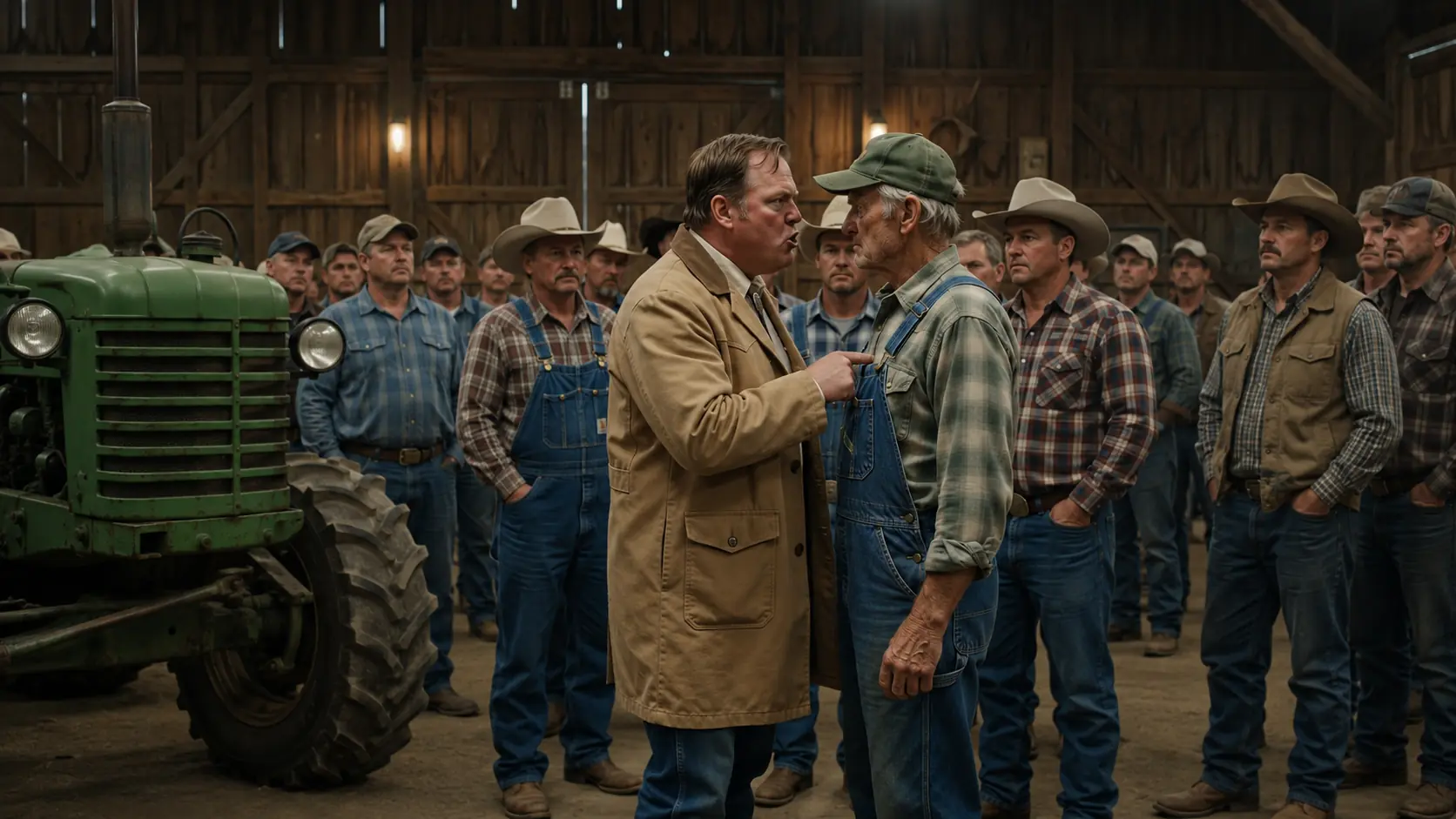
It was November 4, 1989, and the Keller family was liquidating one of the largest private collections of John Deere tractors ever offered in the state. Thirty-two machines stood in disciplined rows beyond the barn, their green paint shining beneath the cold morning sun. Some were less than three years old, while others had worked Iowa fields since the early 1970s. Dealers had arrived from Chicago, Minneapolis, Omaha, and Des Moines because everyone expected the sale to become the most important equipment auction of the decade.
Harold walked slowly past the machines without touching them. His gray eyes studied tires, hydraulic lines, engine housings, drawbars, and paint worn thin where generations of hands had climbed into the cabs. He paused longest beside the oldest tractor, a 1973 John Deere 4020 parked at the far end of the row. Several dealers noticed and laughed because they assumed the oldest machine was the only one he could imagine owning.
Victor Lang stood near a new black pickup wearing a tan ranch coat, polished boots, and a bolo tie held by a silver clasp. He owned three equipment dealerships and had built his reputation by buying machinery cheaply at liquidation sales before reselling it to desperate farmers at heavy markups. Victor watched Harold circle the old tractor and nudged the dealer beside him.
“Maybe Jensen finally came to replace that museum piece he farms with.”
The other man smiled.
“Only if they accept chickens as payment.”
Harold heard them clearly.
He continued walking.
At sixty-seven, he had learned that a man revealed more through unnecessary laughter than through serious conversation. Victor needed everyone to know he was wealthy. Harold had never felt the same need.
The auctioneer, Stan Morrison, climbed onto the platform at precisely nine o’clock. He welcomed the crowd, reviewed payment conditions, and explained that the thirty-two tractors would first be offered as one complete lot. If no acceptable price emerged, each machine would be sold separately.
“Opening bid, two million four hundred thousand dollars.”
The crowd became quiet.
Even Victor hesitated. Thirty-two machines could produce a handsome profit, but few dealers wanted that much capital tied up in one purchase. Stan lowered the opening request to two million two hundred thousand, then two million.
No hands rose.
At one million eight hundred thousand, a Chicago dealer finally entered. A Minneapolis buyer countered at one million seven hundred thousand after Stan reorganized the bidding, but the room never gained momentum. After several attempts, Stan closed the complete-lot offer and announced that the machines would be sold individually.
Relief moved through the barn.
Now every dealer could pursue only the tractors he considered profitable, and local farmers could compete for single machines. Harold remained at the back with both hands inside his overall pockets.
The first tractor was a nearly new 1987 John Deere 4050 with fewer than four hundred operating hours. Bidding climbed past one hundred thousand dollars before a prosperous farmer from Charles City bought it for one hundred twelve thousand. The second machine brought one hundred forty-two thousand, while the third sold for ninety-eight thousand.
Victor bought the fourth tractor.
Then the sixth.
By noon, he and six other dealers controlled most of the machines sold. Every successful bid was followed by whispered calculations about resale price, transportation, financing, and commission. Harold never raised his hand.
During the lunch break, the crowd moved toward food trucks parked beside the grain bins. Men bought hot sandwiches, coffee, and slices of pie while discussing which tractors remained. Harold returned to his truck, opened a metal lunchbox, and removed a simple cheese sandwich wrapped in wax paper.
Victor walked past with two younger dealers.
“Look at him,” one said. “Can’t afford lunch after paying for gas.”
Victor glanced at Harold’s truck.
“I’m surprised that thing survived the drive.”
Harold poured coffee from his thermos.
He did not look up.
Inside his coat pocket rested a bank statement showing more than eleven million dollars across cash, bonds, and investment accounts. Yet the sandwich tasted exactly the same whether anyone knew that fact or not.
The afternoon sale moved quickly. Tractors nineteen through twenty-eight attracted strong bidding, though prices fell as the newer machines disappeared. Victor collected several more, confident that farmers would pay extra once spring planting approached.
Only four tractors remained by three o’clock.
The twenty-ninth machine sold for fifty-two thousand dollars.
The thirtieth brought forty-eight thousand.
The thirty-first, another old 4020, sold for forty-two thousand.
Stan finally introduced the last tractor.
“Lot thirty-two, 1973 John Deere 4020. Reliable machine, solid engine, clean transmission. Who’ll start me at thirty-five thousand?”
One local farmer raised his hand.
“Thirty-five. Thank you. Do I hear forty?”
Silence.
The tractor was useful, but many buyers considered it too old. Victor had already purchased newer machines and showed no interest.
“Going once at thirty-five thousand.”
Harold lifted his hand.
Stan paused.
“Sir, forty thousand?”
“Forty.”
Every face near the back turned toward him.
The local farmer offered forty-two.
Harold bid forty-five.
The farmer hesitated before raising his hand again.
“Forty-eight,” Stan called.
“Fifty,” Harold said.
The local farmer lowered his arm.
Stan looked across the barn.
“Fifty thousand once. Fifty thousand twice. Sold to the gentleman in the green cap.”
A ripple of disbelief spread through the room.
Stan asked Harold’s name and recorded it beside the winning lot. Harold nodded once, then walked toward the payment table as people whispered about hidden loans, desperate borrowing, and foolish pride.
The payment clerk, Sarah Evans, found his lot number.
“Mr. Jensen, your total is fifty thousand dollars. Will you be financing through one of the banks represented today?”
“No.”
“Personal check?”
Harold removed an old checkbook.
“That’ll do.”
He wrote the amount carefully and handed it across the table. Before Sarah could process it, Victor stepped between them.
“Hold on.”
Harold looked up.
Victor seized the winning slip.
“You can’t pay fifty grand. Quit wasting real farmers’ time.”
Harold closed one hand around Victor’s wrist.
“Take your hand off what I bought.”
The nearby conversations stopped.
Victor stepped closer, using his height and broad shoulders to crowd the older man.
“Prove you have the money, or I’ll throw you outside myself.”
Harold released him and reached into his coat. Victor smiled, expecting excuses, but Harold placed a folded bank statement on the table.
“Call your dealers,” Harold said. “I’m buying every tractor you touched.”
Sarah opened the statement.
Her eyes moved across the balance twice.
Victor tried to glance at it, but she pulled the page closer.
“Mr. Jensen,” she whispered, “is this current?”
“Friday morning.”
Victor laughed uncertainly.
“How much does he have?”
Sarah did not answer.
Harold looked directly at Victor.
“Enough.”
Victor’s confidence weakened.
“You already lost the other tractors.”
“They were sold to dealers.”
“So?”
“So dealers sell tractors.”
Victor folded his arms.
“You think we’ll hand over thirty-one machines because you suddenly found a rich relative?”
Harold retrieved his statement.
“No relatives involved.”
“Then where did the money come from?”
“Farming.”
Victor laughed again, but fewer men joined him.
“You farm three hundred twenty acres with equipment older than half the people here.”
“That’s right.”
“You expect us to believe that made you a millionaire?”
“No.”
Harold slipped the statement into his pocket.
“I don’t need you to believe anything.”
The barn doors opened behind him as people began leaving. Harold completed payment for lot thirty-two and collected the tractor documents. Then he walked outside, climbed into his rusted truck, and drove home without explaining another word.
Victor watched him go.
“That check will bounce.”
Sarah looked down at the completed payment confirmation.
“It already cleared.”
Monday morning, Harold returned to the auction office carrying a pencil-written list. Sarah recognized him immediately and invited him to sit.
“How can I help you, Mr. Jensen?”
“I want the other tractors.”
She thought she had misunderstood.
“The auction is over.”
“I know.”
“All thirty-one remaining machines were sold.”
“Most went to dealers.”
“Yes.”
“Contact them.”
Sarah stared at the list.
“You want one particular model?”
“All of them.”
Her chair creaked as she leaned back.
“Every tractor?”
“Every tractor from the Keller sale.”
“Mr. Jensen, the dealers paid nearly three million dollars collectively. With their markups, you may be looking at more than three million two hundred thousand.”
Harold nodded.
“Find the price.”
Sarah lowered her voice.
“May I ask why?”
“After the purchase.”
She called all seven dealers. At first, they assumed Harold wanted quotations for selected machines, but every conversation changed when Sarah explained that he intended to buy their complete Keller inventories immediately.
Victor refused.
Then he learned the other dealers were negotiating.
He returned Sarah’s call twenty minutes later.
“What is Jensen offering?”
“He asked each dealer to set a reasonable immediate-sale price.”
“Reasonable according to whom?”
“According to the market.”
Victor calculated his potential profit. Holding the machines until spring might earn more, but it would involve transport, storage, maintenance, insurance, advertising, and financing costs. Selling immediately for an eighteen-percent markup would provide a large guaranteed return within days.
By Tuesday evening, every dealer agreed.
The combined price was three million two hundred eighty thousand dollars.
Harold arrived Wednesday with his banker, Charles Wilkins. Victor and the other dealers sat around a conference table expecting negotiations. Instead, Charles opened a leather case and removed a cashier’s check with distribution instructions attached.
Victor studied the amount.
“This is real?”
Charles looked over his glasses.
“First Federal does not issue imaginary checks.”
The dealers signed their transfer documents.
Harold became the owner of all thirty-two tractors.
Victor watched him organize the papers.
“What are you doing with them?”
Harold remained silent.
“You can’t farm thirty-two tractors.”
“No.”
“You planning to resell?”
“No.”
Victor leaned across the table.
“Then what?”
“I’m giving them away.”
No one moved.
Sarah looked up from her documents.
“Giving them to whom?”
“Young farmers. People trying to start. Families with ground but no equipment. Men and women the banks won’t finance.”
Victor stared at him as if the old farmer had begun speaking another language.
“You spent more than three million dollars to give the machines away?”
“I bought opportunity.”
“That’s insane.”
Harold turned toward him.
“Forty-five years ago, another farmer thought I was worth helping.”
The room became quiet.
Harold told them about returning from military service at twenty-two with four hundred dollars and no land. He had worked for Albert Peterson, an older farmer who paid him modest wages and allowed him to live in a bunkhouse.
Harold saved nearly everything.
After two years, he told Albert he wanted to rent ground but could not afford a tractor. Albert led him into a machinery shed and pointed toward a used Farmall.
“Take it,” Albert said.
Harold had believed he was joking.
“You’ll need something to start with. Pay me when you can.”
That tractor allowed Harold to rent eighty acres. Six years later, he repaid Albert in full, though the old farmer had never demanded the money. When Harold later needed help buying his first farm, Albert loaned him the down payment without collateral.
“I would not own one acre without him,” Harold said.
Victor shook his head.
“That was decades ago.”
“Debts of gratitude don’t expire.”
The story reached the local newspaper before the end of the week. The headline described the farmer in patched overalls who had purchased the complete Keller tractor collection with cash.
Reporters drove to Harold’s farm.
They expected a grand house hidden beyond the county road. Instead, they found a small white farmhouse, a weathered machine shed, and the same rusted truck parked beside a woodpile.
Harold agreed to one interview.
“How did you accumulate eleven million dollars while operating such a modest farm?” the reporter asked.
“I spent less than I earned.”
“That cannot be the whole explanation.”
“It’s most of it.”
Harold explained that he had never expanded simply to impress neighbors. He maintained his own equipment, avoided unnecessary debt, purchased land carefully, and invested his savings in municipal bonds and dividend-paying companies.
During prosperous years, he saved.
During the farm crisis, when land prices collapsed and banks seized neighboring properties, he remained debt-free. He purchased several distressed parcels, improved them, and sold them after values recovered.
“You could have bought a bigger home,” the reporter said.
“My home keeps out the rain.”
“A new truck?”
“The old one starts.”
“Better clothes?”
“My overalls still have room for patches.”
The story spread across Iowa.
Applications for the tractors arrived by the hundreds. Harold required each person to describe their farming plans, finances, experience, and reasons for needing equipment. He read every page himself at his kitchen table.
One application came from twenty-four-year-old Michael Torres, who farmed rented ground using borrowed machinery while working construction during the day and at a gas station at night. He had saved eighteen thousand dollars in five years, but no bank would finance the remaining cost of a dependable tractor.
Another came from Jennifer Walsh, a twenty-eight-year-old teacher whose father had died with farm debts. His machinery had been sold, yet Jennifer continued working eighty acres using rented equipment. Several lenders had openly questioned whether a woman could operate a farm alone.
The youngest applicant was nineteen-year-old David Kim, the son of Korean immigrants who rented two hundred acres. David worked at a feed mill and attended community college while trying to save enough to begin farming independently.
Harold selected thirty-two recipients from six counties.
He invited them to his farm on a cold December morning. The tractors stood in long rows beyond the machine shed, their engines recently serviced and fuel tanks filled.
The young farmers gathered uncertainly.
Many believed they had been invited to discuss financing.
Harold stood before them wearing the same patched overalls.
“These tractors belong to you.”
No one reacted at first.
Michael Torres finally spoke.
“What do you mean?”
“Each of you will choose one.”
“What are the payments?”
“Whatever you can manage someday.”
“Interest?”
“None.”
“Collateral?”
“Your word.”
Michael looked toward the machines.
“Why would you do that?”
“Because somebody once did it for me.”
Jennifer covered her mouth as tears filled her eyes.
David’s parents began crying quietly.
Harold raised one hand.
“I have one condition.”
The group listened.
“When you are able, help another farmer. It does not need to be money. Loan equipment, share knowledge, rent ground fairly, repair something, or give someone a chance when everyone else says no.”
Michael stepped forward.
“How do we repay you?”
“You just heard how.”
By Christmas, every tractor had reached its new farm.
The oldest 4020—the machine Harold personally won—went to a young father operating ninety rented acres after his family farm was foreclosed. Michael chose a powerful 1985 machine worth nearly one hundred forty thousand dollars. Jennifer selected a dependable 4040, while David chose a tractor he promised to maintain for the rest of his career.
Harold returned home after the final delivery.
His farm looked unchanged.
The truck still rusted near the barn.
The overalls still carried patches.
But thirty-two families entered the new year with opportunities they had not possessed weeks earlier.
Victor Lang watched Harold’s story appear in agricultural magazines nationwide. Customers entering his dealerships began asking whether he was the man who tried to throw Harold out of the auction barn.
At first, Victor denied it.
Then a photograph surfaced showing him gripping the winning slip.
His business did not collapse, but something more uncomfortable happened. Farmers began challenging the way his sales staff treated customers wearing old clothing or driving damaged trucks.
One afternoon, Victor visited Harold’s farm.
Harold was replacing a bearing inside the machine shed.
“You made me look like a fool,” Victor said.
Harold continued working.
“I did not dress you that morning.”
Victor’s jaw tightened.
“You knew everyone thought you were broke.”
“Yes.”
“You could have corrected us.”
“Why?”
“Because we would have treated you differently.”
Harold looked up.
“That is exactly why I stayed quiet.”
Victor had no answer.
Years passed.
Michael expanded from eighty rented acres to more than one thousand. He repaid Harold over eight years, though Harold repeatedly told him the money was unnecessary. Every payment Harold received went directly to another struggling farmer.
Jennifer built a successful operation and began mentoring women denied financing or dismissed by dealers. She never returned the tractor’s price in cash, but she helped eleven other women enter farming.
David saved aggressively and bought his first one hundred sixty acres without debt. He later helped Asian American farming families navigate lenders, leases, and equipment purchases.
By 1999, twenty-eight of the original thirty-two recipients remained in agriculture. Together they operated thousands of acres, employed local workers, and supported businesses throughout the region.
Harold never accepted credit for their success.
“I gave them machinery,” he said. “They did the work.”
He continued helping farmers until his death in 2003. By then, he had directly assisted seventy-two families with equipment, land rent, and emergency financing.
His funeral filled the largest church in the county.
More than nine hundred people attended.
Victor sat near the back.
Michael delivered the eulogy.
“Harold taught us that wealth is not what a man displays,” he said. “It is what remains useful after he is gone.”
He looked toward the rows of farmers whose lives had changed because one quiet man remembered a gift from his youth.
“He looked poor because he kept nothing unnecessary for himself. He was rich because everything he possessed could become hope for someone else.”
Harold’s estate funded a foundation for young farmers. In the years that followed, it helped hundreds more purchase machinery, rent land, and survive difficult harvests.
The old 4020 he bought at the Keller auction remained in service.
Its owner eventually passed it to his son with one instruction.
“When you no longer need it, give it to someone who does.”
That was how Harold’s generosity continued—not as a monument, but as machinery moving through fields, families remaining on their land, and opportunities passed from one pair of hands to another.
The crowd at the auction had looked at patched clothing and seen failure.
Victor had looked at an old farmer and assumed he possessed nothing.
Harold never shouted about his wealth.
He simply placed a bank statement on the table, purchased every tractor the dealers controlled, and proved that the richest man in the barn was the one who needed the least for himself.
But the true surprise was not that Harold could afford thirty-two tractors.
It was that he understood they were worth far more once he gave them away.