In the middle of a crowded shopping mall, a janitor spotted a frightened little girl curled up behind a statue, clutching a crumpled drawing.
She had been lost all night, too scared to move, too small to be noticed.
While others walked past her, he knelt beside her, offered comfort and food, and stayed with her.
He brought her to safety, never knowing she was the granddaughter of a respected retired community leader.
His quiet act of kindness would soon ripple far beyond the mall, becoming a spark of hope that inspired an entire community.
It was just another ordinary afternoon at Lakeside Plaza, the kind of day that slipped between the cracks of memory, full of jingles from store speakers and the gentle chaos of families preparing for Thanksgiving.
Children darted between kiosks, their hands sticky with frosting and pretzel salt, while parents clutched shopping bags like lifelines. The buzz of escalators hummed over it all, a mechanical reminder that time was always moving.
Nobody paid attention to the man in the green janitor’s uniform moving quietly through the food court, pushing a cart filled with brooms, rags, and silence.
That man was Marlon Davis.
At sixty-two, Marlon had learned how to blend in, not just with the marble tile floors or the stainless steel railings, but with the world itself.
He didn’t mind.
After losing his wife three years ago, he found peace in the predictability of cleaning up after people. Mornings brought empty benches and quiet sunbeams. Afternoons brought the noise.
He didn’t complain.
He just worked.
But that afternoon, as the scent of cinnamon rolls mingled with the muffled laughter of teenagers, Marlon noticed something.
Something quiet in a sea of noise.
It wasn’t a sound exactly. It was the absence of one.
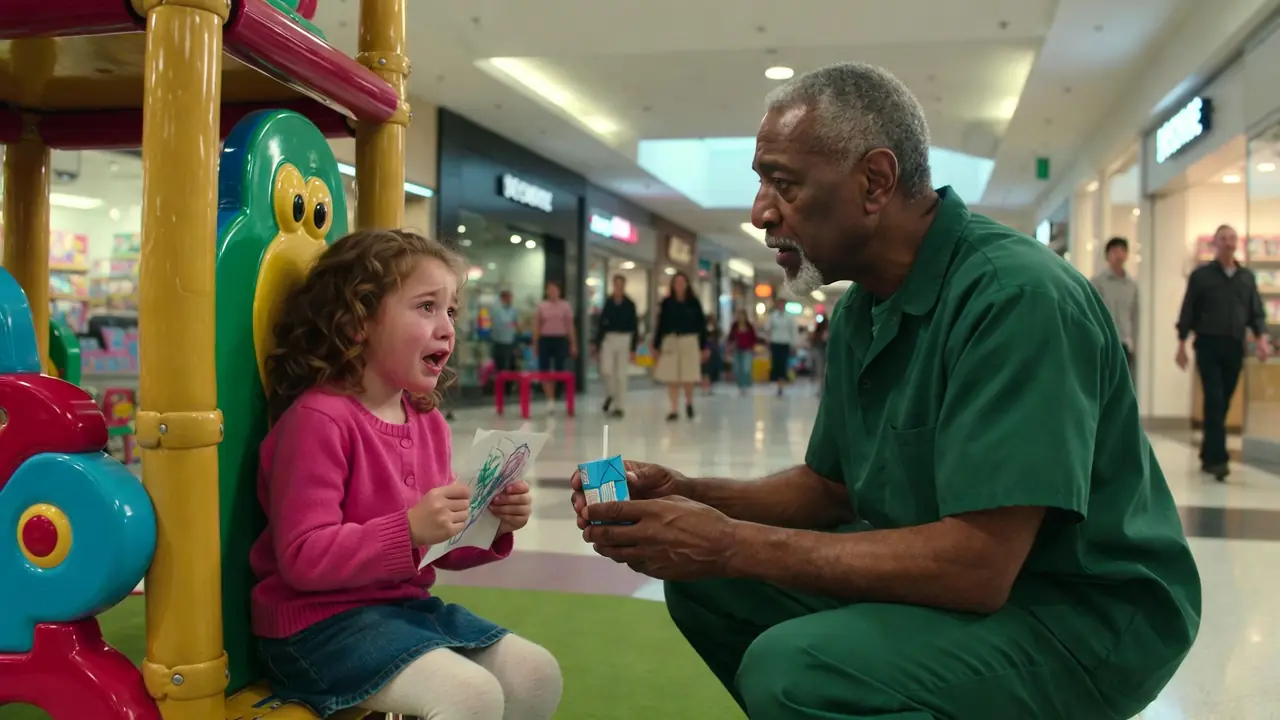
Near the play zone, nestled behind a faded green dinosaur with googly eyes and chipped paint, sat a little girl. She couldn’t have been more than seven. Her legs were pulled tightly to her chest, her arms wrapped around them like shields, and her face was half buried behind a piece of paper clutched in small, shaking hands.
No one saw her.
Shoppers passed by, glancing at price tags and phone screens, but not at the child barely breathing in their midst.
Marlon slowed his cart and narrowed his eyes. Something about the way she sat, the stillness, the way her fingers trembled around that paper, tugged at something deep inside him.
He remembered that posture.
That fear.
That loneliness.
He parked the cart a few feet away and approached, careful not to startle her.
Kneeling down with effort, his knees cracking slightly, he offered the gentlest greeting he knew.
“Hey there, little one,” he said, his voice low and steady. “You all right?”
The girl didn’t answer at first.
She didn’t even flinch, but her eyes lifted.
They were wide, dark, and exhausted. Not the kind of tired that comes from skipping naps, but the kind that settles into the bones after a long night of crying alone.
Her cheeks were streaked with dried tears. Her lips were chapped and pale. Her whole body seemed to be curling in on itself, like she was trying to disappear.
Marlon didn’t press.
He didn’t ask her name or what was wrong. He reached into his cart, pulled out a soft napkin, and offered it gently.
“You don’t have to talk if you don’t want to,” he said. “But I’m here, all right?”
She blinked slowly, then took the napkin.
Her hands trembled as she wiped her face, and for a moment, she looked like she might say something. But nothing came.
Marlon sat beside her, cross-legged on the floor, ignoring the way his knees groaned.
He could feel people moving around them, oblivious, but all his attention was on this girl and the invisible weight she carried.
Minutes passed.
Maybe more.
Time felt still inside that pocket of quiet.
The girl sniffled. Her grip on the paper softened slightly.
Marlon glanced down.
Crumpled and smeared, but still clear enough to make out two stick figures, one taller, one shorter, holding hands beside a big red heart.
The words underneath were shaky and faint.
Me and Grandma.
His chest tightened.
He reached into his cart again and pulled out a juice box, apple juice, still cool from the mini fridge back in the janitor’s lounge.
“You thirsty?” he asked gently, holding it out.
She nodded slowly and reached for it with both hands, like it was the first act of kindness she had received in days.
She drank slowly, eyes never leaving him, as if waiting for him to vanish like everyone else had.
Only then did she speak.
Her voice was faint, scratchy, like it hadn’t been used in too long.
“I couldn’t find her,” she whispered. “I waited.”
Marlon leaned in, his heart sinking.
“Waited where, honey?”
She pointed, barely lifting her arm toward the corridor that led to the department store.
“By the coats. But she never came back.”
Her eyes began to fill again, but she fought the tears like a soldier.
“I tried to look, but the doors closed, the lights went off, and I couldn’t get out.”
Marlon’s breath caught.
He understood now.
This child hadn’t just been lost for a few minutes.
She had been here all night.
The realization hit like a blow. She must have wandered, searching for her grandmother as the mall shut down, hidden herself away out of fear, and waited in silence through the long, cold dark.
And now the mall had opened again, and no one, not security, not staff, not shoppers, had seen her until now.
He exhaled slowly, forcing down the ache that climbed into his throat.
“You are very brave,” he said softly. “Very, very brave.”
She didn’t respond, but something in her eyes flickered.
Trust.
A sliver of it.
Marlon rose carefully and extended his hand.
“Come on, sweetheart. Let’s go find her.”
The girl stood with him, still clutching her drawing in one hand and the juice box in the other.
Her hand slid into his.
Small, cold, but steady.
And just like that, in the middle of a food court filled with noise and people too busy to notice anything but themselves, a janitor and a little girl began walking, not just toward the security office, but toward something neither of them could name yet.
Something rare.
Something real.
They walked slowly through the wide corridors of Lakeside Plaza, past kiosks full of sparkling earrings and phone cases, past people sipping iced lattes and laughing at things that suddenly felt very far away.
She stayed close to his side, her small hand gripping his like it was the last tether to safety.
He didn’t rush her.
Her name was still a mystery. Her story was only barely unfolding, but there was no need to push.
He knew the power of silence, the kind that builds trust more than a thousand well-meaning words.
As they neared the security office, she tugged lightly on his sleeve just once.
Marlon stopped, turned to her, and crouched down.
She held out the crumpled drawing. Her fingers trembled as she opened it carefully, like it was something sacred.
“This is Grandma,” she whispered, pointing to the stick figure with a yellow dress and curly scribbled hair. “And that’s me.”
Her voice caught, but she pushed through it.
“She said she’d be right back. I waited and waited. I thought maybe she forgot.”
Her eyes welled again, but she blinked hard, refusing to let the tears fall this time.
Marlon’s heart twisted.
“She didn’t forget you,” he said gently. “No way. She’s probably tearing this place apart, trying to find you.”
The girl looked at him, unsure.
He smiled softly.
“I can feel it. Grandmas don’t forget the people they love.”
He stood again slowly and offered her his elbow like a proper gentleman.
She took it without a word.
They passed a pair of teenage girls who glanced at the two of them, curious, then quickly looked away.
A man in a suit almost bumped into them and didn’t even say sorry.
Marlon had seen it all before. People were busy, always too busy to see what mattered.
But he saw her.
He saw how tightly she held that drawing, how she flinched every time someone brushed by too close, how her eyes kept darting toward exits, still scared the lights might shut off again.
So he talked.
Not too much, just enough to fill the air with something lighter than fear.
“You know,” he said, pointing to a passing display of stuffed animals in the toy store window, “when I was about your age, I thought mall mannequins came alive at night. I used to sneak past the shoe department just to avoid the one with the mustache. Gave me nightmares for a week.”
A tiny laugh escaped her lips, almost like she wasn’t ready for it.
She looked down quickly, but the sound was there, fragile and real.
“What’s your name, sweetheart?” he asked gently.
She hesitated, then whispered, “Jaylen.”
“That’s a beautiful name,” he said sincerely. “Mine’s Marlon.”
She didn’t say it back, but she nodded, and he could tell she had tucked it away somewhere safe.
When they reached the security office, a small glass room tucked between the photo booth and the pretzel stand, Marlon knocked gently.
The guard on duty, a young man named Owen, who always wore mismatched socks, looked up from his desk.
“Hey, Marlon,” he said, then glanced at Jaylen. “Everything all right?”
Marlon nodded.
“We’ve got a lost little one here. Says she’s been missing since yesterday evening.”
Owen’s smile vanished. He stood, alarm blooming across his face.
“Since yesterday?”
Marlon nodded again, calm but firm.
“She spent the night here alone.”
Jaylen leaned slightly behind Marlon’s leg as Owen radioed in a code.
Missing child found.
Within seconds, voices crackled through the walkie-talkie, urgency shifting through the building like an electric pulse.
Owen knelt down to her level, careful not to overwhelm her.
“We’re going to find your grandma. I promise,” he said.
Marlon rested a steady hand on Jaylen’s shoulder.
“You’re safe now,” he said. “No more hiding. No more scary lights.”
Minutes passed.
One of the managers brought a blanket and a warm croissant from the cafe down the hall.
Jaylen sat in a chair beside Marlon, still clutching her drawing, the juice box now crumpled beside her.
He didn’t leave her side, not once.
He just sat quietly, letting the world settle around her.
Then came the sound.
The rapid slap of shoes against tile, the frantic breath of someone who had been running too far and too fast.
“Jaylen!”
The little girl bolted upright before Marlon even saw her.
An older woman came barreling into view, curls bouncing, eyes red-rimmed and wide with panic.
“Jaylen!” she cried out, her voice cracking open with relief.
Jaylen flew into her arms without hesitation.
Evelyn Saunders dropped to her knees and clutched her granddaughter like a lifeline, sobbing openly.
“I’ve been looking for you all night,” she whispered, kissing her cheeks, her hair, her hands. “Baby, I thought I lost you.”
Jaylen said nothing.
She only buried her face into Evelyn’s shoulder, arms locked around her neck like she never intended to let go.
Marlon stood slowly, giving them space.
But Evelyn saw him.
She looked up, eyes full of tears, and crossed the distance between them in three uneven steps.
“You’re the one,” she said breathlessly. “You found her. You stayed with her.”
“I just did what anyone would,” Marlon said gently.
But Evelyn shook her head.
“No. Not everyone would. Most people walked past. I know. I was here yesterday, too. I saw how people didn’t stop. I did the same for just a second. I turned to answer my phone, and then…”
Her voice broke.
She swallowed hard.
“If you hadn’t…”
“It’s okay,” Marlon said quietly, placing a hand over hers. “She’s safe now.”
And she was.
For the first time in over twenty-four hours, Jaylen was safe in her grandmother’s arms, in the light, no longer curled behind plastic dinosaurs or waiting for someone to see her.
But Marlon knew something had shifted, not just for the little girl, now wrapped in warmth and croissant crumbs, but for himself, too.
Because something fragile and powerful had passed between them in that quiet moment behind the dinosaur.
Something that didn’t need a name.
Something that didn’t need to be shouted to be real.
It was just kindness.
But sometimes that was more than enough.
Later that afternoon, after Jaylen had been reunited with her grandmother and wrapped safely in a wool coat two sizes too big, Evelyn stayed behind for a moment, holding the girl close with one arm while reaching for Marlon’s hand with the other.
Her grip was firm, not from strength, but from the weight of everything she hadn’t said yet.
“I don’t know how to thank you,” she began, her eyes still shimmering. “She’s everything to me. My only grandchild.”
Her voice faltered.
“If something had happened…”
But the thought broke off like a brittle twig.
She shook her head and pulled herself together.
“I won’t forget this,” she said.
Marlon could tell she meant it.
Jaylen looked up at him one last time before leaving, eyes shy and tired, but clearer now, like something inside her had been set right.
She didn’t say goodbye with words.
She just stepped forward and wrapped her arms around his waist.
No hesitation.
No fear.
It was quiet. It was brief. But it meant more than anything.
When they were gone, Marlon stayed behind in the security office a few minutes longer.
Not because he had to. His shift had resumed, and he still had half the food court to mop, but because the silence after something big always felt loud to him.
Owen clapped him on the back lightly.
“You did good, man,” he said. “Real good.”
Marlon only nodded.
It didn’t feel like heroism.
It felt like what should be normal.
Still, something about the hug stuck with him.
That tiny girl had looked at him like he mattered, like he was seen.
He went back to work.
There was a spilled drink near the pretzel stand, a gum stain someone had tracked in by the candy shop, and the usual crumbs of human living scattered between tables and trash bins.
Marlon cleaned quietly, methodically, falling into the rhythm of it.
But every now and then, he glanced toward the play area where Jaylen had been.
The dinosaur still stood there, goofy and unmoved.
But to him, it looked different now.
Like it had witnessed something, too.
By the end of his shift, his back ached and his knees protested, but he didn’t rush.
He never did.
As he pushed his cart back to the janitor’s room, he reached into the front pocket of his uniform and pulled out something crinkled.
Jaylen’s drawing.
He hadn’t even realized he had tucked it there.
Maybe she had slipped it in.
Maybe Evelyn had.
He smoothed it out under the fluorescent light of the break room.
It was the same one from before. Her and her grandmother holding hands beneath a crooked sun and floating hearts.
But in the corner, where the margin used to be blank, there was a new figure now.
A tall man in green with a mop in one hand and a juice box in the other.
Above him, in shaky block letters, were the words:
My brave friend.
Marlon sat down hard on the bench.
For a long while, he didn’t move.
He just stared at the drawing, the corner of his mouth twitching with something between a smile and a sigh.
No one had called him brave in years.
No one had drawn him, not since his own kids were young.
He folded it carefully, slid it back into his shirt pocket like it was made of glass, and got back up.
When he clocked out, the mall had already started to quiet.
Music still played, but softer now. Security guards chatted near the doors, families filtered out, and lights began to dim row by row.
Outside, the sky was bruised with dusk.
Marlon walked to his bus stop like always, his pace slow and steady, the drawing pressing warm against his chest.
That night, he didn’t turn the TV on.
He brewed his tea, set it on the old table by the window, and sat in silence.
The apartment was still, filled only with the ticking of the wall clock and the occasional creak of old floorboards.
The photo of his wife sat beside the lamp, the same as always, smiling like she knew something he didn’t.
He reached into his pocket, unfolded the drawing again, and propped it up beside her picture.
“You would have liked her,” he said quietly. “Jaylen.”
He sipped his tea and stared out at the dark city blinking in the distance.
Somewhere out there, a little girl was sleeping safe.
A grandmother had her arms full again.
The mall had returned to its noise and neon.
And he was just a janitor.
Just a man with a cart and a mop.
And a moment that had somehow mattered more than he ever expected.
He didn’t know that someone else was already talking about him.
He didn’t know that Jaylen, still curled in bed, was telling her story again, this time to her grandfather, retired Major Harold Saunders, who had just returned from a brief trip out of town.
Her voice, still quiet but no longer shaking, described a nice man who didn’t leave.
A man who gave me juice and stayed when no one else did.
A man she had drawn as a superhero with tired eyes and a kind smile.
Harold listened without interrupting, his face unreadable at first.
But when she showed him the drawing and pointed at the janitor with the mop, something in his expression shifted.
His hand rested gently on her back.
He didn’t say much.
Just one thing, quiet and firm.
“We’re going to find him.”
And so, while Marlon finished his tea and placed the drawing gently in a drawer he hadn’t opened in years, where old birthday cards and faded Polaroids lived, the first ripple of something far greater than gratitude had already begun to move through the dark.
Three days passed.
Marlon returned to work just like he always did, early, before the sun had fully shrugged off the fog, before the crowds poured in with their coffee cups and weekday urgency.
The mall, in its quietest hour, was his favorite version of itself.
Empty corridors, polished tiles reflecting soft amber light, the faint hum of vending machines, and distant HVAC units.
No strollers. No squeaky shoes. No loud music yet.
Just stillness.
He moved through it with ease, mopping, wiping down railings, emptying trash bins like he had done for the last eleven years.
The routine was grounding, predictable, safe.
He liked it that way.
The events with Jaylen had settled into a private corner of his mind, a soft memory folded neatly like her drawing, resting in the top drawer of his kitchen counter at home.
He didn’t tell anyone about it.
Not the full story.
Not the way she had held his hand or the way her voice had cracked when she whispered, “I thought maybe she forgot me.”
He carried that part close, like a quiet note written just for him.
People didn’t usually ask Marlon about anything other than wet floors or lost phones anyway, and that was fine.
He wasn’t in this world to be noticed.
By noon, the mall had filled back to its normal pace. School groups trailed teachers with clipboards, couples strolled past jewelry displays, and toddlers squealed from the top of the indoor slide near the play zone.
Marlon was on the second floor cleaning the glass panels near the escalator when he felt it.
A shift.
A sound he couldn’t quite place, low at first, like a vibration beneath his feet.
He paused and listened.
There it was again.
A soft but steady rumble coming from the parking lot.
He leaned over the railing, squinting through the midday glare bouncing off car windows.
What he saw didn’t make sense at first.
A SUV crawling slowly through the lot, followed by a second, then a third.
The vehicles were clean, polished, deliberate. Not flashy, but purposeful.
Marlon furrowed his brow.
Shoppers began to take notice, too, pointing through the glass and pulling out phones.
A quiet buzz moved through the upper floor like wind rustling through tall grass before a storm.
The convoy stopped just outside the main entrance.
The driver’s doors opened in unison.
From the first SUV stepped a tall man with a salt-and-pepper beard, dressed in a civilian jacket over a crisp shirt.
His posture was unmistakable. Shoulders squared, presence commanding without trying to be.
Two younger men flanked him, one carrying a folder, the other holding what appeared to be a small box.
Behind them came a woman in a navy pantsuit, walking quickly but respectfully, leading the way into the mall.
Marlon stepped back from the railing.
He wasn’t sure why, but his heart had started ticking just a little faster.
The group entered the building and moved with direction, not hesitation.
They didn’t glance at maps or signs. They walked past the security desk like they had been there before, like they were expected.
Marlon took a step toward the nearby balcony and suddenly stopped.
The tall man had looked up right at him.
Their eyes met.
Marlon blinked.
The man raised a hand in greeting.
Then he started up the escalator.
Marlon stood frozen, one gloved hand still gripping his spray bottle.
He wasn’t scared exactly, but something told him this moment wasn’t routine.
When the group reached the second floor, the tall man approached first, extending a hand.
“Mr. Davis?” he asked, his voice calm, rich, and warm with quiet authority.
Marlon hesitated, then nodded.
“Yeah,” he said. “That’s me.”
The man smiled, not as a formality, but as someone who meant it.
“My name is Harold Saunders. I believe you met my granddaughter a few days ago. Jaylen.”
It hit Marlon like a wave, both sudden and soft.
“Oh,” he said, eyes wide. “Yes. She was behind the dinosaur.”
Harold chuckled, not at the absurdity, but at the exactness.
“She told me every detail. How you sat with her, stayed with her, got her juice, walked her to safety.”
Marlon looked down, suddenly aware of how wrinkled his uniform was, how dusty the rag in his hand had become.
“She was just a scared kid,” he said. “I couldn’t leave her like that.”
“You didn’t,” Harold said. “And that matters.”
Behind him, one of the aides stepped forward, handing Marlon a simple white envelope.
“This is for you,” Harold said. “A small gesture of thanks from our family.”
Marlon took it, but didn’t open it.
His hands were trembling slightly now.
Harold continued.
“Jaylen doesn’t open up easily. Not to most people. Not even to us sometimes. But that night, when I got back home, she stayed up just to tell me about you. She said, and I’m quoting here, ‘He was the first grown-up who didn’t ask questions first. He just sat with me.’”
Marlon felt his throat tighten.
He tried to answer, but the words caught somewhere between humility and disbelief.
“And this,” Harold added, turning to the second aide, who stepped forward and opened a thin case, “is from Jaylen.”
Inside was a framed version of the drawing, not the original, but a copy printed on sturdy paper, mounted beneath glass with a brass plate at the bottom.
It read:
To Mr. Marlon Davis, my brave friend. Love, Jaylen.
Marlon stared at it, unable to breathe for a second.
His own image, as drawn by a little girl who had spent the night in fear, was now immortalized in crayon and construction paper.
Him with his mop.
His quiet kindness.
He pressed a hand to his chest, overwhelmed.
“I’m just…” he finally said, the words falling out uneven. “I’m just a janitor.”
“You’re not just anything,” Harold replied, his voice firm. “You’re the man who showed up when no one else did. That makes you a hero in my book.”
Around them, people had started to notice.
Some clapped softly. Others just watched, a little quieter than before.
The buzz of the mall dulled for a moment, and in that space of stillness, Marlon stood not as someone overlooked, but as someone who had made a difference without ever asking for it.
And that, he thought, might be the greatest thing he had done in his entire life.
The days that followed moved differently, not just for Marlon, but for the mall itself.
Something in the air had shifted.
The same music played through the ceiling speakers. The same sale signs blinked in neon red. The same smell of caramel popcorn drifted through the walkways.
But now people moved just a little slower.
They looked up more often.
They noticed things.
And they noticed him.
Not with pity, not with obligation, but with something deeper.
Something like respect.
Kids waved at him from strollers. Store clerks nodded with real smiles. A barista at the coffee shop started leaving a cup labeled Mr. Marlon on the counter near closing, just in case he passed by.
For a man who had spent much of his life being walked around like an obstacle, this was new.
Quiet.
Strange.
But not unwelcome.
One afternoon, about a week after the visit from Harold Saunders, Marlon was polishing the railings near the food court when he noticed a small group gathered by the play area.
A woman was pointing up at the wall, holding her young son close.
Marlon followed her gaze and stopped cold.
There it was.
Jaylen’s drawing, the framed version Harold had given him, now enlarged and mounted on the wall above the janitor’s closet.
It hung beside a brass plaque that read:
A single act of kindness can change everything. In honor of Marlon Davis.
His heart thudded gently in his chest, not from pride, but from something more tender.
Gratitude, maybe.
Or grace.
He walked closer, almost on instinct, just as the little boy tugged his mother’s hand and whispered something.
The woman turned and looked at Marlon, eyes lighting up as if she recognized a celebrity.
“Excuse me,” she said softly. “Are you Mr. Davis?”
Marlon nodded, already preparing to wave it off.
But the woman’s voice caught.
“I just wanted to say thank you. My son has anxiety. He saw your story on the news, the one with the drawing. He told me, ‘If a janitor can be brave, maybe I can, too.’”
She wiped her eye quickly and smiled.
“He’s been speaking up in class, helping other kids. It’s a small thing, but it started with you.”
Marlon didn’t know what to say.
He never did, really.
But he put a hand over his chest and nodded gently, the way his father used to when he didn’t have words either.
“That means more than you know,” he said.
Back at home that night, Marlon pulled open the drawer where he kept the original drawing, the one Jaylen had given him before leaving the security office that first day.
He unfolded it carefully, placed it beside the news clipping Harold had mailed him later, and sat down with a steaming mug of tea.
There were letters now, too.
A whole stack of them.
Some handwritten in neat cursive, others scribbled in crayon. Messages from parents, teachers, and people who had heard the story.
Words like:
You reminded me what kindness looks like.
And:
Thank you for being the kind of man the world needs more of.
He never thought a juice box and a soft word could echo that far.
Then came the envelope, the one he hadn’t opened yet, the one Harold had handed him in the mall.
His hands shook slightly as he tore the seal, revealing a formal letter with the city’s emblem at the top.
It read:
On behalf of the Lakeside Plaza Board of Directors and the Office of the Mayor, we are proud to announce the formation of the Marlon Davis Kindness Fund, created in your honor.
This scholarship will be awarded annually to children facing emotional hardship, children like Jaylen who show resilience, compassion, and quiet strength.
Your actions have inspired a community-wide initiative that we believe will change lives for years to come.
Thank you for reminding us all that heroes don’t wear capes.
Sometimes, they just carry a mop.
Marlon exhaled long and slow.
He leaned back in his chair and closed his eyes for a moment.
The silence wasn’t lonely anymore.
It was full.
A week later, as if time had saved the best for last, Jaylen returned.
She came with Evelyn, her small hand wrapped tightly around her grandmother’s fingers, but the moment she saw Marlon in the food court, she let go and ran to him, arms wide, face lit with something pure.
She hugged him again, this time with no trace of hesitation.
And when she pulled back, she held something behind her back.
“I made another one,” she said shyly, producing a new drawing.
This one was more detailed, more colorful.
It showed Marlon standing tall, mop in one hand, the other resting gently on the shoulder of a small girl beside him.
Behind them, a golden heart glowed.
At the bottom, written in uneven purple marker, it said:
My hero always.
Marlon’s knees nearly gave out.
He took the drawing with both hands and cradled it like glass.
“You’ve got quite the talent,” he whispered. “This means more than I can say.”
Jaylen looked up at him, her voice small but sure.
“You made me not afraid anymore.”
Marlon knelt down and looked her in the eye.
“Promise me something,” he said. “Next time you see someone having a hard day, you sit with them just like I sat with you.”
She nodded solemnly.
“I promise.”
Evelyn stepped forward then, her hand on Marlon’s shoulder.
“You didn’t just help her,” she said softly. “You helped all of us.”
Marlon stood, looking around the mall at the faces that now paused to smile, to wave, to simply see him.
He never asked for this.
He never wanted a plaque or a fund or even a drawing on a wall.
He only wanted to do right by someone small and scared in a moment that most people would have walked away from.
And yet here he was, proof that the smallest gesture done from the purest place could ripple out farther than anyone imagined.
When people asked him later how it all happened, how a janitor with tired knees and a quiet life became the heartbeat of a community, he always gave the same answer.
“I just saw a little girl crying,” he would say with a soft shrug. “And I couldn’t walk away.”
Because sometimes, that is all it takes.
A decision to care.
A moment to stop.
A heart that refuses to stay silent.
And when that happens, even the quietest kind of kindness can light up the world.