Henry Whitlow was seventy-nine years old and still woke before sunrise to walk through his apple orchard, even though most of the trees were older than some of the houses now being built around him.
His farm sat just outside Hendersonville, North Carolina, where the hills rolled gently beneath blue morning haze, and the air smelled of wet grass, red clay, and fruit when autumn came.
The orchard had belonged to Henry’s father before him, and to Henry’s grandfather before that. Three generations of Whitlows had pruned those trees, hauled crates, repaired fences, cursed late frosts, prayed for rain, and sold apples from a roadside stand with a hand-painted sign.
Whitlow Apples
Fresh Cider, Pies, Preserves
The sign leaned slightly now.
Henry leaned slightly too.
His wife, Clara, had painted that sign in 1979, wearing one of his old flannel shirts and laughing because the red paint kept dripping down her wrist. She had been gone for seven years, but every time Henry passed the sign, he still saw her standing there in the morning light, paint on her fingers, hair pinned badly, smiling like the world was something they could repair together if they worked hard enough.
The world had changed since then.
Big farms sold to grocery chains. Tourists wanted polished farm experiences with parking lots, gift shops, coffee bars, and photo spots. Developers wanted land. Younger families wanted houses with mountain views. Henry’s children had moved away years ago. His daughter taught in Raleigh. His son worked in Atlanta. They called often, visited when they could, and worried constantly.
“Dad,” his daughter Emily told him, “you can’t keep that orchard going alone.”
“I’m not alone,” Henry said.
“Dad.”
“I have the trees.”
“Trees don’t drive you to the doctor.”
“No, but they listen better than most people.”
His daughter always sighed.
Henry knew she was right in practical ways. His knees hurt. His back stiffened after only a few hours of work. The packing shed roof leaked. The cider press needed repair. Half the orchard needed replanting. Property taxes had risen again after a resort company bought land across the road.
But he stayed.
Because the orchard was not just land.
It was his marriage. His childhood. His father’s hands. His mother’s pies. His children running between rows with apple juice on their shirts. Clara singing while labeling jars of preserves. Every tree carried a year of his life somewhere in its bark.
One Saturday in late September, Henry drove into Hendersonville to deliver a small order of apples to a church bake sale.
The air was cool, the sky pale and clear, and downtown was crowded with people moving between market stalls, coffee shops, and craft booths. Henry parked his old pickup behind the church hall, unloaded six crates of apples, and stayed long enough to drink a paper cup of weak coffee while the church ladies argued about tablecloths.
He was heading back to his truck when he noticed a young woman standing near the curb with a folding table.
She looked about twenty-three or twenty-four, with dark curls tied under a red bandana, flour on one sleeve, and tired eyes that kept moving between the crowd and the trays in front of her. On the table were handmade pies, each wrapped carefully in brown paper and tied with string. Apple. Peach. Sweet potato. Blackberry.
A small cardboard sign read:
Nina’s Homemade Pies
Fresh Baked This Morning
$12 Each
People walked past.
Some glanced.
A few smiled politely.
No one stopped.
Henry slowed.
The young woman straightened whenever someone came near, then tried not to look disappointed when they kept walking. Her table sat just outside the main market area, slightly too far from the crowd, partly blocked by a parked delivery van. She had clearly arrived late or been given a bad spot.
Henry knew what it meant to bring something good and have people pass it by.
He stepped closer.
“You make these yourself?” he asked.
The young woman looked up quickly.
“Yes, sir. I did.”
“All of them?”
“Yes.”
“That’s a long morning.”
Her smile flickered.
“Started at two.”
Henry looked at the pies. The crusts were uneven in the right way, handmade, not factory perfect. The apple pies had a deep golden top, with small vents cut like leaves. The blackberry pies had dark juice bubbling slightly at the edge. Someone had cared about these.
“What’s your name?” he asked.
“Nina.”
“Nina what?”
“Nina Brooks.”
“Henry Whitlow.”
She glanced at his cap, which read Whitlow Apples in faded red stitching.
“You’re the orchard man.”
“That’s one of the kinder things people call me.”
She smiled, but worry quickly returned to her face.
Henry nodded toward the pies.
“Slow day?”
Nina tried to answer lightly.
“People are still deciding.”
“That means yes.”
Her shoulders dropped.
“I guess so.”
“How many have you sold?”
She looked down.
“Three.”
Henry counted the remaining pies.
There were at least twenty.
The market would end in less than an hour.
“What happens if you don’t sell them?”
“I take them home.”
“Big family?”
“No.”
“Then that’s too much pie for one kitchen.”
She pressed her lips together.
“I was hoping to make enough to pay the fee for a shared kitchen space next month. I’ve been baking out of my aunt’s house, but I need licensed kitchen hours if I want to sell properly. If I miss the payment, I lose the spot.”
Henry looked at the table again.
“How much do you need?”
Her face flushed.
“I’m sorry. I didn’t mean to tell you all that.”
“You didn’t answer.”
She hesitated.
“Two hundred dollars.”
“And you’ve sold three pies.”
“Yes.”
“That’s thirty-six.”
“I know.”
The words came quietly, and Henry heard the shame beneath them.
He knew that shame too. Farmers knew it well. The shame of weather ruining a crop. The shame of bringing crates to market and returning with half of them full. The shame of working hard and still falling short because the world did not always reward effort on schedule.
A gust of wind lifted the corner of Nina’s cardboard sign.
She grabbed it quickly.
Henry reached into his jacket pocket and pulled out his wallet.
Nina’s eyes widened.
“No, sir. I wasn’t asking—”
“I know.”
“I can’t take money.”
“I’m not giving you money.”
He pointed to the pies.
“I’m buying them.”
She stared.
“All of them?”
“All of them.”
“No, you can’t.”
“I can. I am old, but still legally allowed to purchase pie.”
“That’s too much.”
“Depends on how good they are.”
“They’re good,” she said automatically, then looked embarrassed.
Henry smiled.
“There. That’s the first confident thing you’ve said.”
“I can’t let you buy twenty pies.”
“Twenty-one.”
“What are you going to do with twenty-one pies?”
“Become popular.”
She laughed despite herself.
Henry handed her the money.
Nina looked at the bills and froze.
“Mr. Whitlow, this is more than the price.”
“Market tip.”
“No.”
“Yes.”
“I can’t.”
“You can.”
Her eyes filled.
“I’ll pay you back.”
“You’ll do no such thing.”
“I have to.”
“Then pay me back by getting that kitchen space and baking pies worth arguing over.”
She wiped her cheek quickly with her sleeve.
“You don’t even know me.”
Henry began gathering pies into two cardboard boxes from under her table.
“I know you started at two in the morning. I know you tied every string the same way. I know your crust is made by hand. I know you looked at every person who passed by like they were carrying your next chance.”
Nina stared at him.
Henry lifted one box.
“That’s enough to know for today.”
She helped him carry the pies to his truck.
Before he left, she handed him one apple pie separately.
“This one is the best,” she said. “For you.”
“I bought it.”
“No,” she said. “This one is thank you.”
Henry accepted it.
“Then I’ll judge it honestly.”
She smiled through tears.
“Please do.”
That evening, Henry returned to the orchard with twenty-one pies.
He gave two to his neighbor. Three to the church kitchen. Four to the workers at the feed store. One to his mail carrier. Several went into the freezer. He kept the apple pie Nina had handed him for himself.
After supper, he cut a slice.
The first bite made him sit back in his chair.
The crust was tender but firm. The apples were tart and sweet, spiced carefully, not drowned in sugar. The filling tasted like someone had respected the fruit instead of trying to hide it.
Henry looked at the slice for a long moment.
Then he said to the empty kitchen, “Clara, you would have liked this girl.”
The next Saturday, Nina came to the orchard.
Henry was sorting apples near the roadside stand when a small blue car pulled up. Nina stepped out carrying a pie box.
Henry raised an eyebrow.
“If that’s repayment, turn around.”
“It’s not.”
“Good.”
“It’s a new recipe. Apple cider caramel pie. I used your apples.”
“My apples?”
“The church lady told me where to find you.”
“Church ladies are a powerful information network.”
Nina smiled.
She handed him the box.
“I got the kitchen space.”
Henry nodded once.
“Good.”
“I wanted to tell you in person.”
“Better.”
“And I wanted to ask if I could buy apples directly from you sometimes. Not a lot yet. Just enough for my pies.”
Henry looked over the orchard.
“You want ugly ones?”
Nina blinked.
“Ugly ones?”
“Too small, strange shape, spots on the skin. Perfectly good inside, but customers at the stand ignore them because people think fruit should look like it went to college.”
She laughed.
“I can use ugly apples.”
“I’ll give you a fair price.”
“I don’t want a discount.”
“I didn’t offer one. I said fair.”
That became their first agreement.
Every week, Nina came to Whitlow Orchard and bought crates of apples that might otherwise have gone to cider or compost. She inspected them with care, asked questions about varieties, learned which apples held shape in baking and which softened, which had bright acidity, which needed less sugar.
Henry taught her without calling it teaching.
“Rome apples behave in pies.”
“GoldRush will wake up a filling.”
“Don’t waste Honeycrisp under too much cinnamon.”
“Soft apples are not bad apples. They just need a different job.”
Nina wrote things down in a small notebook.
Henry pretended not to be pleased.
Over time, she became part of the orchard rhythm.
She brought test pies. Henry judged them with brutal honesty.
“Too sweet.”
“Crust is tired.”
“Good filling, bad bottom.”
“This one tastes like you trusted the apples.”
That last comment made her smile for three days.
Nina’s business grew slowly.
She began selling at better market stalls. Then local coffee shops bought her hand pies. Then a small grocery store carried her seasonal pies. She named the business Second Slice Bakery, because, as she told Henry, “Most good things deserve another chance.”
Henry said the name was sentimental.
She said so was an orchard.
He had no reply.
Years passed.
Nina moved from rented kitchen hours to a small bakery space downtown. She hired two employees. Then four. She expanded into pastries, preserves, and holiday orders. Her apple pies became known across the county, always made with Whitlow apples.
She printed that on the menu.
Made With Apples From Whitlow Orchard
Henry complained.
“You don’t need my name on your menu.”
“I do.”
“People come for your pies.”
“They come because the apples are good.”
“They come because sugar has corrupted them.”
Nina laughed.
But the orchard continued to struggle.
The roadside stand no longer brought in enough. Wholesale buyers wanted volume Henry could not provide alone. Storms damaged part of the older section. The cider press broke beyond simple repair. Taxes rose again after the resort nearby opened. The land, once considered too far from town, was now valuable.
Letters came.
Offers.
Developers.
Real estate agents.
“Preserve your family legacy by selling at the right time,” one letter said.
Henry crumpled it and threw it into the stove.
But crumpled paper did not fix the packing shed roof.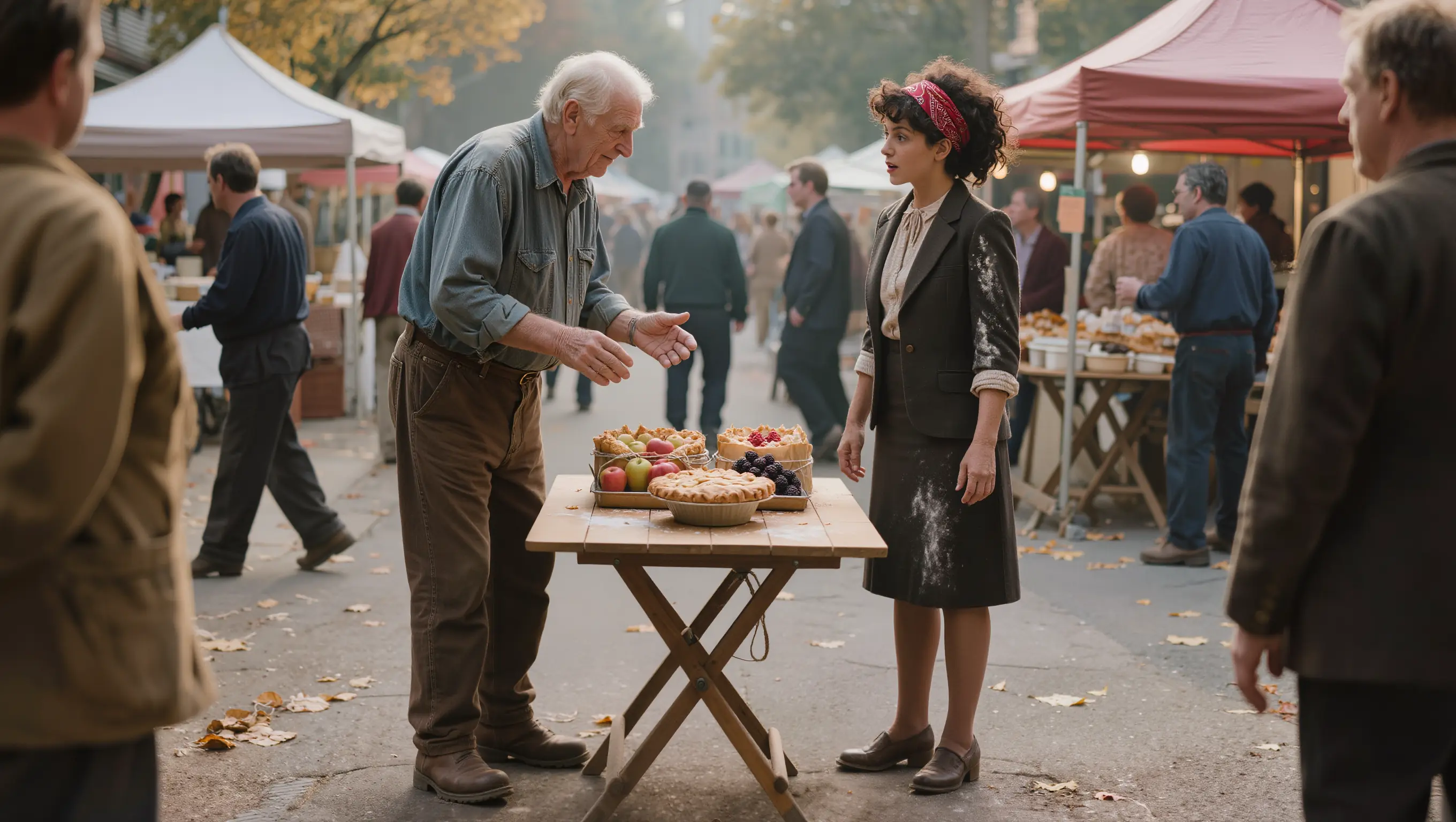
It did not replace dying trees.
It did not pay taxes.
One winter morning, Henry sat at the kitchen table with a stack of bills, an offer letter, and Clara’s old recipe box beside him. His hands shook slightly as he opened the latest tax notice.
For the first time in his life, he considered selling.
Not because he wanted to.
Because he was tired.
Nina noticed before he told her.
She came by in February to pick up stored apples and found him standing by the old cider press, one hand resting on the worn wooden frame.
“You’re quiet today,” she said.
“I am often quiet.”
“No. Today is different.”
He looked at her.
“You got too observant.”
“I learned from you.”
He tried to smile, but it faded.
Nina stepped closer.
“What’s wrong?”
“Nothing that belongs to you.”
“That sounds like something very wrong.”
Henry sighed.
He led her to the kitchen and showed her the bills, the tax notice, the repair estimates, and the developer’s offer.
Nina read everything carefully.
Her face hardened at the line describing luxury cabins and a private access road.
“They want to tear out the orchard?”
“Most of it.”
“And the house?”
“Probably.”
“No.”
“That is not a legal response.”
“It’s the only one I have right now.”
Henry sat down slowly.
“I can’t keep up, Nina.”
She looked at him.
The man who had once bought all her pies so she could keep a kitchen space now sat across from her, surrounded by numbers that treated his life like acreage.
She remembered the market. The rain threatening her sign. The people passing. The way he had seen her effort before anyone else did.
“You told me soft apples aren’t bad apples,” she said quietly. “They just need a different job.”
Henry looked up.
“What are you thinking?”
“I’m thinking the orchard needs a different job.”
Over the next month, Nina built a plan.
She did not do it alone.
She brought in a small-business consultant who loved farms, a local agricultural nonprofit, a tourism coordinator, and a land preservation lawyer. Henry hated the number of meetings. He hated the word “branding.” He hated when people said “experience” instead of “visit.”
But he listened.
Nina’s plan was practical.
Whitlow Orchard would stop trying to compete with large suppliers and become a heritage baking orchard. Part of the land would be placed under an agricultural preservation agreement to prevent development. The old packing shed would be repaired and converted into a bakery, kitchen, and teaching space.
Nina’s business would lease part of the orchard property for seasonal baking workshops, pie classes, farm dinners, and apple picking weekends. Henry would remain owner and orchard keeper, working as much or as little as he could. Younger workers would be hired for physical labor.
Second Slice Bakery would make Whitlow Orchard its official home.
Henry stared at the proposal.
“You want to move your bakery here?”
“Part of it. The production kitchen downtown stays. But the heart of the business belongs here.”
“That’s foolish.”
“No. It’s honest.”
“You worked hard to build your own place.”
“Because you helped me when I had one folding table and three sold pies.”
“You don’t owe me your business.”
“I know.”
“Then why?”
Nina looked out the kitchen window at the rows of old trees.
“Because this orchard gave me my first real ingredient. Because your apples built my reputation. Because places like this disappear when everyone decides they’re too old to matter.”
Henry looked away.
She softened.
“And because you believed in me before I looked believable.”
For once, Henry had no dry answer.
The work began in spring.
The packing shed roof was repaired first. Volunteers came from town. Customers of Second Slice Bakery donated. Local restaurants placed advance orders for Whitlow apple desserts. The agricultural nonprofit helped with preservation paperwork. Henry’s daughter and son came home for a long weekend and, after seeing the plan, agreed to help.
“I thought selling was the only way to save you from the orchard,” Emily said.
Henry looked toward Nina, who was measuring the old shed wall.
“Maybe the orchard just needed more people.”
The first season was messy.
Very messy.
Parking had to be arranged. The old stand needed repairs. The shed had to pass inspection. Henry had to accept that other people would prune trees under his supervision and not always exactly the way he would have done it. Nina had to learn that farm schedules followed weather, not calendars.
They argued often.
“You can’t host a pie class during harvest chaos,” Henry said.
“People want to see harvest.”
“People want romance. Harvest is ladders, sweat, and arguing with crates.”
“Then we show them the real thing.”
“That is bad marketing.”
“That is honest marketing.”
He grumbled.
She won.
The first Whitlow Apple & Pie Weekend happened in October.
Henry expected modest attendance.
By nine in the morning, cars lined the field.
Families walked between rows. Children picked apples. Nina taught a pie crust class in the repaired packing shed. The smell of baked apples, butter, cinnamon, and fresh cider moved through the orchard. Local musicians played near the stand. A sign beside the old cider press told the story of the Whitlow family and the orchard’s history.
Henry stood near the roadside stand wearing his old cap, watching strangers admire the trees he had feared would be bulldozed.
A little boy held up an apple and asked, “Did you grow this?”
Henry nodded.
“With help from rain, bees, dirt, and stubbornness.”
The boy looked impressed.
Nina overheard and wrote the phrase on the chalkboard.
Henry told her to erase it.
She did not.
By the end of the weekend, the orchard had earned more than the stand usually made in a month. More importantly, the preservation fund had passed its first goal. The cider press repair was scheduled. The tax payment was covered.
That evening, Henry and Nina sat on the porch with two slices of apple pie.
His pie, made with her recipe, from his trees.
“This is strange,” Henry said.
“What is?”
“Being helped by someone I helped.”
Nina smiled.
“It completes the recipe.”
“That was terrible.”
“I know. I almost didn’t say it.”
“You should have trusted that instinct.”
They both laughed.
Years passed, and Whitlow Orchard became known not as the biggest orchard in Henderson County, but as one of the most beloved.
Second Slice Bakery at Whitlow Orchard brought visitors from across the region. There were pie workshops, cider weekends, farm breakfasts, school tours, preservation days, and a small apprenticeship program for young bakers and orchard workers. Nina hired local teenagers during harvest season and taught them that imperfect fruit could still become something beautiful.
Henry taught too, though he refused to call it teaching.
He showed apprentices how to prune without wounding a tree, how to recognize blight early, how to twist apples from the branch instead of yanking, how to smell rain before it arrived.
“Trees don’t rush,” he told them. “That is why they outlive fools.”
The students loved him.
He pretended not to care.
On Henry’s eighty-fifth birthday, Nina organized a dinner beneath the oldest apple tree in the orchard.
Henry warned her not to make a fuss.
She made a fuss.
Not a loud one.
A long wooden table sat between rows, covered with simple white cloth, candles in jars, baskets of apples, plates of roasted chicken, bread, cider, and pies. His children came. His grandchildren came. Workers, neighbors, bakery staff, and old customers came. The evening air smelled of grass and fruit.
After dinner, Nina stood with a small wooden box in her hands.
Henry narrowed his eyes.
“No speeches.”
“It’s not a speech.”
“You’re standing.”
“People can stand silently.”
“You won’t.”
She laughed, then opened the box.
Inside was a brass key attached to a small carved apple made from wood taken from the old packing shed.
Henry stared.
“What’s that?”
“The key to the teaching kitchen.”
“I have a key.”
“This one is symbolic.”
“I dislike symbolic.”
“I know. That’s why it also works.”
He took it slowly.
Nina’s voice softened.
“The kitchen is officially named Clara’s Kitchen.”
Henry looked up sharply.
Nina continued, “Your children approved. We used the photo of her painting the orchard sign for the wall. The apprenticeship program will carry her name too.”
Henry looked toward the packing shed, where warm light glowed through the windows.
Clara’s Kitchen.
For a moment, he could not speak.
Nina stepped closer.
“You once bought every pie on my table so I could keep going. You told me to bake pies worth arguing over. Everything I built started there.”
Henry swallowed.
“You built it.”
“Because you helped me believe it was worth building.”
His hand tightened around the key.
Around them, the orchard was quiet except for the soft movement of leaves.
Nina said, “You saved my first chance. I wanted to help save the place that gave it to me.”
Henry looked at the old trees, the repaired stand, the glowing kitchen, his family, the young apprentices laughing near the cider press, and the woman who had once stood behind a folding table trying not to cry over unsold pies.
“Clara would have liked you,” he said.
Nina’s eyes filled.
“I wish I could have met her.”
“In a way,” Henry said, looking toward the sign his wife had painted, “you did.”
Later that night, after everyone left, Henry walked slowly through the orchard with Nina beside him. The moon hung above the trees. The air was cool, and the branches whispered softly overhead.
“You know,” Henry said, “I almost didn’t stop at your table that day.”
Nina looked at him.
“Why did you?”
He thought about it.
“The pies looked honest.”
She laughed softly.
“That’s all?”
“No,” he said. “You looked like someone who had worked hard and was trying not to disappear.”
Nina’s smile faded.
“I felt that way.”
“I know.”
They reached the oldest tree, the one his grandfather had planted.
Henry placed one hand against its bark.
“I thought I was buying pies.”
“You were.”
“No,” he said quietly. “I think I was planting something without knowing it.”
Nina stood beside him.
“Then it grew.”
Years earlier, Henry Whitlow had helped a young baker by buying every pie she had left when the world seemed ready to walk past her.
He thought it was a small kindness.
A practical kindness.
A way to help one tired young woman pay for a kitchen space and keep trying.
But years later, that young woman returned with a business, a plan, a community, and the courage to imagine the orchard differently. She did not simply repay him. She helped protect his land, restore his livelihood, honor his wife’s memory, and turn a fading farm into a living place again.
What Henry received was not just money for repairs or relief from taxes.
He received a future for the trees.
He received laughter in the packing shed, young hands learning old work, families walking the rows, and Clara’s name glowing above a kitchen filled with apple pie and second chances.
And every Saturday during harvest season, when visitors lined up at the stand and someone asked which apples were best for baking, Henry would point toward Nina and say,
“Ask her. She knows what to do with things other people almost pass by.”