Steam rose from the old soup cart in slow white ribbons, curling into the evening air above Franklin Avenue.
Mr. Samuel Brooks stood behind it with both hands resting on the metal counter, watching the city move past him like a river that had forgotten how to notice the shore.
Cars honked at the corner.
Office workers hurried by with their heads down.
A bus sighed against the curb, released a handful of tired passengers, then pulled away in a cloud of exhaust.
Somewhere nearby, someone laughed into a phone. Somewhere else, a delivery driver cursed at traffic. Shoes struck pavement. Doors opened and closed. The city kept breathing, loud and careless.
Samuel’s cart was not much to look at.
A square metal stand.
A small grill.
A deep soup pot.
A faded green umbrella patched twice with duct tape.
A handwritten sign taped to the front that read:
Hot soup. Fresh rolls. Coffee.
The letters were uneven because Samuel’s hands were not as steady as they used to be.
He was seventy-four years old, tall once, but now slightly bent through the shoulders. His skin was dark and weathered, his beard white and trimmed close, his eyes deep-set and tired in a way that made strangers assume he was stern. He was stern sometimes, but mostly he was old, and old age had taught him to use fewer words.
His hands were working hands.
Hands with thick fingers and small old marks near the knuckles.
Hands that had chopped onions, lifted crates, washed pots, fixed wheels, counted coins, tied bread bags, wiped counters, and held on through seasons when holding on was the only victory available.
He stirred the soup once, though it did not need stirring.
Chicken, rice, carrots, onions, celery, black pepper, and the little bit of thyme his wife, Ruth, used to say made cheap soup taste like someone cared.
Ruth had been gone nine years.
Samuel still heard her sometimes.
Not like a ghost.
Like a habit of love that refused to leave.
Don’t water it down too much, Sam.
People can taste when you stop caring.
He never watered it down too much.
Even when business was slow.
Even when rain kept customers away.
Even when the city raised vendor fees and the corner landlord complained that his cart made the block look “old-fashioned.”
Even when his knees ached before sunset and his back tightened every time he lifted the water jug.
Samuel kept the soup honest.
A construction worker stopped by first.
“Evening, Mr. Brooks.”
“Evening, son.”
“The usual?”
“You always ask like I changed my mind.”
The man laughed and handed over a few folded bills.
Samuel filled a bowl, added a roll, and placed a paper napkin beside it.
“Eat before it gets cold.”
“Yes, sir.”
When the man left, Samuel looked into the small cash box.
Not enough.
It was almost never enough anymore.
A new sandwich shop had opened two blocks away with bright lights, polished counters, and a menu written in words Samuel did not enjoy saying. People stood in line there to buy food that cost more than his dinner supplies for a whole day.
His cart had no shine.
It had age, cleanliness, and memory.
Those things did not always compete well with shine.
Still, he opened every afternoon.
He had been on that corner for twenty-one years.
Before that, he had worked in a hotel kitchen.
Before that, a school cafeteria.
Before that, whatever job would feed his family.
He had never become rich. He had never expected to. But for most of his life, Samuel had believed that if a man worked hard, kept his word, and served good food, he would remain useful.
Lately, he was not so sure.
The world seemed to be moving too fast for men like him.
People ordered meals from phones. Payments happened without coins. Young workers looked at his cart with polite curiosity, as if it belonged in a museum beside old radios and handwritten letters.
Samuel adjusted his apron and looked down the block.
That was when he saw the man.
He stood near the closed pharmacy, not close enough to order, not far enough to seem uninterested.
He was perhaps forty, maybe a little younger, though exhaustion had placed shadows beneath his eyes and made him look older. He wore a gray suit jacket that had once been good quality but was now wrinkled from too many days without a closet. His shirt was clean but worn at the collar. His tie had been folded into his pocket. His shoes were city shoes, polished once, but scuffed now from too much walking.
In one hand, he held a black briefcase.
Not a new one.
Not expensive.
But he held it tightly, like it contained the last proof that he had once belonged somewhere respectable.
The man looked at the soup pot.
Then at the rolls.
Then away.
Samuel had seen that look before.
Hunger trying not to embarrass itself.
The man took one step forward.
Stopped.
Turned as if to leave.
Then his stomach betrayed him with a sound loud enough to reach the cart.
His face tightened.
Samuel picked up a bowl.
“You planning to stand there arguing with your pride all night?” he called.
The man froze.
Several passing pedestrians glanced at him, then kept moving.
The man turned slowly.
“Excuse me?”
Samuel set the bowl on the counter.
“I asked if you were hungry.”
The man’s jaw worked once.
“I was just looking.”
“Looking is free. Eating costs less than fainting.”
“I don’t have any cash.”
“I didn’t ask what you had.”
The man stood very still.
His pride was still alive.
Samuel could respect that.
“Name?” Samuel asked.
The man hesitated.
“Marcus.”
“Marcus what?”
Another pause.
“Marcus Reed.”
Samuel nodded.
“You eat today, Marcus Reed?”
Marcus looked toward the street.
“I had coffee.”
Samuel snorted.
“Coffee is what you drink while waiting for food. It is not food.”
Marcus gave a small, tired smile that disappeared almost immediately.
“I’m fine.”
“People who are fine don’t stare at soup like it owes them money.”
That caught him off guard.
For the first time, Marcus looked directly at Samuel.
His eyes were intelligent, guarded, and deeply ashamed.
“I’m not asking for charity,” Marcus said quietly.
“Good. I’m not offering charity.”
Samuel filled the bowl.
“Then what is it?”
“Soup.”
Marcus did not move.
Samuel added extra rice from the bottom of the pot, two pieces of chicken, and a roll still warm beneath the cloth. He placed the bowl on the counter and pushed it forward.
“Eat first. Define words later.”
Marcus stared at the food.
His hand tightened around the briefcase handle.
“I can pay you tomorrow.”
“Maybe you can. Maybe you can’t. Soup gets cold either way.”
Marcus swallowed.
There was a plastic stool beside the cart, old and slightly uneven. Samuel pointed to it.
“Sit.”
“I don’t want to take up space.”
Samuel looked around at the busy sidewalk.
“Son, this city has room for billboards, traffic cones, pigeons, and men shouting into phones. It has room for you to sit down.”
Something in Marcus’s face shifted.
Not relief exactly.
Something more painful.
The shock of being spoken to like a person.
Slowly, he sat.
He ate carefully at first. Small spoonfuls. Controlled movements. His back straight. His eyes low. As if manners could cover hunger.
But hunger tells the truth.
By the fifth spoonful, his shoulders loosened.
By the seventh, his hand shook.
By the tenth, he closed his eyes for half a second and breathed in through his nose like the warmth had reached a place in him colder than his stomach.
Samuel turned away to wipe the counter.
Not because it needed wiping.
Because dignity sometimes required a witness to look elsewhere.
When Marcus finished the bowl, Samuel refilled it without asking.
Marcus looked up quickly.
“No, sir. Please. I can’t—”
“You can.”
“I don’t want to take advantage.”
“Then don’t. Eat with gratitude and stop making the soup feel guilty.”
A laugh escaped Marcus.
Small.
Broken.
But real.
Samuel almost smiled.
Almost.
“Where you sleeping tonight?” Samuel asked.
Marcus’s laugh faded.
He looked down at the briefcase.
“I’ll figure it out.”
“That answer usually means nowhere good.”
Marcus did not respond.
Samuel waited.
He had learned over seventy-four years that silence could be a gentler invitation than questions.
Finally, Marcus said, “I was staying in a weekly room on Addison Street. I lost it yesterday.”
“Lost your job too?”
Marcus nodded once.
“Three months ago. I managed operations for a shipping company. They were bought out. New owners brought their own people. I kept thinking I’d find something quickly.”
He rubbed one thumb along the edge of the briefcase.
“I had savings. Then rent. Then storage. Then phone. Then interviews that went nowhere. People say they’ll call. They don’t. After a while, you stop knowing whether you’re unlucky or invisible.”
Samuel knew that sentence.
Not those exact words, but the shape of them.
Invisible.
Every old person knew something about that.
“What’s in the briefcase?” Samuel asked.
Marcus glanced down.
“Resumes. References. Old work files I probably don’t need. A notebook. Two shirts.”
“A whole life in a case.”
Marcus smiled sadly.
“Not a very impressive life.”
Samuel looked at him.
“You still carrying it. That means something.”
Marcus lowered his eyes.
Before he could answer, a voice cut in from the side.
“Well, isn’t that touching?”
Samuel’s jaw tightened before he turned.
Calvin Price stood near the edge of the sidewalk, hands in the pockets of his expensive coat, smiling like a man who had never used warmth for anything but display.
Calvin owned three storefronts on the block, including the closed pharmacy building and the narrow storage room Samuel rented for supplies. He liked being called a developer, though Samuel privately thought he developed mostly headaches.
For months, Calvin had been pressuring Samuel to leave the corner.
He wanted the block cleaner.
Newer.
More attractive to what he called “better foot traffic.”
Samuel knew what that meant.
People with more money and fewer questions.
Calvin looked Marcus up and down.
“Giving away food now, Mr. Brooks?”
Samuel set down the ladle.
“Serving it.”
“To customers?”
“To people.”
Calvin smiled wider.
“That sounds expensive.”
“Kindness often is.”
Marcus stiffened and started to rise.
“I should go.”
Samuel pointed at the stool.
“You should finish your roll.”
“I don’t want to cause trouble.”
“You didn’t bring trouble,” Samuel said. “Trouble wears polished shoes and thinks sidewalks need permission to be human.”
A few people nearby slowed.
Calvin’s smile hardened.
“You should be careful, Samuel.”
“At my age, careful is mostly stretching before lifting things.”
“I’m serious.”
“So am I.”
Calvin stepped closer.
“You’re already behind on the storage payment. You know the city is reviewing sidewalk vendor spacing next month. If complaints start coming in about loitering, sanitation, attracting the wrong element…”
He let the words hang.
Marcus’s face flushed.
Wrong element.
Samuel’s hands curled around the edge of the cart.
He had spent most of his life swallowing insults because rent was due and groceries cost money and proud men sometimes had to choose between answering disrespect and keeping peace.
But age changes fear.
It does not always remove it.
Sometimes it simply makes fear less interesting.
Samuel looked directly at Calvin.
“This man was hungry,” he said. “I had food. That is the whole matter.”
Calvin’s eyes narrowed.
“You’re making this block look desperate.”
Samuel nodded toward the sandwich shop down the street.
“No. The block was already desperate. Some people just put nicer lights over it.”
A woman passing by covered her mouth to hide a laugh.
Calvin heard it.
His face went red.
“You’ll regret embarrassing me.”
“I’ve regretted bigger things.”
Calvin looked at Marcus.
“And you. Don’t get comfortable. This corner isn’t a shelter.”
Marcus stood then, not because Samuel told him to, but because something inside him had remembered its own height.
“No,” Marcus said quietly. “It’s a food cart. And he fed me.”
Calvin looked him over with contempt.
“And what are you going to do about it?”
Marcus held his gaze.
“Remember.”
For some reason, that landed harder than a threat.
Calvin scoffed and walked away.
The sidewalk slowly returned to its usual motion.
Marcus sat again, but his appetite had changed.
“I’m sorry,” he said.
Samuel picked up the ladle.
“For being hungry?”
“For bringing his attention.”
“Calvin’s attention is like rain. It falls whether invited or not.”
Marcus looked toward the direction Calvin had gone.
“He can really hurt your business?”
“He can try.”
“Has he?”
Samuel did not answer.
That was answer enough.
Marcus’s eyes sharpened slightly.
The exhausted man was still there.
But something else had appeared beneath the fatigue.
A habit of noticing systems.
Paperwork.
Pressure.
Weak points.
“Do you keep records?” Marcus asked.
Samuel looked at him.
“Of what?”
“Payments. Notices. Rent. Permit fees. Complaints. Anything from him or the city.”
Samuel frowned.
“I keep everything.”
“Can I see it sometime?”
“You want to read my paperwork?”
Marcus looked embarrassed, as if the request itself was strange.
“I’m good with records. Contracts. Logistics. Compliance. I used to untangle messes for a living.”
Samuel studied him.
Marcus’s suit was wrinkled. His shoes were worn. He had just eaten soup because he had no money for dinner. But his eyes had changed when he spoke about paperwork. They had become clear.
Useful.
Alive.
Samuel recognized that too.
A man could be down and still carry tools inside him.
“Tomorrow,” Samuel said. “You come before five.”
Marcus blinked.
“Tomorrow?”
“You said you can read records. I’ve got records.”
“I don’t have anywhere to clean up.”
Samuel wiped the counter.
“There’s a church basement three blocks over. Pastor Lena lets people shower in the morning if they ask respectful. Tell her Samuel sent you.”
Marcus stared at him.
“You know everyone?”
“No. But I know enough people who still answer when called.”
Samuel packed two rolls into a paper bag, then added soup in a sealed container.
Marcus immediately shook his head.
“No, sir.”
“Don’t start.”
“I’ve already eaten.”
“Night is long.”
Marcus looked at the bag.
His pride fought him.
Then his fingers closed around it.
“Thank you,” he whispered.
Samuel nodded once.
“Come tomorrow.”
“I will.”
“Don’t say it polite. Say it true.”
Marcus lifted his eyes.
“I will come tomorrow.”
Samuel believed him.
The next afternoon, Marcus returned.
He wore the same suit jacket, but his shirt was clean, his face washed, his beard trimmed as best he could manage. He arrived ten minutes before five, carrying the briefcase like a man reporting for work.
Samuel pointed toward the back of the cart.
“Water jugs need filling first.”
Marcus paused.
“I thought you wanted me to look at records.”
“I do. After water.”
A faint smile moved across Marcus’s face.
“Yes, sir.”
He worked quietly. He carried water, stacked paper bowls, wiped the counter, organized napkins, and tightened one loose screw on the cart handle without being asked. When customers came, he stepped back respectfully and watched how Samuel served them.
At seven, after the dinner rush, Samuel unlocked the storage room and pulled out three boxes of papers.
Marcus stared.
“You said you kept everything.”
“I do.”
“You meant everything.”
“Paper remembers what people deny.”
Marcus looked at him, then smiled.
“That is very true.”
They sat on overturned crates under the weak storage room light. Samuel brought coffee in paper cups. Marcus opened folders, sorted notices by date, separated official city letters from Calvin’s private demands, and began making notes.
Within an hour, his expression had changed.
“Mr. Brooks,” he said slowly, “some of these fees don’t match city code.”
“I figured they were new.”
“They’re not.”
Marcus held up one paper.
“This one says ‘sidewalk appearance maintenance.’ That’s not a city fee.”
“Calvin said everyone paid it.”
“Did he give receipts?”
“Sometimes.”
Marcus looked through the stack.
“These aren’t official receipts.”
Samuel sat back.
He had known, in a quiet place inside himself, that Calvin had been pushing him unfairly. But knowing in your bones and seeing it arranged in paper were different things.
“He’s been taking money from you,” Marcus said.
Samuel’s mouth tightened.
“For years?”
Marcus did not answer quickly.
That was answer enough.
The old man looked toward the cart through the storage room doorway.
The green umbrella moved slightly in the evening wind.
His life was out there.
A soup pot, a grill, a stool, and a sign written by an unsteady hand.
He had defended that little cart against weather, competition, rising fees, and his own aging body. Now he saw how much of his fear had been manufactured by one man with polished shoes.
Marcus lowered his voice.
“I can help you organize this.”
Samuel looked at him.
“You need to help yourself first.”
Marcus smiled, but it was tired.
“Sometimes helping someone else reminds you what you’re still good at.”
Samuel said nothing for a long moment.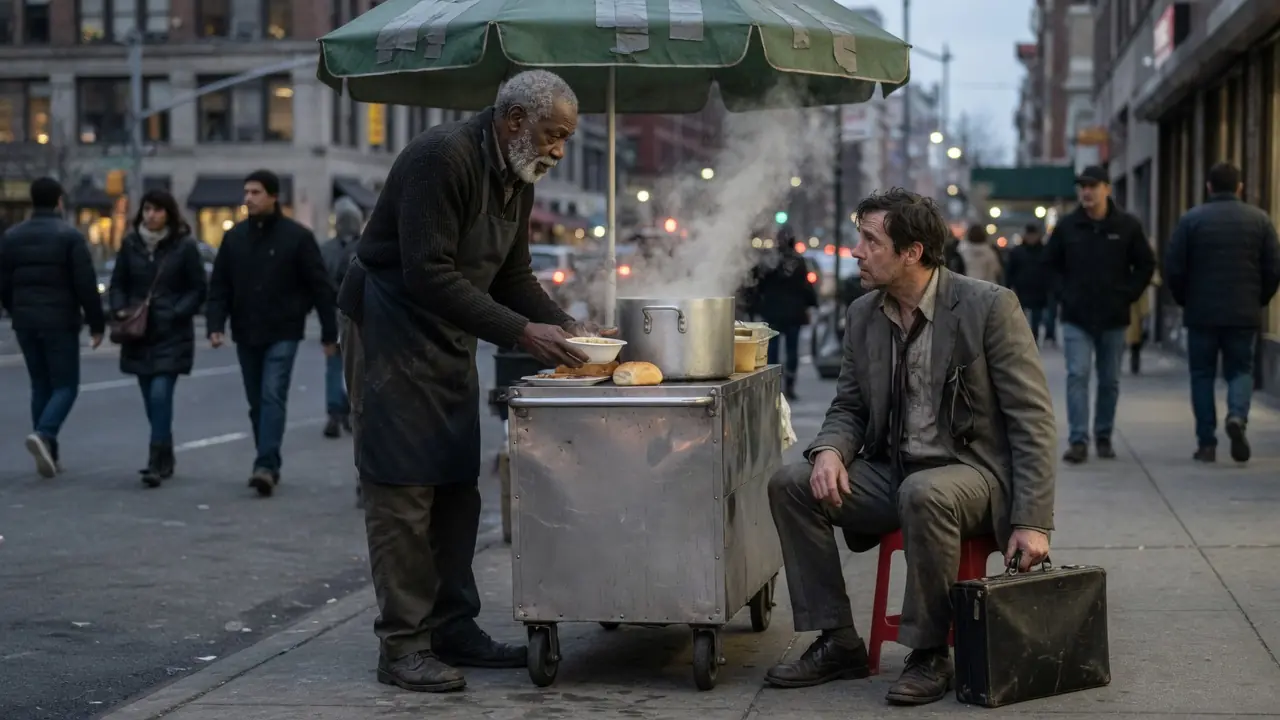
Then he pulled another box closer.
“Then remind yourself.”
So Marcus came back the next day.
And the next.
A routine formed.
In the mornings, Marcus went to job centers, libraries, and interviews. Some days he came back with hope. Some days he came back with that tight, quiet disappointment men carry when they have been rejected too often to show surprise.
In the afternoons, he helped Samuel set up the cart.
He carried water.
He lifted crates.
He checked inventory.
He organized records.
Samuel fed him.
Not as charity.
Not as payment exactly.
As part of the rhythm.
People noticed.
Some customers accepted Marcus quickly. Others watched him with suspicion. A few asked Samuel if it was wise to let a man “like that” handle supplies.
Samuel always gave the same answer.
“A man like what?”
Most people had no good reply.
One evening, a woman in a red coat looked at Marcus’s worn shoes and whispered too loudly, “People fall that far for a reason.”
Marcus heard.
He looked down and continued stacking bowls.
Samuel heard too.
He handed the woman her soup and said, “Yes. Sometimes the reason is that nobody caught them when the ground gave way.”
The woman had the decency to look ashamed.
After she left, Marcus said, “You don’t have to defend me.”
Samuel wiped the ladle.
“I wasn’t defending you. I was correcting nonsense.”
Marcus was quiet for a moment.
Then he said, “There’s a difference?”
“There is when you’re old enough.”
Marcus smiled.
Weeks passed.
The air turned colder.
Samuel’s knees worsened.
Marcus noticed how the old man leaned more heavily on the cart by the end of the night. He noticed how Samuel hid bills beneath the cash tray. He noticed how often the old man massaged his right hand when he thought no one was looking.
One night, after closing, Marcus found Samuel sitting on the stool, eyes closed, breathing carefully.
“You alright?”
Samuel opened one eye.
“If I say yes, will you stop looking dramatic?”
“No.”
“Then why ask?”
Marcus crouched beside the cart.
“You need help.”
“I have help.”
“You need more.”
Samuel gave him a sharp look.
“Careful, son.”
Marcus lowered his voice.
“You fed me when I couldn’t feed myself. Let me speak plainly now. This cart is too much for you alone.”
Samuel looked away.
The city lights reflected in the soup pot.
“This cart is what I have.”
“It doesn’t have to be all you have.”
Samuel’s face closed.
“You sound like my nephew. He says I should retire, move into a senior building, stop standing in the cold.”
“Do you want that?”
“No.”
“Then don’t do that.”
Samuel looked back at him.
Marcus continued.
“But there is a difference between quitting and letting people stand beside you.”
The old man said nothing.
The words had found a tender place.
Marcus knew because he carried the same wound.
“I used to think needing help meant I had failed,” Marcus said. “Then I sat on a plastic stool eating your soup because I was too hungry to keep pretending. I hated needing it. But I needed it.”
Samuel’s jaw tightened.
“And now?”
“Now I think the shame was heavier than the hunger.”
Samuel looked down at his hands.
The city moved around them.
Finally, he said, “Ruth used to help me. My wife.”
Marcus stayed quiet.
Samuel continued.
“She could stretch ten dollars into dinner for six and still find enough to send somebody home with leftovers. After she passed, I kept working because stopping felt like admitting she was gone.”
His voice roughened.
“Then work became the only place I still knew who I was.”
Marcus heard the truth beneath it.
The cart was not only business.
It was grief with wheels.
Respectfully, he said, “Maybe who you are is bigger than the cart.”
Samuel looked at him for a long time.
Then he grunted.
“You always talk this much after soup?”
“Only when the soup is life-changing.”
“Don’t flatter old men. It makes us suspicious.”
But Samuel did not argue again.
By December, Marcus found steady work.
It began through a regular customer who ran a small warehouse and needed someone temporary to fix scheduling problems. Marcus took the job for two weeks. Then four. Then full-time.
He still came to the cart after work.
Now he wore clean shirts and carried a lunch bag, but he always stopped at Samuel’s corner before going home. Sometimes he helped close. Sometimes he only drank coffee and talked through city paperwork. Sometimes he brought groceries and pretended they had been on sale.
Samuel pretended to believe him.
Together, they filed a formal complaint against Calvin’s false fees.
Marcus wrote the statement.
Samuel signed it.
Three other vendors joined after Marcus helped them organize their own papers. A flower seller. A pretzel man. A woman who sold tamales on weekends.
Calvin laughed at first.
Then letters began arriving from real offices.
Then people from the city came asking questions.
Then Calvin stopped laughing.
The pressure did not vanish overnight. Men like Calvin rarely disappeared just because truth arrived. But the corner changed. Vendors started talking to one another. They compared notes. They shared copies. They stopped paying fees that did not exist.
Samuel watched it happen with quiet wonder.
One bowl of soup had become paperwork.
Paperwork had become courage.
Courage had become a group of people standing straighter on the sidewalk.
“You did this,” Samuel told Marcus one night.
Marcus shook his head.
“No. You fed me first. That was the first document.”
Samuel frowned.
“That doesn’t make any sense.”
“It does to me.”
Years moved.
Marcus rose quickly in his work because he had always been good. Hardship had not erased his skill. It had only hidden it under exhaustion. Once he had a place to sleep, food to eat, and someone who expected him to keep standing, the rest of him returned.
He became operations manager.
Then regional director.
Then he left to start a company that helped small food vendors organize logistics, permits, supplies, and fair pricing. He hired people who had been ignored by more polished businesses. Former caregivers. Older workers. People restarting after hard seasons. People with talent but no clean story.
He named the company Second Table.
Samuel told him the name sounded like a church potluck.
Marcus said that was exactly the point.
Through all of it, he never stopped visiting.
Every Friday evening, he came to Franklin Avenue.
Sometimes in work clothes.
Sometimes in a suit.
Sometimes carrying his little daughter, Ruthie, named with Samuel’s permission and Mrs. Ruth’s photograph watching from the cart shelf.
Ruthie loved Samuel’s rolls more than anything in the world and called him Grandpa Soup before anyone could stop her.
Samuel complained about the nickname.
Then kept extra rolls for her anyway.
He grew older.
His shoulders bent more.
His hands shook on cold evenings.
The cart became harder to push, harder to clean, harder to keep alive.
One winter morning, Marcus found him sitting in the storage room, looking at a notice on his lap.
Samuel tried to fold it before Marcus could read it.
“Don’t hide paper from me,” Marcus said.
Samuel sighed.
“It’s nothing.”
“It is never nothing when someone folds it that fast.”
Marcus took the notice gently.
The building owner was selling the storage property.
The new buyer planned renovations.
Vendors would need to leave within sixty days.
Marcus read it twice.
Samuel watched his face.
“Don’t start,” the old man said.
“I haven’t said anything.”
“You’re thinking loudly.”
Marcus looked at him.
“What do you want?”
Samuel gave a tired laugh.
“What I want is for my knees to be fifty years old and my wife to be standing at that cart telling me I forgot extra pepper.”
Marcus waited.
Samuel’s smile faded.
“I don’t know what I want now.”
That honesty cost him.
Marcus sat beside him on the crate.
For a while, neither man spoke.
Then Samuel said, “Maybe this is the sign. Maybe the world is done with old soup carts.”
Marcus looked out toward Franklin Avenue, where people hurried past without knowing the history of the corner.
“No,” he said. “The world is not done with tables. It’s just bad at protecting them.”
Samuel turned toward him.
Marcus folded the notice carefully.
“Give me sixty days.”
“For what?”
“To answer properly.”
Samuel narrowed his eyes.
“I don’t like mysterious rich-man sentences.”
“I’m not rich.”
“You wore a coat last week that cost more than my first car.”
“It was on sale.”
“Lying to old people is unattractive.”
Marcus laughed.
“Sixty days, Mr. Brooks.”
Samuel studied him, then looked toward the cart.
“Fine. But if your answer involves putting my face on a billboard, I will haunt you while living.”
“Understood.”
Fifty-eight days later, Marcus asked Samuel to close early.
Samuel refused.
Marcus expected that.
So he brought Ruthie, who looked up at Samuel with wide eyes and said, “Please, Grandpa Soup.”
Samuel closed early.
Marcus drove him three blocks east, to a brick building that had once been a furniture repair shop. For years it had sat empty, windows dusty, door chained, old sign fading above the entrance.
Now the windows were clean.
The brick had been washed.
Warm light glowed inside.
Above the door hung a new sign in deep green letters.
Brooks Table.
Community Kitchen and Vendor Cooperative.
Samuel stared through the windshield.
“No.”
Marcus smiled.
“You haven’t seen inside.”
“No.”
“You say that when you’re scared.”
Samuel turned to glare at him.
Ruthie whispered loudly from the back seat, “Grandpa Soup is scared?”
“I am not scared,” Samuel said.
Marcus opened the car door.
“Then come in.”
Inside, the building smelled of fresh wood, coffee, and simmering soup.
The front room held long tables made from reclaimed wood. Along one wall were shelves for local vendors to sell sauces, bread, spices, and handmade goods. The back had a licensed commercial kitchen with shining counters, proper storage, and equipment Samuel could only stare at.
But it was not fancy in a cold way.
It was warm.
There were hooks for aprons.
A chalkboard menu.
A corner for coffee.
A framed photograph of Ruth near the entrance, smiling in the yellow dress she had worn to a church picnic years ago.
Samuel stopped walking.
His breath caught.
Marcus stood beside him.
“I asked your nephew for the photo,” he said softly. “I hope that was alright.”
Samuel looked at Ruth’s face.
For a moment, he was back at the old cart, young enough to believe time was generous, watching her add thyme to a pot and tell him not to be cheap with flavor.
He swallowed hard.
“What is this?”
Marcus’s voice was steady, but emotional.
“A place for food vendors who can’t afford their own kitchens. A place for people to eat when they’re short on money. A place to train people who need work but don’t have perfect resumes. A place where your soup can keep feeding people without your knees doing all the suffering.”
Samuel turned toward him.
“You built this?”
“We built it,” Marcus said. “Second Table funded part of it. Vendors contributed. Customers donated. Your old regulars helped. Lily from the flower stand painted the back room. The tamale family brought the first stockpots. The pretzel man cried over the oven, but he denies it.”
Samuel’s mouth trembled.
Marcus continued.
“You don’t have to run it. You don’t have to work every day. You can sit in the corner and criticize how everyone chops onions.”
“That is an important job.”
“The most important.”
Samuel looked around again.
Long tables.
Soup pots.
Warm light.
Ruth’s photograph.
A kitchen big enough for many people to belong.
His voice became rough.
“Why would you do all this for me?”
Marcus’s eyes filled.
“Because one night, when I had nothing but a briefcase and shame, you gave me soup and a stool. You didn’t make me explain my whole failure before you fed me. You didn’t ask if I deserved warmth. You just gave it.”
Samuel looked down.
Marcus placed a hand gently on his shoulder.
“You told me the city had room for me to sit down. This is me making sure the city has room for you too.”
Samuel covered his face with one hand.
He did not cry loudly.
He was not that kind of man.
But his shoulders shook once, and Marcus looked away to give him the dignity Samuel had once given him.
Opening day came the next week.
The line stretched down the block.
Old customers came.
Vendors came.
People from shelters, offices, apartments, churches, and repair shops came. Men in suits stood beside workers in dusty boots. Elderly women sat with college students. Children ate rolls too quickly. Volunteers carried trays. The air smelled of soup, bread, coffee, and something Samuel had not felt in a long time.
Beginning.
Marcus stood near the counter with Ruthie on his hip.
Samuel wore a clean apron with his name embroidered in green thread.
Mr. Brooks.
He complained about the embroidery for ten minutes, then touched it when he thought no one was watching.
Before the first meal was served, Marcus tapped a spoon gently against a glass.
The room quieted.
He looked at Samuel.
“I was going to give a speech,” Marcus said, “but Mr. Brooks hates speeches almost as much as weak coffee.”
People laughed.
Samuel muttered, “Then don’t give one.”
Marcus smiled.
“I’ll keep it short. Years ago, I came to his cart hungry, ashamed, and convinced that my life had become a closed door. He fed me. Not with pity. With respect. That difference saved me.”
The room grew still.
“He taught me that hunger is not a character flaw. Need is not failure. And a man sitting down to eat should not have to prove he is worth the bowl.”
Samuel lowered his eyes.
Marcus lifted his glass.
“So this place stands for what he already lived. No one earns dignity. You are born with it. A good table simply reminds you.”
For a moment, no one moved.
Then applause filled Brooks Table.
Samuel stood behind the counter with both hands pressed to the wood, overwhelmed by the sound.
Ruthie clapped so hard she nearly dropped her roll.
Afterward, Samuel served the first bowl of soup.
He made sure it had enough chicken.
Enough rice.
Enough thyme.
He placed a warm roll beside it and handed it to a man from the line who looked tired in a way Samuel recognized immediately.
“Eat before it gets cold,” Samuel said.
The man nodded, eyes grateful.
And just like that, the work continued.
Years later, people told the story of Brooks Table in different ways.
Some said it began when Marcus Reed built a community kitchen.
Some said it began when vendors stood together against unfair treatment.
Some said it began with a company called Second Table and a clever business model that helped small food workers survive in a changing city.
Marcus always corrected them.
“No,” he would say. “It began with one bowl of soup.”
Samuel never liked being called a hero.
He said heroes were people in books, and he was just an old man who knew how to season broth.
But Marcus knew better.
A hero is not always someone who saves a life in one grand moment.
Sometimes a hero is a tired old man behind a humble cart, feeding a stranger before asking questions.
Sometimes a hero is someone who sees shame sitting on a plastic stool and refuses to let it eat alone.
Sometimes a hero is a person who says, “You have room here,” when the rest of the world keeps saying, “Move along.”
On quiet evenings, when Brooks Table was clean and the last pot had been washed, Samuel would sit beneath Ruth’s photograph with a cup of coffee.
Marcus would sit across from him.
Ruthie would do homework at the end of the table, occasionally stealing rolls when she thought nobody noticed.
Samuel always noticed.
He let her steal them anyway.
One rainy night, much like the night Marcus had first appeared at the cart, the front door opened just before closing.
A man stood there, soaked through, holding a folder against his chest.
He looked embarrassed.
Hungry.
Unsure whether he had the right to step inside.
Samuel saw him from across the room.
Marcus saw him too.
For a moment, they looked at each other, remembering.
Then Samuel lifted his voice.
“Don’t stand there arguing with your pride all night.”
The man blinked.
Marcus smiled.
Samuel pointed to a chair.
“Sit down. Soup’s hot.”
And so the table grew again.
That was the lesson Samuel Brooks left behind, though he never wrote it down.
Kindness does not have to be loud to change a life.
It does not need perfect timing, perfect wealth, or perfect certainty.
Sometimes kindness is only a bowl placed in front of a hungry man.
A stool offered without judgment.
A roll added quietly because one is not enough.
But when kindness protects someone’s dignity, it becomes more than food.
It becomes a bridge back to life.
And sometimes, years later, the man you fed when he had nothing comes back not simply to repay you, but to make sure the table you started is never empty again.