At seventy-nine years old, George Miller still opened Miller’s Wash & Fold every morning before the sun came up.
The laundromat sat on a quiet corner in Toledo, Ohio, between a closed pawn shop and a little Mexican bakery that filled the street with the smell of sugar and cinnamon by seven o’clock. George’s place was not beautiful. The blue paint on the front door had faded. Two washing machines rattled if loaded too heavily. The old vending machine took quarters only when it felt generous.
But the laundromat was clean, warm, and safe.
That mattered to George.
His late wife, Alice, used to sit by the front window with a cup of tea, greeting customers like they were guests in her home. She had known who was newly married, who had lost a job, who needed help folding sheets, and which children came in hungry on Saturday mornings.
“People don’t just bring dirty clothes here,” Alice used to say. “They bring tired lives too.”
George had laughed at that when he was younger.
Now that she was gone, he understood.
One cold January evening, George was closing late after repairing a dryer belt. Snow had been falling for hours, covering the sidewalks and making the streetlights glow blurry and pale. He was about to turn off the OPEN sign when he noticed movement near the row of plastic chairs.
Two children were crouched beside the lost-and-found bin.
The older child was a boy, maybe twelve, with dark hair, a thin face, and a gray hoodie under a jacket that did not look warm enough for winter. Beside him stood a little girl around seven, wearing pink mittens with holes in the thumbs. Her brown curls were tangled, and she held a small backpack against her chest.
The boy had opened a brown paper bag from the trash can near the vending machine.
Inside was half a stale donut.
George froze.
The boy saw him and immediately stood, stepping in front of the girl.
“We’re leaving,” he said quickly.
George looked at the donut, then at their faces.
“I didn’t ask you to leave.”
“We weren’t stealing.”
“I didn’t say you were.”
The little girl looked down at the donut with hungry eyes.
George’s heart tightened.
“What are your names?” he asked.
The boy’s jaw set. “Why?”
“Because I don’t like calling people ‘hey you.’”
The girl whispered, “I’m Emma.”
The boy glanced back at her, worried.
Then he said, “I’m Tyler.”
George nodded. “I’m Mr. Miller. George Miller.”
“We know,” Tyler said. “It says on the window.”
“So it does.”
The laundromat hummed quietly around them. Outside, snow blew against the glass. Inside, warmth drifted from the dryers, carrying the smell of soap, cotton, and old dust.
George looked at the paper bag again.
“That donut isn’t dinner.”
Tyler lifted his chin. “It’s fine.”
Emma’s stomach growled.
Her face crumpled with embarrassment.
George pretended not to hear it.
He walked behind the counter, reached for his coat, and pulled out a small container wrapped in a grocery bag. Alice had taught him never to leave home without food. That night it was chicken noodle soup, two rolls, and an apple.
It had been meant for George.
He set it on the folding table.
“Sit down,” he said.
Tyler narrowed his eyes. “We don’t have money.”
“I didn’t ask for money.”
“We can’t pay you back.”
“Good. I’m terrible at bookkeeping.”
Emma looked confused. “What’s bookkeeping?”
“Something boring adults pretend is important,” George said.
For the first time, Tyler almost smiled.
Almost.
George warmed the soup in the back room microwave and divided it into two paper bowls. He gave Emma the larger portion, pretending not to notice Tyler watching to make sure his sister received enough. Then he split the rolls, added butter, sliced the apple, and placed everything in front of them.
Emma sat immediately.
Tyler remained standing.
George understood. The boy’s pride was the only coat he had left.
“Eat,” George said gently. “Then you can decide whether I’m dangerous.”
Tyler sat.
They ate quietly at first. Then faster. Emma held her bowl with both hands, drinking the last of the broth. Tyler tore his roll in half and gave one piece to her when he thought George wasn’t watching.
George turned away and busied himself with a stack of towels.
When the food was gone, Emma whispered, “Thank you.”
“You’re welcome.”
Tyler wiped his mouth with his sleeve. “We should go.”
“Where?”
The boy froze.
George leaned against the counter. “It’s snowing hard. You don’t have laundry. You were looking for food in the trash. So I’m going to ask again. Where are you going?”
Tyler looked at the floor.
Emma whispered, “We don’t know.”
Tyler closed his eyes.
George’s voice softened. “Where are your parents?”
“Our mom is working,” Tyler said quickly.
“What kind of work?”
“Cleaning. Sometimes houses. Sometimes offices.”
“And your father?”
“Gone.”
George did not push.
“Does your mother know you’re here?”
Tyler’s face tightened.
Emma answered before he could stop her. “Our motel room got locked.”
Tyler turned to her. “Emma.”
George’s stomach sank.
“What motel?”
Tyler did not answer.
Emma did. “Sunset Inn.”
George knew it. A tired place near the highway, rented by the week to families who were always one late payment from the sidewalk.
“Why was the room locked?” George asked.
Tyler’s voice came out low. “Mom was short. She went to ask her boss for an advance. The manager said we couldn’t wait inside unless she paid. So we walked.”
“In the snow?”
“I know how to walk.”
George looked at his worn sneakers, wet around the soles. “You’re twelve.”
“Almost thirteen.”
“That doesn’t make snow warmer.”
Tyler’s eyes flashed. “I can take care of her.”
“I can see that,” George said. “But no child should have to do it alone.”
That made Tyler look away.
George called the Sunset Inn. The manager confirmed a woman named Laura Bennett had been staying there with two children. No, she had not paid. No, he did not know where she was. No, he would not let the children back into the room without payment.
George hung up before he said something Alice would have scolded him for.
Then he called the number Tyler reluctantly gave him.
No answer.
Again.
No answer.
Emma began to cry silently.
George walked to the front door, locked it, and turned the sign to CLOSED.
Tyler stood quickly. “What are you doing?”
“Keeping you warm.”
“We can’t stay here.”
“You can tonight.”
“No.”
“Yes.”
Tyler shook his head. “People say that, then they call someone, and then we get split up.”
George looked at him for a long moment.
“You and your sister stay together,” he said. “That is rule one.”
Tyler stared at him.
George pulled two clean blankets from the laundry service shelf and handed one to Emma. “There’s a couch in the office. It isn’t fancy, but it’s softer than a bus bench.”
Emma wrapped the blanket around herself.
Tyler still hesitated.
George said, “I’m going to keep calling your mother. If she comes, she’ll find you here. If she needs help, we’ll help. But I am not sending you back into that snow.”
Tyler swallowed hard.
Finally, he sat down.
Their mother arrived after midnight.
Laura Bennett burst through the front door soaked, pale, and terrified. She had walked nearly four miles after her phone died and her boss refused the advance. When she saw her children wrapped in blankets near the office heater, she dropped to her knees.
“Tyler. Emma.”
Emma ran to her first.
Tyler tried to stand strong, but when Laura pulled him close, he broke.
“I’m sorry,” he cried. “I didn’t know what to do.”
“No, baby,” Laura sobbed. “I’m sorry. I should have been there.”
George stood near the counter, giving them space.
Laura finally looked up at him.
“Mr. Miller, thank you. I don’t know what would have happened if you hadn’t—”
“Don’t finish that sentence,” George said gently. “They’re safe.”
Laura wiped her face. “We’ll go. I just need to figure out where.”
“Tonight, you’ll stay here.”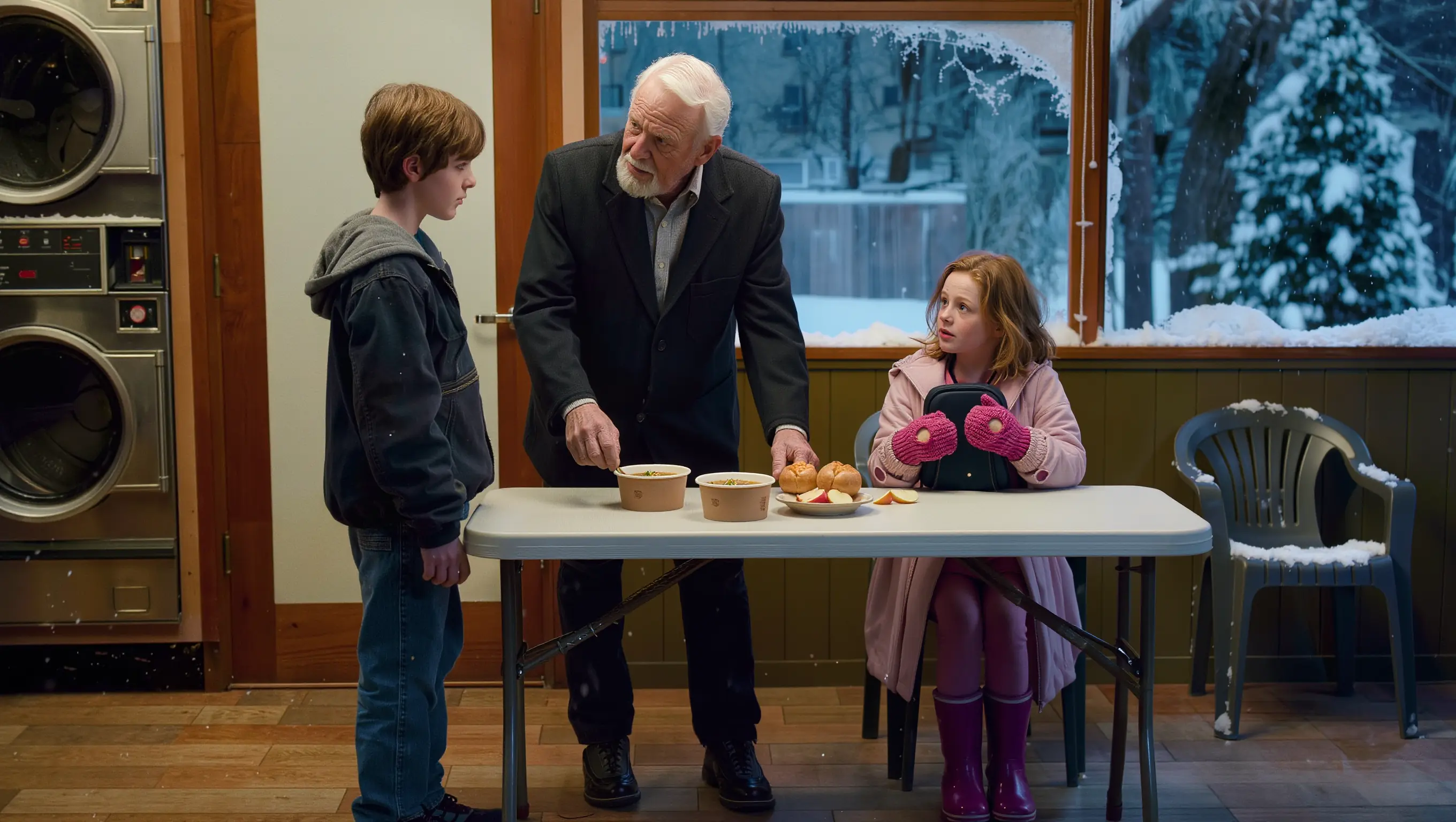
She shook her head immediately. “No. Sir, we can’t.”
“You can.”
“I can’t pay you.”
“I didn’t ask.”
“I don’t want charity.”
George looked at Tyler and Emma, clinging to her coat.
“My wife used to say warmth is not charity. It is what people owe each other in winter.”
Laura covered her mouth.
So they stayed.
One night became a week.
George called a church friend, then a housing advocate, then a woman from a family support nonprofit. He helped Laura get her documents from the motel. He let the children sleep in the small apartment above the laundromat that he had used for storage since Alice passed away. He made oatmeal in the mornings and soup at night. He packed lunches in paper bags, writing Tyler and Emma’s names carefully on each one.
Laura found work at a hospital laundry department.
The irony made George laugh.
“You’re stealing my industry,” he told her.
She smiled for the first time in days. “I’ll try not to become your competitor.”
As weeks passed, the laundromat changed.
Emma drew pictures and taped them behind the counter: washing machines with smiling faces, George wearing a crown, Tyler holding a giant basket of socks. Tyler helped sweep, clean lint traps, wipe folding tables, and carry small baskets for elderly customers.
George had to remind him constantly, “You are a child, not an employee.”
Tyler always answered, “I’m helping.”
George let him help, but he made one thing clear.
“You do not earn your bed here. You do not earn dinner. You help because you care, not because you have to prove you deserve a roof.”
Tyler did not answer.
But he heard him.
Laura eventually saved enough for a small apartment nearby. When she and the children moved out, Emma cried so hard that George promised she could visit every Saturday.
She did.
Both children did.
Saturday mornings became their time. Emma sat behind the counter drawing while George showed Tyler how to repair machines. Tyler learned how to clean filters, replace belts, reset jammed coin slots, and listen to machines before they broke completely.
“Machines talk,” George told him.
Tyler laughed. “No, they don’t.”
“They do. You just don’t speak dryer yet.”
By fifteen, Tyler spoke dryer fluently.
He could diagnose half the machines by sound. He fixed the old vending machine when even George had given up on it. Emma painted a new sign for the lost-and-found bin: LOST SOCKS AND OTHER MYSTERIES.
George had not laughed so much in years.
The children grew.
Tyler became serious, skilled, and protective. Emma became bright, artistic, and warm-hearted. Laura became a supervisor at the hospital laundry and later moved into a better apartment. But every Sunday, they came to George’s little house for dinner. Every Christmas, they helped decorate the laundromat window. Every birthday, they brought cake and refused to let George pretend he did not want candles.
When Tyler graduated high school, George sat in the front row beside Laura and Emma.
Tyler received a scholarship to study mechanical engineering.
After the ceremony, he hugged George hard.
“I’ll pay you back,” Tyler whispered.
George smiled. “For soup?”
“For everything.”
“You already have.”
“No,” Tyler said. “Not yet.”
Years moved on.
Tyler went to college, then started working for a company that designed energy-efficient appliances. Emma went to art school and became a designer. They called George often, visited when they could, and still treated Miller’s Wash & Fold like home.
But George was getting older.
At eighty-seven, his hands shook too much to repair the machines. His knees hurt. The rent rose after the building was sold to a developer. The new owner wanted to replace the laundromat with a boutique fitness studio.
George received the notice on a Monday.
Ninety days to leave.
He sat behind the counter for a long time, listening to the machines hum.
He thought of Alice by the window.
Emma’s drawings.
Tyler fixing the vending machine.
Laura crying on the floor with her children in her arms.
He had given the place fifty years.
Now it was ending.
He did not tell Tyler or Emma.
Laura did.
Two days later, Tyler walked into the laundromat wearing a navy coat, his face tight with anger and hurt. Emma followed behind him, holding a folder and a rolled-up design board.
George sighed. “Your mother talks too much.”
Tyler placed the eviction notice on the counter. “You were going to let us find out after it closed?”
“I didn’t want to bother you.”
Emma’s eyes filled. “This place kept us alive.”
George looked away. “It was just a laundromat.”
“No,” Tyler said. “It was the first place anyone said we could stay together.”
George had no answer.
Tyler opened the folder.
“We bought the building.”
George stared at him. “You what?”
“Not alone,” Emma said quickly. “Tyler’s company invested. I sold two major design projects. Mom helped with paperwork. The church helped connect us with a community development grant.”
George sat slowly.
Tyler continued, “Miller’s Wash & Fold is staying. But we’re expanding it.”
Emma unrolled the design board.
The drawing showed the old laundromat restored, brighter but familiar. In the back was a family support room with tables, books, and food storage. Upstairs, the apartment had been renovated into short-term emergency housing managed through a nonprofit.
The new sign read:
MILLER’S LIGHT LAUNDROMAT
Clean Clothes. Warm Meals. Open Doors.
George covered his mouth.
Emma stepped closer. “We kept your name.”
Tyler smiled softly. “We kept Alice’s chair by the window too.”
The renovation took three months.
George complained about the new paint, the new machines, the new computer system, and the fact that everyone kept telling him not to lift anything heavier than a towel.
No one listened.
But the old bell above the door stayed. Alice’s chair stayed. Emma’s childhood drawings were framed along the wall. The lost-and-found sign was restored and hung proudly near the counter.
On reopening day, people lined up outside before noon.
Some came to wash clothes.
Some came for the free community meal served in the back room.
Some came because they remembered what George had done for them quietly over the years: letting them sit inside during storms, giving children quarters for dryers, folding blankets for elderly customers, feeding two homeless kids who became family.
Tyler stood near the front with a microphone.
George groaned. “No speeches.”
Emma smiled. “Too late.”
Tyler looked at the crowd.
“When I was twelve,” he said, “my little sister and I were homeless, hungry, and eating from the trash behind this laundromat. George Miller opened the door. He fed us, warmed us, found our mother, and made sure we were not separated. He told me we didn’t have to earn dinner. We didn’t have to earn safety. We were children, and that was enough.”
George’s eyes filled.
Emma took the microphone next.
“I used to think warm places belonged to other people,” she said. “Mr. Miller taught me that a door could open for us too.”
She turned toward him.
“So we are keeping this door open.”
The crowd applauded.
George cried, and for once, he did not pretend it was allergies.
Years later, Miller’s Light Laundromat became more than a place to wash clothes. Families came for clean laundry, hot soup, donated coats, school supplies, and help finding housing resources. Children did homework in the family room. Parents rested without being judged. The upstairs apartment sheltered families for short stays until safer arrangements were made.
George no longer worked long days. He sat in Alice’s chair by the window, greeting customers and giving advice no one asked for.
One snowy evening, a boy came in holding his little sister’s hand. Their clothes were damp. Their faces were thin and frightened.
The boy looked at Tyler, now standing behind the counter.
“We don’t have money,” he said.
Tyler looked toward George.
George nodded.
Tyler came around the counter, opened the door to the family room, and said the words that had once saved him.
“I didn’t ask for money.”
Emma brought soup.
George watched the children sit at the table, steam rising from their bowls.
For a moment, he saw Tyler and Emma all over again.
He closed his eyes and felt Alice beside him.
“You were right,” he whispered.
About people bringing tired lives with their laundry.
About warmth being owed.
About doors.
The machines hummed. Snow fell outside. The lights stayed on.
And George Miller, who had once thought he was only feeding two hungry children for one night, lived long enough to see that kindness become a place where no child had to eat from the trash again.