Earl Whitaker was seventy-seven years old and still woke before sunrise, even though the farm no longer needed him the way it once had.
His farmhouse sat outside Stillwater, Oklahoma, at the end of a narrow county road lined with barbed-wire fences, red dirt, and wind-bent grass. The house was small and white, with a tin roof, a sagging porch, and a screen door that slapped too loudly whenever the wind caught it.
Behind the house stood an old barn, a tool shed, a chicken coop, and forty acres of land that had belonged to Earl’s family for three generations.
At one time, the farm had been full of sound.
His wife, June, singing in the kitchen.
His two sons running through the yard.
Cattle lowing near the back fence.
A tractor coughing to life before breakfast.
Neighbors stopping by without calling first.
But now the cattle were gone. The sons lived in different states. June had been gone for eight years. The tractor worked only when it felt charitable. The barn leaned a little more after every storm. And Earl moved through the property alone, carrying feed buckets, tightening fence wire, fixing gates, and pretending his knees did not hurt as badly as they did.
People told him to sell.
His oldest son said, “Dad, that place is too much for one man.”
His younger son said, “You could move closer to us.”
Earl always answered, “This land raised me. I’m not walking away because it got old when I did.”
So he stayed.
He made coffee in the same dented pot every morning. He fed the chickens. He checked the fence line. He watered the garden. He kept a radio playing in the barn, not because he listened closely, but because silence had become too large after June died.
On a late May afternoon, the sky began changing in a way Earl did not like.
In Oklahoma, a man learned to read the weather whether he wanted to or not. The air went heavy first. Then the birds quieted. Then the wind turned strange, pushing from one direction and then another, as if the whole sky could not make up its mind. By four o’clock, dark clouds were stacking in the west, thick and green-gray along the horizon.
Earl stood on the porch, one hand on the railing, looking toward the county road.
“Bad mood coming,” he muttered.
He had just turned to go inside when he heard the motorcycle.
It came fast at first, then uneven.
A sharp rattle.
A grinding snap.
Then the engine roared briefly and cut.
Earl looked toward the road.
A motorcycle had rolled to a stop near his mailbox, half on the shoulder, half in the grass. A biker was crouched beside it, one hand on the rear wheel, the other reaching toward the chain. The man was broad-shouldered, wearing a black helmet, a denim vest over a dark shirt, jeans, and heavy boots. A backpack was strapped to the rear of the bike. Even from the porch, Earl could see the problem.
The chain had slipped and jammed.
Earl glanced at the sky.
The storm was closer now.
The wind picked up, bending the grass flat in waves.
The biker stood, took off his helmet, and looked around. He was younger than Earl expected, maybe thirty-two, with a short beard, dark hair damp with sweat, and a face tightened with urgency. He pulled out his phone, lifted it, turned in a circle, then cursed under his breath.
No signal.
Earl watched him try to move the bike. It barely shifted.
Then the first hard drop of rain hit the porch railing.
Earl grabbed his cane, stepped off the porch, and started down the gravel drive.
The biker looked up when he saw him coming.
“Sir, sorry,” the man called. “I’m not trying to block your drive.”
“You’re doing a poor job of not blocking it,” Earl said.
The biker blinked, then gave a nervous half-smile.
“Chain jammed. I’m trying to get it loose.”
Earl reached the mailbox and looked down at the motorcycle.
“Trying wrong.”
The biker crouched again.
“You know bikes?”
“I know when metal’s angry.”
The man looked toward the sky.
“I need to get moving. I’m supposed to be in Stillwater by five.”
Earl checked his watch.
It was 4:18.
“You won’t make Stillwater by five with your chain sitting like that.”
“I have to.”
“People say that to machines all the time. Machines remain unimpressed.”
The biker’s jaw tightened.
“My little sister’s scholarship interview is at five-thirty. I’m bringing her portfolio. She left it at my place after working on it all night. If I don’t get there, she loses the slot.”
That changed the air between them.
Earl looked at the backpack strapped to the motorcycle.
“That in there?”
“Yes.”
“And she needs it today?”
“Yes, sir.”
Thunder rolled across the fields.
Earl looked at the sky again, then at the bike.
“Get the bag off first.”
The biker moved quickly, unstrapping the backpack.
Earl pointed to the farmhouse.
“Take it to my porch before the rain gets into it.”
“I need to fix the bike.”
“You need the portfolio dry. Move.”
The biker obeyed.
By the time he returned, rain was falling harder. Not a steady rain yet, but heavy, sharp drops that hit the dirt and burst into dust before soaking it.
Earl leaned on his cane and studied the chain.
“What’s your name?”
“Tyler.”
“Tyler what?”
“Tyler Brooks.”
“Earl Whitaker.”
“Sir, I really appreciate anything you can do, but I don’t have much time.”
“Then stop talking.”
Tyler closed his mouth.
Earl walked toward the shed beside the drive.
“My tools are in here.”
“I have tools on the bike.”
“Do they include a jack, breaker bar, chain tool, and common sense?”
Tyler paused.
“Not all of that.”
“Then we use mine.”
They dragged a small rolling jack from the shed, along with a tool tray, penetrating oil, gloves, and a flashlight. Earl moved slowly, but he knew where everything was. Tyler moved quickly, but his hands shook with pressure.
The storm grew rougher.
Wind whipped rain across the road. The sky darkened early, turning the fields a strange, bruised color. Earl’s hat nearly blew off twice. Tyler kept looking toward the farmhouse porch, where the backpack sat safely under the awning.
Earl noticed.
“Your sister’s name?”
“Maya.”
“She good at what she does?”
Tyler nodded immediately.
“She’s incredible. Interior design. Sketches, layouts, color boards, everything. She got invited to interview for a summer program. It could help her get scholarships.”
“And you forgot the portfolio?”
“She forgot it. I told her I’d bring it.”
“Then today you are useful.”
“I’m trying to be.”
“Trying will not loosen a jammed chain.”
Earl knelt with effort, one hand gripping the jack handle. Tyler quickly moved closer.
“Let me.”
“I’m old, not decorative.”
“I didn’t mean—”
“Good. Then hold the bike steady.”
Tyler did.
Together, they raised the rear wheel just enough. Earl sprayed the jammed area, waited ten seconds, then directed Tyler where to apply pressure.
“Not there. You’ll bend the guard.”
“Here?”
“Closer.”
“Here?”
“Now you’re using your eyes. Good.”
The chain was wedged badly between the sprocket and guard. Tyler had likely tried to force it loose and made it worse.
Earl said as much.
Tyler winced.
“I panicked.”
“Panic is expensive.”
“I know.”
“You know now.”
Rain ran down Earl’s neck. His hands were stiff, but steady. Tyler worked beside him, following each instruction. They loosened the guard, shifted the wheel slightly, worked the chain free inch by inch, then inspected the damage.
“Can it ride?” Tyler asked.
“Not far.”
“How far?”
“To town if you ride like you respect consequences.”
Tyler looked toward the road.
“That might be enough.”
Earl shook his head.
“You ride into this storm with that chain, you may end up stopped again five miles down, and your sister gets nothing.”
Tyler’s face fell.
“What do I do?”
Earl stood slowly, wiping rain from his forehead.
“We don’t send you. We send the portfolio.”
Tyler stared at him.
“What?”
Earl pointed toward the farmhouse.
“I’ve got an old pickup. It runs better than it looks. You call your sister from my landline, tell her to stay put, and I drive the portfolio to Stillwater.”
“No, sir. I can’t ask you to do that.”
“You didn’t. I offered.”
“I can drive.”
“You’re soaked, rushed, and thinking like a man who believes speed is a plan. I know the back road. I’ll drive.”
Thunder cracked closer.
Tyler looked torn between gratitude and pride.
Earl started walking toward the house.
“Stand there arguing if you want. I’m getting my keys.”
Tyler grabbed the tool tray and followed.
Inside the farmhouse, the kitchen smelled of coffee, old wood, and rain blowing through the screen door. Tyler stood dripping near the mat, still holding his helmet, as if afraid to move.
Earl pointed to the towel rack.
“Dry your hands. Phone’s on the wall.”
Tyler called Maya.
His voice changed the moment she answered.
“Maya, listen. I’ve got your portfolio. Bike broke down. No, it’s okay. I’m with a man named Earl. He’s driving it over.”
He paused, listening.
“I know. I know. Don’t cry. Stay at the building. Tell them it’s coming. I’m sorry. I’m really sorry.”
Earl grabbed his keys from a hook near the door, took the backpack from the porch, and checked inside. The portfolio case was dry.
“Good bag,” he said.
Tyler hung up.
“She’s scared.”
“Fear can wait in a chair. It doesn’t have to run the meeting.”
Tyler looked at him.
“You always talk like that?”
“Only when people are wasting time.”
Earl put on an old raincoat.
“You stay here and get the bike into the shed. Storm’s getting worse. There’s coffee on the stove. Don’t touch the radio unless you like gospel.”
Tyler shook his head.
“I should go with you.”
“You should get that motorcycle out of my driveway before wind knocks it over.”
“But—”
“Tyler.”
The old man’s voice was not loud, but it carried the weight of fence posts, weather, and years of being obeyed by stubborn animals.
Tyler stopped.
“Yes, sir.”
Earl drove.
His old pickup rattled down the county road with the portfolio case on the passenger seat. Rain beat hard against the windshield. The wipers dragged across the glass with a tired squeak. Water ran across low parts of the road. Wind pushed at the truck. Earl kept both hands on the wheel and took the back road toward Stillwater.
He did not drive fast.
He drove correctly.
By 5:16, he pulled up outside the arts center where Maya’s interview was being held.
A teenage girl stood under the awning, clutching her phone, her face pale with panic. She was seventeen, with dark curls pulled back, a gray cardigan, and shoes that were clearly not made for rain. When Earl stepped out holding the portfolio case, she ran toward him.
“Mr. Whitaker?”
“Earl.”
“Is it okay? Is it dry?”
He handed it to her.
“Dry as church toast.”
She opened the case just enough to check. Her eyes filled with relief.
“Thank you. Thank you so much.”
“You thank me after they give you the spot.”
She wiped her eyes quickly.
“I’m already late.”
“Then go in.”
She hesitated.
“My brother…”
“Your brother is in my kitchen being emotionally loud near coffee.”
Despite everything, Maya laughed.
Earl nodded toward the door.
“Go show them what you made.”
She hugged the portfolio to her chest.
Then she ran inside.
Earl waited in the truck for twenty minutes to make sure she did not come back out in tears. She did not.
When he returned home, the storm had begun to calm. The rain still fell, but the worst wind had moved east. Tyler had managed to get the motorcycle into the shed. He had also cleaned the mud from the kitchen floor, stacked the tools neatly by the door, and left Earl’s radio exactly where it was.
Earl noticed that.
Tyler stood when Earl entered.
“Did she get it?”
“She got it.”
“Was she too late?”
“She went inside.”
Tyler sat down hard in the chair, covering his face with both hands.
For a moment, he said nothing.
Then he whispered, “Thank God.”
Earl removed his wet hat and hung it by the door.
“Your bike will need a proper chain and probably a sprocket soon.”
Tyler looked up.
“I know.”
“Do you?”
“I do now.”
Earl poured coffee into two mugs and pushed one across the table.
Tyler wrapped his hands around it.
“I don’t know how to repay you.”
“You can start by not riding on a chain that looks like it lost a bar fight.”
“I mean it.”
“So do I.”
Tyler gave a tired laugh.
Then his face grew serious.
“My sister’s been working for this for two years. Our mom works nights. I help where I can, but Maya did the hard part. I just had one job today.”
“And you did it badly, then found help.”
Tyler looked down.
“That’s fair.”
“Most important jobs go that way.”
Earl sat across from him.
“You care about her. That counts.”
“It doesn’t feel like enough.”
“It rarely does.”
The phone rang at 6:42.
Tyler jumped up to answer it.
“Maya?”
He listened.
His face changed slowly.
Then he smiled.
“She got a second interview,” he said, voice breaking. “They loved the portfolio.”
Earl nodded once.
“Good.”
Tyler covered the receiver.
“She wants to thank you.”
Earl shook his head.
“No.”
Tyler smiled into the phone.
“He says no, but he means he’s happy.”
Earl pointed at him.
“Don’t translate me.”
Tyler laughed for the first time that day.
That evening, after the rain stopped, Tyler’s friend arrived with a trailer to haul the motorcycle. Before leaving, Tyler stood by the porch with his helmet under one arm.
“I’ll come back,” he said.
“People say that.”
“I mean it.”
Earl studied him.
“I believe you might.”
Tyler nodded toward the farmhouse.
“You helped my sister today.”
“I drove a bag through rain.”
“You saved her chance.”
Earl looked away.
“Then tell her to use it well.”
“She will.”
Tyler stepped off the porch, then turned back.
“Earl?”
“What?”
“Thank you for not treating me like some biker causing trouble.”
Earl’s expression softened.
“You were causing trouble.”
Tyler laughed.
“But you were useful trouble.”
Tyler did come back.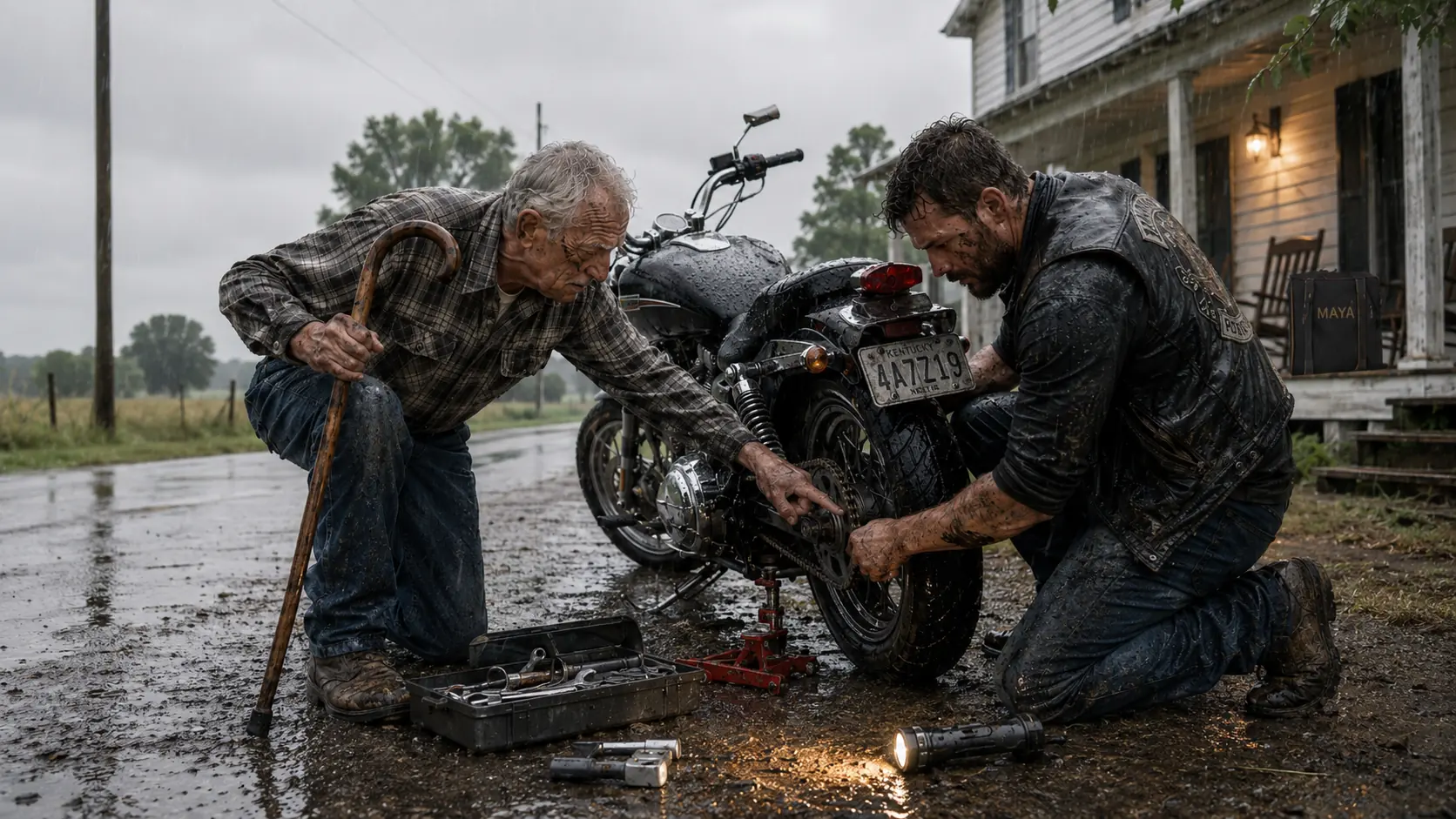
The first time, he returned with a new chain for the motorcycle and a box of pastries from Maya. Earl said pastries were unnecessary, then ate two before lunch.
The second time, he came to fix the shed door he had noticed sticking.
The third time, he brought Maya.
She was shy at first, but Earl liked her immediately. She showed him photos of the design boards from her interview. He did not understand all of it, but he understood care.
“This room here,” he said, pointing to one of her sketches, “looks like someone could sit down without being told they’re in the way.”
Maya stared at him.
“That’s exactly what I wanted.”
“Then you did it.”
She smiled in a way that made Tyler look proud enough to burst.
Over time, Tyler became a regular presence at Earl’s farm.
He owned a small mobile motorcycle repair service in Stillwater, driving from rider to rider with tools in the back of his van. He was good with engines, better with people, and deeply loyal to anyone who had once helped him without making him feel small.
He stopped by on Sundays.
At first, just to check Earl’s truck or repair something on the property. A loose gate. A broken hinge. A tractor belt. A leaking hose. A shed roof panel. Earl protested every time.
“I am not helpless.”
“I know.”
“Then stop fixing things before I ask.”
“You look like you were about to ask.”
“I was not.”
“Your barn door was asking.”
Earl could not argue with that because the barn door was, in fact, asking loudly.
Maya came sometimes too, especially after she was accepted into the summer design program. She helped Earl reorganize the old farmhouse kitchen in a way that made cooking easier with his stiff knees. She moved heavy pots to lower shelves, labeled jars, widened the space near the table, and added a bench by the back door for taking off muddy boots.
Earl called it unnecessary.
Then used it every day.
Tyler and Maya brought life into the farm.
They filled the kitchen with conversation. They argued about music. They asked Earl questions about the land, the old tractor, the storm cellar, the barn, his wife June, the family history, and why he kept a broken weather vane in the shed.
“Because I might fix it.”
“It’s been broken since before I met you,” Tyler said.
“I didn’t give a deadline.”
Years passed.
Maya went to college, then became an interior designer focused on affordable housing and practical spaces for working families. Tyler’s repair service grew into a respected motorcycle and small-engine shop. He hired two mechanics, then three. Riders across Oklahoma knew him as the man who would tell the truth, charge fairly, and never let someone ride away unsafe.
Earl aged.
He hated it.
His hands stiffened. His knees worsened. The farm became harder to manage. The roof needed replacing. The barn needed structural repair. The county began discussing drainage changes that would affect his low pasture. Property taxes rose after land nearby was purchased for new development.
Then came the letter that sat on his kitchen table for three days.
A developer wanted to buy the farm.
Not just wanted.
Pressed.
The offer was large enough to tempt his sons, who worried constantly. It would pay Earl well, allow him to move into a comfortable place, and end the burden of maintaining the property.
But the buyer intended to divide the land into storage units and roadside commercial lots.
Earl read that part four times.
Storage units.
On land where his father had planted wheat.
Where June had grown sunflowers.
Where his boys had learned to drive the tractor.
Where Tyler’s broken motorcycle had once been hauled into the shed while a storm rolled over the fields.
Earl folded the letter.
Then unfolded it.
Then placed it under the coffee pot.
Tyler found it two weeks later.
He had come by to replace a cracked hose on the old pickup and noticed Earl was quieter than usual.
“You sick?” Tyler asked.
“No.”
“Mad?”
“Usually.”
“At me?”
“Not currently.”
“Then what?”
Earl said nothing.
Maya, who had come with him to measure the pantry for new shelves, found the letter while looking for a pencil.
She read the first lines, then looked at Earl.
“Are you selling the farm?”
Tyler turned sharply.
“What?”
Earl took the letter from her.
“You two are nosy.”
Maya’s voice softened.
“Earl.”
He hated when people said his name gently.
It made it harder to be difficult.
Tyler sat across from him.
“Tell us.”
“There’s nothing to tell.”
“You got an offer.”
“That is something.”
“I get mail too.”
“Earl.”
The old man exhaled.
“The roof is bad. Barn’s worse. Taxes are worse than both. My boys think I should take the offer. Maybe they’re right.”
“Do you think they’re right?” Maya asked.
Earl looked toward the window.
Outside, the pasture stretched under late afternoon light. The barn leaned, but it still stood. The driveway curved toward the road. The old mailbox had weathered another season. The shed door Tyler had fixed hung straight.
“No,” Earl said quietly.
Tyler leaned back.
“Then we need a plan.”
“We?”
“You drove through a storm for my sister’s future. Let us drive a little for yours.”
“I don’t want charity.”
“I don’t offer charity to men who insult my chain maintenance.”
Despite himself, Earl smiled.
Maya opened her notebook.
“What if the farm could support itself differently?”
“It’s a farm.”
“Yes,” she said. “But it’s also a place. And places can have more than one purpose.”
Earl frowned.
“That sounds like design talk.”
“It is.”
“I distrust it.”
“You should. It gets expensive.”
Tyler laughed.
But Maya was serious.
Over the next month, she and Tyler built a proposal.
Earl’s farm sat near a popular rural riding route. The old barn, once stabilized, could become a small community workshop and event space. The front pasture could host seasonal markets, repair clinics, and safe riding workshops. Earl’s tool shed and Tyler’s shop could partner on motorcycle maintenance classes, small-engine repair basics, and rural skills days. Maya could help design the barn restoration and make the farmhouse safer for Earl to live in.
They called it Whitaker Roadstead.
Earl hated the name.
“What is a roadstead?”
“A safe place near a road,” Maya said.
“Sounds made up.”
“It’s a real word.”
“Still sounds made up.”
Tyler leaned forward.
“The point is, we bring people here a few weekends a year. Not constantly. Enough to create income, qualify for rural preservation grants, and make the county see the farm as community value instead of empty land for development.”
Earl looked at the sketches.
There was his barn, repaired but not made fancy.
His driveway, widened slightly for safe access.
A small open-air market under shade tents.
A workshop area where Tyler could teach chain care, tire checks, basic repairs.
A community table near the garden.
The old farmhouse porch, repaired and safe.
A sign near the mailbox:
Whitaker Roadstead
Farm Skills, Road Skills, Second Chances
Earl stared at the last words.
“No.”
Maya smiled.
“I knew you’d hate that line.”
“Then why put it there?”
“To make the rest seem reasonable.”
Earl looked at Tyler.
“She does that often?”
“All the time.”
The plan grew.
Renee, one of Tyler’s regular customers and an event organizer, helped with permits. A local roofing contractor offered a discount after hearing Earl had helped Tyler and Maya years earlier. Maya contacted a rural preservation group. Tyler organized riders who volunteered labor. Earl’s sons, initially doubtful, flew in for a weekend and saw the plan laid out across the kitchen table.
His oldest son, Mark, looked at Earl.
“Dad, do you want this?”
Earl looked older than he liked.
“I want to stay.”
That settled it.
His sons agreed to help with paperwork and contribute what they could toward repairs, but Tyler and Maya insisted the project be broader than family obligation. It would become a community effort, practical and sustainable.
The first Whitaker Roadstead Day happened the next spring.
Earl woke before dawn, grumbling about strangers in his pasture.
By seven, Tyler and his crew had set up repair stations.
By eight, Maya had arranged tables, signs, and seating so the space felt welcoming but not crowded.
By nine, motorcycles began arriving slowly down the county road.
Riders parked in the front pasture. Local families came too. Neighbors brought honey, bread, eggs, handmade tools, and vegetables. Tyler ran a chain maintenance demonstration and began by telling everyone, “Do not do what I did the first time I came here.”
Earl sat on the porch, listening.
Maya led a small tour of the barn restoration plan and explained how old buildings could be strengthened without erasing their history. Earl pretended not to be impressed.
At noon, he walked to the barn with his cane.
A group of young riders stood near a workbench, watching Tyler explain how to spot chain wear before it became dangerous.
Earl interrupted.
“He’s leaving out the part where panic makes repair worse.”
Tyler looked over.
“I was getting there.”
“You were circling it.”
The riders laughed.
Earl took the worn chain Tyler had kept from his motorcycle years ago. Tyler had brought it as a teaching prop.
“This,” Earl said, holding it up, “is what happens when someone hears a warning and keeps riding because he thinks important things excuse bad maintenance.”
Tyler nodded.
“That someone was me.”
“And what did we learn?”
A young rider said, “Replace the chain sooner?”
Earl pointed at him.
“That boy may live long enough to become useful.”
Everyone laughed.
By the end of the day, Whitaker Roadstead had raised enough to fund the first phase of barn repairs. More importantly, the preservation group approved a matching grant. The county agreed to adjust drainage work to protect the lower pasture. The developer stopped calling after the farm became a local story.
Earl did not say much that evening.
He sat at the kitchen table after everyone left, looking at the donation totals, grant paperwork, repair schedule, and Maya’s sketches.
Tyler sat across from him.
“You okay?”
“No.”
Maya looked worried.
Earl added, “I dislike being grateful in groups.”
Tyler smiled.
“You can be grateful privately.”
“I can be annoyed publicly.”
“That works too.”
Earl touched the edge of the old chain lying on the table.
“You two did all this because I drove a portfolio through rain.”
Maya’s eyes softened.
“You did more than that.”
“No. I drove.”
“You believed my dream mattered,” she said.
Tyler nodded.
“And you didn’t let my mistake cost her chance.”
Earl looked down.
“That was one afternoon.”
Maya smiled.
“Some afternoons are bigger than they look.”
Years passed, and Whitaker Roadstead became part of the community.
Twice a year, riders came for safety clinics, farm breakfasts, small-engine workshops, and local markets. Tyler taught maintenance. Maya coordinated barn improvements and accessible farmhouse updates. Earl taught practical things no one knew they needed: how to sharpen tools, patch a gate, read the sky, store fuel safely, and know when a machine was asking for attention before it failed.
Young riders loved him.
He told them not to.
They did anyway.
The barn was repaired. The roof replaced. The porch made safe. The garden expanded. The farm began earning enough from seasonal events, grants, and workshop partnerships to cover the taxes and basic upkeep.
Earl remained stubborn.
But less alone.
On his eighty-second birthday, Tyler and Maya organized a small dinner in the barn.
Earl said he did not want a party.
They called it a “maintenance meeting with cake.”
He accepted that.
The barn glowed with string lights and clean wooden beams. Long tables were filled with food from neighbors, riders, and Earl’s sons. The old tractor sat near the open door, polished better than it had been in years. On the wall hung a framed photograph from the storm day: Tyler’s motorcycle in the shed, Earl standing beside it in his raincoat, looking deeply irritated.
Earl stared at it.
“Who took that?”
“Mr. Dobbins,” Tyler said.
“Traitor.”
After dinner, Maya stood with a small wooden box.
Earl sighed.
“No.”
“You don’t know what it is.”
“It is either emotional or unnecessary.”
“It is both,” Tyler said.
“Worst kind.”
Maya opened the box.
Inside was a key tied to a piece of old motorcycle chain, cleaned and polished.
Earl frowned.
“What’s this?”
Tyler’s voice softened.
“The barn workshop key.”
“I have a key.”
“This one is symbolic.”
“I dislike symbolic objects.”
“We know,” Maya said. “That’s why we made it from something practical.”
Tyler stepped closer.
“The chain is from my bike. The one that jammed outside your mailbox.”
Earl looked at the polished links.
“You kept it?”
“You told me machines warn before they quit. I kept it to remember.”
Maya added, “And this key opens the workshop that exists because you answered that warning.”
Earl’s throat tightened.
Around them, the barn grew quiet.
Tyler said, “You saved my sister’s chance, Earl. You helped me become a better brother. Years later, you let us help save your farm. This place is not just yours anymore because you lost it. It’s ours because you shared it.”
Earl closed his fingers around the key.
He looked at Tyler.
Then Maya.
Then his sons.
Then the riders, neighbors, and young people gathered in the barn he had almost lost.
“I don’t know what to say,” he muttered.
Tyler smiled.
“That has never stopped you before.”
Earl laughed, and the room laughed with him.
Then he wiped his eyes quickly and blamed the dust.
Later that night, after everyone left, Earl sat on the porch with Tyler and Maya. Crickets sang in the grass. The barn lights glowed softly. The repaired roof shone under the moon.
“You know,” Earl said, “when I heard that bike snap outside my mailbox, I almost stayed on the porch.”
Tyler looked at him.
“Why didn’t you?”
Earl looked toward the road.
“Because you looked like a man about to let panic ruin something important.”
Tyler nodded.
“I was.”
“And because the sky was turning ugly.”
“It was.”
“And because I was bored.”
Maya laughed.
Earl smiled.
“Mostly the first two.”
They sat in quiet comfort.
Then Earl said, “You both gave me more years here.”
Maya reached over and squeezed his hand.
“You gave us the first one.”
Tyler looked toward the driveway where the old mailbox stood straight, with the Whitaker Roadstead sign beneath it.
“Funny how one broken chain built all this.”
Earl shook his head.
“No. The chain broke. People built this.”
The next morning, a young biker arrived early for a workshop, pushing his motorcycle slowly up the drive.
Earl was already on the porch with coffee.
The boy looked embarrassed.
“Sir, my bike started making a noise near the road. Tyler said I should ask you before I ride it farther.”
Earl stood with his cane.
“Smartest thing Tyler ever taught you.”
The boy looked worried.
“Is it bad?”
Earl walked down the porch steps, slow but steady.
“Machines whisper before they shout,” he said. “Let’s see what yours is trying to say.”
Years earlier, Earl Whitaker had helped a biker in an urgent storm, not with grand words or easy charity, but with tools, a dry porch, a landline, an old pickup, and the practical sense to protect what mattered first.
He thought he had only fixed a jammed chain and delivered a portfolio through rain.
But that one afternoon changed three lives.
Maya reached her interview and found the path she had worked so hard for.
Tyler learned that panic was not a plan and that help did not have to humiliate a person.
And years later, when Earl’s farm stood at the edge of being lost, the biker and his sister returned with plans, tools, riders, neighbors, grants, and a community strong enough to keep the old land alive.
What Earl received was not just a repaired barn, a new roof, or money for taxes.
He received proof that usefulness does not end with age.
He received a porch full of voices, a barn full of students, a road full of returning friends, and a future rooted in the land he had refused to abandon.
And every time thunder rolled over Stillwater or a motorcycle slowed near his mailbox, Earl would lift his coffee, narrow his eyes toward the road, and say,
“Well, let’s see what needs fixing now.”