At seventy-eight years old, George Miller still opened the side door of his old garage every afternoon, even when no customers came.
The garage sat at the end of a quiet street in Louisville, Kentucky, behind a small white house with faded shutters and a porch that leaned slightly to one side.
The sign above the garage door had once been bright green, painted by George’s late wife, Helen, back when the place still had more work than one man could handle.
MILLER’S REPAIR GARAGE
Underneath, in smaller letters, Helen had painted:
If It Rolls, Rattles, Or Refuses To Start, Bring It Here.
George had always thought the line was too long for a sign.
Helen had always said it made people smile.
She had been right, of course. She was usually right.
Helen had been gone for nine years now, but George had never repainted the sign. The letters had faded. The paint had chipped. The edges had weathered from summer heat and winter storms.
Still, every morning when he stepped outside with his coffee, George looked up at those words and felt, for one brief second, as if Helen was standing beside him again, hands on her hips, telling him not to be so stubborn.
The garage was no longer busy.
Years ago, farmers brought tractors. Families brought old pickup trucks. Teenagers brought bicycles with bent wheels and chains hanging loose.
Mothers brought strollers with broken brakes. Old men brought lawnmowers and sat for an hour just to talk.
George fixed everything he could.
He had strong hands then, steady eyes, and the kind of patience that came from believing most broken things only needed someone willing to look closely.
But time had changed the town.
People bought new instead of repairing old. Cars needed computers more than wrenches. Bikes came from big stores and were thrown away when the gears failed. The younger people in town drove past George’s place without knowing what it had once meant.
So George spent most afternoons alone.
He sharpened old tools that did not need sharpening. He sorted bolts by size. He cleaned the workbench. He drank coffee. He listened to the radio.
He kept the garage open because closing it felt too much like admitting that the best part of his life had already ended.
On a stormy Thursday evening in May, George was working on an old lawnmower that belonged to a neighbor when the sky turned almost black.
Rain had been threatening all afternoon. By five o’clock, thunder rolled over the rooftops, and the wind began pushing leaves across the driveway. George looked toward the open garage door and sighed.
“Going to be a bad one,” he muttered.
He reached up to pull the garage door halfway down, but before he could, he heard a sharp metallic scrape from the road.
Then a crash.
George froze.
A second later, he heard a boy cry out.
He dropped the wrench and hurried outside as fast as his knees allowed.
Across the street, near the curb, a boy was sitting on the wet pavement beside a bicycle. Rain poured over him. The bike lay twisted on its side, one wheel bent, the chain jammed between the gear and the frame.
The boy looked about eleven years old, thin and soaked, with brown hair plastered to his forehead and a navy raincoat clinging to his small shoulders.
He was trying to stand, but one hand kept slipping on the wet road.
George crossed the street, boots splashing through shallow water.
“Hey there, son,” he called. “You hurt?”
The boy looked up quickly. His face was pale, but his jaw was tight with determination.
“I’m fine,” he said.
George looked at the scraped knee, the shaking hands, and the bicycle lying like a wounded animal beside him.
“That bike tells a different story.”
The boy tried to lift it. “I can fix it.”
The chain snapped tighter.
He winced.
George crouched carefully, ignoring the pain in his knees. “Leave it for a second. Let me see you first.”
“I said I’m fine.”
“And I heard you.” George pointed to the boy’s knee. “Now I’m listening to the blood.”
The boy looked down and seemed surprised to see the scrape.
“It’s not bad.”
“No. But it’s not nothing either.”
The rain fell harder. Cars hissed past in the distance. The boy glanced nervously down the road.
George noticed.
“What’s your name?”
The boy hesitated.
“Ethan,” he said.
“Ethan what?”
“Ethan Parker.”
“I’m George Miller.”
The boy looked toward the garage. “I know. It says on the sign.”
“So it does.” George nodded toward the bicycle. “You want to tell me what happened?”
Ethan swallowed. “The brakes slipped. I was going too fast. The chain caught. I hit the curb.”
“In this rain?”
“I had to get home.”
George looked at him more closely. “Why?”
“My mom gets off work soon. If I’m not home, she’ll worry.”
“Where does she work?”
“The hospital laundry department.”
“What time does she get off?”
“Six.”
George checked his watch. It was 5:18.
“You live far?”
“About three miles.”
George looked at the bike again. “Not on this, you don’t.”
Ethan’s face tightened. “I have to.”
“No, son. You have to get out of the rain before you shake apart.”
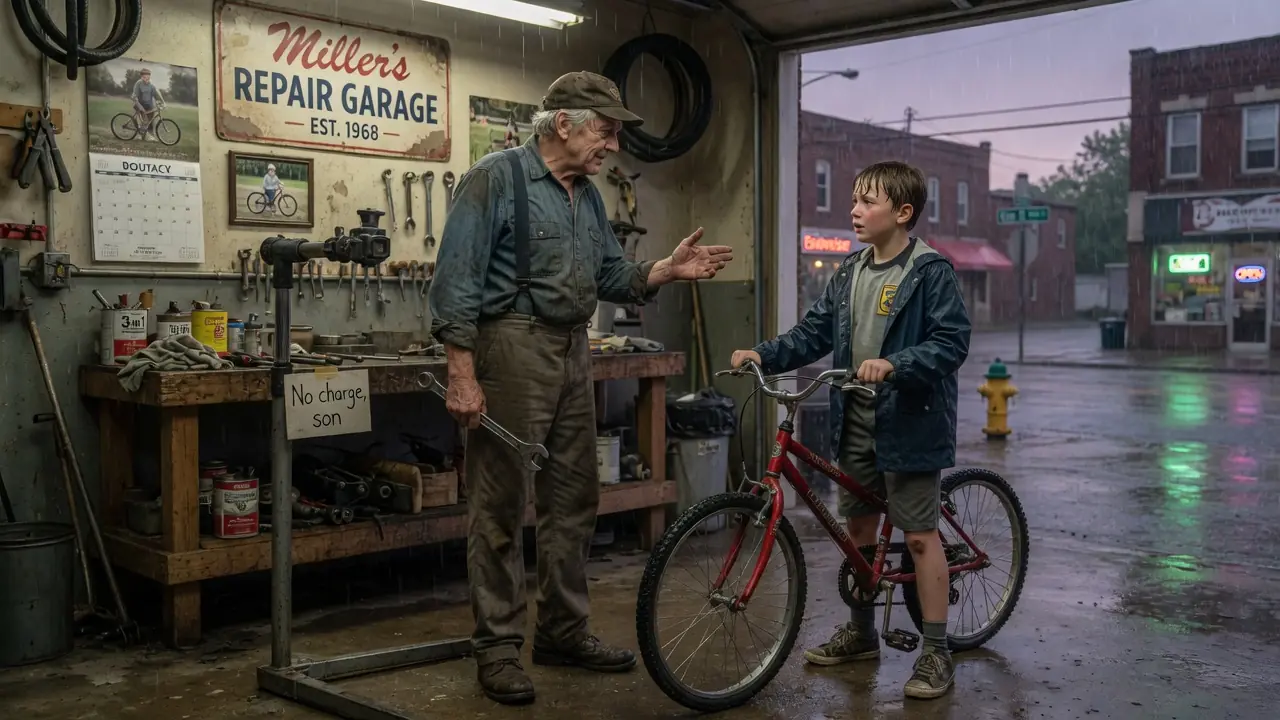
The boy looked at the garage, then back at George. “I don’t have money.”
George felt something in his chest soften.
“I didn’t ask for money.”
“I can’t pay for a repair.”
“I didn’t offer a bill.”
Ethan looked suspicious. “Then why are you helping?”
George stood slowly and reached for the bicycle. “Because you’re a child sitting in the road during a thunderstorm with blood on your knee and a broken bike.”
Ethan opened his mouth, then closed it.
George lifted the bike. It was heavier than it looked, or maybe George was weaker than he liked to admit. Ethan quickly grabbed the back wheel to help.
Together, they carried it across the street and into the garage.
Warm yellow light filled the space. Rain hammered the roof. The smell of oil, rubber, metal, and old wood wrapped around them. Ethan stood near the entrance, dripping water onto the concrete floor, looking as if he might bolt at any moment.
George handed him a towel from the shelf.
“Dry your face.”
Ethan took it. “Thank you.”
“Sit on that stool.”
“I’m okay.”
“Ethan.”
The boy sat.
George pulled a small first-aid kit from a drawer and cleaned the scrape on Ethan’s knee. The boy hissed but did not complain.
“You always ride in weather like this?” George asked.
“Sometimes.”
“School bus doesn’t come your way?”
“It does. But I go to the after-school program until five. The late bus doesn’t stop near our apartment.”
“So you ride.”
Ethan nodded.
“Your mom know your brakes are bad?”
The boy looked down. “She knows the bike is old.”
“That’s not what I asked.”
“She was going to fix it when she got paid.”
George did not miss the way Ethan rushed to defend her.
“I believe you,” he said.
Ethan looked up, surprised.
George turned toward the bicycle and lifted it onto the repair stand. The front wheel was bent, the brake cable was frayed, and the chain had wedged itself badly into the gear. It was repairable, but not quickly.
Ethan stood. “Can you fix it before six?”
George looked at him.
“Not before six.”
Panic flashed across the boy’s face. “I have to get home.”
George reached for his keys hanging from a nail near the workbench.
“I’ll drive you.”
Ethan stepped back. “No.”
“Yes.”
“I can’t ride with strangers.”
“Smart rule,” George said. “So you call your mother first.”
“She can’t answer during work.”
“Then call the hospital department. Leave a message. Give them my name, address, and phone number. Everything proper.”
Ethan hesitated.
George handed him the old garage phone.
The boy dialed from memory. After two transfers and one impatient voice, someone from the hospital laundry department confirmed that Maria Parker was still working and would receive the message.
George took the phone next.
“This is George Miller at Miller’s Repair Garage. Ethan had a bicycle accident in the rain. He’s scraped but all right. I’m driving him home now, and I’ll bring the bike back once it’s repaired.”
He gave the address twice.
When he hung up, Ethan looked embarrassed.
“She’ll be mad.”
“No,” George said, reaching for his coat. “She’ll be scared first.”
The drive to Ethan’s apartment took fifteen minutes. The building sat near the edge of town, a brick complex with outdoor stairs and laundry lines drooping between balconies. George parked near the entrance.
Ethan opened the truck door, then stopped.
“My mom isn’t home yet.”
“I’ll wait until you’re inside.”
“I have a key.”
“Good. I’ll wait anyway.”
Ethan looked at him for a second, then nodded.
He ran through the rain and unlocked the apartment door. Before going inside, he turned back and lifted one hand.
George lifted his hand too.
Then he drove back to the garage.
The next morning, Ethan returned.
George was surprised to see him standing outside before the garage opened, wearing dry clothes, a clean bandage on his knee, and the same worried expression.
“My mom said thank you,” Ethan said.
“Tell her she’s welcome.”
“She said I’m not supposed to ride until the bike is safe.”
“Your mother is a wise woman.”
Ethan looked toward the repair stand. “Can I watch?”
George unlocked the side door. “You can do more than watch.”
That was how it began.
At first, Ethan came because his bike needed fixing. George showed him how to remove the damaged chain, clean the gears, tighten the brake cable, and true the front wheel as best as the old rim allowed.
Ethan listened carefully.
He did not fidget. He did not complain. He asked questions that made sense.
“What happens if the chain is too tight?”
“Why does the brake cable fray there?”
“How do you know the wheel is straight enough?”
George answered every question.
By the end of the morning, the bike was rideable again. Not perfect. But safe.
Ethan ran his hand along the handlebar.
“How much do we owe?”
George shook his head.
“No bill.”
“My mom said we should pay something.”
“Tell your mother you paid by learning how to check your brakes.”
Ethan frowned. “That’s not money.”
“No, but it may keep you out of the road next time.”
The boy looked at the bike again.
Then he whispered, “Thank you.”
George nodded.
“Come by next Saturday. I’ll show you how to patch a tire.”
Ethan looked up. “Really?”
“If you’re not too busy crashing into curbs.”
For the first time, Ethan laughed.
He came the next Saturday.
Then the next.
Then nearly every Saturday after that.
At first, Maria Parker apologized every time. She came by after her shift one evening, still wearing her hospital uniform, her hair pulled back under a net, her eyes tired but kind.
“Mr. Miller, I appreciate what you’re doing for Ethan, but I don’t want him bothering you.”
George looked toward the workbench, where Ethan was sorting washers by size.
“He’s not bothering me.”
“He talks too much when he gets interested.”
“I’ve noticed.”
“I can tell him to stop.”
“Don’t.”
Maria’s face softened.
George added, “A boy who asks how things work is a boy trying to understand the world. Let him ask.”
Maria looked at Ethan, and her eyes filled.
“He hasn’t had many men stick around long enough to answer.”
George did not ask about Ethan’s father.
He did not need to.
Over time, the garage became Ethan’s place.
He came after school when Maria worked late. He did homework at the small table near the window. He learned to patch tubes, adjust chains, clean bearings, replace brake pads, and tighten spokes. He learned that forcing a rusted bolt usually made things worse. He learned that grease under fingernails could be washed off, but pride in doing a job properly stayed all day.
George taught him more than repair.
He taught him to sweep the floor before leaving.
To put tools back where they belonged.
To never mock someone for not knowing something.
To explain repairs honestly.
To charge fairly.
To admit when he did not know.
“Machines forgive ignorance,” George told him once. “They don’t forgive arrogance.”
Ethan remembered that.
When Ethan was twelve, he fixed his first flat tire without help.
When he was thirteen, he repaired a neighbor’s bike and refused payment because the neighbor was a little girl with a lunchbox full of coins.
When he was fourteen, he began helping George on busy Saturdays, though busy meant three customers instead of one.
George pretended Ethan was only an apprentice.
But the truth was, the garage had started to feel alive again.
Maria noticed too.
One evening, she brought a casserole to George’s house after work.
“You don’t have to feed us,” George said.
She smiled. “You keep saying that. Yet somehow my son comes home with grease on his hands and light in his eyes.”
George looked away.
Maria placed the casserole on the table.
“Let me say thank you in a way I can afford.”
So he did.
Soon, Sunday dinners began.
Not every Sunday. At first, only once in a while. Then often enough that George began setting three plates without thinking. Maria brought food when she could. Ethan helped carry dishes. George complained about Maria putting too much pepper in the beans, and Maria told him old men had weak tongues.
Ethan laughed at them both.
The house was no longer silent.
Years passed in the small, steady way good things often do.
Ethan grew taller. His voice deepened. His hands became stronger and more confident. He played no sports because he worked after school and helped his mother, but he joined a robotics club and became the student everyone asked when something broke.
George went to Ethan’s school science fair when he was fifteen.
Ethan had built a low-cost bicycle-powered phone charger from scrap parts.
George stood in front of the display for ten full minutes, asking questions like he was a judge, even though he barely understood half of it.
When Ethan won second place, George clapped louder than anyone.
“You embarrassed me,” Ethan said afterward.
“Good,” George said. “Keeps you humble.”
At sixteen, Ethan got a part-time job at a bike shop downtown. The owner quickly realized the boy already knew more than most applicants twice his age.
At seventeen, Ethan rebuilt George’s old bicycle as a birthday gift.
George had not ridden in years, but he stood in the garage looking at the polished frame, the new tires, the adjusted brakes, and the leather seat Ethan had saved for months to buy.
“You did this?”
Ethan nodded nervously. “It’s not perfect.”
George ran a hand over the handlebar.
“No,” he said softly. “It’s better than perfect. It’s cared for.”
Ethan looked down quickly, but George saw the emotion on his face.
When Ethan graduated high school, George sat beside Maria in the front row.
Ethan received a scholarship to study mechanical engineering.
His final senior project was a community bike repair program for kids who needed transportation to school. He called it Safe Wheels.
In the dedication, he wrote:
For George Miller, who taught me that broken does not mean finished.
George read the sentence after the ceremony and had to take off his glasses.
“Dust,” he muttered.
Maria smiled. “Of course.”
Before Ethan left for college, he stood in the garage one last evening.
Rain fell softly outside, nothing like the storm from years before. The old sign creaked in the wind. Tools hung neatly on the wall. The repair stand waited empty.
Ethan placed a small envelope on the workbench.
“What’s that?” George asked.
“Payment.”
George frowned. “For what?”
“For the first repair.”
George shook his head. “No.”
“Open it.”
Inside was not money.
It was a photograph.
A younger Ethan stood beside his repaired bike, grinning awkwardly, one hand on the handlebar. George stood beside him, pretending not to smile.
On the back, Ethan had written:
The day I learned someone could stop in the rain.
George held the photo for a long time.
“I’ll pay you back one day,” Ethan said quietly.
George looked at him over the photograph.
“You already have.”
Ethan shook his head.
“Not yet.”
College took Ethan far from Louisville, but not away from George.
He called every Sunday. He sent pictures of labs, machines, engines, and once a bicycle chain design he claimed was “beautiful,” though George said it looked like something a snake would leave behind.
Ethan studied hard. He worked part-time. He repaired bikes for classmates. He built low-cost mobility devices in one engineering club and volunteered with a campus program that collected abandoned bikes, repaired them, and gave them to students who needed transportation.
Every time he fixed a bike, he thought of the rain.
He thought of George stepping into the storm.
After college, Ethan took a job with a company that designed affordable electric bicycles and mobility systems. He could have moved to a big city and stayed there. For a while, he did. He learned. He saved. He built connections.
But his mind kept returning to small towns, broken bikes, long walks to school, mothers working late, and children trying to get home before someone worried.
By the time Ethan was twenty-nine, he had started a nonprofit that repaired and donated bicycles to low-income students, taught repair skills to teenagers, and built safe transportation programs for rural and working-class neighborhoods.
He named the program The Rainlight Project.
George pretended the name was too fancy.
Secretly, he loved it.
But George was aging.
At eighty-seven, his hands shook when holding small bolts. His knees hurt in the cold. His eyesight weakened. The garage roof leaked in three places. The big door stuck so badly that George sometimes had to leave it closed all day.
Customers became even fewer.
One winter storm tore part of the roof loose.
The repair estimate was more than George could afford.
Maria noticed buckets placed beneath the leaks and called Ethan.
George did not know until Ethan arrived three days later with a folder under one arm and determination all over his face.
George was sitting on a stool near the workbench when Ethan walked in.
“You came to scold me,” George said.
“Yes.”
“At least you’re honest.”
Ethan looked around the garage. His face tightened when he saw the water stains on the wall, the warped door, the rust forming on some tools.
“You should have told me.”
“I didn’t want to bother you.”
Ethan stared at him. “You came out in a thunderstorm for me.”
“That was different.”
“How?”
“You were a child.”
“And you are family.”
The word settled into the garage.
George looked down at his hands.
“I can’t keep it going,” he admitted.
Ethan placed the folder on the workbench and opened it.
Inside were plans.
The garage would be restored. The roof rebuilt. The sign repaired, but Helen’s lettering preserved. The floor resurfaced. The workbench strengthened. The side room expanded into a classroom.
Then Ethan turned to the second page.
The garage would become the first permanent training center for The Rainlight Project. Teenagers would learn bike repair, basic mechanics, tool safety, and practical problem-solving. Repaired bikes would be donated to children who needed a safe way to get to school, work, or home. The program would also provide emergency repair support during bad weather.
At the top of the plan was a new sign:
THE GEORGE MILLER RAINLIGHT WORKSHOP
Broken Does Not Mean Finished.
George stared at it.
“No.”
“Yes.”
“No, Ethan.”
“Yes, George.”
“I don’t need my name on anything.”
“I know. That’s why it belongs there.”
George’s eyes filled. “I only fixed your bike.”
Ethan’s voice softened. “You fixed the road I was on.”
George covered his face with one hand.
The renovation took eight months.
George complained almost every day.
The new roof looked too new.
The lights were too bright.
The classroom had too many chairs.
The young volunteers moved tools wrong.
The safety posters made the garage look “like a government pamphlet.”
Ethan listened respectfully and ignored every complaint that came from fear.
But he preserved everything that mattered.
Helen’s sign was restored and placed above the original door. George’s old workbench remained. The stool Ethan had sat on the first rainy night was kept by the repair stand. The photo Ethan had given George before college was framed near the entrance.
On opening day, the whole street filled with people.
Neighbors came. Former customers came. Maria came in a blue dress and cried before anyone spoke. Children stood with bikes waiting for repairs. Teenagers wore new workshop aprons with the Rainlight logo on the front.
George stood beside Ethan, overwhelmed.
Ethan gave a short speech.
“When I was eleven,” he said, “my bike broke in a storm. I crashed near this garage, soaked, scared, and desperate to get home before my mother worried. George Miller came out in the rain. He brought me inside, fixed my bike, drove me home, and then invited me back to learn.”
George lowered his head.
“He taught me that repair is not just about tools. It is about attention. Patience. Dignity. It is about seeing something broken and refusing to call it worthless. This workshop exists because he saw that in a bike, and in me.”
The crowd applauded.
George cried openly.
He did not try to hide it.
Years later, the George Miller Rainlight Workshop became one of the most trusted places in Louisville.
Children came after school to learn repairs. Teenagers rebuilt donated bikes. Parents came when they could not afford transportation. Volunteers delivered repaired bicycles to students who had been walking miles to school.
George no longer bent over bikes for hours, but he came every morning.
He sat near the workbench, told stories, corrected mistakes, and reminded students that a wrench was not a hammer no matter how convincing it felt in the moment.
One rainy afternoon, a boy about eleven rolled a broken bicycle into the garage.
His jacket was soaked. His hands were shaking. The chain hung loose from the gear.
“I don’t have money,” the boy whispered.
George looked across the room at Ethan.
Ethan’s eyes filled.
George smiled gently and reached for a towel.
“I didn’t ask for money,” he said. “I asked what happened to the bike.”
The boy looked up.
And for a moment, the years folded back.
Rain on the road.
A broken chain.
A frightened child.
An old man stepping into the storm.
George patted the stool beside the repair stand.
“Sit down, son,” he said. “Let’s see what still works.”
Outside, rain tapped against the restored roof.
Inside, the lights glowed over tools, wheels, chains, and children learning that broken things could be repaired.
George had once believed he was only helping one boy get home.
But kindness, when given at the right moment, keeps moving.
A repaired bike became a lesson.
A lesson became a calling.
A calling became a workshop.
And an old man who thought his useful days were nearly over lived long enough to see his name above a door that opened for every child caught in the rain, trying to find a way home.