The first time Martin Hayes saw the boy, the child was standing beside a broken bicycle in the middle of a rainstorm, trying very hard not to cry.
It was late October in Grand Rapids, Michigan, and the afternoon sky had turned the color of wet cement. Rain fell in cold, slanting sheets across the empty road beside Hayes Repair Shop, splashing against parked cars and running in narrow streams along the curb.
Most people had already hurried home. The hardware store across the street had pulled down its metal gate, and the little barber shop next door had turned off its sign.
Martin was seventy-seven years old, with silver hair, a thick gray mustache, tired green eyes, and hands permanently marked by grease, small scars, and decades of honest work. He had owned Hayes Repair Shop for almost forty-five years. At one time, he fixed everything: bicycles, lawn mowers, old radios, kitchen chairs, broken lamps, even the occasional toy car brought in by a serious-faced child.
Now, most things were cheaper to replace than repair.
That was what people told him.
Martin hated hearing it.
His wife, Elaine, used to say, “Things deserve a second chance. People too.”
Elaine had been gone for eight years, but Martin still opened the shop every morning because the place felt like the last conversation he had left with her.
That rainy afternoon, he was about to close when he heard metal scrape against pavement.
He looked through the front window.
A boy stood near the curb, soaked from head to toe. He looked about eleven, with dark blond hair plastered to his forehead, a thin jacket zipped to his chin, and a backpack hanging heavily from one shoulder. Beside him lay a bicycle with its chain twisted badly around the gears. The front wheel was bent just enough to make it useless.
The boy tried to lift the bike.
It fell again.
He wiped his face quickly, but Martin could not tell whether it was rain or tears.
Martin opened the shop door.
“Hey there,” he called. “You all right?”
The boy stiffened immediately. “I’m fine.”
Martin looked at the bike lying sideways in the rain.
“That bicycle disagrees.”
The boy’s face flushed. “I can fix it.”
“Can you?”
“Yes.”
The chain slipped again when he touched it.
Martin stepped under the awning. “What’s your name?”
The boy hesitated. “Evan.”
“Evan what?”
“Evan Miller.”
“I’m Martin Hayes.”
The boy glanced at the sign above the door. “I know.”
“So you read signs. Good start.” Martin nodded toward the bike. “Bring it inside before the rain finishes what the crash started.”
Evan shook his head. “I don’t have money.”
“I didn’t ask for money.”
“I can’t pay you.”
“You said that already.”
“Then why are you helping?”
Martin looked at the boy’s red hands, his wet shoes, and the way he kept glancing down the street as if time itself were chasing him.
“Because you’re standing in the rain with a broken bike,” Martin said. “That’s usually enough reason.”
Evan did not move.
Martin understood pride. He had seen it in men who brought in tools they could not afford to replace, in mothers asking whether a stroller wheel could last one more month, in children pretending a broken toy did not matter when it clearly did.
So he softened his voice.
“You can help me fix it,” he said. “That way it’s not a handout.”
Evan looked up. “Really?”
“Really. But first, get out of the rain.”
The boy pushed the bicycle through the shop door, leaving a trail of water on the concrete floor. Inside, the shop smelled of oil, metal, sawdust, and old rubber. Tools hung neatly along the wall. Wooden shelves held screws, cables, gears, bolts, and parts Martin had saved because, as Elaine used to say, “A useless piece today may become a miracle tomorrow.”
Martin handed Evan an old towel.
“Dry your hands.”
Evan took it carefully. “Thanks.”
Martin lifted the bicycle onto the repair stand. The damage was worse than it had looked from outside. The chain was jammed, the rear derailleur bent, the brake cable frayed, and the front wheel needed straightening.
“What happened?” Martin asked.
Evan looked down. “I hit the curb.”
“That curb jump out at you?”
The boy almost smiled. “No.”
“Were you rushing?”
Evan’s silence answered.
Martin picked up a wrench. “Where were you going?”
“Home.”
“From school?”
Evan nodded.
“You live far?”
“Three miles.”
Martin paused. “You ride three miles to school?”
“And back.”
“In this weather?”
“I don’t have a choice.”
Martin studied him. “No bus?”
Evan’s jaw tightened. “We used to take the bus. But Mom’s work schedule changed, and the school bus stop is too far from our apartment. I ride.”
“You have a helmet?”
Evan looked away.
That answer made Martin’s chest tighten.
The boy quickly added, “I’m careful.”
“You crashed today.”
“I know.”
The sharpness in his voice was not anger. It was fear.
Martin went quiet and began loosening the rear wheel. Evan watched every movement carefully.
After a while, the boy whispered, “I can’t be late.”
“Why?”
“My little sister.”
Martin looked up.
Evan swallowed. “She gets out of after-school care at five. If Mom isn’t there, they charge extra. Mom said we can’t afford any more late fees. I’m supposed to pick Lily up and walk her home.”
Martin checked the clock.
4:42.
“How far is the care center?”
“Ten minutes by bike.”
“Not on this bike.”
Evan’s eyes filled with panic. “I have to go.”
He grabbed his backpack.
Martin stepped away from the bike. “I’ll drive you.”
Evan froze. “No.”
“Yes.”
“I can run.”
“In this rain, with that backpack, after crashing?”
“I don’t know you.”
“That’s smart,” Martin said. “So here’s what we’ll do. You call your mother from my shop phone. You tell her my name, the shop address, and that I’m driving you to pick up your sister. She can say yes or no.”
Evan hesitated.
Martin pointed to the old phone near the register. “Go on.”
Evan called. His mother answered on the second ring, breathless and tired.
“Mom? It’s me. I crashed my bike, but I’m okay. I’m at Hayes Repair Shop. Mr. Hayes says he can drive me to get Lily.”
Martin heard the woman’s voice grow sharp with fear, then soften when Evan repeated that he was not hurt.
Evan held the receiver toward Martin.
“She wants to talk to you.”
Martin took the phone.
“Mrs. Miller? Martin Hayes. Your son is safe. Wet, shaken up, but not injured from what I can see. I’ll take him to pick up his sister, then bring both of them back here until you can come.”
There was a silence.
Then the woman said, “I don’t know how to thank you. I’m stuck at the hospital until six. I clean patient rooms. They won’t let me leave early again.”
Her voice broke on the last word.
Martin looked at Evan, who was pretending not to listen.
“It’s all right,” Martin said. “We’ll handle today.”
He drove Evan to the care center in his old pickup truck. The boy sat stiffly, backpack on his lap, still dripping onto the seat.
“You always this quiet?” Martin asked.
Evan glanced at him. “You always ask this many questions?”
Martin smiled. “Fair enough.”
They reached the care center at 4:57.
Evan ran inside and returned with a little girl in a purple raincoat, maybe six years old, holding a paper bag with a drawing sticking out. Her brown curls bounced under her hood, and her eyes widened when she saw Martin.
“This is Mr. Hayes,” Evan said. “My bike broke.”
Lily looked at Martin seriously. “Did you fix it?”
“Not yet,” Martin replied. “Your brother brought me a proper disaster.”
Evan’s cheeks reddened. “It’s not that bad.”
“It’s impressive.”
Lily gasped. “Evan, you made an impressive disaster.”
For the first time that day, Evan laughed.
Back at the shop, Martin gave both children dry towels and hot chocolate made from a tin he kept in the office. Lily sat on a stool and drew a picture of Martin’s truck. Evan stood near the repair stand, watching his broken bike like it was more than metal.
Martin noticed.
“You worried your mother will be mad?”
Evan nodded.
“Because of the bike?”
“It was my dad’s.”
Martin’s hands paused.
“Your father gave it to you?”
Evan shook his head. “He left it. Before he left us.”
Lily’s crayon stopped moving.
The shop went quiet except for the rain hitting the windows.
Martin said softly, “I’m sorry.”
Evan shrugged like boys do when they do not want grief to show. “It’s the only good bike we have. Mom said if I took care of it, it could last through middle school.”
Martin looked at the old frame again. It was worn but sturdy. The kind of bike that could survive if someone gave it enough attention.
“Then we’ll take care of it,” he said.
Evan looked up. “Can you really fix it?”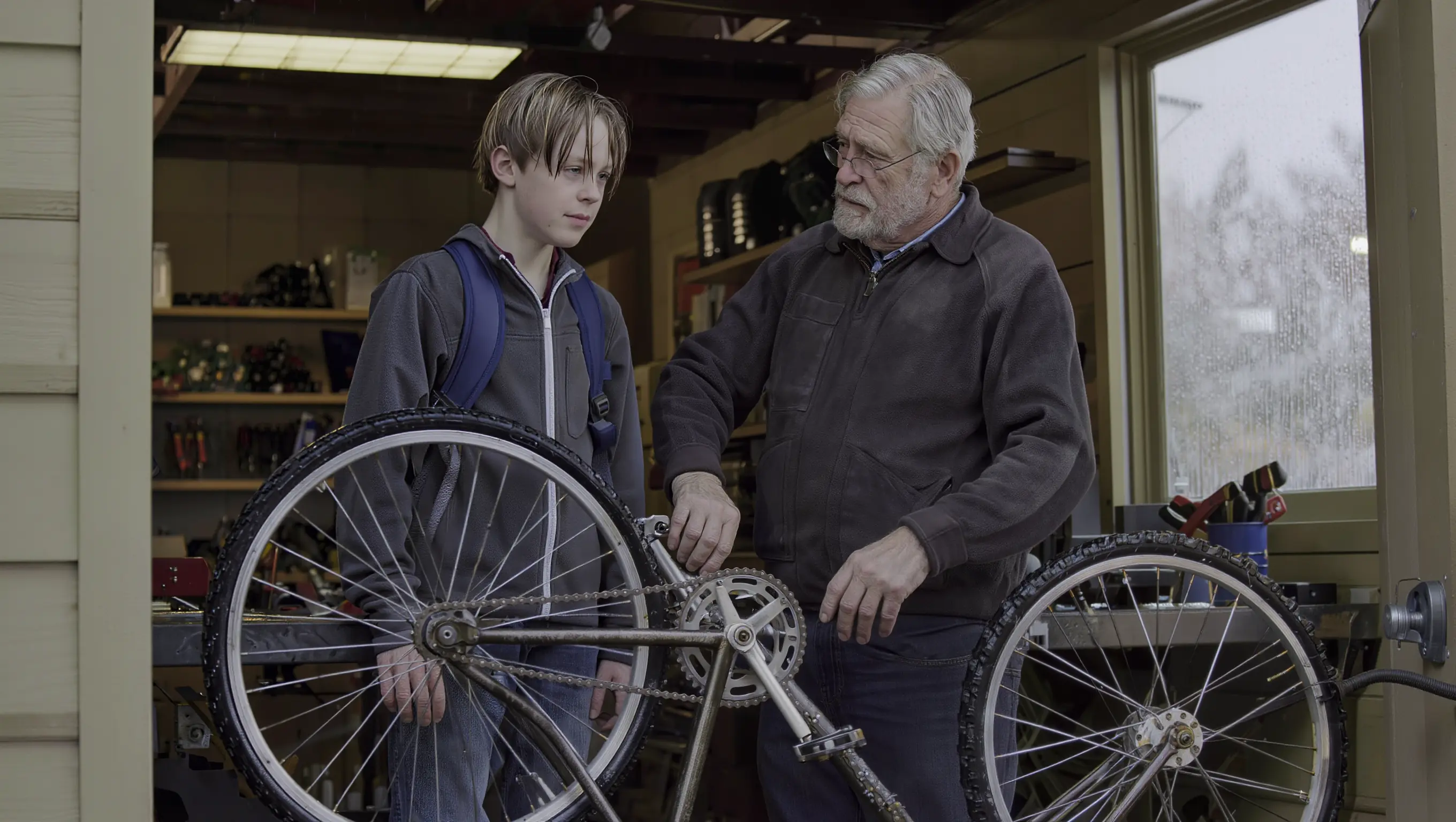
Martin smiled. “Son, I’ve fixed worse things than this.”
Their mother arrived just after six thirty.
Rachel Miller came through the door wearing a hospital cleaning uniform under a wet coat, her face pale with exhaustion and fear. She was in her early thirties, with tired hazel eyes and hair pulled back in a messy bun. The moment she saw Evan and Lily safe, her shoulders dropped as if she had been holding up the entire sky.
“Evan,” she said, pulling him close. “Are you hurt?”
“No, Mom. I’m okay.”
“Lily?”
“I had hot chocolate,” Lily announced.
Rachel looked at Martin, embarrassed and grateful at once.
“Mr. Hayes, I’m sorry. I don’t know what to say. I told Evan to be careful, but I didn’t know the brakes were that bad. I was going to have them checked when I got paid.”
Martin nodded. “Brakes like to fail before payday. Rude habit.”
Rachel gave a tired laugh that almost became a sob.
“How much will the repair be?” she asked.
Evan looked down.
Martin wiped his hands on a cloth. “We haven’t discussed money.”
Rachel’s face tightened. “I can pay something Friday.”
Martin looked at the children, then at Rachel’s worn shoes and wet sleeves.
“The bike needs a chain, brake cable, wheel adjustment, and a few smaller parts,” he said. “I can use pieces I already have.”
“I can’t ask you to—”
“You didn’t.”
She looked away, ashamed. “I don’t like charity.”
Martin’s voice softened. “Neither do I. That’s why Evan is going to help me fix it Saturday morning.”
Evan’s eyes widened. “I am?”
“Yes. You’ll learn how to maintain it. That’s payment enough.”
Rachel looked between them.
“You’d do that?”
Martin shrugged. “Someone should teach the boy brakes before gravity does it again.”
Lily whispered, “Gravity is mean.”
Martin nodded seriously. “Very.”
Saturday morning, Evan returned.
Then he came the next Saturday.
Then the one after that.
At first, he only helped with his own bike. Martin taught him how to clean a chain, check brake pads, adjust a seat, tighten bolts, patch tubes, and listen for the difference between a loose spoke and a bent rim.
Evan learned fast.
Too fast for Martin not to notice.
The boy had patience. He had focus. He had hands that wanted to understand how things worked.
Soon, Evan began stopping by after school with Lily. Rachel worked long hours, and Martin’s shop became the safest place between school and home. Lily drew pictures in the office while Evan swept floors, organized parts, and watched repairs.
Martin never called it babysitting.
He called it apprenticeship.
Evan liked that word.
One afternoon, he asked, “Why do you fix old things when people can just buy new ones?”
Martin looked at a rusted bicycle frame on the stand.
“Because new isn’t always better. Sometimes old things only need someone patient enough to see what still works.”
Evan thought about that.
“People too?” he asked.
Martin looked at him carefully.
“Yes,” he said. “People too.”
Years passed.
Evan grew taller. His voice deepened. His hands became sure around tools. By fifteen, he could repair most bicycles without help. By sixteen, he was helping neighborhood kids fix flats for free. By seventeen, he built Lily a bike from spare parts and painted it purple because she insisted every fast thing should be purple.
Rachel’s life became steadier too. With Martin watching the children after school, she took classes to become a certified nursing assistant. She got better hours. She saved enough to move to a safer apartment. But every Friday evening, she brought dinner to the shop, and the four of them ate at the old workbench like family.
Martin never said how much those dinners meant.
He did not need to.
Evan knew.
When Evan graduated high school, Martin sat in the front row beside Rachel and Lily. Evan received a scholarship to study mechanical engineering. His senior project was a low-cost, durable bicycle repair kit for students who rode to school.
He dedicated it to Martin.
After the ceremony, Evan hugged him tightly.
“I’ll pay you back one day,” he whispered.
Martin smiled. “You already fixed my leaky sink. We’re even.”
“I mean it.”
“So do I.”
Evan left for college, but he never really left. He called every Sunday. He came home during breaks and worked at the shop. He sent Martin photos of machines, prototypes, and once a bicycle-powered generator he built from scrap parts.
Martin saved every photo.
But age moved in quietly.
At eighty-four, Martin’s arthritis worsened. His hands shook on cold mornings. His landlord sold the building to a developer. The new lease doubled the rent. Martin could not afford it.
He folded the notice and tucked it into a drawer.
For two weeks, he said nothing.
Then Lily found it.
She was twenty now, home from art school, painting a new sign for the shop because the old one had faded. She opened the drawer looking for tape and saw the notice.
“Martin,” she said softly.
He closed his eyes. “You weren’t supposed to see that.”
“Were you going to close?”
He looked around the shop: the repair stand, the old tools, Elaine’s photograph on the shelf, Evan’s first broken bike frame hanging from the back wall.
“I suppose everything closes eventually.”
Lily called Evan that night.
Three days later, Evan walked into the shop wearing a navy coat, carrying a folder, his face full of hurt.
“You should have told me,” he said.
Martin looked up from the counter. “Hello to you too.”
“You were going to let me find out after it was gone?”
“I didn’t want to drag you backward.”
Evan stared at him. “Backward? This shop is where I learned to move forward.”
Martin looked away.
Evan placed the folder on the counter.
“What’s this?” Martin asked.
“A plan.”
“I dislike plans carried in expensive folders.”
“You’ll like this one.”
Evan opened it.
Inside were drawings of the shop, restored and expanded. The front remained a repair shop. The back became a teaching space with workbenches, bike stands, safety equipment, and storage for donated bicycles. Another page showed a program proposal.
THE HAYES YOUTH REPAIR PROJECT
Safe Bikes. Strong Skills. Second Chances.
Martin stared.
Evan continued, “I bought the building with two partners. We’re keeping your shop open. You stay as long as you want. The program will teach kids how to repair bikes, maintain tools, and build practical skills. We’ll donate refurbished bicycles to students who need transportation to school.”
Martin’s hands trembled.
“No.”
“Yes.”
“Evan, you can’t spend money on an old man’s shop.”
“I’m not,” Evan said. “I’m investing in the place that saved me.”
“It was a bike repair.”
“It was not.”
Evan’s voice broke slightly.
“You fixed my bike so I could pick up Lily. You helped my mom keep her job. You gave us a safe place after school. You taught me that broken things were not useless. You gave me the skill that became my life.”
Martin looked down.
“I only did what anyone should have done.”
“But you were the one who did it.”
Lily entered from the back room carrying a wooden sign she had painted.
She turned it around.
HAYES REPAIR & YOUTH WORKSHOP
Underneath, in smaller letters:
Built For Every Kid Who Needs A Way Home.
Martin covered his face.
The renovation took two months.
Martin complained about almost everything.
The new lights were too bright.
The new tool wall was too organized.
The safety posters made the shop look like a school.
The coffee machine had too many buttons.
No one listened.
But they kept everything that mattered. Elaine’s photo stayed above the counter. The old repair stand remained. Evan’s first repaired bicycle hung on the wall. Martin’s workbench was refinished but not replaced.
On opening day, children lined up outside with broken bicycles. Some had flat tires. Some had no brakes. Some had bikes that looked too small but were all their families could afford.
Martin stood near the first workbench, overwhelmed.
Evan brought over a boy around eleven with a bent front wheel.
The boy looked embarrassed. “I don’t have money.”
Martin glanced at Evan.
Evan smiled.
Martin lowered himself onto the stool and said, “I didn’t ask for money. I asked what happened to the wheel.”
The boy looked surprised.
Then he began to explain.
During the opening ceremony, Evan spoke.
“When I was eleven, I crashed my bike in the rain. I was scared because I had to pick up my little sister and my mom couldn’t leave work. Martin Hayes brought me inside, fixed the bike, and taught me how to fix it myself. But more than that, he gave me a place where I mattered.”
Martin wiped his eyes with a rag and pretended it was grease.
Lily spoke next.
“This shop gave us safety. Now it will give that to other kids.”
The program grew quickly.
Students came after school to learn repairs. Donated bikes were restored and given to children who needed transportation. Teenagers learned responsibility, patience, and pride through tools. Parents came in tired and left relieved because a broken bike no longer meant a child had no way to school.
Martin no longer worked long days, but he came every morning at eight.
He sat near the front bench, corrected Evan’s technique, teased Lily about her signs, and taught children that the first step in fixing anything was listening.
One rainy afternoon, many years after Evan’s first crash, Martin watched a little girl bring in a purple bike with a loose chain. She looked worried.
“My mom said we can’t afford a new one,” she whispered.
Martin smiled gently.
“Good,” he said. “New bikes are often overrated.”
She looked confused.
He patted the repair stand. “Let’s see what still works.”
Across the shop, Evan stopped and listened.
The little girl smiled.
Martin guided her hands toward the tools.
Rain tapped against the windows, just as it had years ago. But inside the shop, the lights were bright, the benches were full, and children laughed over the sound of spinning wheels.
Martin had once thought he was only fixing a boy’s broken bicycle.
But kindness, like a wheel, keeps turning.
A repaired bike became an apprenticeship.
An apprenticeship became a future.
A future became a workshop.
And an old man who thought his repair shop would die with him lived long enough to see it become a place where every child could learn that broken did not mean finished.