For fifty-one years, Thomas Bell opened his little clock shop on Maple Street at exactly eight o’clock in the morning.
Not 7:59.
Not 8:01.
Eight.
The townspeople of Fairview, Pennsylvania, used to joke that if Thomas Bell was late, the whole town should check whether time itself had stopped. He was eighty years old now, tall but stooped, with silver hair brushed neatly back, careful blue eyes behind wire-rimmed glasses, and hands that still moved with surprising steadiness when holding tiny gears, springs, and watch screws.
His shop, Bell’s Clock Repair, sat between a bakery and an old tailor’s store. In the front window hung brass pocket watches, small alarm clocks, cuckoo clocks, and one tall grandfather clock that had not been for sale in twenty years because it had belonged to his late wife, Marion.
Inside, the air smelled of wood polish, old paper, and machine oil. Dozens of clocks ticked along the walls, each with its own rhythm. Visitors often said the noise would drive them mad, but Thomas found it comforting.
After Marion died, the ticking was the only sound that made the empty apartment above the shop feel less hollow.
He had no children. He and Marion had wanted them, prayed for them, planned for them, even saved a small wooden rocking horse that Thomas had carved by hand. But life had other plans, and after Marion passed, Thomas packed the rocking horse away in the attic, along with baby blankets that had never been used and dreams too tender to throw out.
Every day, he repaired time for other people.
He could not repair his own.
One rainy Thursday in October, Thomas was about to close early because his knees were aching when the bell above the door rang.
He looked up from his workbench.
A little girl stood just inside the shop, soaked from the rain, clutching something in both hands.
She was about nine years old, with dark curly hair stuck to her cheeks, pale brown skin, and large worried eyes. Her yellow raincoat was too small, the sleeves ending above her wrists, and her sneakers were muddy. She stood on the welcome mat as if afraid to step farther inside.
Thomas removed his magnifying glasses.
“Hello there,” he said gently. “Are you lost?”
The girl shook her head quickly. “No, sir.”
“Do you need someone?”
She looked down at her hands. “I need this fixed.”
She stepped forward and placed a small wristwatch on the counter.
It was old, with a cracked leather strap and a scratched round face. The glass had a thin fracture running across the number seven. It was not valuable in money, but Thomas could tell from the way the girl touched it that it was valuable in a way no price tag could measure.
He picked it up carefully.
“Does it belong to you?”
She nodded. “It was my dad’s.”
Thomas looked at her face, then back at the watch.
“It stopped?”
“Yesterday.”
“I see.”
She swallowed. “Can you fix it?”
“I can look.”
“How much?”
Thomas turned the watch over in his palm. “Let me see what’s wrong first.”
The girl opened the pocket of her raincoat and pulled out a small handful of coins. Pennies, nickels, and two quarters. She placed them on the counter in a careful line.
“I have one dollar and thirteen cents.”
Thomas looked at the coins.
Then he looked at the child.
“What is your name?”
“Lily.”
“Lily what?”
“Lily Carter.”
“Well, Lily Carter, my name is Thomas Bell.”
“I know,” she said. “It says so on the sign.”
Thomas smiled faintly. “So it does.”
She pushed the coins closer. “Is it enough?”
Thomas knew before opening the watch that it was not. A full cleaning alone would cost far more. A replacement crystal, strap repair, and internal work would cost enough to make most adults hesitate.
But he also knew a child did not walk through rain alone with a broken watch unless that watch held something she could not bear to lose.
“Tell me about your father,” he said.
Lily’s mouth tightened. “He died.”
The word came out flat, as if she had practiced saying it without crying.
Thomas’s hand stilled.
“I’m sorry,” he said.
She nodded once. “Mom says he’s in heaven. But this was his watch. It used to tick when he held me. I could hear it when he hugged me.”
Thomas looked down quickly.
The clocks on the walls ticked around them, dozens of small hearts keeping time.
“My mom says we can’t fix things right now,” Lily continued. “She says rent comes first. And food. But if the watch stops, it feels like he’s gone again.”
Thomas closed his eyes for one second.
When he opened them, he pulled his stool closer to the counter.
“May I open it?”
Lily nodded.
He used a small tool to remove the back of the watch. Inside, the movement was dirty, but not destroyed. The mainspring had slipped, and the hands were slightly bent. It needed care, patience, and time.
“It can be fixed,” he said.
Lily’s eyes widened. “Really?”
“Yes.”
She pushed the coins closer again. “I can bring more later. I can sweep. I can help clean.”
Thomas gently pushed the coins back toward her.
“I’ll fix it.”
“But I have to pay.”
“You already did.”
She frowned. “No, I didn’t.”
“You brought me a watch that matters. That is payment enough for today.”
Lily looked suspicious. “People don’t fix things for free.”
Thomas smiled sadly. “Sometimes old men do.”
She looked at him for a long moment, then whispered, “Why?”
Thomas looked toward the grandfather clock in the window, the one Marion had loved.
“Because some things are too important to leave broken.”
Lily’s eyes filled, but she blinked hard.
“When can I get it back?”
“Come tomorrow after school.”
Her face fell. “I don’t know if I can.”
“Why not?”
“My mom works late. I’m supposed to go straight home.”
“Then come Saturday morning.”
She hesitated. “Okay.”
Thomas took a small paper tag and wrote her name on it. Then he placed the watch in a repair tray.
“Do you live nearby?” he asked.
“Three streets over.”
“Did you walk here alone?”
Lily nodded.
“In this rain?”
She looked down.
Thomas sighed softly. “Would you like me to call your mother?”
“No.” Fear flashed across her face. “She’ll be mad.”
“For the watch?”
“For me coming here.”
Thomas studied her carefully. “Does she know you left?”
Lily shook her head.
He did not scold her. Fear and grief had already done enough.
“What is your mother’s name?”
“Rachel.”
“Do you know her phone number?”
Lily recited it quietly.
Thomas called. A tired woman answered after several rings.
“Hello?”
“Mrs. Carter? My name is Thomas Bell. I own Bell’s Clock Repair on Maple Street. Your daughter Lily is here, safe.”
There was a sharp silence.
Then, “Lily? Oh my God. Is she okay?”
“She is. She came to ask about repairing a watch.”
A broken sound came through the phone. “Her father’s watch.”
“Yes.”
“I’m coming.”
“She’s safe here,” Thomas said. “Take your time in the rain.”
Ten minutes later, Rachel Carter burst into the shop wearing a grocery store uniform beneath a thin coat. She was in her early thirties, with tired green eyes, wet hair pulled into a messy ponytail, and fear still shaking her hands.
“Lily Grace Carter,” she said, but her voice broke before she could sound angry.
Lily ran to her.
“I’m sorry,” the girl cried. “I just wanted Dad’s watch fixed.”
Rachel held her tightly, eyes closed. “You scared me to death.”
“I’m sorry.”
Thomas stood quietly behind the counter.
When Rachel finally looked at him, shame filled her face.
“Mr. Bell, I’m so sorry. She shouldn’t have come here alone. I told her we couldn’t afford it right now.”
Thomas nodded. “She was very brave. Frighteningly brave, perhaps, but brave.”
Rachel wiped her cheek. “How much will it cost?”
“Nothing.”
“No. Please don’t do that. I can pay a little each week.”
“It’s already settled.”
Rachel shook her head. “We can’t take charity.”
Thomas looked at Lily, still clinging to her mother.
“It isn’t charity,” he said. “It’s a repair.”
Rachel’s eyes filled. “Everything feels like charity when you can’t pay for it.”
Thomas understood that kind of pride. He had seen it in customers who brought in wedding clocks, military watches, old anniversary gifts, and inheritance pieces they could barely afford to repair but could not bear to lose.
He spoke gently.
“Mrs. Carter, your daughter misses her father. I know something about missing people. Let me fix the watch.”
Rachel covered her mouth.
Lily looked between them, silent.
Finally, Rachel whispered, “Thank you.”
That night, Thomas stayed in the shop long after closing. Rain tapped the window while he worked beneath the lamp. He cleaned the movement, adjusted the spring, polished the scratched case, replaced the cracked glass with an old crystal from his parts drawer, and softened the leather strap with oil until it could last a while longer.
Near midnight, the watch began ticking again.
Softly.
Steadily.
Thomas held it close to his ear.
For one strange moment, the sound felt like a small life returning.
Lily came Saturday morning with Rachel. She wore a clean sweater and carried the same coins in a small envelope.
Thomas placed the watch on the counter.
Lily froze.
The little watch gleamed under the shop light.
She picked it up with both hands, held it to her ear, and listened.
Then her face crumpled.
“It sounds like him,” she whispered.
Rachel began to cry.
Thomas looked away, pretending to adjust a clock on the wall.
Lily fastened the watch around her wrist, though it was too big. Thomas had punched an extra hole in the strap to help it fit.
She turned to him. “Thank you, Mr. Bell.”
“You’re welcome.”
“I’m going to pay you back one day.”
Thomas smiled. “People keep saying that to old men. I rarely believe them.”
“I mean it.”
“I know you do.”
That should have been the end.
But Lily came back the next Saturday.
Not for a repair.
She brought a drawing.
It showed Thomas standing behind the counter surrounded by clocks. On his wrist, she had drawn a watch bigger than his hand. Above the picture she had written:
MR. BELL FIXES TIME.
Thomas stared at it longer than he meant to.
“Do you like it?” Lily asked.
He cleared his throat. “Very much.”
He taped it behind the counter.
The next week, Lily came again, this time with a math worksheet.
“Mom works until six,” she said. “Can I sit here until she comes?”
Thomas looked at the empty shop.
“I suppose the clocks could use company.”
So Lily sat at the small table near the window and did her homework while Thomas worked. When Rachel arrived, tired from her shift, Thomas had tea ready. Soon it became routine.
Three afternoons a week, Lily came to the clock shop after school. She did homework, read books, and sometimes watched Thomas repair watches. Rachel picked her up after work, apologizing every time until Thomas threatened to charge a fee for unnecessary apologies.
Lily loved the tiny tools.
She loved the way clocks came apart into secrets and returned to life through patience. She asked questions constantly.
“What does that wheel do?”
“Why does the spring need tension?”
“How do clocks know what time it is?”
Thomas answered every question.
At first, he showed her simple things: how to wind a clock properly, how to clean a glass face, how to recognize the difference between a quartz movement and a mechanical one. Then, as she grew older, he taught her more.
By twelve, Lily could change a watch battery.
By fourteen, she could replace a strap and polish a case.
By sixteen, she could disassemble a simple pocket watch under supervision and put it back together without losing a screw.
Thomas began calling her his apprentice.
She pretended to hate it.
She loved it.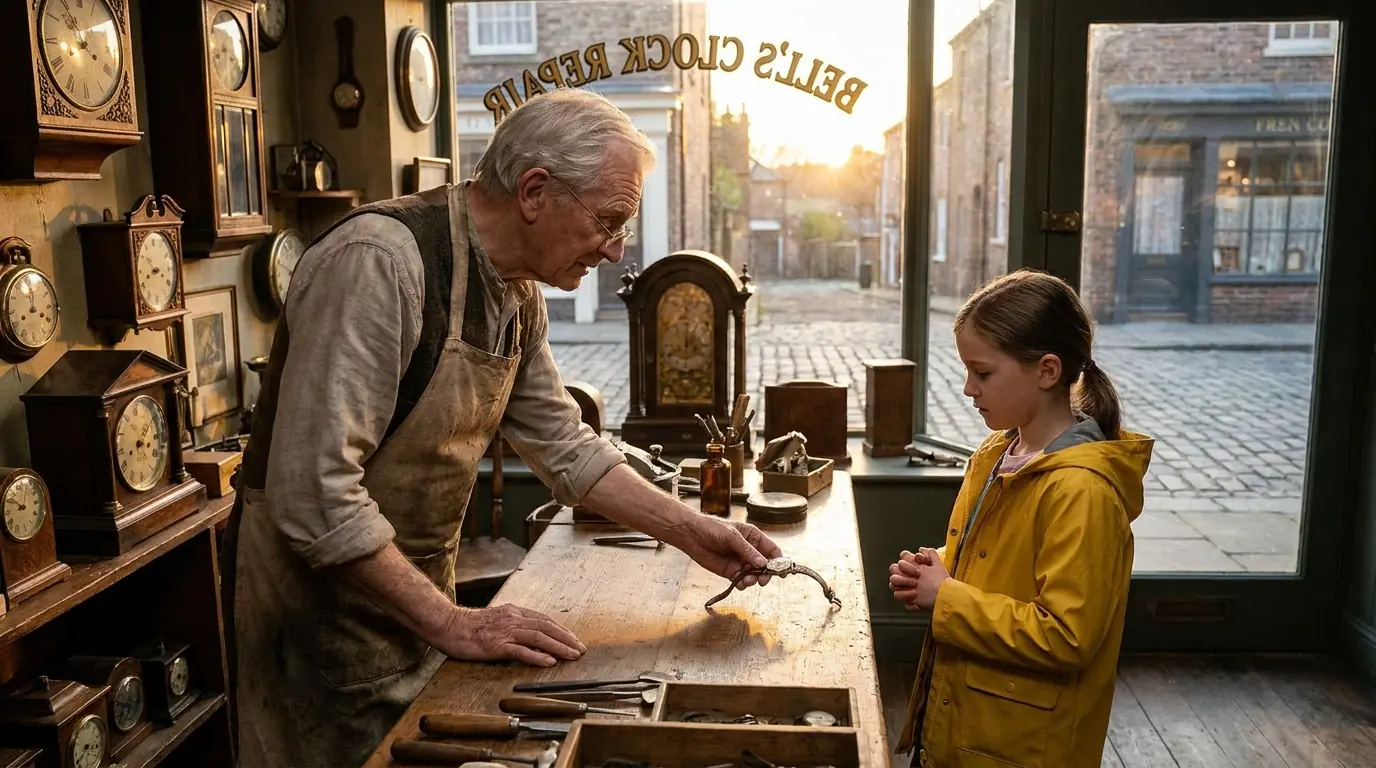
Rachel’s life improved slowly. She found a better position at the grocery store, then became assistant manager. She still struggled, but the sharp edge of survival softened. The clock shop became a second home for both mother and daughter. Christmas dinners happened upstairs in Thomas’s apartment when Rachel had to work late. Lily’s school projects were built on his kitchen table. Rachel helped clean the shop every spring, insisting that a room full of clocks collected dust like “time shedding its skin.”
Thomas laughed more in those years than he had since Marion died.
The apartment above the shop no longer felt like a place where memories sat untouched.
It smelled of soup, tea, homework papers, and oil from the workbench.
On Lily’s eighteenth birthday, Thomas gave her a small set of watchmaker’s tools.
She opened the case and stared.
“These are too expensive.”
“They were mine when I was young.”
Her eyes widened. “Then I can’t take them.”
“You can.”
“Mr. Bell—”
“Lily,” he said softly, “tools are meant to be used by hands that care.”
She hugged him carefully, as if he were something fragile.
“You’re family,” she whispered.
Thomas closed his eyes.
He had spent decades believing life had passed him by without giving him children.
But standing there with Lily’s arms around him, he wondered if family sometimes arrived late, carrying a broken watch.
Lily went to college to study mechanical engineering, focusing on precision instruments. She called Thomas every Sunday. She sent him pictures of labs, machines, tiny components, and once, a clock tower in Boston that she said “needed your judgment.”
He mailed her small notes written on repair tickets.
Remember: if it does not move, do not force it. Understand it first.
A good repair begins with listening.
Tiny parts matter. So do quiet people.
Lily kept every note.
After college, she worked for a company designing medical timing devices, then later started her own firm specializing in precision instruments for hospitals and emergency systems. Rachel cried every time someone called Lily “engineer.”
Thomas bragged to customers until the customers learned to ask about Lily before he could begin.
But while Lily’s life expanded, Thomas’s shop struggled.
Fewer people repaired clocks. Rent rose. Online stores sold cheap replacements. His hands stiffened with arthritis. His eyesight weakened. Some days he could no longer hold the smallest screws without dropping them.
At eighty-eight, Thomas received a letter from the building’s new owner.
The property would be sold.
His lease would not be renewed.
Thomas read the letter twice, then placed it beneath the cash register.
For the first time in more than fifty years, Bell’s Clock Repair might close.
He did not tell Lily.
He did not tell Rachel.
He told himself the shop was old. He was old. Maybe time had finally done what time always did.
But the thought of the clocks being boxed away, Marion’s grandfather clock moved to storage, the workbench dismantled, and Lily’s drawing taken down from the wall nearly broke him.
Rachel found out when she came by with groceries and saw the letter sticking from beneath the register.
“Thomas,” she said quietly.
He looked up.
She held the letter.
His shoulders sank.
“I didn’t want to bother anyone.”
“Bother?” Rachel’s eyes filled with anger and sadness. “You helped raise my daughter.”
“That was different.”
“No, it wasn’t.”
Rachel called Lily that night.
Two days later, Lily walked into the shop.
She was twenty-nine now, tall, elegant, with her father’s repaired watch still on her wrist. Her hair was pulled back neatly, and she wore a navy coat over a cream blouse. But when she saw Thomas at the workbench, her face became the face of the little girl in the yellow raincoat.
“You were going to let it close without telling me?” she asked.
Thomas sighed. “Hello to you too.”
“Mr. Bell.”
“That tone sounds expensive.”
She placed the lease letter on the counter. “You should have called.”
“You’re busy.”
“You are important.”
He looked down at his hands.
“They don’t work like they used to,” he said quietly. “The shop doesn’t either.”
Lily’s expression softened.
She walked to the counter and touched the old drawing still taped behind it, faded at the corners.
“Do you remember what I wrote?” she asked.
“Mr. Bell Fixes Time.”
“You did.”
“I fixed a watch.”
“No,” Lily said. “You fixed the moment my father started disappearing from my memory. You gave me a place to go after school. You taught me to look closely, to be patient, to believe broken things deserved attention.”
Thomas looked away, eyes wet.
Lily opened a leather folder and placed documents on the counter.
“What is this?” he asked.
“A proposal.”
“I dislike proposals.”
“You’ll like this one.”
“I doubt that.”
She smiled. “My company is launching a community workshop and training program for young people interested in mechanical repair, precision tools, and restoration. We need a location with history, workbenches, and someone who understands the soul of repair better than anyone I know.”
Thomas stared.
“No.”
“Yes.”
“Lily.”
“I already purchased the building.”
He froze.
“You what?”
“Technically my company purchased it, but only because that made the paperwork easier. The shop stays. Your apartment stays. The grandfather clock stays. The workbench stays. You stay.”
Thomas sat down slowly.
Lily continued, voice trembling now. “Bell’s Clock Repair will become Bell’s Time Workshop. The front will remain your repair shop. The back will become a training room. Students will learn how to repair clocks, watches, small devices, and medical timing equipment. We’ll offer free repair days for seniors and families who can’t afford to fix keepsakes.”
Thomas pressed a hand over his mouth.
“You should not spend money on an old man’s shop.”
“I’m not,” she said. “I’m investing in the place that built me.”
He shook his head.
Lily reached across the counter and placed something small in front of him.
It was the envelope of coins she had brought years earlier.
One dollar and thirteen cents.
Thomas stared at it.
“You kept that?”
“You pushed it back to me. I kept it because I knew one day I would bring more.”
He tried to speak, but no words came.
Lily took his hand.
“You said some things are too important to leave broken,” she whispered. “So I’m fixing this.”
The renovation took three months.
Thomas complained about almost everything.
The new lights were too bright.
The training tables were too modern.
The website was unnecessary.
The young apprentices used too much slang.
The new coffee machine was suspicious.
Lily listened lovingly and ignored him when required.
But she preserved everything that mattered.
The bell above the door remained. Marion’s grandfather clock stayed in the front window. The old wooden counter was restored, not replaced. Thomas’s workbench remained beneath the lamp. Lily’s childhood drawing was framed and hung near the entrance.
On reopening day, the new sign above the door read:
BELL’S TIME WORKSHOP
Repairing What Matters. Teaching What Lasts.
Thomas stood on the sidewalk beside Rachel and Lily, staring up at it.
“I don’t need my name so large,” he muttered.
Rachel smiled. “Too late.”
Inside, the shop filled with people. Former customers came with clocks. Teenagers from local schools toured the workshop. Seniors brought watches, music boxes, and old radios. Reporters came too, though Thomas answered most questions with, “Ask Lily. She enjoys sentences.”
During the ceremony, Lily stood beside the grandfather clock.
“When I was nine,” she said, “I walked into this shop with my father’s broken watch and one dollar and thirteen cents. I thought if the watch stayed broken, I would lose the sound of him forever. Thomas Bell repaired it for free, but what he really repaired was something inside me.”
Thomas lowered his head.
“He gave me time,” Lily continued. “Time after school. Time to ask questions. Time to grieve. Time to learn. Time to become who I was meant to be. This workshop exists because every child deserves someone patient enough to teach them that broken does not mean finished.”
The room applauded.
Thomas cried quietly.
Lily brought him forward and handed him a brass key.
“I already have keys,” he said.
“This one is different.”
On one side, it was engraved:
FOR THE MAN WHO FIXED TIME.
On the other:
FOR EVERY CHILD WHO NEEDS MORE OF IT.
Years passed, and Bell’s Time Workshop became a beloved place in Fairview.
Children came after school to learn repairs. Older residents brought keepsakes and stayed for tea. Young apprentices discovered that patience was not weakness and tiny parts could change entire systems. Lily visited often, sometimes teaching, sometimes sitting quietly beside Thomas as they worked on watches together.
Thomas stopped working full days at ninety, but he still came downstairs every morning at eight.
Not 7:59.
Not 8:01.
Eight.
He sat at his bench, supervised students, told stories about Marion, and corrected anyone who rushed a repair.
One afternoon, a little boy brought in a broken alarm clock shaped like a blue bird.
“My grandma gave it to me,” the boy said. “Can you fix it?”
Thomas looked at Lily, who was visiting that day.
She smiled.
Thomas turned back to the child.
“Let’s look closely,” he said. “Important things deserve patience.”
The boy climbed onto the stool beside him.
Lily watched them from across the shop, her father’s watch ticking steadily on her wrist.
Later, after the students left, Thomas and Lily sat near the front window. The grandfather clock chimed softly.
“I thought I had lost time,” Thomas said.
Lily looked at him. “When?”
“When Marion died. When the children we wanted never came. When the shop grew quiet.” He looked around the workshop. “Then you walked in with that watch.”
Lily’s eyes filled.
“I was just a kid who missed her dad,” she said.
“And I was just an old man who missed being needed.”
She reached for his hand.
The clocks ticked around them, no longer lonely, but alive with many rhythms.
Thomas had once believed time only took things away.
But now he understood it also returned things in forms no one expected.
A broken watch became an apprenticeship.
An apprenticeship became a future.
A future became a workshop.
And an old man who thought his life had narrowed to ticking clocks lived long enough to hear his name spoken by children learning to repair what mattered.
At closing time, Lily helped him lock the front door.
The bell rang softly.
Thomas looked at her wrist.
“Still ticking?” he asked.
Lily held the watch to her ear and smiled.
“Still ticking.”
Thomas nodded, satisfied.
Some repairs, he knew, lasted longer than a lifetime.